Healthy aging is less about appearing younger and more about protecting the abilities, choices, relationships, and everyday activities that matter to the person. The first priority may be movement, a daily task, the home layout, an assistive tool, transportation, technology, or a broader support decision. Start with one valued activity and identify what is making it harder before changing several parts of life at once. If a change appears suddenly, keeps getting worse, threatens safety, or has no clear explanation, move from household troubleshooting to appropriate professional help.
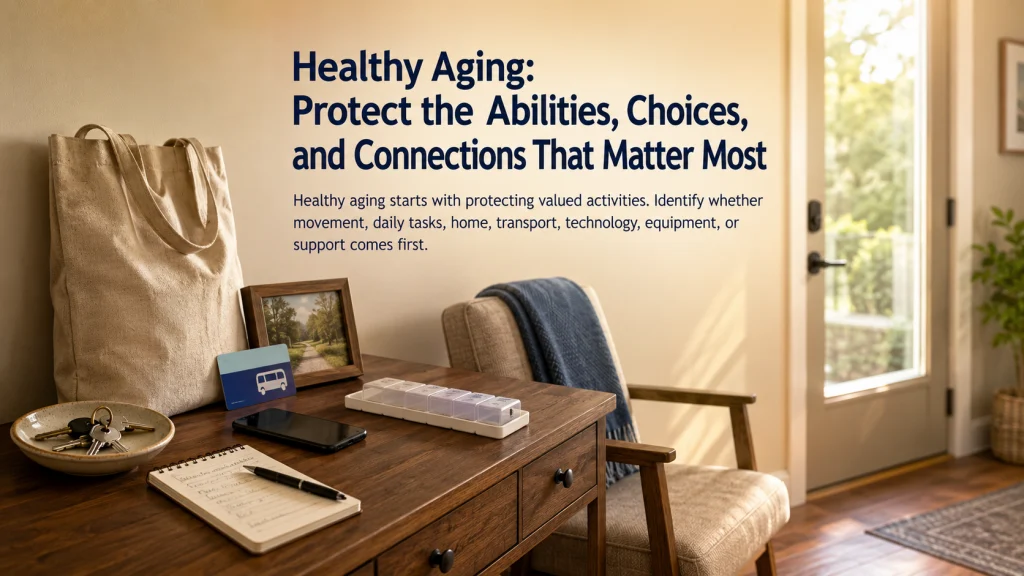
Seven ordinary objects can represent seven kinds of independence
House keys, a grocery bag, a stable chair, a bus card, a phone, a pill organizer, and a handwritten contact list sit on one table. None of these objects represents healthy aging by itself. Together, they point to ordinary choices: leaving home, carrying what is needed, sitting and standing safely, getting across town, staying connected, managing a routine, and knowing whom to call.
What people often fear losing is not an abstract score. It is the freedom to make tea without asking, meet a friend without complicated arrangements, choose when to leave the house, or keep a familiar role in the family. The useful outcome is the ability to keep doing what matters, with an environment and level of support that make participation possible.
Start with the ability or choice you most want to protect. Products marketed to older adults often promise independence while solving only one narrow obstacle. The wrong fit can add setup, storage, cleaning, cost, or embarrassment without helping the activity that matters.
Key decision: Name the activity first. “Stay independent” is too broad, but “keep preparing breakfast,” “visit friends twice a month,” or “reach the garden safely” gives the next decision a clear direction.
Define healthy aging through function and valued activities
A person can live with a health condition and still participate in meaningful activities. Another person may have no clear diagnosis yet notice that transportation, fatigue, home barriers, or a difficult routine is shrinking daily choices. Healthy aging therefore cannot be reduced to the absence of every condition.
Function means what a person can do in the context of real life. It includes moving through the home, preparing food, managing personal care, communicating, making decisions, maintaining relationships, handling everyday responsibilities, and taking part in activities that provide purpose or enjoyment.
Physical, mental, and social well-being all matter, but they do not have to look the same for everyone. A person who values quiet time at home may define participation differently from someone who wants frequent travel or community work. The useful standard is not comparison with another person’s life. It is whether the current setup protects choices that matter to this person.
General foundations such as sleep, nutrition, preventive care, movement, social connection, and purpose can support well-being. They should not be turned into a universal checklist or used to blame someone when an environment, task, service, or support system is the real obstacle.
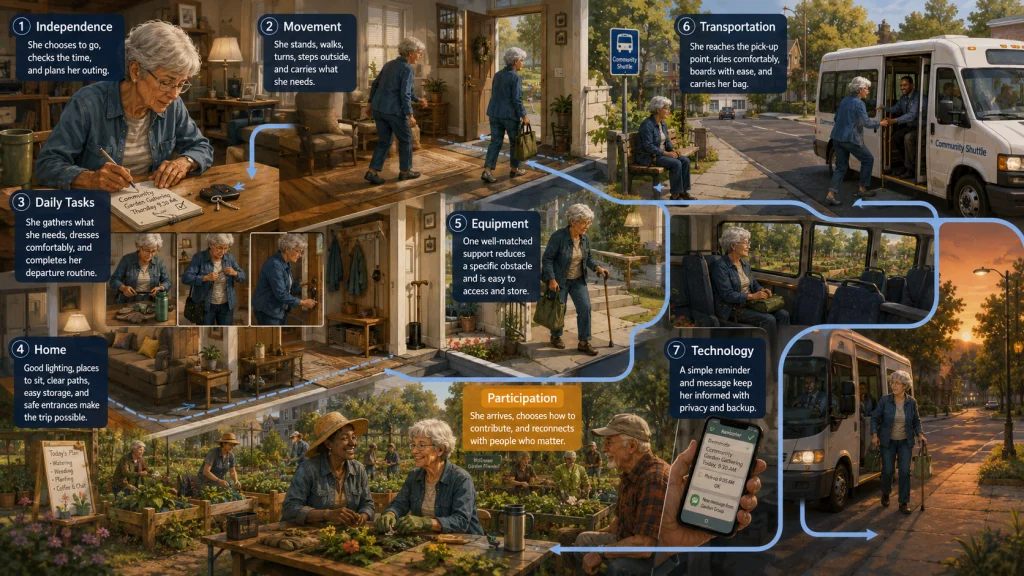
Separate personal capacity, environment, support, and participation
When an activity becomes harder, the cause is not automatically personal weakness. The difficulty may come from the interaction between the person, the task, the setting, and the support available around it.
The seven-domain map below is meant to locate the obstacle, not describe the full solution.
| Domain | First question |
|---|---|
| Everyday independence | Which choice or responsibility needs protection? |
| Movement capacity | Which physical action has become harder? |
| Daily tasks | Which step in the routine breaks down first? |
| Home environment | Which part of the setting creates extra demand? |
| Assistive equipment | Which defined obstacle should a tool reduce? |
| Transportation | Which part of the complete trip limits access? |
| Technology | Which communication or support task needs help? |
Participation is the outcome created when these parts work together. Someone may have enough leg strength for a short walk but still be unable to leave home because the entrance has unstable steps. Another person may move well inside the home but lose community access when transportation is no longer workable.
Key decision: Ask whether the main obstacle is in personal capacity, the task, the environment, or the support around the activity. The answer changes the route.
Run a five-minute value-and-function check
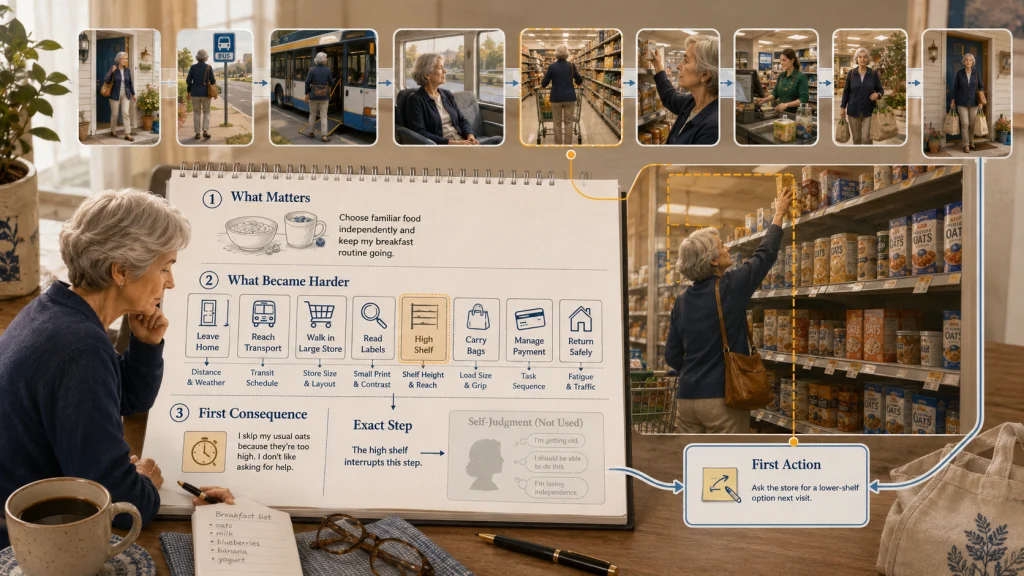
Choose one ordinary activity that matters now. Avoid beginning with a broad goal such as “be healthier” or “stay independent.” Then answer three questions.
- What matters? Name the activity, choice, role, or relationship you want to protect.
- What has become harder? Describe the exact step, place, time, or condition that creates difficulty.
- What consequence appears first? Notice whether the first loss is safety, confidence, comfort, time, privacy, social contact, or the ability to complete the task.
For example, “shopping is harder” may mean several different things. The obstacle could be walking through a large store, reaching high shelves, carrying bags, reading labels, arranging transportation, or managing payment. Each version points to a different first action.
Use neutral language because words shape the decision. “I now pause before stepping into the shower” identifies a moment that can be examined. “I am failing at bathing” turns one difficult step into a judgment about the whole person. The first description opens a path to support. The second can make someone feel smaller than the problem actually is.
Route 1: Protect everyday independence through planning and support
This route fits when the concern is broader than one movement or household task. The person may be planning ahead in midlife, thinking about living alone, noticing that responsibilities are becoming harder to coordinate, or trying to discuss future support without turning the conversation into a crisis.
Help can feel like a loss when it is imposed without discussion. It can feel like relief when the person chooses what is shared, who is involved, and which parts of the routine remain private. Independence is not doing everything without help. It is retaining meaningful control over choices, relationships, and the shape of daily life.
Begin with the responsibilities that keep life stable: housing, meals, appointments, communication, household maintenance, social contact, and access to help. Identify who knows the person’s preferences and who could step in for one defined task if needed.
Purpose also belongs here. Paid work, caregiving, volunteering, creative activity, faith, learning, friendship, and family roles can all provide structure and connection. The goal is not to assign a new purpose from outside. It is to protect the activities and relationships the person already values.
Route 2: Look at strength, balance, and mobility capacity
This route fits when the main difficulty appears during standing, walking, turning, climbing, reaching, carrying, or recovering after activity. The pattern may be gradual, or it may become visible when a familiar route takes longer and requires more rest.
General movement capacity is not the same as medical rehabilitation. A lifestyle review can describe what activity has become harder and what conditions change it. It should not diagnose the cause, prescribe an individualized program, or clear someone for exercise.
Use one familiar activity as a baseline, such as walking from the bedroom to the kitchen, standing from a usual chair, or reaching the mailbox. Record what makes the activity harder: distance, pace, fatigue, discomfort, uneven ground, carrying something, low lighting, or the need to hold a surface.
Safety warning: Do not test balance by standing on one leg, closing the eyes, removing needed support, or attempting an unfamiliar challenge. New or worsening weakness, repeated falls, fainting, severe shortness of breath, chest pain, or sudden change requires appropriate professional help.
Route 3: Redesign a daily task before assuming the answer is exercise
Cooking, dressing, bathing, toileting, shopping, medication routines, laundry, and household organization are sequences of smaller actions. One difficult step can make the entire activity feel unavailable, even when most of the sequence still works.
Task redesign begins by observing the sequence. A person preparing breakfast may be able to stand comfortably but struggle to reach cookware stored overhead. Another may reach everything but lose track of several items when the counter is crowded. Neither situation is solved by treating “breakfast preparation” as one vague ability.
Small changes can carry emotional weight because daily tasks are tied to privacy, habit, and identity. Moving a pan to a lower shelf is not just a storage change if it allows someone to keep making a familiar meal in their own way.
Change one source of friction at a time. Move frequently used items within comfortable reach, break a long task into shorter stages, sit for a suitable portion, reduce unnecessary carrying, or use a consistent order. Difficulty with an essential task may signal a need for professional assessment, especially when the change is new, worsening, unexplained, or affecting food, hygiene, medication routines, communication, or basic safety.
Route 4: Treat the home layout as part of the task
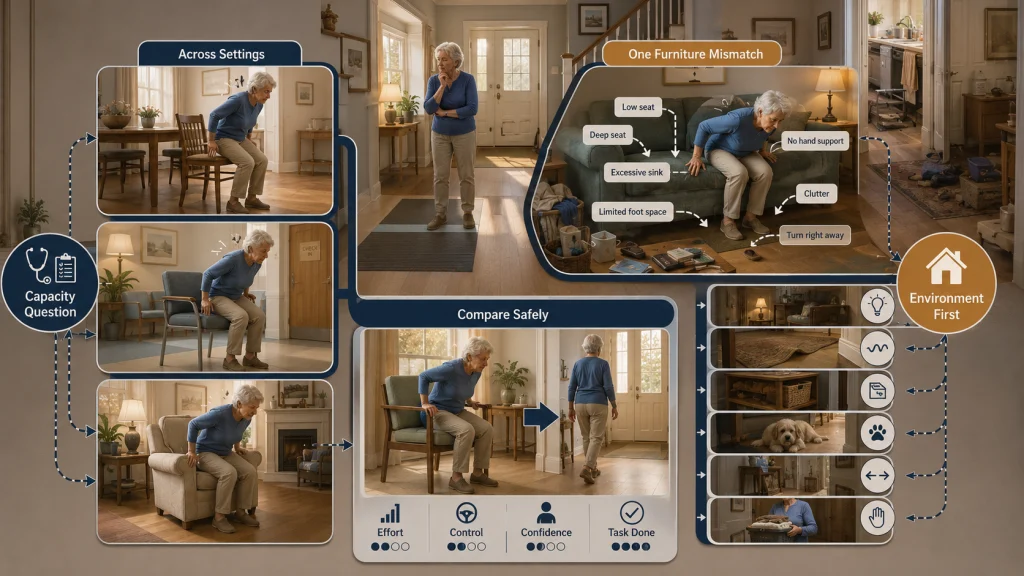
A difficult activity does not always mean the person’s capacity has declined. The home may demand more reaching, stepping, carrying, bending, turning, or low-light navigation than the activity requires elsewhere.
Consider two people who both have trouble rising after sitting. One struggles from several chairs in different settings, which points toward a movement-capacity question. The other rises comfortably from a firm chair with arms but struggles from one low, soft sofa. That pattern points first to the furniture and layout rather than a general conclusion about strength.
Walk through the home by activity, not by room. Follow the path used to enter, prepare food, reach the bathroom at night, carry laundry, answer the door, and leave for transportation. Notice loose items, poor lighting, unstable surfaces, awkward storage, missing hand support, pets underfoot, and places where both hands are already occupied.
Do not make structural, electrical, or bathroom changes without appropriate expertise. A home review should identify barriers and priorities before money is spent, not encourage improvised installations.
Route 5: Match assistive equipment to one defined obstacle
An assistive product can reduce effort, improve reach, provide support, or make a task easier to repeat. It can also sit unused when it does not fit the person’s body, home, routine, maintenance ability, or sense of identity.
Begin with the use case. What exact action should become easier? Where will the item be used? Does it require training, adjustment, charging, cleaning, storage, replacement parts, or help from another person? Can it move through the doorway, fit beside the bed, or remain available at the moment it is needed?
Stigma matters because an item that feels embarrassing, conspicuous, or imposed may not be used consistently. That concern should not be dismissed. Discuss appearance, language, privacy, and who participates in the choice while keeping safety and function visible.
No single device fits every person who has the same broad difficulty. Mobility aids and other assistive equipment may require assessment, fitting, and training from an appropriate professional. Avoid borrowing or purchasing a device solely because it helped someone else.
Route 6: Separate community access from exercise ability
A person may walk well inside the home and still be cut off from shops, appointments, friends, or activities because transportation is unreliable, confusing, costly, inaccessible, or unavailable at the right time.
Missing one ride can mean more than missing a destination. It can mean missing a weekly conversation, a familiar volunteer role, or the only outing that breaks up several quiet days. That is why transportation belongs inside the independence decision rather than being treated as a side issue.
Map the whole trip. Reaching a destination may require leaving the house, reaching a pickup point, waiting, boarding, carrying items, navigating the destination, and returning before fatigue or darkness becomes a concern. Start with one important destination and identify the weakest link.
Driving safety should not be judged through a home checklist alone. Crashes, near misses, getting lost, delayed reactions, sudden confusion, or concern from multiple people requires an appropriate driving and health evaluation rather than a family argument based on one incident.
Route 7: Use technology to support communication and everyday routines
Technology may help with communication, reminders, transportation, access to information, household controls, and contact with support. It can also introduce passwords, charging, updates, subscriptions, confusing interfaces, unwanted sharing, and the feeling of being watched.
Start with the task rather than the device. “Make it easier to call family” is clearer than “buy smart-home technology.” “Remember the evening routine without sharing health data” sets a different boundary from “allow a chosen relative to receive a missed check-in.”
Useful support respects consent and control. The person should understand what the system records, who receives information, what happens when the internet or power fails, and how to pause or remove access. Monitoring should not quietly expand beyond the agreed purpose.
Consumer technology should not be presented as proof that a person is safe, medically stable, or able to manage every task alone. A missed alert may reflect a dead battery, poor connection, incorrect setup, or a change that requires human follow-up.
Choose one baseline tied to a real activity
Changing the home, routine, equipment, transportation, and support system at the same time makes it difficult to learn what helped. A simple baseline keeps the first step connected to the activity that matters.
Choose an observation that can be repeated without creating risk. Examples include whether breakfast can be prepared without retrieving items from an unsafe height, whether the person can reach a usual destination with one planned rest, whether a phone call can be made without assistance, or whether a weekly outing still fits the available transportation window.
Record the condition, not a judgment about the person. Useful details include time required, number of pauses, need for another person’s help, confidence, discomfort, missed steps, or environmental barriers. Avoid tests that challenge balance, endurance, memory, or driving beyond ordinary safe activity.
After one practical change, repeat the same observation under similar conditions. Keep the change when it protects the activity without creating new safety, cost, maintenance, or privacy problems. Adjust or stop when it shifts the burden elsewhere.
Use support to preserve choice
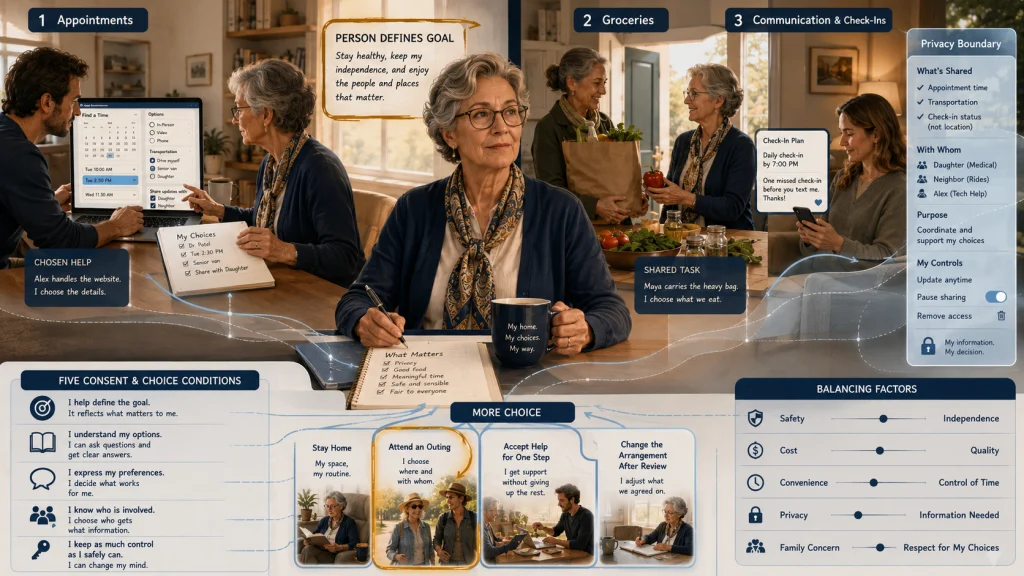
Doing everything alone is not the only form of independence. People of every age rely on transportation systems, family, friends, services, tools, and shared routines. The question is whether support expands meaningful choice or quietly replaces it.
Support preserves choice when: the person helps define the goal, understands the options, can express preferences, knows who is involved, and retains as much control as the situation safely allows.
Interdependence can be practical and respectful. One person may handle online scheduling while another chooses appointment times. A neighbor may carry heavy groceries while the person continues selecting and preparing food. A family member may receive a reminder only after a missed check-in rather than monitoring every movement.
The most respectful support leaves the person recognizable in their own life. It protects the routines, relationships, humor, privacy, and small preferences that make help feel like partnership rather than replacement.
Shared decision-making also means accepting that preferences can differ. Safety, privacy, convenience, cost, and family worry may pull in different directions. Keep returning to the specific activity, the actual risk, and the person’s stated priorities.
Know when lifestyle troubleshooting should stop
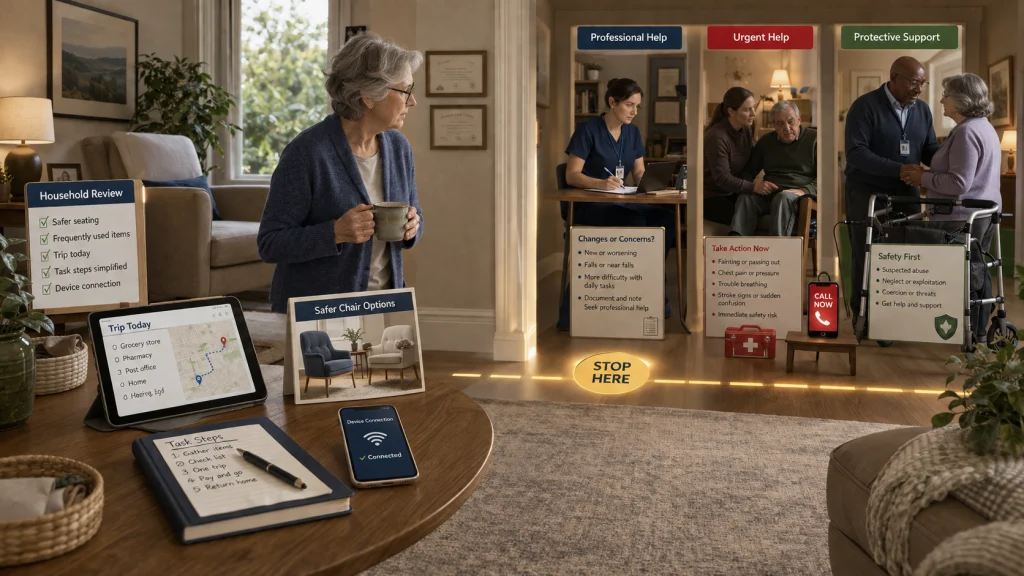
Some changes need prompt professional or emergency help rather than another household experiment.
Safety warning: Seek appropriate help for new, severe, persistent, worsening, or unexplained changes; a fall or repeated falls; fainting; chest pain; severe shortness of breath; stroke signs; sudden confusion; dangerous driving; inability to manage essential needs; suspected abuse or neglect; or an immediate safety threat.
Do not try to decide through an article whether a change is normal aging, frailty, dementia, depression, a balance disorder, a medication effect, or another condition. Describe what changed, when it began, how often it occurs, and which activities are affected.
When abuse, neglect, exploitation, or immediate danger is suspected, prioritize the person’s immediate safety and contact appropriate local emergency or protective services. Do not confront a potentially dangerous person in a way that increases risk.
Match the situation to the right first route
Use the table to identify the first area to examine. More than one route may matter, but begin with the one closest to the earliest consequence.
| Reader situation | First route | First check using what is available | Professional boundary |
|---|---|---|---|
| Planning ahead, living alone, or coordinating support | Independence planning | Name one responsibility and who could help with one part | Legal, financial, care-placement, or crisis decisions require appropriate expertise |
| Standing, walking, turning, reaching, or carrying has become harder | Movement capacity | Observe one familiar activity without adding a challenge | New, worsening, unexplained, or safety-relevant change needs evaluation |
| One step in cooking, dressing, bathing, or another routine breaks down | Daily task redesign | Write the task as a sequence and identify the first difficult step | Inability to meet essential needs requires prompt support |
| The activity changes with a chair, doorway, step, light level, or storage location | Home environment | Compare the same task in a safer, easier setting | Structural, electrical, or specialized safety work needs qualified help |
| A tool may reduce one specific obstacle | Assistive equipment | Define the action, location, fit, care, and storage needs | Mobility and other safety-critical devices may require fitting and training |
| Community activities are limited by getting there and back | Transportation | Map one complete trip and identify the weakest link | Driving safety concerns require appropriate evaluation |
| Communication, reminders, access, or support coordination is difficult | Technology | Name the task and decide what data may be shared | Technology must not replace emergency response or needed human support |
A route is a starting point, not a diagnosis. If the change is severe, sudden, worsening, unexplained, or affecting essential safety, move directly to appropriate professional help.
Protect one valued activity first
Name one activity, role, relationship, or choice you want to keep available. Identify whether the first obstacle is movement capacity, a task sequence, the home, equipment, transportation, technology, or the wider support plan.
Then choose one safe baseline and one next step. The goal is not to remove every sign of age or prove that no help is needed. It is to protect participation, dignity, and meaningful choice with the right combination of personal effort, environment, tools, and support.
Explore the seven healthy-aging routes
Use the guide that matches the ability or choice you want to protect first.
| Your first concern | Use this guide | What it helps you decide |
|---|---|---|
| Planning, support, purpose, family conversations, or living alone | how to stay independent as you age | How to protect choice while planning practical support |
| Strength, balance, walking, standing, or general movement | maintaining mobility as you age | How to observe movement capacity without turning the process into rehabilitation |
| Cooking, bathing, dressing, shopping, or another daily task | activities of daily living | How to identify and redesign the step that creates difficulty |
| Steps, lighting, storage, seating, entrances, or bathroom layout | home safety for older adults | How to separate environmental barriers from personal capacity |
| A tool or adaptation may reduce a defined obstacle | assistive devices for older adults | How to examine use case, fit, training, care, storage, and acceptance |
| Appointments, shopping, visits, travel, or community access | transportation options for older adults | How to map the whole trip and preserve community participation |
| Communication, reminders, household access, or support coordination | technology for older adults | How to balance usefulness, setup, consent, privacy, and human support |
FAQs
🧭 What should I focus on first for healthy aging?
Choose one activity or choice that matters and identify the first obstacle. Movement, the home, transportation, a daily task, equipment, technology, and support planning require different first steps.
🏠 Does difficulty at home always mean physical decline?
No. A low chair, poor lighting, difficult steps, high storage, or a crowded path may make one activity harder even when the same activity is manageable elsewhere. Compare the person, task, and environment before drawing a conclusion.
🤝 Does accepting help reduce independence?
Not necessarily. Well-matched support can preserve control, privacy, relationships, and access to valued activities. The person should participate in defining the goal and the type of help whenever safely possible.
🚶 Should I start with exercise when movement becomes harder?
Start by describing the exact activity and what makes it difficult. A sudden change, repeated falls, fainting, severe breathlessness, or another safety concern needs professional help rather than an unsupervised exercise plan.
🪑 How do I know whether equipment will help?
Define the action the equipment should support, where it will be used, and what fitting, training, cleaning, maintenance, and storage it requires. A universal device choice is unlikely to fit every person and home.
🚌 Is transportation part of healthy aging?
Yes. Community participation depends on reaching destinations and returning safely, not only on the ability to exercise. The full trip may include walking, waiting, boarding, carrying items, payment, and backup plans.
🚨 When should household adjustments stop?
Stop when the change threatens safety, prevents essential needs from being met, appears suddenly, keeps progressing, or cannot be explained by the task or environment. Falls, fainting, chest pain, stroke signs, sudden confusion, abuse, neglect, or immediate danger require appropriate help.