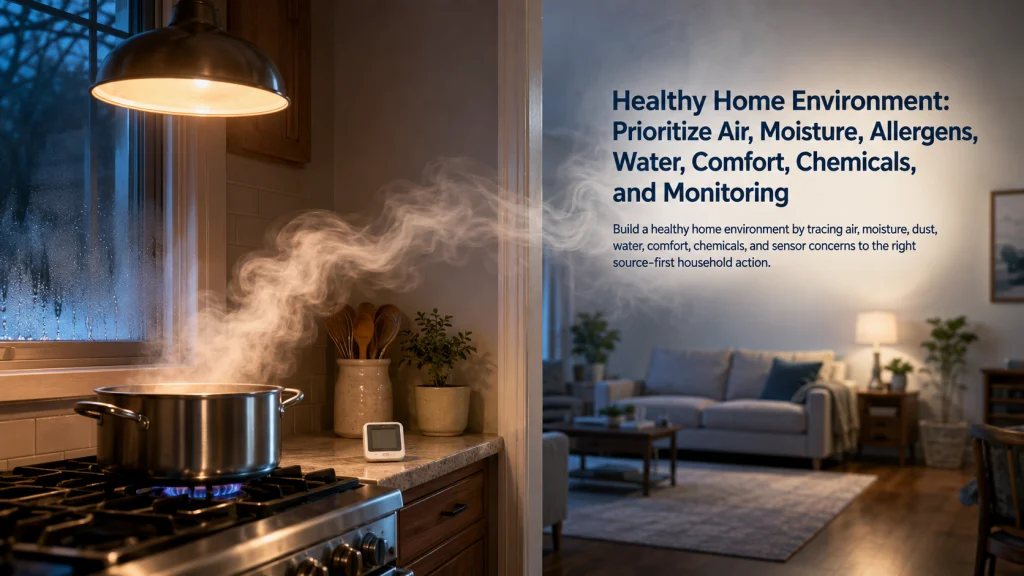
A healthy home environment starts with identifying the condition that needs attention, not choosing a purifier, filter, cleaner, dehumidifier, or monitor first. Stale air, dampness, visible dust, unusual water taste, noise, heat, strong product odors, and sensor alerts can come from different sources and move through the home in different ways. Name the source or pathway, take one low-risk reversible action, and observe what changes before buying equipment. Leave self-guided troubleshooting when an alarm, suspected hazard, building defect, or significant symptom calls for emergency, utility, property, environmental, or medical help.
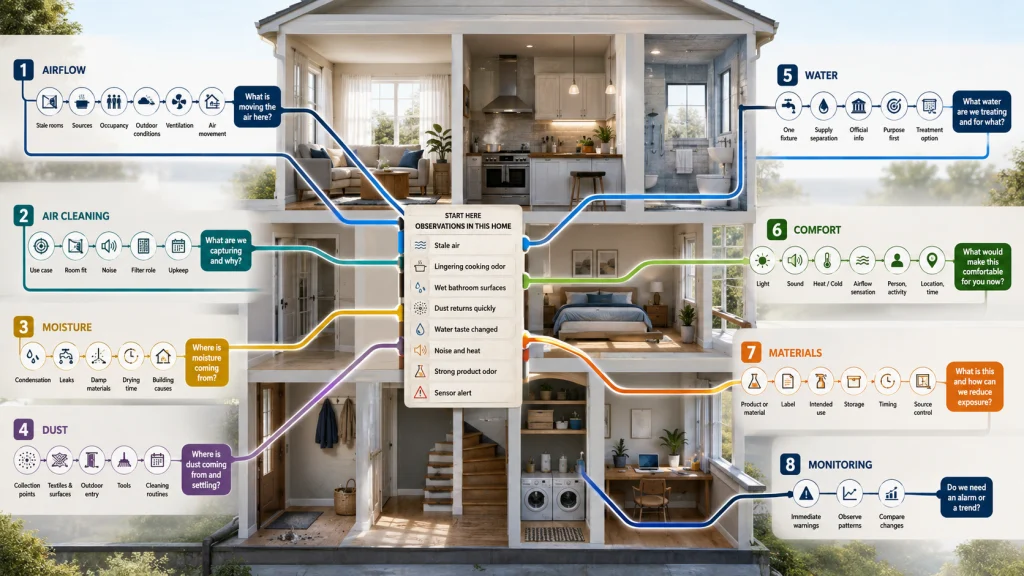
Eight Observations in One Home Need Eight Different First Questions
By the end of one ordinary day, the same household may notice eight things that all feel like signs of an unhealthy home.
| What someone notices | The first question to ask |
|---|---|
| A closed bedroom feels stale in the morning | Is the issue fresh-air exchange, occupancy, an outdoor condition, or another indoor source? |
| Cooking odor remains long after the meal | Was the source captured or vented while cooking, and where did the air move afterward? |
| The bathroom mirror and walls stay wet | Is moisture being produced faster than it can leave or dry? |
| Dust returns quickly after cleaning | Where is it collecting, what is being disturbed, and which surfaces hold it? |
| Tap water tastes different | Is the change at one fixture, throughout the home, or part of a wider water-supply issue? |
| One room is noisy and overheated | Is the problem a source, a pathway through the building, sunlight, equipment, or room use? |
| A new furnishing or household product smells strong | What is the material or product, how is it being used, and can the source be removed or isolated? |
| A monitor changes color or displays an alert | What does the device actually measure, and does the reading require immediate action, confirmation, or simple observation? |
These observations do not point to one universal purchase. A filter cannot repair a leak, a monitor cannot remove a source, and a stronger cleaner cannot correct a ventilation or storage problem. Ask what must be controlled, maintained, repaired, ventilated, cleaned, measured, or escalated before choosing equipment.
Use Precise Terms Before Choosing a Solution
A healthy home is not defined by one smell, one reading, or a spotless appearance. Its conditions must fit the people, activities, building, and available responsibilities.
| Term | Practical meaning | Question it answers |
|---|---|---|
| Healthy home environment | The combined air, moisture, cleanliness, water, comfort, material, maintenance, and safety conditions | Which environmental condition deserves attention first? |
| Indoor environmental quality | How air, light, sound, temperature, and moisture affect a space | Is the room working well for its occupants and activities? |
| Source | The activity, material, appliance, leak, outdoor condition, or building issue where a concern begins | Where is the condition coming from? |
| Pathway | The route through air, water, dust, surfaces, openings, ducts, plumbing, or rooms | How does the condition reach the place where it is noticed? |
| Exposure | Contact through breathing, drinking, touching, or using the affected space | Who encounters it, where, and during which activities? |
| Comfort | How workable light, sound, temperature, and airflow feel for a person and task | Is the room difficult to use even when no hazard is established? |
| Control | An action that removes, reduces, isolates, captures, ventilates, filters, or manages a condition | Which action addresses the source or pathway most directly? |
| Maintenance | Routine work that keeps a system, device, surface, or storage method functioning | Has a neglected task allowed the problem to return? |
| Monitoring | Observation or a suitable device used to notice change or signal a condition | What information is needed before the next decision? |
The distinction matters because a comfort complaint, a maintenance issue, a source problem, and an emergency alert should not be handled as if they were the same kind of event.
Use a Source-Pathway-Person Framework Without Diagnosing Health Effects
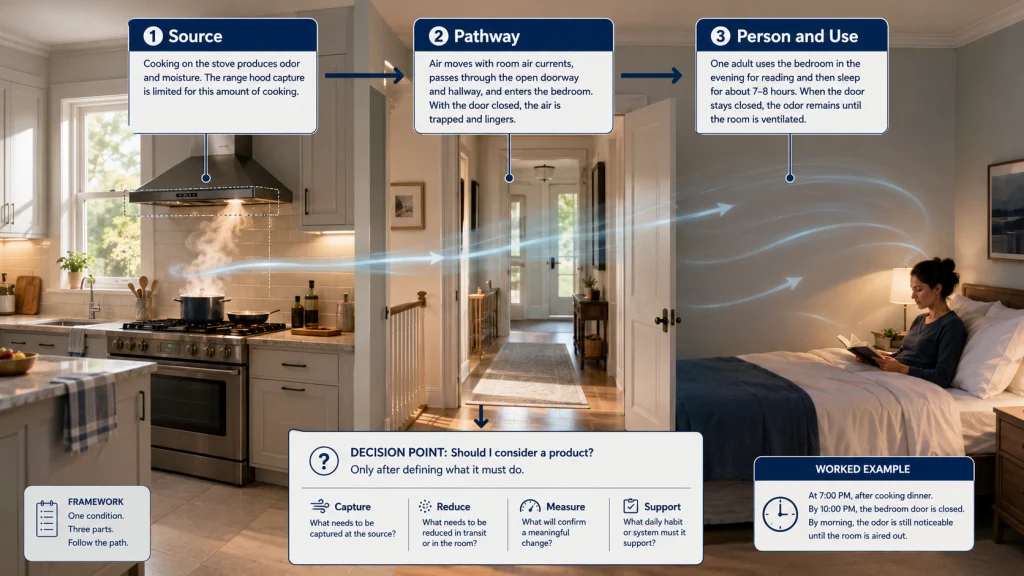
Write down three connected parts before deciding what to do. This keeps attention on observable household conditions without using an odor, symptom, or consumer reading to diagnose a medical problem.
| Part of the framework | What to observe | Example question |
|---|---|---|
| Source | Activity, material, appliance, moisture entry, outdoor event, stored item, or building system | What begins or releases the condition? |
| Pathway | Air movement, water movement, dust transfer, surfaces, gaps, shared walls, plumbing, or room-to-room traffic | How does it move, spread, collect, or remain? |
| Person and use | Who uses the space, what they are doing, how long they are there, and whether the condition limits normal use | Who encounters it, during which activity, and what changes when they leave or alter the task? |
A cooking odor may begin at the stove, move through an open doorway, and remain in a bedroom. That description is more useful than immediately labeling the air unsafe or assuming an air cleaner is the only answer.
Key decision: Start with the source and pathway when they are observable. Use a product only after defining what it must capture, reduce, measure, or support.
Start With Airflow and Sources When a Room Feels Stale or Odors Linger
A bedroom may feel fine with the door open, then stale after two people sleep there overnight. A kitchen odor may fade near the stove yet appear in a hallway later. Those details point toward fresh-air exchange, source capture, room-to-room movement, or an outdoor condition entering the home.
Follow the timing before changing the whole house. Note what happened beforehand, which rooms were affected, whether doors or windows were open, and whether an existing exhaust feature was running. Opening a window is not automatically appropriate because outdoor conditions and building design matter.
Use the indoor air quality and ventilation guide when the unresolved decision concerns stale air, lingering odors, occupancy, outdoor air, ventilation habits, or movement between rooms.
Practical tip: Replace “the air feels bad” with a short scene: room, time, activity, openings, and exhaust use. That description is easier to compare the next day.
Consider Air Cleaning Only After Naming the Particle or Use Case
It is understandable to look for an air-cleaning device when dust is visible or outdoor smoke has entered. The difficulty is that one product category can make unrelated concerns look like the same job. Settling dust, disturbed particles, smoke, moisture, and an unidentified odor do not share one performance target.
Define the remaining task after obvious source and ventilation questions. Then account for room placement, noise, maintenance access, replacement availability, and the people living with the equipment.
Review the air cleaners and filter guide when the decision has narrowed to particle capture, filter role, room fit, upkeep, compatibility, or operating friction.
Editorial observation: Similar specification sheets can hide different ownership routines. Filter access, replacement storage, sound, cleaning steps, and compatibility often matter after setup.
Treat Condensation, Leaks, Dampness, and Mold as Moisture Questions First
Wiping a bathroom mirror after a shower is ordinary. Finding the same ceiling mark, damp cabinet, or material that never dries calls for a different question. The repeated pattern matters more than the fact that water is visible.
Trace whether moisture comes from an activity, leak, condensation, or the building, then ask how long materials stay wet and who controls the cause. Surface cleaning may change the appearance while plumbing, drainage, roofing, exhaust, or another fixed condition continues.
Editorial observation: Moisture-control equipment can add a tank, drain route, filter, noise, and maintenance. If a leak remains unresolved, the equipment may manage a symptom while adding another task.
Continue with the humidity, moisture, and mold guide for recurring condensation, leaks, damp materials, drying problems, control decisions, and qualified-assessment boundaries.
Safety warning: Do not disturb suspected asbestos, lead-containing material, hazardous residue, or a large or unexplained affected area. Seek qualified assessment when the material, source, extent, or building condition is uncertain.
Follow Dust and Allergen Pathways Through Textiles, Surfaces, and Routines
The discouraging part of dust is seeing it return to the same shelf, bed edge, chair, or floor line soon after cleaning. That pattern can reveal more than a decision to clean more often.
Look at where material settles first, which textiles hold it, what enters from outdoors, and which routine redistributes it. A tool that captures well but is awkward to empty, clean, carry, or store can quietly break the routine. Large furnishings create a different workload from washable bedding or clear hard surfaces.
The household allergens and cleaning guide is the next step for dust, pet-related material, bedding, upholstery, surface methods, tool care, and repeatable cleaning routines.
A visually spotless room is not the standard. Focus on recurring collection points without turning the home into a permanent cleaning project.
Locate a Water Concern Before Choosing Filtration
A different taste at the kitchen tap can feel like a whole-home problem. First separate one fixture from several, hot water from cold, and a brief change from a continuing one. That branch helps distinguish a local question from a wider supply concern.
Check whether an official advisory or service notice applies before using taste, appearance, or a consumer reading to declare water safe or unsafe. Define the treatment purpose rather than shopping under a broad promise of “better water.”
Editorial observation: Filtration brings an ownership schedule. Cartridge access, replacement availability, installation space, compatibility, and realistic maintenance can matter as much as the initial format.
Use the home water quality and filtration guide for location, utility or testing information, defined treatment goals, upkeep, and filtration fit.
Treat Light, Sound, Heat, and Cold as Real Usability Conditions
The same room can feel calm at breakfast and nearly unusable by late afternoon. Sun may strike one seat, glare may hide a screen, traffic noise may interrupt a call, or a draft may reach only the bed.
Start with the person and activity. Record place, time, direction, duration, and whether the condition is local or room-wide. A change that supports sleep can interfere with daytime work, while masking sound does not repair a mechanical source.
Features involve tradeoffs too. More light can create glare, added airflow can introduce noise, and an inconvenient control may go unused.
Use the indoor comfort guide for lighting, glare, noise, heat, cold, airflow sensation, and room-specific comfort decisions.
Key decision: Define the person, place, task, and time before changing the whole room.
Identify the Material, Product, and Use Pattern Behind a Strong Odor or Exposure Concern
A strong smell after opening a furnishing, using a cleaner, starting a hobby project, or bringing renovation material indoors can make a room feel uncertain. Smell alone does not identify the substance, amount, health effect, or safe response, so keep the product or material at the center of the investigation.
Record the label, intended use, timing, storage, and instructions for ventilation or cleanup. When safe, stop unnecessary use, close the container, remove a movable source from occupied space, or isolate the activity as directed. Do not mix products or assume that natural, green, or fragrance-free means suitable for every task.
Storage and follow-through matter. A product that cannot be closed securely, stored appropriately, or used without improvising around its instructions is a poor household fit.
Use the household chemicals and materials guide for cleaners, furnishings, renovation products, labels, storage, exposure claims, and decisions needing specialist help.
Safety warning: A suspected gas leak, hazardous release, combustion problem, or other immediate danger is not a product-comparison question. Leave the area when safe and contact emergency or utility services as appropriate.
Use Alarms and Sensors for Defined Decisions, Not General Reassurance
A color change or number on a screen can feel more certain than the room itself. That confidence is useful only when the household knows what the device measures, what the display means, and what action follows.
Separate devices that warn of immediate danger from tools used to observe moisture, temperature, comfort, leaks, or change over time. Name the decision first: respond now, document a pattern, compare before and after an ordinary change, or arrange assessment.
Power, access, replacement needs, placement limits, and a response every household member understands can matter more than an extra display feature.
The home monitoring and detector guide covers alarms, meters, sensors, readings, maintenance, and the difference between immediate warning and general observation.
Note: A monitor can reveal a pattern or trigger a response. It cannot remove a source, repair a building system, or diagnose a medical condition.
Use a Source-Control-Before-Product Ladder
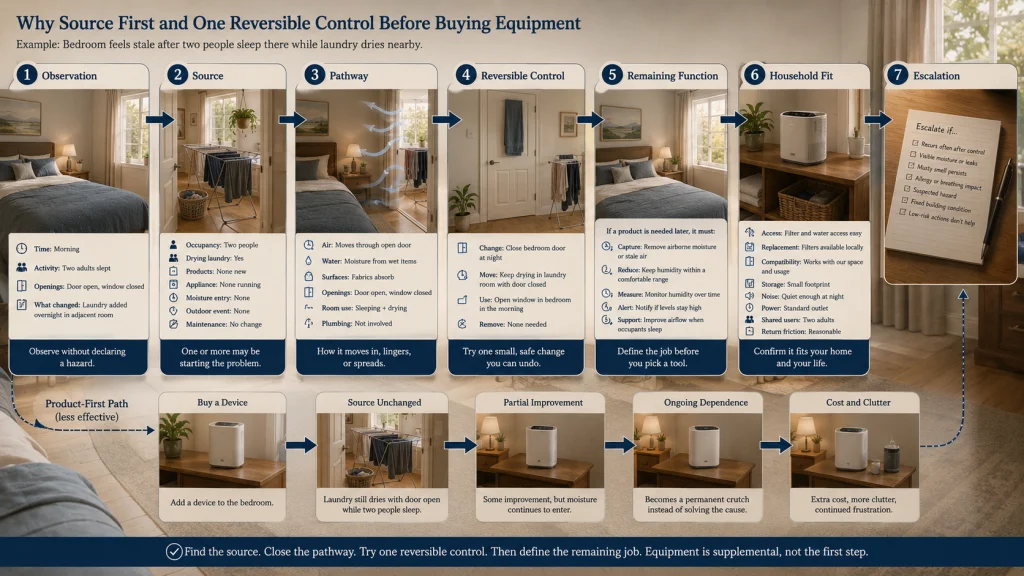
A short decision ladder prevents equipment from becoming the first response to a problem it cannot solve.
- Name the observation. Describe what changed, where, when, and during which activity.
- Look for the source. Identify the material, activity, moisture entry, appliance, outdoor event, maintenance issue, or building condition that may begin it.
- Trace the pathway. Note how air, water, dust, surfaces, openings, plumbing, or room use may move or retain it.
- Try one low-risk reversible control. Remove an unnecessary source, change an ordinary routine, use an existing control correctly, or isolate the affected activity when safe.
- Define the remaining function. State exactly what a product would need to capture, reduce, measure, alert, or support.
- Check household fit. Consider maintenance, replacement parts, compatibility, storage, noise, power, access, shared users, and return friction.
- Set an escalation point. Decide what result, recurrence, alarm, symptom, or building condition means the household should stop and seek qualified help.
Editorial observation: The purchase price is only the visible part of a home-wellness product. Consumables, cleaning access, replacement availability, storage, setup, warranty limits, and the effort required to return or replace an unsuitable item shape whether the solution remains workable.
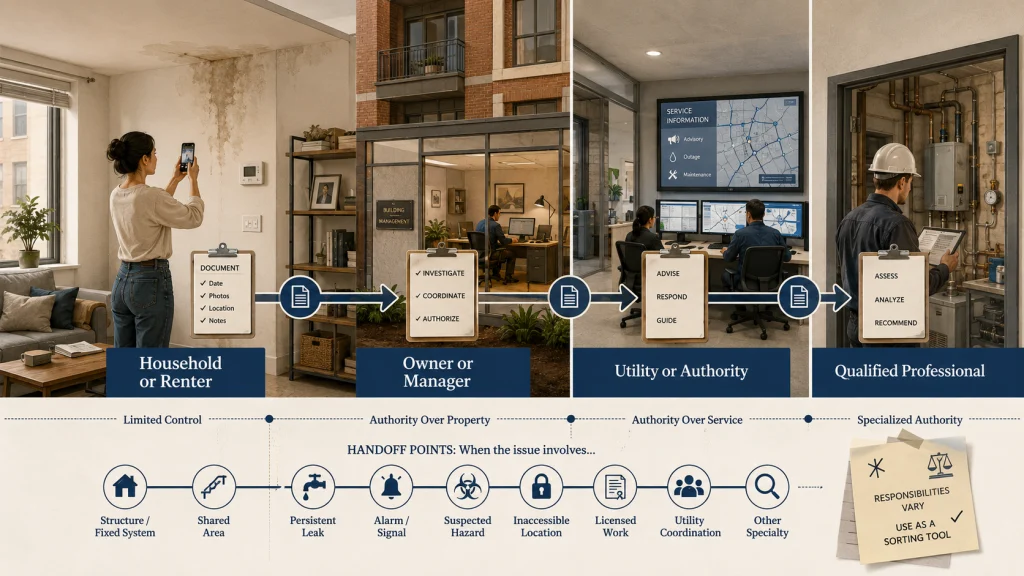
Separate Renter Actions From Owner, Utility, and Professional Responsibilities
The person who notices a condition is not always authorized or qualified to correct it. Renters, owners, utilities, and specialists control different parts of the response.
| Responsibility level | Examples of appropriate actions | When to pass the issue onward |
|---|---|---|
| Household or renter | Document the condition, follow ordinary product instructions, manage movable sources, use existing controls, and report property issues promptly | When the source involves the structure, fixed system, shared area, persistent leak, alarm, suspected hazard, or access the occupant does not have |
| Property owner or manager | Investigate reported building conditions, arrange maintenance, provide access, and coordinate qualified repair where required | When the issue needs licensed work, environmental assessment, utility coordination, or emergency response |
| Utility or public authority | Provide official advisories, service information, emergency response, or guidance within its responsibility | When the concern is inside private plumbing, equipment, or another condition outside that service’s role |
| Qualified professional | Assess specialized environmental, structural, mechanical, electrical, plumbing, hazardous-material, or remediation concerns | When another specialty, medical evaluation, or emergency service is required |
This is a practical sorting tool, not legal advice. Responsibilities vary, so document the condition and avoid work beyond your access or competence.
Create a One-Room Observation Log Before Buying Equipment
Choose one room rather than auditing the whole home. A short record can connect a condition to time, weather, occupancy, cleaning, cooking, equipment, or room use.
| What to record | Example entry | Why it matters |
|---|---|---|
| Date, time, and room | Tuesday evening, upstairs bedroom | Shows whether the condition follows a schedule or location |
| Observation | Room felt stuffy after the door had been closed | Keeps the record descriptive rather than diagnostic |
| Activity or source | Two people in the room, laundry drying nearby | Connects the condition to occupancy, moisture, products, or tasks |
| Pathway and controls | Door closed, window closed, exhaust not relevant | Shows how air, water, dust, sound, or heat may move or remain |
| One reversible change | Moved drying laundry and changed when the door was closed | Tests one explanation without changing several variables |
| Result and next step | Condition improved on two evenings; continue observing | Helps decide whether to keep the change, investigate another pathway, or escalate |
The log cannot prove a medical cause or identify a hazardous substance. It organizes the pattern for the next guide, property report, or qualified assessment.
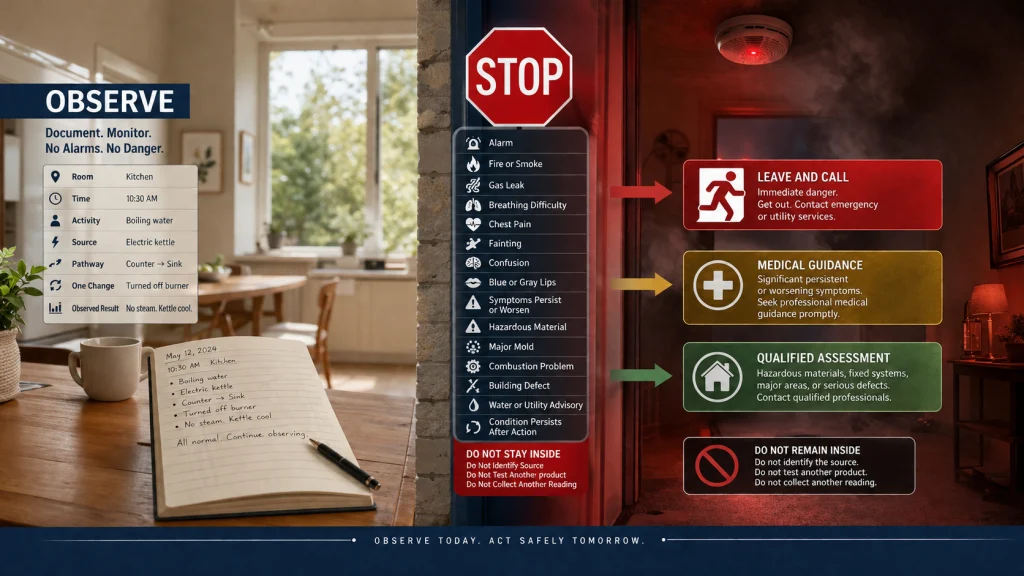
Know When Observation Must Stop
Some conditions are not appropriate for a worksheet, product comparison, or routine adjustment.
Emergency boundary: If a smoke or carbon monoxide alarm sounds, you see fire or smoke, suspect a gas leak, or anyone has severe breathing difficulty, chest pain, fainting, confusion, blue or gray lips, or other emergency signs, leave the area when safe and contact emergency or utility services as appropriate. Do not stay inside to identify the source or test another product.
Persistent or worsening symptoms need qualified medical guidance. Home observations and consumer readings cannot diagnose a medical condition.
Suspected hazardous materials, major mold, combustion problems, or significant building defects require qualified assessment. Follow official water, utility, property, and product warnings.
Stop condition: Escalate when the issue involves an alarm, immediate danger, significant symptoms, a suspected hazardous material, a fixed building system, an official advisory, or a problem that persists after a reasonable low-risk household action.
Choose the First Action by Following the Condition Backward
Begin with one clear observation, trace it to the likely source and pathway, then choose the guide that owns that decision.
Make one reversible change before a broad shopping response, then decide what result means keep observing, report the condition, or seek qualified help.
A healthier home is not created by treating every observation as the same problem. It comes from matching the action to the source, pathway, room, people, and level of responsibility involved.
Bring the Right Observation Into the Next Guide
Carry one useful piece of information from the room into the guide that owns the next decision.
| Bring this information | Continue with |
|---|---|
| Room, time, activity, openings, exhaust use, and outdoor conditions | Indoor Air Quality and Ventilation |
| Named particle or use case plus placement, noise, upkeep, and replacement constraints | Air Cleaners, Filters, and Air Cleaning |
| Where moisture appears, whether it returns, drying time, and who controls the cause | Humidity, Moisture, and Mold Control |
| Where material returns, which surfaces hold it, and where the routine breaks down | Household Allergens and Cleaning |
| Whether one fixture or the wider supply is affected and the treatment question | Drinking Water Quality and Home Filtration |
| Person, activity, location, time, and direction of the comfort condition | Lighting, Noise, Temperature, and Comfort |
| Product identity, label, timing, use, storage, and instructions followed | Household Chemicals and Materials |
| Device purpose, alert or reading, maintenance status, and expected response | Home Monitoring, Detectors, and Sensors |
The table now works as a handoff rather than a second summary. Choose the unresolved decision and bring the observation with you.
FAQs
🏠 What does a healthy home environment include?
It includes indoor air, moisture, cleanliness, drinking water, lighting, sound, temperature, household materials, maintenance, and safety conditions. The useful goal is not a flawless home but a home where concerns are identified accurately and matched to appropriate controls or help.
🌬️ Should I buy an air purifier when a room feels stale?
Not automatically. Staleness may relate to occupancy, ventilation, an indoor source, or outdoor conditions, while an air cleaner has a more limited role. Identify when and where the condition occurs before deciding whether particle capture is relevant.
💧 Is condensation always a humidity problem?
Condensation involves moisture meeting a surface where water can form, but the practical cause may involve an activity, ventilation, temperature difference, leak, or building condition. Track where it appears and whether materials dry before choosing a control.
🧹 Why does dust return soon after cleaning?
Dust may be resettling, entering from outdoors, coming from textiles, or being redistributed by the cleaning method and household activity. Observe where it returns first and which routines or materials connect those locations.
🚰 Does unusual tap-water taste mean I need a filter?
A filter should not be the first assumption. Determine whether the change affects one fixture or the wider supply, check for official information, and define the treatment goal before choosing equipment.
👃 Can a strong odor tell me whether a product is dangerous?
No. Odor alone does not identify the substance, amount, exposure, or health effect. Identify the product or material, follow its instructions, control the source when safe, and escalate suspected hazardous releases rather than continuing to investigate indoors.
📟 Can a home sensor tell me what is making someone feel unwell?
A consumer sensor may provide information about a condition it is designed to measure, but it cannot diagnose the cause of symptoms. Significant, persistent, or worsening symptoms need qualified medical guidance regardless of the displayed reading.
🚨 When should I stop troubleshooting the home myself?
Stop when the situation crosses from an ordinary household observation into an alarm, immediate danger, serious or worsening symptoms, a suspected hazardous material, a fixed-system defect, or an official advisory. Use the full emergency boundary above instead of running another home test or product comparison.