Learning how to stay independent as you age begins with protecting choice, participation, control, and access rather than proving that every task can still be done alone. The first useful step may be correcting an assumption, planning ahead, accepting one form of help, beginning a family conversation, noticing repeated changes, preparing for solo aging, or rebuilding purpose after retirement. Start with one valued activity and test the smallest acceptable form of support. Sudden changes, repeated falls, confusion, inability to meet essential needs, suspected abuse, exploitation, or immediate danger require appropriate professional or emergency help.
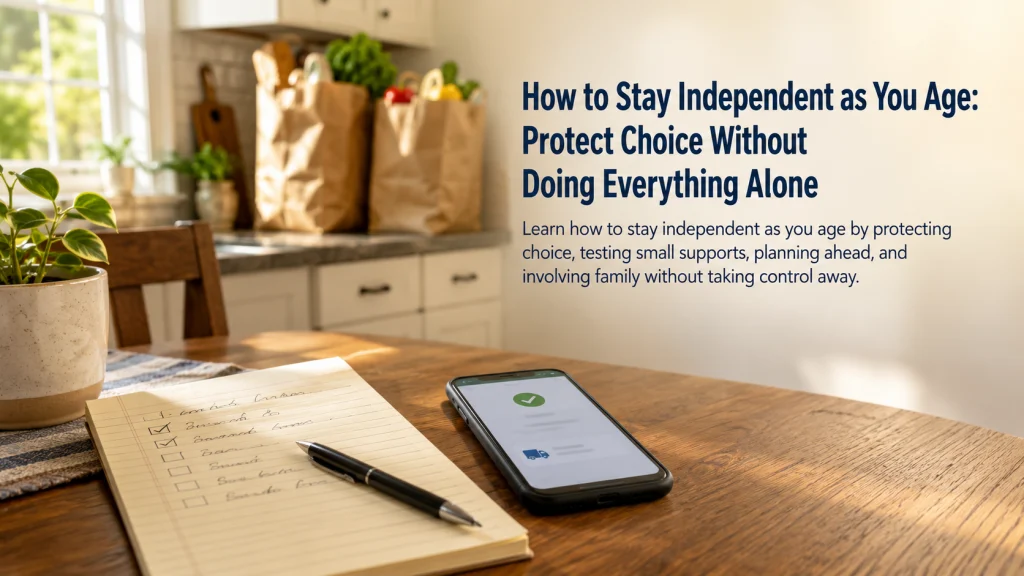
Doing it yourself is not the only form of independence
Imagine a sheet divided into two columns. The first says, “I do it myself.” The second says, “I decide how it gets done.” Grocery delivery, a ride from a friend, a reach tool, and automatic bill reminders belong in the second column.
| I do it myself | I decide how it gets done |
|---|---|
| I shop, carry every bag, and bring everything home without help. | I choose the food, timing, budget, and substitutions, while delivery handles transport and carrying. |
| I drive every trip personally. | I choose the destination and schedule, while a friend, service, or other option provides the ride. |
| I reach every item without assistance. | I decide where items belong and use a suitable tool or storage change to keep access comfortable. |
| I remember every routine without prompts. | I choose the routine and use reminders that remain under my control. |
Independence is often preserved by keeping control over the outcome, not by personally performing every step. The next decision is which kind of support protects your choices instead of replacing them.
The broader healthy aging framework helps identify whether the first issue is movement, a daily task, the home, equipment, transportation, technology, or wider independence planning. This article focuses on the decisions that protect autonomy before another person, product, or service takes over more than necessary.
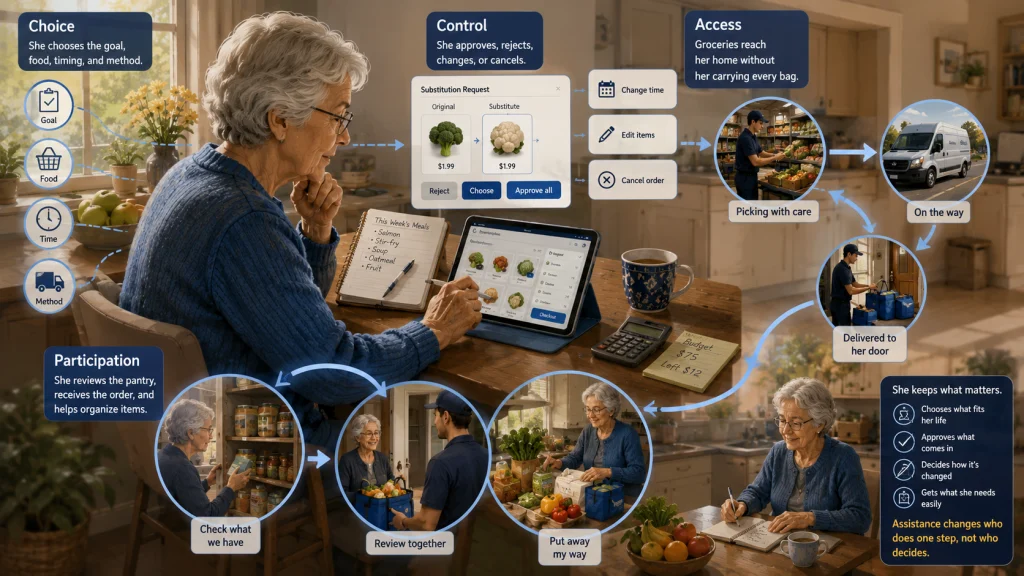
Define independence as choice, participation, control, and access
Total self-sufficiency is an unrealistic standard for people of any age. Daily life already depends on roads, stores, phones, services, household tools, family, friends, and shared systems. The useful question is whether a person can continue making meaningful choices and participating in the parts of life that matter.
| Part of independence | What it looks like in daily life |
|---|---|
| Choice | Selecting the goal, timing, method, helpers, and acceptable tradeoffs |
| Participation | Remaining involved in tasks, relationships, roles, and community life |
| Control | Understanding what is happening and having a real say in decisions |
| Access | Being able to reach people, places, information, services, and necessary resources |
Support can strengthen all four parts. Grocery delivery is a clear example. When the person still chooses the food, budget, timing, and substitutions, delivery may preserve control and participation rather than remove them. The task changes, but the decision remains with the person.
Independence is not identical to living alone, refusing assistance, or avoiding every adaptation. A support arrangement should be judged by what it protects, what it replaces, and whether the person can understand, choose, maintain, and stop using it.
Separate ability, environment, tools, people, and services
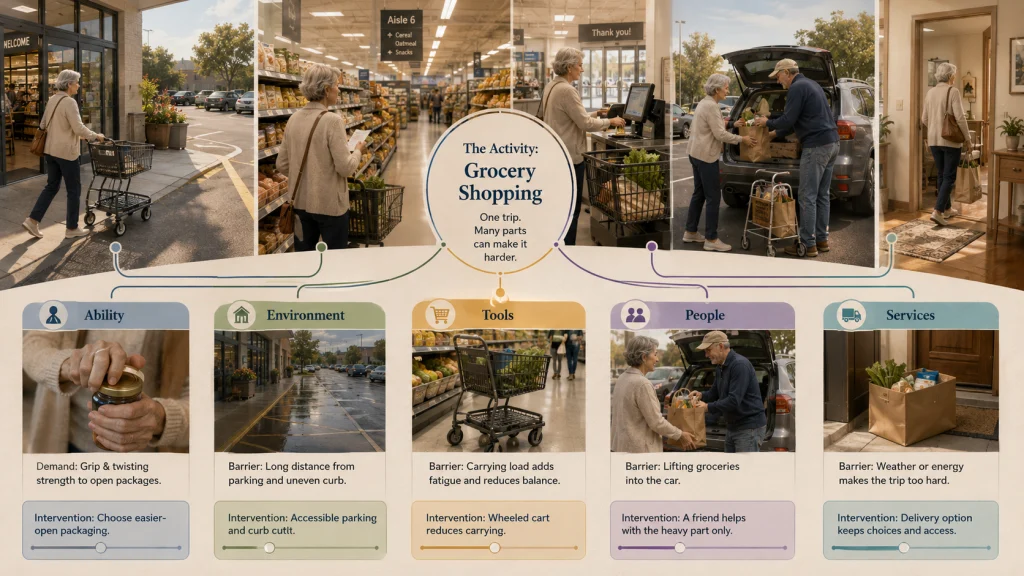
When one activity becomes harder, jumping directly to “the person needs more help” is too broad. The source may be personal ability, the setting, a missing tool, the way help is offered, or a service gap.
| Part of the system | Question to ask |
|---|---|
| Ability | Which physical, sensory, cognitive, or emotional demand is involved? |
| Environment | Does the layout, lighting, distance, noise, storage, or timing make the activity harder? |
| Tools | Could one suitable device or adaptation reduce a defined source of friction? |
| People | Which part could be shared without taking over the whole activity? |
| Services | Would transport, delivery, maintenance, scheduling, or another service preserve access? |
A low grocery shelf, a long walk from parking, a difficult payment screen, and heavy bags create different problems even though they appear during the same shopping trip. The first response should match the specific demand rather than assign a broad label to the person.
Identify the valued activity or decision at risk
Begin with something concrete: preparing breakfast, attending a weekly gathering, managing household bills, choosing clothes, caring for a pet, reaching an appointment, or maintaining privacy during personal routines.
Then describe the first point where control or participation begins to shrink. Is the activity avoided? Does it take much longer? Does another person now make decisions without discussion? Has fear replaced confidence? Has a small support request expanded into someone else controlling the whole routine?
A useful statement has three parts:
I want to protect: __________. The first difficulty is: __________. The choice I want to keep is: __________.
This prevents a broad concern such as “Mom is losing independence” from becoming the conclusion. The real issue may be transport to one destination, difficulty opening packaging, missed payments, a new movement change, or family members making decisions too quickly.
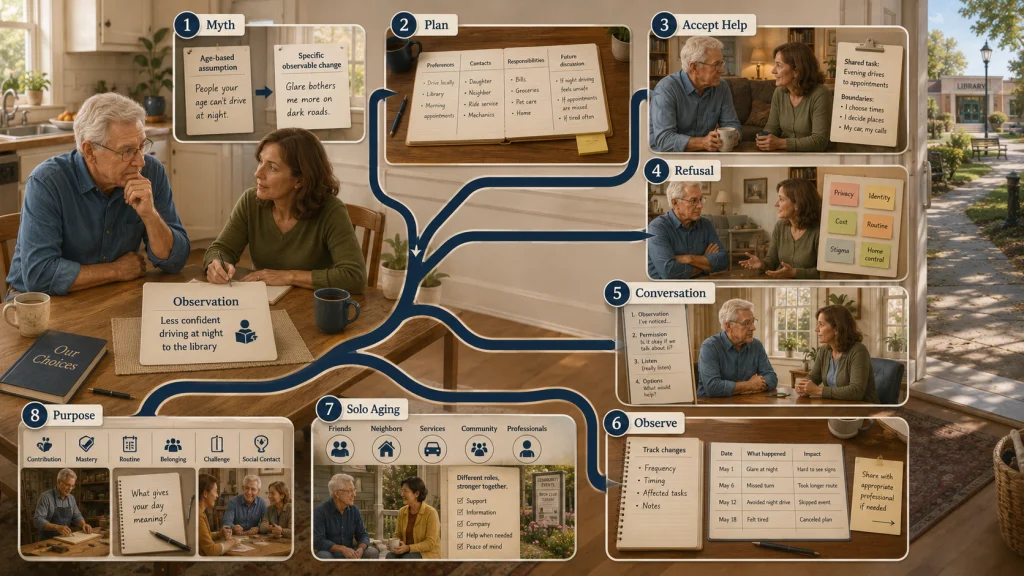
Route 1: Challenge assumptions before treating change as inevitable decline
Some decisions begin with a belief rather than an observed problem. Forgetting one name, preferring more rest, using delivery, changing social interests, or asking for help with a heavy task may be treated as proof that independence is disappearing.
Normal variation, preference, environment, temporary stress, and health changes should not be collapsed into one story about age. The useful response is to describe what actually changed, how often it happens, and which activity is affected.
Common myths about aging helps separate assumptions about dependence, learning, technology, movement, social life, and support from the specific evidence available in the situation.
Correcting a myth does not mean ignoring risk. It means avoiding a verdict before the pattern is clear enough to route properly.
Route 2: Plan before one urgent event controls every decision
Planning is most useful while the person can compare options without immediate pressure. The plan does not need to solve every future possibility. It needs to make preferences visible and identify who should be involved when one area changes.
Review the domains separately: health support, housing preferences, daily help, transportation, legal documents, financial organization, emergency contacts, meaningful activities, and communication. This article does not provide legal, financial, housing, or care-placement advice. Those decisions require the appropriate specialist.
Use planning for aging to organize priorities, documents, contacts, responsibilities, and the conditions that should trigger a new conversation.
A plan can protect choice because it records preferences before other people must guess. It should remain reviewable and should not be used to lock someone into an old decision when circumstances or preferences change.
Route 3: Accept task-specific support while keeping boundaries
Help becomes easier to evaluate when it is attached to one task. “I need help with everything” can feel overwhelming. “I want help carrying laundry downstairs, but I will sort, wash, and fold it myself” protects a clear boundary.
Start with the part that creates the highest effort, risk, delay, or frustration. Decide what remains under the person’s control, who provides the support, how often it happens, what it costs, and how the arrangement can be changed or stopped.
Accepting help as you age focuses on choosing support without treating assistance as failure or allowing one small change to erase privacy and control.
A product or service supports independence only when the person can understand it, choose it, maintain it, and stop using it. Setup demands, storage, noise, privacy, stigma, replacement, and household fit all belong in that decision.
Route 4: Understand what the person may be protecting when help is refused
Refusal may protect privacy, identity, routine, money, home control, or the right to make decisions. It may also reflect fear that accepting one small service will lead to more people entering the home or taking over unrelated choices.
Calling the person difficult or unreasonable closes the conversation before the concern is understood. Ask what feels unacceptable about the proposed help. The issue may be the helper, timing, cost, language, noise, loss of privacy, stigma, or lack of control over cancellation.
Why older adults may refuse help examines the needs and boundaries that can sit underneath resistance without assuming every refusal is irrational.
Understanding the reason does not require agreeing that every situation is safe. It creates a better chance of finding a smaller, more acceptable option or identifying when professional assessment is necessary.
Route 5: Begin a family conversation with observations and permission
A conversation is less likely to feel like a takeover when it begins with what was observed rather than a verdict about the person. “I noticed the last two grocery trips were canceled because the walk from parking felt difficult” is more useful than “You cannot shop alone anymore.”
Ask permission to discuss one topic. Share the observation, ask how the person sees it, and listen for the activity or choice they want to protect. Offer options rather than presenting a finished plan.
How to talk to aging parents about help provides a communication process built around timing, language, consent, disagreement, and follow-up.
The goal is not to win one conversation. It is to create enough trust that new information can be discussed without every concern becoming a threat to the person’s autonomy.
Route 6: Observe repeated changes and route them correctly
One unusual day may reflect fatigue, stress, illness, a disrupted routine, or an unfamiliar situation. Repeated changes across ordinary conditions deserve closer attention.
Record what happened, when it began, how often it occurs, and which tasks are affected. Separate movement, daily activities, the home, transportation, communication, money management, food, personal care, and social withdrawal rather than placing every concern under one label.
Signs an aging parent may need help helps organize observations and route each pattern to the appropriate type of support or assessment.
Observation does not determine whether a person is medically safe, cognitively capable, fit to drive, able to live alone, or in need of a particular care level. Those conclusions require qualified assessment.
Route 7: Build support without relying on a default family structure
A spouse or nearby adult child is not the only possible foundation for support. Friends, neighbors, community groups, paid services, professionals, and reciprocal arrangements can form a deliberate network.
Begin with functions rather than titles. Who could be an emergency contact? Who can provide a ride, notice a missed routine, help compare services, enter the home if authorized, or advocate during an appointment? One person does not need to fill every role.
Solo aging focuses on building contacts, backup plans, shared information, service relationships, and decision support when no default helper is available.
The network should respect consent and privacy. Access to keys, accounts, health information, and financial details should not expand simply because someone has offered help.
Route 8: Rebuild contribution and direction after a work role ends
Retirement can remove structure, identity, social contact, responsibility, and a familiar reason to begin the day. Replacing employment with an endless list of hobbies may not address what the work role provided.
Look for the missing function. Is it contribution, mastery, routine, belonging, income, challenge, recognition, or contact with other people? The answer may point toward volunteering, caregiving, paid work, learning, creative projects, community roles, or a different daily structure.
How to find purpose in retirement helps connect activities to the role or value the person wants to rebuild.
Purpose should not become another standard the person must perform. Quiet routines, relationships, rest, and private interests can be meaningful without public achievement.
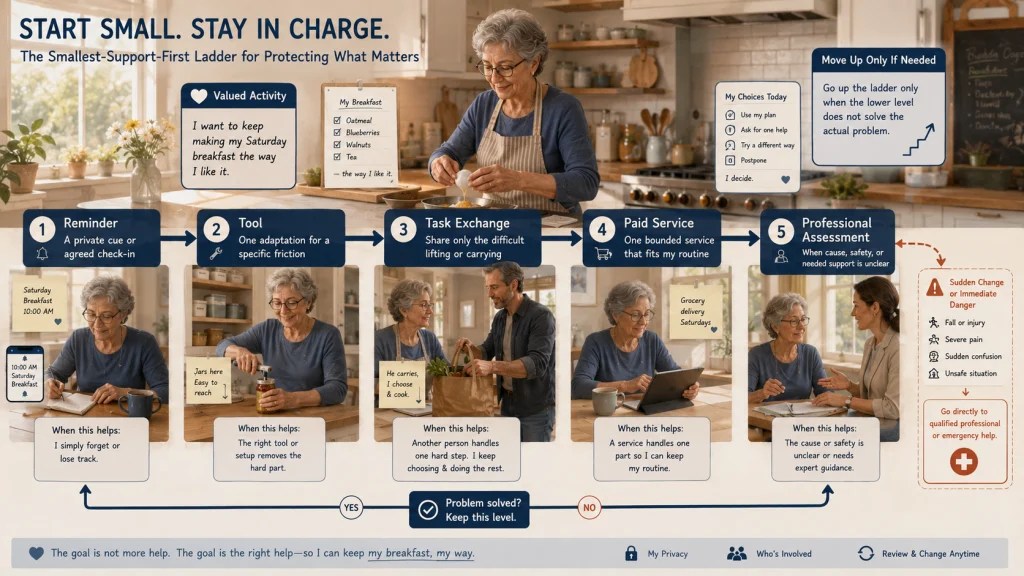
Use the smallest-support-first ladder
Begin with the least intrusive option that can reasonably protect the activity and safety. Move upward only when the lower step does not solve the actual problem.
- Reminder: Add a cue, written sequence, calendar prompt, or agreed check-in.
- Tool: Use a suitable device or adaptation for one defined source of friction.
- Task exchange: Share one part of the activity while the person keeps the choices that matter.
- Paid service: Add delivery, transport, maintenance, household help, or another defined service.
- Professional assessment: Seek qualified evaluation when the cause, safety, or level of support cannot be determined through an ordinary household change.
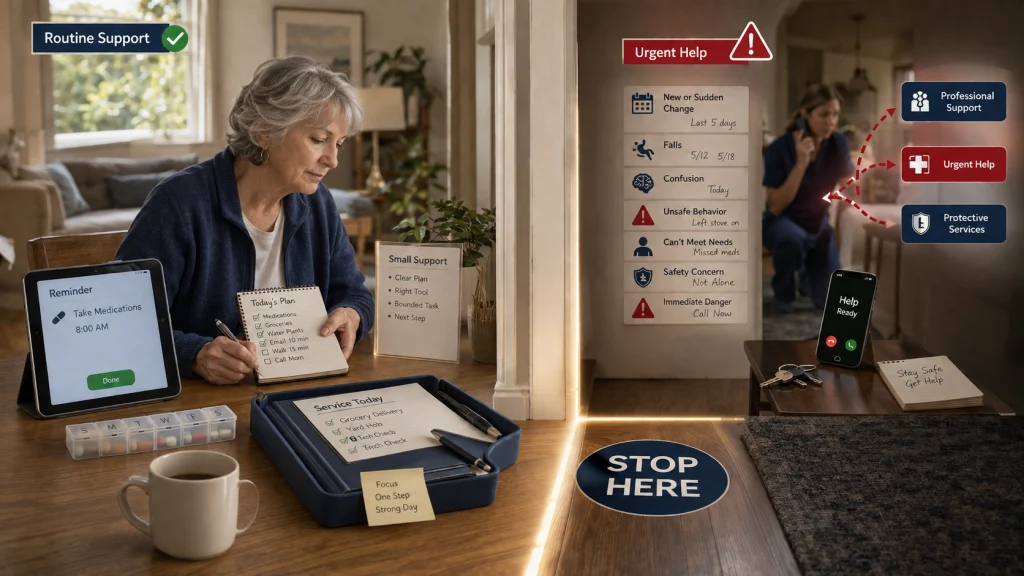
The ladder is not a rule that every situation must begin at the bottom. Sudden change, immediate danger, repeated falls, confusion, or inability to meet essential needs may require professional or emergency help immediately.
For a routine problem, define success before testing the next step. A reminder may work when it helps someone make an appointment independently without another person taking over the calendar. A task exchange may work when a neighbor carries a heavy box while the person still decides what stays, what moves, and where it belongs.
Reassess whether support still protects choice
A support arrangement should be reviewed after the person has used it in ordinary life. A solution that looked efficient may create new problems with privacy, cost, storage, noise, maintenance, scheduling, stigma, or another person’s control.
Ask four questions:
- Does the support preserve the activity or choice that mattered?
- Does it reduce the original risk or source of friction?
- Is the person willing and able to use it under the agreed boundaries?
- Can the arrangement be changed, paused, or stopped without unnecessary conflict?
Support that slowly expands beyond the original agreement should be discussed again. A ride arrangement should not automatically become permission to control appointments. A reminder system should not quietly become continuous monitoring.
Route movement, home, transportation, and technology questions correctly
This article does not solve every factor that affects independence. Use the appropriate guide when the first issue belongs elsewhere.
| Primary issue | Use this guide |
|---|---|
| Strength, balance, walking, standing, or physical movement capacity | Maintaining mobility as you age |
| Steps, lighting, seating, storage, bathrooms, entrances, or household layout | Home safety for older adults |
| Driving, rides, public transport, travel, or community access | Transportation options for older adults |
| Communication, reminders, monitoring, access, privacy, or connected support | Technology for older adults |
Daily-task redesign, assistive-device fitting, legal planning, financial planning, driving decisions, housing choices, capacity assessment, and clinical care planning also require the correct specialist or dedicated guidance.
Know when the smallest-support experiment is not enough
Safety warning: Seek qualified professional or emergency support for a new or sudden functional change, repeated falls, confusion, unsafe behavior, inability to meet basic needs, suspected abuse or exploitation, or immediate danger.
Do not use an online article to decide whether an older adult is medically safe, cognitively capable, fit to drive, able to live alone, or in need of a particular level of care. Do not diagnose dementia, depression, frailty, a balance disorder, or neglect.
When abuse, exploitation, or immediate danger is suspected, prioritize immediate safety and contact appropriate local emergency or protective services. Avoid confronting a potentially dangerous person in a way that increases risk.
Protect one choice with the smallest acceptable support
Name one activity or decision that matters, the first point where control is shrinking, and the smallest support the person is willing to test. Keep the goal specific enough to review after ordinary use.
The test might be one ride to a valued weekly activity, help with carrying while the person keeps the rest of the task, a reminder that remains private, or one household responsibility shared with a trusted person. Independence is preserved when support expands access and reduces risk without erasing voice, dignity, or control.
Choose the next independence decision
| Current question | Detailed guide |
|---|---|
| Is an assumption about aging shaping the decision? | Common myths about aging |
| What should be organized before a crisis? | Planning for aging |
| How can support be accepted without losing control? | Accepting help as you age |
| What may be protected when help is refused? | Why older adults may refuse help |
| How should a family conversation begin? | Talking to aging parents about help |
| Which repeated changes deserve closer attention? | Signs an aging parent may need help |
| How can support be built without a default family helper? | Solo aging |
| What can replace the contribution and structure of work? | Finding purpose in retirement |
FAQs
🧭 Does independence mean doing everything alone?
No. Independence can include choosing how a task gets done, who helps, which parts remain private, and when support begins or ends. The outcome and control may matter more than personally completing every step.
🚗 Can accepting a ride preserve independence?
Yes. The person may still choose the destination, timing, route preferences, and who provides the ride. Transport support can preserve access without transferring control over the reason for the trip.
🤝 What is the smallest form of support to try first?
Start with the least intrusive option that can reasonably protect the activity, such as a reminder, suitable tool, task exchange, or defined service. Skip directly to professional help when the change or risk requires it.
💬 How can I offer help without taking over?
Begin with one observation, ask permission to discuss it, and ask what the person wants to protect. Offer choices and define the boundary of the support rather than presenting a finished decision.
🏠 Is living alone the same as being independent?
No. A person can live alone while lacking access or support, and another person can share a home while retaining strong control and participation. Independence depends on choice, access, and meaningful involvement.
🌱 Why can retirement affect independence?
Work may provide structure, contribution, identity, income, and social contact. Rebuilding the missing function can support daily direction without requiring one ideal retirement lifestyle.
🚨 When should the family seek professional help?
Seek appropriate help for sudden functional change, repeated falls, confusion, unsafe behavior, inability to meet basic needs, suspected abuse or exploitation, or immediate danger. An article cannot determine medical safety, capacity, driving fitness, or the required level of care.