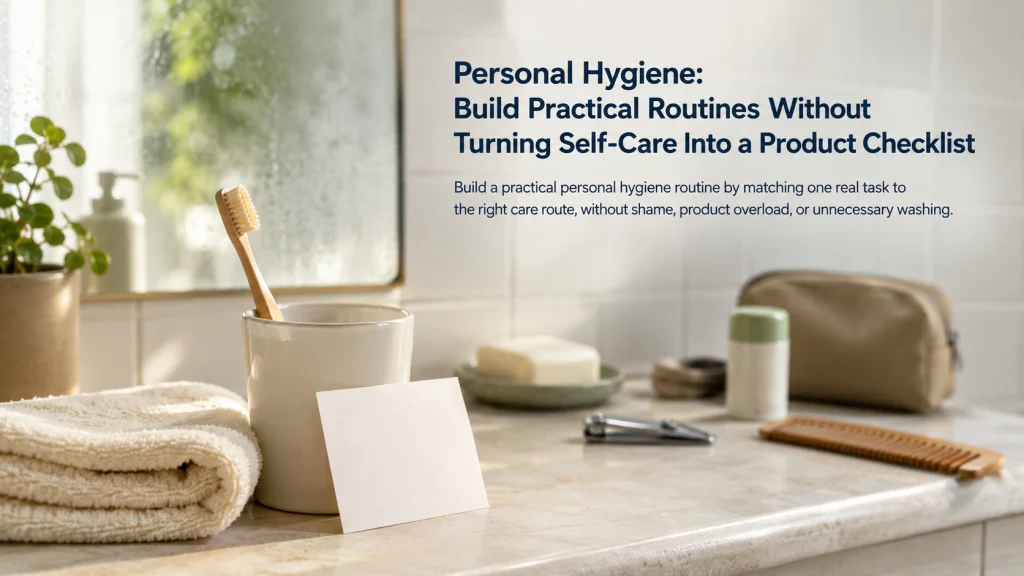
Personal hygiene works best when it begins with one real task, not a universal checklist or a shelf of products. First identify whether the difficulty involves routine basics, bathing, oral care, hands and feet, hair and grooming, intimate care, personal items, or a lifestyle and access constraint. Then choose one low-risk action that fits the situation and notice whether it makes the task clearer, easier, or more consistent. Persistent symptoms, major functional changes, or difficulty meeting essential needs deserve appropriate professional or practical support rather than more washing or more products.
Eight Objects Do Not Make One Routine
Imagine eight ordinary items beside a blank routine card: soap, deodorant, a toothbrush, nail clippers, a comb, a menstrual product, a towel, and a travel toiletry bag. Each object represents a different decision. Owning all of them does not tell you what needs attention today, how often a task belongs in your life, or which step is causing friction.
A person may be brushing regularly but struggling to remember clean towels. Someone else may have a workable bathing routine but limited privacy in a shared bathroom. Another person may be adding products when the real issue is discomfort that should be evaluated rather than scrubbed harder.
Key decision: Start with the task that is unclear, uncomfortable, repeatedly missed, or producing a practical problem.
That starting point keeps personal care grounded in function. It also leaves room for different bodies, schedules, abilities, homes, cultural practices, budgets, and preferences without turning cleanliness into a moral judgment.
Separate Hygiene, Grooming, Self-Care, and Treatment
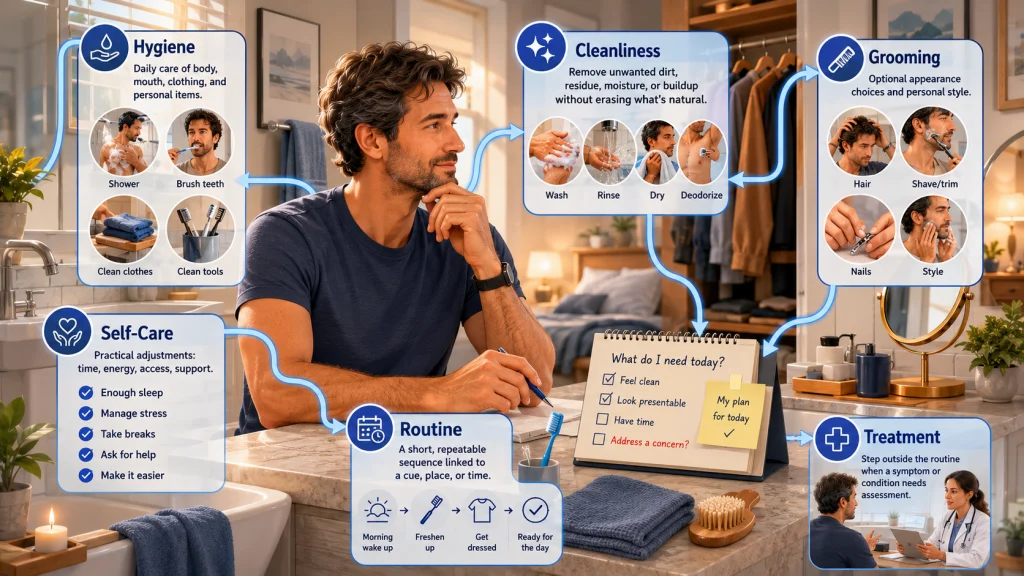
Several ideas are often mixed together under the same label. Separating them makes the next decision easier.
| Term | Practical meaning | What it does not automatically mean |
|---|---|---|
| Personal hygiene | Everyday practices used to care for the body, mouth, clothing, and frequently used personal items. | A single schedule that every adult must follow. |
| Cleanliness | The condition of being reasonably free from unwanted dirt, residue, moisture, or buildup for the task at hand. | Having no natural scent, texture, oil, or variation. |
| Grooming | Appearance and presentation choices such as styling, shaving, trimming, or cosmetic finishing. | A health requirement or proof of good character. |
| Self-care | Practical actions that help a person meet everyday needs with available time, energy, access, and support. | A replacement for dental, medical, or other qualified care. |
| Routine | A repeatable sequence tied to a cue, place, time, or situation. | A long checklist completed perfectly every day. |
| Treatment | Care intended to assess or address a health condition or symptom. | Something to improvise by washing more or trying random products. |
Use hygiene to organize ordinary care, grooming to describe optional presentation choices, and professional evaluation when symptoms or functional problems move beyond routine troubleshooting.
Start With the Task, Not the Product or Social Judgment
A useful starting question is concrete: what is not working? The answer may be “I forget the evening step,” “my feet stay damp in work shoes,” “I cannot reach part of my body safely,” or “this product makes the task uncomfortable.” Those answers lead somewhere. Judgments about effort, character, or being “clean enough” do not.
Social pressure can blur the task. A longer routine may not help when the real need is a clean towel, dry clothing, or permission to treat appearance steps as optional.
This task-first approach reduces wasted effort and makes it easier to notice when the problem is not hygiene at all.
Choose the Right Personal-Care Route
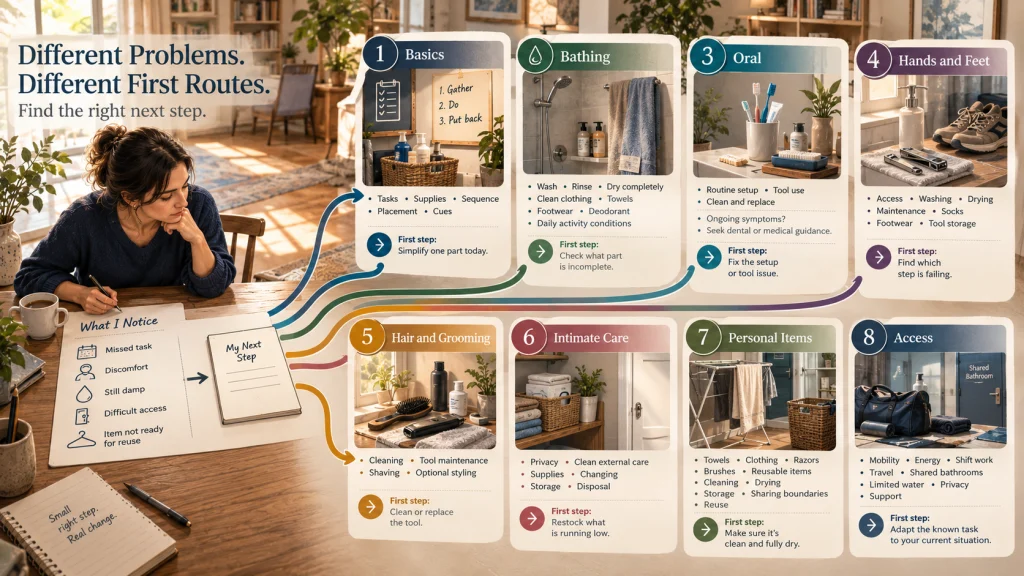
Use the map to identify the decision you need to make. The later sections explain each route in practical detail.
| Route | The decision it answers |
|---|---|
| Routine basics | How can essential tasks become easier to remember and repeat? |
| Bathing and body odor | Which part of the wash, dry, clothing, or odor-management sequence needs attention? |
| Oral care | Is the next step routine setup, tool use, or qualified dental care? |
| Hands, nails, and feet | Which small-area care workflow is breaking down? |
| Hair, scalp, and grooming | Which steps are cleaning, tool maintenance, or optional presentation? |
| Intimate and menstrual care | What belongs to ordinary external care, and what belongs outside routine troubleshooting? |
| Clothing and personal items | Is the weak point the body-care task or the item used around it? |
| Lifestyle, ability, and access | What adaptation or support would make a known task possible? |
Choose one answer for the current problem. Other routes can wait until that first obstacle is clearer.
Route 1: Build the Basic Routine
Choose this route when the problem is inconsistency, uncertainty, clutter, missed steps, or a routine that asks too much at the wrong time. The goal is to decide which tasks matter, where they happen, what supplies they require, and what cue makes them easier to remember.
Begin with the personal hygiene basics guide when you need help separating daily tasks from occasional tasks, reducing unnecessary steps, or building a sequence that fits your actual morning and evening.
Visible supplies, easy replacements, and a forgiving sequence reduce friction. For someone with low energy, two repeatable evening steps may work better than ten steps that rarely happen.
Practical tip: Write down only the tasks you already believe are necessary. Mark which one is unclear or repeatedly missed before adding anything new.
Route 2: Sort Out Bathing and Ordinary Body Odor
Use this route when the question centers on bathing frequency, shower technique, cleanser, drying, deodorant, antiperspirant, sweating, or ordinary body odor. Frequency depends on the person, activity, climate, skin comfort, work conditions, and what needs cleaning. More frequent washing is not automatically a better fit.
The bathing and body odor guide helps separate external-body care from appearance pressure and from symptoms that deserve evaluation.
A practical first check is to look at the whole sequence: washing, rinsing, drying, clean clothing, and whether damp fabrics or footwear are being reused. A stronger cleanser cannot fix a towel that never dries or a shirt that stays damp after work.
Note: Persistent, worsening, painful, sudden, or unexplained odor changes should not be treated as a personal failure. Stop escalating the routine and seek appropriate evaluation when the change does not fit ordinary activity or hygiene conditions.
Route 3: Focus on Oral Care
Choose this route for questions about brushing, cleaning between teeth, tongue care, dentures, dry mouth, tool storage, or symptoms involving the teeth, gums, mouth, or jaw. Oral care belongs in its own route because the tools, timing, comfort issues, and professional boundaries differ from bathing or grooming.
Use the oral hygiene guide to build an ordinary routine and understand when a dental concern should move out of self-guided troubleshooting.
Place supplies where the routine happens and tie a missed step to a workable cue. Change equipment only for a defined problem, such as grip or safe storage, rather than hoping complexity will create consistency.
Safety warning: Pain, swelling, bleeding that persists, a broken tooth, mouth sores that do not resolve, drainage, fever, difficulty swallowing, or a sudden functional change requires appropriate dental or medical guidance. Do not try to solve those signs by brushing harder or adding harsh products.
Route 4: Address Hands, Nails, and Feet
This route covers handwashing, sanitizer decisions, nail care, foot washing, drying, socks, footwear, and ordinary hand or foot odor. These tasks often fail for practical reasons: no clean towel nearby, damp shoes used again too soon, tools stored where they are forgotten, or nail care postponed until it becomes uncomfortable.
The hand, nail, and foot hygiene guide organizes these tasks without treating every concern as the same problem.
Identify the environment first. Hands may need a task cue, feet may need complete drying and a sock or footwear plan, and nails may need a safe, comfortable schedule.
Safety warning: Pain, spreading redness, swelling, drainage, bleeding, an open wound, loss of sensation, or a change that limits walking or hand use belongs in appropriate professional care. Do not cut, scrape, or aggressively clean an area that may be injured or infected.
Route 5: Separate Hair and Scalp Care From Grooming
Hair washing, scalp care, shaving, facial-hair tools, brushes, and combs are commonly grouped with beauty steps. The practical task is to separate cleaning and maintenance from optional styling.
Go to the hair, scalp, and grooming hygiene guide when you need to decide what belongs to scalp and tool care, what belongs to personal appearance, and what may be a symptom rather than a routine problem.
The useful change may be a comfortable wash schedule, a clean and dry reusable tool, or safer storage and replacement. None requires copying a complete beauty routine.
Editorial observation: Hygiene, grooming, beauty, and wellness products are often displayed together even though they create different storage, cleaning, replacement, comfort, and cost burdens. Match a product to a defined task before allowing it to expand the routine.
Route 6: Handle Intimate and Menstrual Care Respectfully
Choose this route for ordinary external vulvar or penile care, foreskin-care questions, menstrual-product routines, comfort, storage, changing supplies, discharge, genital odor, or irritation. Privacy, access to a clean bathroom, water, disposal options, mobility, and cultural preferences can all shape what is practical.
The intimate and menstrual hygiene guide keeps everyday care separate from marketing claims and from symptoms that need qualified evaluation.
A useful first step is to name the task without shame: external washing, remembering supplies, changing a menstrual product, finding a comfortable disposal method, or arranging privacy. Avoid adding fragrance, harsh cleansing, or more frequent washing simply because a natural variation feels socially uncomfortable.
Safety warning: New, severe, persistent, worsening, painful, bleeding, swollen, fever-associated, or unexplained genital or urinary symptoms require appropriate professional evaluation. Urgent symptoms or immediate safety concerns require prompt care.
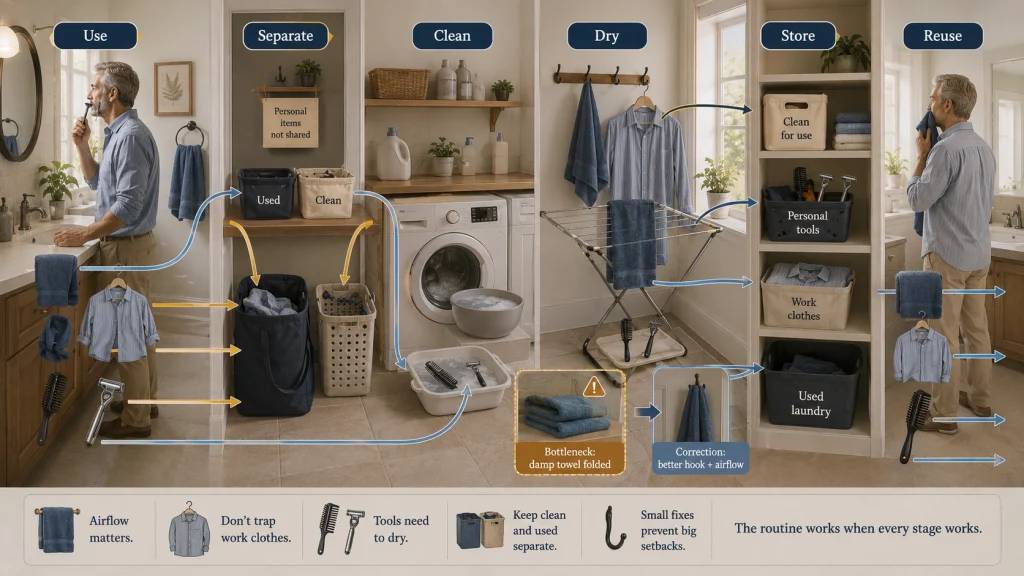
Route 7: Check Clothing, Towels, and Personal Items
Sometimes the body-care steps are clear, but the surrounding items keep reintroducing dampness, residue, odor, or confusion. Towels do not dry fully, washcloths are mixed together, work clothes stay in a bag, or reusable tools are shared without a clear cleaning plan.
Use the clothing, towels, and personal-item hygiene guide for routines involving fabrics, razors, brushes, combs, reusable personal tools, storage, drying, and shared-item boundaries.
Moving a hook, separating clean and used items, labeling personal tools, or creating a drying place may make the routine comfortable and repeatable.
Practical tip: Follow one item from use to its next use. Notice where it is stored, whether it dries, how it is cleaned, and whether another person handles it.
Route 8: Adapt Self-Care to Lifestyle, Ability, and Access
Select this route when the task is known but the situation makes it difficult. Limited mobility, disability, low energy, caregiving, a shared bathroom, travel, shift work, limited water access, privacy concerns, or a major change in daily function may require a different setup rather than more motivation.
The personal hygiene challenges guide focuses on adapting tasks to the person’s real environment, available support, and current capacity.
Rotating shifts may require a portable sequence. Limited standing may require seating, reachable storage, or support. Crowded housing may require a privacy and item-storage plan. These are design problems, not character flaws.
Safety warning: Difficulty maintaining essential hygiene because of a new disability, major functional change, severe distress, unsafe access, abuse, neglect, or inability to meet basic needs belongs in qualified support. Immediate danger requires prompt help.
Separate Necessary Hygiene From Optional Grooming and Treatment
Marketing and social expectations can make every step look equally necessary. A three-column check helps keep the routine proportionate.
| Category | Examples | Decision rule |
|---|---|---|
| Ordinary hygiene | Washing a body area as needed, oral care, changing soiled clothing, drying reusable items, and maintaining basic supplies. | Keep the task clear, accessible, comfortable, and repeatable. |
| Optional grooming | Styling, shaving for appearance, fragrance, cosmetic finishing, or extra presentation steps. | Choose according to preference, comfort, culture, time, and budget. |
| Professional treatment or evaluation | Persistent pain, swelling, bleeding, drainage, fever-associated changes, unexplained odor changes, severe irritation, or loss of function. | Stop routine experimentation and seek appropriate qualified guidance. |
A step can change categories by situation. Ask what job it serves and whether it adds irritation, cost, or maintenance burden.
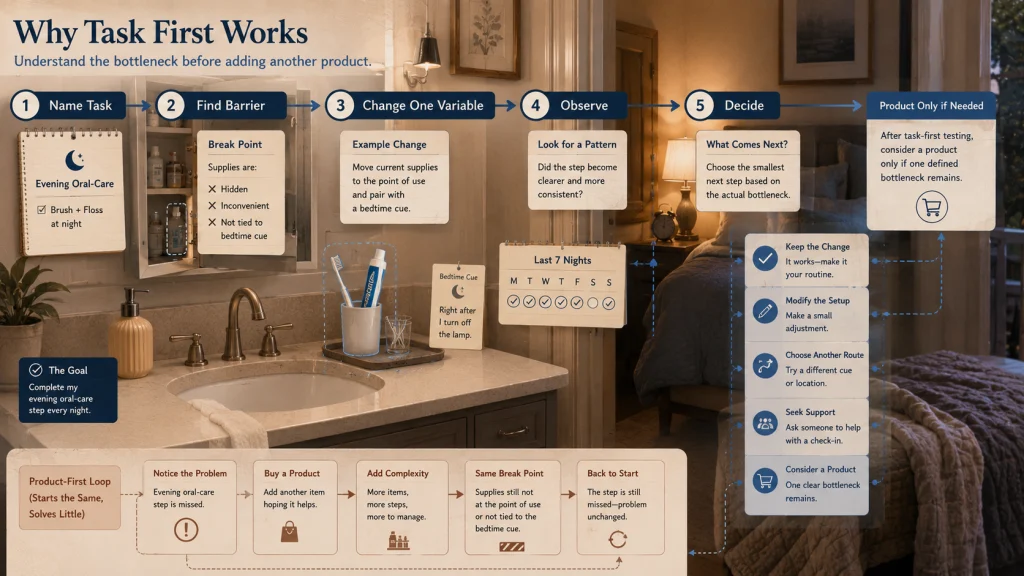
Build One No-Purchase First Action
Before buying anything, test whether the bottleneck can be changed with placement, timing, sequence, drying, or a simpler cue. This creates useful feedback without adding another object to manage.
- Name one task. Use a specific phrase such as “put on clean socks after work” or “complete the evening oral-care step.”
- Find the break point. Is the supply missing, hard to reach, uncomfortable, easy to forget, or difficult to use in the available space?
- Change one variable. Move the item, pair the task with an existing cue, shorten the sequence, create a drying place, or prepare supplies earlier.
- Observe the result. Did the task become easier and more consistent? Did discomfort, mess, time pressure, or access remain?
- Decide what comes next. Keep the change, modify it, choose a different route, or seek support when the barrier is not a routine problem.
For example, buying another cleanser will not solve a towel-storage problem. A new organizer will not help if the routine is scheduled at a time when the person has no energy or privacy.
More Washing Can Be the Wrong Response
When a person notices odor, irritation, residue, or discomfort, washing more may feel like the safest answer. Sometimes the useful change is elsewhere: complete drying, clean clothing, a less crowded routine, a tool that is easier to clean, or professional evaluation for a persistent symptom.
Increasing washing can add friction, hide the original cause, and reinforce the idea that every natural variation must be removed.
Key decision: If the ordinary routine is already being completed and the problem is new, severe, persistent, worsening, unexplained, painful, or limiting normal function, stop adding cleansing steps and seek appropriate guidance.
This boundary is especially important for the mouth, scalp, skin folds, feet, genital area, wounds, and any area with swelling, bleeding, drainage, fever, or sudden change.
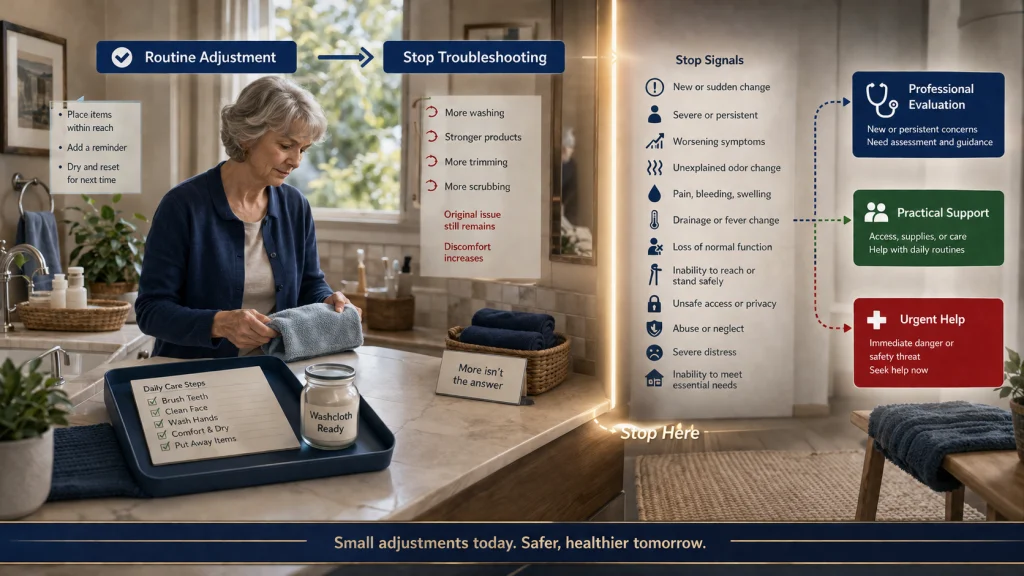
Know When the Problem Is No Longer a Hygiene Task
Ordinary routines can address ordinary care. They cannot diagnose or treat a health condition, explain a sudden change, restore lost function, or make an unsafe situation safe.
Safety warning: New, severe, persistent, worsening, unexplained, painful, bleeding, swollen, draining, fever-associated, or function-limiting symptoms require appropriate professional evaluation. Urgent symptoms or immediate safety concerns require prompt care.
Stop self-guided routine changes when more washing, stronger products, repeated trimming, or more frequent cleaning is making the area more uncomfortable. Also stop when the person cannot safely reach, stand, transfer, use a tool, access clean water, maintain privacy, or meet essential needs.
Embarrassment does not identify the cause. The right response may involve dental or medical care, accessibility support, caregiving help, safer access, or another qualified service that addresses the actual barrier.
Choose One Task and One Workable Next Step
Begin by naming the task that is unclear, uncomfortable, repeatedly missed, or creating a practical problem. Match it to the route that owns that decision, then take one low-risk action that does not require buying anything.
Keep the change when it improves access, comfort, clarity, or consistency. Modify it when the routine still creates friction. Change routes when the first diagnosis of the problem was wrong, and seek appropriate support when symptoms, safety, access, or function move beyond ordinary personal care.
Explore the Personal Hygiene Guides
| Guide | What the detailed guide develops |
|---|---|
| Personal hygiene basics | A small, repeatable system for deciding tasks, cues, frequency, and replacement needs. |
| Bathing and body odor | A complete external-body workflow shaped by activity, comfort, drying, and clothing. |
| Oral hygiene | A workable mouth-care sequence with clear dental stop conditions. |
| Hand, nail, and foot hygiene | Separate workflows for areas that have different access, moisture, tool, and footwear needs. |
| Hair, scalp, and grooming hygiene | A boundary between scalp care, reusable-tool maintenance, shaving, and presentation choices. |
| Intimate and menstrual hygiene | Respectful routines shaped by comfort, privacy, access, supplies, and symptom boundaries. |
| Clothing and personal-item hygiene | The full path from use to cleaning, drying, storage, sharing, and safe reuse. |
| Personal hygiene challenges | Adaptations for capacity, environment, support, privacy, access, and changing daily conditions. |
FAQs
🧭 Where should I start if my whole hygiene routine feels disorganized?
Choose one task that is repeatedly missed or unclear. Identify whether the barrier is timing, access, supplies, comfort, privacy, or energy, then change only that part before adding new steps.
🧼 Does good personal hygiene require showering every day?
There is no single bathing schedule that fits every adult and every situation. Activity, climate, work, skin comfort, access, and the body areas that need attention all affect what is practical.
🪥 Is oral care part of personal hygiene or a separate health issue?
Routine mouth and tooth care is part of personal hygiene, but persistent pain, swelling, bleeding, sores, drainage, or functional changes belong in dental or medical care. A routine can support ordinary care without replacing evaluation.
🧴 Do I need special products to improve personal cleanliness?
Often the first improvement comes from placement, timing, drying, clean clothing, accessible supplies, or a shorter sequence. Consider a product only after identifying a specific task it would make easier, safer, or more comfortable.
✂️ Is grooming the same as hygiene?
No. Hygiene focuses on ordinary care of the body and personal items, while grooming often includes optional appearance and styling choices. A grooming step may matter personally or professionally without becoming a universal health requirement.
🩸 When should an intimate or menstrual-care concern be evaluated?
Seek appropriate guidance for new, severe, persistent, worsening, painful, bleeding, swollen, fever-associated, urinary, or unexplained symptoms. Do not respond by adding fragrance, harsh cleansing, or repeated washing.
🧺 Can towels and clothing be the real hygiene problem?
Yes. Damp towels, reused work clothes, mixed personal tools, or items that never dry can undermine an otherwise clear routine. Follow one item from use through cleaning, drying, storage, and reuse to find the break point.
♿ What if disability, fatigue, or limited access makes hygiene difficult?
Adapt the task to current reach, balance, energy, privacy, facilities, and available support. A major functional change, unsafe setup, neglect, abuse, or inability to meet essential needs requires qualified practical or professional help.