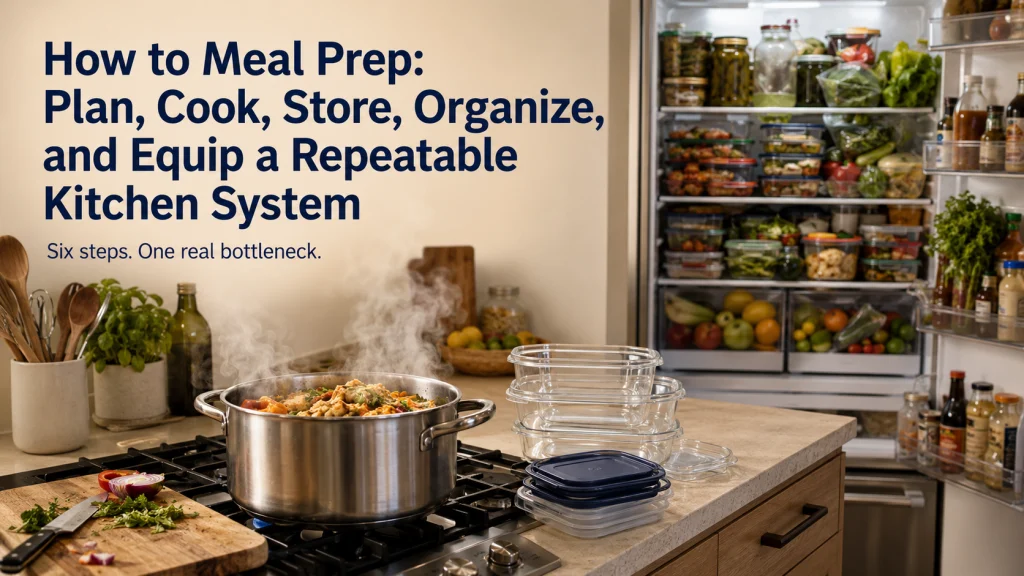
Meal prep works best when you identify the failing part of the routine before changing everything at once. The bottleneck may be planning, shopping, ingredient format, cooking, storage, workflow, equipment, or household fit. Start with one problem, make one safe change, and review it after an ordinary week. A useful system makes home meals easier without becoming a rigid diet plan or a Sunday production line.
Six Kitchens Can Have Six Different Meal Prep Problems
Six households can all say that meal prep is not working while needing completely different solutions. One household reaches late afternoon with no plan. Another buys ingredients in quantities or formats that do not match the meals it actually cooks. A third prepares too much food at once and gets tired of it before it is used. A fourth cooks successfully but has no safe, orderly place to cool and store the result. A fifth loses time clearing counters, finding tools, and cleaning between tasks. A sixth buys new equipment, then discovers that the missing ingredient, crowded refrigerator, or unpredictable schedule is still the real obstacle.
| What keeps happening | Likely bottleneck | First question |
|---|---|---|
| Meals are decided too late | Planning | Which days actually need a planned meal? |
| Food runs out or goes unused | Shopping and ingredient choice | Did the list match quantities, formats, and meals at home? |
| Cooking takes too many separate sessions | Cooking method | Could one repeated component be prepared once? |
| Prepared food is hard to cool, identify, or use | Storage | Is there enough safe refrigerator or freezer space? |
| Setup and cleanup take longer than cooking | Workflow and organization | Which repeated movement or search creates delay? |
| A new tool saves little or no time | Function mismatch | What exact task was the tool supposed to remove? |
Retail shelves separate planners, containers, knives, organizers, and appliances into neat categories. At home, they meet in one evening: a meal stalls because an ingredient is missing, its format adds work, the counter is covered, or cooked food has nowhere safe to cool. A faster appliance may leave that chain unchanged. Find where it breaks first.
Know Which Meal Prep Method You Are Actually Using
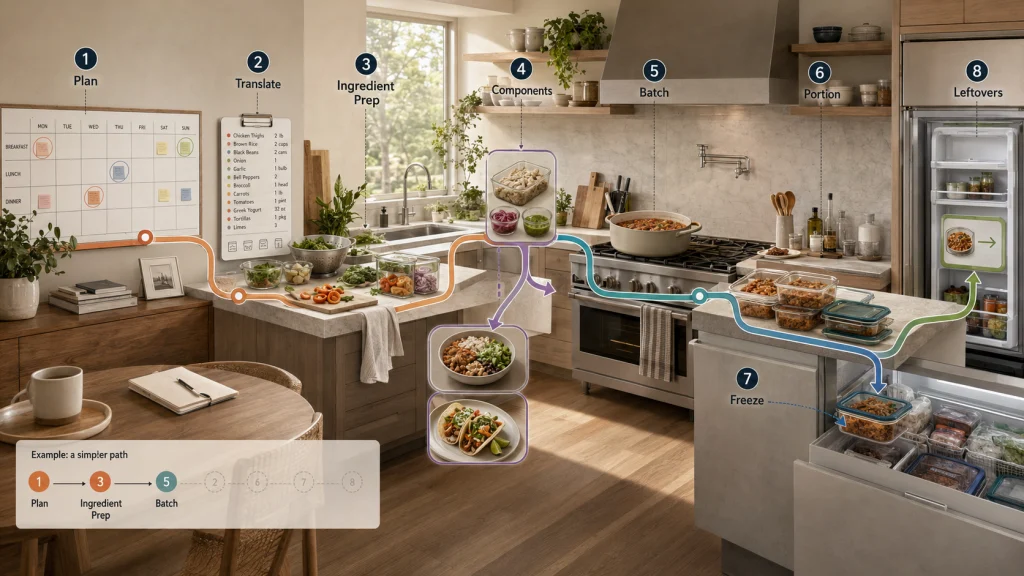
“Meal prep” is often used as a single label for several different activities. Separating the terms makes it easier to choose a method without taking on work you do not need.
| Method | What it means | What it solves |
|---|---|---|
| Meal planning | Choosing which meals or meal types will be needed during a defined period | Late decisions, conflicting schedules, and unclear shopping needs |
| Grocery translation | Turning the plan into exact ingredients, quantities, package formats, and purchase timing | Missing items, excess quantities, and preparation that was not anticipated |
| Ingredient prep | Washing, trimming, measuring, or otherwise preparing ingredients for later use | Repeated setup during the week |
| Component prep | Preparing flexible parts that can be combined in more than one meal | Limited time without committing to identical finished meals |
| Batch cooking | Cooking a larger amount of one dish or component in one session | Repeated cooking of the same item |
| Portioning | Dividing prepared food into practical amounts for storage or serving | Unclear use, awkward containers, and repeated handling |
| Freezing | Moving suitable food into longer-term cold storage | Short refrigerator windows and irregular future schedules |
| Leftover planning | Deciding in advance how extra cooked food will be identified and used | Forgotten food and unnecessary second cooking sessions |
A household may use only two or three methods. Planning dinners does not require cooking them in advance, and preparing one flexible component is not the same as portioning finished meals. Choose the smallest method that addresses the repeated problem.
Identify the Dominant Bottleneck Before Choosing a Method
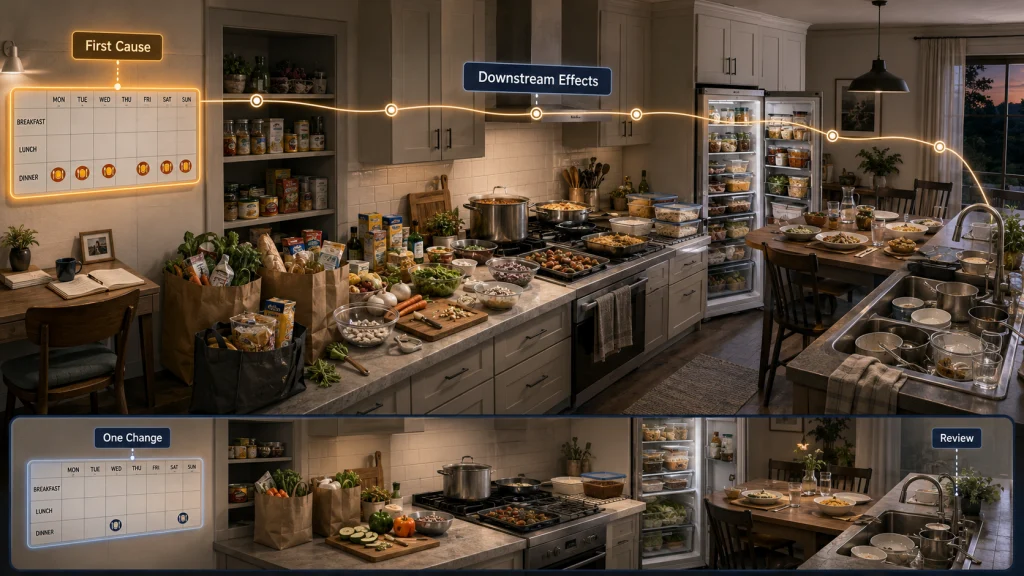
The dominant bottleneck is the point that causes the most repeated delay, waste, confusion, or unsafe handling. It is not necessarily the most annoying moment. A cluttered drawer may be irritating, but it is not the first problem to solve when the household repeatedly buys food for five home dinners and then eats only two at home.
Key decision: Choose the bottleneck that appears most often and affects the next steps in the routine. Work on that one before changing planning, cooking, storage, organization, and equipment together.
- Describe the failure as an event. Use “we had no plan on Wednesday” instead of “we are bad at meal prep.”
- Locate it in the sequence. Did it begin during planning, inventory, shopping, preparation, cooking, cooling, storage, serving, or cleanup?
- Check what happened next. A missing item may trigger an extra trip, a substitution, takeout, or an abandoned recipe. The consequence shows how much the bottleneck matters.
- Choose one low-friction change. Test a smaller list, one prepared component, a cleared work zone, or a defined storage space before rebuilding the whole routine.
- Review after a week. Keep the change only when it reduces the original problem without creating a larger one elsewhere.
Related bottlenecks often form a chain. Poor planning can cause a rushed purchase, added preparation, late cooking, and disorganized cooling. Start with the first repeatable cause rather than treating every later symptom.
Start With Weekly Planning When Decisions Happen Too Late
When “What are we eating?” arrives with hunger, fatigue, or a crowded evening, the kitchen is reacting rather than preparing. That pattern points to planning. The answer need not assign a recipe to every day. It can mark the meals needing support, nights needing minimal preparation, food already available, and chances to use leftovers.
Check the refrigerator, freezer, and pantry first, review the coming schedule, estimate which meals will be eaten at home, and then write a short list. Match fresh, frozen, and shelf-stable items to when they are likely to be used.
Practical tip: Plan the difficult days first. A day with a late meeting, commute, caregiving duty, class, or evening activity usually needs a clearer decision than a flexible day at home.
For a step-by-step starting routine, use the guide to meal prep for beginners. It focuses on beginning small rather than filling the week with more commitments than the household can maintain.
Use Batch Cooking or Freezer Prep When Repeated Cooking Is the Bottleneck
The strongest case for cooking ahead is repetition. Preparing more of a recurring component or dish in one session may remove duplicate setup and cleanup. The advantage disappears when preferences change quickly, storage is tight, the food reheats poorly for the household, or the larger session creates an exhausting cleanup burden.
Start by finding one repeatable item rather than multiplying an entire recipe list. A component that supports several meals can preserve flexibility. A finished dish may offer more convenience but commits storage space and future meals to one result. Freezer preparation can extend the usable window, but only when there is a clear labeling, freezing, thawing, and reheating plan.
Note: Cooking twice as much is not automatically efficient. Capacity, cooking time, cooling space, container shape, cleanup, and the likelihood of using the extra food all change the result.
The detailed batch cooking guide helps separate full-dish cooking, component preparation, make-ahead work, and freezer use so the method matches the repeated task.
Focus on Storage When Safety, Space, or Freshness Is the Bottleneck
A meal can be cooked on time and still fail after the burner is off. Food may sit out while shelves are rearranged, disappear into an unlabeled container, or crowd raw and ready-to-eat foods together. Repeated uncertainty about cooling, identification, space, or freshness makes storage the next priority.
Storage decisions begin before cooking. Check refrigerator and freezer space, decide what will be refrigerated or frozen, choose containers that fit both the food and the shelf, and prepare a simple labeling method. Large amounts of hot food may need to be divided into shallower containers so they can cool more promptly. Perishable food should be refrigerated or frozen within two hours, or within one hour when the surrounding temperature is above 90°F. A refrigerator should stay at 40°F or below, and a freezer should stay at 0°F.
Safety warning: Do not rely on smell, appearance, or a quick taste to prove that stored food is safe. When storage time, temperature, contamination, or handling is uncertain, use current official food-safety guidance or discard the food rather than guessing.
Use the meal prep storage guide when container fit, cooling, labeling, refrigerator organization, freezing, thawing, reheating, or freshness is the main unresolved decision.
Change the Workflow When Setup, Counter Space, or Cleanup Is the Bottleneck
Sometimes the lost time is visible before cooking begins. The cutting board has no landing place, the useful knife is buried, and every container lid requires a search. Preparing more food only enlarges the same struggle. Remove the obstacles between the first ingredient and a cleared counter.
Watch the path of the work. Where do groceries land? Is there a clear place to wash produce, prepare ingredients, handle raw foods separately, portion finished food, and set containers before filling them? Which tools are used most often, and are they stored near the task rather than near similar-looking products? A useful layout follows the sequence of work, not the appearance of a retail display.
Editorial observation: Organizers help only when they shorten a repeated action or protect a needed zone. An organizer that takes up counter space, hides frequently used items, or adds another cleaning step can make the routine slower.
The guide to kitchen organization for meal prep is the better next step when the main difficulty is access, movement, counter use, cleanup, or putting the kitchen back into working order.
Evaluate Tools Only After the Function Is Defined
“Save time” is not a specific job. One household may need less chopping, another more cooking capacity, and another less supervision. A tool can perform one function well while doing nothing for cleanup, storage, or the wider workflow. Define the job before judging the equipment.
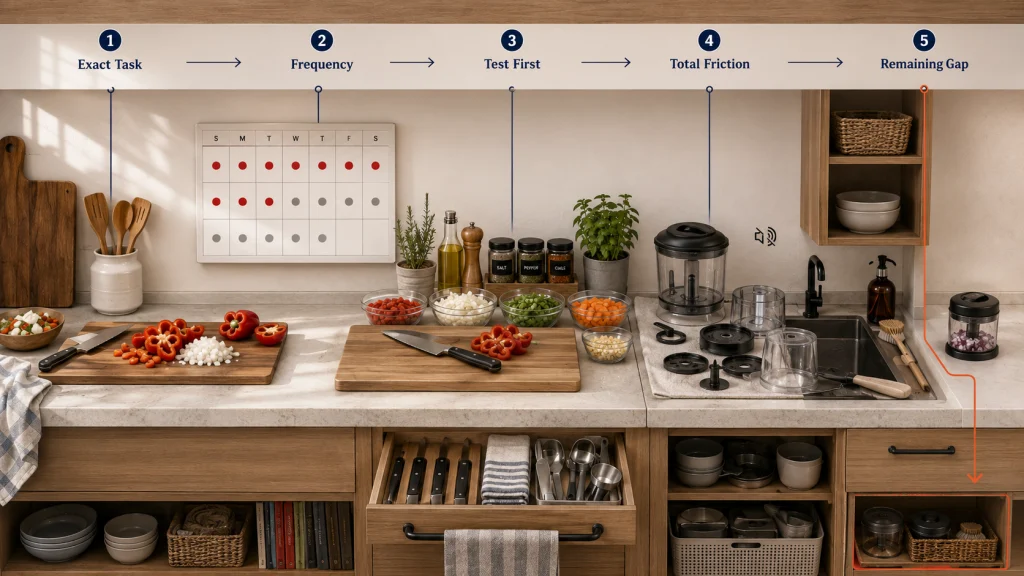
Use a product-last decision ladder:
- Name the exact task. Identify the action that repeats or creates delay.
- Measure how often it matters. A task done once a month may not justify permanent counter or storage space.
- Test the current setup. A sharper workflow, smaller batch, or better placement may solve the problem without another purchase.
- Check total ownership friction. Consider capacity, cleaning, maintenance, noise, storage, compatibility, replacement parts, and return difficulty.
- Buy only for a remaining function gap. The equipment should remove a defined obstacle without creating a larger one.
The real test is whether the routine becomes easier after assembly, cleaning, maintenance, and storage are counted. A tool that removes one step but creates recurring chores has not solved the named problem.
Use the guide to meal prep tools and appliances when the function is clear and the remaining question concerns capacity, fit, care, storage, workflow, or practical ownership.
Adapt the System to the Household After the Core Method Is Clear
A system can look orderly on paper and fall apart at the first late shift, changed pickup time, or evening when people eat separately. Household size, preferences, help, kitchen space, energy, and tolerance for leftovers change what is realistic. Adapt the routine after the basic method is clear, or every constraint can become another untested layer.
A household with changing work shifts may benefit from flexible components rather than meals assigned to exact days. A household in which people eat at different times may need clearer labeling and serving portions. A small kitchen may need shorter preparation sessions instead of one large session. A household that dislikes repeated meals may prepare ingredients or components while leaving final assembly open.
Key decision: Keep the core method stable, then adjust timing, quantity, responsibility, and storage to fit the people who will actually use it.
The broader guide to meal prep systems helps match a known method to household size, schedule patterns, available space, and the amount of structure people will realistically follow.
Fix Shopping and Pantry Decisions When Purchasing Is the Bottleneck
Many meal prep failures are already visible on the receipt. The ingredient may be correct while its quantity, format, preparation state, or timing is wrong for the week. A large package still becomes waste when it cannot be stored or used. A full pantry creates similar false confidence when it lacks the few items needed to make a practical meal.
Translate the plan into purchasing decisions. Check inventory first. Note how many meals are likely to be eaten at home. Write quantities where overbuying is common. Consider whether fresh, frozen, canned, dried, pre-cut, or otherwise prepared formats change the amount of work, storage, cost, and waste. Choose shopping frequency and channel according to how quickly foods are used and how predictable the schedule is.
Practical tip: Treat a larger package as a conditional saving. It saves money only when the household can store it correctly and use it before quality or safety becomes a problem.
The guide to grocery shopping and pantry planning is the right route when inventory, quantities, ingredient format, pantry stock, shopping frequency, delivery, pickup, or store choice is driving the problem.
Apply Clean, Separate, Cook, and Chill to Every Method
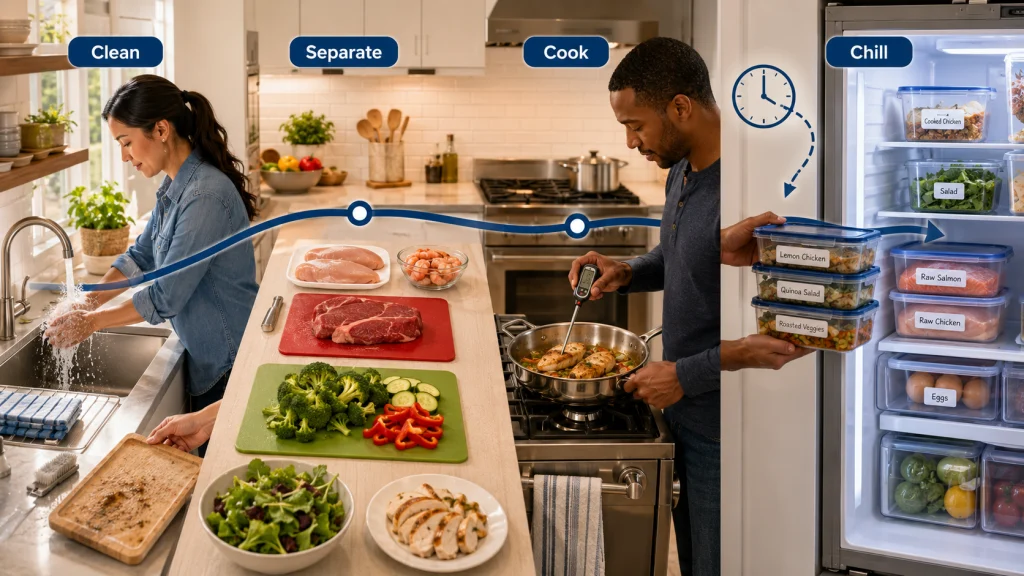
Planning, batch cooking, storage, and kitchen organization change the amount and timing of food handling, but they do not replace basic food-safety practices. The four-part foundation applies whether you prepare one ingredient, one dinner, or several components.
- Clean: Wash hands with soap and water for at least 20 seconds, and clean work surfaces, utensils, and cutting boards between tasks. Here, “clean” describes hygiene, not the moral value of a food.
- Separate: Keep raw meat, poultry, seafood, eggs, and their juices away from ready-to-eat foods during shopping, storage, and preparation. Use clean plates and utensils for cooked food.
- Cook: Use a food thermometer and the current safe internal temperature for the specific food. Color and texture alone are not reliable doneness checks.
- Chill: Refrigerate or freeze perishable food promptly. Use the two-hour limit at ordinary room temperature and the one-hour limit above 90°F. Keep the refrigerator at 40°F or below.
Prepared food may be handled several times. Before starting, decide where raw ingredients will stay, how doneness will be checked, how food will be divided, and where it will cool and be stored.
Safety warning: Older adults, pregnant people, young children, and people with weakened immune systems can face greater risk from foodborne illness and may need stricter professional guidance. Severe, persistent, worsening, or otherwise concerning symptoms after eating require appropriate medical care.

TempPro TP19H is a fast digital food thermometer designed for checking internal temperatures during everyday cooking and meal prep. Its folding probe, rotating display, temperature-lock function, and calibration feature make temperature checks quick and easy to read around pots, pans, and larger dishes. The waterproof body and straightforward controls also make it practical for frequent use in a busy kitchen.
Check On AmazonIf you click this link and buy, we earn a commission at no additional cost to you.
Use a Seven-Day Observation Before Making Large Changes
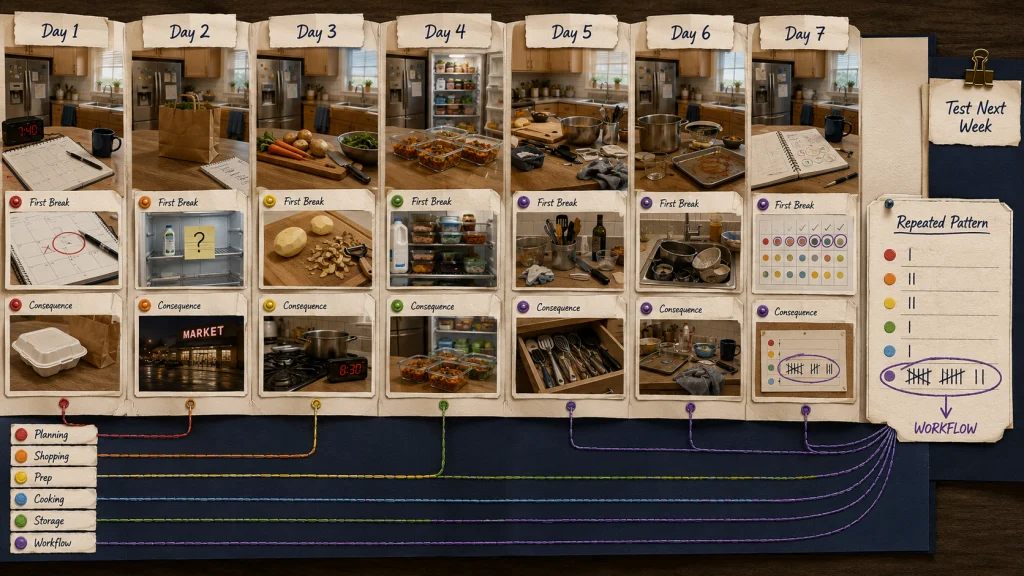
Memory holds onto the dramatic night when dinner collapsed, not the smaller delay that happened repeatedly. A seven-day log makes those quiet patterns visible. Record the first point where preparation became harder than expected, but do not repair every event yet. Find the cause that repeats.
| Day | What was supposed to happen? | Where did it break? | What was the consequence? | Smallest useful change |
|---|---|---|---|---|
| Day 1 | Record the intended meal or preparation task | Planning, inventory, shopping, prep, cooking, storage, serving, or cleanup | Delay, extra purchase, unused food, unsafe handling, or abandoned plan | One change to test later |
| Days 2 to 7 | Repeat using the actual day | Use the same categories | Note the real effect | Do not add a second fix yet |
At the end of the week, count patterns. Repeated late decisions point to planning. Unused purchases point to quantities, formats, or expected meals at home. Successful cooking followed by exhausting cleanup points to workflow. Choose one change and review it after another ordinary week.
What This Meal Prep Guidance Does Not Cover
This guidance is for generally healthy US adults who want to make home meal preparation easier to manage. It does not prescribe calorie targets, macronutrient targets, portion sizes for weight change, therapeutic diets, disease-specific nutrition, eating-disorder strategies, medication-related meal timing, pregnancy nutrition, infant feeding, child feeding, or individualized nutrition plans.
Food allergies, celiac disease, severe intolerances, swallowing difficulties, and other medically significant restrictions require individualized guidance. A general kitchen workflow cannot replace support that addresses contamination risk and personal needs.
Note: Meal preparation does not require cooking every meal at home, preparing identical containers, or following one universal weekly schedule. A workable system may include leftovers, simple assembled meals, frozen options, purchased prepared components, dining away from home, or days with no advance preparation.
Choose One Bottleneck, One Change, and One Review Date
Write the first repeated breakdown in one plain sentence, then choose the guide that owns it. Make one change small enough to survive a normal week, not only an organized Sunday. Keep food safety beside planning, cooking, cooling, and storage.
Set a review date. Keep the adjustment when the problem happens less often without adding waste, cleanup, storage pressure, or schedule friction. When the week is no easier, return to the log and test the next cause instead of adding equipment or more advance cooking.
Choose the Guide That Matches the First Breakdown
Use the first repeated failure, not the most popular meal prep method, to choose where to go next.
| Start here when | Next guide | Main decision |
|---|---|---|
| You need a small first routine | Starting meal prep without overbuilding it | How to plan and begin with manageable steps |
| Repeated cooking is the main burden | Choosing a batch cooking method | What to prepare ahead and in what form |
| Cooling, storage, freezing, or freshness is unclear | Storing prepared food safely and practically | How food, containers, space, and timing fit together |
| Setup, access, counter use, or cleanup causes delay | Organizing the kitchen around the workflow | How to reduce repeated movement and friction |
| A defined task may require different equipment | Evaluating tools by function and fit | Whether a tool solves the named task |
| The method must fit a particular household or schedule | Adapting a repeatable household system | How timing, people, space, and flexibility change the routine |
| Shopping, quantities, formats, or pantry stock cause the problem | Connecting groceries and pantry stock to the plan | How purchasing decisions support actual meals |
Choose one row and stay with that decision until you can tell whether the change worked. The other guides remain available when a second bottleneck becomes visible.
FAQs
🧭 How do I start meal prepping without doing a full week?
Choose one difficult meal period or one repeated task. Plan only that part, such as two workday lunches, one prepared component, or one dinner with planned leftovers. Expand after the small version works during a normal week.
🛒 Should I plan meals before checking the pantry?
Check the refrigerator, freezer, and pantry first. Existing food can shape the plan, reduce duplicate purchases, and show which ingredients need to be used soon. Then translate the selected meals into quantities and formats for the shopping list.
🍲 Is batch cooking necessary for meal prep?
No. Meal planning, ingredient preparation, component preparation, and leftover planning can all reduce work without cooking large amounts. Batch cooking is useful only when repeated cooking is the real bottleneck and the extra food can be stored and used safely.
🧊 How much refrigerator space should I clear first?
Clear enough space for the food you actually plan to prepare, including room for safe separation and prompt cooling. Check container dimensions against shelf height and depth before cooking. When space is limited, reduce the batch rather than crowding the refrigerator.
🔧 When is a new kitchen tool worth considering?
Consider it after you can name the exact repeated task and confirm that workflow changes do not solve it. Compare the time or effort saved with cleaning, maintenance, noise, storage, capacity, compatibility, and return friction. A tool that removes one task but adds several others may not improve the system.
📅 What should I do when every week is different?
Plan by meal type or flexibility instead of assigning every dish to an exact day. Keep a few adaptable components or backup options, then decide closer to the meal when the schedule becomes clearer. Review which days repeatedly need support and focus preparation there.
🚩 When should I stop using prepared food?
Stop when safe time, temperature, separation, or handling is uncertain, or when the food shows signs of spoilage. Do not taste food to test its safety. Use current official storage guidance for the specific food, and discard it when you cannot verify that it was handled safely.