Maintaining mobility as you age begins with identifying the ordinary movement that is becoming harder, not choosing a long exercise list. Difficulty rising from a chair, feeling unsteady while turning, stopping early on a familiar walk, and avoiding activity because of fear point to different starting routes. Choose one movement problem, connect it to one observable daily task, and test one manageable change rather than trying to improve strength, balance, walking, and confidence at the same time. Sudden decline, a fall, fainting, chest pain, severe breathlessness, new weakness, or another unexplained change requires qualified evaluation instead of self-directed activity.

Four ordinary tasks can reveal four different mobility problems
One person has to push hard through both hands to rise from a low chair. Another walks comfortably on a straight indoor path but feels uncertain when turning on an uneven sidewalk. A third can walk well but struggles to carry a grocery bag from the car. A fourth starts a familiar route confidently, then has to stop halfway because continuing feels increasingly difficult.
All four situations may be described as a mobility problem, but they do not call for the same first step. Chair rise may point to a specific transfer task. Uneven turning may make steadiness and controlled weight shift the first question. Carrying groceries may expose a broader functional-strength need. Stopping halfway may be more about duration and recovery than basic walking skill.
Before choosing an exercise, identify which movement is limiting the day. That distinction keeps a broad goal such as staying mobile from turning into an unfocused plan that is difficult to follow or evaluate.
Define mobility by what daily life asks you to do
Mobility is the ability to move through ordinary life with enough control, capacity, and confidence for the tasks that matter to you. It can include rising, standing, walking, turning, stepping over a threshold, carrying an object, using stairs, changing direction, and recovering after activity.
Mobility is not the same as joint flexibility, workout performance, or completing a standard routine. A person may have flexible joints but still hesitate on stairs. Another may complete seated movements comfortably but have limited walking endurance. Someone else may be physically capable of a route but avoid it because fear has narrowed where they feel safe going.
Key decision: Name the daily movement that has changed before deciding whether the first route is functional strength, balance, chair-based access, chair rise, walking skill, walking endurance, adaptable activity, or confidence.
Run a five-minute pattern check across the day
This is not a scored test and should not be used to diagnose a condition or calculate fall risk. It is a brief review of where effort, support, recovery, or hesitation appears in ordinary movement.
| Movement area | Question to notice | What to record |
|---|---|---|
| Rising | Which chairs require extra pushing, rocking, or repeated attempts? | Chair type, hand support, and how the movement feels. |
| Standing | Does standing become difficult because of discomfort, fatigue, uncertainty, or another reason? | Where it happens and what makes you sit down. |
| Walking | Is the difficulty starting, continuing, changing pace, or handling the route? | Location, surface, pace, and the point where the problem appears. |
| Turning | Do quick turns, narrow spaces, or uneven surfaces change confidence? | The direction, surface, and support used. |
| Carrying | Does holding an object change posture, pace, balance, or distance? | Object, distance, and whether both hands are needed. |
| Stairs | Is the main issue stepping, strength, breathlessness, confidence, or recovery? | Direction, use of the rail, and where you pause. |
| Recovery | How long does an ordinary activity affect the rest of the day? | What you stop doing afterward and why. |
| Confidence | Which activities are being delayed, shortened, or avoided? | The task you would do if you felt more secure. |
Look for the clearest repeated pattern rather than the longest list of difficulties. A single task that affects meals, errands, social plans, or access to part of the home may deserve attention before a less disruptive limitation.
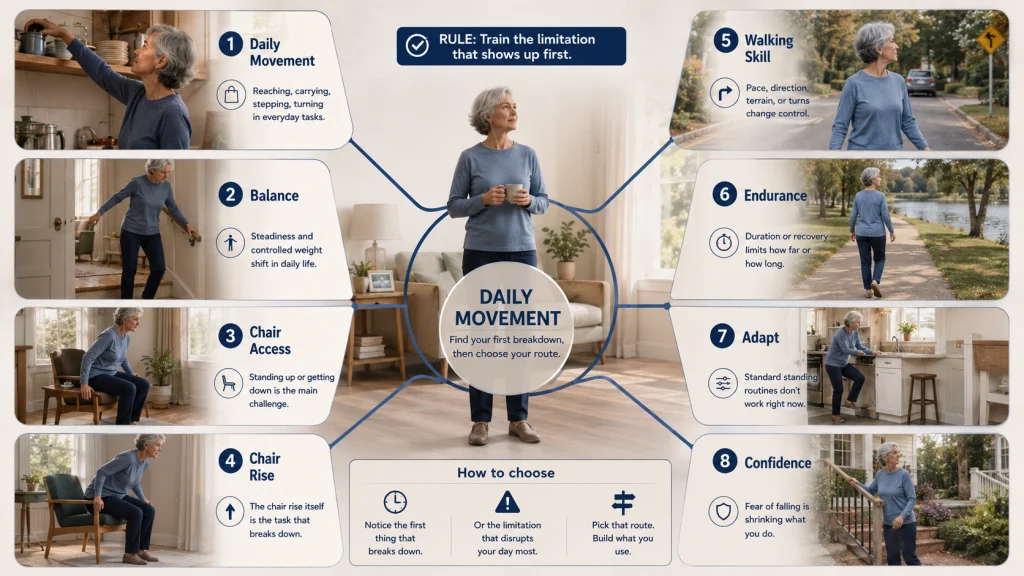
Map the movement problem to one of eight routes
The route depends on what breaks down first. Use this map to name the pattern before moving to the detailed task table later in the article.
| Route | First clue |
|---|---|
| Functional movement | Several reaching, carrying, stepping, or turning tasks feel harder. |
| Balance practice | Steadiness or controlled weight shift is the main problem. |
| Chair-based movement | Standing tolerance or floor access blocks the starting position. |
| Sit-to-stand practice | Rising from a chair is the exact limiting task. |
| Walking skill | Pace, direction, terrain, or turns change walking control. |
| Walking endurance | Duration, repeated stops, or recovery limits the route. |
| Adaptable activity | A standard standing routine is not accessible. |
| Fear-related avoidance | Concern about falling is shrinking participation. |
More than one route may apply, but the first test should follow the limitation that appears earliest or disrupts the day most.
Choose functional movement when several daily patterns are affected
Choose this direction when the difficulty is broader than one chair, one route, or one balance moment. Reaching into a cupboard, carrying laundry, stepping around an obstacle, turning with an object, and moving between rooms may all feel more demanding than before.
The starting task should be specific enough to observe. Instead of choosing “get stronger,” choose an ordinary pattern such as carrying a light household item between two stable surfaces or stepping around a familiar obstacle with appropriate support nearby. The goal is to understand which daily pattern deserves a focused plan.
The functional movement guide for older adults is the next step when several of these daily patterns are involved.
Choose balance practice when steadiness is the main limitation
Steadiness deserves priority when standing position, weight shift, turning, or changing direction creates the clearest difficulty. It may show up while reaching, stepping around furniture, looking to the side, or moving onto a less predictable surface.
Balance work should match the actual situation and available support. It should not begin with a difficult pose chosen only because it looks challenging. A useful starting task may involve noticing how weight shifts during a familiar supported movement and whether the person can stay controlled without rushing.
Continue with the balance practice guide for older adults when controlled position and weight shift are the main questions.
Choose chair-based movement when access is the first barrier
When standing tolerance is limited, floor access is impractical, or uncertainty blocks a standard routine, the starting position may need to change first. Chair-based activity matches the task to current access instead of treating standing as the only valid entry point.
The chair itself matters. It should be stable, placed where the surrounding area is clear, and suitable for the movement being attempted. The purpose is to create a workable entry point without pretending that a seated routine answers every walking, transfer, or balance need.
The chair-based movement guide for older adults develops that seated starting point without pretending it answers every walking or transfer need.
Choose sit-to-stand practice when chair rise is the exact task
Chair rise deserves separate attention when the difficulty is clear and repeatable. A low, soft chair may feel very different from a firm dining chair, while armrests, foot position, seat depth, fatigue, and what happens immediately afterward can all change the movement.
Start by describing the chair and the support already being used. Do not turn chair-rise time, repetition count, or the amount of hand pressure into a diagnosis. The useful question is whether a carefully chosen setup allows a safe, observable practice task without worsening symptoms or creating instability.
Move to the sit-to-stand guide for older adults when chair rise itself is the task to examine.
Choose walking skill when the route changes the movement
Walking skill becomes the first question when one setting feels manageable and another does not. Pace, direction, visibility, obstacles, turns, and surface changes can make a straight indoor hallway feel very different from an uneven outdoor path.
Observe where the route becomes demanding. It may be the first turn, a curb, a crowded area, a sloped section, the need to look around, or the transition from indoors to outdoors. The first task should isolate one route demand rather than combining pace, distance, terrain, and carrying at once.
The walking skill guide for older adults focuses on those route demands rather than simply adding more distance.
Choose walking endurance when duration and recovery are limiting the route
Endurance is the clearer route when walking begins with reasonable control but cannot continue for the desired duration, requires repeated stops, or leaves too little energy for what must happen afterward.
Distance alone does not explain the problem. Pace, terrain, weather, carrying, conversation, available rest points, and what must happen afterward can all change how manageable a route feels. Choose one familiar route or time period and change only one variable so the result is understandable.
Use the walking endurance guide to work with duration and recovery without confusing them with balance or route skill.
Choose adaptable activity when a standard routine is not accessible
Many routines quietly assume prolonged standing, easy floor access, two free hands, a clear path, and quick position changes. Those assumptions can exclude a person before the activity begins.
An adaptable plan starts with the movement and support that are currently available. That may mean seated activity, shorter bouts, a supported position, a smaller range, more recovery, or a different task entirely. Adaptation should increase access without claiming to correct an unexplained limitation.
The adaptable activity guide starts from the movement and support that are available now.
Choose the confidence route when fear is shrinking participation
Fear can narrow daily life even when no fall occurs. A person may stop using part of the home, decline errands, avoid walking with others, rush through a difficult area, or hold onto furniture because losing balance feels too possible.
The first step is not to dismiss the fear or force exposure to a difficult task. Record what is being avoided, what feels unsafe about it, and whether the concern follows a fall, near fall, new symptom, environmental change, or loss of confidence. That context helps separate a practical confidence plan from a situation that needs assessment.
The fear of falling guide is the better route when avoidance, not only physical capacity, is shrinking participation.
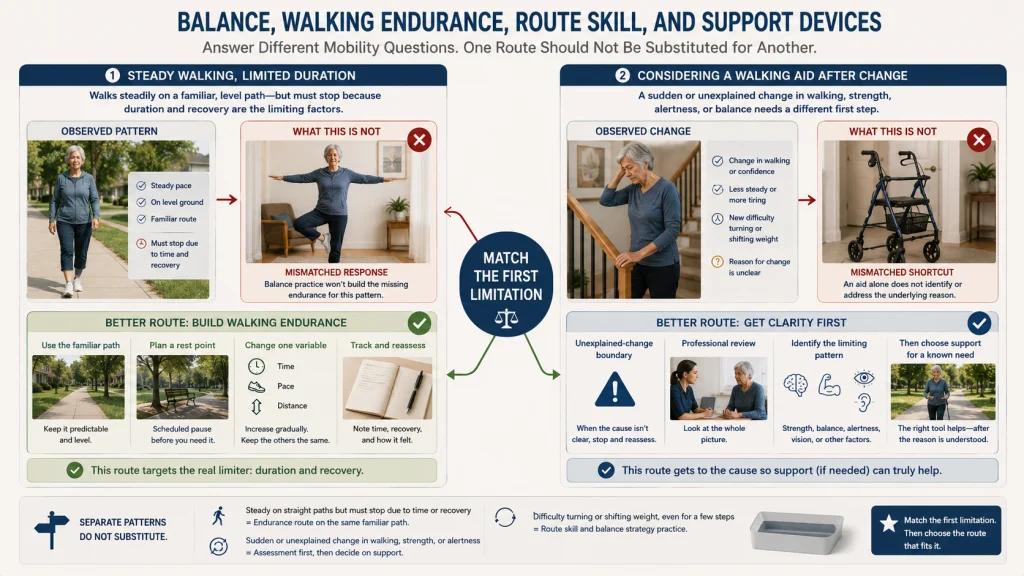
Do not substitute one mobility route for another
Mobility problems can overlap, but the first response should still match the limiting pattern.
Balance practice may be useful for steadiness, but it cannot replace endurance work when continuing the route is the main problem. The reverse is also true. More walking time does not directly answer a turning or controlled-weight-shift problem.
A support device may assist a known mobility need, but fitting or selecting one is outside this guide. It must not be used to bypass review of a new, severe, worsening, or unexplained symptom.
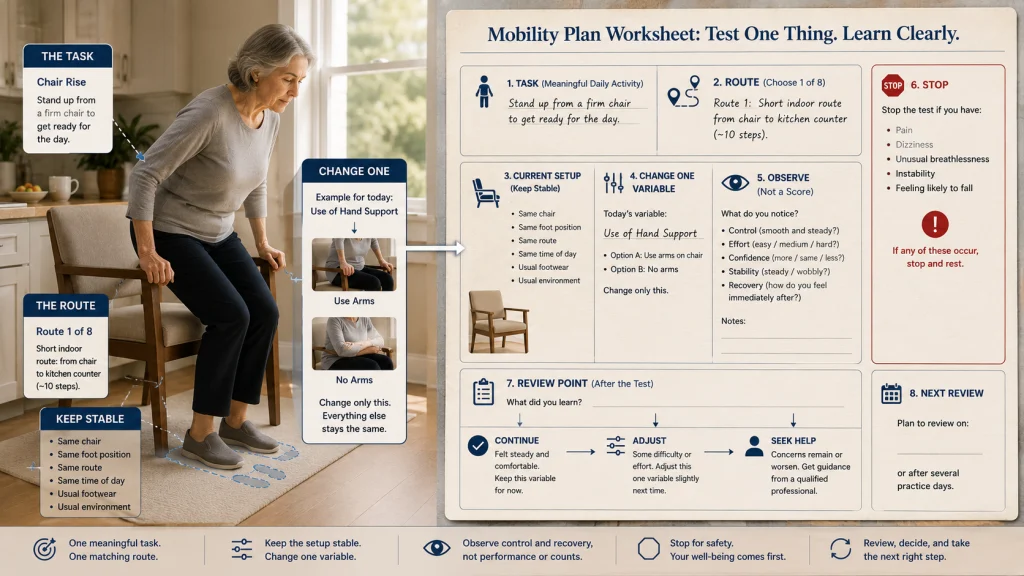
Choose one route and run one observable activity test
Changing several movement domains at once makes it difficult to know what helped, what created fatigue, or what needs a different plan. Use one familiar daily task and one variable that can be observed without turning the task into a performance test.
| Worksheet item | Write your answer |
|---|---|
| Daily task | What exact task is being limited? |
| Chosen route | Which of the eight routes best matches the first limitation? |
| Current setup | Where does the task happen, and what support is already used? |
| One variable | What single element will change, such as chair height, route length, pace, rest timing, or starting position? |
| Observable result | What will you notice about control, confidence, effort, support, or recovery? |
| Stop condition | What symptom, instability, or change means the activity should stop? |
| Review point | When will you decide whether to continue, adjust, or seek help? |
An example might be: “My task is rising from the firm kitchen chair. I will keep the same chair and foot position, change only the use of hand support as appropriate, and notice control, effort, and any instability. I will stop if the movement causes pain, dizziness, unusual breathlessness, or a sense that I may fall.”
Practical tip: Choose a task that matters in the day, not a movement selected only because it is easy to count.
Separate lifestyle activity from individualized rehabilitation
Self-directed lifestyle activity can help a person organize a familiar, non-clinical movement goal when the situation is stable and the task can be approached safely. It does not provide individualized exercise clearance, rehabilitation, diagnosis, mobility-aid fitting, or treatment for a medical condition.
Qualified assessment becomes important when the cause of a change is unclear, when the person has fallen, when ordinary movement is becoming progressively harder, or when symptoms alter safety. A professional may need to evaluate strength, balance, walking, medication effects, vision, neurological signs, cardiovascular symptoms, pain, or other factors that cannot be sorted through a general article.
Editorial observation: Household friction can hide the actual movement issue. A person may describe “trouble in the kitchen” when the limiting task is standing long enough to prepare food, carrying items between surfaces, or turning in a narrow space. Naming the movement makes the next decision clearer without assuming its cause.
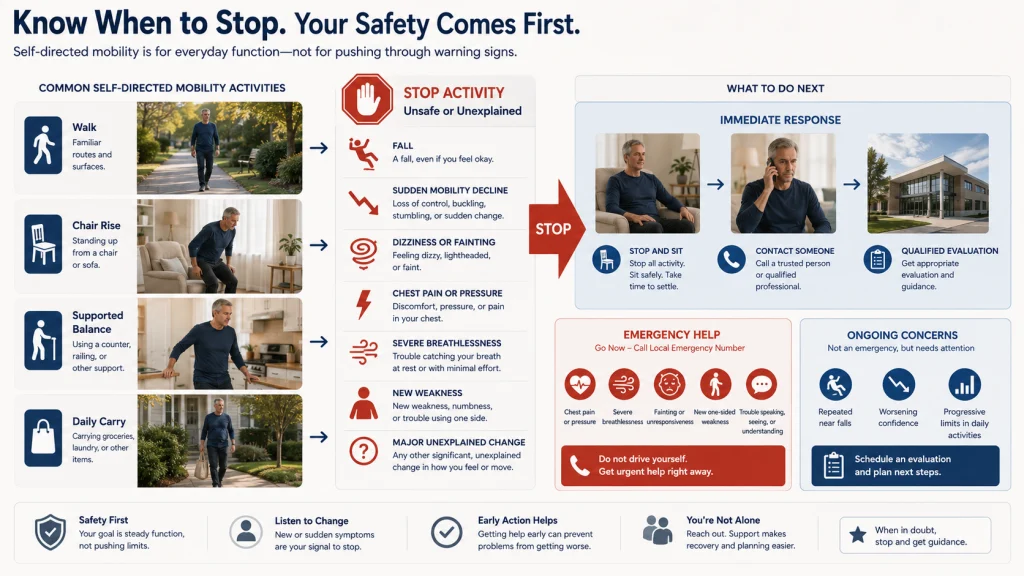
Stop and seek qualified help when the pattern is unsafe or unexplained
Safety warning: Stop self-directed activity and seek qualified evaluation after a fall, sudden mobility decline, dizziness, fainting, chest pain, severe breathlessness, new weakness, or another major unexplained change. Emergency symptoms require immediate appropriate help.
New, severe, persistent, worsening, or function-limiting symptoms should not be treated as a routine motivation problem. Do not continue a walking route, chair task, balance activity, or endurance test when the person feels unsafe, cannot maintain control, or develops concerning symptoms.
Assessment is also appropriate when fear, repeated near falls, or declining confidence is substantially restricting daily life. The purpose is not to label the person. It is to avoid guessing when the cost of a wrong assumption could be high.
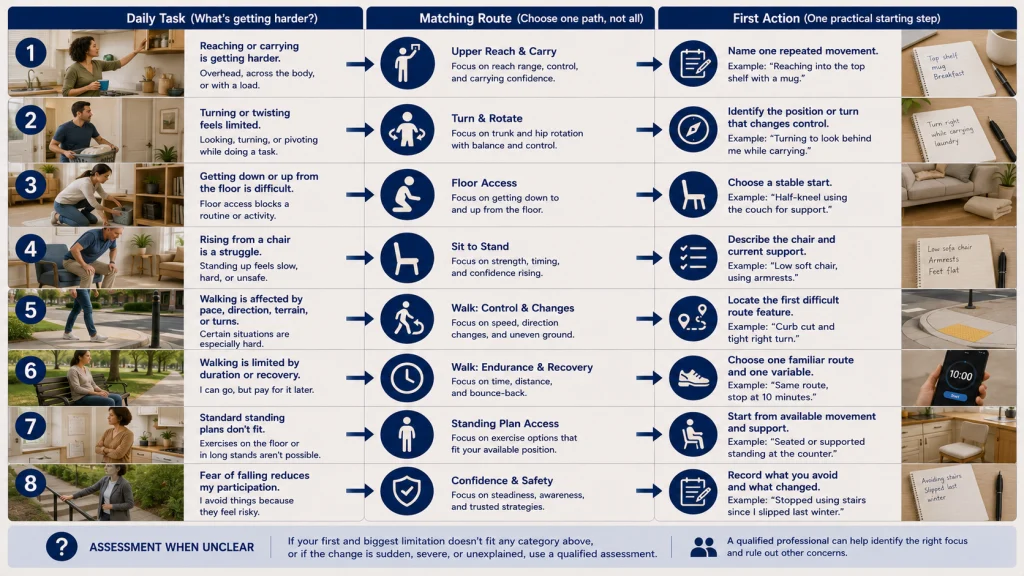
Use the task-to-guide table for the next step
Select the row that matches the first limiting task. If none fits clearly, or if the change is unexplained, use qualified assessment instead of forcing the problem into a category.
| What is limiting the day? | Best next guide | First practical action |
|---|---|---|
| Several reaching, carrying, turning, or stepping tasks feel harder. | Functional movement guide | Name one repeated daily pattern. |
| Steadiness or weight shift is the main limitation. | Balance practice guide | Identify the position or turn that changes control. |
| Standing tolerance or floor access blocks a standard routine. | Chair-based movement guide | Choose a stable seated starting position. |
| Rising from a chair is the specific problem. | Sit-to-stand guide | Describe the chair and support currently used. |
| Pace, direction, terrain, or route demands change walking. | Walking skill guide | Identify the first route feature that creates difficulty. |
| Duration, repeated stops, or recovery limits walking. | Walking endurance guide | Choose one familiar route and one variable. |
| A standard standing plan is not accessible. | Adaptable activity guide | Start from the movement and support currently available. |
| Fear of falling is reducing participation. | Confidence and fear guide | Record what is being avoided and what changed. |
Use one guide first. The purpose of this page is to help you stop treating every mobility concern as the same problem.
Select one movement, one action, and one reassessment condition
Write one sentence that identifies the movement limiting the day. Then choose the matching guide and record the first practical action in a place you will see it. Keep the action small enough to observe and relevant enough to matter.
A complete plan might read: “My first issue is having to stop halfway through the walk to the mailbox. I will use the walking endurance route, keep the same familiar path, change one variable at a time, and stop if I develop instability, chest pain, severe breathlessness, dizziness, or another concerning change.”
Use the broader healthy aging guide when the main challenge may involve another area of independence rather than movement itself. Reassess the route when the task changes, the plan is not helping, confidence continues to shrink, or a new symptom appears.
Explore the next mobility guide
Use this final list only after the task-to-guide table has identified the first route.
| Route | Guide |
|---|---|
| Broader daily movement | Functional exercises for older adults |
| Steadiness | Balance exercises for older adults |
| Seated access | Chair exercises for older adults |
| Chair rise | Sit-to-stand exercise for older adults |
| Walking control | Walking exercises for older adults |
| Walking duration | How to improve walking endurance |
| Adaptable participation | How to stay active with limited mobility |
| Fear-related avoidance | Fear of falling in older adults |
FAQs
🧭 What does maintaining mobility actually mean?
It means preserving the ability to move through ordinary tasks that matter to you, such as rising, walking, turning, carrying, and recovering after activity. It is broader than flexibility and different from improving workout performance.
🪑 Should chair difficulty always lead to sit-to-stand practice?
No. First identify whether the issue is the specific chair rise, general standing tolerance, pain, dizziness, weakness, or another unexplained change. A stable, familiar chair task may fit self-directed practice only when the situation is safe and clear.
⚖️ Are balance exercises enough to improve walking endurance?
Not when duration and recovery are the main constraints. Balance practice and walking endurance answer different questions, even though both can affect mobility.
🚶 How do I know whether walking skill or endurance is the problem?
Walking skill is more likely to be the first route when direction, pace, terrain, turns, or obstacles create difficulty. Endurance is more likely when walking starts reasonably well but duration, repeated stops, or recovery limits the route.
🪜 Can I work on every mobility area at once?
That usually makes the result harder to understand. Choose the movement that affects daily life most, change one variable, and review what happened before adding another goal.
🛋️ Are chair-based movements only for people who cannot stand?
No. A seated starting point may also fit limited standing tolerance, difficult floor access, low confidence, or the need for a more accessible entry point. It should still match the person’s current situation and safety needs.
🧠 What if fear of falling is the main reason I avoid activity?
Record which tasks are being avoided, what feels unsafe, and whether the concern followed a fall, near fall, new symptom, or environmental change. Do not dismiss the fear or force a difficult activity without appropriate support.
🚩 When should I stop self-directed mobility activity?
Stop after a fall or when movement brings sudden decline, dizziness, fainting, chest pain, severe breathlessness, new weakness, instability, or another major unexplained change. Seek qualified evaluation, and get immediate help for emergency symptoms.