Learning how to sleep better starts with identifying which part of your sleep system is not working well enough. The main obstacle may be daily habits, sleep timing, bedroom conditions, bedding comfort, a mismatched consumer product, or a recurring difficulty that needs more than lifestyle troubleshooting. Choose one route and test one change at a time instead of changing your entire routine at once. Persistent, severe, unexplained, or safety-relevant problems should be discussed with a qualified professional.
Three reasonable fixes can miss three different problems
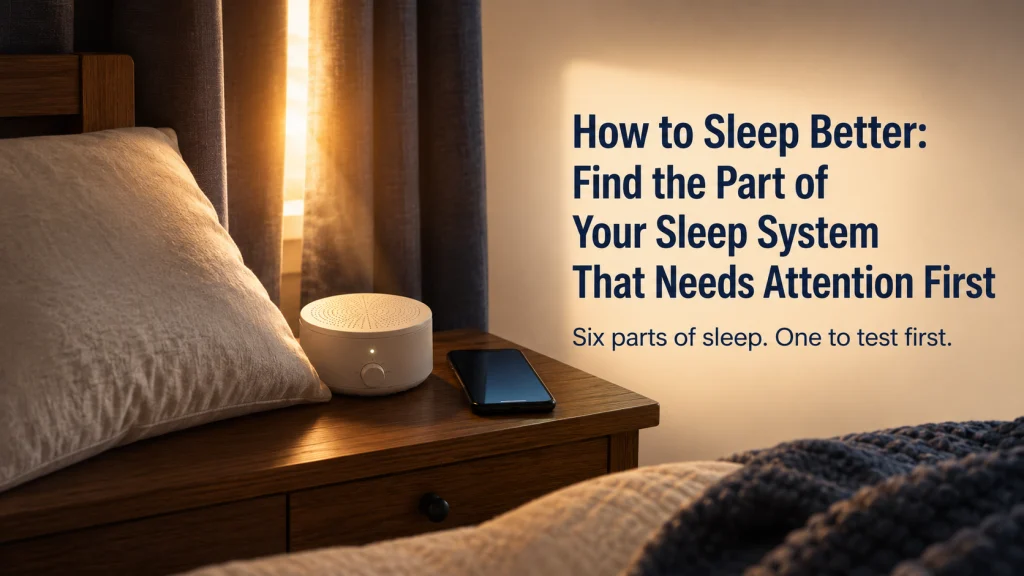
A new pillow sits on the bedside table beside a white-noise machine and a phone set with an earlier bedtime alarm. Each item could be useful. Each could also fail completely when it targets the wrong obstacle.
A pillow cannot correct a bedtime that keeps moving by several hours. An earlier alarm does not block dawn light. White noise may soften an inconsistent sound, but it does not remove heat trapped under heavy bedding. Before changing another product or rule, identify which part of the sleep system is actually breaking down.
Editorial observation: Products displayed beside each other as sleep solutions often address completely different obstacles. A better match begins with the specific problem, such as dawn light, partner noise, trapped heat, or a pillow-height mismatch, rather than the broad goal of sleeping better.
Author note: Nora Calven’s background as a former home and wellness retail buyer informs the product-fit, compatibility, maintenance, and usability discussion in this guide. It does not provide a basis for diagnosis or medical advice.
Stop treating better sleep as one problem
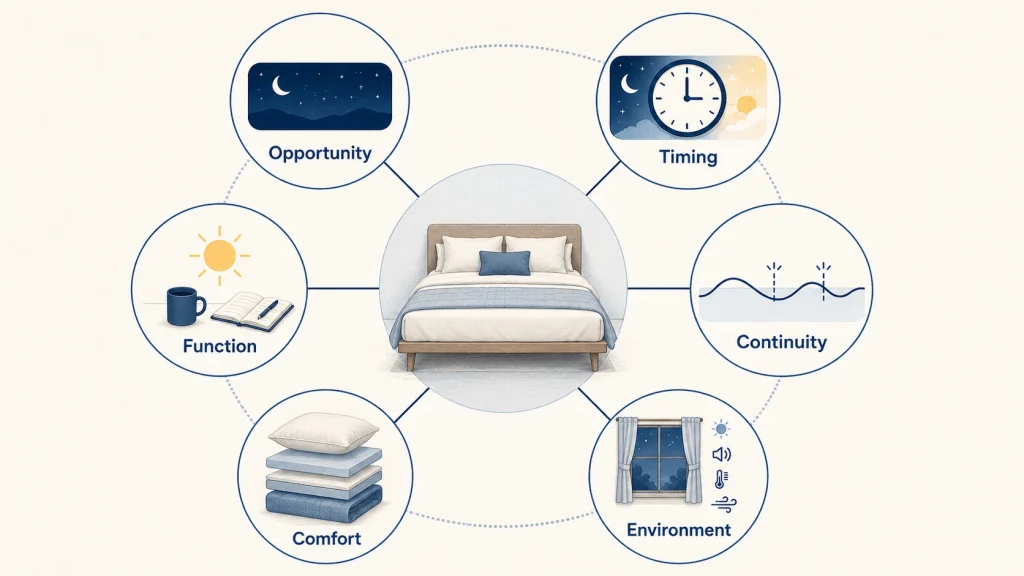
Sleep is not controlled by one switch. Several parts work together, and the same complaint can come from different places. Feeling tired in the morning, for example, may reflect too little sleep opportunity, an inconsistent schedule, repeated awakenings, an uncomfortable room, physical discomfort, or a recurring problem that should not be self-diagnosed.
Six-part sleep-system diagram
| Opportunity Is there enough protected time for sleep? | Timing Do bedtime and wake time line up consistently? | Continuity Is sleep repeatedly interrupted or hard to resume? |
| Environment Do light, noise, temperature, humidity, ventilation, or air conditions interfere? | Physical comfort Do the mattress, pillow, bedding layers, or sleep position create pressure, heat, or instability? | Next-day function Does sleepiness or reduced alertness affect ordinary activities or safety? |
The diagram is a map, not six assignments. If several parts are imperfect, changing all of them at once usually creates more confusion. The useful first question is not, “What is the best sleep routine?” It is, “Which part of my current system gives me the clearest evidence of a problem?”
Key decision: Choose the route that best matches when the problem appears, what seems to trigger it, and what changes it, rather than choosing the most popular sleep advice.
Run a five-minute pattern check
A short pattern check can narrow the starting point without turning your bedroom into a laboratory. Use recent ordinary nights, not only the worst night you remember.
- When does the problem appear? Before sleep, during the night, too early in the morning, or mainly after waking?
- What changes on weekends? A large shift may point toward timing or sleep opportunity rather than a bedroom product.
- What wakes you? Notice light, sound, temperature, bathroom trips, discomfort, another person, a pet, or no clear trigger.
- Does another room change the experience? A different room can reveal whether noise, light, airflow, temperature, or the sleep surface matters.
- Is daytime safety affected? Drowsy driving, unintended dozing, or difficulty staying alert during important tasks changes the priority from routine testing to professional guidance.
Do not force every answer into one category. Pick the pattern with the strongest and most repeatable connection. If you sleep noticeably better in a darker room, environment is a stronger first route than buying a new pillow. If bedtime drifts later on free days and early obligations create short nights, timing and opportunity deserve attention before room upgrades.
Route 1: Daily habits are disrupting the transition to sleep
Some difficult nights begin long before the bedroom. A late coffee, unfinished work, a bright phone screen, a heavy meal, or an evening that never really slows down can carry daytime momentum straight into bed. The frustration often comes from feeling physically tired while the routine around bedtime still keeps the mind and body engaged.
This route fits when the clearest clues appear in what happens before bed or across the day. That may include stimulating phone use that continues longer than intended, alcohol used as a shortcut, intense exercise too close to bedtime for personal comfort, little morning light, or very little daytime movement.
The first comparison should match the strongest clue. Someone who regularly drinks caffeine late in the day needs a different test from someone who goes directly from work messages to bed. If the evening is calm but bedtime shifts by several hours across the week, the timing route is a better starting point.
Practical tip: Use the smallest change that can produce a clear comparison, such as moving one caffeinated drink earlier or setting a consistent stopping point for work messages.
Route 2: Sleep timing keeps moving
The bedroom can be quiet, dark, and comfortable while the week still pulls sleep in different directions. An early alarm on workdays, a much later bedtime on free nights, long naps, travel, or rotating shifts can leave someone chasing sleep at a time that keeps changing.
Look closely at bedtime drift, weekday and weekend differences, naps, work hours, travel, seasonal clock changes, and whether the schedule leaves enough time in bed before the required wake time. These patterns are easy to misread as a need for stronger relaxation products.
A simple weekly review is more revealing than one unusually late night. Compare planned bedtime, actual bedtime, and required wake time across seven days. The gap between them may explain more than the bedding or the room.
Note: This route identifies schedule and regularity as the starting point. It does not diagnose a circadian-rhythm disorder or provide a treatment schedule for one.
A pillow cannot solve schedule drift. A darker room may improve the environment, but it will not create enough sleep opportunity when bedtime is repeatedly delayed. Keep the first test focused on one timing variable rather than changing every evening habit simultaneously.
Route 3: Bedroom conditions are creating interruptions
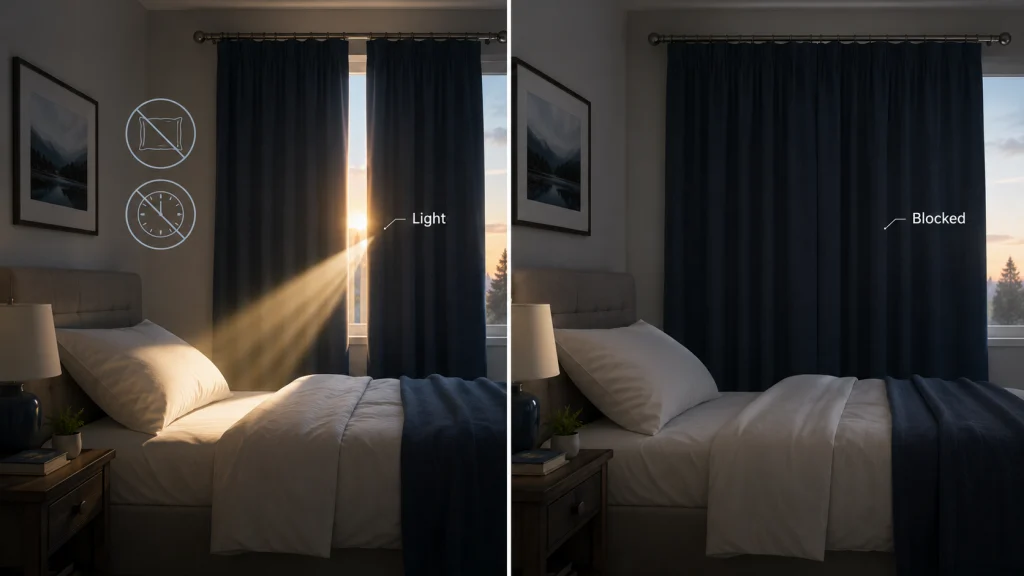
If sleep improves in another room, during a quieter part of the night, or after a change in weather, the room deserves attention. A person may spend hours adjusting bedtime while dawn light, street noise, trapped heat, dry air, or poor airflow keeps producing the same interruption.
Temperature, humidity, light, noise, ventilation, and air conditions affect comfort and continuity in different ways. The question is not whether the bedroom meets an ideal standard. It is whether one condition repeatedly lines up with difficulty falling asleep, waking, or returning to sleep.
Dawn light is a clear example. A schedule change cannot block light entering the room. A new pillow cannot change it either. A useful first comparison may be as simple as using existing curtains more effectively or sleeping in a suitable room that is slightly cooler while leaving bedtime and bedding unchanged.
Use comparison before purchase
When practical, change one environmental condition with what is already available. Move a noisy device, close a door, adjust a fan position, or compare another suitable room. The purpose is not to create a permanent solution in one night. It is to find evidence that the room is the right route.
Safety warning: Do not block required ventilation, disable alarms, create unsafe electrical setups, or use heating or cooling equipment outside its instructions. Stop the test if the room becomes unsafe or uncomfortable.
Route 4: Bedding comfort is the limiting factor
A steady schedule and a quiet room can still end in repeated repositioning, trapped heat, or a morning spent noticing the neck, shoulders, or back. In that situation, the sleep surface and textile layers may be doing more than the clock or the room.
Useful clues include a pillow that leaves the head or neck unsupported, bedding that holds too much heat, layers that shift or bunch, a mattress surface that feels unstable, irritation from unclean textiles, or materials that have changed with wear and age.
Comfort is specific. A pillow can be well made and still be the wrong height for a person’s sleep position, body proportions, mattress firmness, or preference. A warm comforter can feel reassuring in one season and oppressive in another. Materials also flatten, stretch, clump, and become harder to clean over time.
Key decision: Identify whether the issue is support, temperature, texture, hygiene, movement, or age before replacing the entire sleep surface.
Use safe household comparisons before a larger purchase. Remove one top layer to test trapped heat, inspect a pillow if its care instructions allow it, or compare a clean spare pillow of a different loft. Do not stack unstable objects or create a surface that increases fall risk.
Route 5: A consumer sleep product must match the obstacle
The product aisle makes very different problems look interchangeable. A mask, earplugs, an alarm, a humidifier, a weighted blanket, and a cooling system may all be sold near one another, but they act on different parts of the sleep system and create different cleaning, fit, maintenance, compatibility, noise, storage, and return demands.
Start with the obstacle, then ask whether a product can act on it safely and consistently. A mask may address unwanted light but not a late schedule. Earplugs may reduce some sounds but can raise fit, comfort, or awareness concerns. A humidifier changes moisture, not room temperature, and it requires cleaning and appropriate placement. A weighted blanket changes pressure and warmth, not timing or ventilation.
Note: Evidence strength: setting-specific. The usefulness of sound-reducing, humidity-changing, pressure-based, or cooling products depends on the exact obstacle, the room, fit, comfort, maintenance, and the user’s need to hear alarms or household signals. A mixed result should be treated as a product-fit question, not proof that the entire category works or fails.
| Obstacle | Question before buying | First check using what you have |
|---|---|---|
| Light | Is unwanted light the repeatable trigger? | Use existing curtains or compare a darker room. |
| Noise | Is the sound steady, intermittent, or safety-relevant? | Move the source, close a door, or compare another room. |
| Dryness or humidity discomfort | Is room moisture actually the issue, and can the device be cleaned correctly? | Check ventilation, room conditions, and existing moisture sources. |
| Heat | Is heat coming from the room, bedding, or personal comfort needs? | Remove one layer or compare a suitable cooler room. |
| Wake timing | Is the problem waking at the intended time or going to sleep at the intended time? | Review actual sleep opportunity and schedule consistency. |
Use the table to rule out category mismatches. If a simple household comparison does not change the pattern, the product may not be addressing the main obstacle. If a purchase is still reasonable, evaluate the details that determine whether it will be used correctly, including setup, cleaning, fit, replacement parts, ongoing cost, and return friction.
Route 6: A recurring difficulty needs a clearer boundary
Sometimes the pattern refuses to stay in one lane. A person may improve the room, keep a steadier schedule, and still spend many nights waiting for sleep, waking too early, struggling to return to sleep, overheating without a clear room cause, or starting the day feeling unrefreshed.
That uncertainty can be exhausting in its own right. The useful next step is not to keep adding products. It is to organize the pattern: when it occurs, how often it repeats, what seems to change it, and how it affects daytime function.
The purpose of this route is to describe a recurring difficulty, not name a condition. Avoid using consumer devices, online quizzes, odors, or isolated measurements as proof of a diagnosis.
Note: A defined difficulty can still involve habits, timing, environment, or bedding. The difference is that the pattern persists or remains unclear after simple lifestyle checks.
Stop self-troubleshooting when the problem is persistent, severe, worsening, unexplained, or limiting ordinary function. A qualified professional can evaluate factors that a home routine or consumer product cannot safely sort out.
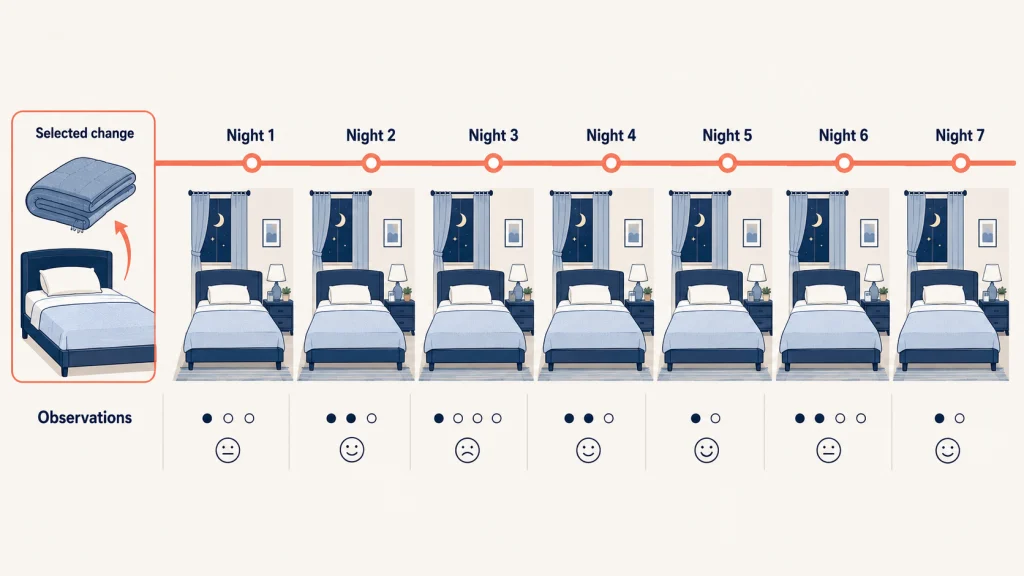
Choose one change, not six
Once you select a route, test one variable for seven nights when the change is safe and practical. Seven nights are long enough to include different workdays or household conditions, while still keeping the test simple. This is not a medical sleep study. It is a household comparison designed to reduce guesswork.
Keep bedtime, wake time, room setup, and other major factors as stable as practical unless one of those is the variable being tested. Record only enough detail to see a pattern.
| Night | Bedtime | Wake time | Awakenings | Daytime function | Single variable changed |
|---|---|---|---|---|---|
| 1 | _____ | _____ | _____ | _____ | _____ |
| 2 | _____ | _____ | _____ | _____ | _____ |
| 3 | _____ | _____ | _____ | _____ | _____ |
| 4 | _____ | _____ | _____ | _____ | _____ |
| 5 | _____ | _____ | _____ | _____ | _____ |
| 6 | _____ | _____ | _____ | _____ | _____ |
| 7 | _____ | _____ | _____ | _____ | _____ |
Use simple descriptions such as “alert,” “sluggish,” or “struggled to stay awake” rather than trying to create a precise score. If the variable is inconsistent, note that instead of pretending the test was clean. A result is useful only when you know what actually changed.
Practical tip: Do not add a second change halfway through because the first two nights were disappointing. Finish the test when it remains safe, or stop for a clear safety, comfort, or worsening concern.
Decide whether to keep, adjust, stop, or escalate
At the end of the test, do not ask only whether sleep was perfect. Ask whether the pattern moved in a useful direction and whether the change was practical enough to continue.
| Result | What it means | Next action |
|---|---|---|
| Keep | The change produced a repeatable improvement and was manageable. | Continue it without adding several new changes immediately. |
| Adjust | The direction was promising, but fit, timing, comfort, or household friction limited it. | Modify one detail and run another focused comparison. |
| Stop | The change did not help, created new problems, or was too difficult to maintain. | Return to the previous setup and choose a better-matched route. |
| Escalate | The problem is persistent, severe, unexplained, worsening, or affecting safety or ordinary function. | Seek qualified professional evaluation rather than extending home experiments. |
An unclear result is not a failure. It may mean the variable was not strong enough, the test was inconsistent, or the wrong route was selected. Change the route before adding more products.

Know when lifestyle troubleshooting should stop
Some patterns should not be handled as a product-selection problem or a longer home experiment.
Safety warning: Breathing pauses, gasping during sleep, dangerous daytime sleepiness, drowsy driving, severe or persistent impairment, or unexplained symptoms require prompt guidance from a qualified professional. Do not drive or perform safety-sensitive tasks when you cannot stay alert.
Also seek professional guidance when a sleep difficulty is new and severe, keeps worsening, repeatedly limits work or daily activities, or continues despite reasonable changes. Consumer sleep products and wearable data cannot rule out a medical cause.
This guide does not diagnose insomnia, sleep apnea, circadian-rhythm disorders, parasomnias, restless legs syndrome, depression, medication effects, or any other condition. It does not recommend supplements, sedatives, or medication changes.
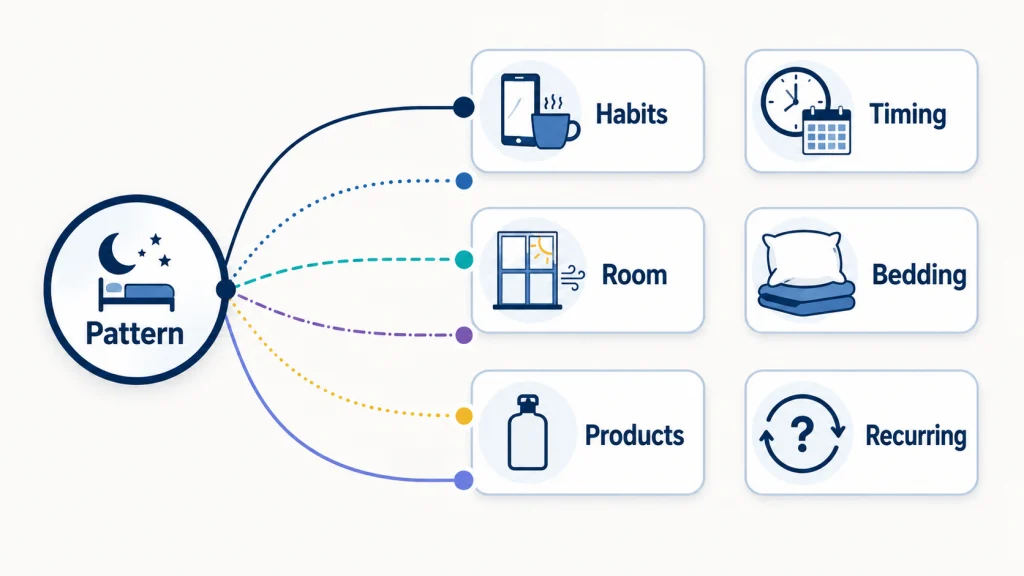
Name the route before changing the routine
Choose the route that best matches your strongest pattern: daily habits, sleep timing, bedroom conditions, bedding comfort, consumer product fit, or a recurring difficulty. Write down one change, the reason for choosing it, and what you will watch for over seven nights.
Do not judge progress by how many sleep tips you follow. Judge the first step by whether it targets the right obstacle, produces a clearer pattern, and remains safe and workable in your household.
Explore the six sleep routes
Use the guide that matches the route you selected. Each one goes deeper into a different decision without requiring you to change everything at once.
| Selected route | Use this guide | What it helps you decide |
|---|---|---|
| Daily habits | Healthy sleep habits | Which daytime or evening behavior deserves the first test |
| Sleep timing | Sleep schedule | How regularity, sleep opportunity, naps, work, or travel affect timing |
| Bedroom conditions | Sleep environment | Whether light, noise, temperature, humidity, ventilation, or air conditions matter |
| Bedding comfort | Bedding for better sleep | Whether support, pillow loft, thermal layers, hygiene, or product age is limiting comfort |
| Consumer product fit | Sleep products | How to match a product category to a defined obstacle and practical household needs |
| Recurring difficulty | Common sleep problems | How to organize a defined pattern and recognize when home troubleshooting should stop |
FAQs
🧭 What should I change first to sleep better?
Change the factor with the clearest connection to your pattern. Start with one route, such as timing, room conditions, or bedding comfort, and test one variable rather than rebuilding your entire routine.
⏰ Should I focus on bedtime or wake time?
Focus on the time that is most inconsistent or most responsible for reducing sleep opportunity. Track both for a week so you can see whether late bedtimes, changing wake times, or weekend shifts are driving the problem.
🌙 How do I know whether my bedroom is the problem?
Look for repeatable changes with light, noise, temperature, humidity, airflow, or another room. A simple comparison is more useful than buying several room products at once.
🛏️ Can a new pillow fix poor sleep?
A pillow may help when height, support, heat, or wear is the real obstacle. It will not correct schedule drift, insufficient sleep opportunity, dawn light, or a recurring difficulty unrelated to pillow fit.
🧪 Why test only one sleep change?
One change makes the result easier to interpret. When several habits, products, and room conditions change together, you may not know which factor helped, failed, or created a new problem.
📅 Is a seven-night test always appropriate?
It is useful for safe, practical household comparisons that remain comfortable. Stop sooner when a change worsens symptoms, creates a safety concern, or becomes clearly unsuitable.
🚗 When should I stop trying home fixes?
Stop when the problem is persistent, severe, worsening, unexplained, limits ordinary function, or affects safety. Breathing pauses, gasping, dangerous daytime sleepiness, or drowsy driving require prompt professional guidance.