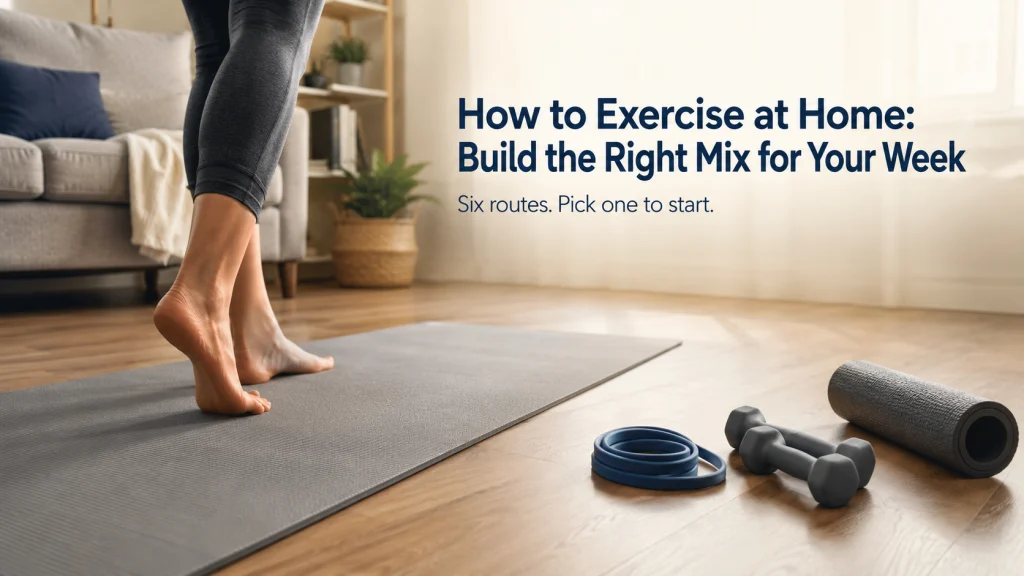
Exercising at home works best when you first decide what movement needs to do in your week. You may need a starting routine, strength work, cardio, lower-impact movement, mobility and recovery, better equipment decisions, or a plan that fits limited space and time. Current federal activity targets provide a useful direction, but they do not have to become a day-one quota. Start with one route, remove one practical obstacle, and build from an amount you can repeat.
One Living Room Can Support Six Different Exercise Needs
Picture six adults using the same empty living-room floor. One completes a first five-minute movement session. Another uses resistance for strength. A third chooses low-impact cardio, while someone else works on mobility. One person is deciding where equipment can be stored, and another is building a routine around a small apartment and an unpredictable schedule.
All six are exercising at home, but they do not need the same first step. Exercising at home is not one workout category, and a balanced week is not created by collecting random exercises. The first decision is which job movement needs to do in your week.
Retail fitness sections often place mats, bands, dumbbells, cardio machines, recovery tools, and apps side by side even though they solve different problems. A person can spend heavily on a treadmill when the actual obstacle is not cardio capacity but the lack of a repeatable weekly plan. Equipment may help later, but it cannot decide your purpose, schedule, starting level, or recovery needs.
Physical Activity, Exercise, Workouts, and Training Are Related but Not Identical
These terms are often used as if they mean the same thing. Separating them makes home fitness easier to plan.
| Term | Practical meaning | Home example |
|---|---|---|
| Physical activity | Any movement that uses more energy than resting | Walking stairs, carrying laundry, gardening, or an active household task |
| Exercise | Planned movement done for a fitness or function-related purpose | A ten-minute brisk indoor walk or a short resistance session |
| Workout | One defined exercise session | A session with a warm-up, several movements, and a finish |
| Training | A repeated plan that changes over time toward a goal | Gradually adding repetitions, resistance, time, or skill across several weeks |
This distinction prevents a common planning error. Someone who needs more daily movement may not need a formal workout every day. Someone who wants to become stronger needs repeated resistance work, not only more general activity. Someone returning after a long inactive period may first need a simple exercise habit before a structured training plan makes sense.
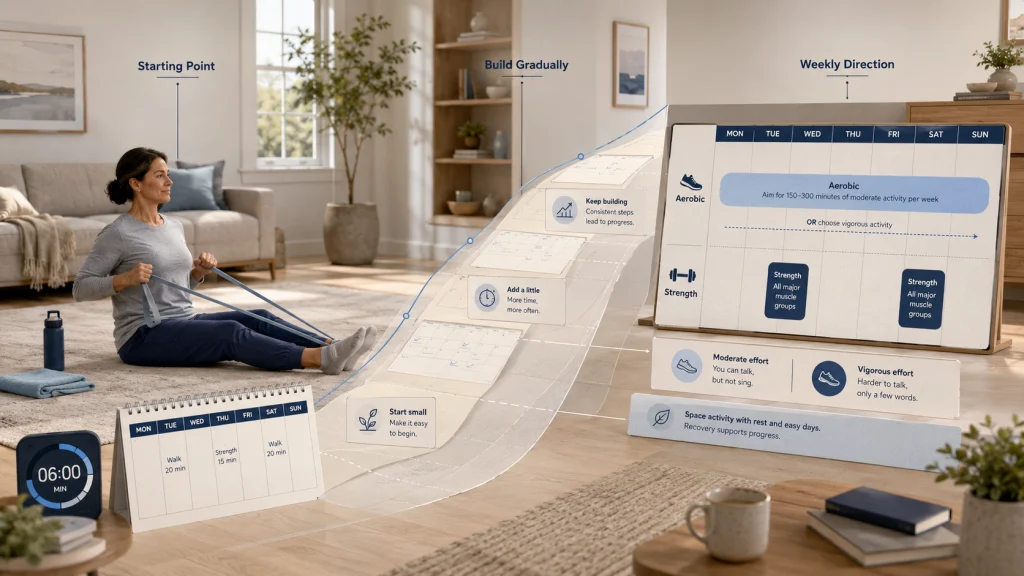
Use the Adult Activity Framework as a Direction, Not a Starting Test
Current US guidance for adults describes a weekly mix of aerobic activity and muscle-strengthening activity. The commonly used target is 150 to 300 minutes of moderate-intensity aerobic activity, or 75 to 150 minutes of vigorous-intensity activity, or an equivalent combination. Muscle-strengthening activity is recommended on at least two days each week.
That framework describes the amount associated with broad health benefits. It does not mean every inactive beginner should immediately schedule 150 minutes plus two full strength sessions. Some activity is better than none, and people who are inactive can begin with small amounts and build gradually.
| Framework element | Longer-term direction | Possible starting point |
|---|---|---|
| Aerobic activity | Build toward the weekly moderate, vigorous, or combined target | One short, comfortable session that can be repeated |
| Muscle strengthening | Work the major muscle groups on at least two days | Learn a few controlled movements and leave recovery time |
| Weekly frequency | Spread activity across the week | Choose two or three realistic time windows first |
| Intensity | Include suitable moderate or vigorous activity | Use a manageable effort that does not force poor control |
Relative intensity matters because the same activity can feel easy to one person and demanding to another. During moderate aerobic activity, many people can talk but not sing comfortably. During vigorous activity, speaking more than a few words usually requires a pause for breath. These are practical orientation tools, not medical tests.
Key decision: Compare your current week with the framework, then choose the smallest useful step between the two. Do not treat the final target as proof that your first week is inadequate.
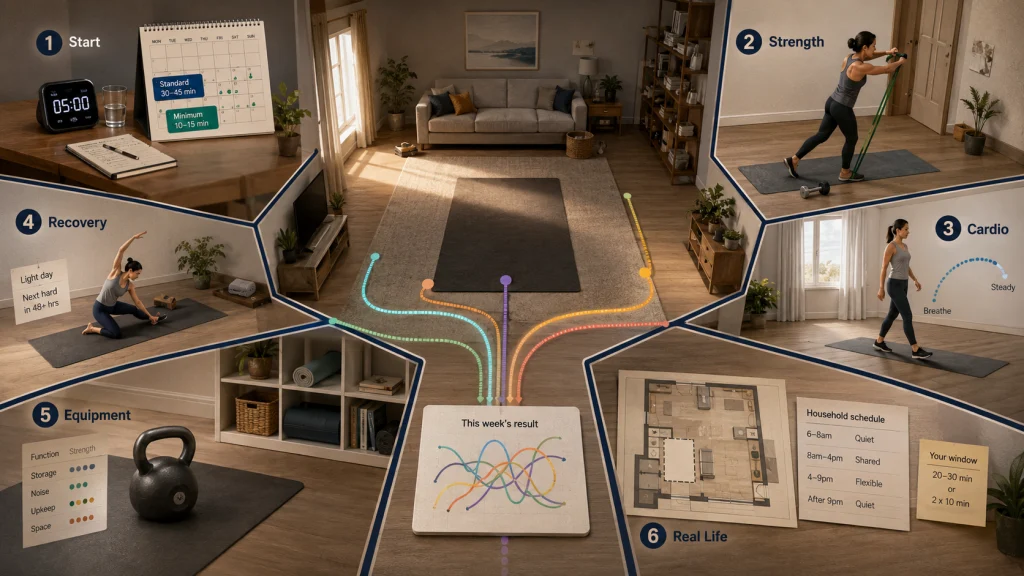
The Six Routes Through Home Exercise
Use this map to identify the question that needs an answer first. Each route names a different planning job, and the sections that follow explain how that job changes the first move.
- Starting and routine design: How can a first session become something you can repeat next week?
- Strength training: How can resistance become controlled, progressive work rather than a random challenge?
- Cardio and low-impact movement: Which activity raises effort while fitting current capacity, impact tolerance, and the room?
- Flexibility, mobility, and recovery: What would improve usable movement and readiness for the next session?
- Equipment and fitness gear: Is there a defined function that a tool can perform within the household limits?
- Plans shaped by real life: How should activity change for the goal, floor space, schedule, noise limits, and household?
Only one route needs to lead the first decision. Other elements can be added after the current obstacle is easier to see and manage.
Route 1: Start by Making Activity Repeatable
Use this route when the hardest part is beginning, returning, or continuing. Begin with a session small enough to start, clear enough to remember, and convenient enough to repeat. Volume can grow after the routine has a stable place in the week.
A workable starting system answers four questions: What will you do? Where will you do it? When is the most realistic window? What is the reduced version for a difficult day? A plan that only works when energy, time, and motivation are high is not yet reliable.
Practical tip: Define both a standard session and a minimum session. The minimum version should preserve the habit without pretending that every day supports the same workload.
Use the complete process for starting a home exercise routine when uncertainty, inconsistency, or a long break is the main barrier.
Route 2: Add Strength Work When Resistance Is Missing
Strength training asks muscles to work harder than they normally do. At home, resistance can come from body position, controlled tempo, household objects that are safe to hold, resistance bands, free weights, or larger equipment. The tool matters less than whether the movement is controlled, repeatable, and gradually challenging.
Difficulty alone does not create a strength plan. Useful programming considers major movement patterns, starting difficulty, technique, recovery, and a clear method of progression. Progress might mean more controlled repetitions, a slightly harder variation, more resistance, or better range. Rushing through additional work is rarely the only option.
Review the broader approach to strength training at home when your week lacks purposeful resistance work.
Route 3: Choose Cardio by Effort, Impact, and Repeatability
Cardio is activity that raises breathing and heart rate for a sustained period. At home, that can include brisk indoor walking, stepping patterns, dancing, cycling, or other continuous movement. The best option is not automatically the one that looks hardest. It is the one that reaches a useful effort while fitting your current capacity, space, coordination, and tolerance for impact.
Low-impact describes how force is managed through the body. A session can limit impact and still reach a moderate or vigorous effort. Quieter options may also suit apartments, shared floors, or people who prefer to avoid jumping.
Use the guide to home cardio and low-impact activity when aerobic movement is the missing part of your week.
Route 4: Treat Mobility and Recovery as Support for Future Sessions
Flexibility, mobility, and recovery are related but not interchangeable. Flexibility concerns how far tissues can lengthen. Mobility concerns usable movement through a range with control. Recovery includes the time and conditions that help you return to activity ready for the next useful effort.
The practical question is whether limited range, accumulated fatigue, poor session spacing, or an unrealistic workload is interfering with consistency. The useful adjustment may be a lighter day, more recovery time, a simpler movement, or a smaller increase in workload. Stretching is only one possible tool within that decision.
Explore mobility and workout recovery when the problem is not choosing more exercises but supporting the next session.
Route 5: Buy Equipment Only for a Defined Job
Equipment can add resistance, make a movement more comfortable, support progression, reduce setup time, or make a preferred activity available indoors. It can also create storage friction, noise, maintenance work, subscription costs, and an expensive reminder of a routine that was never designed.
Before buying, name the job in one sentence. For example: “I need adjustable resistance that stores in a drawer,” or “I need a quiet indoor cardio option that is usable during bad weather.” A vague goal such as “I should get fit” is not specific enough to compare tools.
Editorial observation: Large equipment often receives attention because it looks like a complete solution. In practice, floor space, setup time, comfort, noise, maintenance, and return friction can matter as much as the feature list.
Use the home fitness equipment guide when a tool may solve a clearly identified bottleneck.
Route 6: Shape the Plan Around Goal, Space, Schedule, and Household Life
A technically sensible workout can still fail when it does not fit the home. A small room may require movements that use one standing area. An upstairs apartment may rule out repeated jumping. A shared household may require quiet sessions or equipment that can be cleared quickly. A changing work schedule may need flexible session windows instead of fixed weekdays.
Goals also change the emphasis. Someone building a basic activity habit needs a different first week from someone adding strength to an established cardio routine. The plan should reflect the current objective without pretending that one routine can optimize every outcome at once.
Review home workout plans for real-life constraints when the main question is how to organize activity around a specific goal, space, schedule, or lifestyle.
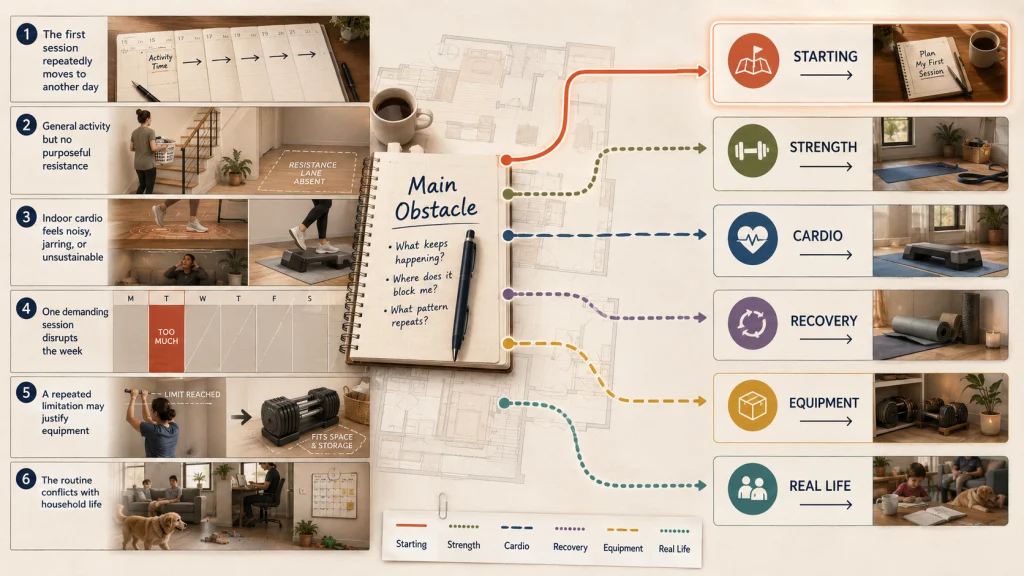
Choose Your First Route by Naming the Main Obstacle
When several parts of home fitness seem incomplete, begin with the pattern that blocks action now. This table identifies the kind of decision to open next. It does not ask you to diagnose a condition or buy a solution.
| What keeps happening | What the pattern points to | Route to open |
|---|---|---|
| The first session keeps moving to another day | The entry point is too vague, large, or dependent on motivation | Starting and routine design |
| You stay generally active but never work against purposeful resistance | The week has movement but lacks a strength stimulus and progression method | Strength training |
| Indoor aerobic sessions feel too noisy, jarring, or difficult to sustain | The activity choice may not fit current capacity, impact tolerance, or the room | Cardio and low-impact movement |
| One demanding session disrupts the rest of the week | Workload, movement difficulty, or session spacing needs review | Mobility and recovery |
| A repeated limitation remains after simple setup changes | A tool may have a defined function, provided it fits storage, noise, upkeep, and cost limits | Equipment and fitness gear |
| The routine works on paper but conflicts with the household | The structure needs to reflect the real goal, room, schedule, interruptions, or preferences | Plans shaped by real life |
Treat the result as a planning lead. Once the main obstacle becomes manageable, the priority can move to another route.
Separate Exercise Selection From Intensity, Duration, and Frequency
Choosing an exercise is only one part of planning. The same movement can create a very different session depending on how hard it feels, how long it continues, how often it appears, and how much recovery surrounds it.
- Exercise selection: what movement or activity you do.
- Intensity: how demanding the effort is for you.
- Duration: how long the activity or work period lasts.
- Frequency: how often the session or activity appears in the week.
- Progression: what changes after the current amount becomes manageable.
- Recovery: whether you have enough time and capacity to perform useful work again.
This separation makes adjustments more precise. When a session feels unmanageable, you may not need a different exercise. You may need less resistance, fewer repetitions, a shorter duration, more rest, or fewer weekly sessions. When a session feels consistently easy and technique remains controlled, one variable can be increased gradually rather than changing everything at once.
Note: Choose an effort level that serves the route you selected and still allows safe, repeatable participation. Extra difficulty has value only when it supports that purpose.
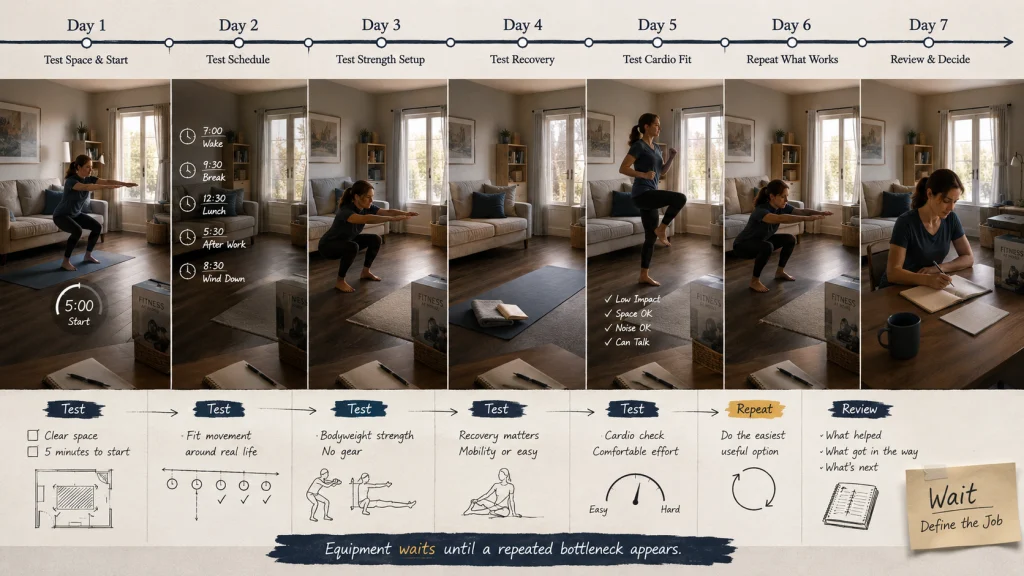
Build a No-Purchase First Week
Use a no-purchase week to see whether equipment is the real bottleneck or whether the routine itself needs work. Over seven days, test when, where, and how movement can happen with minimal setup. Treat the week as a practical trial rather than a finished long-term program.
| Day | Simple action | What you are testing |
|---|---|---|
| Day 1 | Clear one safe movement area and complete five minutes of comfortable activity | Location and starting friction |
| Day 2 | Take a normal day and notice available movement opportunities | Schedule reality |
| Day 3 | Complete a short resistance session using controlled bodyweight movements | Strength interest and movement setup |
| Day 4 | Rest or use gentle comfortable movement | Recovery and response to the previous session |
| Day 5 | Try a short indoor cardio option at a conversational effort | Noise, impact, space, and preferred activity |
| Day 6 | Repeat the easiest useful session from the week | Repeatability |
| Day 7 | Record what helped, what interfered, and which route should come next | Planning evidence from your own household |
At the end of the week, look for a pattern rather than judging performance. If clearing space took longer than moving, storage and setup need attention. If the sessions were easy to begin but lacked challenge, strength or cardio planning may be next. If the first session caused excessive fatigue that disrupted the week, the starting amount may need to be reduced.
Know When Equipment Solves a Real Bottleneck
A purchase becomes easier to justify when you can connect it to a repeated problem that has already appeared. Use this sequence before comparing features:
- Name the activity or movement you are trying to support.
- Describe the specific limitation in your current setup.
- Check whether a no-purchase adjustment solves it.
- Define space, storage, noise, comfort, maintenance, and budget limits.
- Compare only tools that meet those limits.
- Decide how the item will enter the weekly routine.
A clear routine gives equipment a job. Once the purpose and weekly place are defined, a tool may reduce friction or support progression. The strongest buying decision usually begins with a sentence about function rather than a feature list.
Use Clear Safety and Professional-Help Boundaries
This article provides general educational guidance for adults. It does not diagnose an injury, prescribe rehabilitation, create a disease-specific program, or replace advice from a physician, physical therapist, or qualified exercise professional.
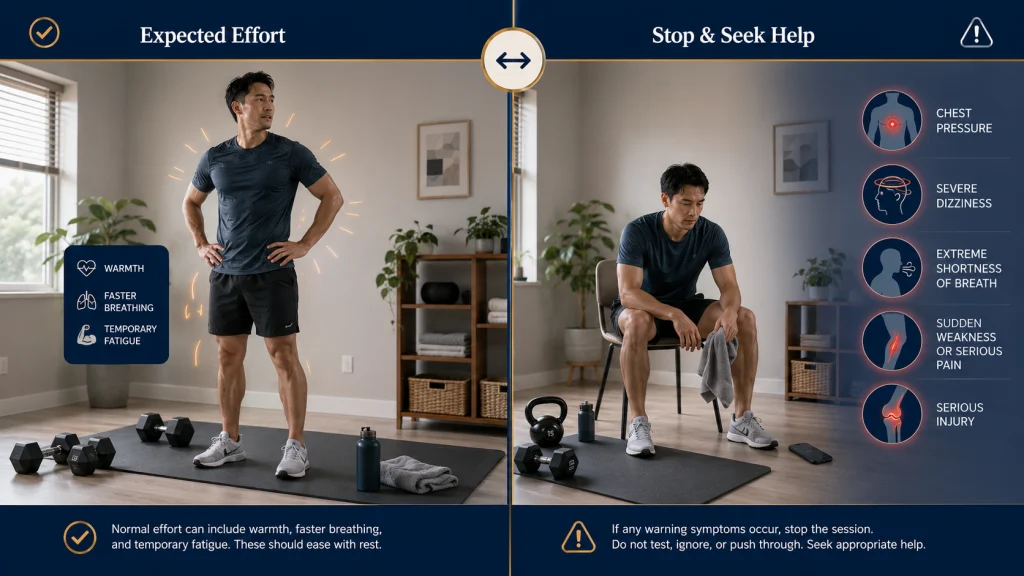
Safety warning: Stop exercising and seek appropriate help for chest pain or pressure, extreme shortness of breath, fainting, severe dizziness, sudden weakness, a serious injury, or severe pain. Emergency symptoms require immediate emergency assistance.
Persistent joint or muscle pain, neurological symptoms, pregnancy, recent surgery, chronic health conditions, disability-related limitations, or a long period of inactivity may require individualized guidance before you increase activity or follow a general program. The appropriate professional depends on the situation and the type of limitation.
Normal effort can include faster breathing, warmth, and temporary muscle fatigue. Warning signs should not be treated as proof that you need to push harder. When you are uncertain whether a symptom is expected exercise effort, stop the session and obtain qualified guidance rather than testing the symptom repeatedly.
Home setup also matters. Use a stable, uncluttered surface, enough clearance for the movement, suitable footwear when needed, and equipment that is intact and used as intended. Keep children, pets, cords, unstable furniture, and breakable items out of the movement path.
Choose One Route and One First-Week Action
Begin by naming the main job movement needs to do in your current week. Then choose one action that can happen without waiting for ideal motivation, a complete room, or new equipment.
Your first action might be a five-minute session, one controlled strength practice, a quiet cardio test, a recovery adjustment, an equipment requirement list, or a schedule redesign. The right choice is the one that removes the present obstacle and gives you enough information to plan the next step.
Continue With the Guide That Matches Your Route
Each guide below develops one part of the decision in greater depth. Open the route you selected rather than reading the list as a six-part assignment.
| Guide | What it develops |
|---|---|
| How to start working out at home | A repeatable entry system, minimum sessions, realistic scheduling, and gradual progress from a low starting point. |
| Strength training at home | Resistance choices, movement control, progression, recovery, and the role of optional equipment. |
| Cardio workouts at home | Relative intensity, lower-impact choices, indoor constraints, and ways to build aerobic activity gradually. |
| Workout recovery | The distinctions among flexibility, mobility, fatigue, workload spacing, and readiness for another session. |
| Home gym equipment | Function-first comparisons involving space, storage, comfort, noise, upkeep, compatibility, and cost. |
| Home workout plans | How goals, floor area, schedules, interruptions, noise limits, and preferences change the weekly structure. |
FAQs
🏠 Can I get enough exercise without leaving home?
Home can support aerobic activity, strength work, mobility, and general movement when the plan fits your space and current capacity. The more important question is whether the routine includes the types of activity you need and can be repeated across the week.
⏱️ Do I need to start with 150 minutes a week?
No. The federal target is a direction to build toward, not a required first-week quota. An inactive beginner can start with small amounts, repeat them consistently, and increase gradually.
💪 Does home exercise have to include strength training?
A balanced adult activity week includes muscle-strengthening work as well as aerobic activity. Strength work does not require a commercial gym, but it should provide suitable resistance and involve controlled effort across the major muscle groups.
🧰 Should I buy equipment before I begin?
Usually, begin by testing the routine and identifying the actual limitation. Equipment becomes useful when it solves a defined problem involving resistance, access, comfort, progression, space, or convenience.
📅 How many days should I work out at home?
The answer depends on the activity type, intensity, duration, recovery needs, and your starting point. Instead of choosing a number in isolation, spread activity across realistic days and avoid placing demanding sessions so closely that you cannot recover or maintain control.
🚩 When should I stop a home workout?
Stop and seek appropriate help for chest pain or pressure, extreme shortness of breath, fainting, severe dizziness, sudden weakness, serious injury, or severe pain. Persistent or unexplained symptoms also deserve qualified guidance rather than repeated self-testing.