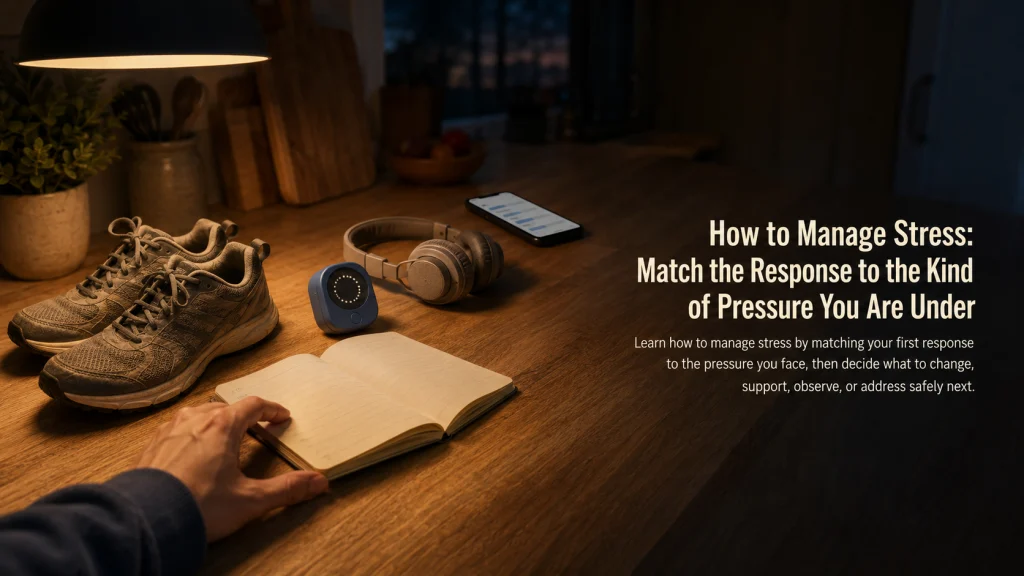
Learning how to manage stress starts with identifying what needs attention first. Some situations call for changing a demand, some call for calming physical activation, and others require a better recovery routine, a quieter environment, or support shaped to a recurring life constraint. Start with a brief safety and function check, then choose one route and one first action instead of trying several stress management techniques at once. If stress is persistent, worsening, difficult to cope with, or interfering with daily life, self-guided lifestyle support may not be enough.
Six Objects on One Kitchen Counter
On a stressful evening, a kitchen counter might hold a notebook, walking shoes, a breathing timer, headphones, a dim lamp, and a phone showing an unfinished task list. Every item could be useful. None of them answers the first question: what kind of response is needed right now?
The notebook may help sort a crowded calendar. Walking shoes may create an after-work transition. A breathing timer may settle a tense body, while headphones or softer light may reduce sensory load. The phone may reveal that the real problem is an assignment that has grown beyond the time available.
Before choosing a technique, separate what must be changed from what must be carried more safely. That distinction prevents a calming activity from being mistaken for a solution to an unchanged workload, conflict, financial problem, caregiving demand, or unsafe situation.
Stop Treating Stress Management as a Single Technique
Stress is a mental and physical response to demands, challenges, or difficult situations. It can affect attention, emotion, behavior, sleep, appetite, and the way the body feels. Responses vary by person and situation.
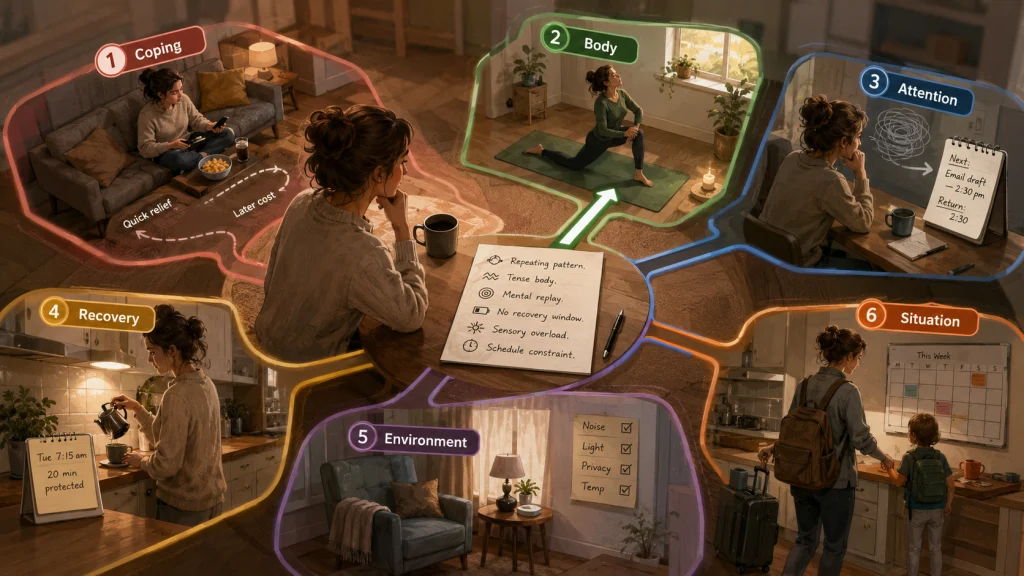
A useful first step depends on whether the immediate obstacle is an unclear pattern, physical activation, repetitive thinking, missing recovery time, an unsuitable environment, or a recurring constraint.
| Route | Question this route answers |
|---|---|
| Everyday coping | What pattern keeps repeating, and which response creates a later cost? |
| Body-based relaxation | What would make physical activation manageable enough for the next safe decision? |
| Attention reset | Where can attention go when more thinking is no longer producing a useful action? |
| Restorative routine | What kind of recovery can survive an ordinary week instead of waiting for a perfect opening? |
| Environment and tools | Which feature of the space is interfering with the ability to unwind? |
| Situation-specific adaptation | What recurring work, caregiving, travel, social, or schedule constraint must the response fit? |
Use this map to select the question that deserves attention first. The navigation table later turns that choice into one no-cost check and a more detailed guide.
Run a Two-Minute Safety and Function Check First
Before troubleshooting routines, check whether you can safely handle the next part of the day. Severe impairment or danger needs a different response from lifestyle planning.
Safety warning: Do not drive, operate equipment, supervise a risky activity, or continue a task that requires steady judgment if you feel unable to focus or stay in control. Move to a safer setting and ask a trusted person for immediate help when needed.
Ask five direct questions:
- Can I think clearly enough to make a basic decision?
- Can I drive or travel safely?
- Can I work without creating a serious safety risk?
- Can I care for a child, older adult, or another person safely?
- Can I keep myself and the people around me safe?
If the answer is no, pause lifestyle troubleshooting and use practical support, professional help, crisis support, or emergency services according to the risk. Do not delay the action to finish reading.
Separate the Stressor From the Stress Response
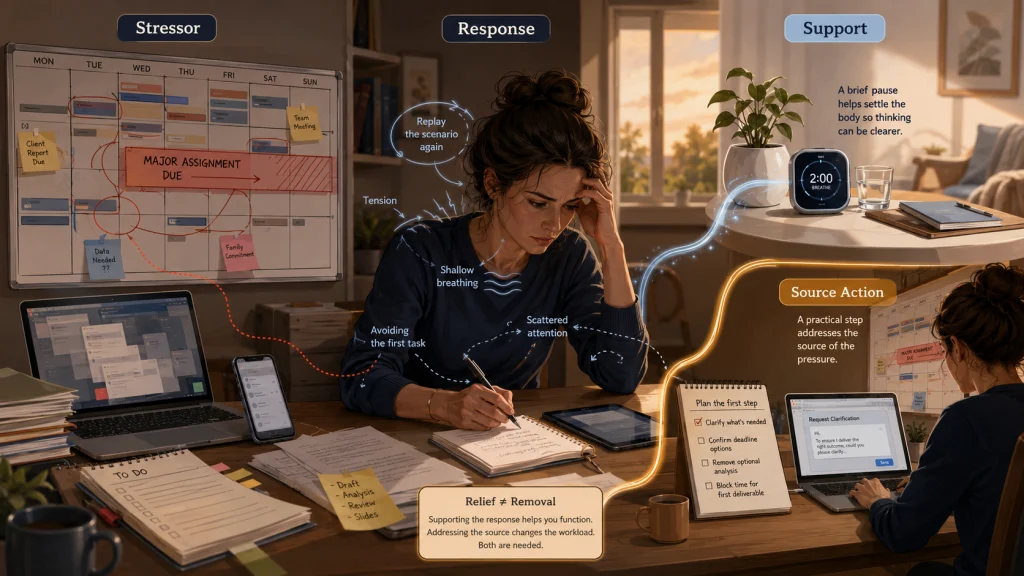
The stressor is the demand, event, conflict, uncertainty, or condition creating pressure. The stress response is what happens in your mind, body, emotions, and behavior as you deal with it. Both layers matter, but they are not interchangeable.
| Situation | Stressor to examine | Response that may need support |
|---|---|---|
| An overdue bill | The amount due, timing, missing information, or need to contact the provider | Avoidance, racing thoughts, tension, or difficulty beginning the first practical step |
| A noisy home | The source, timing, room use, household agreement, or lack of quiet space | Irritability, difficulty concentrating, or staying activated after the noise stops |
| Caregiving load | Too many tasks, insufficient backup, unclear roles, or no protected recovery time | Constant alertness, guilt about resting, exhaustion, or loss of patience |
| An argument | The unresolved issue, communication boundary, or need for time before discussion | Physical tension, repeated mental replay, impulsive messaging, or trouble settling |
| An overloaded calendar | Too many commitments, unrealistic timing, weak boundaries, or no buffer between tasks | Urgency, scattered attention, shallow breathing, or abandoning the plan entirely |
A breathing exercise may make a tense body easier to manage before a difficult conversation or planning session. It cannot remove an overloaded work assignment, renegotiate a deadline, or decide which task should be dropped. Relief can create enough steadiness to act, while source reduction changes the condition that keeps recreating the pressure.
Key decision: Name one part of the situation that needs action and one part of your response that needs support. Do not force a single technique to do both jobs.
Decide What Is Changeable Today
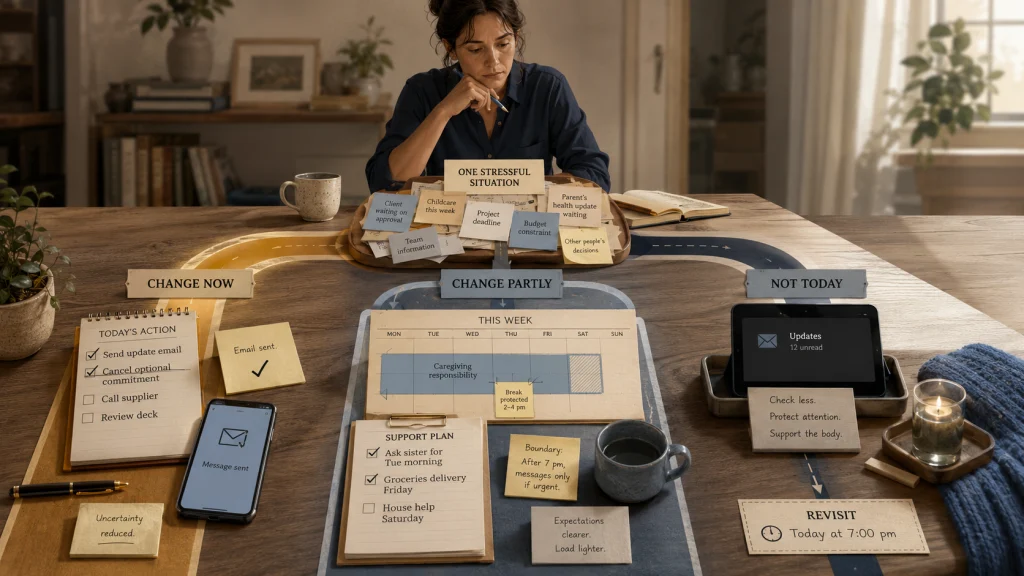
The practical question is whether the stressor can be changed now, changed partly, or cannot be changed today.
| Category | What it means | First useful move | Example |
|---|---|---|---|
| Changeable now | A concrete action can reduce the demand or remove uncertainty today | Complete, cancel, clarify, delegate, schedule, or communicate | Send the missing information that is holding up a task |
| Partly changeable | Some features are fixed, but timing, boundaries, support, or expectations can move | Choose the smallest adjustable part and ask for the support it requires | Keep a caregiving responsibility but arrange one protected break |
| Not changeable today | No immediate action can alter the event, outcome, or timing | Reduce unnecessary exposure, support the body and attention, and choose when to revisit it | Wait for a decision that will not arrive until another day |
Rechecking an inbox may feel active while adding interruption. Calling everything uncontrollable can also hide a useful choice, such as asking for clarification, setting a stopping time, or moving one commitment.
Route 1: Recognize Patterns and Choose Coping Deliberately
Start here when the pattern is unclear, the same trigger keeps producing the same response, or your current coping creates a later cost. Examples include delaying a task until urgency rises, withdrawing from useful support, staying online long after the information stops helping, or using alcohol or other substances to get through the pressure. When every day seems to end with the same regret, naming the sequence can make the problem feel less shapeless.
Identify the trigger, notice the response that follows, and compare short-term relief with what happens later. The guide to coping skills for stress develops that process for different situations.
Note: A coping response can be understandable and still be costly. The goal is to notice what it solves, what it postpones, and whether a safer or more useful alternative is available.
Route 2: Work With Immediate Physical Activation
This route fits moments when physical activation blocks a calm next step. The aim is to create enough room for the next decision, not to prove that the stressor has disappeared.
Body-based methods require attention to comfort, pacing, and context. Some people prefer guided breathing, while others respond better to gentle movement, a position change, or a quieter transition. The guide to breathing and body-based relaxation explains those choices in more detail.
Stop any exercise that causes significant discomfort, marked dizziness, faintness, severe shortness of breath, or worsening symptoms. New, severe, persistent, or unexplained physical symptoms need qualified evaluation rather than repeated self-testing.
Route 3: Reset Attention When the Mind Stays Engaged
Choose this route when attention is stuck on replaying a conversation, predicting outcomes, checking for updates, or moving between thoughts without reaching a useful action. The stressor may still matter, but continued mental engagement is no longer producing new information.
An attention reset can help you choose where to place focus and when the issue deserves another planning session. It does not require forcing thoughts away. The guide to mindfulness and mental reset covers practical entry points and fit problems.
Practical tip: Give the concern a specific return point. Write the next action or question, choose when you will review it, and then move to an activity that uses attention differently.
Route 4: Build Recovery That Actually Fits the Week
Use this route when recovery happens only after depletion, obligations crowd it out, or downtime leaves you just as scattered. A person can be technically off work for an evening and still never feel off duty. Restorative time can be active or quiet, provided it is repeatable and helpful.
Start by examining the transition around the activity. A reasonable plan can fail because there is no stopping time, setup takes too long, the household needs the same space, or the activity begins so late that sleep is displaced. The guide to stress relief activities helps match restorative options to energy, time, and routine.
Recovery also includes basic supports such as regular sleep opportunities, movement, meals, and connection with trusted people. These are not performance targets. They are parts of daily life that can become less dependable when pressure accumulates.
Route 5: Check the Environment Before Buying a Calming Tool
Noise, harsh light, uncomfortable temperature, lack of privacy, visual clutter, and shared-space conflict can all make unwinding harder. Sometimes a simple environmental change is enough. In other cases, a tool may support a clearly defined need, such as reducing sound at a particular time or making a short routine easier to start.
Editorial observation: Items sold under one stress-relief label often solve very different practical problems. Compare setup, storage, cleaning, noise, privacy, shared-space fit, ongoing cost, and how often the item would realistically be used. A product is unnecessary when moving the routine, changing the light already available, agreeing on a quiet period, or clearing one small area solves the obstacle.
The guide to relaxation products and spaces focuses on fit and tradeoffs rather than treating shopping as the default response.
Route 6: Adapt the Response to the Situation
A strategy that works on an open weekend may fail during shift work, caregiving, travel, social demands, or a fragmented day. The routine has to survive the hour when the house is loud, the shift changes, or someone else needs you.
Look for the point where the situation predictably becomes harder. It may be the transition into work, the final hour of caregiving, the lack of privacy while traveling, or a calendar with no buffer. Then choose a response that can happen at that point rather than relying on an ideal block of free time later.
The guide to stress by lifestyle and situation helps adjust support to recurring demands without pretending that every constraint can be removed.
Choose One Change and One Support
Changing six variables at once makes it difficult to learn what helped. A clearer test pairs one source-focused change with one response-focused support.
For an overloaded calendar, the change might be declining one optional commitment. The support might be a ten-minute transition after the last required task. For a noisy home, the change might be a household agreement about one quiet period. The support might be moving a calming activity to the room and time with the least interruption.
Key decision: Keep the test small enough that you can tell whether the source change, the support, or the combination made daily life more manageable.
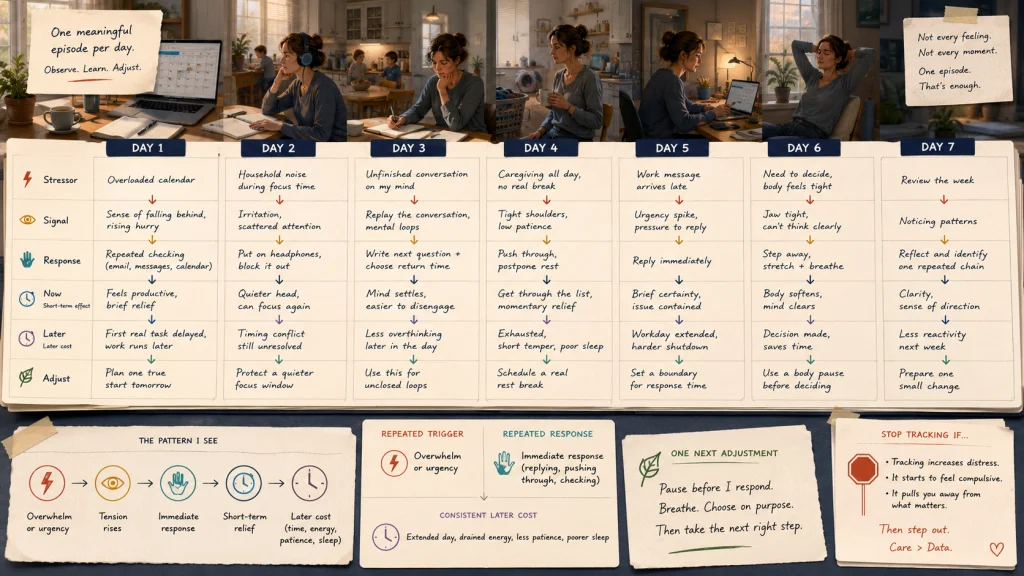
Use a Seven-Day Observation Loop
Record one meaningful episode each day for a week. Keep the notes brief and practical.
| Day | Stressor | Signal | Response | Short-term effect | Later cost | Next adjustment |
|---|---|---|---|---|---|---|
| 1 | Name the demand or situation | Note the first mental, physical, emotional, or behavioral clue | Record what you did next | Describe what changed within the next hour | Note any delayed problem, avoidance, lost sleep, or extra work | Choose one small change for the next similar moment |
| 2 | Name the demand | Note the first clue | Record the response | Note the immediate effect | Note any later cost | Keep or adjust one element |
| 3 | Name the demand | Note the first clue | Record the response | Note the immediate effect | Note any later cost | Keep or adjust one element |
| 4 | Name the demand | Note the first clue | Record the response | Note the immediate effect | Note any later cost | Keep or adjust one element |
| 5 | Name the demand | Note the first clue | Record the response | Note the immediate effect | Note any later cost | Keep or adjust one element |
| 6 | Name the demand | Note the first clue | Record the response | Note the immediate effect | Note any later cost | Keep or adjust one element |
| 7 | Name the demand | Note the first clue | Record the response | Note the immediate effect | Note any later cost | Choose the next route |
Do not score yourself or capture every sensation. Look for a repeated trigger, an early signal, and whether the response helps, postpones the issue, or creates another problem. Stop tracking if it increases distress or becomes compulsive.
Interpret the Result Without Forcing a Success
At the end of the week, place the response into one of five categories. The purpose is to choose the next action, not to prove that the first idea worked.
- Keep: The response was realistic, helped in the moment, and did not create a meaningful later cost.
- Modify: The basic idea helped, but the timing, duration, setting, or level of effort did not fit.
- Replace: The response repeatedly failed to help or created a larger problem afterward.
- Address the source: The response offered brief relief, but the same preventable demand kept recreating the pressure.
- Seek support: The pattern is persistent, worsening, hard to cope with, unsafe, or interfering with ordinary functioning.
A modest result still provides direction. A routine may work only before the household becomes busy, or a calming activity may help only after a task is clarified.
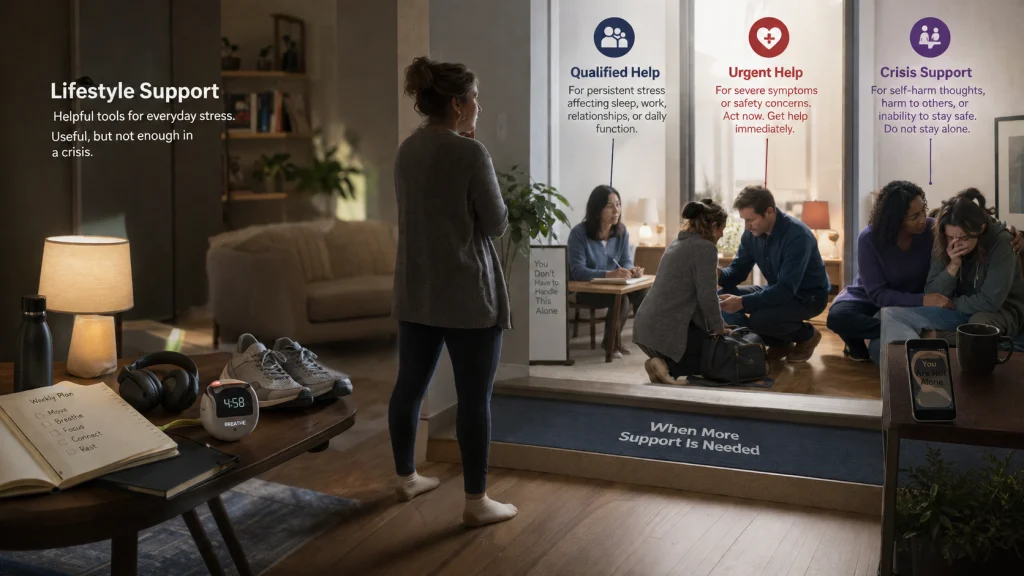
Know When Lifestyle Support Is No Longer Enough
Self-guided stress management has limits. Qualified help is appropriate when stress or related symptoms are persistent, worsening, difficult to cope with, or interfering with work, sleep, relationships, self-care, decision-making, or other daily responsibilities. Seek support sooner when you are using alcohol, drugs, or medication in an unsafe way to cope, or when people close to you are concerned about a change in your behavior.
Urgent action: Chest pain or pressure, severe shortness of breath, fainting, signs of stroke, sudden weakness, serious injury, severe or unexplained physical symptoms, immediate danger, or inability to stay safe require urgent professional or emergency help. In the United States, call 911 for an immediate medical or safety emergency.
Crisis support: If you are thinking about self-harm, suicide, harming someone else, or you feel unable to stay safe, call or text 988 in the United States for immediate crisis support. If danger is immediate, call 911 or go to the nearest emergency department. Do not remain alone when you can safely contact a trusted person who can stay with you or help you reach care.
This guide cannot determine the cause of symptoms. New, severe, persistent, worsening, unexplained, or function-limiting symptoms need qualified evaluation. Pregnancy, recent surgery, chronic conditions, disability-related needs, or existing mental health care may change which self-guided activities are appropriate.
Name the Route Before Adding Another Technique
Start by naming the job that needs doing: understand the pattern, settle physical activation, reset attention, protect recovery time, improve the environment, or adapt to a recurring situation. Then choose one action small enough to test without changing the rest of the week.
Keep the response when it fits and helps without creating a larger later cost. Change the plan when the stressor remains untouched, daily functioning worsens, symptoms persist, or safety becomes uncertain. The best next step is the one matched to the pressure you are actually under, not the longest list of things you could try.
Continue With the Guide for Your Chosen Route
| Detailed guide | What it develops |
|---|---|
| Coping skills for stress | Pattern recognition, response choices, and a workable coping plan |
| Breathing and body-based relaxation | Comfort, pacing, method fit, and practice boundaries |
| Mindfulness and mental reset | Present-moment attention, guidance options, and practice fit |
| Restorative activities | Recovery choices matched to time, energy, and routine |
| Relaxation products and spaces | Environmental fit, practical tradeoffs, and no-purchase alternatives |
| Stress by lifestyle and situation | Adaptation for recurring work, caregiving, travel, and schedule constraints |
FAQs
🧭 Can one stress technique work for every situation?
No single technique has the same job in every situation. A calming method may support the stress response, while a deadline, conflict, unsafe condition, or overloaded schedule still needs direct action.
🫁 Should I calm my body before solving the problem?
That can be useful when physical activation is blocking clear thinking or safe action. Once you are steadier, return to the stressor and decide whether it needs clarification, a boundary, a practical task, or outside support.
📝 What if I cannot identify the main stressor?
Track one meaningful episode a day and look for repeated situations, early signals, and later costs. Qualified support is appropriate when the pattern remains unclear and stress is persistent, worsening, or interfering with daily life.
💡 Do I need to buy something to relax?
Usually not as a first step. Test whether timing, light already available, room choice, privacy, sound, or a simpler transition solves the actual obstacle before adding a product.
📅 Why observe the pattern for seven days?
A week can reveal differences between workdays, evenings, and days with fewer obligations. Keep the process brief, and stop if tracking increases distress or becomes difficult to control.
⚖️ Is stress the same as anxiety?
Stress often relates to an external demand or difficult situation, while anxiety can continue without a current external threat. The experiences can overlap, and this guide cannot determine the cause or provide a diagnosis.
🧱 Can breathing fix work stress?
Breathing may reduce physical activation enough to plan or communicate more clearly. It cannot reduce an unrealistic workload, renegotiate a deadline, clarify responsibilities, or provide missing support by itself.
🚨 When should I seek professional help?
Seek qualified help when stress or related symptoms are persistent, worsening, difficult to cope with, or interfering with ordinary functioning. For self-harm thoughts, immediate crisis, or inability to stay safe in the United States, call or text 988; call 911 for immediate danger or a medical emergency.