Indoor air quality problems do not all have the same first solution. A lingering odor may call for removing a source, using local exhaust, bringing in suitable outdoor air, or adding supplemental air cleaning, depending on where the condition begins and how it moves. Start by identifying the source, pathway, room, timing, and existing ventilation before buying equipment. Leave the area and seek appropriate emergency, utility, medical, or building help when alarms, combustion concerns, severe symptoms, or major building defects move the situation beyond ordinary household troubleshooting.
Four Responses to One Lingering Odor
Dinner is over, but the cooking odor remains in the kitchen and drifts toward the living room. One person opens a single window across the room. Another turns on a portable fan that circulates the same indoor air. A third uses an outdoor-vented kitchen exhaust fan near the stove. A fourth removes the source by cleaning the pan, taking food scraps out, and covering what remains.
All four actions can change what the room feels like, but they do not perform the same job. The open window may create outdoor-air exchange when conditions and airflow allow it. The portable fan mainly moves air around the room. The exhaust fan sends nearby air outside when it is correctly vented and operating. Removing the source reduces what continues to enter the room.
| Intervention | Primary role | Question to ask |
|---|---|---|
| Open one window | May bring outdoor air in and allow indoor air out | Is outdoor air suitable, and is there a useful airflow path? |
| Run a recirculating fan | Moves indoor air within the space | Is air only being redistributed? |
| Use outdoor-vented local exhaust | Removes air near the source | Does the fan actually discharge outdoors? |
| Remove or contain the source | Reduces continued release | Can the condition be stopped before it spreads? |
Key decision: Air movement, outdoor-air ventilation, local exhaust, filtration, and source control are different tools. Name the job before choosing the action.
For concerns that may belong to moisture, dust, water, chemicals, comfort, or monitoring rather than ventilation, use the broader healthy home environment guide to identify the correct starting point.
Define the Air Question Before Trying to Solve It
Indoor air quality describes conditions in the air inside a building and how those conditions relate to the people, activities, materials, and systems in that space. A practical home assessment does not begin by guessing a diagnosis. It begins by separating the source from the pathway and the control method.
| Term | Practical meaning |
|---|---|
| Pollutant source | An activity, material, appliance, condition, or outdoor event that adds something to indoor air |
| Pathway | The route through which air or a condition moves between a source and an occupied area |
| Concentration | How much of a substance is present in a given space at a particular time |
| Ventilation | Intentional exchange of indoor and outdoor air |
| Infiltration | Uncontrolled outdoor air entering through openings, gaps, and pressure differences |
| Exhaust | Air intentionally removed from a room or building |
| Recirculation | Indoor air moved and returned within the home rather than exchanged with outdoors |
| Filtration | Air passed through a filter intended to capture certain particles |
| Air cleaning | A broader category of supplemental methods intended to reduce selected airborne contaminants |
An odor can suggest that something changed, but it cannot identify every substance present or prove a specific health effect. A monitor reading can add information, but it should not be treated as a diagnosis or as a complete explanation of the home.
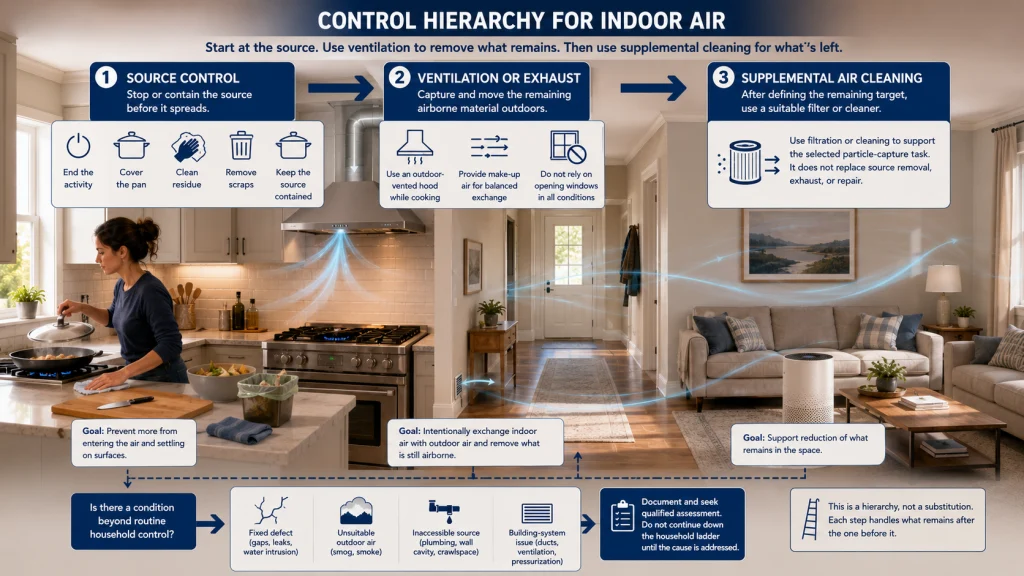
Use Source Control Before Asking Air to Carry the Whole Solution
A useful improvement order begins with the condition entering the air. Stop, remove, contain, repair, or relocate the source when that can be done safely. Then use ventilation or local exhaust to move remaining indoor air out and bring suitable outdoor air in. Filtration or other air cleaning may supplement those steps when the target condition matches what the method can address.
- Control the source: Stop the activity, contain the material, clean up the residue, repair the defect through the appropriate person, or move the source away from occupied space when safe and practical.
- Use ventilation or exhaust: Create intentional air exchange or remove air close to the source while considering outdoor conditions and building constraints.
- Add supplemental filtration or air cleaning: Consider it only after defining the target, room, airflow path, maintenance burden, and limits.
Note: This order is not a promise that the first step can solve every situation. Some sources cannot be removed by the occupant, some outdoor air should not be brought inside at that moment, and some building problems require qualified assessment.
Build a Low-Cost Plan Around the First Controllable Point
Once the source and pathway are named, the next step should be small enough to evaluate. A pan left uncovered, an unused outdoor-vented hood, a bathroom fan that is never switched on, and a window opened during smoky conditions do not need the same response.
Choose the first point the household can safely control. Remove or contain the source, use existing exhaust correctly, create an appropriate air path, or document a building problem for the responsible person. Then observe whether the condition becomes shorter, stays closer to the source, or returns under the same circumstances.
The focused guide to improving indoor air quality at home turns that observation into a prioritized action plan without beginning with a product purchase.
Start With the Meaning of Indoor Air Quality When the Concern Is Still Vague
A bedroom may feel close after the door has been shut all night. The living room may seem different after several guests leave. A cooking smell may fade in the kitchen but remain in the hallway. These are real observations, yet none identifies the source or control method by itself.
Write down what changed, where it is noticed, when it begins, how long it lasts, and what activity or outdoor condition occurs nearby. That description is more useful than calling the entire home “bad air.”
The guide to what indoor air quality means provides the foundational language for sources, pathways, indoor activities, outdoor influence, and occupied spaces.
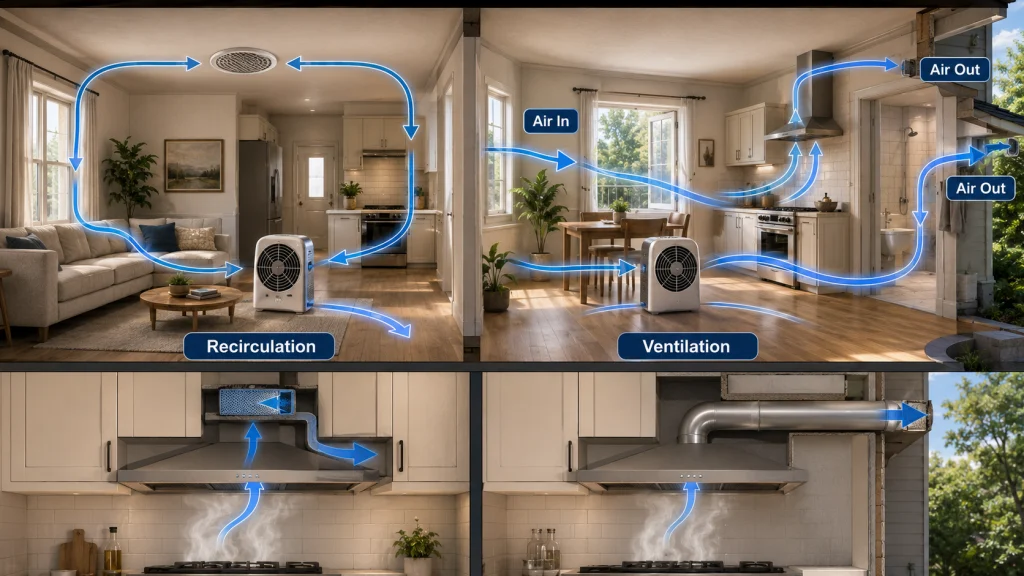
Separate Ventilation From Recirculation
A breeze can make a room feel different without changing where the air goes. That is why the path matters more than the feeling of movement.
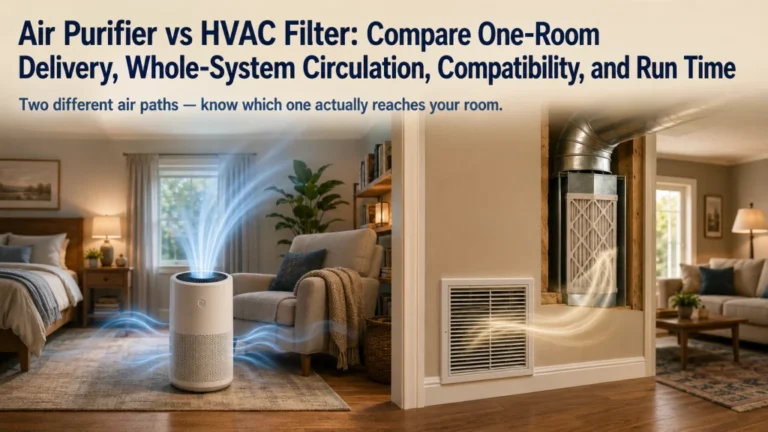
Room air → fan or return path → the same indoor space
The air is redistributed. A filter may capture selected particles when one is present and maintained, but no outdoor-air exchange is created by the fan alone.
Outdoor air → occupied room → exhaust path → outdoors
Indoor and outdoor air are intentionally exchanged, or air is removed near the source. The entry, exit, and route between them all matter.
A kitchen fan that sends air back into the room and a hood ducted outdoors may look similar from below, yet they perform different jobs. The same distinction applies to bathroom fans, window fans, whole-house fans, and dedicated ventilation controls.
Editorial observation: Range hoods, bathroom fans, window fans, whole-house fans, heat-recovery controls, energy-recovery controls, and replacement filters are often compared on one shelf or specification page even though their installation and upkeep demands are very different. Noise ratings can affect whether a fan is used, filter access can determine whether maintenance is realistic, large components may create storage problems before installation, and unclear compatibility can create return friction. A product label does not reveal the air path by itself.
Plan Both Air In and Air Out
Opening a window can feel like a complete action, but a room still needs somewhere for air to go. A closed bedroom door, a blocked hallway, or an exhaust fan with no replacement-air path can leave the intended route incomplete.
Stand in the room where the condition begins and trace the path with simple questions. Where can outdoor or replacement air enter? What opening or fan lets indoor air leave? Does the route carry kitchen or bathroom air away from other occupied rooms, or push it deeper into the home?
For a room-by-room method, continue with practical ways to ventilate a house without turning the task into an HVAC calculation.
Check Outdoor Conditions Before Opening Windows
On a mild day, an open window may be the simplest way to exchange air. On a smoky afternoon, during high outdoor humidity, or beside active construction, the same action may bring in the condition the household is trying to avoid.
Check current outdoor air conditions, weather, humidity, pollen, rain, temperature, security, and nearby activity. The useful question is not “Are open windows good?” It is “Is outdoor air the better air source at this time and place?”
The decision guide on when to open windows for ventilation handles the situations where smoke, humidity, pollen, weather, or safety changes the answer.
Identify the Role of a Whole-Home Ventilation System
Some households know exactly which control brings outdoor air in. Others have wall switches, ceiling grilles, or equipment labels that are rarely explained after move-in. The first task is not choosing a replacement system. It is discovering what the existing system is intended to do.
Exhaust systems remove indoor air. Supply systems bring outdoor air in. Balanced systems do both. Heat-recovery and energy-recovery arrangements transfer some heat, and in some designs some moisture, between separate air streams.
Use the guide to whole-house ventilation systems to identify system roles, controls, served rooms, and maintenance responsibility without calculating required airflow or judging code compliance.
Capture Cooking Air Close to the Stove
Once cooking air reaches the hallway, the whole home has become part of the cleanup. Local exhaust is more useful when it begins near the stove, before heat, moisture, odors, and airborne material spread into adjacent rooms.
Check whether the hood sends air outdoors or returns it to the kitchen. Notice whether the cooking area sits under the capture zone, whether the fan is turned on early enough, and whether noise makes people avoid using it. Grease access, cleaning, controls, and replacement parts also shape whether the setup works in everyday life.
The kitchen ventilation guide takes the next step when hood function, ducting, capture, timing, noise, or maintenance is the main question.
Give Shower Moisture a Direct Exit
A mirror that stays fogged long after the shower is a visible reminder that moisture is still moving through the room. The household may wipe the glass and leave, while the air continues to reach cooler surfaces, towels, walls, or the hallway.
Check whether the fan exhausts outdoors, whether replacement air can enter under or around the door, and whether the fan operates during the shower and afterward. A fan that is too noisy, blocked, disconnected, or hard to control may exist on the ceiling without becoming part of the routine.
Continue with bathroom ventilation guidance when fan operation, airflow path, or recurring condensation is the first concern. Visible damage, major dampness, or suspected mold belongs to a separate assessment path.
Separate Renter Actions From Building Responsibilities
A renter may notice an odor each evening, hear a shared fan start, or feel air entering around a door without knowing what happens behind the walls. Repeatedly opening a window or buying another device cannot resolve a shared duct, roof exhaust, central system, or neighboring source that the occupant does not control.
Keep a plain record of the room, time, duration, weather, nearby activity, fan status, and whether the condition seems connected to a shared area or another unit. Describe what is observed without diagnosing a contaminant or medical effect.
The guide to indoor air quality in apartments separates safe renter actions from the issues that belong with building management or another qualified party.
Treat Air Cleaning as a Separate Product Decision
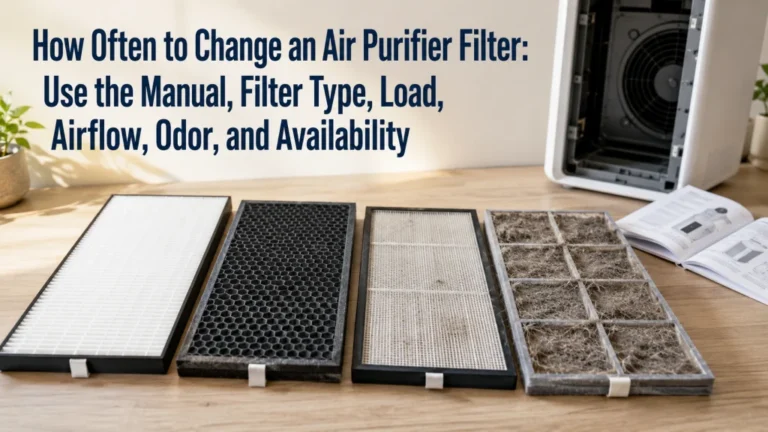
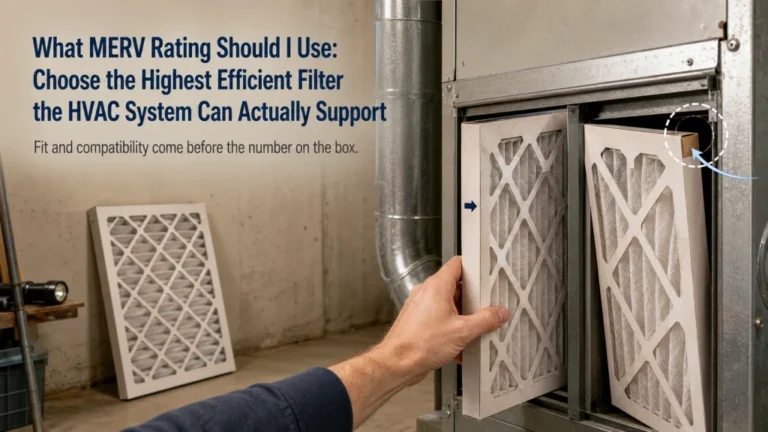
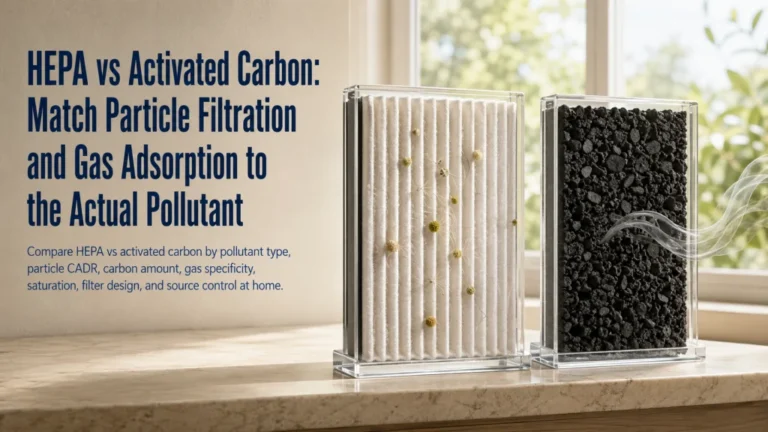
A purifier or HVAC filter does not replace source removal, suitable ventilation, local exhaust, or repair of a building problem. Air-cleaning methods also do not address every gas, odor, particle, moisture condition, or safety concern in the same way.
Before comparing equipment, identify the target condition, room, existing airflow, operating time, noise tolerance, replacement schedule, compatibility, and maintenance burden. This article stops before product selection or filter sizing.
Use the guide to air cleaners and air filters when filtration, HVAC filters, purifier roles, upkeep, and product fit are the actual questions.
Route Moisture, Allergens, Chemicals, and Sensors Separately
Not every concern noticed in the air belongs to ventilation. A damp surface may begin with a leak or humidity problem. Dust returning to textiles may require a cleaning and source-control workflow. A strong product odor may call for material and exposure awareness. A changing monitor display may require careful interpretation of the device and its limits.
- Use humidity, moisture, and mold guidance for condensation, leaks, dampness, or visible growth.
- Use household allergen and cleaning guidance for dust, pet material, textiles, and cleaning workflow.
- Use household chemical and material guidance for cleaners, furnishings, renovation materials, and exposure claims.
- Use home environmental monitoring guidance for alarms, meters, sensors, placement questions, and consumer-reading limits.
These routes prevent one air-quality label from turning unrelated conditions into the same ventilation or purifier problem.
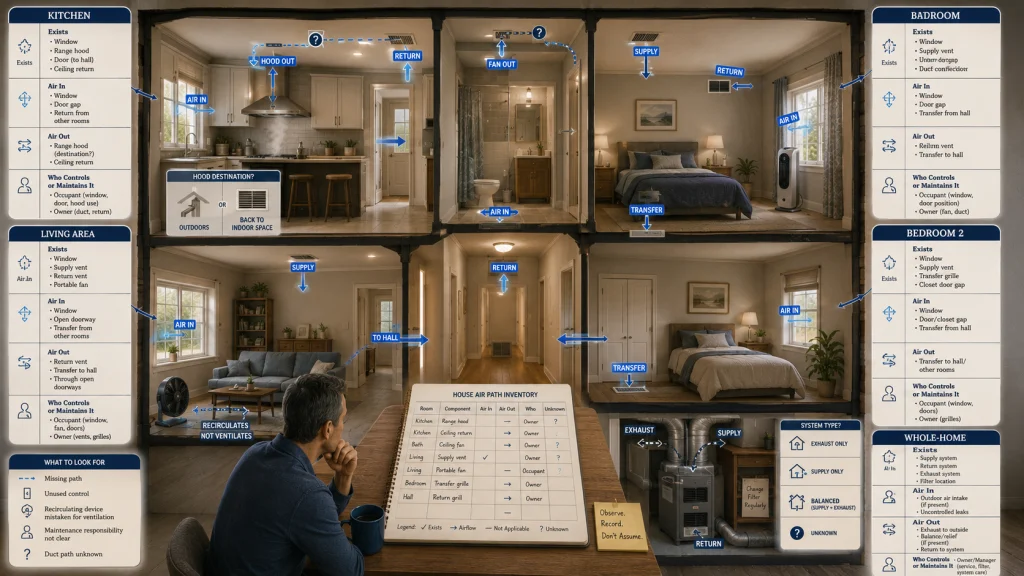
Inventory the Air Paths Already in the Home
Before adding equipment, record what the home already has and what each component actually does. A short inventory can reveal a missing exhaust path, an unused control, a recirculating device mistaken for ventilation, or a maintenance question that belongs to the owner or building manager.
| Room or system | What exists | Where air enters | Where air leaves | Who controls or maintains it |
|---|---|---|---|---|
| Kitchen | Window, hood, fan, door, central return, or none observed | Openings or supply path | Outdoor duct, another room, or unknown | Occupant, owner, manager, or contractor |
| Bathroom | Window, exhaust fan, door gap, or none observed | Doorway, window, or supply path | Outdoor duct or unknown | Occupant, owner, manager, or contractor |
| Bedrooms and living areas | Windows, supply vents, returns, transfer grilles, portable fans | Outdoor opening or mechanical supply | Return, exhaust path, open doorway, or unknown | Occupant or building responsibility |
| Whole-home equipment | Exhaust, supply, balanced system, or system not identified | Dedicated outdoor-air intake or unknown | Dedicated exhaust outlet or unknown | Owner, manager, service provider, or contractor |
Practical tip: Do not dismantle equipment or enter unsafe spaces to complete the inventory. Record what can be observed safely, note unknowns, and pass installation or building-system questions to the responsible qualified person.
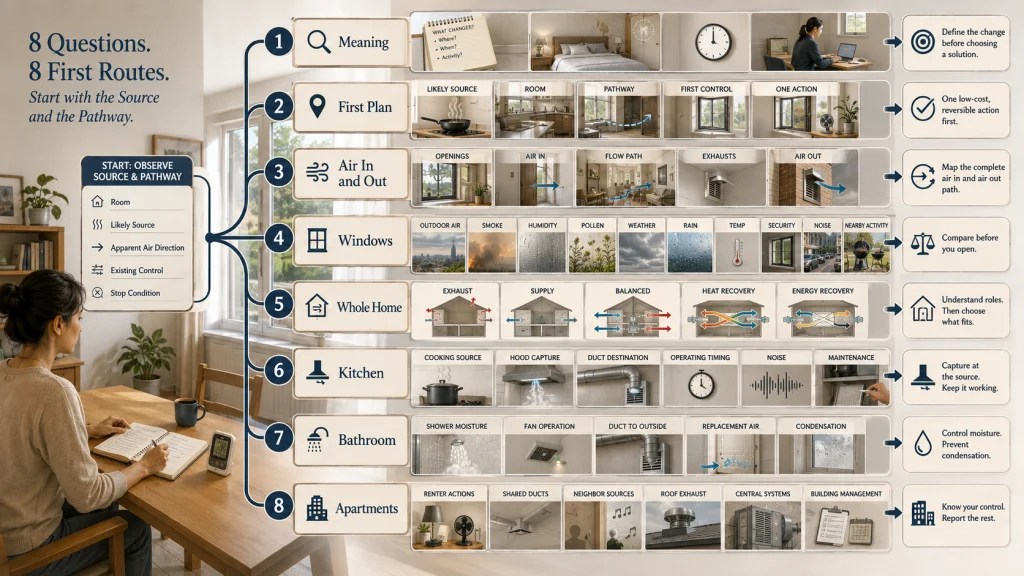
Choose the Guide That Matches the First Air Question
Use the first decision that remains unclear. Each guide below takes one part of the air pathway further without turning the page into an HVAC design, purifier comparison, or medical interpretation.
| First question | Focused guide | Bring this observation |
|---|---|---|
| What does indoor air quality include? | Understanding indoor air quality | What changed, where, when, and during which activity |
| What should I do first at low cost? | Building a source-first improvement plan | Likely source, room, pathway, and available controls |
| How should air enter and leave the home? | Ventilating a house intentionally | Openings, exhaust points, interior doors, and airflow path |
| Are windows helpful right now? | Choosing when to open windows | Outdoor air conditions, weather, humidity, pollen, and safety |
| What type of whole-home system is present? | Understanding whole-home ventilation systems | Controls, served rooms, intake, exhaust, and maintenance responsibility |
| How should cooking air be removed? | Using kitchen ventilation | Cooking source, hood type, duct path, timing, and noise |
| How should shower moisture leave? | Using bathroom ventilation | Fan operation, duct path, replacement air, and condensation pattern |
| What can a renter control or escalate? | Handling apartment air-quality concerns | Room, timing, shared systems, neighboring sources, and management history |
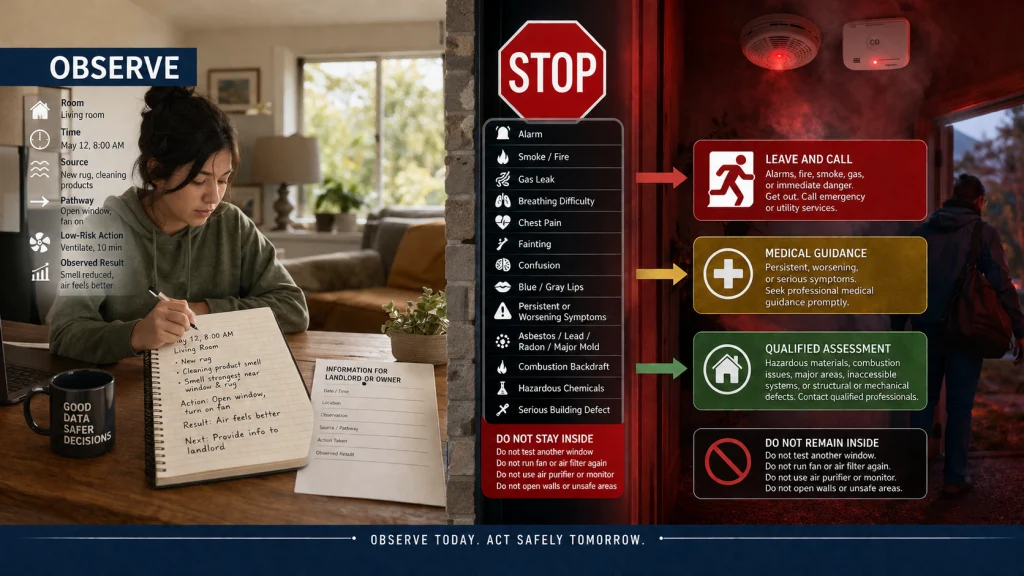
End Lifestyle Troubleshooting When the Situation Requires Immediate or Qualified Help
Household observation cannot diagnose asthma, allergies, poisoning, infection, mold-related illness, carbon monoxide exposure, chemical sensitivity, or another medical condition. Consumer odors, visible conditions, and monitor readings are not substitutes for professional evaluation.
Safety warning: A sounding smoke or carbon monoxide alarm, visible fire or smoke, a suspected gas leak, severe breathing difficulty, chest pain, fainting, confusion, blue or gray lips, or other emergency signs require leaving the area when safe and contacting emergency or utility services as appropriate. Do not remain inside to continue testing windows, fans, filters, or consumer monitors.
Persistent or worsening symptoms require qualified medical guidance. Suspected asbestos, lead, radon, major mold, combustion backdrafting, hazardous chemicals, or building-system defects require appropriately qualified assessment. Renters should document the observed condition and use the applicable building or management process without attempting unsafe inspection or repair.
Name the Source, Pathway, and Control Type
Begin with the room and activity where the condition appears. Identify what may be entering the air, how it reaches occupied space, and whether the first useful control is source removal, local exhaust, suitable outdoor-air ventilation, or supplemental filtration.
Choose the focused guide that owns the next decision, then make one low-risk and reversible change. Escalate when the source belongs to a landlord, utility, contractor, environmental professional, or clinician, and stop immediately when alarms or emergency signs make household troubleshooting unsafe.
Carry the Right Notes Into the Next Guide
Before opening a focused guide, bring five observations: the room, the likely source, the direction air seems to travel, the control already available, and the condition that would make you stop or escalate. Those notes prevent each new page from starting the investigation again.
For window and ventilation questions, add current outdoor conditions. For kitchen or bathroom exhaust, add whether the fan reaches outdoors and whether noise or controls limit use. For apartment concerns, add dates, shared-system clues, and the part of the problem the occupant cannot access safely.
FAQs
🪟 Does opening one window always improve indoor air?
No. The result depends on outdoor conditions, weather, the available airflow path, and whether air can also leave the home. Smoke, pollen, humidity, temperature, noise, or safety may make another approach more suitable.
🌀 Is a portable fan the same as ventilation?
Usually not. A portable fan often recirculates indoor air and changes how air moves within the room. Ventilation requires exchange between indoor and outdoor air.
🍳 Should I use the kitchen hood every time I cook?
Local exhaust is intended to capture cooking air near the source, especially when the hood vents outdoors. The useful routine depends on the cooking activity, hood type, capture area, noise, controls, and maintenance.
🚿 Why does the bathroom mirror stay fogged?
The mirror shows that moisture remains in the room air or is condensing on a cooler surface. Check the exhaust path, replacement-air path, fan operation, and whether recurring dampness needs separate assessment.
🏢 What can a renter do about recurring odors?
Record where and when the odor appears, nearby activities, fan status, weather, and whether it seems connected to shared areas or another unit. Use renter-controlled actions safely, then report building-system or neighboring-source concerns through the appropriate management process.
🧹 Will an air purifier solve every indoor-air concern?
No. Air cleaning is supplemental and must be matched to a defined target and use case. It does not replace source control, local exhaust, suitable ventilation, repairs, or emergency action.
📟 Can a consumer monitor diagnose the problem?
No. A monitor can provide a reading for the conditions it is designed to measure, but it cannot diagnose illness or explain every source in the home. Interpretation belongs in a separate monitoring process.
🚩 When should I leave instead of troubleshooting?
Leave when safe and seek appropriate emergency or utility help for sounding smoke or carbon monoxide alarms, visible fire or smoke, suspected gas leaks, or serious emergency symptoms. Do not stay inside to test ventilation or consumer equipment.