Air cleaners and air filters make more sense when you begin with the air problem rather than the product format. Identify whether the concern is particles, gases, or both, then match the mechanism to the actual room or central system and to a fan speed the household can live with. Source control and appropriate ventilation still come first when they apply. The final choice should include placement, run time, maintenance, annual cost, and safety, not just the strongest claim on the box.
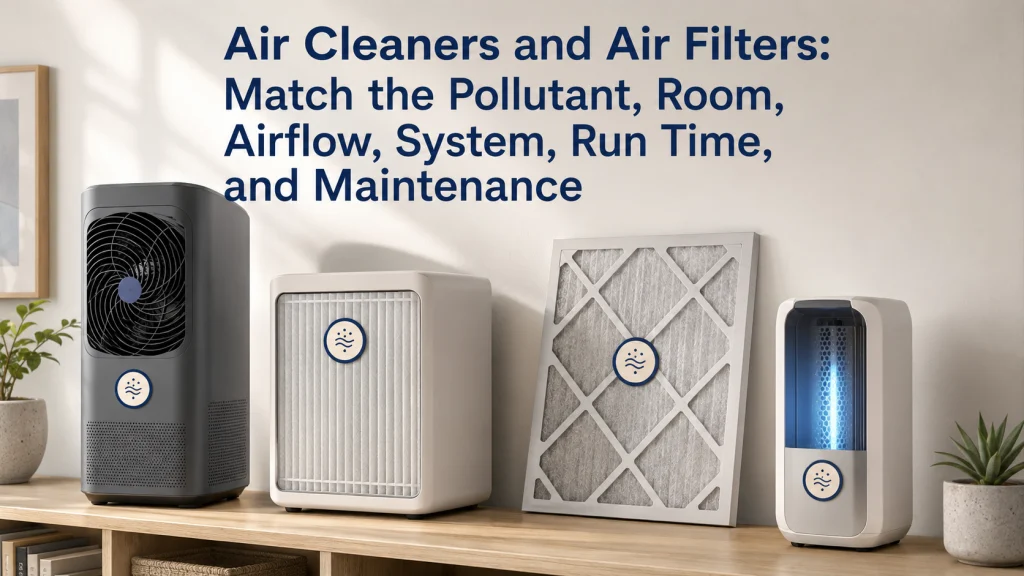
Four Products Can Share One Room Claim and Still Solve Different Problems
Imagine four boxes that all advertise coverage for the same 500-square-foot room. One contains a portable unit with a strong particle-delivery rating. Another contains a smaller unit with a thin carbon sheet. A third is a high-efficiency central filter that may not match the home’s equipment. The fourth is an ozone generator promoted for odor control.
The number on the front does not settle the decision. It does not identify the pollutant, show the rate at the fan speed you will tolerate, confirm central-system compatibility, reveal replacement cost, or explain whether the device creates an unwanted byproduct.
| Option in the same room-size category | What it may be designed to do | What the room claim leaves unanswered |
|---|---|---|
| High-delivery portable particle unit | Move room air through particle-filter media | Noise at the speed you will use, placement, filter cost, and performance in an open layout |
| Small unit with limited carbon media | Combine some particle filtration with some gas adsorption | Which gases are targeted, how much media is present, and how quickly it may become spent |
| Higher-efficiency central filter | Filter air while the central system is moving it | Whether the filter fits, whether the system can operate with it, and how often air actually circulates |
| Ozone-generating device | Market odor treatment through a reactive byproduct | Whether the byproduct is safe for occupied use and whether the original source still needs correction |
The useful comparison begins with the target pollutant and the real operating conditions. Product format comes later.
Use the Main Air-Cleaning Terms Without Treating Them as Interchangeable
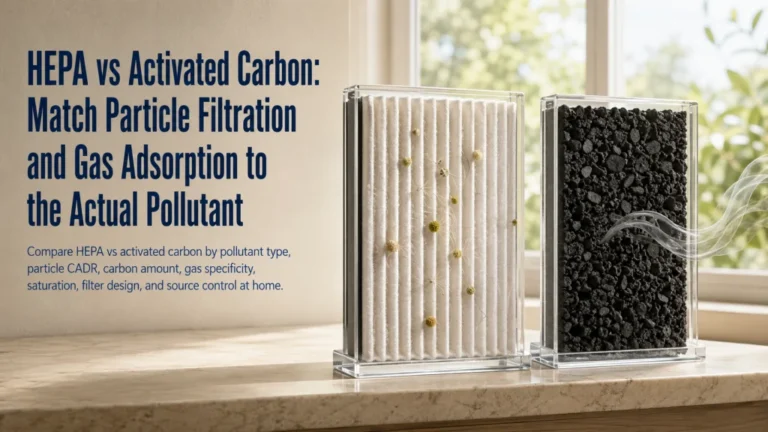
Air cleaner and air purifier are broad consumer terms. They do not identify a mechanism by themselves. A particle filter is intended to capture airborne particles as air passes through its media, while a gas adsorbent uses material that holds certain gases or vapors on its surface. Activated carbon is a common gas-adsorbent material, but the amount, construction, and target pollutant still matter.
A portable unit is placed in or near a room and uses its own fan. A central filter works inside a compatible heating and cooling system while that system moves air. A byproduct is something created by operation rather than removed from the room. Ozone is the key byproduct to screen for when evaluating ionizing or reactive technologies.
| Metric or claim | What it helps describe | What it cannot decide alone |
|---|---|---|
| CADR | The delivery of cleaned air for specified particle categories under stated test conditions | Gas removal, noise at your chosen speed, open-plan behavior, placement, or annual filter cost |
| ACH | How often an equivalent room volume is processed or replaced during a period of time | Whether the calculation matches the actual ceiling height, doors, openings, fan speed, and room mixing |
| MERV | The particle-filtration efficiency category of a central filter | Whether a particular filter size and resistance are compatible with a specific system |
| Room coverage | An advertised or calculated space based on stated assumptions | The target pollutant, operating speed, ceiling height, layout, maintenance, and byproducts |
Each metric answers one narrow question. Keep it beside the mechanism and operating conditions it describes rather than asking it to stand in for the whole decision.
Confirm Source Control and Ventilation Before Adding Filtration
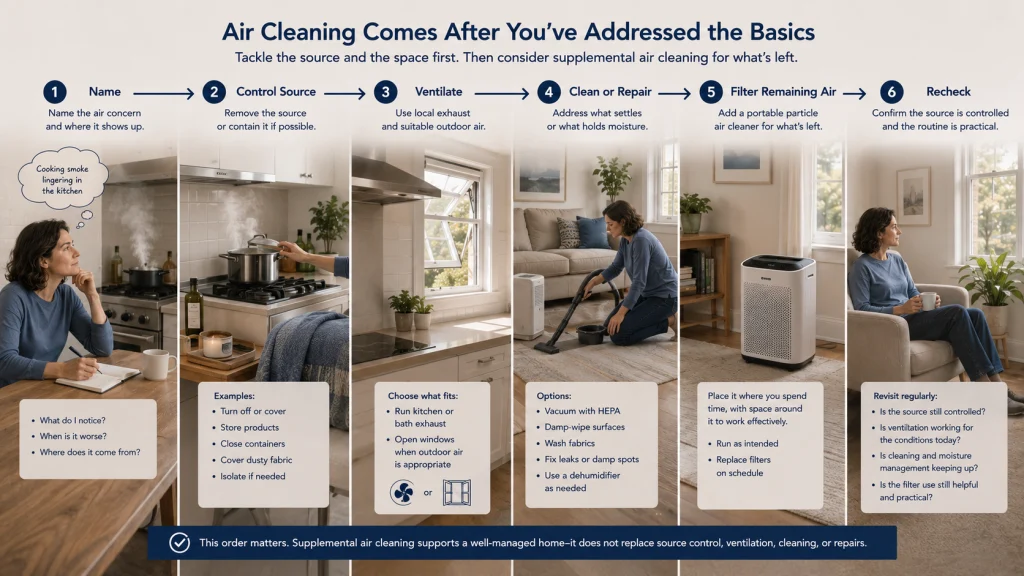
It is easy to reach for a filter because it feels like an immediate action. Yet supplemental air cleaning works downstream from the source. It may reduce some material that reaches the device, but it does not repair a venting problem, remove damp building material, stop smoke at its origin, replace ordinary cleaning, or make a hazardous release safe to remain around.
Source-control-before-filter ladder:
1. Name the concern as specifically as possible.
↓
2. Remove, reduce, contain, or repair the source when that can be done safely.
↓
3. Use local exhaust or clean outdoor-air ventilation when conditions make that appropriate.
↓
4. Address settled dust, moisture, or household material issues through the correct process.
↓
5. Add an air cleaner or filter for the remaining airborne load.
↓
6. Recheck whether the routine is practical and the original source is still controlled.
For the broader control sequence, start with the healthy home environment guide and the detailed approach to indoor air quality and ventilation. Air cleaning becomes the next decision only after those first controls have been considered.
Separate Particle Problems From Gas and Odor Problems
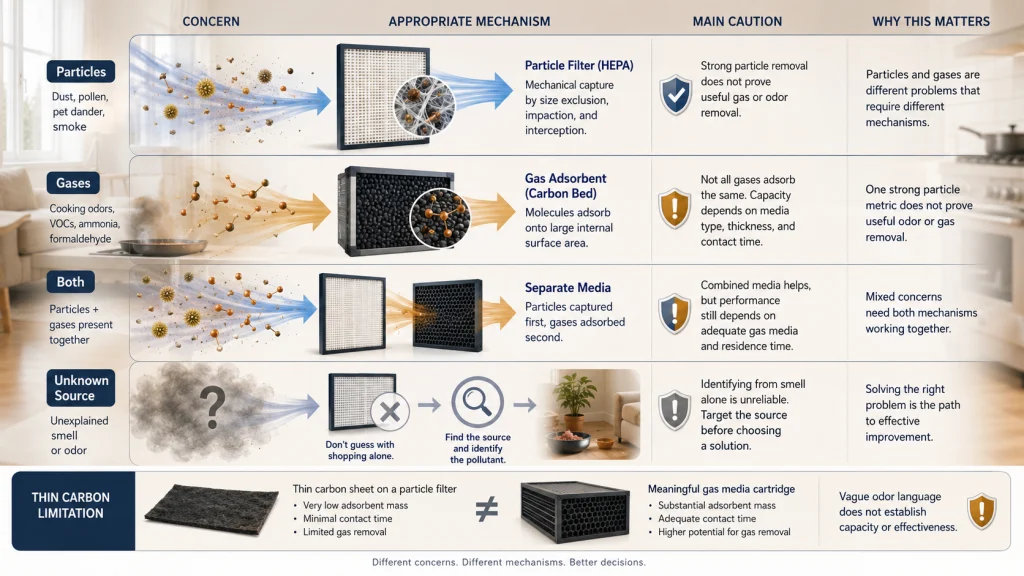
Dust drifting through a sunbeam and a stubborn cooking odor may be noticed in the same room, but they are not the same filtration problem. Particle filters and gas adsorbents are not stronger and weaker versions of one mechanism. They address different material, so the pollutant has to be named before the media is compared.
| What you are trying to reduce | Primary mechanism to investigate | Decision caution |
|---|---|---|
| Pollen, airborne dust, pet dander, or particle-heavy smoke | Particle filtration with verified clean-air delivery | The room, speed, placement, and replacement condition still control real use |
| Specific odors, gases, or vapors | A gas adsorbent selected for that target | A thin carbon sheet or vague odor claim does not establish useful capacity |
| A mixture of particles and gases | Separate particle and gas media with clear documentation | One strong particle metric does not prove gas performance |
| An unspecified smell or unexplained air concern | Source identification before product comparison | Some odors signal a source that should not be handled as a comfort problem |
The detailed comparison of media belongs in HEPA versus activated carbon. Use that decision after the pollutant category is clear.
Use the Evidence Question Before the Shopping Question
Sometimes the most useful first step is to stop shopping long enough to ask what the proposed mechanism can reasonably remove and what remains outside its role. A particle unit may have useful particle data while offering little information about gases. A central filter may have a documented efficiency category but still depend on system operation. An electronic feature may sound advanced without showing a useful clean-air result.
The guide to whether air purifiers work separates supported capabilities from marketing language, health promises, and tasks that still require source control or ventilation. Read that first when the main question is not which unit to buy, but whether the category can address the concern at all.
Build the Purchase Decision Around Use and Ownership
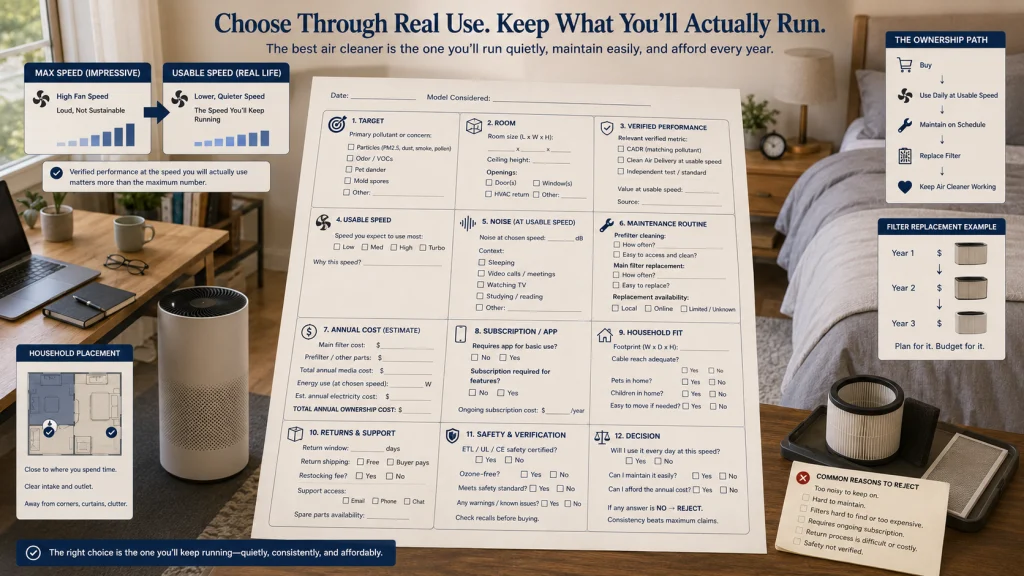
A bright product page cannot show how a machine will feel beside a bed at night, during a video call, or when a replacement filter is suddenly unavailable. A complete buying decision includes the pollutant, verified metric, room, noise, maintenance, and cost after the first purchase. It should also account for app dependence, storage, return freight, and whether basic controls remain usable without an account or subscription.
Editorial observation: Maximum-speed performance matters only when that speed fits the room and routine. A unit that feels unobtrusive across a store aisle may feel intrusive beside a desk or bed, and a hard-to-find replacement filter can quietly turn a capable machine into one that is used less often or maintained late.
| Purchase and annual-cost worksheet | What to record before comparing options |
|---|---|
| Target | Particles, a specific gas or odor, or both |
| Priority space | Room dimensions, ceiling height, door pattern, and open connections |
| Verified performance | The metric that matches the target, not a general room badge |
| Likely operating speed | The speed that remains tolerable during sleep, calls, television, or quiet work |
| Replacement routine | Prefilter cleaning, main-filter replacement, availability, and disposal |
| Ongoing cost | Replacement media, energy use, subscriptions, and optional accessories |
| Household fit | Footprint, controls, cable reach, storage, pets, children, and return friction |
| Safety verification | Electrical condition, stable placement, byproduct information, warnings, and recalls |
Use the complete air-purifier selection process when these ownership questions are more important than a single feature comparison.
Match Clean-Air Delivery to the Real Room, Not Just the Floor Area
Picture a closed bedroom beside an open kitchen and living area. Their floor areas might look similar on paper, yet the open space has more paths for air to move and more places for particles to enter or disperse. Ceiling height, door position, stairwells, connected zones, and the fan speed used in daily life all change the sizing problem.
Start with the occupied zone that matters most, then account for room volume, openings, and whether one unit can serve that area from a practical location. A broad open plan may call for several well-placed cleaning points instead of asking one distant machine to do every job.
The sizing guide for choosing an air-purifier size covers CADR, ceiling height, open layouts, and multiple-unit decisions without pretending that one coverage number fits every home.
Plan Placement, Fan Speed, Run Time, Doors, and Windows Together
A unit tucked behind a sofa may keep the room looking tidy while leaving its inlet crowded and its controls awkward to reach. Placement has to work for the air path and for the people living around it. Leave the inlet and outlet clear, keep the unit stable, route the cord safely, preserve access for filter changes, and choose a spot where the sound remains tolerable.
Doors and windows change the problem rather than producing one universal rule. Closing a bedroom door may help one unit focus on that room, while opening a door may be necessary when the goal includes an adjoining area. Outdoor-air ventilation can be valuable when outdoor conditions are suitable, but it also changes the amount and type of material entering the space.
Use the air-purifier operating guide for placement, speed, run time, multiple rooms, and day-to-day adjustments.
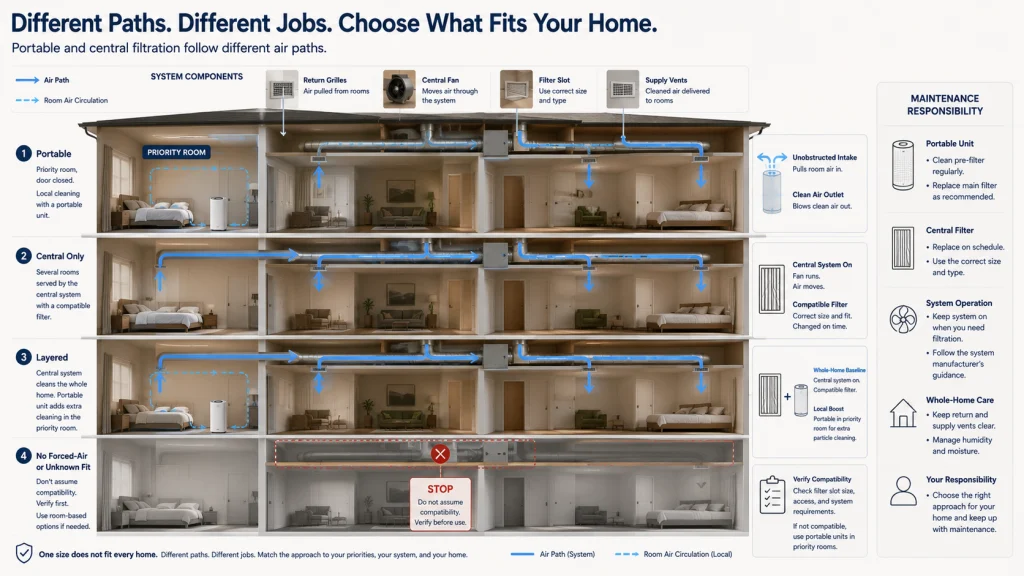
Choose Between a Portable Unit, a Central Filter, or a Layered Approach
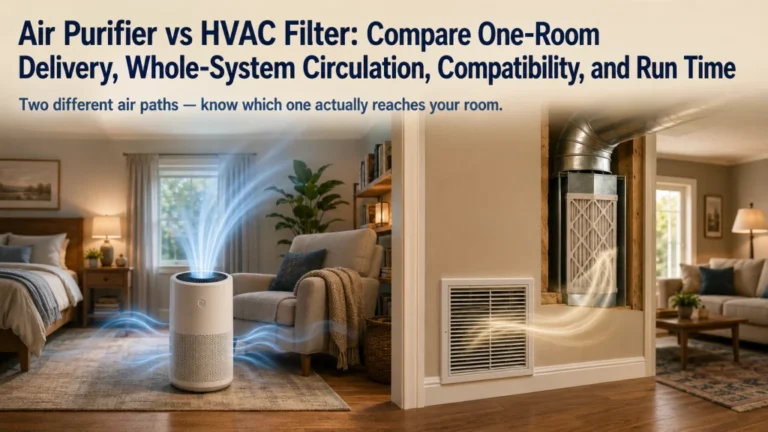
Before comparing portable and central filtration, follow the air path. A portable unit treats the air that reaches its own intake, while a central filter treats air only when a compatible system is circulating it. One follows room placement and local mixing. The other follows ducts, system operation, and filter fit.
Portable-versus-central routing map:
Start with the priority area.
↓
Is one closed or frequently occupied room the main concern?
→ Evaluate a portable unit for that room.
↓
Are several rooms served by a compatible central system that runs often enough?
→ Evaluate central filtration with system fit confirmed.
↓
Do priority rooms need extra particle control even with central filtration?
→ Consider a layered approach using both roles.
↓
Is system compatibility unknown, or is there no forced-air system?
→ Do not force the central route. Verify the system or stay with a room-based option.
For the full comparison, use air purifier versus HVAC filter. That decision should be based on airflow path, occupied rooms, system operation, and maintenance responsibility.
Treat MERV as a Filter-Efficiency Category, Not a Standalone Upgrade Instruction
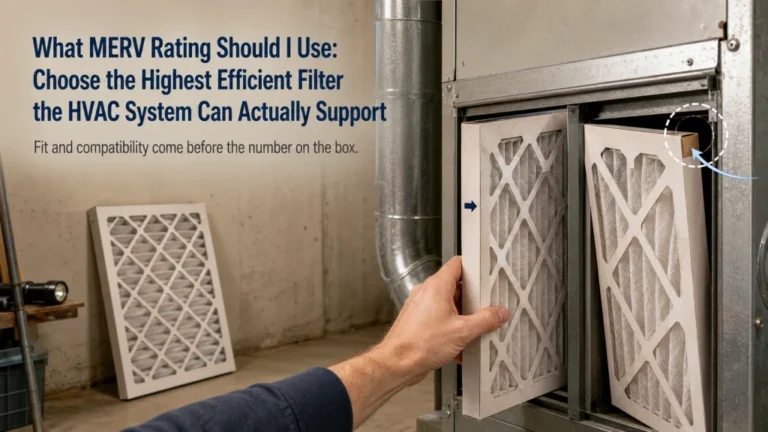
The filter slot is a physical constraint, not a blank space for the highest number on the shelf. A higher efficiency category may capture more particles in the relevant test ranges, but the system still needs the correct dimensions and an acceptable operating match. A filter that does not seat correctly, restricts an unsuitable system, or remains in place after loading is not a useful upgrade.
Record the current filter dimensions and label, the system documentation, the available filter space, and who is responsible for maintenance. When compatibility is uncertain, use qualified system guidance rather than experimenting with progressively higher ratings.
The detailed article on choosing a residential MERV rating keeps the efficiency question connected to filter fit and system capability.
Make Filter Maintenance Part of the Initial Decision
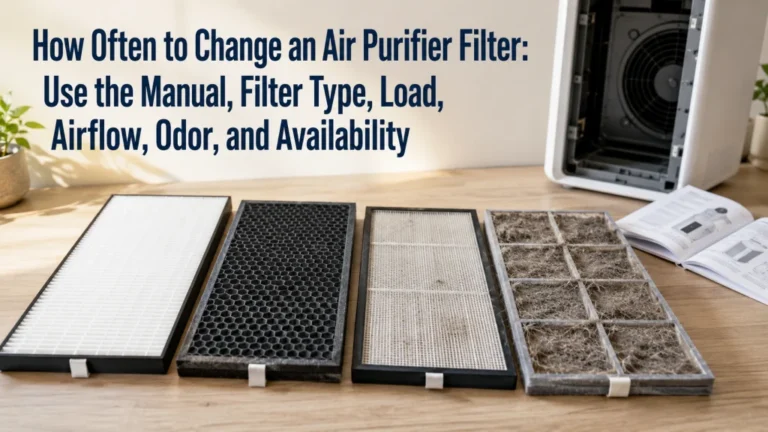
A filter hidden behind a panel is easy to forget until airflow changes, the app sends a reminder, or a replacement is needed immediately. Filter life is not one fixed number for every household. Loading changes with pollutant levels, run time, pets, cooking, smoke events, construction dust, prefilter care, and the amount of air moving through the system. A timer is a prompt to inspect and follow the instructions, not proof that the media is still effective or already spent.
Before choosing a unit, check how the prefilter is accessed, whether it is cleaned or replaced, how the main filter is installed, whether replacement media is consistently available, and what the annual routine may cost. A low purchase price can become a poor fit when the required filter is difficult to find or the unit is awkward to open.
Use the air-purifier filter replacement guide to build a maintenance schedule around actual use and manufacturer instructions.
Screen Ionizer, Plasma, Electrostatic, and Ozone Claims for Byproducts
Electronic air-cleaning language can describe several different mechanisms. A feature name does not show how much cleaned air is delivered, which pollutants are addressed, or whether ozone is intentionally produced or generated as a side effect.
Safety warning: Do not use an ozone generator as a routine occupied-room air cleaner. Do not assume an odor disappearing means the source has been corrected or the air is safe. Verify the device type, operating restrictions, emissions information, current warnings, and any applicable certification before use.
A UV feature is a separate mechanism, not proof of particle delivery, gas removal, or medical protection. Verify its intended role, enclosure, maintenance requirements, byproduct information, and operating warnings rather than treating the feature name as a complete performance claim.
The focused guide to ozone and ionizer safety separates particle charging, collection methods, reactive claims, and situations where the safer decision is to avoid the device.
Evaluate DIY Particle Air Cleaners as Purpose-Built Temporary Systems
A box-fan filter or Corsi-Rosenthal-style build is a particle-cleaning option, not a general gas-removal device. The design, filter orientation, fan condition, stable assembly, cord placement, clear airflow, and supervision all matter. Damaged fans, unstable stacks, blocked airflow, wet components, overheating, and improvised electrical changes are stop conditions.
DIY can be a practical route when the goal is clear and the build follows current safety guidance. It should not be presented as an automatic substitute for every portable unit, central filter, ventilation need, or hazardous-source response.
Use the DIY air-cleaner guide for box-fan and multi-filter configurations, safe setup, placement, and maintenance boundaries.
Send Moisture, Cleaning, Chemical, and Sensor Questions to the Correct Process
Air cleaning should not absorb every healthy-home problem into one product decision. Visible moisture, damp materials, and mold concerns belong in humidity, moisture, and mold control. Settled dust, fabric reservoirs, and household cleaning routines belong in household allergens and cleaning.
Questions about a coating, solvent, fragrance, furnishing, renovation material, or other chemical source belong in household chemicals and materials. Questions about sensor numbers, detector placement, trends, and what a device can or cannot measure belong in home environmental monitoring.
These boundaries prevent a filter from becoming the default answer when the actual task is source removal, moisture repair, cleaning, material evaluation, or measurement interpretation.
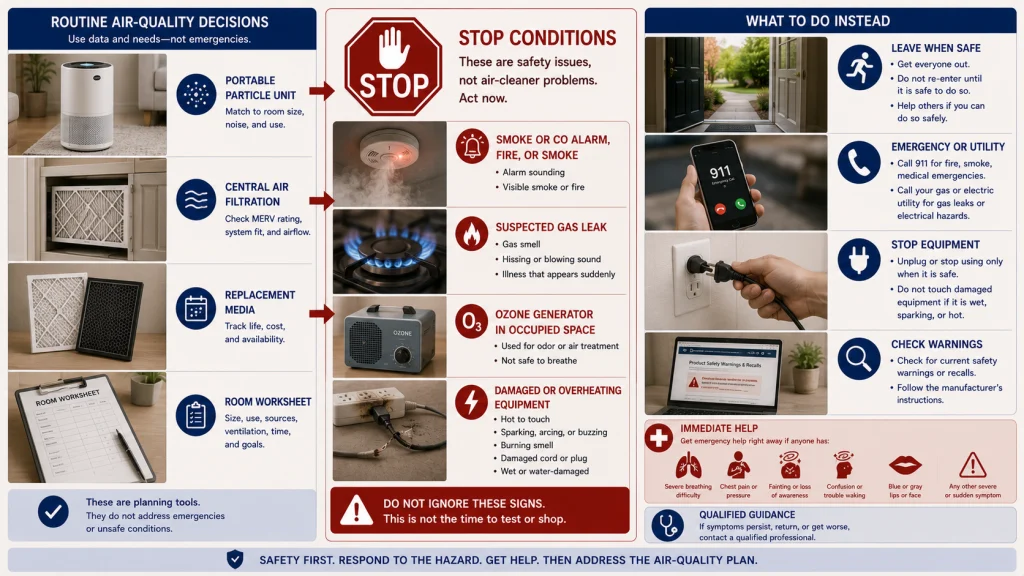
Recognize Alarm, Smoke, Gas, Equipment, and Medical Stop Conditions
Ozone and emergency boundary: Do not use an ozone generator as a routine occupied-room air cleaner. A sounding smoke or carbon monoxide alarm, visible fire or smoke, or a suspected gas leak is not an air-cleaner shopping problem. Leave the area when it is safe to do so and contact emergency or utility services as appropriate. Do not remain inside to test a purifier or wait for an odor to change.
Stop using equipment that is damaged, unstable, wet, unusually hot, sparking, producing a burning smell, or operating with a damaged cord or plug. Follow current manufacturer warnings and recall instructions, and do not modify electrical parts or defeat safety features.
Air-cleaning products do not diagnose or treat asthma, allergies, infection, smoke injury, mold-related illness, chemical exposure, or other medical conditions. Severe breathing difficulty, chest pain, fainting, confusion, blue or gray lips, or other emergency signs require immediate appropriate help. New, persistent, unexplained, or worsening symptoms require qualified medical guidance.
Choose an Air-Cleaning Method You Can Verify, Operate, and Maintain
Start by naming the pollutant and checking whether the source, ventilation, moisture, or cleaning problem has been skipped. Then decide whether the remaining job belongs to a portable room unit, a compatible central filter, gas media, a combined approach, or a verified DIY particle system.
Before buying, write down the room or system, the metric that matches the target, the speed the household can comfortably keep running, the replacement routine, the annual cost, and the safety checks. The most useful option is the one that quietly fits daily life while doing the defined job, without creating a new maintenance, compatibility, noise, or byproduct problem.
Explore the Next Air-Cleaning Decision
| Your next question | Use this guide |
|---|---|
| Can an air purifier address the pollutant I have in mind? | Do air purifiers work? |
| How do I compare a complete set of purchase and ownership factors? | How to choose an air purifier |
| What clean-air delivery and room assumptions should I use? | What size air purifier do I need? |
| Where should the unit go, and how should it run? | How to use an air purifier |
| Do I need particle media, gas media, or both? | HEPA versus activated carbon |
| Should I use a room unit or central filtration? | Air purifier versus HVAC filter |
| Which central-filter efficiency category fits my system? | What MERV rating should I use? |
| How should I plan prefilter care and replacement? | How often to change an air-purifier filter |
| What should I know about ozone, ionizers, and reactive features? | Are ozone air purifiers safe? |
| Is a box-fan or multi-filter build appropriate for my goal? | DIY air purifier |
FAQs
🌬️ Is an air purifier the same as an air filter?
Air purifier is a broad consumer term, while an air filter describes a component or mechanism that removes material from moving air. A portable purifier may contain one or more filters, and a central system may use a filter without being marketed as a purifier.
🏠 Can one portable unit handle an open floor plan?
It depends on room volume, openings, air mixing, placement, target pollutant, and the fan speed used in practice. Treat connected spaces as a geometry and airflow question rather than relying on the total floor-area claim alone.
🧪 Does activated carbon remove every odor or gas?
No. Gas-media performance depends on the target, media type, amount, construction, airflow, and how spent the media has become. An unexplained or hazardous odor should be investigated at the source rather than covered with a general carbon claim.
🔁 Should a portable air cleaner run continuously?
Run time should match the pollutant event, room use, outdoor conditions, noise tolerance, and the unit’s instructions. Consistent operation at a usable speed is usually more practical than relying on a brief burst at a setting the household cannot tolerate.
🛠️ Can I install a higher-MERV filter in any central system?
No single rating is appropriate for every system. Confirm the exact filter dimensions, system guidance, available filter space, and operating compatibility before changing efficiency categories.
⚠️ Are ionizers and ozone generators the same thing?
They are not identical labels, but some electronic devices may intentionally produce ozone or create it as a byproduct. Verify the actual mechanism and emissions information instead of assuming the feature name establishes safe occupied-room use.