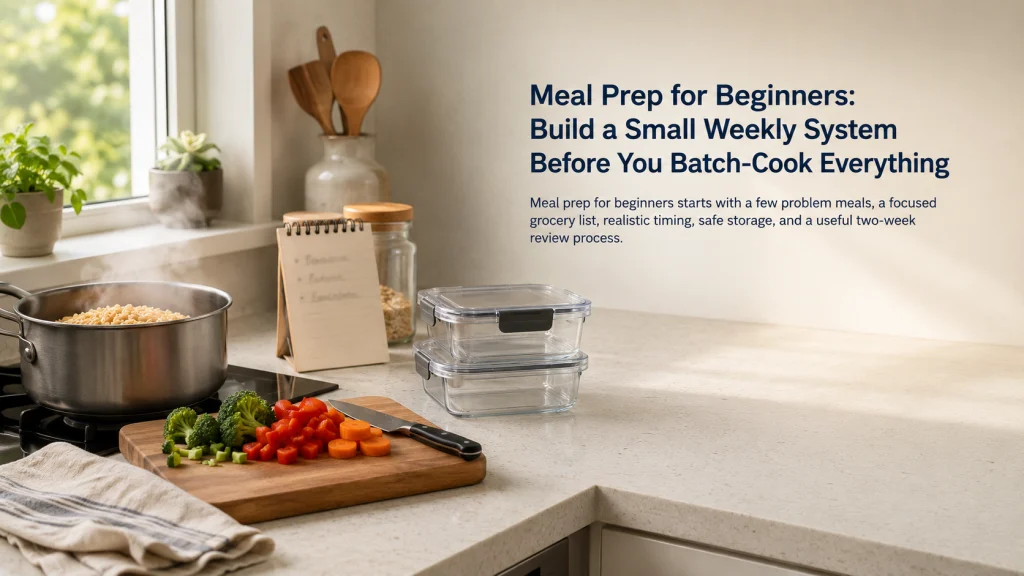
Meal prep for beginners should make an ordinary Tuesday easier, not turn the first week into a test of discipline. Start with two or three meals that repeatedly leave you rushed, undecided, or surrounded by unused ingredients, then choose the lightest preparation level that would help. Check what is already at home, build a focused list, give the work a realistic place in the week, and review what was actually eaten after two weeks. The goal is a small system that feels useful enough to repeat, not a refrigerator arranged for a photograph.
Two First Weeks That Look Nothing Alike
The first plan covers twenty-one prepared meals, twelve recipes, a new set of containers, and one long Sunday cooking session. By midweek, the refrigerator is crowded, several meals no longer sound appealing, and the remaining ingredients do not match the original plan.
The second plan prepares two lunches, one dinner component, and one backup meal. It uses a grain already in the pantry, vegetables that can appear in more than one dish, and a short preparation block divided between two days. There are fewer finished meals to photograph, but there is more useful information about timing, appetite, storage, and what the household will realistically repeat.
| First-week approach | What it asks the beginner to predict | What the week can teach |
|---|---|---|
| Prepare nearly everything | Every meal choice, quantity, recipe, storage need, and available hour | Whether one ambitious plan can be completed |
| Test a small system | Which two or three moments need help first | What to keep, remove, resize, or move to another day |
Key decision: Treat the first two weeks as observation, not as a performance. The smaller plan is easier to finish, and finishing it gives you evidence for the next version.
The broader meal prep decision guide can help when the main difficulty is still unclear. This page begins after planning has been identified as the first layer to improve.
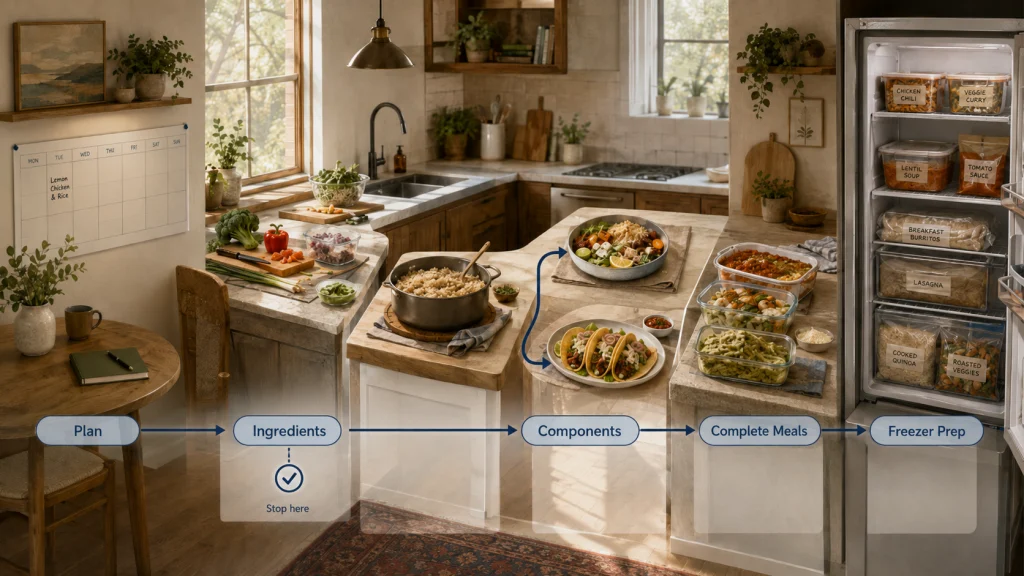
Choose a Meal Prep Level Before Choosing Recipes
Meal prep is not one method. It ranges from writing a plan to freezing complete meals, and each level asks for a different amount of time, storage, and confidence. A beginner can start at the lowest level that removes a real problem.
- Planning only: Decide which meals will happen at home and what ingredients they require.
- Ingredient preparation: Wash, chop, portion, or thaw ingredients that otherwise slow down a later meal.
- Component preparation: Cook one flexible element, such as a grain, sauce, protein, or roasted vegetable, for use in more than one meal.
- Complete meals: Assemble or cook a meal that needs only reheating or a small finishing step.
- Freezer preparation: Prepare food specifically for a later week, with suitable cooling, packaging, labeling, thawing, and reheating plans.
These levels can coexist. You might plan breakfasts, prepare lunch ingredients, cook one dinner component, and keep one frozen backup. That is still a coherent system because each action solves a named problem.
When the planning is already stable and repeated cooking is the main burden, move to the separate guide to batch cooking methods. Do not add a higher prep level simply because it looks more complete.
Start With the Two or Three Meals That Need Help Most
The most useful place to begin is often easy to recognize. It is the lunch assembled while standing at the counter, the dinner decision made after everyone is already hungry, or the breakfast skipped because choosing and preparing it feels like one task too many.
Other meals may be working perfectly well. A relaxed dinner that the household enjoys cooking together does not need to be pulled into the project just because it appears on the calendar. Preparation earns its place when it removes a repeated snag, not when it makes the week look more complete.
- Which meal is skipped, delayed, or replaced most often?
- Which one creates cleanup at the least convenient time?
- Where do ingredients keep waiting for a plan that never happens?
- Which meal would become easier with one ready component rather than a finished dish?
Practical tip: Choose no more than three problem moments for the first test. That is enough to reveal whether the real difficulty is deciding, timing, quantity, variety, or storage without asking the whole week to change at once.
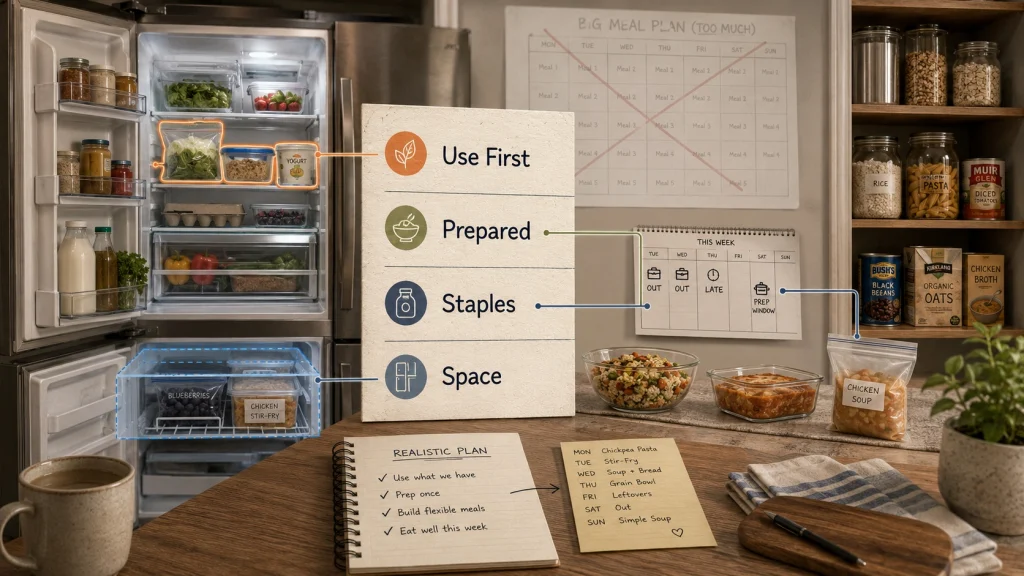
Check the Refrigerator, Freezer, Pantry, and Current Leftovers First
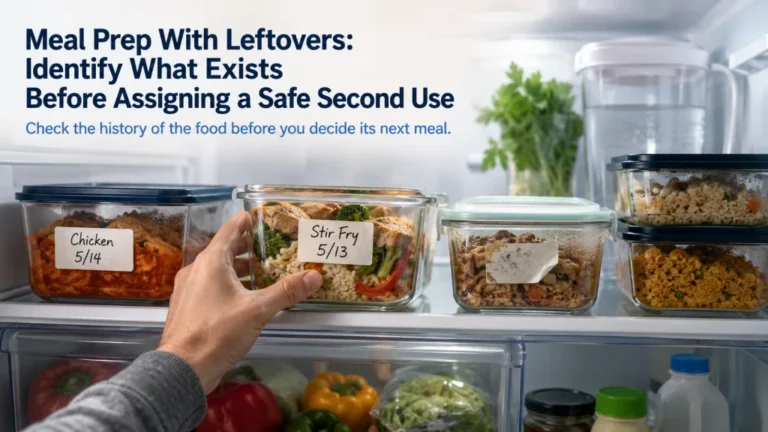
A plan made without an inventory often creates duplicates and ignores food that already has the shortest useful life. Spend a few minutes looking before deciding what to prepare. The goal is not to create a permanent pantry system. It is to understand what this week can use.
| Inventory area | Record only what changes this week’s plan |
|---|---|
| Refrigerator | Perishable food that should be used soon, open packages, prepared components, and current leftovers |
| Freezer | Ready meals, frozen ingredients, available space, and anything that should be thawed safely |
| Pantry | Staples that can anchor a meal, nearly empty items, and duplicates that should not be bought again |
| Schedule | Meals eaten away from home, late days, social plans, and realistic preparation windows |
Inventory card: Write four lines: use first, already prepared, available staples, and space limits. Those four lines are enough for a beginner plan. Ongoing pantry counts, baseline stock, and shopping frequency belong in a broader purchasing system.
If clearing a counter, finding tools, or reaching ingredients consumes more time than the food itself, the next problem may be kitchen organization for meal prep rather than the weekly plan.
Let the Calendar Shape the Food Plan
A week can look open on Sunday and become crowded by Wednesday. Mark the meals that will truly happen at home before choosing what to prepare. A late meeting, an appointment across town, or an evening that usually ends with everyone tired changes what “easy” needs to mean.
Some days need a reheatable dinner. Others only need vegetables washed or one component ready to finish. A free evening may be better protected for fresh cooking, while a busy afternoon may justify a portable lunch. The plan should make room for the life already happening instead of asking the household to obey a template.
Use the step-by-step guide to plan meals for the week when the main difficulty is choosing meals, matching them to the calendar, and deciding where leftovers can be used.
Turn the Plan Into a List You Can Trust
Replanning in a store aisle is tiring because the original decisions are no longer visible. A useful grocery list carries those decisions with you. Begin with the meals already chosen, subtract what is at home, and group the missing items so they are easy to check.
The list does not need to settle every purchasing question. Package size, store choice, bulk buying, online ordering, and pantry design belong to a later step. For now, the list only needs to prevent the familiar return home with plenty of food but one missing ingredient that stops dinner.
Use the meal prep grocery list process when ingredients are forgotten, duplicate purchases are common, or planned meals fail because the list does not reflect the inventory.
Give the Work a Place in the Week
A meal plan names food. A preparation schedule names actions and gives them somewhere to happen. Without that second step, a reasonable plan can quietly become one long session that starts with enthusiasm and ends with a crowded sink.
The work does not have to live on one day. Produce can be washed after shopping, one component can cook while another low-attention task is underway, and a backup meal can be assembled when more refrigerator space becomes available. Splitting the work is not a lesser version of meal prep. It may be the version the household can actually repeat.
Use a meal prep schedule when the plan is reasonable on paper but the tasks pile into one exhausting block or repeatedly collide with work, caregiving, or cleanup.
Count the Work You Can Feel, Not Just the Clock
Ten minutes while something cooks quietly is different from ten minutes with a knife in hand, several pans in use, and no clear place to set the next ingredient. Total elapsed time matters, but attention and cleanup often decide whether a session feels manageable.
Write setup, hands-on preparation, waiting, cooling, portioning, washing, and putting food away as separate blocks. Hidden work becomes easier to adjust once it has a name. You may discover that the cooking time was never the problem. The difficult part was clearing the counter first or finishing when energy was already gone.
Use the guide to estimate how long meal prep takes when preparation regularly runs past the planned window or the household underestimates finishing tasks.
Editorial observation: Planners and meal-prep kits often display a complete week as one neat package. That format can hide the difference between choosing, shopping, preparing, cooling, cleaning, and putting food away. A seven-day container set can also create pressure to fill every space even when only three meals need advance preparation.
Use the Budget to Simplify the Plan
A spending boundary can make the week clearer. It encourages the plan to begin with food already available, reuse flexible ingredients, and question extras that add cost without making one difficult meal noticeably easier.
Expenses often grow through small additions: another recipe with its own garnish, a convenience item that saves little time in this kitchen, or an ingredient bought for one meal and forgotten afterward. Removing one of those demands can protect both the budget and the energy needed to finish the plan.
Use the guide to meal prep on a budget when the plan needs a spending cap, cost tradeoffs, or a way to choose between convenience and preparation workload.
Leave Enough Flexibility for Food to Still Sound Good
A lunch that sounded appealing on Sunday may feel repetitive by Thursday. That does not mean the entire plan failed. It may mean too many decisions were locked in before the week began.
Keep flexible components separate when possible, change a sauce or finishing element, or leave one meal open for what sounds right later. More recipes are not automatically more variety. They can also mean a longer list, more setup, and several partial ingredients waiting to be used.
Use meal prep without eating the same thing every day when boredom or changing appetite causes prepared food to be ignored.
Prepare for the Meals That Are Likely to Happen
Quantity begins with the meals you chose, the people expected to eat them, and any leftovers that already have a purpose. It should not begin with the number of containers in a set or the empty shelf that seems available on preparation day.
For the first test, make the smallest amount that can answer a real question. Two difficult lunches only require enough food to see whether advance work helps. One dinner component may be useful across several evenings, but only when those uses are named before cooking begins.
Use the guide on how much food to meal prep when overproduction, uncertain household use, or unplanned leftovers make the plan difficult to size.
Read Unused Food as Information, Not Failure
Finding a forgotten container or a soft vegetable at the end of the week can feel discouraging, especially after time was spent planning. Treat it as a clue. The mismatch may have started with too many planned meals, duplicate ingredients, limited visibility, an oversized package, or a schedule that changed after shopping.
Record what went unused and the reason in plain language. “Hidden behind other food” points toward visibility. “Prepared but never wanted” points toward variety or quantity. “Bought for a dinner that moved” points back to the calendar. The purpose is not to judge the week. It is to prevent the same friction from being copied into the next one.
Use meal planning to reduce food waste when spoilage, unused ingredients, or repeated overbuying should shape the next plan.
Know Where Planning Ends and Shopping Decisions Begin
This beginner system ends with a completed plan, list, schedule, budget, quantity estimate, and first-test framework. Choosing where to shop, how often to go, whether to buy in bulk, which ingredient format reduces work, what pantry stock to maintain, and whether online or in-store shopping fits the household are different decisions.
Once the list is complete, use the guide to grocery shopping and pantry planning for purchasing execution, pantry stock, ingredient formats, trip frequency, and shopping channels.
If the weekly plan works but the household still struggles with storage, equipment, or routine fit, continue with the focused guides to meal prep storage, meal prep tools and appliances, or meal prep systems for real schedules. These topics begin after the planning layer is clear.
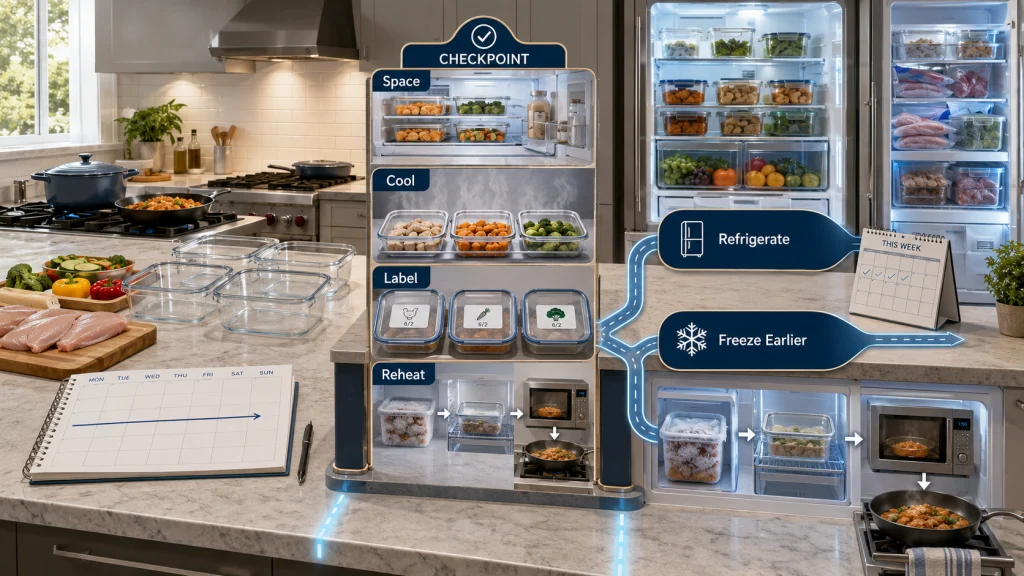
Add a Food-Safety Checkpoint Before Assigning Storage Time
Preparation is not finished when cooking stops. The plan must also leave enough time and space for safe handling, cooling, storage, thawing, and reheating. Storage duration varies by food and method, so use current official guidance for the specific item rather than stretching the plan to fit an assumed number of days.
Safety warning: Refrigerate perishable food promptly, keep raw foods separated from ready-to-eat foods, use safe cooking practices, and do not rely on smell or appearance alone to decide whether questionable food is safe. Freeze food earlier when the planned refrigerated period would exceed current guidance for that food.
- Does the refrigerator or freezer have enough suitable space?
- Can cooked food be cooled and put away without a long delay?
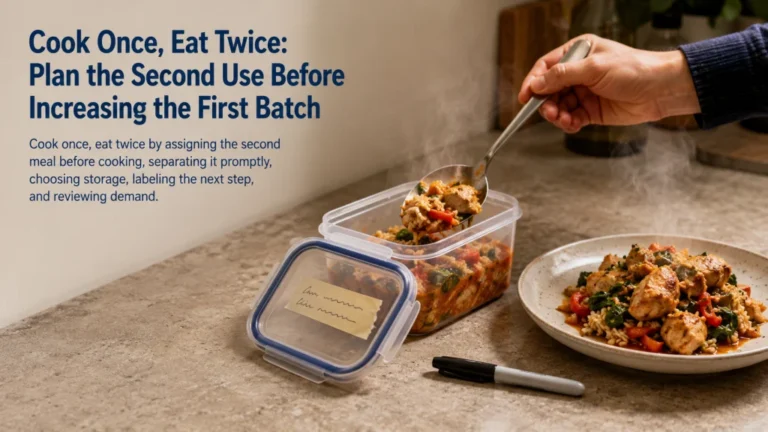
- Will containers be labeled well enough to identify the food and preparation date?
- Is there a clear thawing and reheating plan for anything frozen?
People at higher risk of foodborne illness may need stricter guidance from a qualified professional. Severe or persistent symptoms after eating require appropriate care rather than changes to a meal-prep schedule.
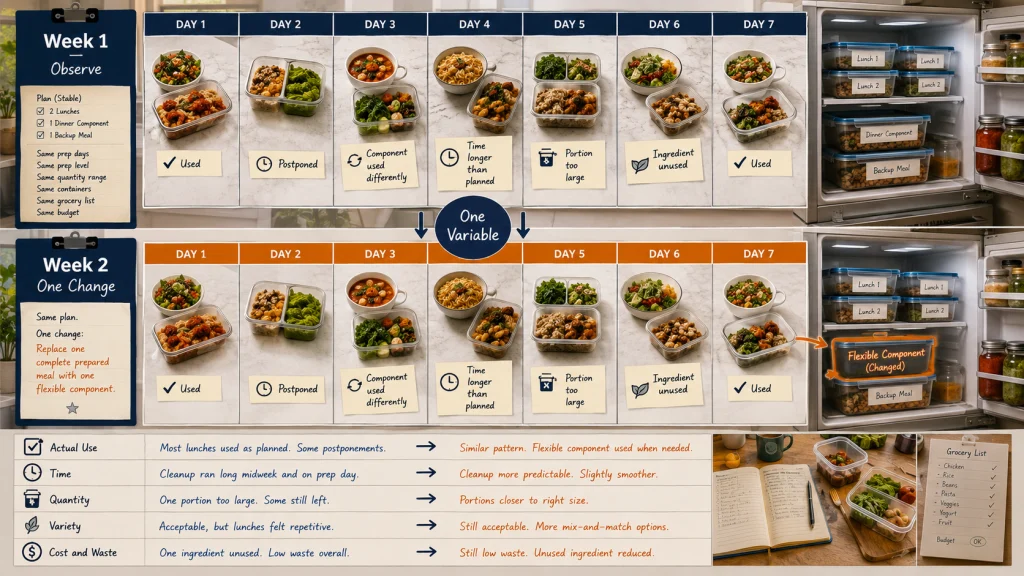
Run a Two-Week Test and Change One Variable
Do not grade the first week as a success or failure. Let it show you where the system asked for too much. The second week can then test one response. Changing meal count, prep level, schedule, quantity, variety, and budget together may create a different week, but it will not show which adjustment mattered.
| What to record | Week 1 | Week 2 |
|---|---|---|
| Meals prepared in advance | What was planned and completed? | What stayed the same? |
| Actual use | What was eaten, postponed, frozen, or discarded? | Did the single change improve use? |
| Time | Where did active work or cleanup exceed the estimate? | Did timing become more realistic? |
| Quantity and variety | Was there too much, too little, or too much repetition? | Did the revised amount or format fit better? |
| Cost and waste | What was bought but not used? | Did the next list avoid the same mismatch? |
Change one variable: Remove one planned meal, move one task to another day, prepare a component instead of a complete dish, or adjust one quantity. Keep the rest of the test stable enough to understand the result.
Match the Question to the Next Planning Step
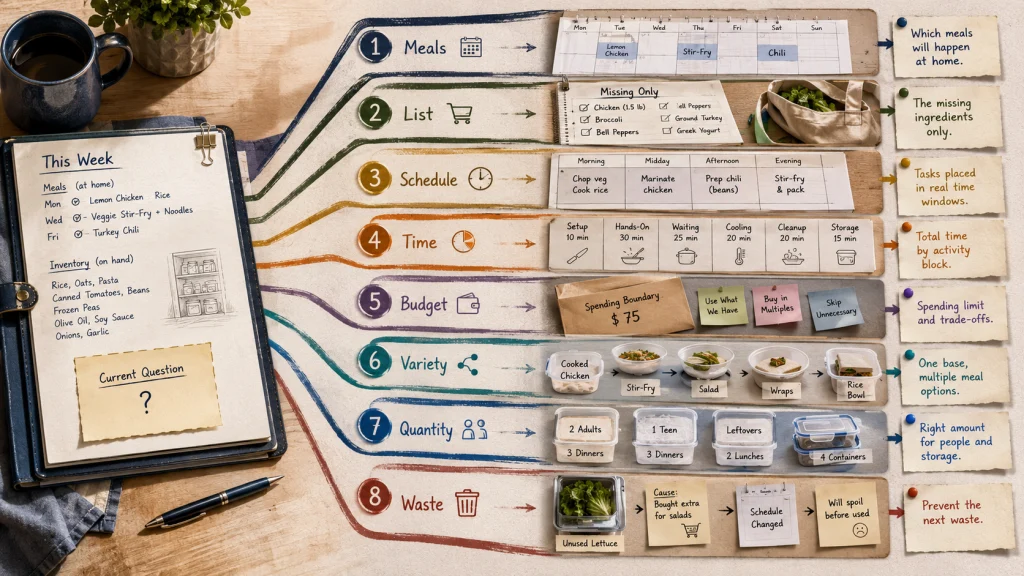
Use the question that is blocking the current plan. Each guide below takes one decision further without turning the first week into a complete lifestyle overhaul.
| Question blocking the plan | Next guide | Bring this information |
|---|---|---|
| Which meals should happen this week? | Planning meals for the week | Calendar, meals at home, leftovers, and the meals that need help |
| What belongs on the shopping list? | Building a meal prep grocery list | Selected meals and current inventory |
| When should each task happen? | Creating a preparation schedule | Available time blocks and task sequence |
| How much time will the work require? | Estimating preparation time | Active, passive, cooling, and cleanup tasks |
| How can the plan stay within budget? | Planning meal prep spending | Spending boundary, inventory, and convenience tradeoffs |
| How can prepared food feel less repetitive? | Building variety into meal prep | Components that can repeat and elements that need change |
| How much food should be prepared? | Estimating meal prep quantity | People, planned uses, leftovers, and storage space |
| Why does food keep going unused? | Reducing waste through planning | What was discarded, why, and where the plan changed |
Keep the First System Inside Its Proper Scope
This guidance is for generally healthy adults building a practical home routine. It does not prescribe calories, macronutrients, weight-change portions, therapeutic diets, allergy or celiac management, eating-disorder strategies, medication-related meal timing, pregnancy nutrition, or feeding plans for infants and children.
A household does not need to cook every meal at home for meal prep to be useful. The system can support only the occasions where advance planning makes life easier. Individual nutrition needs, medical conditions, and severe or persistent symptoms after eating require qualified guidance.
Build the Week That Teaches You What Comes Next
Choose one prep level, two or three meals that need help, and the planning question that currently blocks progress. Complete the inventory, list, schedule, time estimate, quantity, and safety check only as far as that small test requires.
The first useful week may look modest. It may be two calmer lunches, one dinner that no longer begins with an empty-counter stare, and a backup that prevents a rushed decision. Review the system after two weeks, keep what was genuinely used, and change one source of friction. A repeatable routine grows from relief you can notice, not from filling every box in the refrigerator.
Explore the Planning Decision You Need Next
The eight focused guides above cover weekly selection, list building, timing, workload, budget, variety, quantity, and waste. Start with the question that prevented the current plan from being completed, then return to the two-week sheet to see whether the change worked.
FAQs
🧭 What is the easiest meal prep level for a beginner?
Planning only, ingredient preparation, or one prepared component are often easier starting points than a refrigerator full of complete meals. Choose the lowest level that removes a repeated problem in your week.
📅 Do I need to meal prep for all seven days?
No. Prepare only the meals or components that benefit from advance work. Leaving room for fresh cooking, meals away from home, and changing preferences can make the system easier to maintain.
🥣 Should I start with breakfasts, lunches, or dinners?
Start with the meal that repeatedly creates the most friction. The answer may be a rushed lunch, a late dinner, or a morning decision rather than the same meal for every household.
🛒 Should the meal plan or grocery list come first?
Check current food first, choose the meals, and then translate the missing ingredients into a list. Shopping decisions such as package format, trip frequency, and store channel come after the list exists.
⏱️ Why does meal prep take longer than expected?
Setup, chopping, cooking, cooling, portioning, cleanup, and storage are often counted as one task. Estimating active and passive time separately makes the hidden workload easier to see.
🎨 How can I avoid getting bored with prepared food?
Keep flexible components separate and change one element such as seasoning, texture, temperature, or serving format. Variety does not require a completely different recipe for every meal.
📦 Do beginners need a full container set?
No. First identify what will be prepared, how much space is available, and how the food will be stored safely. Existing suitable containers may be enough for a small test.
🚩 When should meal-prep planning stop and professional guidance begin?
Stop using general planning advice for therapeutic nutrition, allergies, celiac disease, eating-disorder needs, medication-related timing, pregnancy nutrition, or individualized feeding needs. Severe or persistent symptoms after eating also require appropriate care.