Batch cooking works best when every extra portion has a clear job before the stove is turned on. The same ingredients can become prepped ingredients, flexible components, complete refrigerated meals, freezer portions, or an accidental surplus, and each outcome needs a different plan. Choose the method first, then confirm the intended uses, recipe yield, cooking capacity, cooling route, and storage destination. The right batch is the amount the household can cook, cool, store, and actually use without creating a new problem.
The Same Ingredients Can Lead to Five Different Outcomes
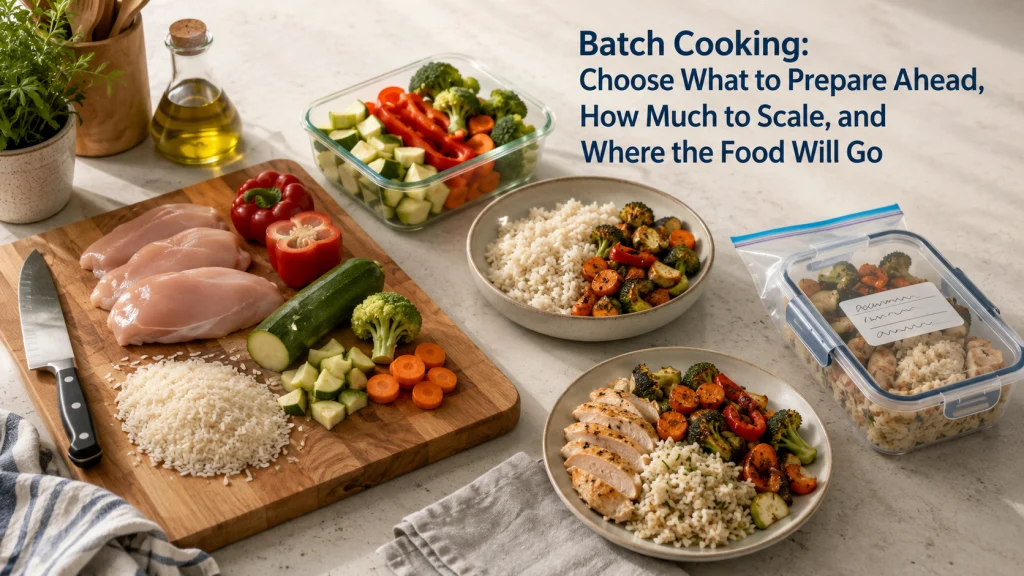
Picture chicken, rice, and vegetables on one kitchen counter. They could be washed and cut for later, cooked as flexible building blocks, assembled into complete refrigerated meals, divided into freezer portions, or tipped into one more pan simply because there is room.
From across the room, all five choices may look like productive meal prep. Only four have a defined next step. The fifth leaves the household to solve cooling, storage, and use after the food already exists.
| Outcome | What is prepared | Next action | Destination |
|---|---|---|---|
| Prepped ingredients | Washed and cut vegetables | Cook in a later meal | Refrigerator |
| Cooked components | Plain rice, cooked chicken, roasted vegetables | Combine in different meals | Refrigerator, with selected portions possibly frozen |
| Complete meals | Fully assembled bowls or dishes | Reheat and eat as planned | Refrigerator |
| Frozen portions | Food chosen for acceptable freezer quality | Freeze, thaw safely, and reheat later | Freezer |
| Unplanned surplus | An extra pan with no assigned use | Find space and decide later | Uncertain |
The useful starting question is not, “How much can I cook?” It is, “What am I preparing ahead, and what must happen to it next?”
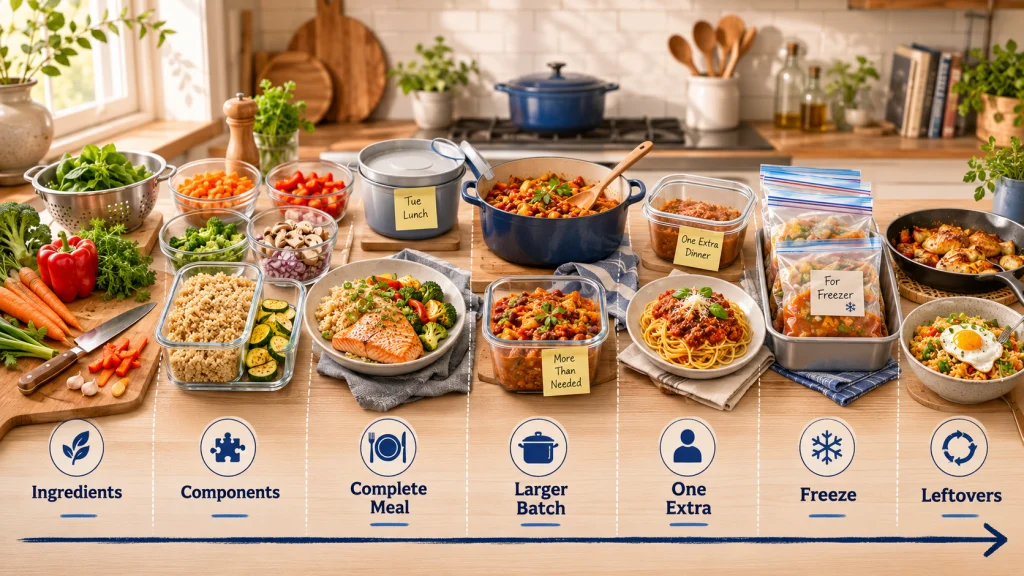
Seven Terms That Should Not Be Used Interchangeably
Advance preparation covers several methods. Naming the method prevents a small task, such as chopping vegetables, from expanding into a full cooking session that the household did not need.
| Term | Practical meaning | Defining question |
|---|---|---|
| Ingredient prep | Raw ingredients are washed, trimmed, measured, cut, or portioned for later cooking. | Will the food still need normal cooking or assembly? |
| Component prep | Flexible building blocks are cooked separately and combined in different ways later. | Can the same component support more than one meal? |
| Make-ahead meal | A complete dish is cooked or assembled before the time it will be served. | Is the dish already assigned to a specific meal? |
| Batch cooking | The yield of one recipe is deliberately expanded, or several planned dishes are cooked in one session. | Are quantity and session scope being increased on purpose? |
| Planned extra | One additional meal is intentionally produced during the original cooking session. | Is there one clear second use rather than a large open-ended surplus? |
| Freezer meal | A meal or portion is prepared with freezing, later thawing, and reheating in mind. | Will the food retain acceptable safety, texture, and structure after freezing? |
| Leftover reuse | Food that already exists is assigned a safe and realistic next use. | Is the starting point an existing surplus rather than a planned new batch? |
These methods can appear in the same week, but they solve different problems. A household may prep vegetables, cook two components, assemble one dinner, and freeze two portions without needing to call the whole process one large batch.
Begin With Planned Uses and Storage Destinations
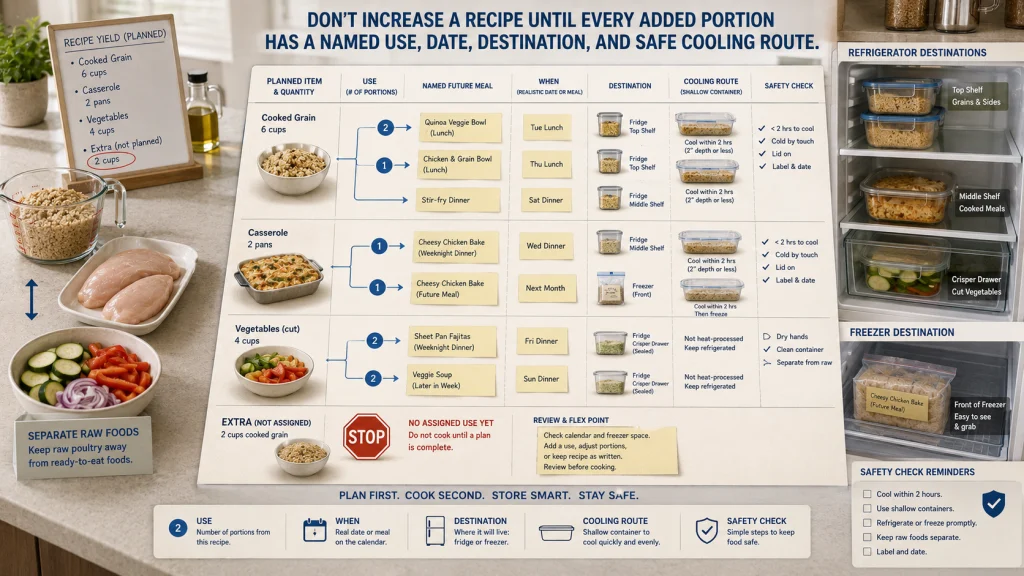
A batch needs jobs before it needs volume. “Lunches for the week” may sound specific, but it can still hide two days away from home, one flexible day, and a refrigerator shelf that is already full. A calmer plan assigns each added portion to a real meal, component role, or freezer use before cooking begins.
Key decision: Do not increase a recipe until every added portion has an intended use, a storage destination, and a safe cooling route.
| Planned item | Number of uses | When it will be used | Destination after cooking | Safety checkpoint |
|---|---|---|---|---|
| Cooked grain component | Three | Two lunches and one dinner | Shallow refrigerated portions | Prompt cooling and clean handling |
| Complete casserole | Two | One dinner now, one later | One refrigerated portion, one frozen portion | Suitable division, cooling, labeling, and later reheating |
| Cut vegetables | Two | Stir-fry and soup | Covered refrigerator storage | Separation from raw meat and poultry |
This worksheet is a pre-cooking check, not a demand for a rigid week. A flexible portion can still be useful, but it needs a safe destination and a realistic time when someone is likely to eat it.
Once the uses and destinations are visible, the next step is to match the food to the method that describes the actual work.
Use Ingredient Prep When the Cooking Should Happen Later
Sometimes the most useful advance work is simply making tomorrow’s cooking easier. Washing, trimming, measuring, or cutting can remove the first barrier without deciding the final seasoning, dish, or serving time too early.
For example, onions, peppers, and carrots might be prepared for two different dinners while proteins and sauces remain undecided. The useful amount is the quantity connected to those meals, not every vegetable that happens to be available.
Some foods lose texture, dry out, discolor, or become harder to store after cutting. Review the complete process for preparing ingredients in advance when uncooked work is the main task.
Use Cooked Components When Flexibility Matters More Than Finished Meals
Component prep suits a week that is partly planned but not fully predictable. A cooked grain, roasted vegetables, a sauce, or a safely cooked protein can shorten later cooking while leaving room to change the final meal.
That flexibility comes with a small amount of work at serving time. Components still need to be combined, seasoned, reheated, or paired with fresh food. This route is helpful when plans move around, but less helpful when someone needs a complete meal that can be picked up with almost no assembly.
Practical tip: Give each component at least two named uses before making more of it. “Rice for Tuesday bowls and Thursday soup” is more useful than “extra rice.”
Use the detailed component meal prep method when cooked building blocks are the intended outcome.
Use Complete Make-Ahead Meals for Assigned Eating Occasions
A complete make-ahead meal earns its place when it removes a known future decision. It may be fully cooked and ready to reheat, or assembled now and cooked later, but it should already belong to a particular meal or occasion.
The convenience is greater, and the flexibility is lower. A complete dish can be harder to divide, cool, freeze, or repurpose than separate components. Foods with contrasting textures may also respond differently during storage.
Choose this route when the household needs a known meal at a known time and has enough space to cool and store it in a suitable form. The make-ahead meal process covers the execution details for complete dishes.
Use Freezer Prep Only for Portions Chosen to Be Frozen
Freezer space is most useful when it holds food chosen for a later day, not food that had nowhere else to go. Decide which portions will be frozen, how they will be divided, and how they will later be thawed or reheated before increasing the cooking quantity.
Safety and quality are separate checks. Food may remain safe when handled and frozen correctly while becoming less appealing because sauces separate, vegetables soften, or crisp coatings lose texture. A freezer plan therefore needs both safe handling and a realistic expectation of how the food will eat later.
Note: Freezing pauses microbial growth but does not make mishandled food safe. Food that has remained at unsafe temperatures should not be rescued by freezing.
Use the full freezer meal planning method for food selection, portioning, and the later thawing and reheating sequence.
Use One Planned Extra When a Large Batch Is Unnecessary
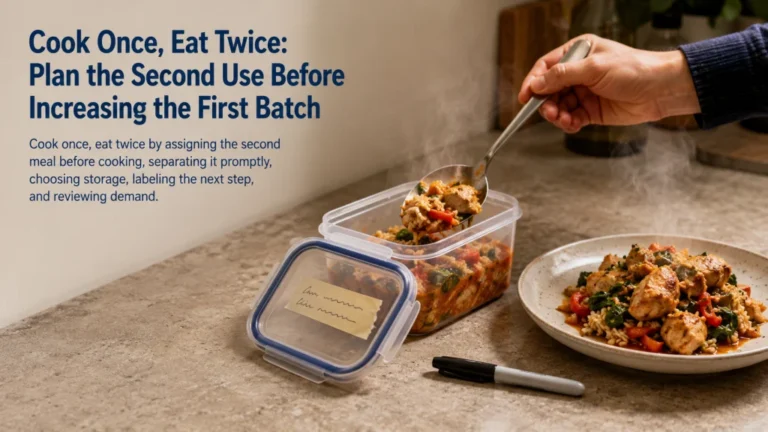
Sometimes the most useful batch is simply tomorrow’s dinner. Cooking once and eating twice creates one deliberate extra meal without filling every shelf or committing the household to several repeated servings.
This route fits uncertain schedules, limited freezer space, and foods that are best soon after cooking. It also provides a clear stopping point: once the second meal is covered, there is no reason to keep scaling.
Follow the cook-once, eat-twice approach when one planned extra meal is enough.
Treat Recipe Scaling as More Than Multiplying Ingredients
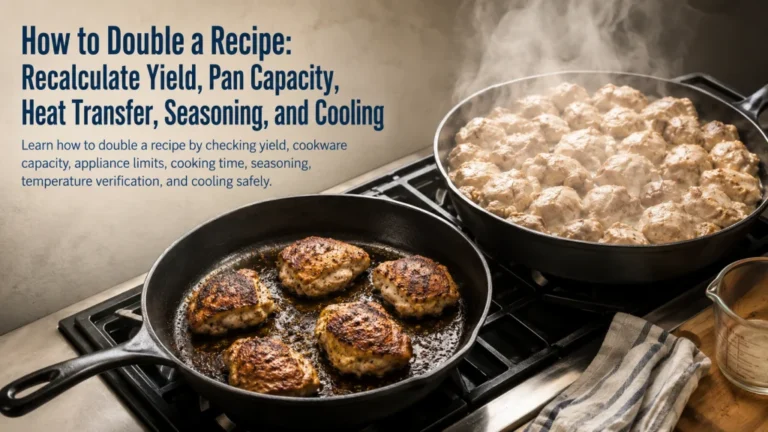
A recipe is more than a list of numbers. When the yield changes, pan depth, surface area, burner output, oven airflow, mixing space, heating time, evaporation, and seasoning distribution may change with it.
A stew in a wider pot may reduce differently from the same volume crowded into a tall pot. Two sheet pans may cook more evenly than one overloaded pan, but only when the oven can circulate heat around both. Baking recipes can be especially sensitive because pan geometry and mixing order affect structure.
Key decision: Scale the recipe only after confirming that the cookware shape, heat source, mixing method, cooking time, doneness check, cooling method, and storage destination can support the new yield.
Use the step-by-step guidance for doubling a recipe safely when the main change is the yield of one dish.
Plan Several Dishes as One Coordinated Cooking Session
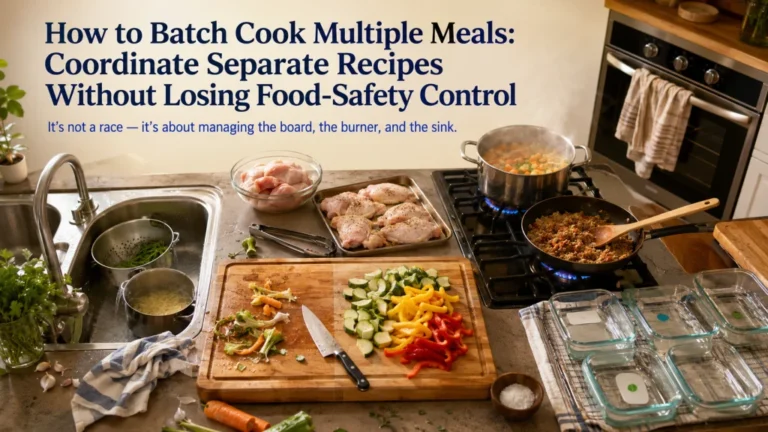
A busy counter can become the real limit long before the cookware is full. Cooking several dishes in one session means burners, oven space, cutting boards, utensils, attention, cooling surfaces, and refrigerator clearance all have to work together.
A useful session plan shows what can happen in parallel and what must remain separate. Raw poultry preparation should not compete for the same board or utensils as ready-to-eat food. Two dishes that need the oven at different temperatures may also create more delay than convenience.
Limit the session to the number of dishes that can be cooked, checked, divided, and chilled without rushing the safety steps. Use the full process for cooking multiple meals in one session when coordination is the central problem.
Start With the Existing Food When Surplus Already Exists
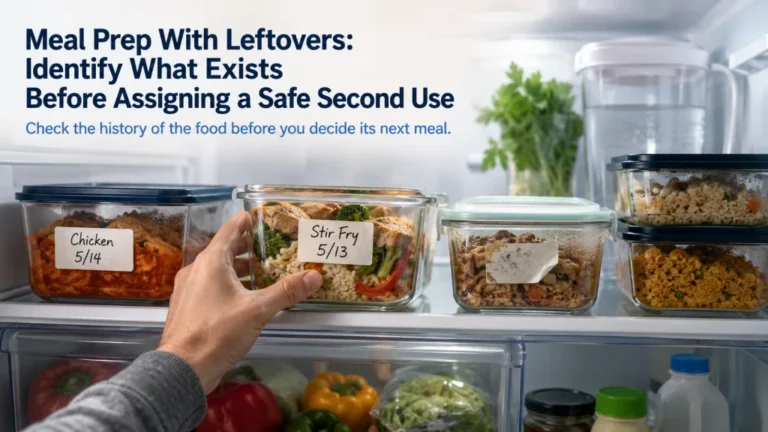
When food is already cooked, the next plan begins with what is known about it. How was it handled, how long has it been stored, and is there a realistic use within a safe window? The answer should not begin by cooking another large batch.
A leftover might become tomorrow’s lunch, a suitable freezer portion, or part of a planned dish. Smell, appearance, and taste cannot confirm safety on their own. When the storage history is uncertain or the food has been left out too long, discard it rather than building another meal around it.
Use the guide to planning meals with leftovers when the starting point is food already on hand.
Verify Cooking, Cooling, and Storage Capacity Before Scaling
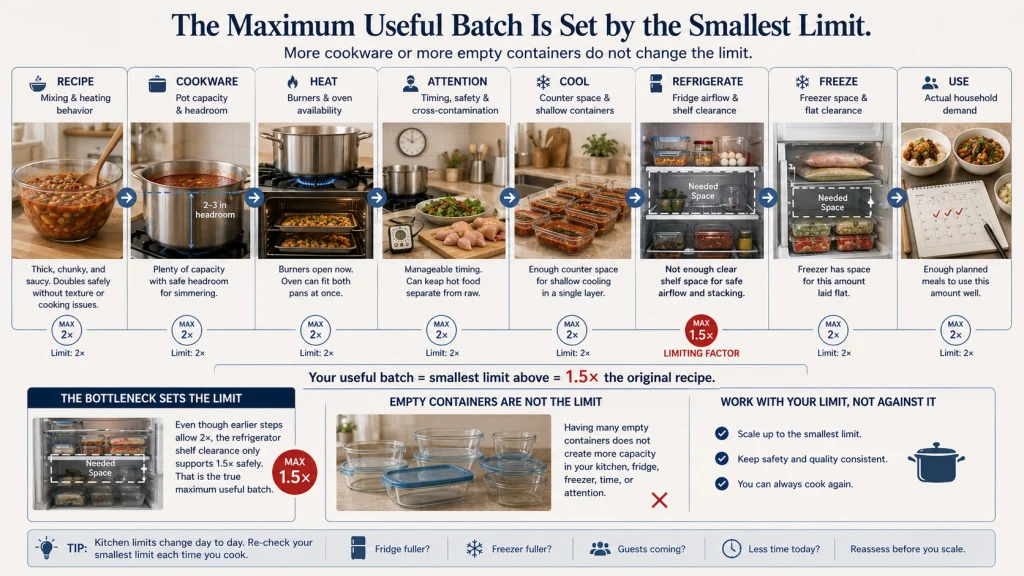
The easiest capacity to see is not always the one that sets the limit. A doubled recipe may fit neatly in a pot and still become difficult to divide, cool, and place in the refrigerator. A row of empty containers can create the same false sense that more food should be made simply because more spaces are available.
Editorial observation: The practical limit often appears after the cooking decision has already been made. Burner space, pan geometry, cooling area, shallow-container availability, refrigerator clearance, freezer clearance, and real household demand need to agree before the larger batch begins.
- Recipe capacity: Will the recipe still mix, heat, reduce, bake, or set correctly at the new yield?
- Cookware capacity: Is there enough headroom to stir safely without crowding or spilling?
- Burner and oven capacity: Can every dish receive the heat and airflow it needs?
- Attention capacity: Can doneness, timing, and cross-contamination controls be managed without rushing?
- Cooling capacity: Can large amounts be divided into smaller, shallow containers promptly?
- Refrigerator capacity: Is there open shelf space that allows cold air to circulate around the food?
- Freezer capacity: Is there a defined space for the portions intended to freeze?
- Household demand: Does every added portion have a likely use?
Any one of these checks can set the practical maximum. The right quantity is the smallest limit created by the recipe, equipment, cooling process, storage space, and household demand.
Keep Clean, Separate, Cook, and Chill Visible Across Every Route
Quantity increases the number of handling steps and the amount of food that must move through safe temperatures. The basic controls should remain visible whether the session involves raw ingredients, cooked components, complete meals, freezer portions, or leftovers.
Clean and Separate Before Heat Is Involved
Wash hands and clean work surfaces before and during the session as needed. Keep raw meat, poultry, seafood, and their juices away from ready-to-eat foods. Use clean utensils and boards when moving from raw preparation to cooked or ready-to-eat food.
Cook With a Food Thermometer
Safe internal temperature depends on the food. Check the thickest or coolest relevant area with a food thermometer rather than relying only on color, texture, or cooking time. When a recipe is scaled, additional depth or crowding may change how long the center takes to reach a safe temperature.
Divide and Chill Promptly
Perishable cooked food should be refrigerated or frozen within two hours, or within one hour when the surrounding temperature is above 90°F. Divide large quantities into smaller, shallow containers so they cool more quickly. Do not leave a deep stockpot or a crowded pan at room temperature while waiting for it to feel cool.
Safety warning: Discard perishable food that has remained at room temperature beyond the safe time limit. Do not use smell, appearance, tasting, reheating, or freezing as a way to prove that mishandled food is safe.
Keep the refrigerator at 40°F or below. Most cooked leftovers should be used within three to four days or frozen for longer storage. Reheat leftovers to 165°F, and follow a safe thawing method rather than thawing perishable food on the counter.
People at higher risk of foodborne illness may need stricter guidance. When a household member has a medical condition or other factor that raises foodborne-illness risk, follow current professional and official food-safety guidance rather than relying on a general batch plan.

TempPro TP19H is a fast digital food thermometer designed for checking internal temperatures during everyday cooking and meal prep. Its folding probe, rotating display, temperature-lock function, and calibration feature make temperature checks quick and easy to read around pots, pans, and larger dishes. The waterproof body and straightforward controls also make it practical for frequent use in a busy kitchen.
Check On AmazonIf you click this link and buy, we earn a commission at no additional cost to you.
Decide the Batch Before You Increase It
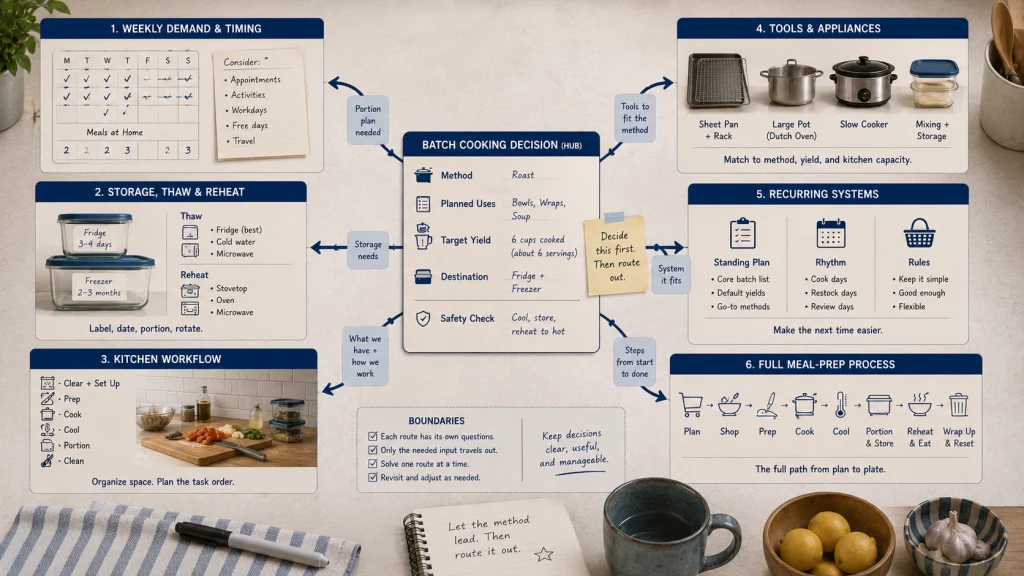
Before cooking, name the method, list the planned uses, confirm the recipe yield, assign the refrigerator or freezer destination, and identify the safety checkpoint that could limit the quantity. That sequence turns a vague plan to “cook more” into food with a clear next step.
Stop scaling when cookware, heat, attention, cooling space, storage space, food quality, or household demand becomes the smaller limit. A modest amount that fits the week is more useful than a large amount that asks the household to solve an urgent storage problem afterward.
Explore Each Preparation Method
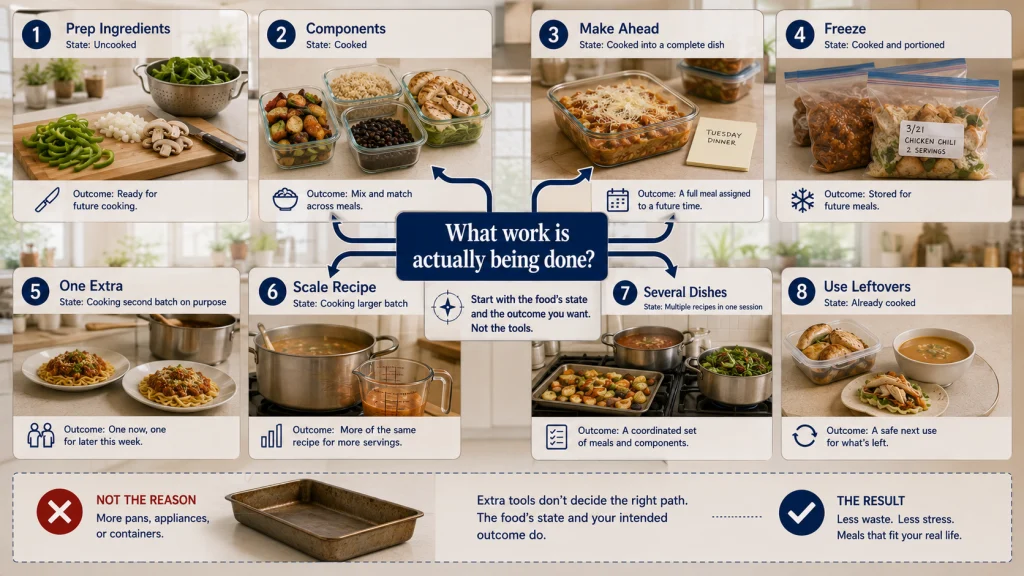
Use the question that best matches the work in front of you. A single session can include more than one method, but each food should still have one clear next action.
| Ask this question | Choose this route |
|---|---|
| Is the food still uncooked and only being washed, cut, measured, or portioned? | Prepare ingredients ahead |
| Are you cooking flexible building blocks to mix and match later? | Prepare meal components |
| Are you completing a refrigerated dish for a specific future meal? | Make meals ahead |
| Are specific portions intended for freezing from the beginning? | Plan freezer meals |
| Do you want one deliberate second meal from the same cooking effort? | Cook once and eat twice |
| Are you changing the yield of one recipe? | Scale one recipe carefully |
| Are you cooking several different dishes in one session? | Cook multiple meals together |
| Are you starting with food that is already cooked? | Plan with existing leftovers |
The route should match the intended outcome, not the amount of cookware or the number of empty containers available.
FAQs
🍳 Is batch cooking the same as meal prep?
No. Meal prep can include planning, shopping, ingredient preparation, storage, and simple assembly without increasing recipe yield. Batch cooking specifically expands the amount of food cooked or coordinates several dishes in one session.
🧮 Can I double any recipe by multiplying every ingredient by two?
Not reliably. Pan geometry, heating time, evaporation, mixing space, seasoning, and the recipe’s structure can change at a larger yield. Confirm that the cookware, heat source, doneness check, cooling method, and storage destination can handle the new amount.
🥘 Should I cool a large batch in the cooking pot?
A deep pot of hot food can cool too slowly. Divide large quantities into smaller, shallow containers and refrigerate or freeze them promptly within the applicable safe time limit.
❄️ Does every extra portion need to go in the freezer?
No. Some portions may be assigned to near-term refrigerated meals, and some foods do not retain desirable texture after freezing. Decide the destination by planned use, safe storage time, freezer space, and expected quality.
📦 Do I need a large container set before I start?
No. Start with the amount the household will use and the containers needed to cool and store that amount safely. Empty containers should not determine how much food you cook.
🥣 Can leftovers become part of a new meal-prep plan?
Yes, when their handling and storage history are known and they remain within a safe window. Assign them a specific next use, and discard food when the time or temperature history is uncertain.
⏱️ How many meals should I cook in one session?
Use the smallest limit created by recipe behavior, burner and oven space, available attention, cooling capacity, storage space, and household demand. There is no single number that fits every kitchen or schedule.
👃 Can smell or appearance confirm that stored food is safe?
No. Harmful contamination may not create an obvious smell, taste, or visible change. Use known time and temperature history, and discard food when safe handling cannot be confirmed.