Learning how to start working out at home begins with a routine small enough to repeat, not with the hardest session you can complete once. Decide when you can move, what activity you will use, how little still counts on a difficult day, and what effort allows you to finish with control. Use the first two weeks to test one simple structure before changing duration, frequency, intensity, equipment, and exercise selection at the same time. New or serious symptoms, significant health limitations, or a need for rehabilitation require individualized guidance rather than a generic starter plan.
Build the First Week Around Calendar Reality
A useful first-week calendar has three boxes for each planned session: available time, chosen activity, and minimum version. The first box reflects the time that actually exists. The second names one activity that fits the room and the person. The third protects the routine when energy, work, family needs, or motivation changes.
| Planned day | Available time | Chosen activity | Minimum version |
|---|---|---|---|
| Tuesday after work | 15 minutes | Easy indoor walking | Walk for 5 minutes |
| Thursday morning | 20 minutes | Basic resistance movements | Complete one short round |
| Saturday late morning | 25 minutes | Comfortable movement of choice | Move gently for 8 minutes |
This is an example of the decision structure, not a universal schedule. Your available days, activity choices, and minimum version may be smaller or arranged differently.
Key decision: Starting well means reducing uncertainty before increasing effort.
Once you know when the session begins and what still counts when the full version is unrealistic, you have something that can be tested. Without those decisions, even a good workout can remain an occasional event rather than part of the week.
Confirm This Starting Guide Fits Your Situation
This guide is for generally healthy adults who are beginning or restarting ordinary home exercise and need to organize schedule, frequency, duration, effort, preparation, recovery, and repetition. It does not provide injury rehabilitation, disease-specific exercise, pregnancy-specific programming, or a complete strength or cardio plan.
Use the broader home exercise decision guide when you are still deciding whether your first priority is starting, strength, cardio, mobility, recovery, equipment, or a plan shaped by space and lifestyle. Once the starting structure is stable, the next need may be strength training at home, home cardio options, or a broader approach to workout recovery.
If the main uncertainty is what to buy or how to use limited space, review the home exercise equipment guide. When schedule, goals, noise, and household constraints need to shape the overall format, use the guide to choosing a home workout plan.
Safety warning: Pregnancy, recent surgery, chronic conditions, disability-related limitations, neurological symptoms, a long period of inactivity, or a history that makes exercise safety uncertain may require guidance from a physician, physical therapist, or qualified exercise professional before following general advice.
Define the Minimum Repeatable Session
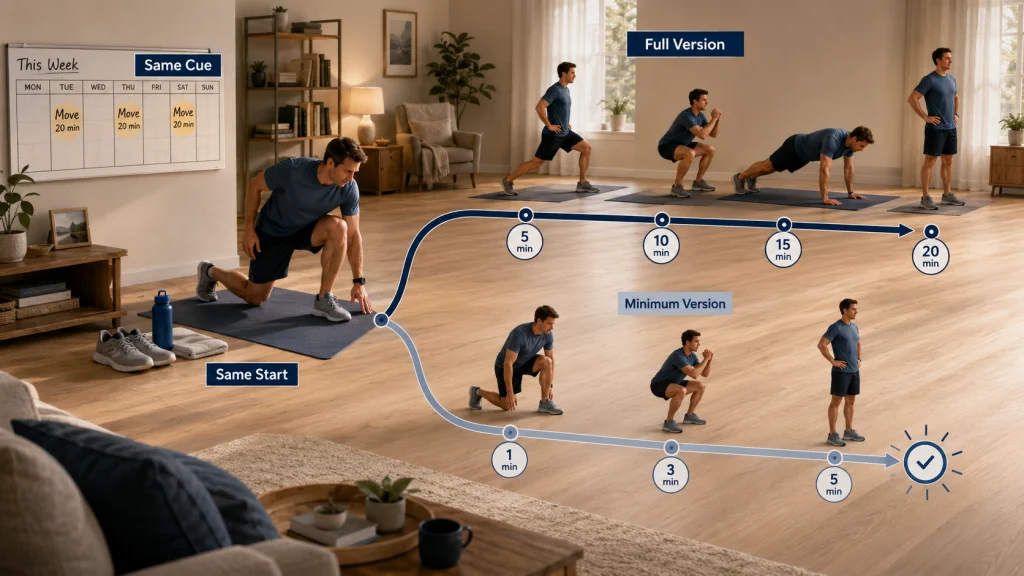
The minimum session is the smallest version that still preserves the cue and the act of beginning. It should be easy to describe, quick to start, and modest enough to use on a crowded day without turning every session into a negotiation.
| Full version | Minimum version | What stays the same |
|---|---|---|
| Twenty minutes of planned movement | Five minutes of the same activity at an easy effort | The scheduled cue, location, first movement, and decision to begin |
The minimum version is not a punishment or a test of willpower. It keeps the routine connected to the calendar while acknowledging that daily capacity changes. On a good day, continue into the full version. On a difficult day, complete the minimum and use the result as information.
Practical tip: Make the minimum version specific enough that you can start it without choosing exercises, searching for a video, rearranging furniture, or finding extra supplies.
Choose a Beginner Schedule That Can Survive a Normal Week
A schedule can look realistic on Sunday and disappear by Tuesday. Work runs late, the room is occupied, sleep was poor, or the only open hour turns out to be the least usable part of the day. A starter week needs enough structure to prompt action and enough flexibility to survive those ordinary disruptions.
Use the beginner workout schedule guide to place sessions around work, caregiving, sleep, space, and backup windows. A planned rest day is different from a workout that keeps landing in a time slot where it never had a fair chance.
Choose a small number of predictable windows, then give each session a minimum version or a backup time. Leave some open space in the week until you know how movement affects energy, soreness, and the rest of your responsibilities.
Decide How Often to Exercise Without Guessing
After one encouraging session, it is easy to assume that more days will create faster progress. Frequency only works when the sessions, effort, recovery, and calendar can support one another. A week with fewer completed sessions may teach you more than an ambitious plan that is repeatedly abandoned.
The guide on how often beginners should work out helps choose the number and spacing of sessions without treating a longer-term activity target as a day-one quota.
Leave enough room to notice what each session does. When excessive fatigue, persistent discomfort, or schedule failure follows every attempt, adjust session size or placement before adding another day.
Choose a Session Length You Can Recover From and Repeat
Longer workouts can feel more legitimate, yet they also ask for more setup, attention, recovery, and calendar space. A shorter session that starts on time and ends with control gives you a clearer baseline for the next week.
Use the guide on how long a workout should be to separate preparation, the main activity, and the transition afterward instead of treating every available minute as exercise time.
Set both the full version and the minimum version before you begin. When the planned length keeps creating dread or last-minute bargaining, reduce it and protect the act of starting. You can judge progression more clearly after the baseline becomes dependable.

Use the Talk Test and Perceived Effort to Adjust Intensity
A video may be labeled beginner-friendly and still move too quickly for the person following it. Effort is relative to current ability, so another person’s pace, range, resistance, or speed cannot set your starting level.
The beginner exercise intensity guide uses conversation and perceived effort to help you stay in control. During moderate activity, breathing becomes more noticeable, but you should still be able to speak in phrases or short sentences.
Let the day influence the setting. Poor sleep, heat, stress, unfamiliar movement, and accumulated fatigue can make a familiar activity feel harder. Reduce pace, range, resistance, or duration when control starts to disappear.
Key decision: Choose an effort that lets you practice the movement, notice warning signs, and return for the next planned session.
Prepare for Movement Before the Main Activity
The first minutes often decide whether a session feels approachable or rushed. A warm-up gives you time to move from rest toward the range, rhythm, and effort the main activity will require.
The guide to warming up before a workout helps match that transition to the activity instead of building a second workout before the first one begins.
Start the chosen movement at an easier pace, smaller range, or lighter resistance. While effort rises gradually, check the floor, footwear, available space, setup, and how the body responds today. A serious warning sign is a reason to stop, not a challenge to push through.
Give the Session a Clear Ending
A home workout can end abruptly when a timer sounds, a call arrives, or another household task takes over. A short transition helps the effort settle and makes the session feel complete rather than interrupted.
The guide on cooling down after a workout explains how to reduce pace and effort without turning the final minutes into another performance target.
Notice how breathing and effort settle, whether any movement caused discomfort, and what needs to be reset before the next session. Recording one useful observation now is easier than trying to reconstruct the experience several days later.
Plan Recovery Without Losing the Routine
Beginners sometimes worry that a rest day will break momentum. Recovery is part of the routine because the next useful session depends on sleep, food, hydration, manageable soreness, and enough spacing before demanding the same muscles again.
The guide to rest days for beginners helps distinguish full rest from easy activity and place more demanding sessions across the week.
Avoid hard work for the same muscle groups on consecutive days at the beginning. Wait for soreness to ease, ordinary movement to feel normal, and energy to return before repeating a demanding session. Persistent or worsening symptoms call for a different response, not a test of commitment.
Make the Minutes Before Exercise Easier
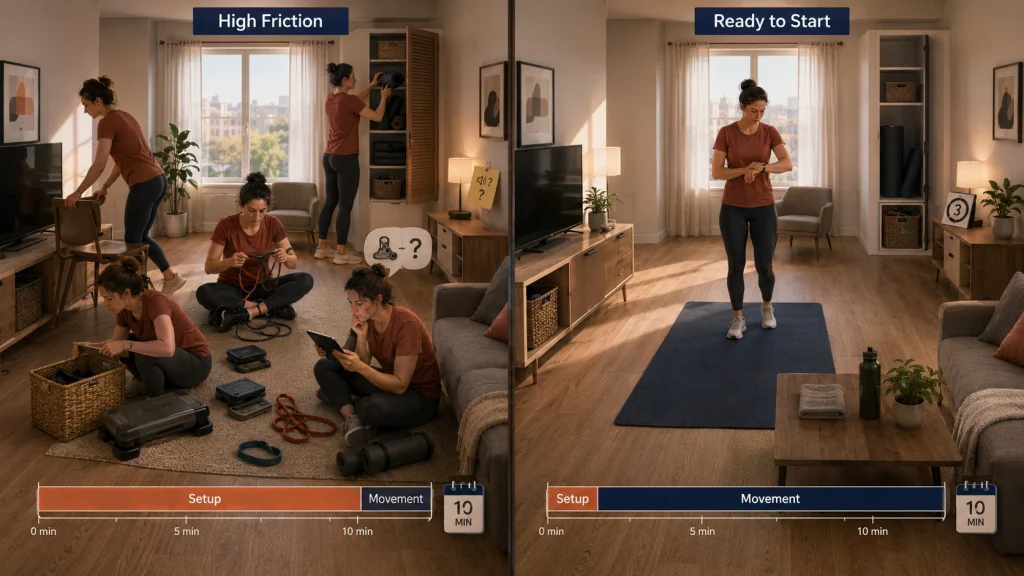
A routine often breaks before the first movement. The floor needs clearing, the activity has not been chosen, equipment is stored elsewhere, or the session begins with a search for a video. Repeating a recognizable cue, location, first action, and minimum version removes some of those negotiations.
The guide on making exercise a habit covers cues, environment, tracking, missed sessions, and restarting. There is no fixed day count that makes a routine automatic for everyone, especially when schedules and responsibilities keep changing.
Prepare the smallest useful setup in advance. Clear enough space, choose an activity that suits the noise level, and keep necessary items together. A resistance system that takes fifteen minutes to assemble can defeat a ten-minute starter routine even when the equipment itself is versatile.
Editorial observation: Equipment features matter only after session time, storage, setup, floor surface, noise, and the minimum version are defined. The best fit is the setup that the household can realistically repeat.
Route Each Starting Question to the Right Decision
Use this table when one part of the routine still feels uncertain. Each guide owns a different decision, so begin with the row that is currently blocking action.
| Unclear question | Use this guide | First no-purchase check |
|---|---|---|
| Which days and time windows are realistic? | Build a beginner schedule | Mark the three most predictable windows in the coming week. |
| How many sessions belong in the week? | Choose weekly frequency | Count sessions you can place without crowding recovery or obligations. |
| How long should each session last? | Set session duration | Separate available time from the smaller minimum version. |
| How hard should the activity feel? | Adjust beginner intensity | Use conversation and perceived effort during the current activity. |
| How should the session begin? | Plan the warm-up | Identify the first easy version of the movement already chosen. |
| How should the session end? | Plan the cool-down | Reserve a short transition before the calendar window closes. |
| When should demanding work be repeated? | Set recovery spacing | Check soreness, energy, ordinary movement, and recent muscle use. |
| How can the routine become easier to repeat? | Reduce habit friction | Define the cue, first action, location, and minimum version. |
Do not solve all eight questions at once. Choose the one creating the most uncertainty, make one decision, and keep the rest of the starter structure stable long enough to observe the result.
Run a Two-Week Test With One Variable at a Time
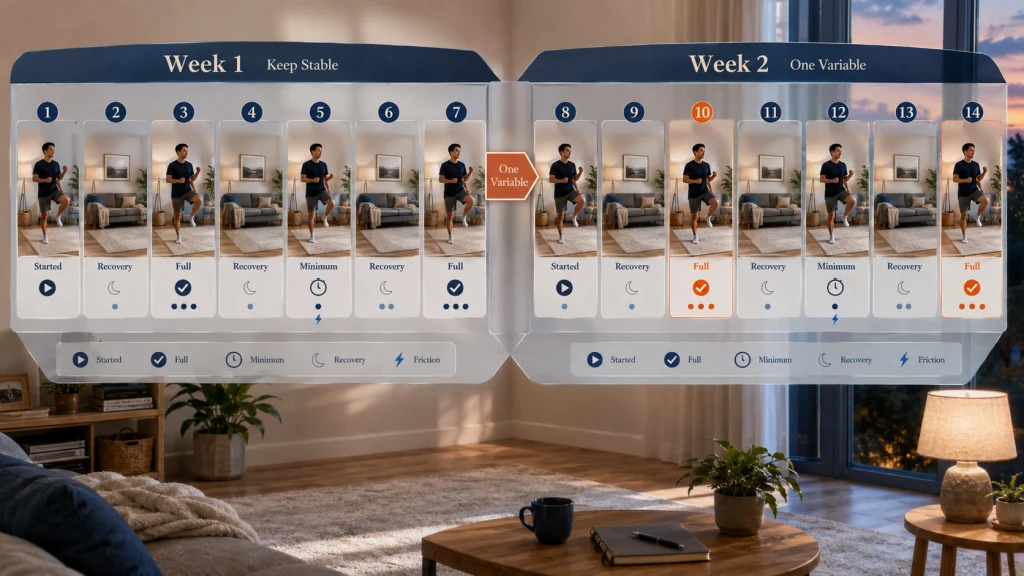
The first two weeks are an experiment in repeatability. They are not a test of how quickly you can build a complete fitness program. Keep the activity, cue, minimum version, and general effort stable during the first week so the result is interpretable.
| Test period | What stays fixed | What may change | What to record |
|---|---|---|---|
| Week 1 | Chosen days, activity, cue, minimum version, and controlled effort | Nothing unless safety, pain, or an obvious schedule conflict requires adjustment | Whether you started, which version you completed, effort, recovery, and the main friction point |
| Week 2 | All parts that worked in Week 1 | One variable only, such as session length, day placement, setup, or minimum version | Whether the single change improved consistency without creating excessive fatigue or new friction |
A worked example might keep three planned days, the same indoor walking activity, a five-minute minimum, and a conversational effort. If Week 1 feels manageable, Week 2 could add a small amount of time to the full version while every other decision stays the same. If Week 1 repeatedly fails because the evening window disappears, change the schedule rather than adding time or effort.
Note: Changing the days, activity, duration, effort, equipment, and recovery plan together may feel productive, but it destroys useful feedback. You will not know which change helped or which one created the problem.
Know When Symptoms or Health Conditions Change the Plan
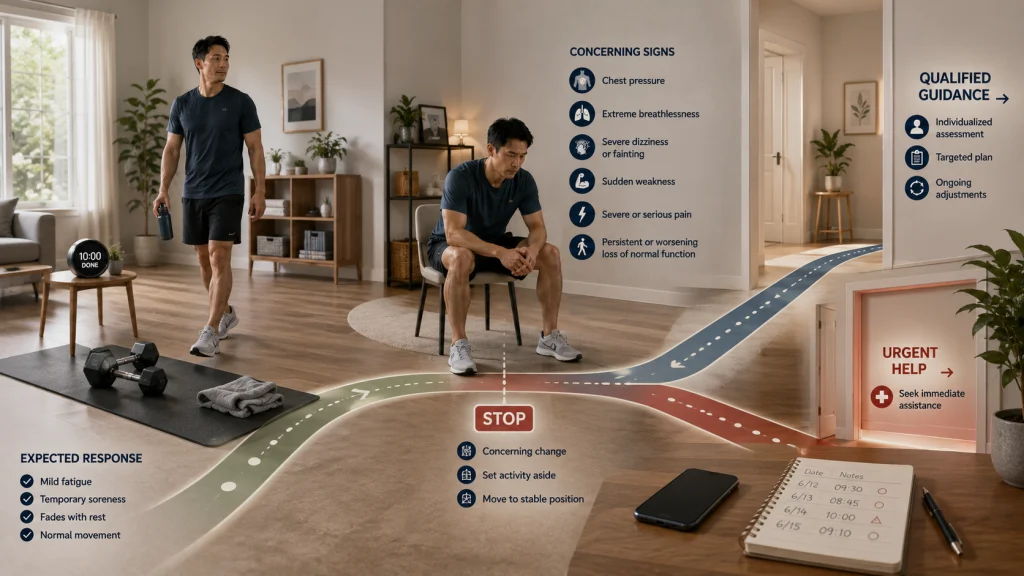
Ordinary muscle fatigue and mild short-lived soreness can occur when beginning unfamiliar activity. The routine should still allow normal daily movement and should improve rather than worsen as recovery continues. A general article cannot determine the cause of pain, weakness, dizziness, breathlessness, or other symptoms.
Safety warning: Stop exercise and seek appropriate help for chest pain or pressure, extreme shortness of breath, fainting, severe dizziness, sudden weakness, a serious injury, or severe pain. Use emergency services when symptoms or circumstances suggest immediate danger.
Persistent joint or muscle pain, neurological symptoms, worsening soreness, repeated loss of function, or symptoms that do not match the activity require qualified evaluation. Do not use a warm-up, cool-down, rest day, or easier variation as a substitute for needed medical or rehabilitation guidance.
Pregnancy, recent surgery, chronic conditions, disability-related limitations, medication effects, or a long period of inactivity may change what activities, effort, and progression are appropriate. Individualized advice can establish boundaries that a generic two-week test cannot.
Write the Four Rules for Your First Two Weeks
Write down the minimum session, the planned days, the effort rule, and the recovery rule. Those four decisions turn a general intention into a routine you can observe and adjust.
Keep Week 1 stable. In Week 2, change only the variable that created the clearest bottleneck. Increase effort or duration only after the current version fits the calendar, can be started without excessive setup, and leaves you able to recover for the next planned session.
Continue With the Decision That Still Feels Unclear
Shape the week through the guides to a realistic beginner schedule, manageable workout frequency, repeatable session length, and controllable exercise intensity.
Shape each session through a gradual warm-up, a clear cool-down, appropriate recovery spacing, and a plan for reducing habit friction. Choose only the decision that is still blocking the two-week test.
FAQs
🗓️ How many days should I plan in my first week?
Choose a small number of sessions that fit predictable time windows and leave room to observe recovery. The right number depends on activity, duration, effort, and your current capacity, so do not increase days before the existing sessions are manageable.
⏱️ Does a five-minute session really count?
A five-minute minimum can preserve the cue and the act of starting when the full session does not fit. It is useful when it is intentionally defined, connected to the planned activity, and not used to ignore symptoms that require rest or evaluation.
🗣️ How do I know whether I am exercising too hard?
Use conversation and perceived effort rather than copying another person’s pace. Reduce the demand when you cannot maintain control, speak in short phrases, or recover as expected, and stop for serious warning signs.
🔥 Should I feel very sore after beginner exercise?
Unfamiliar movement can cause mild temporary soreness, but severe, worsening, persistent, or function-limiting symptoms are not a goal. Adjust the routine and seek qualified guidance when the response does not settle normally.
🧰 Do I need equipment before starting at home?
No. First test the available time, space, activity, minimum version, and setup process. Consider equipment only after you can name the specific limitation it solves without creating more storage, noise, maintenance, or preparation than the routine can support.
🔁 How long does it take for exercise to become a habit?
There is no fixed day count that applies to everyone. Repetition, cue stability, task complexity, schedule changes, and personal circumstances all affect how automatic the routine feels.
🛌 Can I do light movement on a rest day?
Easy movement may fit a recovery day when it reduces rather than adds to the load that needs recovery. Avoid repeating demanding work for the same muscles before soreness, energy, and ordinary function have returned to a manageable level.
🚩 When should I stop and get professional guidance?
Stop and seek appropriate help for chest pain or pressure, extreme shortness of breath, fainting, severe dizziness, sudden weakness, serious injury, or severe pain. Persistent symptoms, major health limitations, recent surgery, pregnancy, neurological changes, or uncertainty about safe activity may also require individualized guidance.