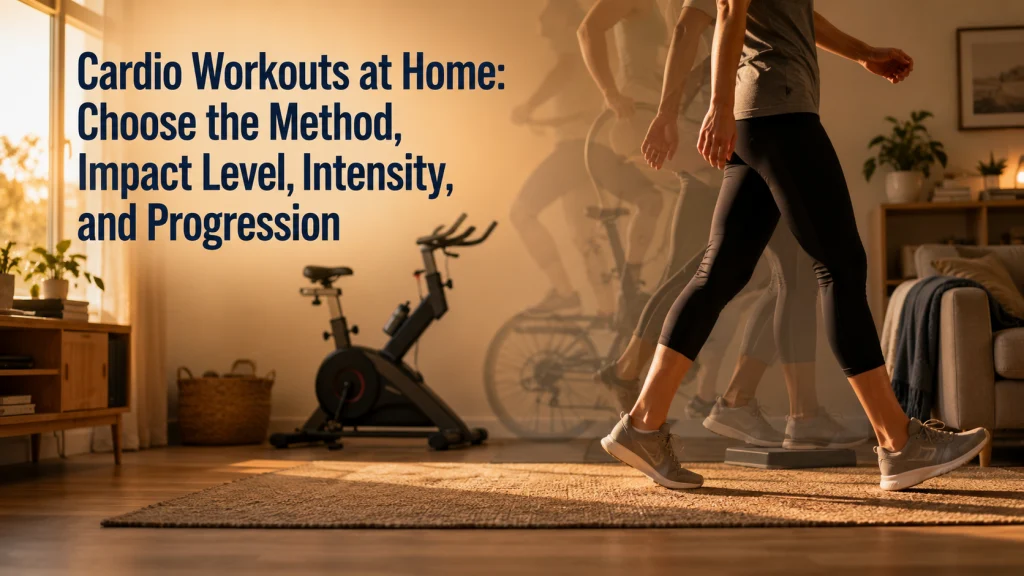
Cardio at home is not one exercise style, one machine, or one intensity level. Walking loops, low-impact steps, dance, stationary cycling, stair work, and intervals can all count when the effort meaningfully raises breathing and heart rate for the person doing them. Choose a method by impact, noise, space, balance, coordination, equipment, household access, and how the effort feels, then build gradually instead of treating exhaustion as the goal. Stop and seek appropriate help for chest pain or pressure, fainting, severe dizziness, extreme shortness of breath, sudden weakness, loss of balance, serious injury, or severe pain.
One Ten-Foot Room Can Support Six Different Cardio Methods
The same small room can be used for walking loops, low-impact step patterns, dance, a stationary bike, brief stair intervals nearby, or steady pacing in place. The movements look different, but each can become aerobic activity when the effort is high enough relative to the person’s current capacity.
A movement name does not determine intensity. A brisk walk may feel vigorous to one person and easy to another. A dance video may raise breathing steadily for one participant while another spends most of the session stopping to follow the choreography.
Six-method room map: One clear floor area can support different aerobic methods by changing the route, rhythm, equipment, or work pattern.
Use the room perimeter or a short back-and-forth lane. Keep turns clear and predictable.
Use a central floor zone for controlled side steps, knee lifts, and direction changes without jumping.
Use the widest open section for music-led movement, with turns and arm patterns scaled to the space.
Place the bike in one stable zone with room to mount, dismount, ventilate, and move around it.
Use nearby stairs only when the route is dry, well lit, unobstructed, and predictable.
Use one simple repeated pattern when consistent effort matters more than variety or choreography.
| Method in the same room | Main movement demand | Likely home friction | Useful fit question |
|---|---|---|---|
| Walking loops | Continuous gait | Turning space and floor path | Can the route stay clear and repeatable? |
| Low-impact steps | No-jump stepping patterns | Coordination and floor grip | Can both feet stay controlled? |
| Dance | Rhythm and changing directions | Noise, coordination, and screen use | Does the music help rather than distract? |
| Stationary cycling | Repeated lower-body cycling | Equipment footprint and storage | Can the setup remain stable and accessible? |
| Stair intervals | Repeated climbing | Balance, shared access, and rail use | Is the stair area safe and unobstructed? |
| Steady pacing | Continuous low-complexity movement | Boredom and limited route variety | Can the pace be sustained without drifting too easy? |
The first decision is not which activity sounds most intense. It is which method can be performed safely, repeated consistently, and adjusted to the intended effort.
Define Cardio, Aerobic Activity, Impact, Intensity, and Endurance Separately
Cardio is an informal term for activity that challenges the heart, lungs, and working muscles through sustained or repeated movement. Aerobic activity is movement that raises breathing and heart rate for a period of time while the body supplies energy largely through oxygen-dependent processes.
Impact describes how forcefully the body meets the floor. Jumping and running usually create more impact than walking, cycling, or controlled step patterns. Low impact does not automatically mean low effort.
Intensity describes how hard the activity feels relative to the person’s current capacity. The same movement can produce different intensity levels in different people.
Cardiorespiratory endurance is the ability to sustain or repeat aerobic work over time. It improves through regular practice and gradual progression, not through a single exhausting session.
Use the Adult Aerobic Framework as a Direction, Not a First-Day Test
Current US guidance encourages adults to accumulate regular moderate-intensity aerobic activity, or a smaller amount of vigorous activity, across the week. Strength training and reduced sedentary time also matter, but this article focuses on aerobic method selection.
A beginner does not need to complete the full weekly target immediately. A person returning after a long inactive period may begin with shorter, easier sessions and build duration or frequency gradually.
Use how to start working out at home when the main issue is building a first schedule, choosing an initial duration, or restarting after a long break.
Progression principle: Begin with an amount that can be completed with control, recover from it, and repeat it. Add one change at a time, such as a little more duration, one extra session, or a slightly harder work interval.
Use the Talk Test and Relative Effort
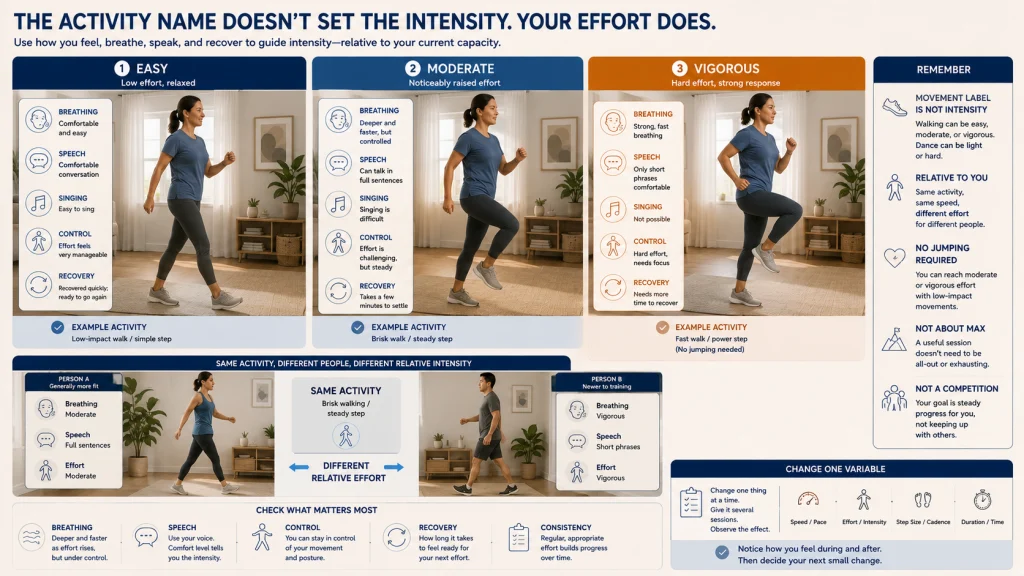
The talk test gives a practical way to judge intensity without relying on the activity label. At a moderate effort, speaking is possible but singing would be difficult. At a vigorous effort, only a few words may be comfortable before another breath is needed.
- Easy: Conversation feels comfortable and breathing is only slightly elevated.
- Moderate: Full sentences are possible, but singing would be difficult.
- Vigorous: Only short phrases are comfortable before pausing for breath.
Use the description as a relative check, not a contest. A session does not need to reach vigorous effort to be useful, and jumping is not required to raise breathing.
Choose Walking When Simple Gait Is the Best Starting Point
Walking works well when the person wants a familiar movement with low setup demand. Indoors, it can use hallway laps, room loops, marching in place, or short back-and-forth routes.
The main challenge is keeping the path clear and the effort high enough to match the goal. Arm swing, pace, route length, and brief faster segments can change the demand without adding equipment.
For a structured version, follow the walking workout at home guide for indoor routes, pacing, intervals, and gradual progression.
Choose Low-Impact Cardio When No-Jumping Control Matters
Low-impact cardio keeps at least one foot connected to the floor or uses a supported method such as cycling. It can reduce landing force while still producing moderate or vigorous relative effort.
This route may fit apartments, shared floors, people who dislike jumping, or anyone who prefers controlled stepping. Noise, balance, footwear, and floor traction still need attention.
The dedicated low-impact cardio workout route develops no-jump movement, smoother transitions, and scalable effort.
Choose Dance When Music and Choreography Support Consistency
Dance cardio combines aerobic movement with rhythm, direction changes, and coordination. Music can make the session easier to return to, but complicated choreography can also interrupt the effort if the person spends more time watching than moving.
Choose a format with steps that can be simplified. Reduce turns, jumps, or fast direction changes when the room, floor, balance, or coordination does not support them.
A dance cardio workout is the better next step when music-led movement is appealing and choreography complexity or impact needs to be adjusted.
Choose Indoor Cycling When a Stationary Bike Fits the Household
Indoor cycling provides repeated lower-body movement without floor impact from stepping or jumping. Resistance and cadence can be adjusted, but the equipment must fit the rider and remain stable.
The real home questions include floor space, mounting and dismounting, seat adjustment, noise, ventilation, access to power if needed, and whether the bike can remain ready for use.
When a stable bike is already available, the indoor cycling workout guide explains how to organize easy, steady, and interval sessions.
Choose Stair Work Only When Access Is Safe and Predictable
Stair climbing can raise breathing quickly because each step lifts body weight. It also adds balance, foot-placement, and shared-space demands that are not present in stationary walking.
The stair area should be well lit, dry, clear of objects, and available without surprising household traffic. A stable rail may be important for some people, but anyone with balance concerns or a history of falls may need individualized guidance.
Detailed pacing and work-rest choices belong in the stair workout at home guide once safe stair access has been confirmed.
Choose Beginner Intervals When Work and Recovery Improve Control
Intervals alternate harder work with easier movement or rest. The harder portion does not need to be all-out. A beginner interval may simply move from an easy walk to a brisker pace, then return to comfortable movement.
This structure can make effort easier to manage because the person knows when the harder portion will end. It can also become too aggressive when work periods are treated as tests of maximum effort.
To set manageable work and recovery periods, continue with interval training for beginners.
Compare Steady-State and Interval Structure
Steady-state cardio keeps the effort relatively consistent for most of the session. Interval training intentionally alternates easier and harder periods.
Steady work may feel simpler to pace and easier to repeat. Intervals may make a shorter session feel more varied or help a person practice brief increases in effort. Neither structure is automatically superior.
The steady-state cardio versus interval training comparison helps match the pacing structure to preference, recovery, available time, and progression.
Choose an Endurance Progression Route for Long-Term Improvement
Cardio endurance improves when the body is exposed to repeatable aerobic work and given enough recovery to adapt. The progression can come from longer sessions, more frequent sessions, slightly harder effort, or better consistency.
Changing all variables at once makes it difficult to judge what caused excess fatigue or soreness. Keep the method stable long enough to see whether the chosen progression is workable.
For a longer progression framework, how to improve cardio endurance covers duration, tolerance, recovery, and repeatable increases over time.
Match Space, Noise, Floor, Balance, Coordination, and Equipment
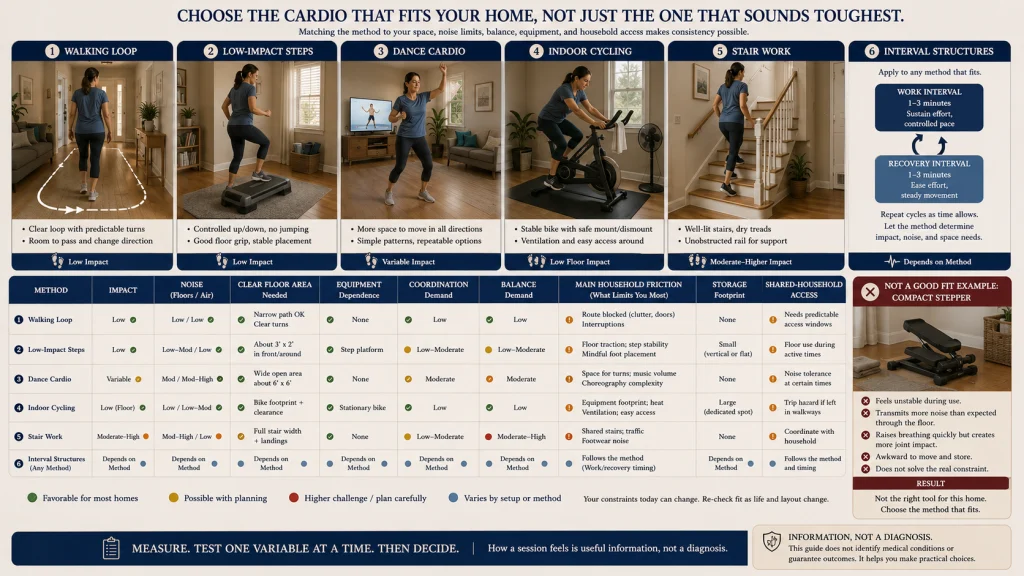
| Method | Impact | Noise | Space | Equipment | Coordination demand |
|---|---|---|---|---|---|
| Walking loops | Low | Low | Clear route needed | None | Low |
| Low-impact steps | Low | Low to moderate | Small clear area | None | Low to moderate |
| Dance cardio | Variable | Moderate | Turning room helpful | Optional screen or audio | Moderate to high |
| Indoor cycling | Low floor impact | Low to moderate | Machine footprint | Stationary bike | Low |
| Stair work | Moderate | Moderate | Safe stair access | Stairs and possible rail | Moderate |
| Intervals | Depends on method | Depends on method | Depends on method | Optional | Depends on method |
Editorial observation: Retail and app categories often label a product or video as cardio without showing whether the household can sustain the setup. A compact stepper may raise breathing but still fail the routine if it feels unstable, sounds loud through the floor, or is awkward to store and retrieve.
Use home gym equipment when the main question is whether a machine or accessory fits the space, storage, noise, maintenance, and budget.
Use Eight Questions to Route the Method
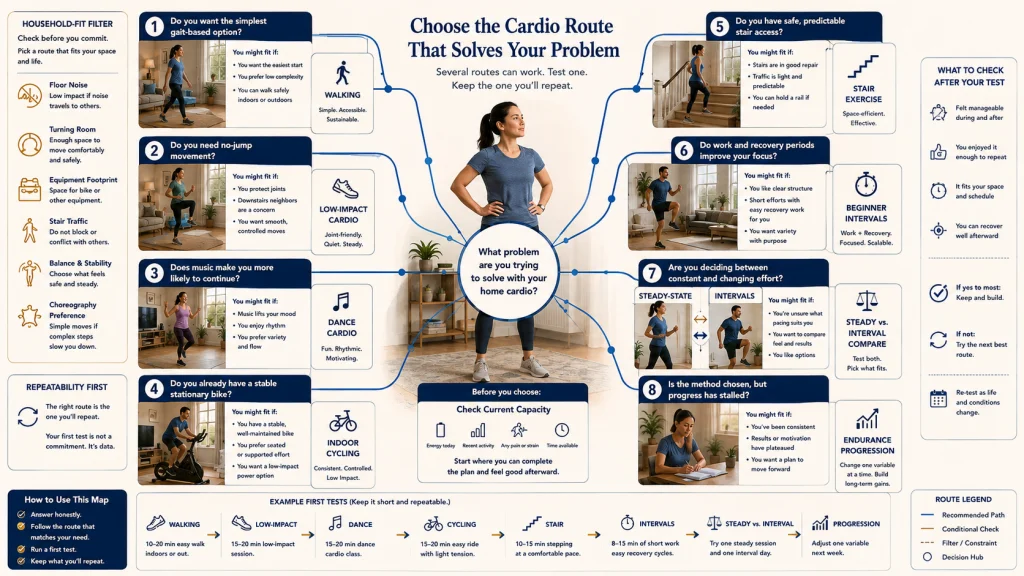
| Question | If yes | Likely route |
|---|---|---|
| Do you want the simplest gait-based option? | Keep movement familiar and easy to pace | Walking |
| Do you need no-jump movement? | Keep impact and landing noise lower | Low-impact cardio |
| Does music make you more likely to continue? | Choose simple choreography and scalable steps | Dance cardio |
| Do you already have a stable stationary bike? | Use resistance and cadence without floor impact | Indoor cycling |
| Do you have safe, predictable stair access? | Use brief climbing work with controlled pace | Stair exercise |
| Do work and recovery periods improve focus? | Alternate manageable effort with easier movement | Beginner intervals |
| Are you deciding between constant and changing effort? | Compare pacing structures | Steady-state versus intervals |
| Is the method chosen but progress has stalled? | Adjust duration, frequency, or effort gradually | Endurance progression |
Build a No-Purchase First Test
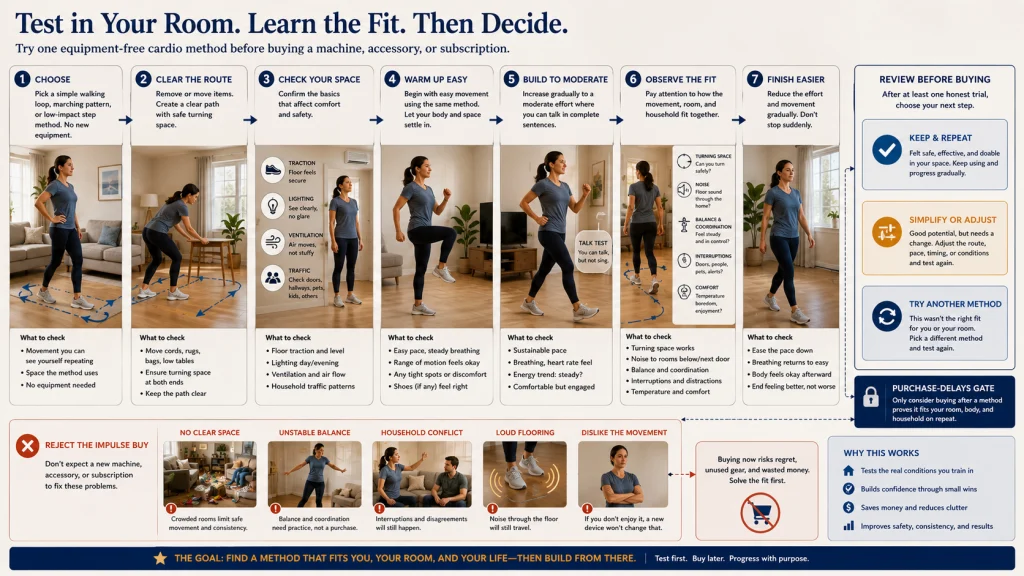
Before buying equipment or subscribing to a program, test the method with what is already available. The goal is to discover whether the movement, effort, room, and household friction fit well enough to repeat.
- Choose one method that needs no new equipment.
- Clear the route and confirm floor traction, lighting, and ventilation.
- Perform a brief easy warm-up using the same movement.
- Increase to a moderate talk-test effort for a short period.
- Notice noise, turning space, balance, coordination, and interruptions.
- Finish with easier movement rather than stopping abruptly.
- Review whether the method felt safe, repeatable, and worth progressing.
If the no-purchase version fails because of space, boredom, balance, or household access, new equipment may not solve the underlying problem. Choose another method before adding cost or storage demands.
Place Cardio Inside the Rest of the Home Routine
Cardio method selection is only one part of a weekly routine. Strength work, recovery, available days, and total session length affect how the aerobic method is scheduled.
Use strength training at home for resistance-training decisions, workout recovery for spacing and recovery choices, and home workout plans when the method needs to be placed into a complete routine.
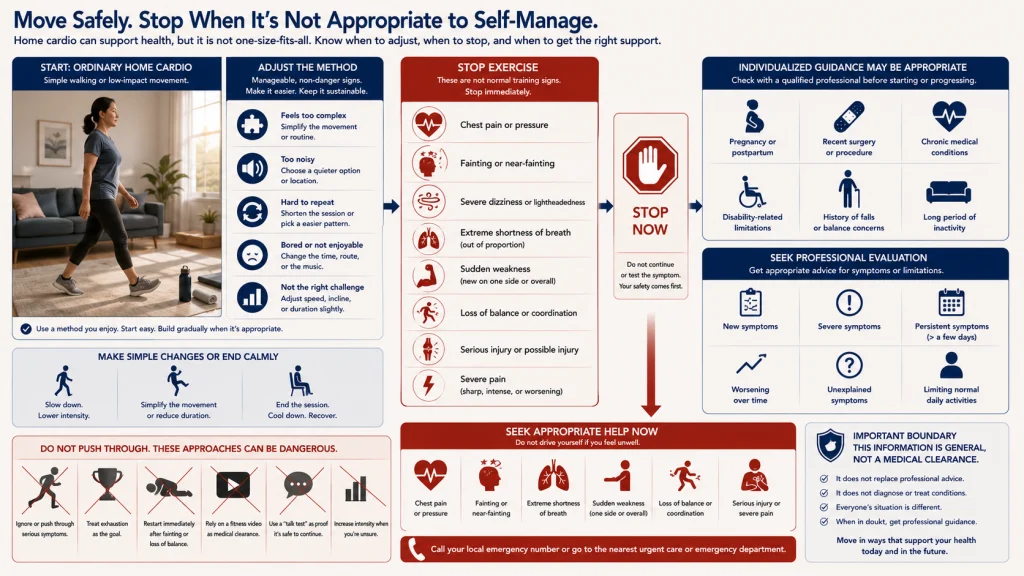
Know When Generic Home Cardio Is Not Appropriate
Stop exercise and seek appropriate help for chest pain or pressure, fainting, severe dizziness, extreme shortness of breath, sudden weakness, loss of balance, serious injury, or severe pain. Pregnancy, recent surgery, chronic conditions, disability-related limitations, a history of falls, or a long period of inactivity may require individualized guidance before beginning or progressing home cardio.
This article does not diagnose cardiovascular, pulmonary, neurological, joint, balance, metabolic, or other medical conditions. It does not prescribe disease-specific exercise, weight-loss programs, running plans, or advanced high-intensity training.
When symptoms are new, severe, persistent, worsening, unexplained, or limiting normal activity, generic intensity advice is not enough. Seek guidance from a physician, physical therapist, or qualified exercise professional as appropriate.
Choose the Method, Impact Level, Effort Check, and Progression Route
Start with the method that fits the room, floor, noise limits, balance, coordination, equipment, and household access. Confirm the effort with the talk test rather than assuming the activity name tells you how hard it is.
Use walking, low-impact steps, dance, cycling, stairs, steady pacing, or intervals according to the job the session needs to do. Progress one variable at a time and keep the routine repeatable enough to accumulate activity across the week.
For the wider movement framework, return to how to exercise at home.
FAQs
🚶 Can walking indoors count as cardio?
Yes. Indoor walking can be aerobic activity when the pace raises breathing and heart rate to the intended relative intensity.
🦶 Does cardio have to include jumping?
No. Walking, cycling, controlled stepping, and other low-impact methods can provide meaningful aerobic effort without jumping.
🗣️ How can I judge intensity without a monitor?
Use the talk test. Moderate effort usually allows full sentences but makes singing difficult, while vigorous effort limits speech to short phrases.
🏠 What is the quietest home cardio option?
Walking, controlled low-impact steps, and some stationary cycling setups are often quieter than jumping. Actual noise depends on the floor, equipment, footwear, and technique.
🎵 Is dance cardio suitable for beginners?
It can be when the choreography is simple, the impact is scalable, and the person can keep moving without spending most of the session trying to follow complex steps.
⏱️ Are intervals only for advanced exercisers?
No. Beginner intervals can alternate easy movement with a slightly brisker effort. The harder period does not need to be all-out.
🚲 Do I need equipment for effective home cardio?
No. Walking, marching, low-impact steps, dance, and movement intervals can be performed without buying equipment.
🚩 When should I stop a cardio session?
Stop and seek appropriate help for chest pain or pressure, fainting, severe dizziness, extreme shortness of breath, sudden weakness, loss of balance, serious injury, or severe pain.