Strength training at home can begin in an empty corner, beside a sturdy chair, or in a room full of equipment. A useful plan covers the major muscle groups, repeats the work consistently, and increases the challenge without losing control. Choose a resistance method, starting difficulty, weekly structure, progression rule, rest approach, effort limit, and exercise mix. Start with the simplest version that fits your week, then adjust what no longer fits.
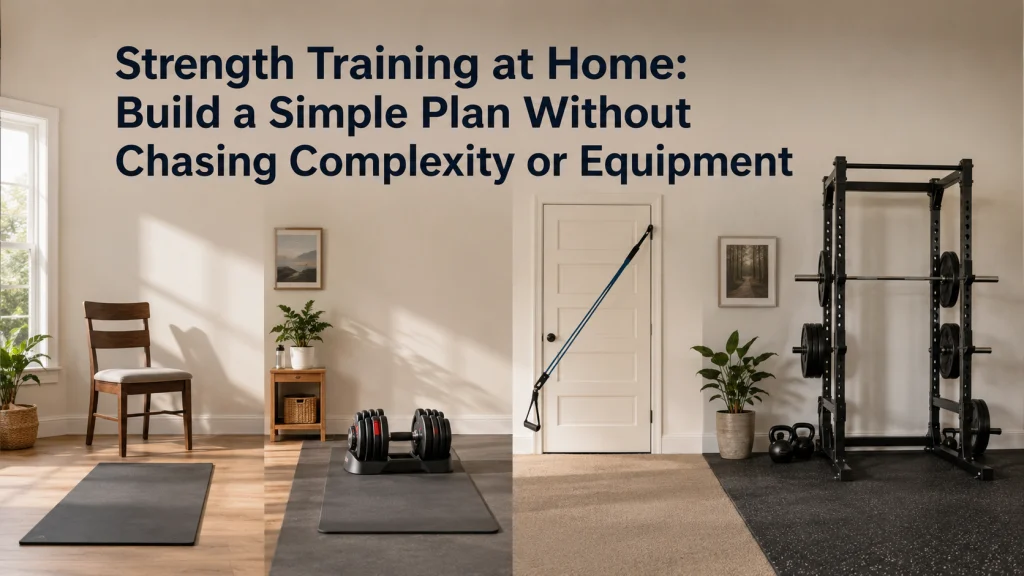
Four home setups, the same six movement jobs
Picture four homes at the start of a workout. One person has only floor space and a sturdy chair. Another has a single adjustable dumbbell. A third uses resistance bands, while the fourth has a fully equipped exercise room. The movements may look different, but every setup still has to cover the same basic jobs: knee-dominant lower-body work, hip-dominant lower-body work, pushing, pulling, trunk work, and carrying or whole-body bracing.
| Home setup | What changes | What does not change |
|---|---|---|
| Bodyweight only | Resistance comes from leverage, tempo, range, pauses, and single-limb variations. | The plan still needs balanced movement coverage, repeatable effort, and progression. |
| One adjustable weight | Load can be changed directly, although some movements may need one-sided execution. | The same programming decisions still apply. |
| Resistance bands | Resistance changes through band tension, setup distance, and attachment position. | The plan still needs a way to track difficulty and increase challenge. |
| Fully equipped room | There are more exercise and loading options. | More options do not replace balanced selection, suitable effort, or regular practice. |
Equipment changes how the work is done, but it does not complete the plan. A crowded workout corner can still hide a narrow routine when pressing is repeated and pulling, lower-body, or trunk work is missed. Extra attachments may look like completeness, but balanced coverage and repeatability are better tests.
For the broader choice between strength, cardio, mobility, and other movement, start with the home exercise decision guide. When the main obstacle is building the habit itself, begin with the home workout starting guide.
What resistance training is designed to challenge
Resistance training asks muscles to work against a demand from body weight, a band, a free weight, a cable, a machine, or another controlled source. The method matters less than whether the movement stays controlled, can be repeated, and can become more challenging over time.
Several related terms describe different training aims:
- Strength refers to the ability to produce force against resistance.
- Hypertrophy refers to an increase in muscle size.
- Muscular endurance refers to the ability to repeat or sustain muscular effort.
- Physical function refers to practical abilities such as rising, lifting, carrying, climbing, reaching, and controlling the body during daily tasks.
A home program may address several qualities, but it should not promise a specific body change or health outcome. Sport, rehabilitation, clinical, and specialized performance goals need more individualized decisions.
Coverage and consistency come before fine-tuning
Current federal activity guidance asks adults to include muscle-strengthening activity on at least two days each week and to work all major muscle groups. This is a broad public-health target, not a personalized routine. In practical terms, strength work should appear regularly, cover the body rather than one favorite area, and provide enough resistance to be meaningfully challenging.
The 2026 American College of Sports Medicine position stand adds that progressive resistance training can work across many reasonable methods. Equipment type, elaborate structures, and repeatedly reaching momentary muscular failure are not consistently necessary. Specific variables matter for specific goals, but a sustainable plan comes before fine optimization.
Key decision: First make the plan complete enough to cover the body and simple enough to repeat. Only then adjust sets, load, rest, or exercise variations for a more specific reason.
This keeps the plan from becoming a collection of unrelated exercises or being delayed by the search for an ideal setup.
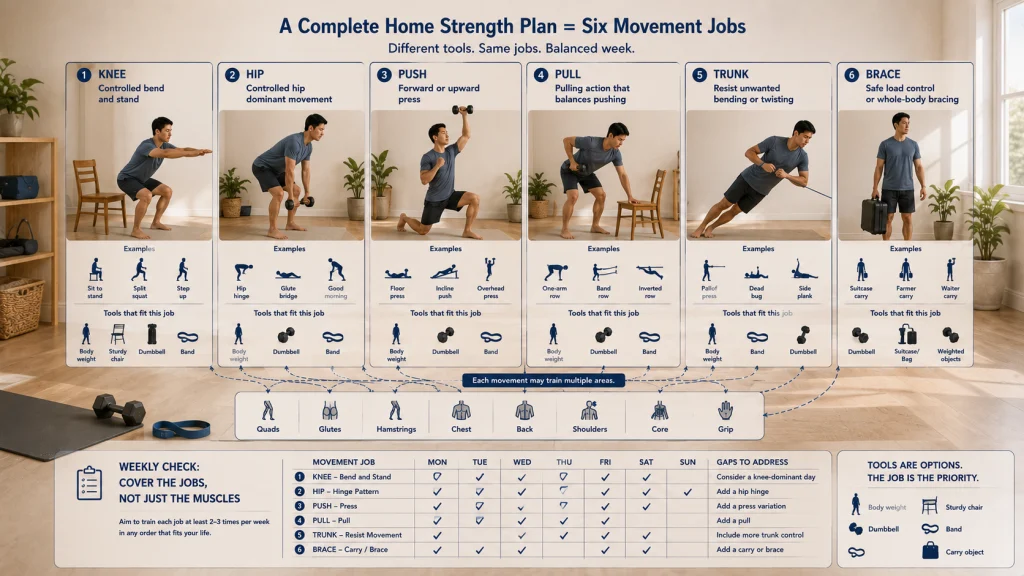
Map major muscle groups through movement jobs
A list of muscles can become too detailed to guide a simple session. Movement jobs provide a practical way to check coverage without declaring one exercise mandatory. Different exercises can fill the same job, and one exercise may involve several muscle groups at once.
| Movement job | Primary areas involved | Coverage question |
|---|---|---|
| Knee-dominant lower body | Thighs, hips, and supporting trunk muscles | Does the plan include a controlled bend-and-stand pattern? |
| Hip-dominant lower body | Hips, back of the thighs, and trunk | Does the plan include controlled hip movement or extension? |
| Push | Chest, shoulders, and arms | Is there a forward or upward pressing task? |
| Pull | Back, rear shoulders, and arms | Is there a pulling task that balances pressing? |
| Trunk control | Abdomen, sides, back, and deep stabilizing muscles | Can the trunk resist unwanted bending, twisting, or arching? |
| Carry or whole-body brace | Grip, shoulders, trunk, hips, and legs | Is there a safe way to practice whole-body tension or load control? |
This map does not require six separate exercises per session. One movement may cover several jobs, and coverage can be spread across the week. Check for repeated gaps rather than making every session identical.
Use eight questions to build the plan
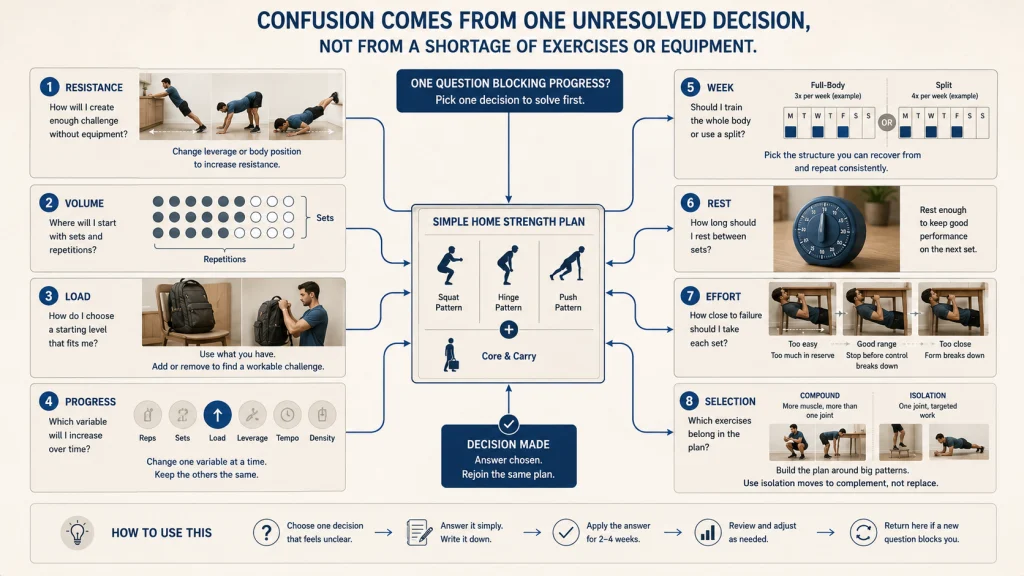
When a home plan feels confusing, the problem is often one unanswered choice rather than a shortage of exercises. It may be the resistance, weekly structure, progression, rest, or effort limit. The table below helps identify that choice.
| Programming question | Decision to make | Focused guidance |
|---|---|---|
| What can I do without equipment? | Choose leverage, range, tempo, support, and body position. | Bodyweight strength training |
| How many sets and repetitions should I use? | Select a manageable starting volume that you can perform with control. | Beginner sets and repetitions |
| How difficult should the resistance be? | Match the load to the movement, repetition target, and current control. | Choosing a starting weight |
| How do I make the plan harder? | Choose one measurable variable to increase when the current task is repeatable. | Progressive overload at home |
| Should I train the whole body or divide sessions? | Match weekly structure to available days, session length, and recovery. | Full-body and split structures |
| How long should I wait between sets? | Rest long enough to perform the next set with the intended control and effort. | Rest between sets |
| Do I need to continue until I cannot complete another repetition? | Set an effort limit that challenges the muscles without making failure the default. | Training to failure |
| Should I use multi-joint or single-joint movements? | Use broad movements for efficiency and smaller movements when they serve a clear gap or preference. | Compound and isolation exercises |
You do not need to settle all eight choices before starting. Pick a resistance method and weekly structure that fit ordinary life, then refine whichever detail causes confusion or blocks progress.
No equipment still requires a resistance decision
Bodyweight training is not automatically easy, and it is not limited to a fixed list of movements. Difficulty changes when you alter leverage, depth, range of motion, speed, pause length, hand or foot position, support, or the share of work placed on one limb. These changes can create useful progression without buying anything.
The main limitation is measurement. Adding five pounds to a weight is easy to record, while changing body angle or range may be less exact. Use a simple note such as support height, variation, repetition range, pause duration, or tempo so the next session can reproduce the same task.
Practical tip: Change one feature at a time. When leverage, tempo, range, and repetitions all change together, it becomes difficult to tell whether the movement is actually progressing.
When floor space and self-load are the main constraints, the bodyweight resistance guide shows how to turn those adjustments into a repeatable plan.
Sets and repetitions organize practice, not perfection
A repetition is one complete performance of a movement. A set is a group of repetitions performed before a rest. These numbers help organize work, but they do not guarantee that the resistance, range, or technique is suitable.
A useful beginner starting point leaves enough attention to learn the movement and enough recovery to repeat it during the week. More sets add work, time, and fatigue. Fewer sets may fit an unfamiliar movement, a session with several movement jobs, or an early consistency phase.
Track whether the final repetitions still resemble the first ones. If a target range is completed easily and consistently across sessions, that may indicate a need for progression. If control breaks down early, the immediate answer may be less resistance, fewer repetitions, more rest, or a simpler variation rather than more volume.
If the numbers still feel arbitrary, the sets and repetitions guide separates a manageable starting amount from the changes that may come later.
Choose a starting load by the movement in front of you
There is no single correct household weight for every exercise. A load that is manageable for a lower-body movement may be too demanding for a smaller upper-body movement. Starting resistance should allow the intended range with controlled speed, stable positioning, and no need to turn the movement into a different task just to finish.
Use the first session as a calibration session rather than a test of maximum ability. Begin conservatively, perform a small number of controlled repetitions, and adjust only if the movement remains stable. The target is a meaningful muscular challenge, not strain, breath holding, or a forced final repetition.
Note: A difficult set and an unsafe set are not the same. Local muscular effort can be expected, while sharp pain, sudden weakness, loss of control, or alarming whole-body symptoms require a different response.
The guide to choosing a strength-training weight explains this check.
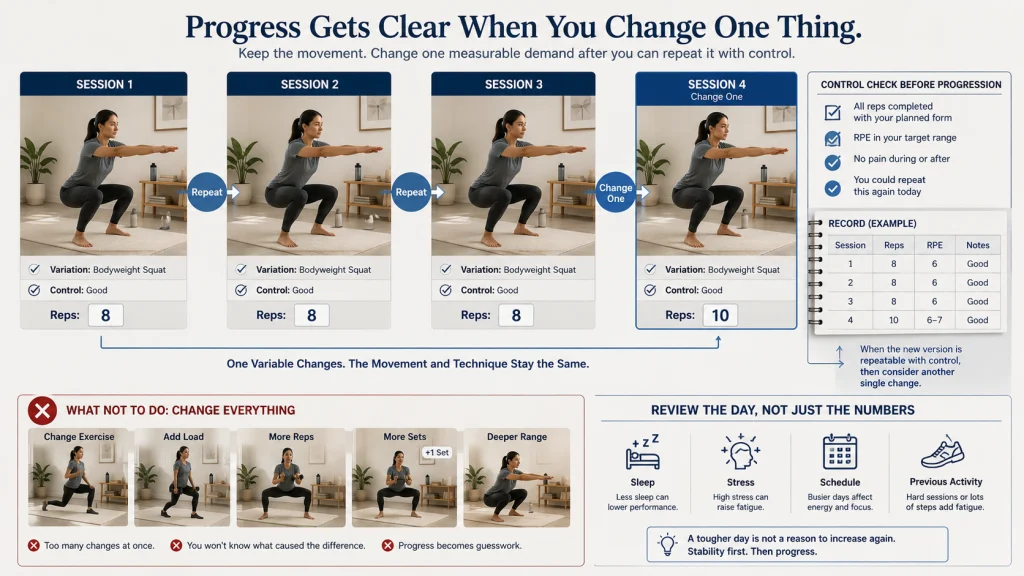
Progress by changing one measurable demand
Progressive resistance means the training demand does not remain permanently unchanged as a task becomes easier. At home, progression can come from more resistance, more repetitions within a planned range, an additional set, greater range of motion, a harder leverage position, a longer pause, slower control, or reduced assistance.
The most useful progression rule is specific enough to repeat. For example, complete the current variation with consistent control across several sessions before increasing one variable. That is more informative than changing exercises whenever a session feels familiar.
Progress does not have to appear in every session. Sleep, stress, schedule changes, and previous activity can all alter what feels manageable on a given day. The home progression guide explains how to increase difficulty over time without turning each workout into a test.
Match weekly structure to the days you can repeat
A full-body structure covers several movement jobs in the same session. A split structure divides work across different sessions. Neither label is automatically more advanced or more effective. The better fit depends on how many days are available, how long each session can be, how much work is assigned to each day, and whether missed sessions leave entire areas untrained.
For someone training on two nonconsecutive days, a simple full-body structure often makes coverage easier. With more available days, a split can distribute work and shorten individual sessions. However, a complicated split may be fragile if the household schedule regularly interrupts planned days.
Key decision: Choose the weekly structure that still covers the body when an ordinary week becomes busy, not the one that looks most detailed on paper.
The full-body versus split guide compares what each structure gains and what becomes harder to maintain.
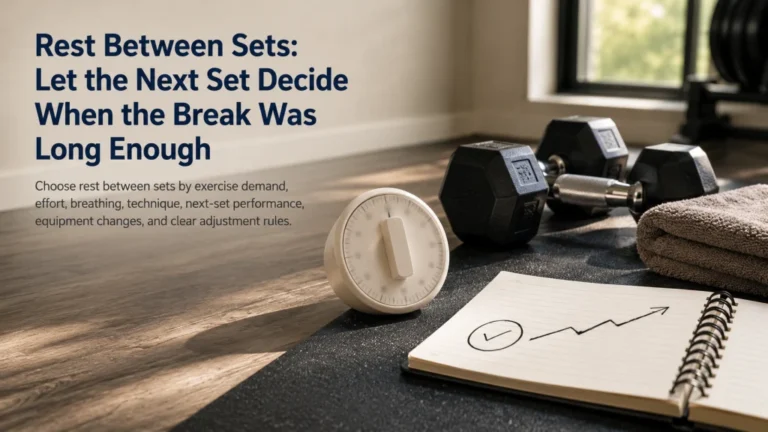
Rest between sets should protect the next set
Inter-set rest is part of the training design. Too little rest can turn the next set into a test of breathlessness or rushed technique rather than the intended strength task. More rest takes additional time, but it may support better repetition quality when the movement is demanding.
By the time the next set begins, breathing should be steadier, the setup should feel secure again, and the movement should still be controllable. When none of those conditions has returned, the rest period may be too short for that task. Smaller movements and easier sets may need less time than large, demanding movements.
Home sessions also include setup time for moving furniture, changing resistance, or checking an attachment point. A plan with frequent equipment changes may need fewer exercise transitions.
The rest-between-sets guide helps match recovery time to the work being performed.
Hard work does not require failure on every set
Training to failure means continuing a set until another repetition cannot be completed with the required movement. It is one way to define effort, but it is not a requirement for every set or every generally healthy adult. The 2026 evidence update found that reaching momentary muscular fatigue did not consistently improve outcomes across programs.
Stopping before failure can preserve technique, make recovery more manageable, and reduce the chance that one demanding set disrupts the rest of the session. The appropriate stopping point depends on the exercise, resistance, experience, safety of the setup, and the person’s ability to judge remaining effort.
Safety warning: Do not continue a repetition when positioning collapses, the load becomes uncontrolled, or you cannot safely return it to a stable position. Stop the set and reset the exercise.
The training-to-failure guide explains effort limits without treating exhaustion as proof of quality.
Start broad, then fill the gaps that remain
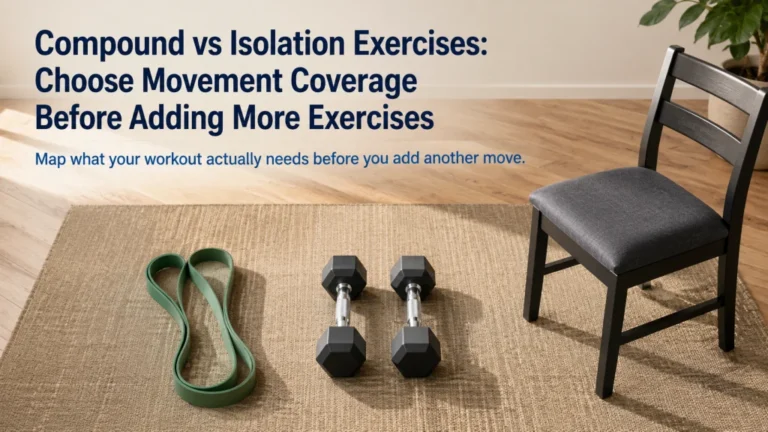
Compound movements involve multiple joints and usually several muscle groups. Isolation movements emphasize a smaller action or a narrower group of muscles. A home plan does not need to choose one category exclusively.
Broad movements can cover several jobs efficiently. Smaller movements can address an underworked area, a preference, or an equipment constraint. Add them to solve a gap, not to make the exercise list look longer.
Editorial observation: Each extra attachment, adjustment, and exercise transition adds storage, setup, and maintenance friction. A movement earns its place when it adds useful coverage or solves a practical constraint.
The compound and isolation comparison helps decide when a broad movement is enough and when a smaller one adds something useful.
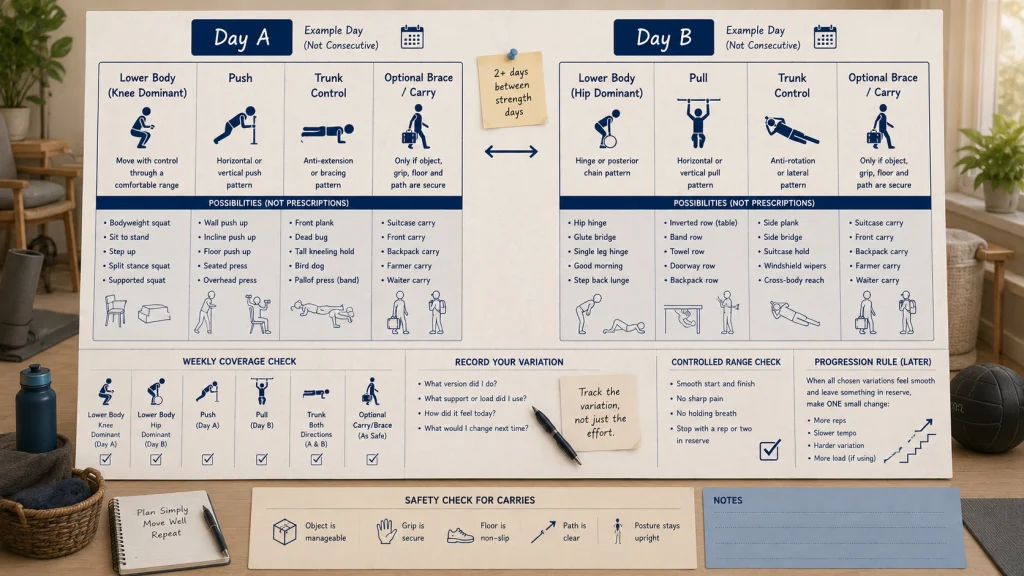
A no-purchase two-day structure
A blank week is easier to fill with a few movement jobs than with a long list of named exercises. This template organizes those jobs without prescribing a finished routine. Choose a safe, controllable movement for each category based on your space, current ability, and available support, and use nonconsecutive days when possible.
| Day A | Day B | Programming note |
|---|---|---|
| Knee-dominant lower-body job | Hip-dominant lower-body job | Use a variation that permits controlled range and a stable return. |
| Push job | Pull job | A pull may require a safe household setup; do not improvise with unstable furniture or fixtures. |
| Trunk-control job | Trunk-control job | Choose different directions of resistance if they can be performed safely. |
| Optional carry or whole-body brace | Optional carry or whole-body brace | Skip the category when the available object, floor, grip, or walking path is not secure. |
Across the two days, include both pushing and pulling and more than one lower-body job. Record each variation and apply one progression rule when it becomes consistently controllable.
This is not a universal program. It is a planning frame that reveals missing categories before equipment or extra exercises are added. For complete routines adapted to different goals and constraints, review the home workout plan options.
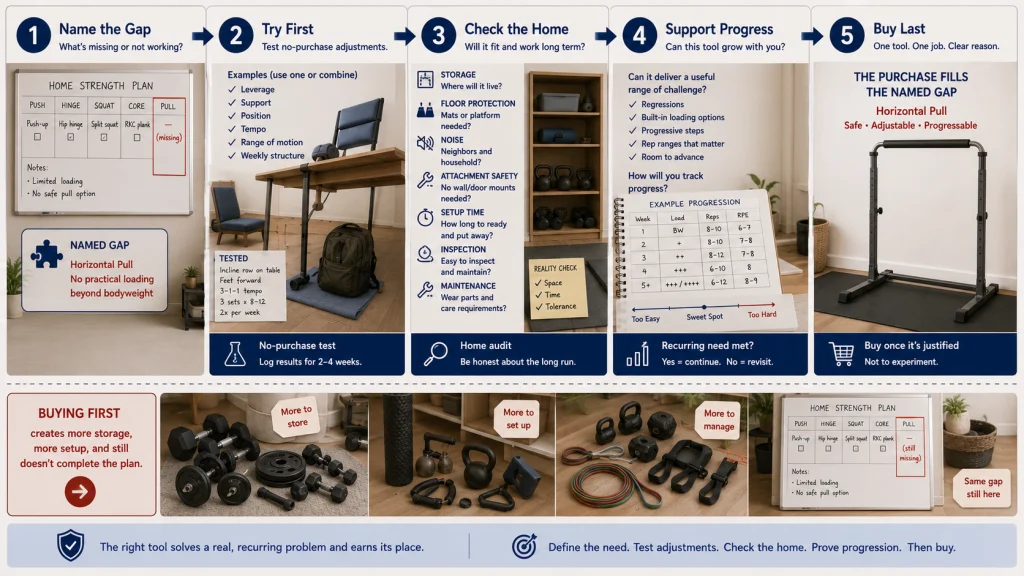
A product-last ladder starts with the missing job
Equipment becomes useful when it solves a problem that keeps returning. Buying first and deciding later can leave the room with more storage and setup work while the same movement gap remains.
- Define the missing job. Identify whether the plan lacks a safe pull, a practical loading option, a comfortable range, or another specific function.
- Try a no-purchase adjustment. Change leverage, support, position, tempo, range, or weekly structure when appropriate.
- Check the space and maintenance burden. Consider storage, floor protection, noise, attachment safety, setup time, and how often the item must be adjusted or inspected.
- Confirm that the item supports progression. A tool should provide a usable range of challenge rather than only one short-lived difficulty level.
- Buy only for a recurring need. A product is easier to justify when it repeatedly removes a real barrier or fills a clear movement gap.
Once the concern is fit, storage, compatibility, or equipment type, the home exercise equipment guide becomes the more useful next step. The goal is not to rank products, but to make the function clear before anything is purchased.
When equipment, coaching, or individualized guidance is justified
Equipment may be justified when bodyweight variations no longer offer practical progression, a safe pulling option is missing, or the same household constraint keeps blocking setup. In each case, the purchase should remove a problem that can be named before shopping begins.
Qualified instruction may be useful when you cannot establish a stable setup, are unsure how to perform a movement safely, repeatedly lose control in the same position, or need help adapting exercises to a limitation. Individualized clinical or exercise guidance may be appropriate for pregnancy, recent surgery, chronic conditions, disability-related limitations, persistent symptoms, neurological symptoms, or a long period of inactivity.
Strength work also sits beside other training needs. Use the home cardio guide for continuous aerobic work and the workout recovery guide for decisions that extend beyond rest between sets.
Know the stop conditions
Normal muscular effort can include local fatigue and a temporary sense that a working muscle is challenged. That does not make every uncomfortable sensation acceptable, and an article cannot determine the cause of a symptom.
Safety warning: Stop exercising and seek appropriate help for chest pain or pressure, fainting, severe dizziness, extreme shortness of breath, sudden weakness, a serious injury, or severe pain. Emergency symptoms require immediate assistance.
Persistent joint or muscle pain, numbness, tingling, unexplained weakness, recurring loss of balance, or symptoms that worsen with training deserve qualified assessment rather than repeated self-testing. Do not use resistance exercise as rehabilitation unless an appropriate professional has provided an individualized plan.
Before each session, clear the floor and movement path. Do not treat chairs, rails, doors, tables, or wall fixtures as load-bearing anchors unless they are designed and confirmed for that use. Keep children, pets, breakable objects, and low ceilings outside the work area.
Note: This guidance is for generally healthy adults and does not replace medical care, physical therapy, or individualized instruction from a qualified exercise professional.
Choose four things before adding complexity
Before the plan grows, choose a resistance method you can use safely, a weekly structure you can repeat, a progression rule you can measure, and the one unresolved choice that is holding the plan back. Then check that lower-body work, pushing, pulling, and trunk control all appear somewhere across the week.
Complexity is useful only when it solves a specific problem. Consistent practice, balanced coverage, suitable effort, and gradual progression should remain visible even when equipment and exercise options expand.
Choose the next question worth solving
| Next question | Where to continue |
|---|---|
| How can I create resistance without equipment? | Plan bodyweight strength work |
| How should a beginner organize volume? | Choose sets and repetitions |
| What starting resistance fits the movement? | Select an appropriate weight |
| How should difficulty increase over time? | Create a progression rule |
| How should sessions be divided across the week? | Compare weekly structures |
| How much recovery is needed inside a session? | Choose rest between sets |
| How close should a set come to failure? | Set an effort limit |
| Which exercise type fits the gap? | Compare exercise categories |
FAQs
🏠 Can strength training at home work without equipment?
Yes. Leverage, range, tempo, pauses, support, and single-limb variations can change resistance. The plan still needs balanced coverage and a trackable progression method.
📅 How many days a week should adults do strength work?
Federal guidance calls for muscle-strengthening activity on at least two days each week, covering all major muscle groups. This is a public-health target, not an individualized prescription.
🔁 Do I need a different exercise for every muscle?
No. Multi-joint movements can involve several muscle groups, and movement jobs can be spread across the week. Check for repeated gaps in pulling, lower-body, or trunk work.
⚖️ Should every set use the same number of repetitions?
Not necessarily. Targets can differ by movement, resistance, and purpose. They should be clear enough to track while repetitions remain controlled.
⏱️ Is a short strength session still useful?
A short session can be useful when it covers planned movement jobs and is repeated consistently. Fewer setup changes can make limited time more practical.
🛑 Should I stop a set as soon as technique changes?
Stop when the movement loses its intended control or the setup becomes unsafe. Do not force a repetition through sharp pain, sudden weakness, or alarming symptoms.
🧰 When does buying equipment make sense?
Equipment is easier to justify when it solves a recurring limitation, supports progression, or fills a clear gap. Consider storage, setup, noise, maintenance, and attachment safety first.
🩺 Who may need individualized guidance before starting?
Pregnancy, recent surgery, chronic conditions, persistent or neurological symptoms, disability-related limitations, or long inactivity may require individualized guidance. Emergency symptoms require immediate help.