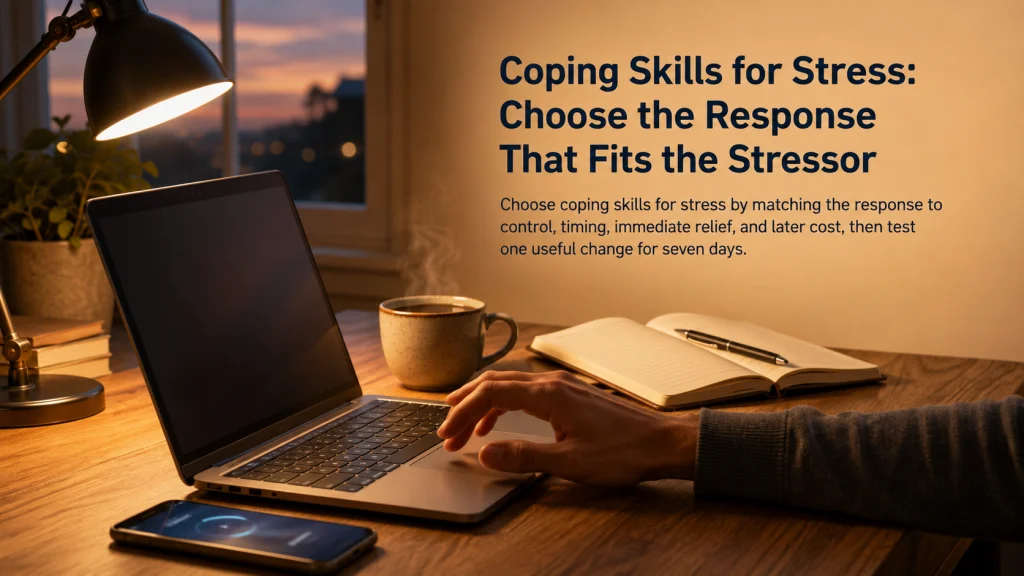
Coping skills for stress are useful only when they fit the stressor, the amount of control available, and the delayed consequence of the response. Begin by naming what is happening, noticing your signals, and deciding whether the next step should change the source, steady the response, create a short pause, or prepare for a recurring situation. Test one change at a time so relief is not mistaken for resolution. Persistent impairment, escalating substance use, unsafe behavior, self-harm thoughts, or inability to function requires qualified or urgent support rather than a self-guided coping experiment.
One Missed Deadline Can Produce Four Different Responses
A deadline is missed. One person asks for a revised due date and clarifies what can still be delivered. Another steps away briefly so they can reply without sending an angry message. A third avoids opening the email. A fourth keeps working until 2 a.m., even though the quality of the work and the next day will suffer.
| Immediate response | What it changes now | What may happen later |
|---|---|---|
| Request a revised due date | Changes the practical conditions of the task | Creates a clearer plan if the request is accepted |
| Take a short pause before replying | Lowers immediate reactivity | Helps only if the conversation still happens |
| Avoid the email | Removes discomfort for a while | Leaves the deadline and uncertainty waiting |
| Work through the night | Creates more working time | May add fatigue, errors, and another difficult day |
All four behaviors can reduce discomfort in the moment. Only some match the actual problem, and even a useful response can become costly when it is repeated in the wrong situation.
Key decision: A coping skill is not automatically useful because it feels relieving. Its value depends on what it changes, what consequence follows later, and whether the stressor is still waiting.
Define Coping as a Response, Not Proof the Problem Is Solved
Coping describes what a person does to manage demands, emotions, thoughts, physical activation, or practical consequences. It can include changing a situation, adjusting expectations, seeking support, pausing before acting, preparing for a predictable challenge, or tolerating what cannot be changed today.
The broader guide on how to manage stress helps decide whether the main need is coping selection, body-based calming, attention reset, restorative time, environmental support, or a situation-specific adjustment. This article stays with recognition and response choice.
A response may be helpful without removing the source. A short walk may make thinking easier, but it does not answer an overdue bill. Asking for help may change the workload, but it may not immediately settle a tense body. The correct judgment depends on the job the response needs to do.
Separate Relief, Recovery, Adaptation, and Source Change
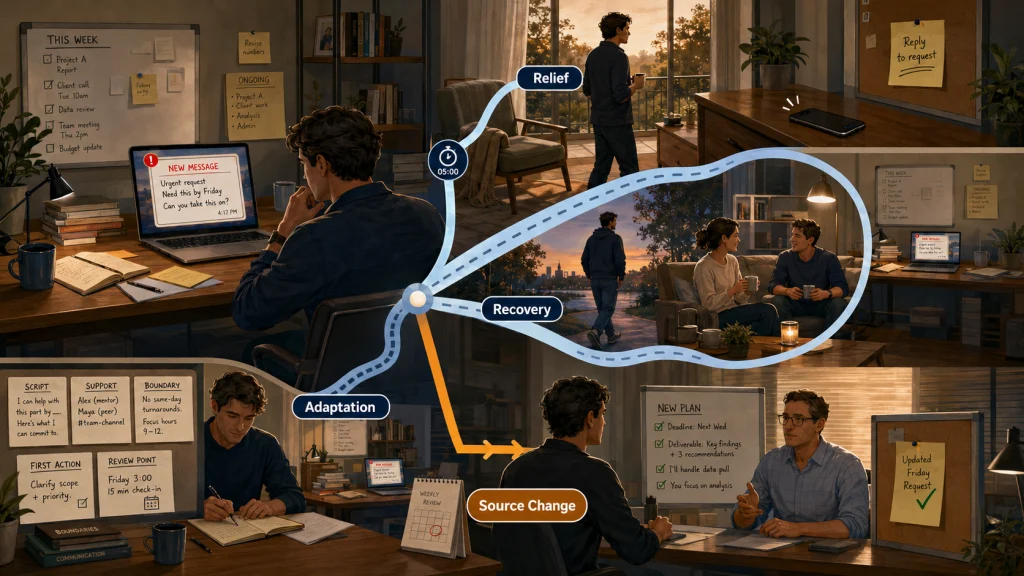
Many coping lists treat all strategies as interchangeable. A clearer approach is to identify the outcome you need first.
| Needed outcome | Main job | Example | Important limit |
|---|---|---|---|
| Relief | Reduce immediate discomfort or reactivity | Step away briefly before replying during an argument | The unresolved issue still needs a next step |
| Recovery | Restore energy and capacity after demand | Protect a quiet evening after several demanding days | Recovery time cannot repair an unchanged overload by itself |
| Adaptation | Make a recurring demand easier to carry | Prepare a script and support plan for a repeated difficult conversation | Adaptation should not normalize an unsafe situation |
| Source change | Alter the demand, boundary, workload, environment, or decision | Renegotiate a deadline or remove a nonessential commitment | Some conditions are only partly controllable or cannot change today |
These outcomes can be combined. A person may need a brief pause first, then a practical conversation, followed by recovery later. The sequence matters because relief can create enough space for action, while relief alone may leave the same pressure in place.
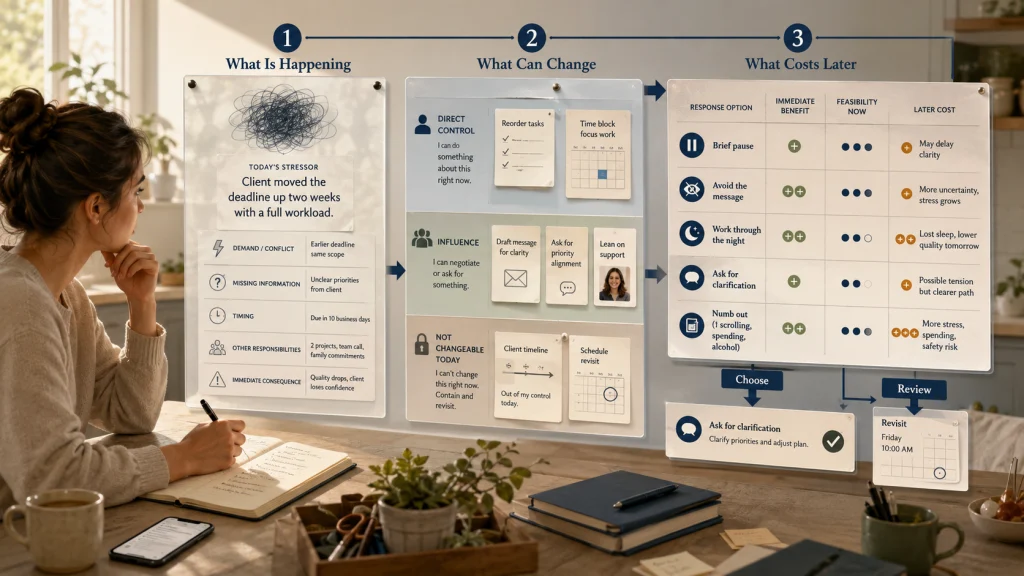
Run the Three-Question Coping Check
Before choosing a technique, answer three questions in plain language.
- What is happening? Name the demand, conflict, uncertainty, loss, interruption, or accumulation of tasks without trying to explain everything at once.
- What can be changed now? Separate the part you control, the part you may influence, and the part that is not changeable today.
- What does the current response cost later? Notice whether it delays action, damages sleep, adds conflict, increases spending, uses substances, creates safety risk, or makes tomorrow harder.
Editorial observation: A useful decision framework starts by defining the job, identifying constraints, and comparing immediate benefit with delayed consequences. An app, device, or calming item may support a pause, but it does not automatically address the deadline, boundary, conflict, or workload creating the pressure.
Clarify Whether Stress, Persistent Worry, or Uncertainty Is Driving the Question
Stress often has an identifiable demand, although several demands can overlap. Anxiety-like worry may continue when no immediate problem is present, spread across many areas, or feel difficult to control. A single article cannot determine which experience or condition explains what a person is feeling.
Use the guide on stress versus anxiety when the boundary is unclear, the worry feels persistent, or the experience no longer seems tied to one practical stressor.
Do not turn a label into a self-diagnosis. The purpose of the distinction is to decide whether ordinary coping selection is enough or whether qualified clarification would be more appropriate.
Notice Your Mental, Physical, Emotional, and Behavioral Signals
A stressor may become visible through the response before the source is obvious. Thoughts speed up, attention narrows, muscles tense, sleep shifts, patience becomes shorter, or familiar tasks are postponed. These are signals to investigate, not proof of one cause.
The guide to recognizing signs of stress helps sort mental, physical, emotional, and behavioral patterns without treating one sign as a diagnosis.
Look for changes from your usual baseline and for clusters that appear around the same conditions. A tight jaw before one meeting may point toward a specific trigger. A broader change affecting sleep, appetite, concentration, relationships, and daily function deserves more careful attention.
Identify Triggers Without Assuming a Single Cause
A trigger is a condition that tends to precede or intensify the response. It may be obvious, such as a difficult message, or it may sit in the background, such as poor sleep, noise, uncertainty, repeated interruptions, or an overloaded calendar.
Use the guide on identifying stress triggers when the same reaction keeps appearing but the pattern is not yet clear.
Avoid forcing every difficult day into one explanation. An argument may feel worse when sleep is short, the room is noisy, and several unfinished tasks are already competing for attention. Recording the conditions separately creates a more useful picture than choosing one cause too early.
Choose Problem-Focused, Emotion-Focused, or Combined Coping
Problem-focused coping aims to change the stressor or its practical consequences. Emotion-focused coping aims to manage the feelings and internal response connected to the situation. Neither category is automatically better. The fit depends on control, timing, readiness, and safety.
The comparison of problem-focused and emotion-focused coping helps choose between changing the situation, steadying the response, or using both in sequence.
An overdue bill may call for gathering information, making a payment plan, or asking for assistance. The fear or shame around opening the bill may also need a short supportive response so the practical task can begin. When the situation cannot change today, the first job may be carrying the response more safely until a decision becomes possible.
Audit Current Coping for Short-Term Benefit and Later Harm
A coping response can help in one setting and create problems in another. Distraction offers a clear example. Watching something light for twenty minutes before a difficult conversation may prevent a reactive exchange. Repeating the distraction every evening while postponing the conversation indefinitely turns a pause into avoidance.
The guide to recognizing costly coping patterns examines what a response relieves now, what it postpones, and what it adds later without assigning a moral label to one behavior.
Review the response in four passes. First, name the immediate benefit, such as distance, comfort, reduced tension, or temporary numbness. Next, identify what remains unchanged, including the task, boundary, workload, decision, or unsafe condition. Then notice any delayed effect on sleep, relationships, spending, isolation, substance use, or safety. Finally, ask whether the behavior is expanding in time, frequency, intensity, or difficulty stopping.
Key decision: Keep a coping response when its benefit supports safer action or recovery without creating an unacceptable consequence. Modify or replace it when the delayed effect repeatedly outweighs the short-term relief.
Persistent avoidance, escalating alcohol or drug use, unsafe anger, dangerous driving, or behavior that threatens safety is no longer a small routine issue. Move toward qualified support rather than trying to optimize the behavior.
Use a Stress Journal When the Pattern Is Unclear
A journal is useful when the same feeling seems to appear without a reliable explanation. Its job is to collect enough detail to compare situations, not to produce a perfect record of every thought.
The stress journal guide shows how to record the stressor, signals, response, immediate effect, later cost, and next adjustment without turning the process into another demanding task.
Keep entries short and concrete. “Three messages arrived during dinner, shoulders tightened, ignored them until midnight, slept late” provides more decision value than “bad day.” Patterns become easier to see when the same fields are used across several entries.
Prepare a Response Before the Next Predictable Stressor
Some situations repeat often enough to deserve a prepared response. The aim is not to control every reaction. It is to reduce the number of decisions required while pressure is already high.
Use the stress management plan guide to match predictable triggers with a first action, a support option, a boundary, and a review point.
A simple plan might say: when a late request arrives, read it once, identify the real deadline, wait ten minutes before replying, then ask which existing task should move. The plan combines a pause with source-focused action instead of relying on either one alone.
Use an Immediate Triage When Too Many Demands Are Open
Overwhelm often makes every demand feel equally urgent. The first task is not to finish everything. It is to reduce the field of attention enough to choose a safe and useful next action.
The guide on what to do when you feel overwhelmed focuses on immediate non-clinical triage, such as capturing open demands, identifying what is time-sensitive, and selecting the next manageable step.
Do not use triage to hide a recurring overload. Once the immediate moment settles, return to the workload, boundary, support, or schedule that keeps recreating the same condition.
Move to a Different Stress-Management Route When the Main Job Changes
Recognition and coping selection are only one part of stress management. Move to the guide that owns the next practical job.
| Current obstacle | Next guide | What that route develops |
|---|---|---|
| Physical activation is blocking clear action | Breathing and body-based relaxation | Ways to work with immediate physical tension without claiming to solve the stressor |
| Attention is stuck in repetitive thought or mental noise | Mindfulness and mental reset | Ways to change the relationship to attention and present-moment engagement |
| Recovery time is missing or repeatedly crowded out | Restorative activities and routines | Ways to build repeatable recovery into ordinary life |
| Noise, light, privacy, sensory input, or a purchase decision is the barrier | Stress-relief products and spaces | Ways to evaluate environmental support and decide when no product is needed |
| Work patterns, caregiving, travel, finances, or another recurring situation shapes the stress | Common sources of stress | Ways to adapt the response to the actual life constraint |
The route changes when the job changes. A person may begin with body-based support, move into a difficult conversation, and later redesign a recurring schedule.
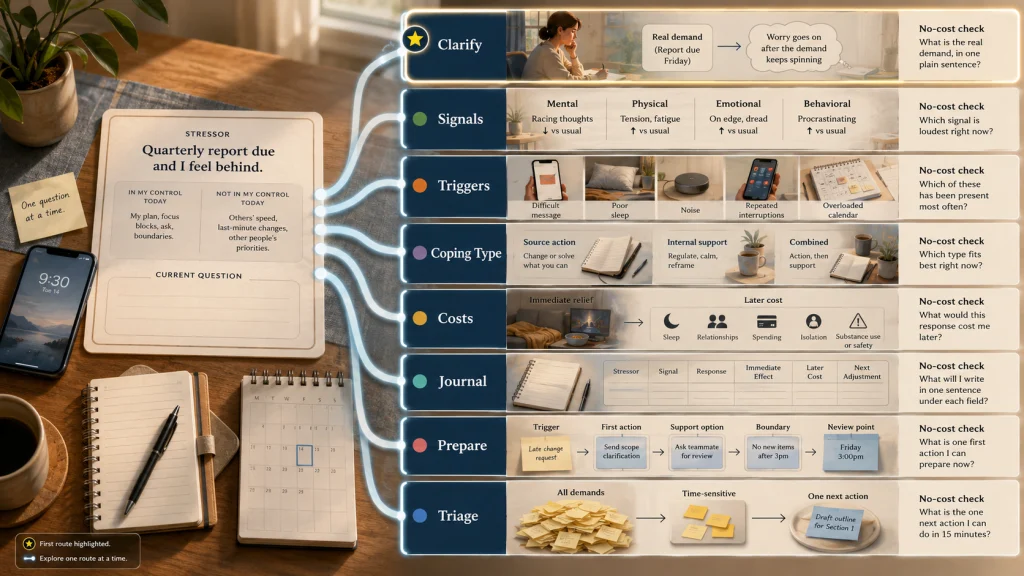
Match the Main Question to the First Detailed Guide
Use this table when the stress pattern is recognizable but the first decision is still unclear.
| Main question | First guide | First no-cost check | Do not assume |
|---|---|---|---|
| Is this ordinary stress, persistent anxiety-like worry, or something that needs clarification? | Clarify stress and anxiety | Write down the identifiable demand and whether worry continues beyond it. | One feeling or behavior proves a diagnosis. |
| How is stress showing up for me? | Identify stress signals | Compare mental, physical, emotional, and behavioral changes with your usual baseline. | One sign identifies the cause. |
| What tends to set off or intensify the response? | Map stress triggers | Record the conditions present before the reaction. | There must be one single trigger. |
| Should I change the situation, manage the response, or do both? | Compare coping approaches | Separate what is controllable now from what is not changeable today. | Problem-solving is always best or emotional support is avoidance. |
| Is my current coping helping now but costing too much later? | Audit coping costs | Name the immediate benefit, unchanged stressor, and later consequence. | A coping category is a moral label. |
| Why does the same stress response keep repeating? | Use a stress journal | Record one event with the same six fields used for later comparison. | A long diary is required. |
| How can I prepare before a predictable stressor returns? | Build a prepared response | Write one trigger, first action, support option, and review point. | A plan can control every reaction. |
| What should I do when there are too many open demands to choose from? | Triage immediate overwhelm | Capture open demands and identify the next time-sensitive action. | Immediate relief fixes a recurring overload. |
Choose the row that describes the decision blocking action now. The other guides remain available later if the pattern changes.
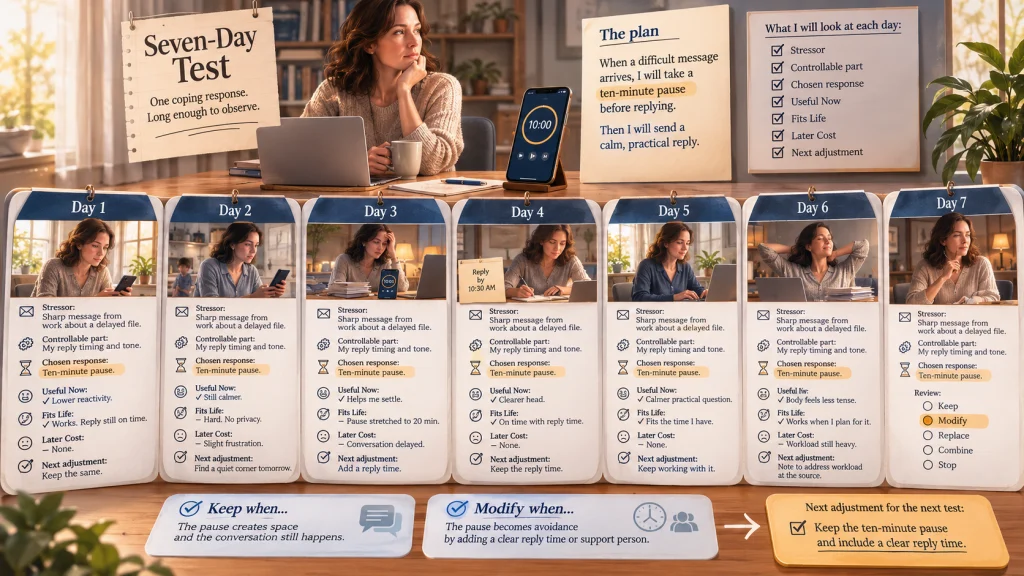
Test One Coping Change for Seven Days
A short observation period can show whether a response is useful, feasible, and sustainable without pretending that seven days settles every problem. Keep the stressor and chosen response specific enough to review.
| Record | Question to answer |
|---|---|
| Stressor | What demand or condition was present? |
| Controllable part | What could be changed, influenced, or scheduled? |
| Chosen response | What one action did you test? |
| Immediate usefulness | Did it create relief, clarity, recovery, adaptation, or source change? |
| Feasibility | Could the response fit the time, privacy, energy, and support available? |
| Later cost | Did it postpone action, harm sleep, add conflict, increase spending, or create risk? |
| Next adjustment | Should you keep, modify, replace, combine, or stop the response? |
For example, test a ten-minute pause before responding to a recurring difficult message. If the pause leads to a calmer reply and the conversation still happens, keep it. If the pause turns into days of avoidance, modify the plan by adding a clear reply time or support person.
Note: Do not test several new coping methods, a new app, a new schedule, and a major boundary change at once. Too many simultaneous changes make the result difficult to interpret.
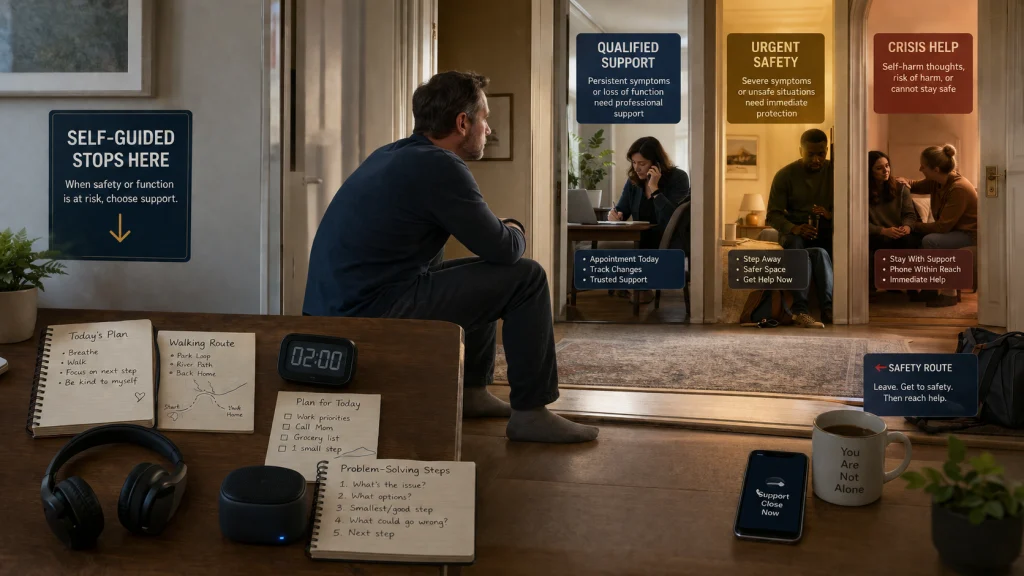
Know When Self-Guided Coping Should Stop
Self-guided coping is appropriate for ordinary stress only while the person can remain safe, complete essential responsibilities, and judge the response with reasonable clarity. A coping framework cannot diagnose a mental-health condition, assess substance dependence, or make an unsafe situation safe.
Safety warning: Persistent distress, major impairment in work or daily care, escalating alcohol or drug use, self-harm thoughts, unsafe aggression, dangerous driving, severe or unexplained symptoms, or inability to cope requires qualified support. Immediate danger, self-harm thoughts with risk of action, or inability to stay safe requires urgent crisis or emergency help.
Seek professional clarification when worry, fear, low mood, sleep disruption, physical symptoms, or loss of function continues, worsens, or no longer fits the identified stressor. Do not use journaling, distraction, breathing, meditation, or problem-solving as a substitute for needed assessment or treatment.
If another person is threatening, controlling, or harming you, prioritize safety and appropriate support rather than trying to improve your coping with the situation.
Write One Stressor, One Controllable Part, and One Review Point
Name the stressor in one sentence. Identify what can change now, what may be influenced, and what cannot change today. Choose one response that fits the required job, then decide when you will review its immediate value and later cost.
Keep the response when it supports action, recovery, or safer adaptation without adding an unacceptable cost. Modify it when it only partly fits, replace it when it repeatedly creates harm, and seek qualified support when safety, function, substance use, persistent distress, or self-harm moves beyond ordinary coping.
Use One Decision at a Time
The detailed guides above follow a practical order: clarify what you are experiencing, identify the pattern, choose a response type, and prepare for the next predictable situation. The routing table already gathers all eight paths in one place, so return to the single question that is still blocking action rather than opening several new coping projects at once.
When the main job changes, change the route. Recognition may lead to a journal, a journal may reveal a boundary that needs action, and immediate overwhelm may later become a planning problem. The next useful step is the one that matches the current obstacle.
FAQs
🧭 How do I choose a coping skill when several might help?
Name what is happening, identify what can change now, and compare the later cost of each response. Choose the action that fits the current job rather than the one that only creates the fastest relief.
⚖️ Is problem-focused coping always better?
No. Problem-focused coping fits situations where practical change is possible and safe. Emotion-focused support may be needed first, or may be the main option when the situation cannot change today.
⏸️ Can distraction be a healthy coping response?
Yes, a brief distraction can create a safe pause before a difficult action. It becomes less useful when it repeatedly postpones the conversation, task, boundary, or decision that still needs attention.
📝 Do I need to journal every day to understand my stress?
No. Short entries around repeated or unclear situations may be enough. Use the same fields so you can compare the stressor, signals, response, immediate effect, and later cost.
🔄 What should I do if the same coping response stops helping?
Recheck the stressor, controllable part, and later cost. The situation may have changed, the response may be expanding, or a different route such as source change, recovery, or professional support may now fit better.
🧠 How can I tell stress from anxiety?
Stress often connects to identifiable demands, while persistent worry may continue beyond a specific stressor or spread across many areas. A general guide cannot diagnose the cause, so seek qualified clarification when the distinction remains unclear or daily function is affected.
🚫 Does avoiding a stressor always mean unhealthy coping?
No. Temporary distance can protect safety, prevent a reactive response, or create time to prepare. Avoidance becomes costly when it repeatedly increases danger, uncertainty, missed responsibilities, conflict, or later distress.
🚩 When is coping advice no longer enough?
Seek qualified support for persistent impairment, escalating alcohol or drug use, unsafe anger, severe symptoms, inability to function, or distress that continues or worsens. Immediate danger, self-harm thoughts, or inability to stay safe requires urgent crisis or emergency help.