Breathing exercises for stress are easier to use when the rhythm matches your tolerance, setting, and main physical signal. A slow pattern without breath holds may suit someone who dislikes counting, while a counted sequence or muscle-release practice may fit a different situation. Stop or simplify the practice if it causes dizziness, air hunger, tingling, strain, or pressure to complete the count. The goal is not to force a dramatic breath, but to choose one low-friction method and practice it in a context where your body can follow it comfortably.
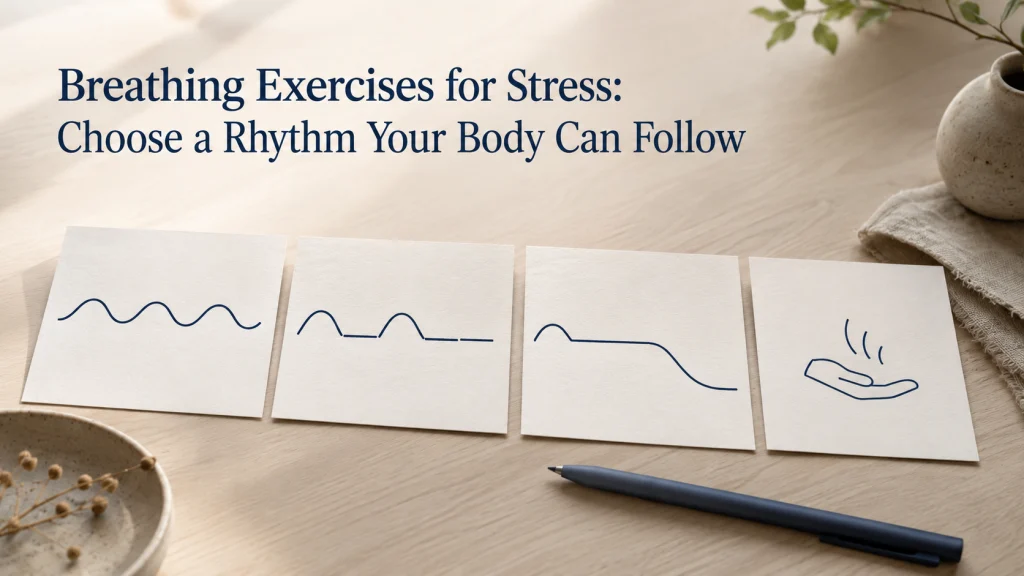
Four Patterns Can Place Very Different Demands on the Body
Picture four simple pacing cards on a table. One shows uncounted, easy breathing. One uses equal counts for every phase. One adds a deliberate breath hold. The last does not change the breath at all, but guides the body through a sequence of tightening and releasing muscle groups.
All four may be described as body-based relaxation methods, yet they do not ask the same thing of the person using them. Counting can feel organizing or distracting. A brief hold can feel steady or uncomfortable. A longer exhale can feel settling or create a sense of air hunger. Muscle release can work well when the clearest signal is tight shoulders, clenched hands, or a rigid jaw rather than a racing breath.
Start with the pattern your body can follow without strain, not the pattern with the most impressive name. Equipment does not make the decision for you. A timer, app, audio track, or visual pacer should support a comfortable rhythm, not pressure you to finish a count that no longer feels manageable.
For the broader question of when a physical reset fits within stress management, begin with the practical guide to managing stress. The sections below help narrow the choice among specific body-first techniques.
What Body-First Relaxation Can and Cannot Change
Body-first relaxation starts with a physical action that may make it easier to settle ordinary arousal. That action might be slowing the pace of breathing, allowing the abdomen and lower ribs to move more freely, following a simple count, or releasing muscle tension in sequence.
These methods can give you something concrete to do when you feel keyed up, restless, or physically tense. They may also create a brief pause before the next decision. That does not mean they remove the source of stress, solve a conflict, repair an overloaded schedule, or replace practical action. A calmer minute can help you respond, but it does not make the stressor disappear.
The distinction matters because disappointment often comes from asking a relaxation method to do work it cannot do. A breathing pattern may lower the friction of the next step. It is not a cure for ongoing stress, and an uncomfortable response is not evidence that you need to push harder.
Run a Safety Screen Before Deliberately Changing Your Breath
Self-guided relaxation breathing is intended for ordinary stress in people who can breathe comfortably at rest. It is not a way to evaluate unexplained shortness of breath, wheezing, chest symptoms, fainting, or repeated dizziness. It also must not replace an inhaler, pulmonary rehabilitation, prescribed care, or emergency treatment.
Safety warning: Seek urgent help for chest pain or pressure, severe shortness of breath, fainting, stroke signs, immediate danger, or thoughts of self-harm. Stop the practice and seek medical evaluation for unexplained breathing difficulty, wheezing, persistent dizziness, symptoms during exertion, or any new, severe, worsening, unexplained, or function-limiting symptom.
Pregnancy, recent surgery, chronic medical conditions, disability-related limitations, a long period of inactivity, or a history of becoming unwell with breath manipulation may change what is appropriate. Individual guidance is also sensible when you are unsure whether a symptom is ordinary tension or something that needs assessment.
Key decision: If you are breathing comfortably and the goal is ordinary relaxation, begin with the least demanding option. If breathing itself is the problem, do not turn the symptom into a self-guided counting exercise.
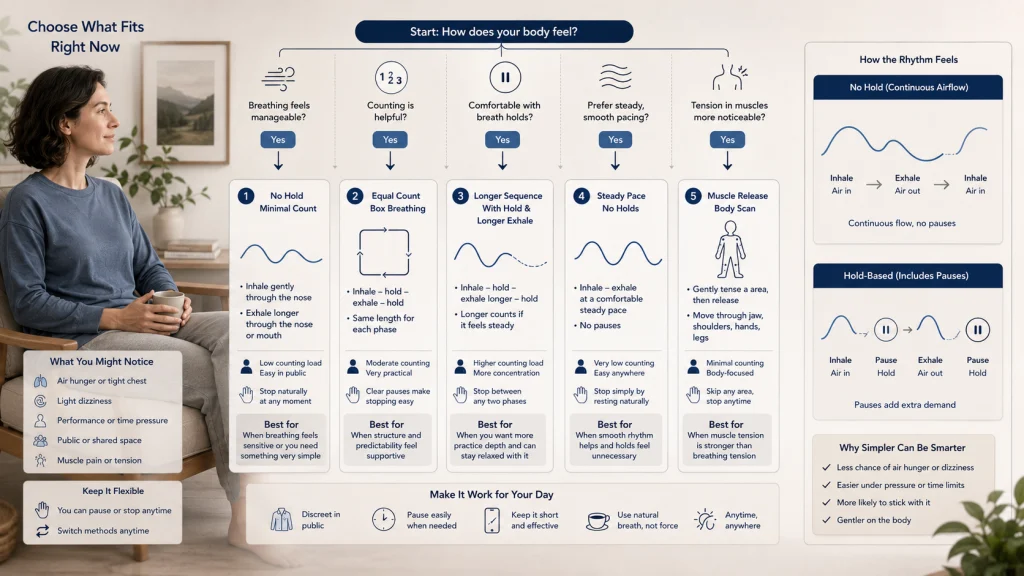
Choose by Tolerance, Counting Load, and the Main Physical Signal
The method name matters less than the demand it creates. Before copying a rhythm, ask whether you want no hold, equal phases, a longer exhale, or no deliberate breath change at all. Also consider whether counting is helpful, whether other people can hear or see the practice, and whether you need to stop immediately without feeling that a sequence is incomplete.
| What feels manageable | Possible starting method | Main demand | When to choose something simpler |
|---|---|---|---|
| Natural breathing with minimal counting | Diaphragmatic breathing | Comfortable lower-rib and abdominal movement | You begin forcing a large inhale or monitoring every breath |
| Equal counts and brief pauses | Box breathing | Following four phases with short holds | Holding creates pressure, air hunger, or dizziness |
| A longer sequence with a deliberate hold | 4-7-8 breathing | Comfort with both retention and an extended exhale | The count feels like a performance target |
| Steady pacing without a hold | Coherent breathing | Maintaining an even, gentle rhythm | The pace feels too slow or mechanically imposed |
| Muscle tension is more obvious than breath tension | Progressive muscle relaxation | Noticing and releasing muscle groups in sequence | Tensing is painful, uncomfortable, or medically restricted |
Use the table to remove methods that add unnecessary friction. A quiet office, shared bedroom, parked car, or busy household can change what feels practical. The easiest technique to start, pause, and repeat is often more useful than one that requires perfect privacy, a long recording, or constant screen attention.
Inhale → Exhale → Inhale → Exhale
Air keeps moving, so the main task is following a gentle pace.
Inhale → Pause → Exhale → Pause
Each pause adds a second task: tolerating a temporary break in airflow.
The diagram is not a ranking. Some people prefer the structure of a pause, while others become more aware of air hunger. Choose the no-hold path when you are uncertain or when retention already feels uncomfortable.
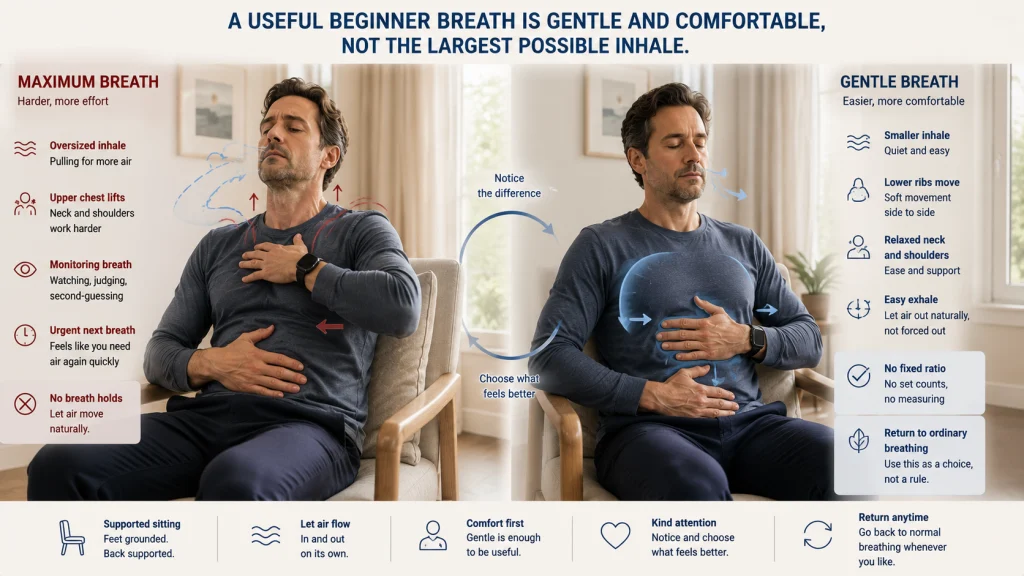
Use Diaphragmatic Breathing to Learn a Comfortable, Low-Effort Pattern
Diaphragmatic breathing is a useful starting point when the main goal is to reduce upper-chest effort and allow easier movement around the abdomen and lower ribs. It does not require a fixed ratio, a breath hold, or a long sequence.
Choose a supported position in which your neck and shoulders do not have to work hard. Let the inhale arrive gently rather than pulling in the largest breath possible. Notice whether the lower ribs or abdomen move without forcing them outward, then allow the exhale to leave without squeezing out every last bit of air.
A common mistake is equating “deep” with “maximum.” Forcing a large inhale can increase chest tension, make the next breath feel urgent, and turn a simple practice into repeated checking. Smaller and easier is the better starting cue when a dramatic breath feels uncomfortable.
Use the full diaphragmatic breathing guide when you want help with position, hand placement, pacing, and the difference between gentle movement and exaggerated belly breathing.
Choose Box Breathing Only When Equal Counts and Brief Holds Feel Manageable
Box breathing divides the cycle into four equal phases: inhale, hold, exhale, and hold again. Its appeal is the clear structure. You do not have to decide what comes next because every phase receives the same count.
That structure also creates the method’s main limitation. Two phases involve no airflow. A person who dislikes breath holds may feel more keyed up while trying to stay on count, especially if the chosen count is longer than a comfortable natural pause.
Begin with a modest rhythm rather than treating a particular number as mandatory. Keep the breath quiet and easy. Shorten the count, remove the holds, or switch methods if you feel strain, tingling, light-headedness, or a growing urge to gulp air.
The detailed box breathing instructions explain how to set a manageable count and how to simplify the pattern without turning it into a test of control.
Use 4-7-8 Breathing Only When Longer Holds and Exhalation Feel Comfortable
The name describes the sequence: inhale for four counts, hold for seven, and exhale for eight. Compared with an equal-count pattern, it places more emphasis on breath retention and a longer exhale.
Those demands make it a poor first choice for someone who already feels air hunger, dislikes holding the breath, becomes dizzy with counted breathing, or feels pressure to complete the full sequence. The count is part of the method, but it is not a rule your body must obey at any cost.
Practice only in a safe, supported setting where you can stop immediately. Do not use it while driving, standing in a place where light-headedness could lead to a fall, or doing any task that requires full attention. A comfortable uncounted breath is preferable to forcing the named ratio.
Review the 4-7-8 breathing guide for a careful explanation of the sequence, common sources of strain, and reasons to choose a no-hold option instead.
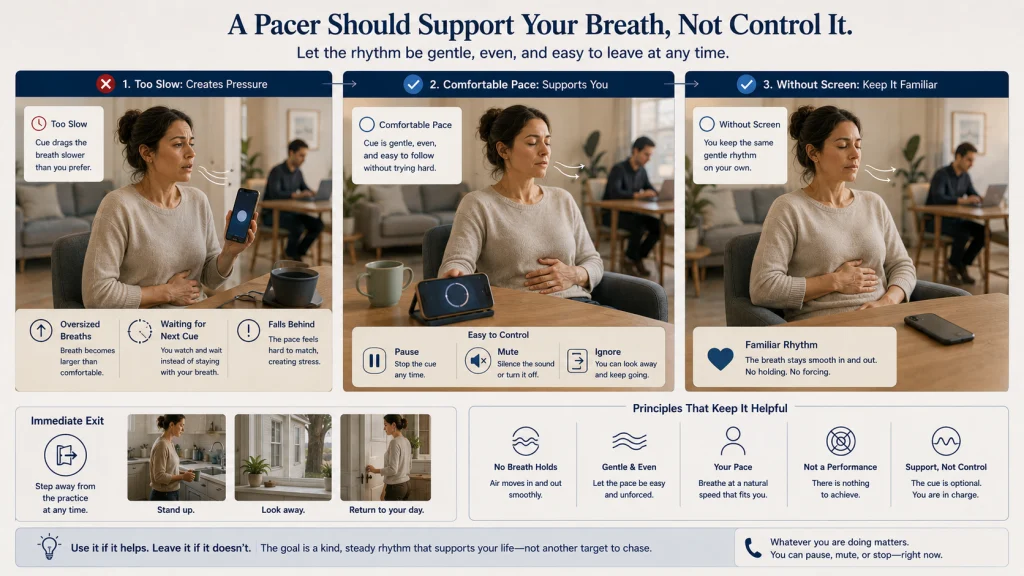
Try Coherent Breathing for Steady Pacing Without a Breath Hold
Coherent breathing uses a slow, regular rhythm with air continuing to move in and out. It may suit someone who likes an even pace but does not want the interruption of a hold.
The practical challenge is finding a rhythm that remains gentle. A timer or visual pacer can be useful, but it should not pull the breath slower than feels comfortable. If you are waiting anxiously for the next cue, taking oversized breaths, or repeatedly falling behind, the pacing tool is setting the demand rather than supporting you.
Editorial observation: This method can be discreet in a shared space because it does not require visible muscle sequences or spoken instructions. It can also become screen-dependent if practice always relies on an animation. Once the rhythm feels familiar, occasionally try it without a device so the technique remains available when a screen is inconvenient.
The complete coherent breathing guide covers comfortable pacing, no-hold practice, and ways to avoid turning the rhythm into another performance target.
Choose Progressive Muscle Relaxation When Tension Is the Clearest Signal
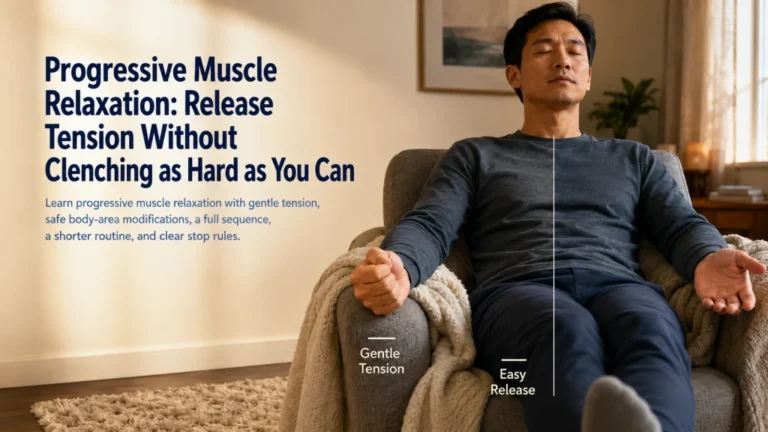
Breathing is not always the most useful doorway. Sometimes the strongest signs are a tight jaw, raised shoulders, clenched hands, rigid legs, or a sense that the whole body is bracing. Progressive muscle relaxation works through that tension more directly by moving through muscle groups and noticing the difference between effort and release.
The practice can be done with very little equipment, but it usually needs more time than a few quiet breaths because the muscle groups are addressed in sequence.
Editorial observation: Privacy and setup can affect whether the method fits daily life. An audio guide may reduce the need to remember the sequence, but it can also add headphones, subscriptions, notifications, and screen friction. A simple written order or familiar routine keeps the practice available without depending on an app.
Do not tense a painful, injured, recently operated, or medically restricted area. You can skip a region, imagine releasing it without tightening first, or choose a different method. The purpose is not to produce the strongest contraction.
Use the progressive muscle relaxation guide for a complete sequence and practical modifications when tightening a muscle group is not comfortable.
Troubleshoot Dizziness, Air Hunger, Tingling, Strain, and Performance Pressure
Discomfort is a signal to change the practice, not proof that it is working. Light-headedness, tingling, chest or throat strain, repeated yawning or gulping, and an urgent need for the next inhale can appear when breathing becomes too large, too fast, too slow, or too controlled.
For example, someone trying to “take a deep breath” may repeatedly lift the chest and pull in more air than feels natural. The effort tightens the shoulders, the long exhale becomes difficult, and the next inhale feels urgent. Pushing for another large breath usually adds to the cycle. Returning to ordinary breathing, sitting safely, and letting the breath become smaller can reduce the added demand.
Safety warning: End the count as soon as the practice itself creates light-headedness, tingling, strain, panic around a hold, or an urgent need to gulp air. Return to ordinary breathing and sit or lie down somewhere safe. Do not restart with a different ratio during the same episode. If the symptoms do not settle, keep returning, or are linked to activity rather than the exercise, stop self-guided practice and arrange appropriate evaluation.
- Shorten the practice rather than trying to finish a preset duration.
- Remove breath holds before changing anything else.
- Use a smaller, quieter inhale instead of a larger one.
- Stop watching the timer if it creates pressure to keep pace.
- Switch to muscle release when breath monitoring itself feels uncomfortable.
The guide to why breathing exercises can cause dizziness helps separate correctable practice friction from symptoms that should not be managed by trying another count.
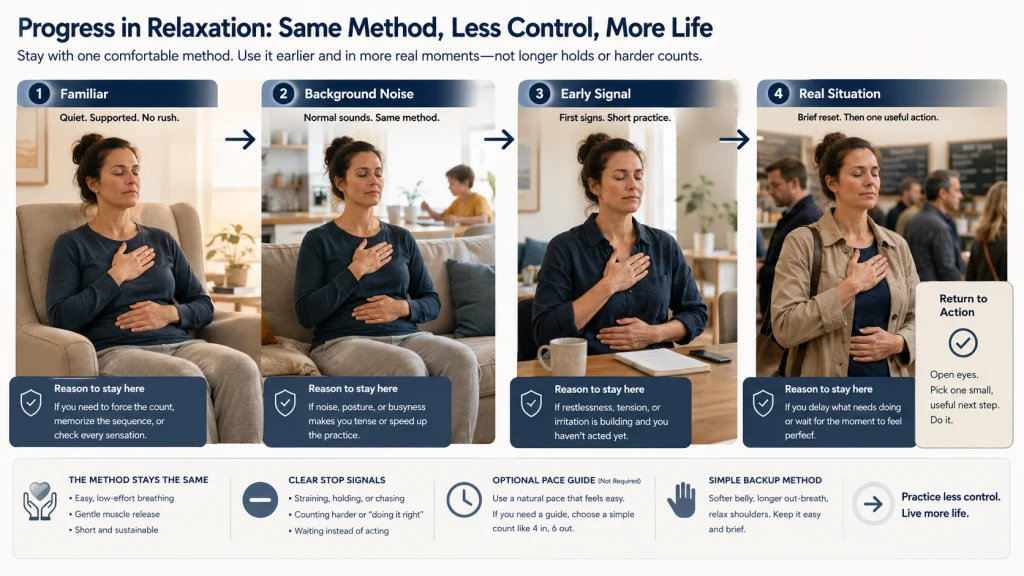
Build From Calm Practice to Stressful Use
A technique is easier to judge when your first attempt does not happen at the peak of a difficult moment. Practicing while relatively calm lets you notice whether the posture, count, sound, and duration are comfortable before stress adds more demand.
| Stage | Practice context | What to learn | Reason to stay at this stage |
|---|---|---|---|
| 1. Familiar | Seated or supported in a quiet place | The basic rhythm and your stop signals | You still need to force, memorize, or chase the count |
| 2. Mildly active environment | A normal room with ordinary background noise | Whether the method works without perfect conditions | Noise, posture, or interruptions make the breath strained |
| 3. Early stress signal | When you first notice tension or restlessness | Whether the technique is available before arousal builds | You cannot use it without monitoring every sensation |
| 4. Real situation | A familiar, non-dangerous stressful moment | Whether a brief version helps you take the next useful action | The method delays needed action or increases discomfort |
Progression does not mean increasing breath holds or making the count harder. It means using the same comfortable method in slightly less controlled settings. If a technique works only with silence, headphones, a specific app, and several uninterrupted minutes, keep a simpler backup option for everyday use.
Editorial observation: The most practical pacing aid is one you can mute, pause, and stop instantly. Visual or audio guidance should reduce setup friction and remain optional once the rhythm is familiar.
Compare One-Minute, Five-Minute, and Longer Practice by Usability
A longer session is not automatically more effective, and a brief session is not automatically too small to be useful. Duration should match the setting, your tolerance, and what you need to do next.
| Practice length | Where it may fit | Main advantage | Main limitation |
|---|---|---|---|
| About one minute | Before a call, after closing a laptop, or at the first sign of tension | Low setup and easy repetition | May be too brief to learn an unfamiliar sequence |
| About five minutes | A planned break or quiet transition | Enough time to settle into a familiar rhythm | Can feel long when counting creates discomfort |
| Longer practice | A deliberate relaxation period in a safe setting | More room for a slow sequence such as muscle relaxation | Higher privacy, time, and interruption demands |
Do not promise yourself a specific effect at a specific minute. Instead, choose a duration you can complete without strain and stop when continuing no longer feels useful. Consistent access matters more than making every session long.
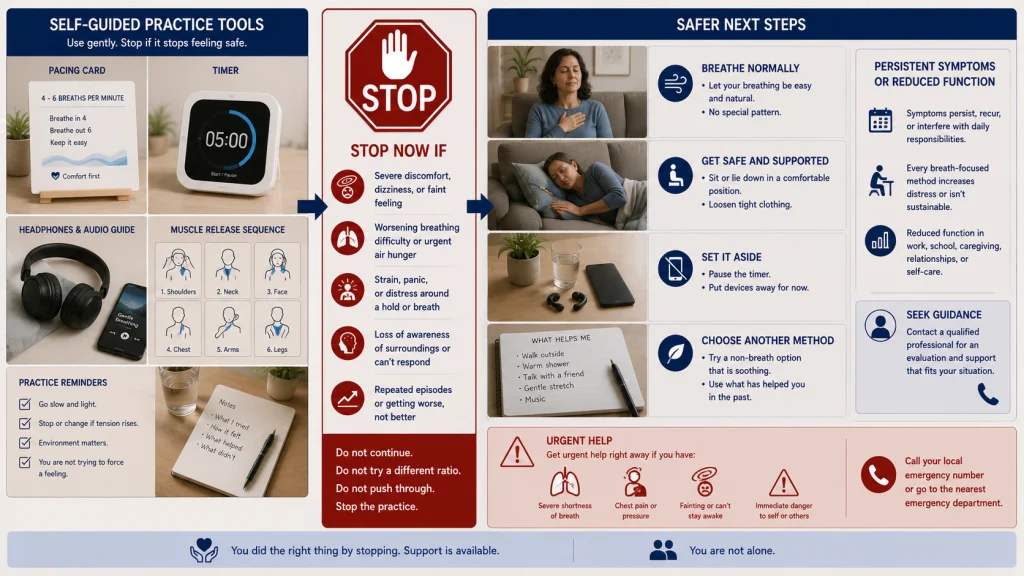
Know When to Stop Self-Guided Practice
Stop immediately when the technique produces severe discomfort, makes you feel faint, worsens breathing difficulty, or prevents you from responding to what is happening around you. A relaxation exercise should never be used to stay in an unsafe situation, delay emergency care, or override a symptom that needs evaluation.
Self-guided practice is also the wrong tool when ordinary stress is no longer the main issue. Persistent or function-limiting symptoms, repeated panic-like episodes, trauma-related reactions, depression, ongoing sleep disruption, or difficulty completing daily responsibilities deserve qualified support rather than a more complicated breathing sequence.
Note: Needing guidance does not mean you failed at relaxation. It means the problem requires a different level or type of support than a self-directed body-first technique can provide.
When there is no urgent symptom but every breath-focused method increases distress, choose a non-breath option such as gentle muscle release or step away from self-guided practice until you can discuss the response with a qualified professional.
Choose One Method and One Safe Practice Context
Begin with the lowest-demand method that matches your clearest physical signal. Use diaphragmatic or coherent breathing when you want a no-hold rhythm, box breathing when equal phases and brief holds feel comfortable, 4-7-8 breathing only when its longer hold and exhale are easy to tolerate, or progressive muscle relaxation when muscle tension is the more obvious problem.
Practice the method while calm, keep the first session brief, and decide in advance what would make you stop. Once the rhythm feels familiar, try it at the early edge of an ordinary stressful moment. The useful technique is not the one with the most memorable count. It is the one that remains comfortable enough to repeat and simple enough to leave when the situation calls for another action.
Explore Each Technique in More Detail
| Next question | Detailed guide |
|---|---|
| How can I learn an easy lower-rib and abdominal breathing pattern? | Learn diaphragmatic breathing |
| How do equal counts and brief holds work? | Set up box breathing |
| What does the 4-7-8 sequence require? | Review 4-7-8 breathing |
| How can I use steady pacing without holds? | Try coherent breathing |
| What can I do when muscle tension is the main signal? | Practice progressive muscle relaxation |
| Why do I feel light-headed or uncomfortable while counting breaths? | Troubleshoot breathing-related dizziness |
Choose the guide that answers the problem you actually have. There is no advantage in learning every named method before finding out whether a simple no-hold rhythm or a muscle-release sequence already fits.
FAQs
🌿 Which breathing exercise should a beginner try first?
Begin with a gentle no-hold pattern that does not require a large inhale. Diaphragmatic breathing or an easy steady rhythm usually creates less counting pressure than a sequence with deliberate retention.
⏱️ Do I need to follow an exact breathing count?
Only named counted methods use a specific sequence, and even then you should not force the count through discomfort. Shorten or stop the pattern when you feel strained, dizzy, or urgently short of air.
🫁 Why can a deep breath feel uncomfortable?
A “deep” breath is often taken as a maximum breath, which can add upper-chest and shoulder effort. Try a smaller, quieter inhale and return to normal breathing if the discomfort continues.
🪑 Is it better to sit or lie down?
Use the position in which you feel supported and can breathe without neck or shoulder strain. Sit or lie down when light-headedness is possible, and avoid practicing where a loss of balance could cause injury.
🔄 How often should I practice?
Practice often enough for the method to feel familiar, but do not chase a rigid frequency or duration. A brief calm practice you can repeat comfortably is more useful than a longer session you avoid or force.
🚩 When should I stop using breathing exercises?
Stop for dizziness, faintness, tingling, strain, worsening breathing difficulty, or distress caused by the count or hold. Seek appropriate evaluation for severe, persistent, unexplained, worsening, exertional, or function-limiting symptoms.