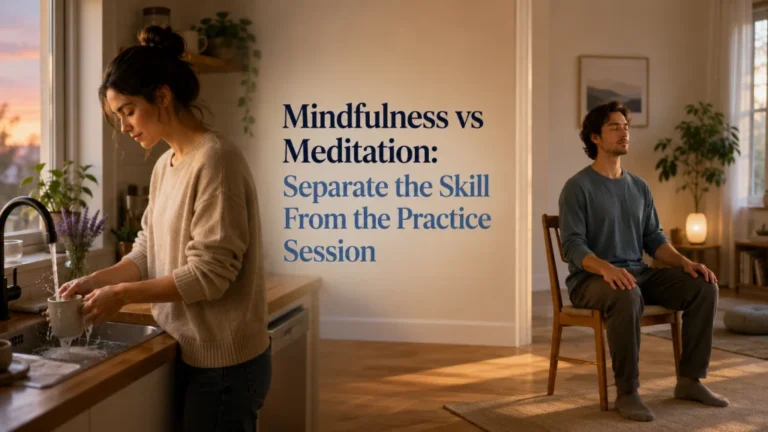
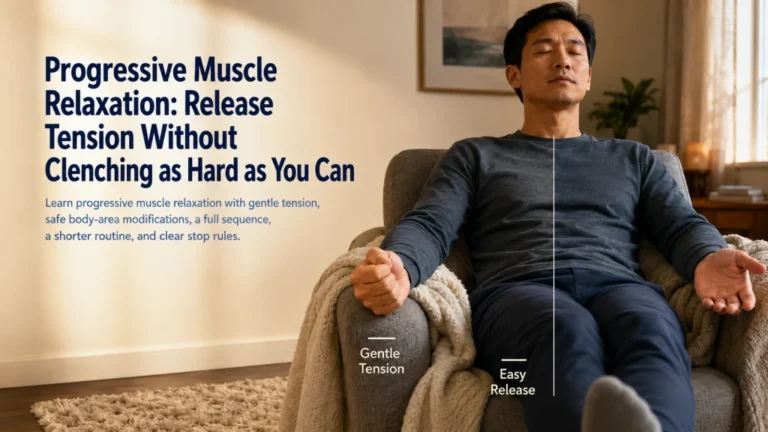
Mindfulness for stress is not one required posture, one app, or one attempt to empty the mind. The shared skill is choosing where attention goes and noticing when it wanders, then selecting a practice that fits your tolerance for stillness, internal sensations, movement, imagination, time, and privacy. Some people do better with inward attention, while others need an external sensory anchor or movement-based practice. If a practice leaves you more frightened, disconnected, flooded by intrusive material, or persistently unsettled, stop and choose a different approach or seek qualified support.
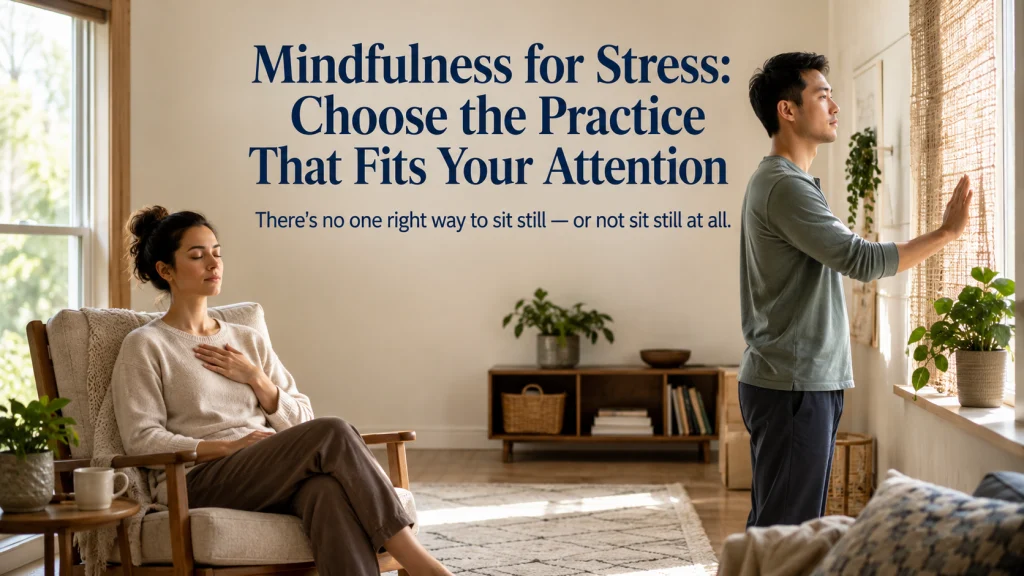
Four Mental Resets Can Use Four Different Postures
One person sits with the eyes closed and follows the breath. Another walks slowly and notices each step. A third names five visible objects in the room. A fourth listens to a short imagery track while resting in a chair.
The postures, attention targets, and levels of movement are different, but the common skill is directing attention on purpose. Mindfulness does not require everyone to sit still, close the eyes, focus inward, or complete a long recording.
Start here: Choose the attention target and setting that feel workable today. The best first practice is not the most impressive one. It is the one you can stop, shorten, and repeat without increasing distress.
Define Mindfulness, Meditation, Grounding, and a Mental Reset
Mindfulness is present-moment attention practiced with awareness of what is happening now. Thoughts, sensations, sounds, and emotions may still appear. The task is noticing rather than forcing a blank mental state.
Meditation is a broader category of structured attention practice. Some forms use mindfulness, while others use a repeated phrase, imagery, movement, sound, or another focus.
Grounding directs attention toward immediate sensory information or the surrounding environment. It is often more externally oriented than a body scan or seated meditation.
A mental reset is an ordinary, non-clinical pause that interrupts automatic attention long enough to choose the next action. It may last only a brief period and does not need to look like formal meditation.
Use mindfulness versus meditation when the main uncertainty is how the two terms overlap and differ.
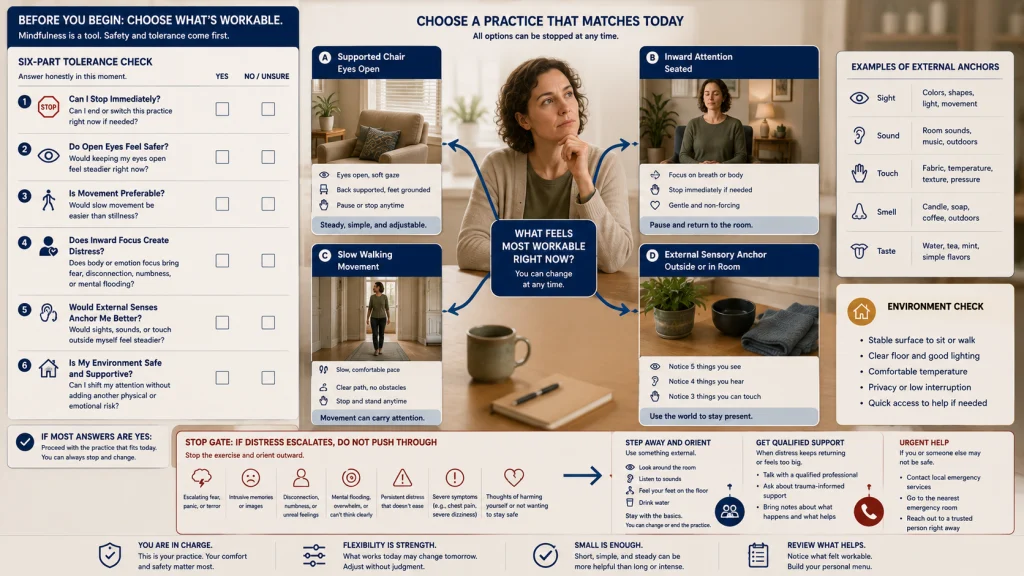
Run a Safety and Tolerance Check Before Choosing the Practice
Ask whether inward attention feels neutral, useful, uncomfortable, or destabilizing. A quiet practice can make some sensations or thoughts more noticeable, which is not always helpful in the moment.
- Can the exercise be stopped immediately?
- Would open eyes feel safer than closed eyes?
- Would movement feel steadier than sitting still?
- Does focusing on the body make you feel frightened, detached, numb, or mentally flooded?
- Would external sights, sounds, or touch provide a more stable anchor?
- Is the person in a safe place where attention can shift inward without creating another risk?
End the exercise when inward focus triggers escalating fear, intrusive memories, a sense of disconnection, numbness, or distress that does not settle. New, severe, worsening, unexplained, or function-limiting symptoms require qualified evaluation. Chest pain, severe shortness of breath, fainting, stroke signs, immediate danger, or self-harm thoughts require urgent help.
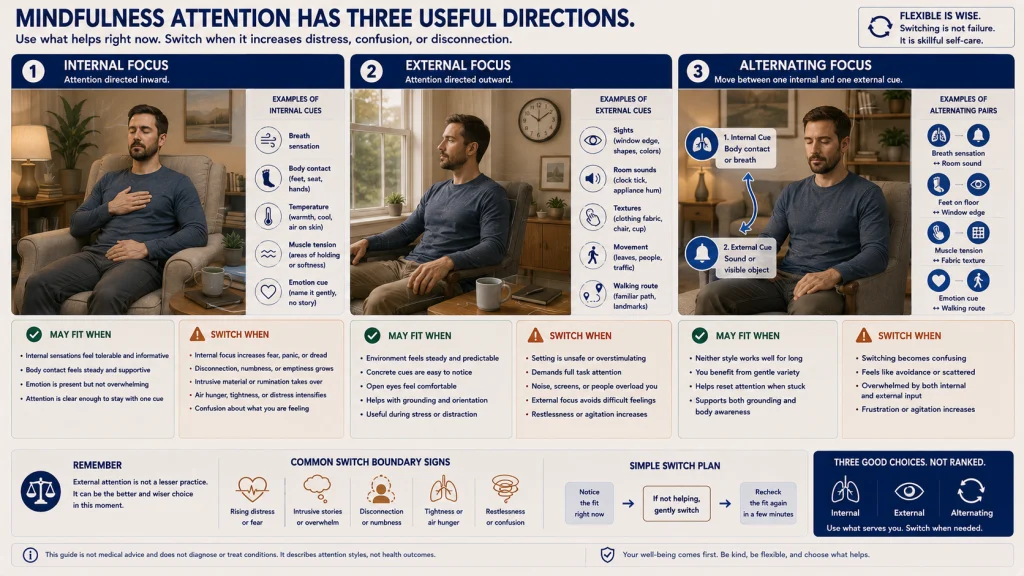
Choose Internal Focus or External Sensory Focus
Some practices ask attention to move inward toward breathing, muscle tension, temperature, or emotion. Others orient attention outward toward objects, sounds, colors, textures, or movement in the environment.
| Attention style | Possible targets | May fit when | Consider switching when |
|---|---|---|---|
| Internal focus | Breath sensation, body contact, muscle tension, emotion | Internal sensations feel tolerable and useful | Body focus increases fear, disconnection, intrusive material, or air hunger |
| External focus | Sights, sounds, textures, room details, walking route | Orientation to the environment feels steadier | The environment is unsafe, overstimulating, or requires full task attention |
| Alternating focus | One body cue followed by one external cue | Neither inward nor outward focus works well for long | Switching itself becomes confusing or frustrating |
External focus is not a lesser form of practice. It may be the better fit when inward attention increases discomfort or when the goal is immediate orientation rather than deeper observation.
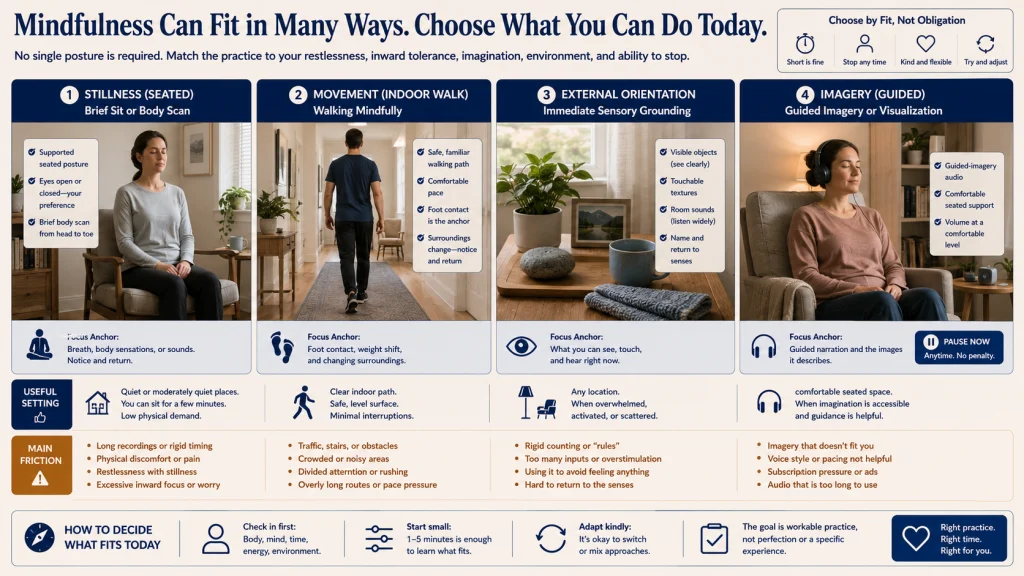
Choose Stillness or Movement
Sitting still can reduce competing tasks, but it can also make restlessness or discomfort more noticeable. Movement provides a changing attention target and may feel more natural for people who become frustrated by a fixed posture.
| Preference | Practice direction | Useful setting | Main friction |
|---|---|---|---|
| Comfortable with stillness | Brief seated meditation or body scan | Stable chair, quiet room, open or closed eyes | Long tracks, discomfort, inward focus |
| Needs movement | Walking meditation or mindful household movement | Clear path, safe pace, familiar surroundings | Traffic, obstacles, divided attention |
| Needs immediate orientation | Sensory grounding | Any safe place with visible or touchable cues | Overly rigid counting or an overstimulating environment |
| Responds to imagination | Guided imagery | Supported position with easy stop control | Unhelpful imagery, voice style, long audio |
Choose Meditation Basics When You Want a Formal Starting Point
A beginner meditation practice can use a stable posture, one attention target, a brief duration, and permission to restart whenever attention wanders. Thoughts continuing during the session does not mean the practice failed.
Use how to meditate for beginners when the main questions concern posture, eyes open or closed, session length, wandering attention, and how to finish without judging the session.
Choose Everyday Mindfulness When Formal Sitting Feels Too Large
Mindfulness can be attached to an ordinary activity rather than reserved for a separate session. Attention might rest on hand temperature while washing dishes, the sound of water, the pressure of the feet while standing, or the first few bites of a meal.
Use mindfulness exercises for adults for short practices that fit work breaks, household routines, transitions, and ordinary moments without requiring a dedicated meditation space.
Choose a Body Scan When Physical Noticing Feels Tolerable
A body scan moves attention through body regions without requiring deliberate muscle contraction. The task is to notice contact, temperature, pressure, tension, or neutral sensation rather than forcing any area to relax.
Use body scan meditation when physical noticing feels manageable and a slower internal practice fits the setting. Switch to an external anchor if body attention becomes frightening, numbing, or mentally overwhelming.
Choose Walking Meditation When Movement Supports Attention
Walking meditation uses the changing contact of the feet, posture, pace, and surroundings as attention anchors. It can suit people who become restless or uncomfortable during seated practice.
Use walking meditation in a safe, predictable area where slow attention does not conflict with traffic, stairs, uneven ground, or another task that requires full awareness.
Choose Guided Imagery When Imagination Is a Comfortable Anchor
Guided imagery uses a spoken description or self-directed scene to organize attention. It may work well for someone who responds to visual detail, sound, temperature, or a sense of place.
Use guided imagery when imagined scenes feel neutral or pleasant. Stop when the imagery becomes intrusive, upsetting, or difficult to leave.
Editorial observation: Audio usability can determine whether imagery feels supportive or irritating. Voice style, session length, offline access, screen brightness, headphones, subscription pressure, and a visible pause control often matter more than the number of scenes in an app.
Choose Sensory Grounding for Immediate External Orientation
Sensory grounding directs attention toward concrete information in the present environment. It may be more suitable than inward observation when body focus or quiet sitting increases distress.
Use the 5-4-3-2-1 grounding technique when a structured external sequence feels useful. The count is a guide, not a test. It can be shortened, reordered, or stopped when the environment does not provide every category comfortably.
Replace the Goal of Clearing the Mind
Mindfulness does not require thoughts to disappear. A wandering mind is part of the practice because noticing the wandering creates the next choice.
A more workable goal is to notice one thought, sound, sensation, or urge and then return attention to the selected anchor. The return may happen many times.
Use how to clear your mind when the phrase itself is creating frustration, performance pressure, or the belief that continued thinking means failure.
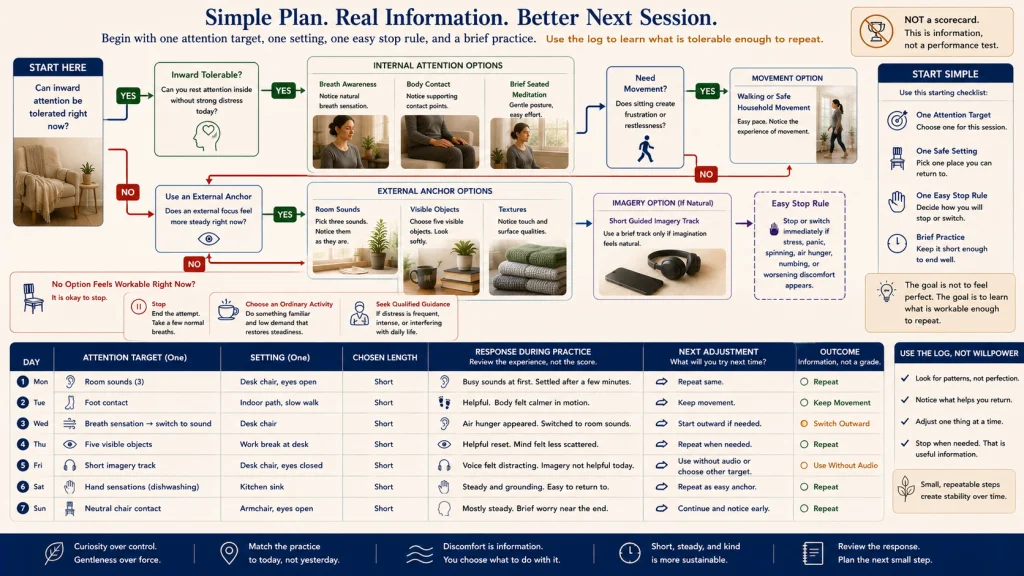
Build a Short Practice and Review the Response
Choose one attention target, one setting, and one easy stop rule. Keep the practice short enough that the response can be reviewed without forcing completion.
- If inward attention feels tolerable, choose breath awareness, body scan, or seated meditation.
- If inward attention increases distress, choose an external sensory anchor.
- If sitting still creates frustration, choose walking or another safe movement practice.
- If imagination feels natural, try a short guided imagery track with an immediate pause option.
- If no option feels workable, stop and use an ordinary activity or seek qualified guidance.
| Day | Attention target | Setting | Length chosen | Response during practice | Next adjustment |
|---|---|---|---|---|---|
| 1 | Three room sounds | Seated, eyes open | Brief | Steady | Repeat |
| 2 | Foot contact while walking | Indoor path | Brief | Less restless | Keep movement |
| 3 | Breath sensation | Seated | Brief | Air hunger appeared | Switch to external sound |
| 4 | Five visible objects | Work break | Very brief | Useful orientation | Keep available |
| 5 | Short imagery track | Chair with headphones | Brief | Voice felt distracting | Try silent practice |
| 6 | Hands during dishwashing | Kitchen | Part of task | Easy to repeat | Use as routine anchor |
| 7 | Body contact with chair | Seated, eyes open | Brief | Neutral | Decide whether to continue |
The log is not a scorecard. It shows which attention target, posture, and setting were tolerable enough to repeat.
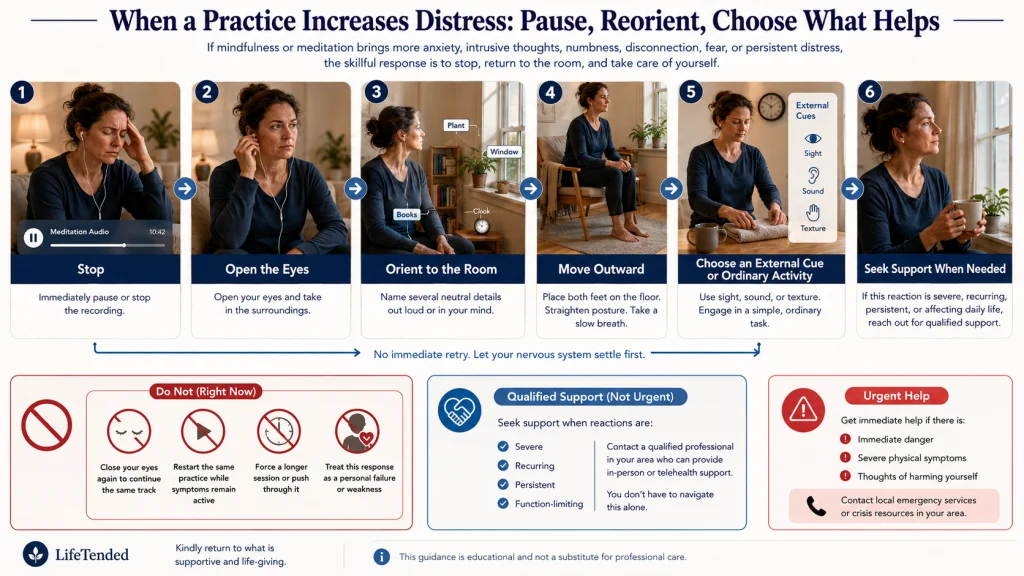
Stop When Practice Increases Anxiety, Intrusive Thoughts, Numbness, or Distress
Mindfulness and meditation can be uncomfortable or distressing for some people. Continuing longer is not automatically the right response.
- Open the eyes and orient to the room.
- Stop the recording or timer.
- Move to a stable posture or ordinary activity.
- Use an external sensory cue instead of an internal focus.
- Do not retry immediately when symptoms remain active.
- Seek qualified support when the response is persistent, severe, recurring, or function-limiting.
This guide does not diagnose anxiety disorders, depression, trauma-related conditions, panic disorder, burnout, dissociation, or a medical cause of symptoms. It also does not turn structured clinical programs into self-treatment.
Choose One Attention Target and One Practice Setting
Begin with the attention style that feels workable: internal or external, still or moving, imagined or sensory. Choose one brief practice, one safe setting, and a clear rule for stopping or switching.
Thoughts do not need to disappear. The useful skill is noticing where attention went and deciding where to place it next. If practice increases distress, move outward, shorten the session, or stop and seek qualified guidance.
For the wider stress-management map, return to how to manage stress.
FAQs
🧠 Does mindfulness mean clearing the mind?
No. Thoughts may continue. The practice is noticing what is present and returning attention to the selected anchor without treating mental silence as a requirement.
🪑 Do I have to sit still with my eyes closed?
No. Mindfulness can use open eyes, walking, household movement, external sensory cues, or a supported seated posture.
👣 What if movement helps me focus better?
Choose a safe movement-based practice such as walking meditation. Avoid slow attention exercises near traffic, stairs, obstacles, or tasks that require full concentration.
👀 What if focusing inward makes me uncomfortable?
Switch to an external anchor such as room sounds, visible objects, textures, or a grounding exercise. Stop if distress persists or worsens.
🎧 Do I need a mindfulness app?
No. Apps can provide pacing or audio, but the basic practice should remain possible without a subscription, screen, streak, or device.
🌄 Is guided imagery a type of mindfulness?
It is an attention practice that can overlap with mindfulness, but it uses imagined sensory detail rather than only observing present sensations.
🧭 When is grounding a better fit?
Grounding may fit when immediate external orientation feels steadier than inward attention, stillness, or body-focused practice.
🚩 When should I stop the practice?
Stop when the exercise clearly worsens your state instead of helping you orient. Open the eyes, return attention to the room, and switch to an ordinary activity or external sensory cue. Seek qualified evaluation when the reaction is severe, recurring, persistent, or limits normal functioning.