A useful sleep schedule is not defined by one universal bedtime. It must fit the wake time you actually need, provide enough opportunity to sleep, remain workable across the week, and account for naps, work, travel, weekends, and other timing pressures. Start by identifying whether the real problem is temporary drift, ongoing inconsistency, daytime sleep, night work, travel, a weekday and weekend mismatch, or a clock change. Then choose one focused adjustment and test it for a clearly dated period instead of trying to change every part of the day at once.

The same sleep duration can fit three very different lives
Consider three adults who each set aside roughly eight hours for sleep. One sleeps from 10 p.m. to 6 a.m., another from 2 a.m. to 10 a.m., and a third from 9 a.m. to 5 p.m. The duration looks similar, but the schedules may interact very differently with work, family responsibilities, daylight, commuting, meals, and social plans.
| Example schedule | What duration alone cannot tell you |
|---|---|
| 10 p.m. to 6 a.m. | Whether the person can fall asleep that early, must wake before the alarm, or loses sleep on weekends. |
| 2 a.m. to 10 a.m. | Whether a late start fits work and household obligations or creates a daily conflict. |
| 9 a.m. to 5 p.m. | Whether daytime sleep is protected from noise, light, interruptions, and changing work shifts. |
Sleep duration alone cannot tell whether a schedule fits a person’s obligations or biological timing. A sleep schedule has four moving parts, bedtime, wake time, regularity, and the timing cues around them. The rest of this guide helps you identify which part is causing the conflict before you choose a response.
Define the four parts of your sleep schedule
A schedule becomes easier to evaluate when you stop treating bedtime as the only number that matters. Each of the following parts can be stable, drifting, constrained, or in conflict with the others.
- Bedtime: when you intend to be in bed and ready for sleep.
- Wake time: when you need or choose to get up, including differences between workdays and free days.
- Regularity: how much those times move from one day to the next and whether the pattern is predictable.
- Timing cues: the light, caffeine, meals, exercise, activity, and routines that repeatedly signal when your day is starting or winding down.
These parts should be reviewed together. A stable bedtime does not solve a wake time that changes by several hours. A fixed wake time does not create enough sleep opportunity if bedtime remains too late. A carefully planned schedule can also be undermined by late naps, bright evening light, or a work pattern that changes faster than the person can adjust.
Key decision: Name the single schedule part that is creating the most friction before changing the rest.
Start with fixed obligations and real sleep opportunity
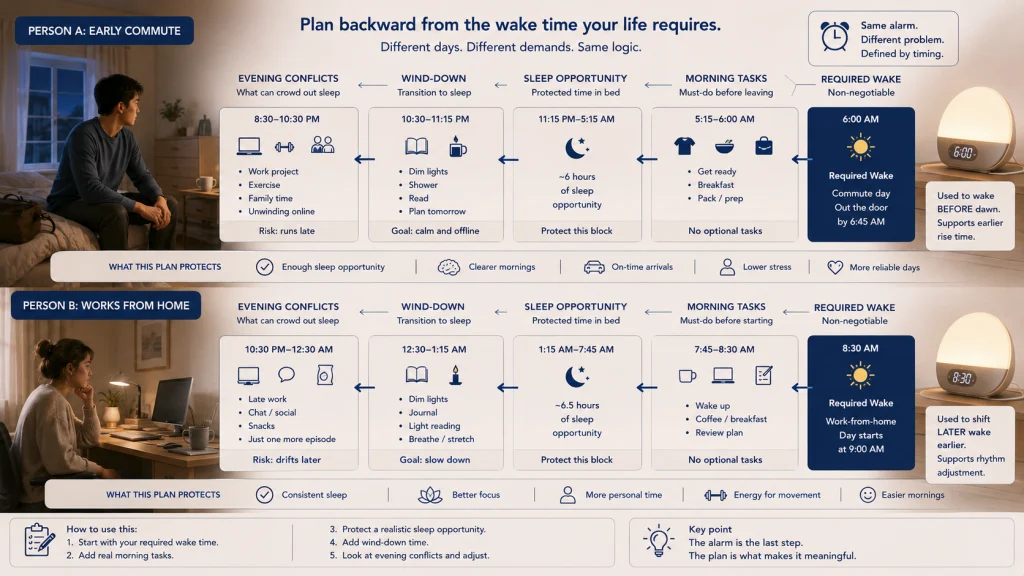
Many planners, sleep apps, and bedside tools ask for a target bedtime first. That sequence can be backwards. A target bedtime only becomes useful after you know the wake time that cannot move, the amount of preparation needed before leaving home, and the evening obligations that regularly limit when sleep can begin.
For example, one person must be awake at 6 a.m. for a commute. Another works from home and does not need to be up until 9 a.m. Giving both people the same target bedtime ignores the three-hour difference in their required wake time. The first person may need an earlier wind-down and firmer evening boundary, while the second may need consistency more than an unusually early bedtime.
Work backwards from the morning:
- Write the earliest non-negotiable wake time for each day.
- Add the time needed for getting ready, caregiving, commuting, or other morning tasks.
- Protect a realistic opportunity for sleep before that wake time.
- Check whether evening work, meals, exercise, naps, or screen-based activities repeatedly crowd that opportunity.
The goal is not to calculate a perfect bedtime from a formula. It is to expose the conflict between the schedule you want and the time your week actually allows.
Editorial observation: Two people can buy the same sunrise alarm for opposite timing problems. One may need help waking before dawn, while the other is trying to shift a delayed routine earlier. The tool only makes sense after the timing problem is defined.
Separate a drifted schedule from an inconsistent schedule
A drifted schedule and an inconsistent schedule can look similar because both involve unwanted timing. The difference is what happened before the current pattern.
Temporary drift usually calls for a defined return plan. Ongoing inconsistency calls for a pattern you can maintain under normal conditions. Confusing the two can lead to an overly aggressive reset for a routine that mainly needs stronger weekly anchors, or a vague consistency goal when the schedule has already shifted far from what daily life requires.
Use a repair plan when the schedule has temporarily drifted
Choose this route when your normal routine was workable, but bedtime and wake time have moved away from it. The practical task is to define the schedule you are returning to, choose a direction, and make changes that are small enough to follow consistently.
The repair should have a start date, a target wake time, and a review date. It should also account for the timing cues that may be holding the current pattern in place, such as sleeping late after a poor night, taking a late nap, using caffeine near the intended sleep period, or keeping the evening highly stimulating.
Use the sleep schedule repair guide when the central problem is a routine that has moved away from a previously workable time.
Use a maintenance plan when the routine works but keeps breaking
A regular sleep schedule does not require every day to look identical. It requires enough stability that ordinary weekend plans, errands, social events, and occasional late nights do not repeatedly erase the pattern that supports workdays.
Maintenance is the better route when the desired bedtime and wake time are already clear, but the routine keeps changing. The key decisions are which time should remain the strongest anchor, how much weekend movement is practical, what to do after a late night, and which obligations regularly cause the pattern to unravel.
Use the consistent schedule guide when the main challenge is keeping a workable pattern across normal weeks.
Separate nap placement from nap duration
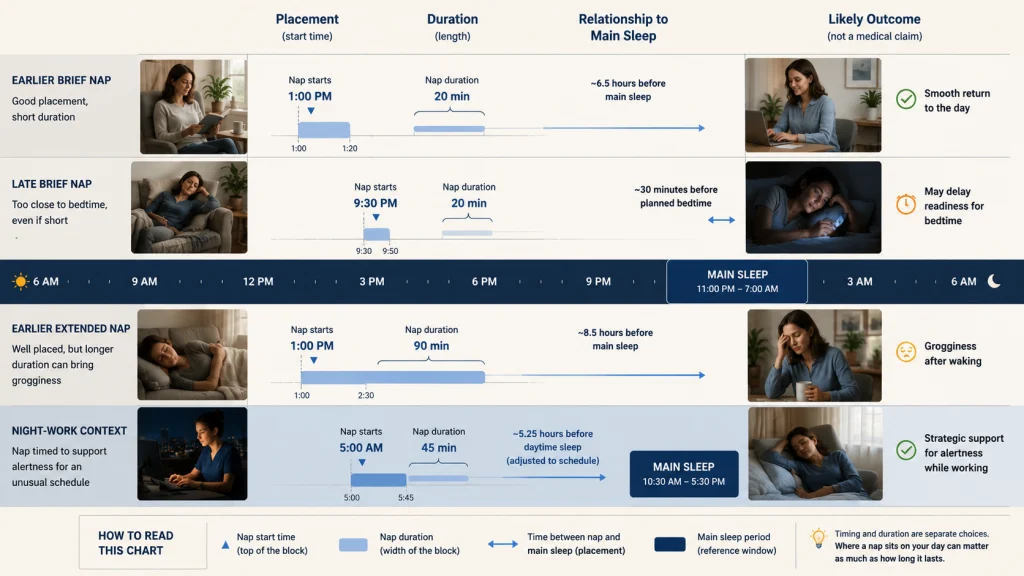
Naps create two different decisions. The first is when the nap occurs in relation to the main sleep period. The second is how long the nap lasts. Solving only one may leave the real problem unchanged.
A nap may be short but placed so late that it reduces readiness for the intended bedtime. Another nap may occur at a workable time but last long enough to leave the person groggy or to replace sleep that should occur during the main sleep period. Night workers may also use naps for a different purpose than someone with a daytime schedule.
| Your main question | Use this guide |
|---|---|
| Where should a nap fit in the day? | Choosing the best nap time |
| How long should the nap last? | Choosing a nap duration |
Track both time and duration for several days before changing the plan. A nap that seems harmless in isolation may explain why bedtime is repeatedly delayed, while a well-placed nap may be a deliberate part of managing an unusual work schedule.
Match the plan to permanent, rotating, or occasional night work
Night work is not one schedule problem. A person on permanent nights faces a different planning task from someone rotating between days and nights or covering an occasional overnight shift.
- Permanent night work: the main question is how to create a repeatable daytime sleep period and protect it from household and social interruptions.
- Rotating shifts: the main question is how often the schedule changes, in which direction it rotates, and which parts of the routine can remain stable.
- Occasional nights: the main question is how to prepare for the shift and return to the usual routine without turning one night into a week of drift.
Light exposure, planned sleep periods, naps, meals, caffeine timing, commuting, and household coordination may all matter, but they should be organized around the actual shift pattern. Use the night-shift sleep planning guide to build around the kind of night work you actually do.
Safety warning: Do not drive or operate equipment when you are struggling to stay awake, having unintended sleep episodes, or unable to maintain attention. Stop the activity and arrange a safer alternative rather than relying on caffeine, loud music, an open window, or determination to push through.

Treat time-zone travel as a direction and local-time problem
Travel across time zones creates a temporary conflict between the schedule your body has been following and the local clock at the destination. The plan should account for travel direction, arrival time, required activities, available recovery time, and the local timing of sleep, light, meals, and activity.
A short trip with flexible mornings may require a different strategy from a work trip with an early meeting immediately after arrival. The most useful question is not simply how many time zones are crossed. It is what the traveler must do on local time and how quickly.
Use the jet lag sleep planning guide when the schedule conflict is caused by time-zone travel. This guide does not prescribe melatonin, sedatives, stimulants, or clinical light therapy.
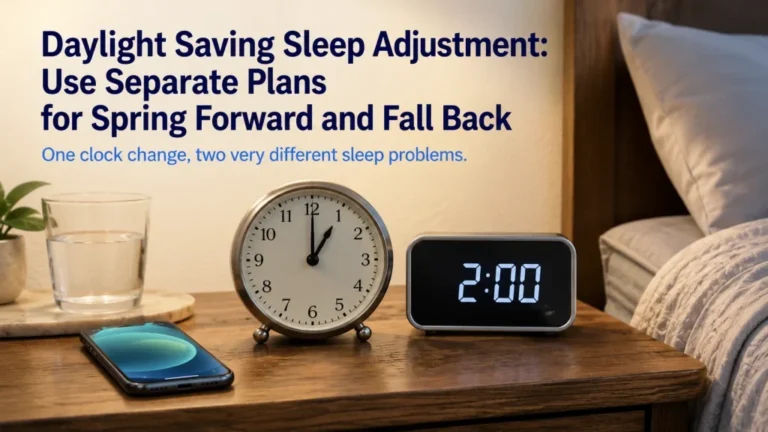
Plan separately for spring-forward and fall-back changes
A daylight-saving transition is a predictable one-hour clock change, not the same problem as a schedule that has drifted for weeks. The direction matters. Spring-forward removes an hour from the clock overnight, while fall-back repeats an hour and may move morning and evening light relative to the schedule.
Review the week around the change rather than focusing only on the night itself. Work start times, school routines, meals, exercise, evening light, and morning preparation may all need small adjustments. People with safety-sensitive work or early driving should take extra care when sleep opportunity is shortened.
Use the daylight-saving adjustment guide for a plan matched to the direction of the clock change.
Use daily habits as timing cues, not as a second full routine
Light, caffeine, meals, exercise, and repeated routines can reinforce when the day feels active and when it begins to wind down. In a timing-focused plan, these are not separate wellness goals. They are cues that should support the chosen bedtime and wake time.
- Light: note when you receive brighter light and when the environment becomes dimmer.
- Caffeine: record the time of the last serving rather than only the total amount.
- Meals: watch for large shifts in meal timing between workdays and free days.
- Exercise: note whether activity time helps the schedule feel organized or repeatedly pushes the evening later.
- Routines: choose a small repeatable sequence that marks the start of the day or the approach of the main sleep period.
For a broader look at daily behaviors and bedroom routines, use the healthy sleep habits guide. Keep the current plan focused on timing so that a long checklist does not hide the one schedule conflict you are trying to solve.
Evidence boundary: General sleep guidance can explain common timing principles and safety concerns. Nora’s role here is narrower: comparing the schedule to real obligations, identifying planning friction, and checking whether a tool or routine matches the problem. This is not a diagnosis of a sleep or circadian condition.
Build a seven-day timing audit before changing the plan
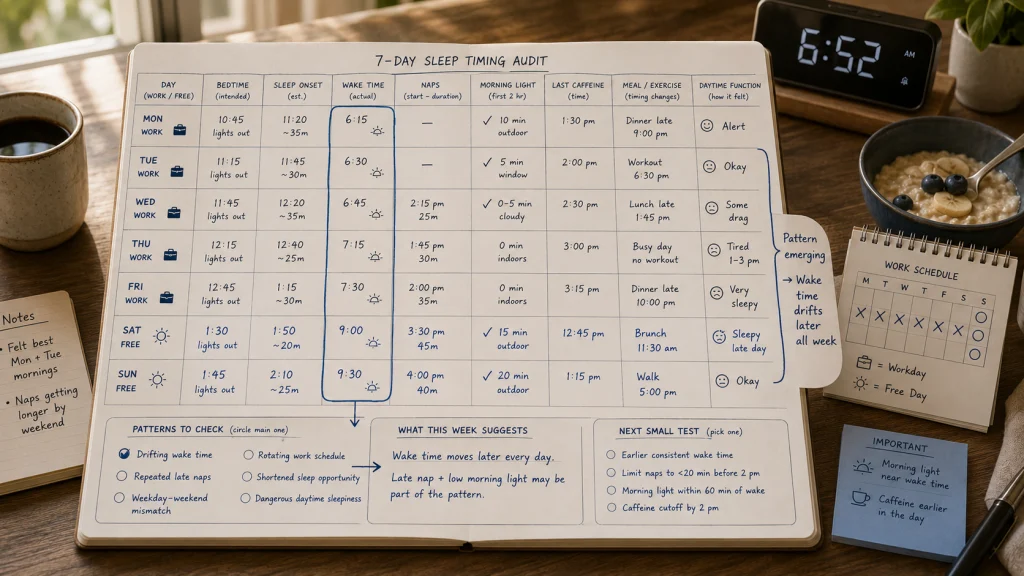
A one-night memory is a weak basis for a schedule decision. A seven-day audit shows the difference between an isolated late night and a repeating pattern. Record estimates rather than chasing perfect measurement.
| Day | Bedtime | Estimated sleep onset | Wake time | Naps | Light and timing cues | Daytime function |
|---|---|---|---|---|---|---|
| Day 1 | Time | Estimate | Time | Start and duration | Morning light, last caffeine, meal or exercise changes | Alert, tired, drowsy, or unintended sleep |
| Day 2 | Time | Estimate | Time | Start and duration | Morning light, last caffeine, meal or exercise changes | Alert, tired, drowsy, or unintended sleep |
| Day 3 | Time | Estimate | Time | Start and duration | Morning light, last caffeine, meal or exercise changes | Alert, tired, drowsy, or unintended sleep |
| Day 4 | Time | Estimate | Time | Start and duration | Morning light, last caffeine, meal or exercise changes | Alert, tired, drowsy, or unintended sleep |
| Day 5 | Time | Estimate | Time | Start and duration | Morning light, last caffeine, meal or exercise changes | Alert, tired, drowsy, or unintended sleep |
| Day 6 | Time | Estimate | Time | Start and duration | Morning light, last caffeine, meal or exercise changes | Alert, tired, drowsy, or unintended sleep |
| Day 7 | Time | Estimate | Time | Start and duration | Morning light, last caffeine, meal or exercise changes | Alert, tired, drowsy, or unintended sleep |
At the end of the week, look for one pattern. Examples include a wake time that moves later each day, a late nap before every delayed bedtime, a large weekend shift, a rotating work conflict, or severe sleepiness after a shortened night. Do not turn the audit into a score. Its purpose is to identify the route that best matches the problem.
Choose one route from the problem-to-guide table
Use the table after completing the audit. Pick the row that explains the largest share of the timing conflict, even if another row also applies occasionally.
| Timing problem | Best next guide | First decision |
|---|---|---|
| A previously workable routine has shifted | Repair a drifted schedule | Define the wake time and direction of change. |
| The routine works but repeatedly breaks | Maintain schedule consistency | Choose the strongest weekly anchor. |
| The main question is when to nap | Place the nap in the day | Relate the nap to the main sleep period. |
| The main question is nap length | Choose nap duration | Define the purpose of the nap. |
| Work requires sleep at unusual times | Plan around night work | Identify whether shifts are permanent, rotating, or occasional. |
| Travel creates a local-time conflict | Plan for time-zone travel | Note direction, arrival time, and required activities. |
| Workdays and free days use different schedules | Review the weekly mismatch | Compare bedtime and wake time across the week. |
| A one-hour clock transition is approaching | Prepare for the clock change | Separate spring-forward from fall-back. |
After choosing a row, write one dated test plan. Include the start date, the one schedule element you will change, what you will keep stable, and the date you will review the result. Avoid combining a new wake time, a new bedtime, a new nap rule, a caffeine change, and a weekend overhaul into the same first test.
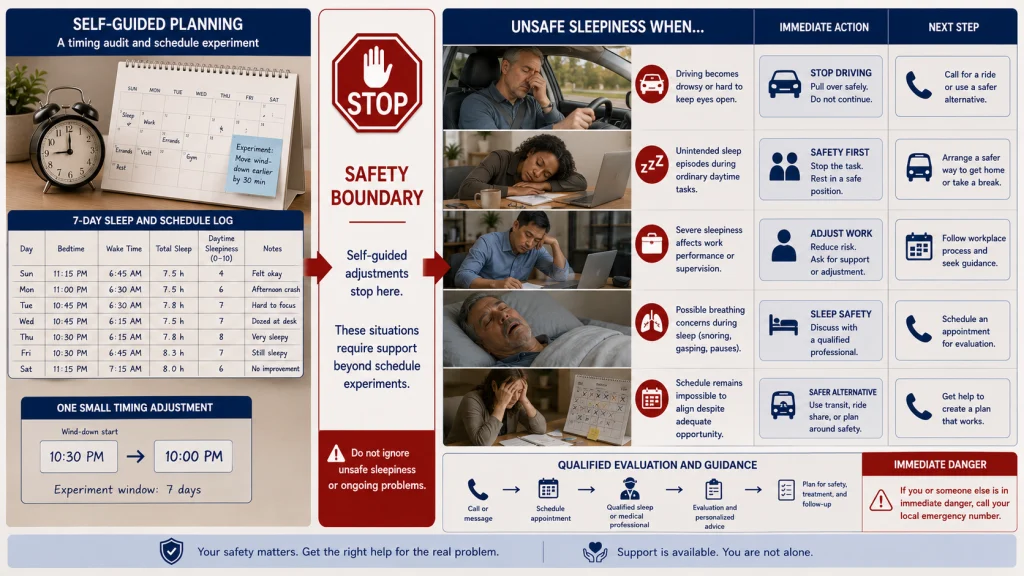
Know when schedule planning is not enough
A timing audit can organize practical decisions, but it cannot diagnose why a schedule is difficult to align. Persistent impairment may relate to a sleep condition, another health condition, medication effects, mood changes, breathing problems, or circumstances that need qualified evaluation.
Safety warning: Dangerous sleepiness, drowsy driving, unintended sleep episodes, breathing concerns during sleep, severe daytime sleepiness, or a persistent inability to align sleep with essential obligations requires prompt qualified guidance. When sleepiness makes driving or another activity unsafe, stop immediately and use a safer transportation or work arrangement.
Seek qualified evaluation when the problem is new, severe, worsening, unexplained, function-limiting, or unchanged despite a realistic schedule opportunity. This article does not diagnose or treat insomnia, circadian-rhythm disorders, narcolepsy, shift-work disorder, mood disorders, medication effects, or other medical conditions.
Finish with one timing problem and one dated test
Write the problem in one sentence: “My main timing problem is ______.” Then select the guide that matches it and define one change you can observe without rebuilding the entire week.
A complete test plan might say: “Starting Monday, I will keep my required 6:30 a.m. wake time stable for seven days, avoid moving it later after a poor night, record naps, and review the pattern the following Monday.” Another might focus only on moving a late nap earlier, protecting daytime sleep after night work, or reducing the weekday and weekend gap.
The broader sleep improvement guide can help you check whether timing is truly the main domain. Once it is, keep the first intervention narrow enough that the result tells you something useful.
Explore the next sleep timing guide
| Use this next | When it fits |
|---|---|
| How to fix a sleep schedule | Your timing has temporarily drifted from a previously workable routine. |
| How to keep a consistent sleep schedule | You know the schedule you want, but ordinary weeks keep disrupting it. |
| How to choose the best time to nap | Your main decision is where a nap should fit relative to the main sleep period. |
| How long a nap should be | Your main decision is nap duration rather than nap placement. |
| How to build a night-shift sleep plan | Your work requires permanent, rotating, or occasional overnight timing. |
| How to plan sleep for jet lag | Time-zone travel creates a temporary conflict with local time. |
| How to manage social jet lag | Your weekday and free-day schedules repeatedly pull in different directions. |
| How to adjust for daylight saving time | You are preparing for a predictable spring-forward or fall-back transition. |
FAQs
🕒 What makes a sleep schedule healthy?
A healthy sleep schedule provides enough opportunity to sleep, fits essential obligations, and is stable enough to be workable across the week. It is not defined by one universal bedtime. Daytime function and safety matter more than copying another person’s clock times.
🌅 Should I choose bedtime or wake time first?
Start with the wake time that is least flexible, then work backwards to protect a realistic sleep opportunity. Bedtime still matters, but it should be chosen in relation to the morning rather than as an isolated goal.
📅 Does every day need the same bedtime and wake time?
No. A regular sleep schedule can allow practical variation. The useful question is whether changes are small and recoverable or whether they repeatedly make the next workday, school day, or required wake time difficult.
😴 Can naps be part of a regular sleep schedule?
Yes, but nap timing and nap duration should be planned separately. Record when the nap starts, how long it lasts, and whether it changes the main sleep period before deciding that naps are helping or interfering.
🌙 Is a night-shift schedule just a reversed daytime schedule?
Not necessarily. Daytime sleep may face more light, noise, household activity, and schedule changes. The plan also depends on whether night work is permanent, rotating, or occasional.
✈️ Is jet lag the same as a broken sleep schedule?
No. Jet lag follows travel across time zones and creates a conflict with local time. A drifted routine can happen without travel and may need a different return plan.
🗓️ How long should I track my schedule before changing it?
Seven days is a practical starting point because it includes both required days and free days for many adults. Start sooner when there is an immediate safety concern, and seek qualified guidance for severe or persistent impairment.
🚗 When is sleepiness a safety problem?
It is a safety problem when you struggle to stay awake while driving, operating equipment, working at height, supervising others, or performing another attention-sensitive task. Stop the activity and arrange a safer alternative rather than trying to push through.