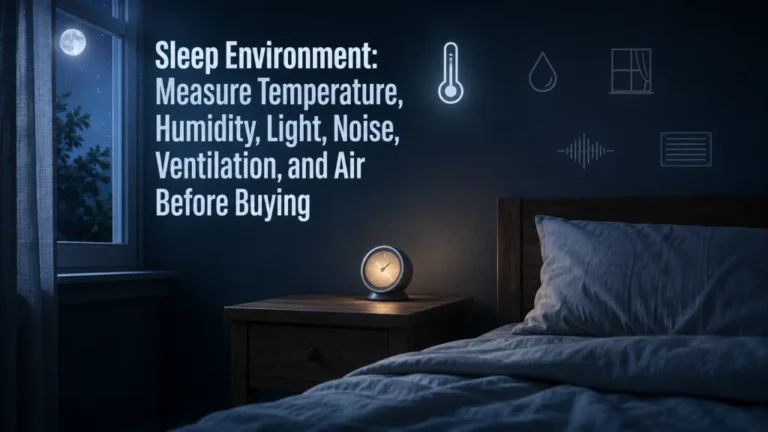
Healthy sleep habits work best when they target the behavior most likely to be disrupting sleep, rather than becoming one long list of rules. The first useful change may involve morning light, caffeine, exercise, evening food or alcohol, phone use, delayed bedtime, or the final wind-down sequence. Choose one obstacle and test one change for 14 nights while keeping the rest of the routine reasonably stable. Persistent breathing concerns, dangerous daytime sleepiness, or significant impairment require qualified evaluation rather than a longer lifestyle experiment.

Tonight’s sleep may be shaped soon after waking
A horizontal day can tell a clearer story than a bedroom checklist. Morning light appears near wake time. The first caffeine source comes later. Exercise, dinner, final phone use, and lights out follow across the same line. By bedtime, several decisions have already influenced how much sleep opportunity remains and how easily the day can settle.
| Wake | Morning | Daytime | Evening | Final hour | Lights out |
|---|---|---|---|---|---|
| Wake time | Light exposure and first caffeine | Activity and later caffeine | Dinner, alcohol, and exercise timing | Phone use and transition | Actual bedtime |
Healthy sleep habits work better as a sequence than as a checklist. In home and wellness retail, I saw shelves place visible nighttime products at the center of the sleep conversation even when the more important decision happened during the day. It was easy to compare three white-noise machines while overlooking a late caffeine source or a bedtime pushed back by autoplay.
That observation is about matching behavior to the problem, not diagnosing sleep. Use this page after the broader sleep decision guide has pointed toward ordinary behavior as the first area to examine. The goal here is to choose the right behavior question, not change every hour of the day.
A useful sleep habit supports opportunity, timing, or transition
A healthy habit is a repeated behavior that makes sleep more workable. It may protect enough time for sleep, reinforce a steadier time pattern, reduce stimulation before bed, or make the transition from activity to rest less abrupt. It does not guarantee a perfect night.
This definition keeps the focus on function. A routine is not useful merely because it sounds calming or appears on a popular checklist. It should address a specific source of friction and fit the person’s work, household, caregiving responsibilities, preferences, and safety needs.
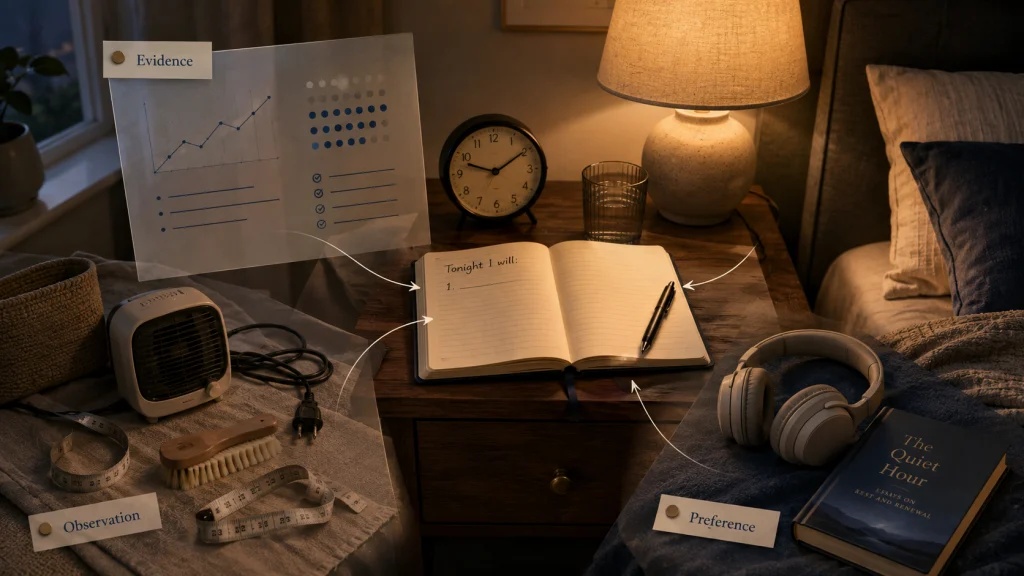
Three kinds of guidance may appear similar but should be used differently:
| Type | How to use it |
|---|---|
| Evidence-informed guidance | Use it to identify behaviors that commonly deserve attention, while allowing for context and individual variation. |
| Editorial observation | Use it to notice setup friction, product mismatch, maintenance demands, and behaviors that retail displays can obscure. |
| Individual preference | Use it to decide whether a safe routine is comfortable and sustainable, not to turn one person’s preference into a universal rule. |
The distinction matters because a behavior can be reasonable in general and still be a poor first target for one reader. The most useful habit is the one connected to the current pattern.
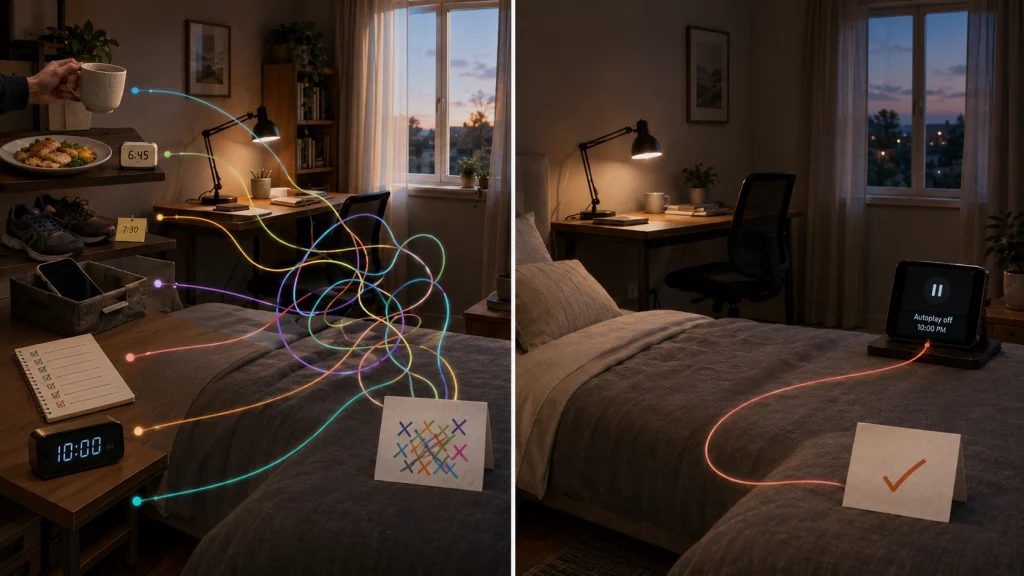
Changing everything at once hides the cause
A complete overhaul can feel decisive: no afternoon coffee, an earlier dinner, a new exercise time, the phone left outside the room, a longer wind-down, a fixed bedtime, and immediate morning light. Seven changes begin on the same Monday.
By Thursday, the routine feels demanding. One evening runs late, several rules break together, and the person cannot tell whether sleep changed because of caffeine, bedtime, exercise, phone use, or ordinary variation. The plan may be abandoned even though one of the seven ideas could have helped on its own.
This failed overhaul shows two problems. Simultaneous changes hide the cause, and a large routine creates more opportunities to miss the plan, which makes adherence harder to interpret.
A controlled experiment does not require perfect control. It requires enough consistency to know what was intended and whether it happened. The point is to learn from the routine, not turn every evening into another test that can be failed.
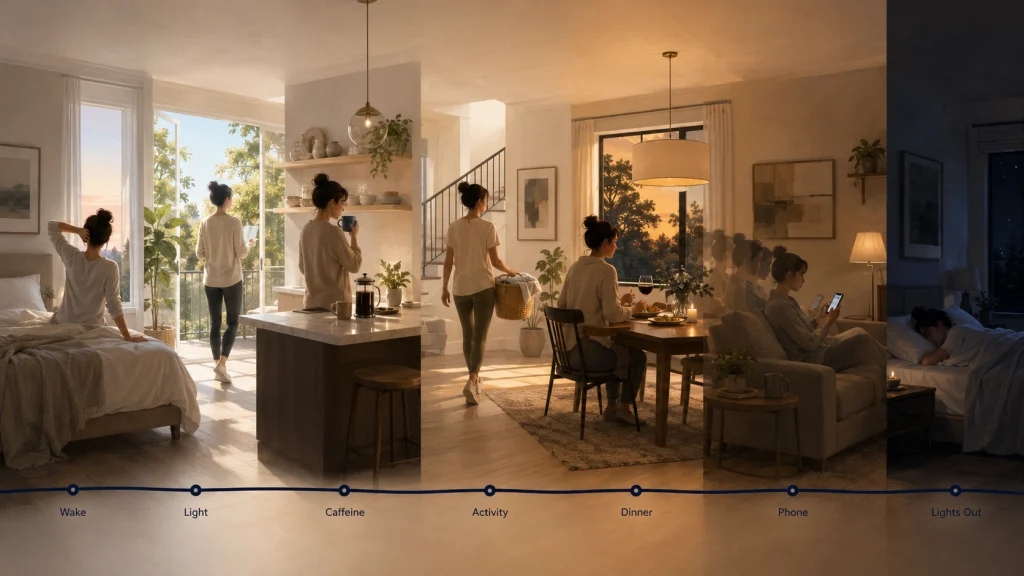
Morning timing cues can affect the shape of the day
Morning light belongs near the beginning of the behavior map because the first useful sleep decision may happen shortly after waking. The practical question is whether the morning provides a clear, repeatable cue or begins in dim light and shifts substantially from day to day.
Context matters. Work hours, season, weather, home layout, mobility, eye comfort, and time outdoors can all change what is practical. This section should not be read as a rigid instruction to create one ideal morning.
Morning timing deserves the first test when wake time feels late or inconsistent, mornings remain dim, or the entire day seems to drift later. The next step is to examine morning light for sleep and define a safe, realistic comparison using the environment already available.
Keep bedtime, caffeine, and exercise reasonably stable during that comparison. Otherwise, a change in evening sleepiness will be difficult to connect to the morning cue.
Daytime stimulant timing may be the hidden factor
Caffeine can appear in coffee, tea, energy drinks, soft drinks, chocolate, and some medicines. The first audit is not a moral judgment about caffeine. It is a timing map that shows every regular source and when it is used.
Look here first when alertness lasts later than intended, daytime tiredness leads to another caffeine source, or a later drink happens almost automatically. Amount, timing, sensitivity, and ordinary bedtime all shape the pattern.
The useful decision is not a universal hour that everyone must follow. It is a personal test based on the current routine. Use the guide to a practical caffeine cutoff time to identify which ordinary source to move earlier or leave out during the test period.
Physical activity timing is a fit question, not a universal ban
Regular movement can be part of a supportive day, but the timing and intensity that feel workable differ. Some people finish evening activity feeling settled. Others remain hot, uncomfortable, stimulated, or rushed because exercise pushes dinner and bedtime later.
This pattern deserves attention when a late workout repeatedly changes the final hours of the day. Separate the response to activity itself from the schedule effects around it, such as a delayed meal, shortened wind-down, or later lights out.
The detailed evening exercise and sleep guide can help define whether the first test should involve timing, intensity, cooldown, heat, or displacement.
This comparison concerns an ordinary routine question. It does not assess whether exercise is medically safe for an individual.
Evening intake can disrupt sleep in different ways
Alcohol and late eating belong in the same time window but should not be treated as one problem. Alcohol may feel relaxing at first, while later sleep may feel more fragmented or less restorative. Late food may create fullness, discomfort, heat, or simply delay the final transition into bed.
Alcohol is the stronger first lead when drinking repeatedly lines up with awakenings, early waking, poorer next-day function, or a bedtime routine that depends on it. Review alcohol and sleep quality to define the exact behavior being tested.
Food timing is the stronger lead when the main clue is a large or late meal, discomfort after eating, or a schedule that compresses dinner and bedtime. The late-night eating and sleep guide separates meal size, timing, comfort, and household constraints.
Test these behaviors separately when possible. Combining them makes it harder to know which change affected the night.
Phone use can affect light, stimulation, time, and interruption
“Screens are bad” is too broad to guide a useful experiment. Phone use before bed can create several different forms of friction: bright light, emotionally activating content, work or social stimulation, lost time, notifications after lights out, and endless feeds that remove a natural stopping point.
These mechanisms require different responses. A person who loses 45 minutes to autoplay has a time-displacement problem. Someone who finishes on time but receives repeated alerts has an interruption problem. Another person may use a quiet audio routine without looking at the screen and experience little of the same friction.
Identify one mechanism before changing the device routine. The guide to phone use before bed separates screen brightness, content, notifications, and lost time so the test does not become a total technology ban.
Practical tip: Record the intended stopping time and the actual stopping time for several nights. The gap may reveal more than an estimate of total screen time.
Bedtime delay may be an autonomy and transition problem
Some people are tired and know they need sleep, yet continue watching, reading, gaming, scrolling, working, or doing household tasks. The delay may protect the only unscheduled time in the day. It may also reflect difficulty ending an enjoyable activity or beginning the final transition.
That experience is not well described by “lacking discipline.” A rigid rule can add shame without changing the daytime schedule, the need for personal time, or the absence of a clear stopping cue.
Bedtime delay is the better starting point when the person regularly intends to go to bed but postpones the action without an external requirement keeping them awake. The guide to bedtime procrastination separates autonomy, lost time, stopping cues, and the practical path from intention to action.
The first experiment may protect a small amount of chosen personal time earlier, add one stopping cue, or reduce the number of decisions required at the end of the evening. It should not attempt to solve every source of delay at once.
The final wind-down should make the transition easier
A bedtime routine is not valuable because it includes a certain number of calming activities. Its job is to create a repeatable bridge between the active day and the attempt to sleep.
The right sequence may be brief. It could include finishing essential tasks, reducing stimulating input, preparing the room, completing personal care, and doing one quiet activity. The sequence should fit the household rather than compete with caregiving, shift work, disability needs, or shared space.
A wind-down sequence deserves attention when bedtime arrives with no clear transition, necessary tasks are repeatedly forgotten, or a complicated routine becomes another source of delay. The guide to a practical bedtime routine for adults helps identify the minimum sequence that supports consistency.
A routine cannot create enough sleep opportunity or repair a clock-based schedule problem. If bedtime and wake time are the central issue, a different sleep route is more appropriate.
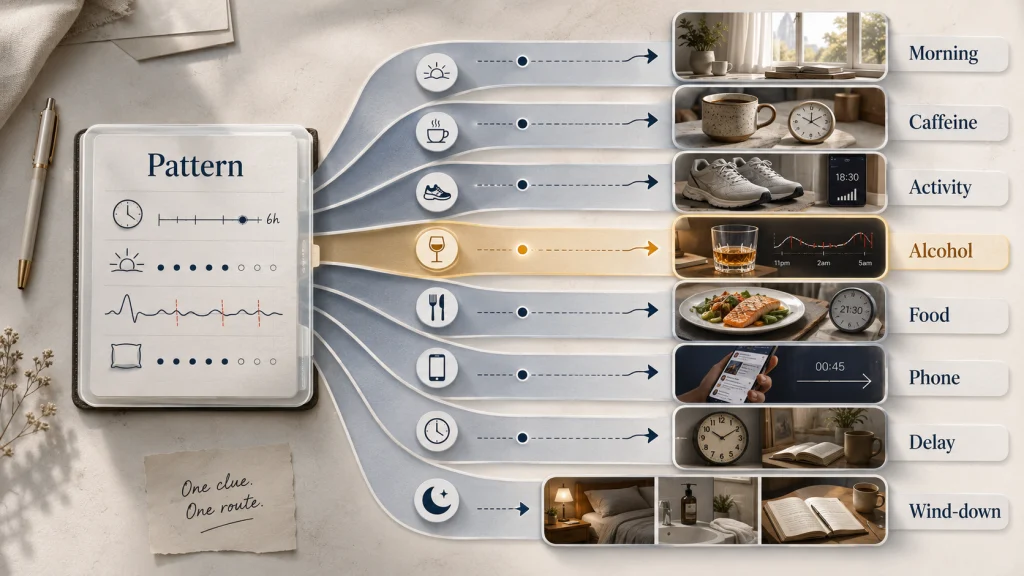
Choose the first behavior by the pattern you can observe
Use the strongest repeatable clue rather than the habit that sounds most impressive.
| Observed pattern | First route | First question |
|---|---|---|
| The day starts late or in dim conditions | Morning timing cues | Does a clearer morning cue change the shape of the day? |
| Alertness remains high after a later caffeine source | Caffeine timing | Which regular source is closest to the intended bedtime? |
| Exercise ends with heat, stimulation, or a delayed evening | Evening activity | Is the issue timing, intensity, cooldown, or displacement? |
| Sleep feels fragmented after alcohol | Alcohol timing | Does the pattern repeat on nights with the same behavior? |
| Fullness or discomfort follows a late meal | Evening food timing | Is meal size, timing, or the compressed evening the clearer issue? |
| Time disappears into feeds, video, work, or notifications | Digital behavior | Is the mechanism light, stimulation, displacement, or interruption? |
| Bedtime is intended but repeatedly postponed | Bedtime delay | What need or missing stopping cue keeps the evening going? |
| There is no reliable transition into bed | Wind-down sequence | What is the shortest repeatable bridge into bed? |
If two rows seem equally strong, begin with the factor that is easiest to observe and safest to change. Keep the second idea unchanged until the first test is complete.
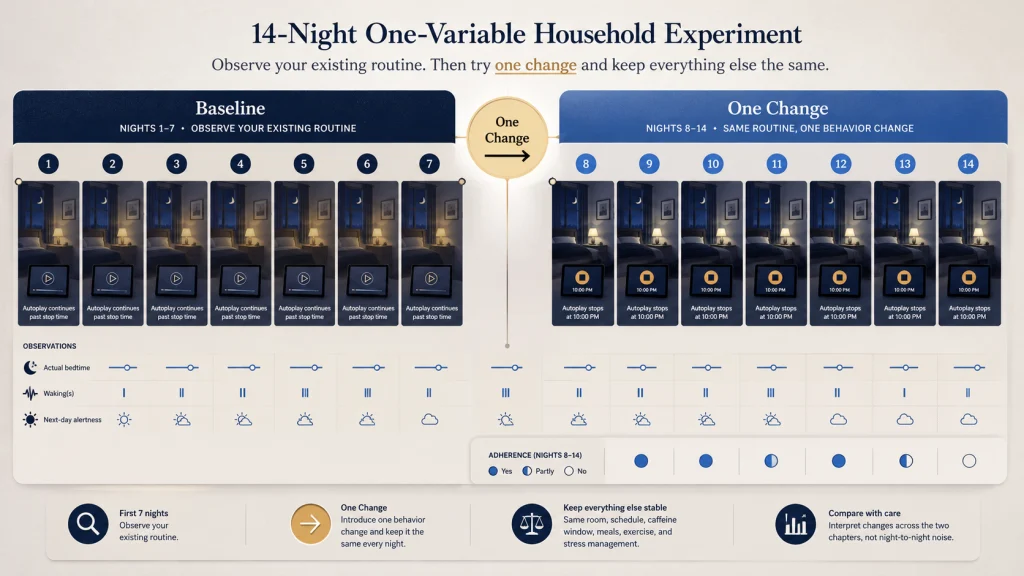
Run a 14-night one-variable experiment
A useful test includes a baseline, one intervention, adherence, a simple sleep pattern, and next-day function. The worksheet is not a medical sleep diary and should not be used to diagnose a condition.
Use the first seven nights to observe the current routine without deliberately changing the selected behavior. Use the next seven nights for one defined change. Keep other major variables as stable as ordinary life allows.
| Night | Selected behavior | Plan followed? | Bedtime pattern | Night waking pattern | Next-day function |
|---|---|---|---|---|---|
| 1 | Baseline | Not applicable | _____ | _____ | _____ |
| 2 | Baseline | Not applicable | _____ | _____ | _____ |
| 3 | Baseline | Not applicable | _____ | _____ | _____ |
| 4 | Baseline | Not applicable | _____ | _____ | _____ |
| 5 | Baseline | Not applicable | _____ | _____ | _____ |
| 6 | Baseline | Not applicable | _____ | _____ | _____ |
| 7 | Baseline | Not applicable | _____ | _____ | _____ |
| 8 | One change | Yes / No / Partly | _____ | _____ | _____ |
| 9 | One change | Yes / No / Partly | _____ | _____ | _____ |
| 10 | One change | Yes / No / Partly | _____ | _____ | _____ |
| 11 | One change | Yes / No / Partly | _____ | _____ | _____ |
| 12 | One change | Yes / No / Partly | _____ | _____ | _____ |
| 13 | One change | Yes / No / Partly | _____ | _____ | _____ |
| 14 | One change | Yes / No / Partly | _____ | _____ | _____ |
Define the intervention before night eight. A usable statement is specific: “For seven nights, I will finish my final caffeinated drink by the selected time and leave the rest of my routine unchanged.” Avoid vague statements such as “I will have better sleep habits.”
Record the pattern in plain language. “Fell asleep near the usual time,” “awake longer after 3 a.m.,” or “struggled to stay alert during the afternoon” may be more useful than inventing a precise score.
No change does not justify adding a random rule
A flat result can mean several things. The selected behavior may not be the main factor. The intervention may have been too inconsistent to evaluate. Ordinary schedule changes may have overwhelmed the comparison. The outcome may also need more time or a different measure.
Review the test in this order:
- Was the intervention defined clearly?
- Was it followed on enough nights to create a fair comparison?
- Did another major factor change, such as work hours, travel, illness, or household disruption?
- Was the selected outcome connected to the behavior?
- Does another pattern now look more likely?
Keep the change when it produces a useful pattern and is workable. Adjust one detail when the direction looks promising but adherence or fit is poor. Stop when the change adds stress, reduces sleep opportunity, creates discomfort, or does not match the original concern.
Do not respond to an unclear result by stacking several new restrictions onto the next night. Select the next route deliberately.
Know when a habit experiment is inappropriate or insufficient
Lifestyle experiments are intended for ordinary, low-risk behavior questions. They are not a substitute for diagnosis, treatment, medication guidance, exercise clearance, or professional evaluation.
Safety warning: Seek qualified help for persistent sleep difficulty, breathing pauses or gasping, dangerous daytime sleepiness, drowsy driving, severe or worsening symptoms, or significant impairment in work and daily life. Do not continue driving or safety-sensitive activity when you cannot remain alert.
Do not use this process to change prescribed medicine, add a supplement, treat alcohol dependence, manage an eating disorder, or push through symptoms during exercise. A normal-looking night in the worksheet does not rule out a problem.
When the experiment is stopped for safety, record what happened and when. That information may help a qualified professional understand the pattern without turning the worksheet into a self-diagnosis.
Write one test statement
Select the behavior route that best matches the strongest observable obstacle. Name the current pattern, the one change you will make, the seven-night baseline, the seven-night intervention, and the next-day sign you will watch.
A useful final statement might read: “Late autoplay is reducing my sleep opportunity, so after seven baseline nights I will stop video playback at the selected time for seven nights and record actual bedtime and afternoon alertness.” One clear test teaches more than a perfect-looking checklist that cannot be maintained or interpreted.
Explore the eight behavior routes
Use the guide that matches the first obstacle identified in the day.
| Behavior question | Detailed guide |
|---|---|
| How should morning light fit the day? | Morning light and sleep timing |
| Which caffeine source should be tested first? | Choosing a caffeine cutoff |
| Is evening activity affecting the final hours? | Evening exercise and sleep |
| Does alcohol line up with fragmented sleep? | Alcohol and sleep quality |
| Is late food creating discomfort or delay? | Late-night eating and sleep |
| Is the phone creating light, stimulation, lost time, or interruption? | Phone use before bed |
| Why is an intended bedtime repeatedly postponed? | Bedtime procrastination |
| What should the final transition include? | A bedtime routine for adults |
FAQs
🧭 Which sleep habit should I change first?
Choose the behavior with the clearest repeatable connection to the problem. A late caffeine source, lost phone time, a delayed bedtime, or discomfort after a late meal gives a more useful starting point than a complete routine overhaul.
☕ Is there one caffeine cutoff that works for everyone?
No. Timing, amount, sensitivity, bedtime, and the type of source all matter. Map the current pattern and test one realistic change rather than copying a universal clock time.
📱 Do I need to stop all phone use before bed?
Not automatically. Identify whether the real obstacle is light, stimulating content, notifications, or time displacement. The first change should target that mechanism instead of becoming a total technology ban.
🏃 Is evening exercise always bad for sleep?
No. Individual response, timing, intensity, heat, cooldown, and schedule displacement can change the experience. Test the factor that best matches the observed pattern.
🍽️ Should I test alcohol and late eating together?
Test them separately when possible because they can affect the evening in different ways. Changing both at once makes the result harder to interpret.
📅 Why does the experiment last 14 nights?
The first seven nights create a baseline and the next seven test one change. This provides a clearer comparison than judging the habit after one unusually good or bad night.
🚨 When should I stop experimenting with sleep habits?
Stop when the problem is persistent, severe, worsening, affects breathing or daytime safety, or significantly limits daily life. Dangerous sleepiness and drowsy driving require prompt qualified help.