A useful sleep environment audit measures how the bedroom changes through the night rather than judging it only at lights-out. Track temperature, humidity, light, noise, ventilation, air conditions, and layout across several ordinary nights before buying multiple products. Separate the room from bedding and body-generated sensations, identify the dominant variable, change one low-risk factor, and remeasure. Suspected combustion, major mold, significant water damage, dangerous temperatures, outdoor smoke, or persistent or severe symptoms require qualified or official guidance.
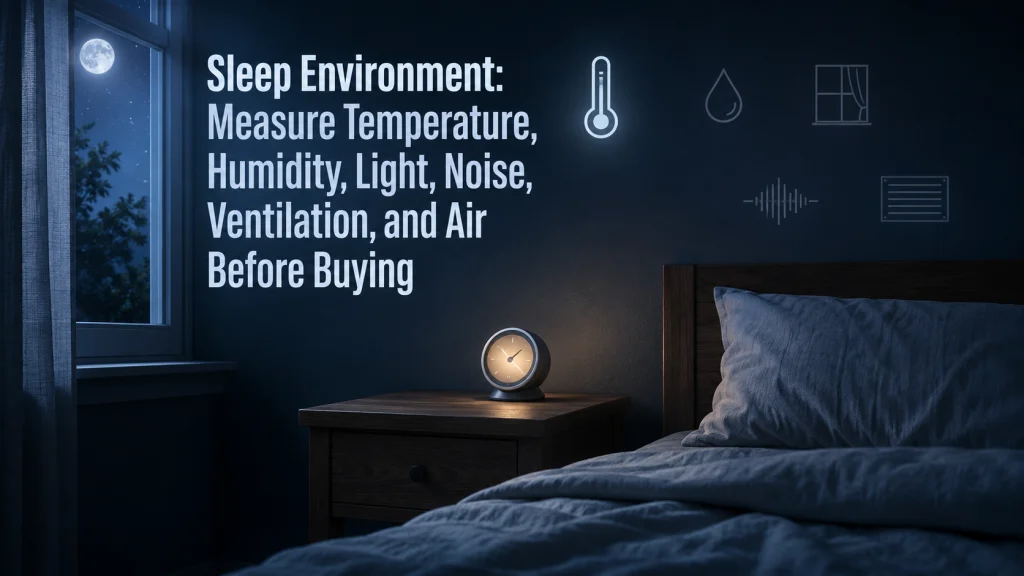
See how the same bedroom can change between bedtime and 3 a.m.
At bedtime, the room appears cool, dark, and quiet. The door is closed, the street has settled, and the bedding feels comfortable. Several hours later, the room is warmer, the air feels still, and a recurring vehicle or building sound arrives at nearly the same time.
Bedtime versus 3 a.m. room check:
The room changes while the sleeper is in it. A closed door can reduce hallway light while also changing air exchange. A curtain can block dawn light while trapping heat near the window. A sound that is absent at bedtime can repeat after traffic, plumbing, pets, or neighbors follow their own schedules.
A useful sleep-environment audit measures the night, not just the room at lights-out.
Define the seven environmental variables and how they interact
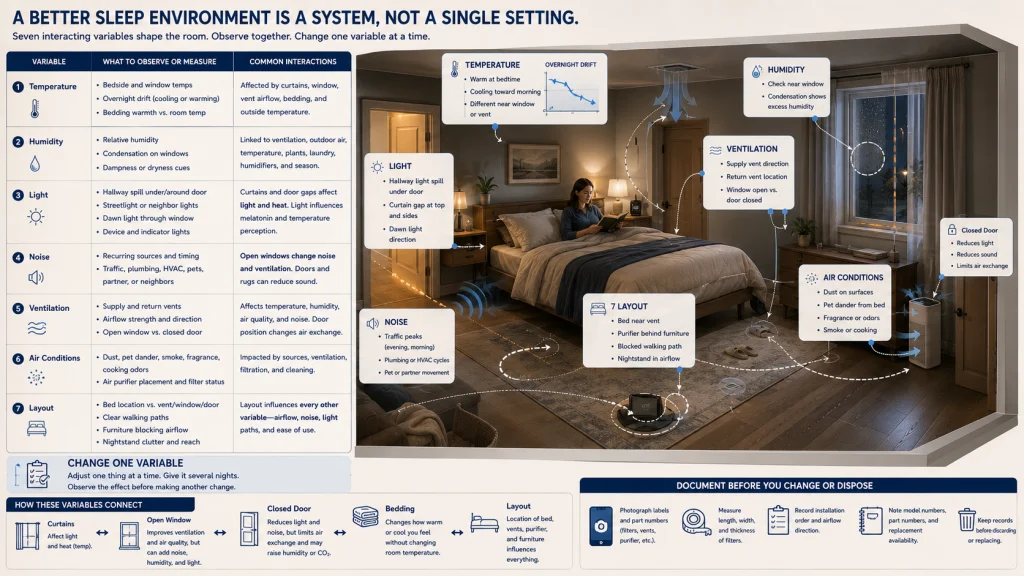
The bedroom is not one condition. It is a system of seven variables that can change separately or influence one another.
| Environmental variable | What to observe or measure | Common interaction |
|---|---|---|
| Temperature | Bedtime level, overnight drift, hot or cold zones | Bedding, curtains, vents, outdoor weather, room occupancy |
| Humidity | Measured moisture, condensation, dry or damp periods | Ventilation, outdoor air, showers, humidifiers, room closure |
| Light | Evening brightness, hallway spill, device indicators, dawn | Curtains, door position, street lighting, partner routines |
| Noise | Source, timing, pattern, direction, impact or airborne sound | Open windows, fans, plumbing, pets, neighbors, traffic |
| Ventilation | Door and window position, air movement, overnight stuffiness | Temperature, humidity, outdoor conditions, occupancy |
| Air conditions | Dust, smoke, fragrance, odors, particles, pet sources, monitor patterns | Source control, cleaning, filtration, outdoor air, placement |
| Layout | Bed placement, blocked vents, light paths, device zones, access | Every other variable |
The variables should be evaluated together but changed one at a time. Otherwise, it becomes difficult to tell whether a better night came from cooler air, less light, a quieter route, different bedding, or simple night-to-night variation.
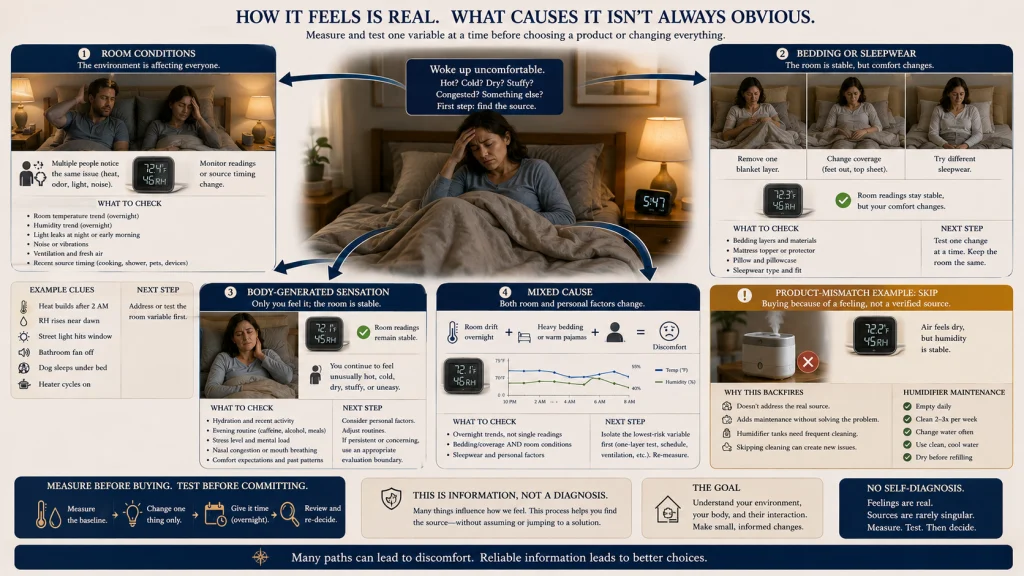
Separate measured conditions from subjective sensations
A sensation is useful information, but it does not always identify the source. Feeling hot may come from the room, heavy bedding, sleepwear, fever, medication effects, or another body-related factor. Feeling that the air is dry may occur even when measured humidity is not unusually low.
| Room, bedding, or body? | Clue | What to check next |
|---|---|---|
| Room condition | Multiple people notice the same heat, odor, light, or noise pattern | Measure the room and identify the source or timing |
| Bedding or sleepwear | Discomfort changes when layers, materials, or coverage change | Adjust one layer without changing the room |
| Body-generated sensation | The person feels hot, chilled, congested, or uncomfortable while room measures remain stable | Avoid self-diagnosis and seek appropriate evaluation when symptoms persist or worsen |
| Mixed cause | Room drift and bedding or body factors occur together | Choose the lowest-risk variable to isolate first |
This distinction prevents product mismatch. A humidifier can function exactly as designed and still be the wrong purchase when the room is already within a normal measured range or the user is unlikely to clean and maintain the tank consistently.
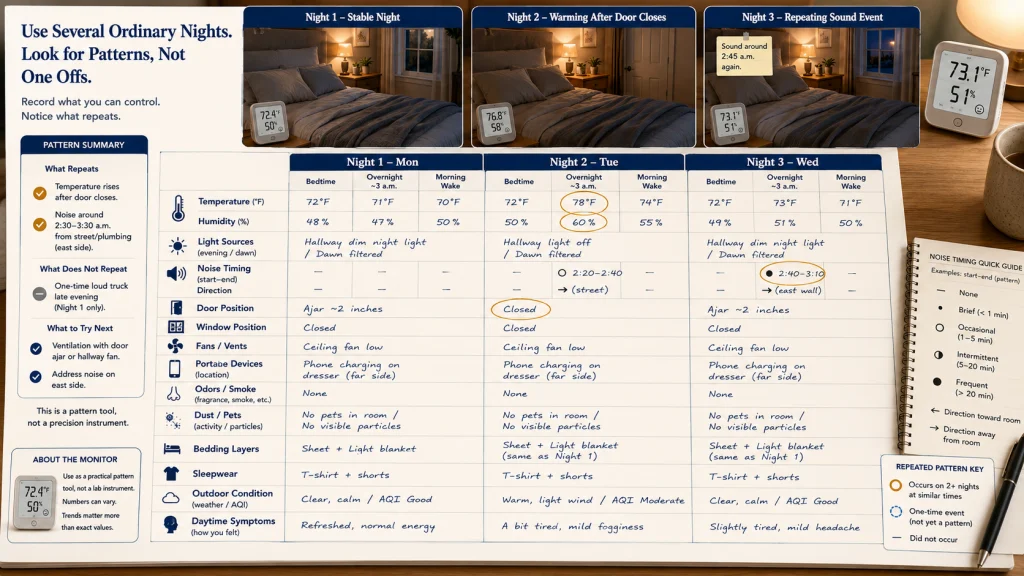
Build a three-night audit
Use three ordinary nights rather than one unusually hot, noisy, or disrupted night. Keep the worksheet simple enough to complete at bedtime and after waking.
Three-night bedroom worksheet:
- ☐ Record bedtime temperature and humidity.
- ☐ Record an overnight or early-morning reading where practical.
- ☐ Note evening, hallway, device, street, and dawn light sources.
- ☐ Record noise events, approximate timing, pattern, and direction.
- ☐ Note whether the door and windows were open or closed.
- ☐ Record fans, vents, portable devices, and their placement.
- ☐ Note odors, smoke, fragrance, dust, pet activity, or visible particles.
- ☐ Record bedding layers and sleepwear.
- ☐ Note major outdoor weather or air-quality changes.
- ☐ Record daytime symptoms without assigning a diagnosis.
Do not chase perfect precision from a consumer monitor. The value comes from repeated patterns, such as temperature rising after the door closes, a sound recurring at the same hour, or condensation appearing only after certain nights.
The broader sleep improvement guide can help when the room is only one of several possible contributors.
After several poor nights, it is understandable to want one purchase that fixes everything. Routing the complaint first is slower than impulse buying, but it gives the next change a clear reason and a fair test.

The TempPro TP50 is a compact indoor thermometer and hygrometer that displays bedroom temperature and humidity together on a simple LCD screen. It also keeps high and low records, making it useful for spotting changes in room conditions across an overnight or multi-night bedroom audit. Its tabletop stand and magnetic back make it easy to position in a consistent location while comparing temperature and humidity patterns from night to night.
Check On AmazonIf you click this link and buy, we earn a commission at no additional cost to you.
Route ambient heat or cold to bedroom temperature
When the room repeatedly warms or cools after bedtime, temperature becomes the first route to investigate. A sleeper may feel comfortable at lights-out, then wake several hours later after the door has closed, the heating cycle has changed, or heat has built near a sunny window.
Check room size, vent position, closed doors, window exposure, occupancy, heating or cooling cycles, and bedding before buying another device. A fan can change air movement without lowering the room temperature, while heavy bedding can create warmth even when the room remains stable.
Continue with the bedroom temperature guide for a measurement-first review of ambient heat, cold, and overnight drift.
Route measured dryness, dampness, or condensation to humidity
Measured dryness, dampness, or recurring condensation points to the humidity route. The useful clue is not a single dry-feeling morning but a pattern that appears across nights, weather changes, or door and window positions.
A humidifier should not be selected from sensation alone. Room size, baseline humidity, outdoor conditions, tank cleaning, placement, and the likelihood of routine maintenance all affect whether it fits the problem. A dehumidifying approach also depends on the moisture source and the wider building conditions.
The bedroom humidity guide develops the measurement, source, maintenance, and one-variable testing process.
Route evening brightness, dawn, hallway light, and device indicators to lighting
Light problems often reveal themselves by timing and direction. A hallway glow may appear after another person goes to bed, a charger may become noticeable only after the room darkens, and dawn light may enter through one narrow curtain gap.
Map the path from street, hallway, window edge, door gap, charger, clock, alarm, or another indicator. A blackout curtain may reduce dawn light but can also affect heat near the window, so remeasure the room after installation.
For source mapping and low-risk changes, continue with the bedroom lighting guide.
Route traffic, neighbors, partners, plumbing, pets, and impact sounds to noise
Noise belongs on its own route when the disruption follows a recognizable source, direction, or schedule. A truck may pass at the same hour, plumbing may knock after another apartment wakes, or a pet may begin moving before dawn.
Record whether the sound is continuous, intermittent, tonal, conversational, mechanical, or impact-based. A fan or sound device may mask some patterns while adding another sound. Window closure may reduce traffic but worsen heat or stuffiness. Partner and pet sounds may require placement or routine changes rather than a louder masking source.
The bedroom noise guide separates source control, masking, room placement, and recurring-event troubleshooting.
Route stuffiness and closed-room air exchange to ventilation
Stuffiness that builds after the room has been closed for several hours suggests an air-exchange problem rather than a bedtime comfort problem. The room may feel acceptable at first and noticeably different only after one or two people have slept there.
Record occupancy, door position, window position, vent obstruction, outdoor conditions, and heating or cooling operation. Opening a window is not automatically appropriate when outdoor smoke, severe weather, noise, security, or other hazards are present.
The bedroom ventilation guide focuses on air-exchange decisions without treating ventilation as a universal solution.
Route dust, smoke, fragrance, odors, particles, pets, and monitor questions to bedroom air conditions
Dust on the nightstand, smoke entering from outside, a recurring fragrance, pet activity, persistent odor, or confusing monitor patterns point toward the room’s air conditions. The first task is to identify what is entering or being generated, not to assume that one device will solve every source.
Start with source control and cleaning before treating filtration as the only answer. A purifier can supplement a plan, but blocked placement, closed intake space, wrong room sizing, filter neglect, and an active source can limit usefulness.
The bedroom air conditions guide covers sources, particles, odors, monitor interpretation, cleaning, and filtration boundaries.
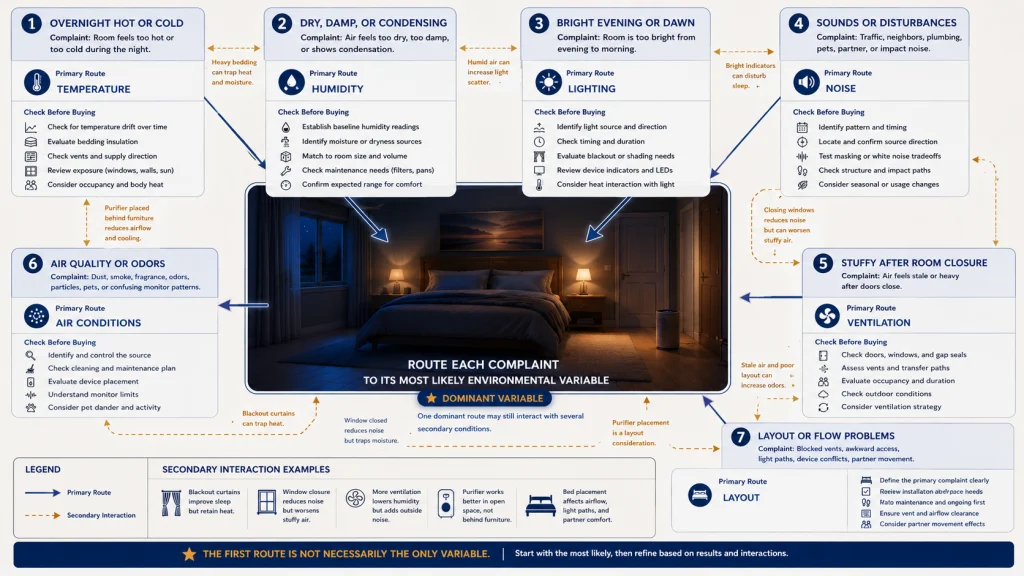
Route placement, access, blocked vents, light paths, device zones, and partner movement to layout
Sometimes the variable is not the device or condition itself but where it meets the sleeper. A bed beside a vent, a purifier behind furniture, a lamp in the walking path, or a nightstand blocking airflow can turn a workable room into an awkward one.
A good device can perform poorly when pressed against a wall, hidden behind furniture, aimed across the pillow, or placed where it blocks access. Bed position may also expose one sleeper to a door gap, vent draft, streetlight, partner movement, or a recurring noise path.
The bedroom layout guide integrates placement and access without replacing the variable-specific checks above.
| Complaint or observation | Primary route | Check before buying |
|---|---|---|
| Room becomes hot or cold overnight | Temperature | Overnight drift, bedding, vents, exposure, occupancy |
| Measured dryness, dampness, or condensation | Humidity | Baseline reading, source, room size, maintenance |
| Evening brightness, dawn, hallway spill, indicators | Lighting | Source, direction, timing, heat interaction |
| Traffic, neighbors, plumbing, pets, partner sounds | Noise | Pattern, source, direction, masking tradeoffs |
| Room becomes stuffy after closing | Ventilation | Door, window, vents, occupancy, outdoor conditions |
| Dust, smoke, fragrance, odors, particles, pets | Air conditions | Source control, cleaning, placement, monitor limits |
| Blocked vent, awkward access, light path, device conflict | Layout | Bed and device placement, walking path, partner movement |
The routing table identifies the first path, not the only variable involved. A room can have one dominant complaint and several secondary interactions.
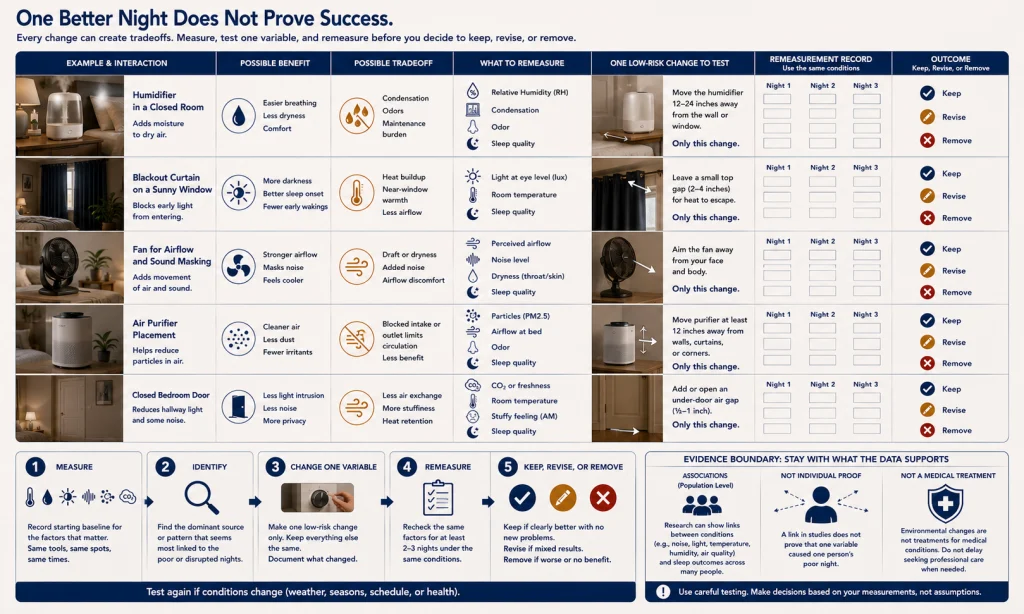
Check interactions before declaring a product successful
| Interaction matrix | Possible benefit | Possible tradeoff | What to remeasure |
|---|---|---|---|
| Humidifier plus closed room | Raises moisture | May overshoot, add maintenance, or worsen condensation | Humidity, condensation, odors, tank condition |
| Blackout curtain plus sunny window | Reduces unwanted light | May trap heat near the bed | Light and overnight temperature |
| Fan plus traffic noise | Adds airflow and masking sound | May create draft, dryness sensation, or more noise | Temperature, sensation, sound pattern |
| Purifier plus blocked placement | May supplement particle control | Restricted intake or outlet reduces effective room circulation | Placement, airflow, source activity, maintenance |
| Closed door plus hallway light | Blocks light and some sound | May reduce air exchange | Light, noise, temperature, stuffiness |
Product fit includes room size, placement, cleaning, replacement parts, operating sound, and the user’s willingness to maintain it. A technically functional device can still fail the household routine.
Apply the measure, identify, change one variable, and remeasure sequence
- Measure: Record the bedtime and overnight pattern across ordinary nights.
- Identify: Name the dominant variable and the likely source.
- Change one variable: Choose a low-risk adjustment that matches the source.
- Remeasure: Repeat the same observations after the change.
- Keep, revise, or remove: Judge the result by the measured pattern and practical maintenance.
Examples include moving a device away from a blocked wall, covering one indicator light, changing one bedding layer, clearing a vent, or testing a quieter route for a recurring sound. Several changes at once may feel efficient, but they remove the ability to learn which one mattered.
Evidence boundary: Research can show that bedroom temperature, particles, ventilation markers, light, or noise are associated with sleep outcomes across groups. That does not prove that one variable caused one person’s poor night, or that changing it will treat a medical condition. The individual decision still requires measurement, source identification, one-variable testing, and appropriate evaluation for persistent symptoms.
Environmental data can guide practical troubleshooting without becoming a diagnosis. A monitor reading, odor, sound event, or temperature pattern cannot diagnose allergies, asthma, sleep disorders, hearing conditions, respiratory disease, chemical exposure, or another condition.
Separate bedroom sleep intent from whole-home health and hazard intent
This article focuses on room conditions when sleep is the main reason for troubleshooting. It helps identify whether the bedroom is hot, dry, humid, bright, noisy, stuffy, dusty, odorous, poorly arranged, or inconsistent through the night.
Whole-home hazards require a different scope. Combustion sources, major mold, significant water damage, radon, building-wide ventilation, persistent smoke entry, broad filtration architecture, and suspected chemical exposure should not be reduced to a bedroom comfort project.
When room measurements remain stable but warmth, pressure, or comfort changes with layers and materials, continue with the bedding for better sleep guide. Product selection should follow the identified variable rather than lead the diagnosis.
Once the dominant problem and maintenance requirements are clear, the sleep products guide can help compare device categories without turning shopping into the first diagnostic step.
Recognize combustion, smoke, mold, water damage, severe temperatures, and persistent symptoms
Stop ordinary troubleshooting and seek qualified or official guidance when:
- Combustion or carbon monoxide is suspected.
- Outdoor smoke or another hazardous air event makes window opening unsafe.
- There is major mold, significant water damage, or an active leak.
- The room reaches dangerously hot or cold conditions.
- There is a strong unexplained chemical odor or suspected exposure.
- Sudden hearing changes, severe symptoms, or persistent worsening symptoms occur.
- The concern extends beyond bedroom comfort into building or health safety.
This article does not diagnose or treat allergies, asthma, mold-related illness, sleep disorders, hearing conditions, respiratory disease, chemical exposure, or another medical condition.
Name one variable, one measurement, one change, and one recheck date
Finish the audit in four lines:
- Variable: Name temperature, humidity, light, noise, ventilation, air conditions, or layout.
- Measurement: Record the bedtime and overnight pattern that supports the choice.
- One change: Select the lowest-risk adjustment that matches the source.
- Recheck date: Repeat the same observations after several ordinary nights.
A complete decision might read: “The dominant variable is overnight heat, not humidity. The room rises after the door closes, while bedding stays the same. I will clear the blocked vent and move the nightstand away from the airflow path. I will repeat the bedtime and 3 a.m. readings for three nights before considering another product.”
A sleep-friendly bedroom is not created by buying every device associated with sleep. It is created by identifying the variable that changes, matching the response to the source, and checking whether the room actually improved.
FAQs
🌡️ What should I measure first in a bedroom?
Start with the complaint that repeats most clearly, then record bedtime and overnight conditions. Temperature and humidity readings are useful only when paired with timing, room setup, and the sleeper’s observations.
💧 Should I buy a humidifier because the room feels dry?
Measure humidity first and consider room size, outdoor conditions, placement, and tank maintenance. A dry sensation does not by itself prove that the room needs added moisture.
🌙 Can blackout curtains make a room hotter?
They can change heat behavior near a window depending on placement and exposure. Remeasure light and overnight temperature after installation.
🔊 Is a fan always helpful for bedroom noise?
A fan may mask some sounds and add airflow, but it can also create draft, noise, or a dry sensation. Match it to the sound pattern and recheck the other variables.
🪟 Should I open a window when the room feels stuffy?
Only after considering outdoor smoke, weather, noise, security, and other hazards. Ventilation decisions should match both indoor and outdoor conditions.
🧹 Should dust lead directly to an air purifier?
Start with source control, cleaning, pet or outdoor entry points, and device placement. Filtration may supplement the plan but should not replace source identification.
📊 Can a consumer monitor diagnose why I sleep poorly?
No. It can show patterns that support troubleshooting, but it cannot diagnose a sleep, respiratory, allergy, or exposure-related condition.
🚩 When should bedroom conditions be professionally evaluated?
Seek qualified or official guidance for suspected combustion, major mold, significant water damage, hazardous smoke, severe temperatures, strong unexplained odors, or persistent or severe symptoms.