Bathing and body odor questions become easier when you identify where the odor returns before changing the entire routine. Start with five layers: skin after heat or activity, washing method, drying, underarm product function and application, and clean versus previously worn fabric. Then route the problem to the smallest matching change, such as adjusting shower timing, improving rinsing and drying, choosing odor control versus sweat reduction, or checking clothing and towels. Sudden or unexplained changes, severe sweating, night sweats, skin symptoms, pain, drainage, fever, wounds, or disruption to daily life require qualified evaluation rather than more products.

Find the Layer Where Odor Returns
One odor complaint can begin in several different places. A person may notice sweat after a hot commute, use a rushed shower method, leave skin damp, apply a product that does not match the goal, and then put on clothing that already holds odor. Adding fragrance at the final step cannot correct every earlier layer.
| Layer | Question to Ask | Likely Next Decision |
|---|---|---|
| 1. Sweaty skin | Did heat, exercise, work, stress, or an ordinary day create moisture before odor appeared? | Decide whether a full shower, targeted wash, clothing change, or cooldown period fits the situation. |
| 2. Shower method | Were the relevant external areas washed gently and rinsed completely? | Review washing order, water temperature, cleanser use, friction, and rinsing. |
| 3. Drying | Was moisture left in skin folds, underarms, or other external areas? | Improve drying and give skin or product time to dry before dressing. |
| 4. Underarm product | Is the goal odor control, sweat reduction, or both, and was the label followed? | Match deodorant or antiperspirant function to the goal and review application. |
| 5. Fabric | Did clean skin contact previously worn clothing, a reused towel, or fabric that still carries odor? | Route the problem to clothing, towels, or personal-item hygiene rather than adding another skin product. |
More fragrance cannot correct the wrong shower method, retained odor in fabric, incorrect product function, or an unexplained change in sweating. Find the layer where odor returns before adding another step.
This guide routes ordinary external-body questions. For the larger category, review the personal hygiene guide.
Define the Terms Before Changing the Routine
Several words are often treated as if they mean the same thing. Separating them prevents a product or washing change from being assigned the wrong job.
- Sweat: Moisture released by the body. Sweat amount can vary with heat, activity, stress, clothing, environment, and individual factors.
- Ordinary body odor: Odor that develops on external skin or fabric during normal daily life and may vary by area, activity, moisture, and routine.
- Deodorant: A product intended primarily to manage odor. It does not automatically reduce the amount of sweat.
- Antiperspirant: A product intended to reduce perspiration in the approved application area. Many antiperspirants include a Drug Facts panel with directions and warnings that control how the product is used.
- Cleanser: A soap, body wash, or other general cleansing format used according to its directions on appropriate external skin.
- Retained fabric odor: Odor that remains in clothing, towels, footwear, or another personal item and returns to contact with clean skin.
- Unexplained change: A noticeable shift in odor, sweating, skin condition, or related symptoms that does not fit the usual routine or environment.
Key decision: Do not ask one product to solve sweat, odor, washing technique, wet skin, and retained fabric odor at the same time. Name the layer first.
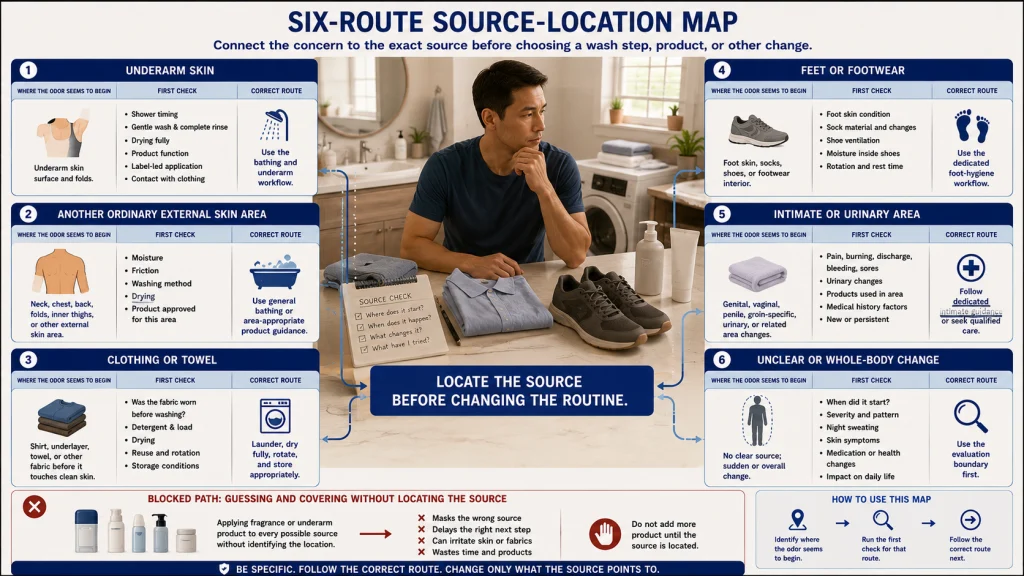
Identify the Body Area Before Choosing Advice
“Body odor” can describe underarms, another external skin area, feet, clothing, towels, footwear, or an intimate area. The location changes what belongs in this guide and what needs a different route.
| Where the Odor Seems to Begin | First Check | Correct Route |
|---|---|---|
| Underarm skin | Shower timing, washing and drying, product function, label-led application, clothing contact | Continue through the bathing and underarm sections below. |
| Another ordinary external skin area | Moisture, washing method, drying, friction, and whether the product is approved for that area | Use the bathing, cleansing, or expanded-area product route as appropriate. |
| Clothing or towels | Whether odor is present before clean fabric touches the body | Use the clothing and towel hygiene guide. |
| Footwear or feet | Shoes, socks, foot skin, moisture, and item rotation | Use the foot hygiene guide. |
| Genital, vaginal, penile, groin-specific, or urinary area | Do not assume the cause is ordinary underarm-style odor | Use the intimate hygiene guide and seek qualified care for concerning changes or symptoms. |
| Unclear or whole-body change | Timing, severity, night sweating, skin symptoms, medication or health changes, and impact on daily life | Use the evaluation boundary later in this guide. |
Routing by location avoids treating every odor question as an underarm product problem. It also keeps intimate, foot, textile, and health concerns from being collapsed into one routine.
Bathing-versus-product decision tree:
-
Did odor or sweating change suddenly, become severe, or appear with symptoms?
- Yes: Stop the routine experiment and use the evaluation boundary later in this guide.
- No: Continue to the source-location question.
-
Does the source seem to be feet, footwear, an intimate or urinary area, clothing, towels, or an access problem?
- Yes: Use the matching foot, intimate, textile, or practical-adaptation route.
- No: Continue with ordinary external skin or underarm routing.
-
Is the main uncertainty whether or when to wash after heat, exercise, work, or an ordinary day?
- Yes: Choose the shower-frequency route, or the post-workout route when exercise and delayed cleanup are central.
- No: Continue to washing method.
-
Does odor remain after washing, or does the routine involve rushed washing, incomplete rinsing, damp skin, or irritation?
- Yes: Choose shower technique first. Use post-shower troubleshooting when the odor still remains or returns quickly.
- No: Continue to cleanser and product function.
-
Is the unresolved choice the general cleansing format?
- Yes: Compare bar soap and body wash for routine fit.
- No: Continue to the underarm goal.
-
Is the goal odor control, sweat reduction, or both?
- Yes: Compare deodorant and antiperspirant. If antiperspirant is the fit, review Drug Facts and application next.
- No or unclear: Return to the source layer before adding a product.
-
Is a product being considered for several external body areas?
- Yes: Check whole-body deodorant claims, approved areas, and warnings.
- No: Make one change at the strongest source layer and use the seven-day log only when the situation remains ordinary and safe to observe.
Route Full-Shower Timing to the Frequency Decision
When the uncertainty is timing, stay with timing before changing products. A full shower may be useful after heat, sweat, work, exercise, or an ordinary day, but the fit depends on activity, climate, skin response, clothing, access, and what needs to be removed.
Another shower adds time without solving a damp-skin, reused-fabric, or application problem. The question is whether washing frequency is the first weak layer, not whether more washing sounds more thorough.
The guide on how often to shower compares full-body washing, targeted washing, schedule changes, and ordinary variation. Use that branch before technique or product selection when timing is the unresolved decision.
Route Washing Order, Temperature, Rinsing, and Drying to Technique
If the timing already makes sense, look at what happens inside the shower and during the minutes after it. Frequent washing can still leave a practical gap when an area is rushed, cleanser remains on skin, water is excessively hot, friction is aggressive, or clothing goes on before the skin is dry.
A technique check can stay ordinary and specific:
- Was the odor-prone external area actually washed?
- Was cleanser used according to its directions rather than applied more aggressively?
- Was the area rinsed completely?
- Was a clean towel used?
- Was the skin dried before clothing or underarm product was applied?
- Did the routine create irritation, pain, or a new skin problem?
The complete sequence for order, temperature, cleanser, rinsing, drying, and aftercare is in the shower-technique guide. A clearer method is more useful than adding heat or friction.
Route General Cleanser Choice to Format and Routine Fit
Once the washing method is clear, the cleanser question becomes narrower. Bar soap and body wash are formats rather than rankings of cleanliness, and the better fit depends on tolerance, fragrance, storage, shared use, packaging, residue, travel, cost, and routine friction.
A format that is awkward to store, rinse, refill, or use in the right place can weaken an otherwise workable routine. Fragrance may change the sensory experience while sweat, dampness, or retained fabric odor stays untouched.
The bar soap versus body wash comparison handles that format tradeoff. Keep the current cleanser stable when drying, clothing, product function, or an unexplained change is the stronger clue.
Route Exercise and Delayed Cleanup to the Post-Workout Workflow
A workout can end long before a shower becomes available. Sweat, damp clothing, shared equipment, locker-room surfaces, travel time, and delayed access create a transition problem rather than a simple frequency question.
A home session beside the bathroom may need one sequence, while a commute after shared equipment or an outdoor activity far from facilities needs another. Cooling down, changing clothing, temporary cleanup, and the eventual shower all belong to the same route.
The guide to post-workout shower timing works through exercise-triggered washing, shared spaces, delayed cleanup, and clothing transitions without turning one workout situation into a universal daily rule.
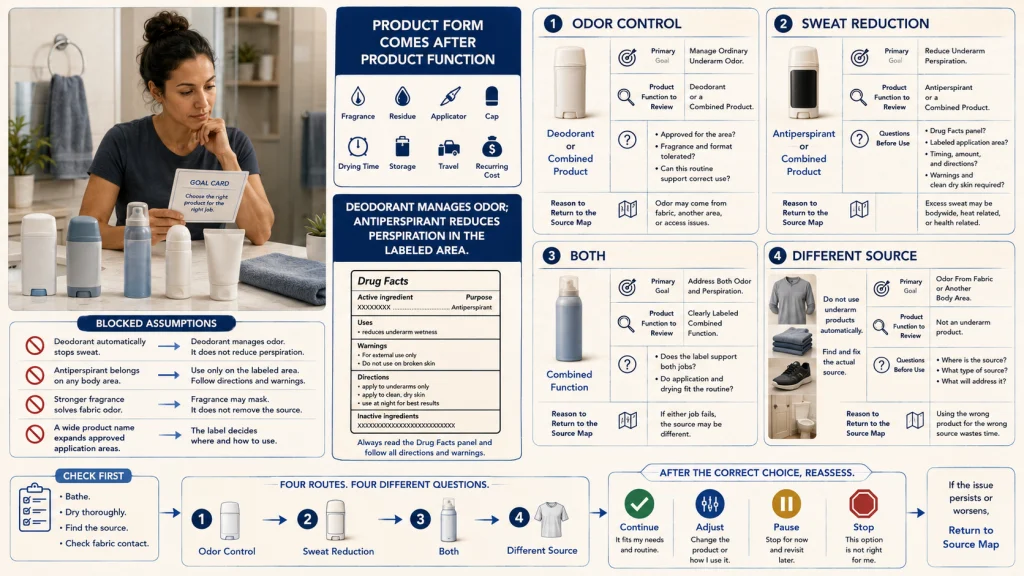
Choose Odor Control or Sweat Reduction Before Choosing a Product Form
After bathing and fabric have been checked, the underarm decision becomes a function question. Deodorant focuses on odor control, while antiperspirant is used to reduce perspiration in the labeled area. Some products combine both jobs.
| Primary Goal | Product Function to Review | Questions Before Use |
|---|---|---|
| Manage ordinary underarm odor | Deodorant or a combined product | Is the product approved for the area, is fragrance tolerated, and does the form fit the routine? |
| Reduce underarm perspiration | Antiperspirant or a combined product | Does the product have a Drug Facts panel, and are timing, amount, directions, and warnings being followed? |
| Address both odor and perspiration | A clearly labeled combined function | Does the label support both goals, and is the application method compatible with clean, dry skin? |
| Odor seems to come from fabric or another body area | Do not assume an underarm product is the correct route | Return to the source map before buying or applying another product. |
Start with function in the deodorant and antiperspirant comparison. Form, fragrance, residue, drying time, storage, and recurring cost become useful comparison points only after the product job matches the goal.
Route Drug Facts and Application Questions to Label-Led Use
If sweat reduction is already the chosen goal, the next branch is application. A stronger formula cannot correct use on the wrong area, damp skin, excessive amount, ignored warnings, or timing that conflicts with the label.
The antiperspirant application guide walks through:
- the labeled application area;
- whether skin needs to be clean and dry;
- the recommended timing and frequency;
- the amount or number of passes;
- directions for damaged or irritated skin;
- the Drug Facts warnings and stop-use instructions;
- drying time before dressing;
- residue, clothing transfer, and routine compatibility.
Editorial observation: A product can match the goal but still fit the routine poorly because the cap, applicator, drying time, fragrance, residue, storage, or recurring replacement cost creates friction. Those factors help compare usable forms, but the exact label remains the authority for application area and directions.
Route Expanded-Area Marketing to a Separate Label Check
A broad product name can blur several decisions that still need to stay separate. Approved application areas, directions, warnings, fragrance, skin tolerance, and whether the source belongs to external skin all matter more than the phrase on the front of the package.
Expanded-area products may address odor without reducing sweat, and they do not replace washing, drying, clean fabric, foot care, intimate guidance, or evaluation for an unexplained change.
The guide to whole-body deodorant claims separates marketing language from application boundaries and product function. A wide-sounding name is not permission to use a product on intimate, irritated, wounded, or otherwise unapproved areas.
Route Odor That Returns After Washing to Troubleshooting
When washing has already happened, repeating the same shower is not the first answer. Odor that remains immediately or returns quickly calls for a transition audit from skin to towel, product, clothing, and environment.
Check whether:
- the odor is actually coming from the underarm skin;
- the area was washed and rinsed fully;
- skin was dried before dressing or applying product;
- the towel was clean and dry;
- the shirt or underlayer had retained odor;
- the product matched odor control or sweat reduction;
- the label directions were followed;
- the change is new, unexplained, severe, or accompanied by symptoms.
Follow the post-shower odor troubleshooting guide to test the likely layers in order. One targeted change is easier to interpret than escalating the entire routine at once.
Send Foot, Intimate, Clothing, and Towel Odor to the Correct Guide
Some odor problems sit next to bathing but require a different workflow. Keeping these routes separate reduces the chance of applying underarm methods to the wrong area or adding skin products when the source is an item.
- Feet and footwear: Use the hand, nail, and foot hygiene guide for foot skin, socks, shoes, moisture, and rotation.
- Intimate or urinary odor: Use the intimate and menstrual hygiene guide. New odor, pain, burning, discharge, bleeding, sores, urinary symptoms, or other concerns require qualified care.
- Clothing, towels, and personal items: Use the clothing and personal-item hygiene guide for laundering, drying, reuse, storage, and retained fabric odor.
Safety warning: Do not place underarm products on an intimate area, wound, rash, or other unapproved site. Follow the exact product label and seek qualified guidance for concerning symptoms.
Route Access, Energy, Travel, and Supported Bathing to Practical Adaptation
A bathing plan can fail because the bathroom is inaccessible, energy is limited, privacy is unavailable, travel disrupts supplies, public facilities feel unsafe, or another person is needed for setup or support. These are not simple motivation problems.
Use the guide to personal hygiene challenges for disability-related access, low energy, supported bathing, travel, public facilities, sensory needs, and practical adaptations. The smallest useful change may involve timing, equipment access, assistance, privacy, or a fallback routine rather than a stronger cleanser.
When a person cannot safely enter, stand in, or exit a bathing space, generic shower technique is not enough. Appropriate professional or household support may be necessary.

Use a Seven-Day Odor-Context Log
A short log can show whether odor follows heat, exercise, clothing reuse, a delayed shower, a particular product, incomplete drying, or an unexplained change. Record context without turning the log into a judgment about cleanliness or appearance.
| Day | Activity and Environment | Body Area or Item | Bathing and Drying | Product and Clothing | When Odor Returned | Symptoms or Unusual Change |
|---|---|---|---|---|---|---|
| 1 | Heat, exercise, work, stress, travel, or ordinary day | Underarm, external skin, foot, intimate area, shirt, towel, or unclear | Full shower, targeted wash, rinse, drying, or delayed access | Product function, label-led use, clean or previously worn fabric | Before washing, immediately after, later that day, or next morning | Rash, pain, swelling, drainage, fever, wound, night sweat, or none noticed |
| 2 | Repeat the same fields | Record the most likely source layer | Note one routine change only | Keep other variables stable when practical | Record timing rather than rating yourself | Stop the log and seek help when warning signs appear |
| 3 to 7 | Continue only if the situation remains ordinary and safe to observe | Look for a repeated location | Compare technique and drying | Compare product function and fabric contact | Identify the earliest return point | Do not delay evaluation for a concerning change |
After seven days, name the strongest pattern and choose one matching guide. If no pattern appears, the change is unexplained, or symptoms are present, stop troubleshooting through products and seek qualified evaluation.

Stop Adding Products When the Pattern Changes or Symptoms Appear
Ordinary bathing and odor vary, but a sudden, persistent, severe, or unexplained change belongs outside routine product comparison. More washing, fragrance, scrubbing, or broader application can delay the right evaluation and may irritate skin.
Safety warning: Seek qualified evaluation for sudden or unexplained odor or sweating changes, unexplained night sweats, severe sweating, disruption to daily life, rash, pain, swelling, drainage, fever, wounds, or other concerning symptoms. Do not use this guide to diagnose hyperhidrosis, infection, skin disease, medication effects, endocrine or metabolic conditions, or genital and urinary conditions.
Body odor does not prove poor hygiene or personal failure. People differ in sweating, skin response, activity, environment, clothing, access, and product tolerance. The purpose of routing is to find the correct next decision without shame or unnecessary escalation.
Note: Do not prescribe medicated washes, antibacterial ingredients, supplements, diet changes, prescription antiperspirants, injections, procedures, or medication changes from a general article. Those decisions require appropriate professional guidance.
Name the Source Layer and Make One Matching Change
Start by naming where odor appears first: underarm skin, another external area, clothing, towel, footwear, an intimate area, or an unclear whole-body change. Then identify the earliest layer that does not fit, such as shower timing, washing and drying, cleanser format, workout cleanup, product function, label-led application, or retained fabric odor.
Choose the matching guide and make the smallest appropriate change. Hand off foot, intimate, textile, access, and supported-bathing questions to their own workflows rather than treating them as one underarm routine.
Stop the routine experiment when odor or sweating changes suddenly, remains unexplained, disrupts daily life, or appears with concerning symptoms. At that point, evaluation is the next step, not a stronger product.
Explore the Next Bathing or Body-Odor Decision
Choose the guide that matches the layer you identified. Each page answers one narrower question so you can change the relevant part of the routine without rebuilding everything.
| When This Is the Main Question | Use This Guide |
|---|---|
| Whether a full shower is useful after an ordinary day, heat, sweat, or schedule change | How often should you shower? |
| How to organize washing, water temperature, cleanser, rinsing, drying, and aftercare | How to shower properly |
| Whether bar soap or body wash fits the skin, storage, travel, and routine | Bar soap versus body wash |
| What to do after exercise, shared equipment, locker rooms, or delayed cleanup | Showering after a workout |
| Whether the goal is odor control, sweat reduction, or both | Deodorant versus antiperspirant |
| How to follow Drug Facts, application timing, amount, warnings, and drying | How to apply antiperspirant |
| How to assess expanded-area claims and approved application boundaries | Whole-body deodorant |
| Why odor remains or returns after washing | Body odor after a shower |
FAQs
🚿 Does body odor always mean I need to shower more often?
No. The source may be incomplete drying, retained odor in clothing or towels, exercise-related delay, product mismatch, application, footwear, or another body area. Identify the first layer where odor returns before increasing full-shower frequency.
🧼 Is stronger cleanser better for body odor?
Not automatically. More aggressive cleanser, heat, or friction can irritate skin without correcting poor rinsing, dampness, fabric odor, or the wrong product function. Use a general cleanser according to its directions and route persistent problems to the correct workflow.
🌡️ Why can odor return soon after a shower?
Possible routine layers include an area that was missed, incomplete rinsing or drying, a reused towel, retained odor in clothing, product applied to damp skin, or a source outside the underarms. A new or unexplained change, especially with symptoms, requires evaluation.
🧴 What is the basic difference between deodorant and antiperspirant?
Deodorant is used primarily for odor control, while antiperspirant is used to reduce perspiration in the labeled area. Some products combine both functions. Follow the exact label, including any Drug Facts directions and warnings.
👕 Can clean skin pick up odor from clothing?
Yes. A previously worn shirt, damp towel, footwear, or fabric with retained odor can make the problem seem as though it begins on freshly washed skin. Check the item before adding another skin product.
🏃 Do I always need a full shower immediately after exercise?
The answer depends on sweat, skin comfort, clothing, shared equipment, travel time, facilities, and individual needs. The post-workout guide compares immediate showering, clothing changes, delayed cleanup, and practical fallback options.
🦶 Should I treat foot odor with an underarm product?
Do not assume an underarm routine is appropriate for feet or footwear. Foot odor has its own skin, sock, shoe, moisture, and item-care questions, so use the dedicated foot hygiene route and follow any product label exactly.
🚩 When should body odor or sweating be evaluated?
Seek qualified evaluation for a sudden, severe, persistent, or unexplained change, unexplained night sweats, daily-life disruption, rash, pain, swelling, drainage, fever, wounds, or other concerning symptoms. Do not keep adding products while a new warning sign remains unexplained.