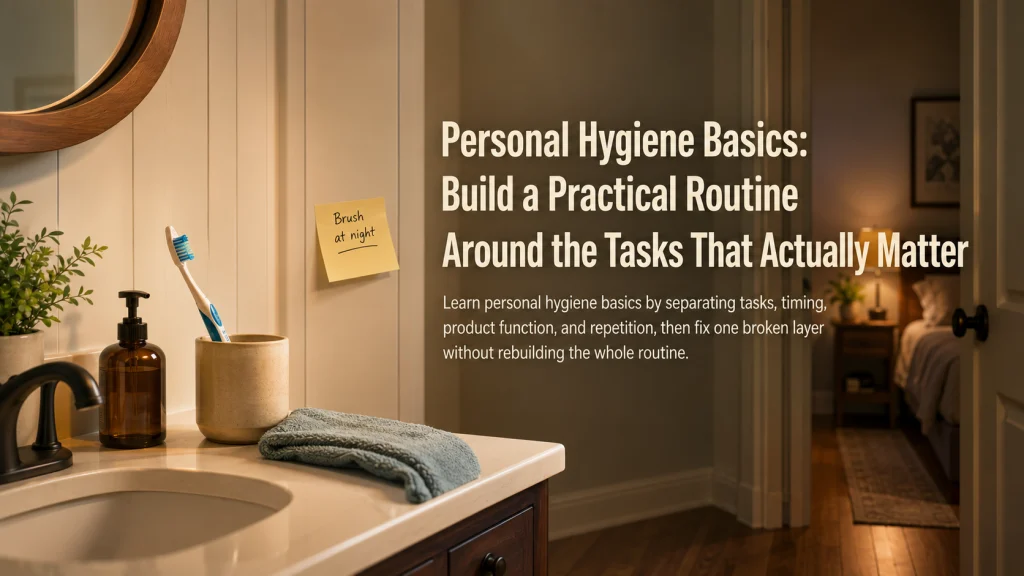
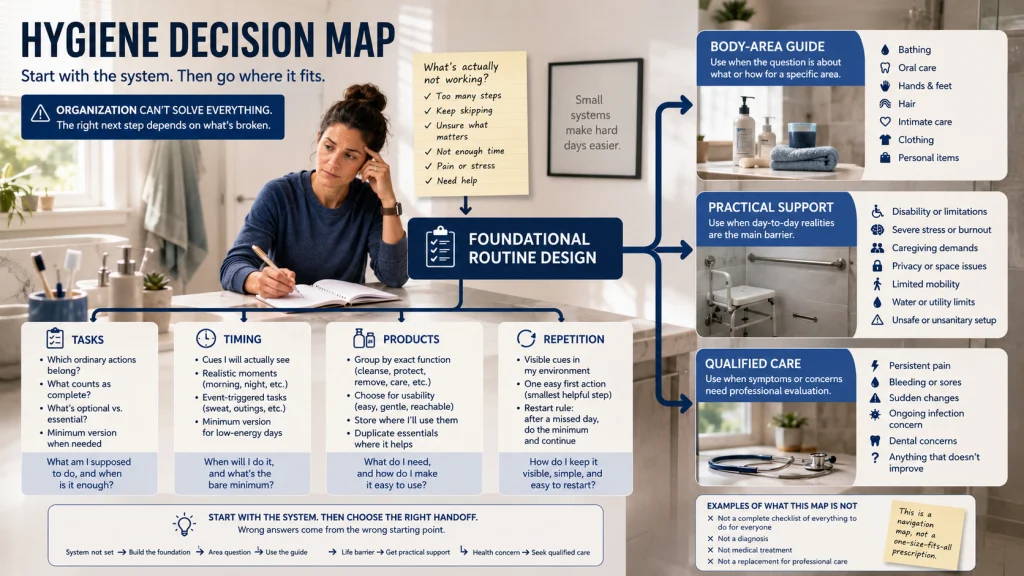
Personal hygiene basics become easier to manage when you separate four decisions: which tasks belong, when they happen, what function each product serves, and what helps the routine repeat. Start with the layer that is actually broken instead of rebuilding the entire system or buying another item. A minimum workable routine should cover essential tasks, fit the bathroom and schedule, and include a simple restart rule for missed days. Body-area questions, severe distress, major functional changes, unsafe access, or persistent symptoms need a different guide or qualified support.
Four Cards Explain Why a Hygiene System Breaks
Picture four cards on a bathroom counter labeled tasks, timing, products, and repetition. A missed evening task leads someone to buy another bottle, but the new bottle does not solve the forgotten cue. It belongs under the product card while the real problem remains under repetition.
The same mismatch happens in other ways. A person may know every task but have no workable time for them. They may own several products that perform the same function while lacking a clean towel where it is needed. They may have a clear morning sequence but no minimum version for low-energy days.
Key decision: Identify which layer is broken before changing the routine.
A practical system does not need to be long or visually impressive. It needs to make ordinary care clear enough to complete, simple enough to repeat, and flexible enough to restart after disruption.
Define the Parts of a Workable Hygiene System
Clear terms prevent routine design, grooming, product shopping, and treatment from being mixed together.
| Term | Practical meaning |
|---|---|
| Hygiene task | A specific action involving ordinary care of the body, mouth, clothing, or personal items. |
| Routine | A sequence that assigns tasks to a cue, time, place, or event. |
| Product function | The exact job an item performs, such as cleaning, drying, storing, carrying, or reducing friction. |
| Cue | A reliable event or condition that prompts the next action. |
| Minimum version | The smallest version that covers the essential task when time, energy, or access is limited. |
| Optional grooming | An appearance or styling choice that may matter personally without becoming a universal hygiene requirement. |
| Treatment | Care intended to assess or address a symptom or condition, which is outside ordinary routine design. |
These parts work together, but they solve different problems. A cue cannot replace a missing task definition, and a product cannot repair a schedule that never allows enough privacy or time.
Confirm That Foundational Routine Design Is the Right Starting Point
This guide fits when the main difficulty is an unclear checklist, an inconsistent adult routine, duplicate supplies, poor storage, repeated misses, or uncertainty about what belongs in ordinary care. It does not decide exact washing frequency for every body area, explain persistent symptoms, or create an individualized supported-care plan.
Use the broader personal hygiene decision guide when you first need to choose between bathing, oral care, hands and feet, hair and grooming, intimate care, clothing and personal items, or a lifestyle and access constraint.
| Current question | Better destination |
|---|---|
| Which foundational tasks belong in my system? | Checklist design |
| When should tasks happen and what is the minimum version? | Adult routine design |
| Which supplies perform a necessary function? | Product-function selection |
| How do I reduce repeated misses and restart? | Habit and cue design |
| How should I care for a specific body area? | The relevant body-area guide |
| Does a symptom need treatment or evaluation? | Qualified dental or medical guidance |
| Do disability, severe distress, caregiving, or unsafe access block essential care? | Situation-specific support and appropriate professional help |
Choosing the right destination keeps a foundational routine from becoming a universal body-care checklist or an attempt to solve a health concern through organization alone.
Route Task Inventory to a Personal Hygiene Checklist
When the routine feels vague, the first problem may be language rather than effort. A person cannot reliably complete “take better care of myself,” but they can complete a clearly named task with an obvious finish.
The personal hygiene checklist guide helps sort daily, event-triggered, periodic, and optional tasks without assigning one identical list to every adult.
Write each item as an action. “Complete oral care before bed” is clearer than “be cleaner.” “Place the used towel where it can dry” creates a visible finish point. “Check whether clean work clothes are ready” identifies a practical job without adding another purchase.
Practical tip: Remove any item that is only an appearance preference unless you intentionally want it in the routine.
Route Timing and Minimum Versions to an Adult Routine
A good task list can still fall apart at the busiest moment of the day. Morning care competes with leaving the house, and evening care often arrives after energy has already been spent elsewhere.
Use the personal hygiene routine for adults to assign cues, point-of-use organization, minimum versions, backups, and review points.
An ordinary evening sequence may include several tasks, while the minimum version protects the essential steps when someone gets home late or has less energy than expected. The backup keeps the system usable until the full routine fits again.
Event-triggered tasks may belong beside the event rather than inside a generic morning or evening list. Changing damp clothing after work, preparing menstrual supplies before leaving home, or cleaning a reusable tool after use are easier to remember when timing matches the real situation.
Route Supply Decisions to Product Function
A crowded shelf can create the impression that the routine is well supplied while making the next action harder to choose. Product decisions become clearer when every item is tied to one defined job.
The personal hygiene products guide helps compare necessary functions, package formats, storage, portability, replacement burden, and no-purchase alternatives without turning the routine into a shopping list.
A pump may be easier for one person to use than a tight cap. A small container may fit a shared bathroom but need frequent refilling. An opaque package can hide when supplies are running low. These details matter because usability and maintenance determine whether the item fits the room and the routine.
Editorial observation: Duplicate products often enter a routine because the task was never defined. Group supplies by function, then check usability, point-of-use storage, refill visibility, portability, recurring cost, and replacement burden before keeping multiple versions.
Sometimes the best correction is simply moving an existing item within reach, creating a drying place, or removing a duplicate that adds another decision.
Route Repeated Misses to Cues and Restart Rules
Missing a task does not automatically mean the task was rejected. The cue may be invisible, the first action may require too much setup, or one disrupted day may have left no clear way back into the sequence.
The guide on building hygiene habits helps reduce point-of-use friction, choose reminders, repeat a stable cue, and restart without waiting for a new week or a sudden burst of motivation.
There is no fixed number of days that makes every routine automatic. A familiar bathroom, visible supplies, and a reliable event can support repetition, while travel, illness, shift changes, low energy, and shared-space conflicts can interrupt it.
A simple restart rule is enough: complete the next available minimum version, reset the necessary supplies, and return to the normal cue. One missed day does not need to become an oversized recovery routine.
Use Four Questions to Find the Broken Layer
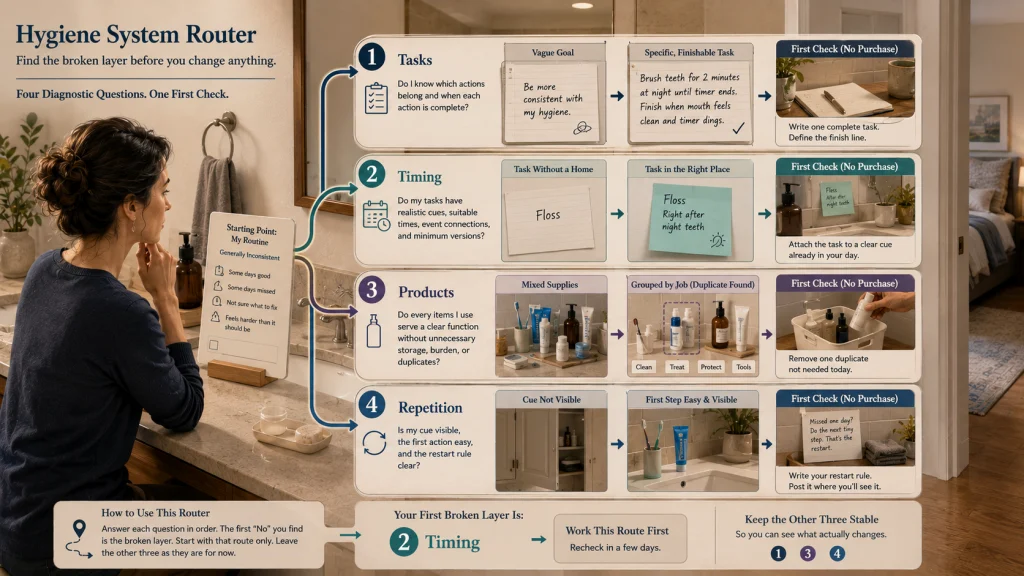
When the system feels generally inconsistent, use this router before changing anything.
| Question | Broken layer | First guide | First no-purchase check |
|---|---|---|---|
| Do I know which tasks belong and when each one is complete? | Tasks | Build the task inventory | Rewrite one vague goal as a specific action. |
| Do the tasks have realistic cues, timing, and minimum versions? | Timing | Design the adult routine | Move one task to the event or time when it is easiest to complete. |
| Does every product perform a defined function without unnecessary burden? | Products | Review product functions | Group existing supplies by job and identify duplicates. |
| Is the cue visible, the first action easy, and the restart rule clear? | Repetition | Reduce repetition friction | Place the first needed item at the point of use. |
Choose one row. Fixing all four layers together makes it difficult to tell whether the task list, schedule, supplies, or cue caused the original problem.
Separate Necessary Hygiene, Optional Grooming, and Treatment
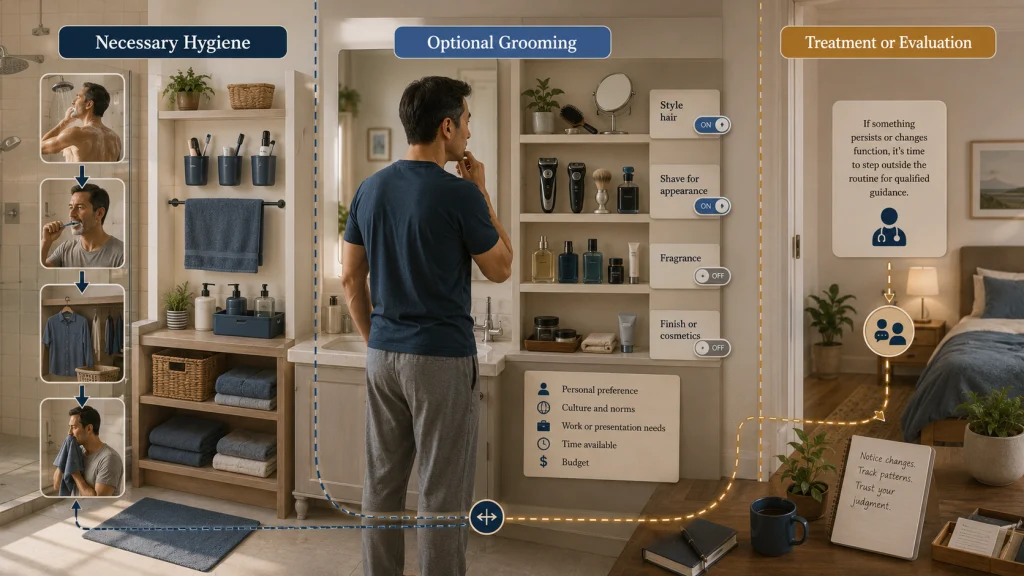
A routine grows quickly when appearance steps, marketing-created extras, and symptom management are treated as basic hygiene. Keep the categories visible while deciding what belongs.
| Category | Purpose | Decision rule |
|---|---|---|
| Necessary hygiene | Ordinary care of the body, mouth, clothing, and personal items. | Keep the task clear, accessible, repeatable, and matched to the actual need. |
| Optional grooming | Styling, shaving for appearance, fragrance, or cosmetic finishing. | Include it by preference, culture, comfort, work needs, time, and budget. |
| Treatment or evaluation | Assessment or care for a symptom, condition, or major functional change. | Move beyond routine troubleshooting and seek appropriate qualified guidance. |
A grooming step can be personally important without becoming mandatory for everyone. A symptom can appear during a hygiene task without being caused by poor hygiene. The category determines what kind of response is appropriate.
Run a One-Week Four-Layer Audit
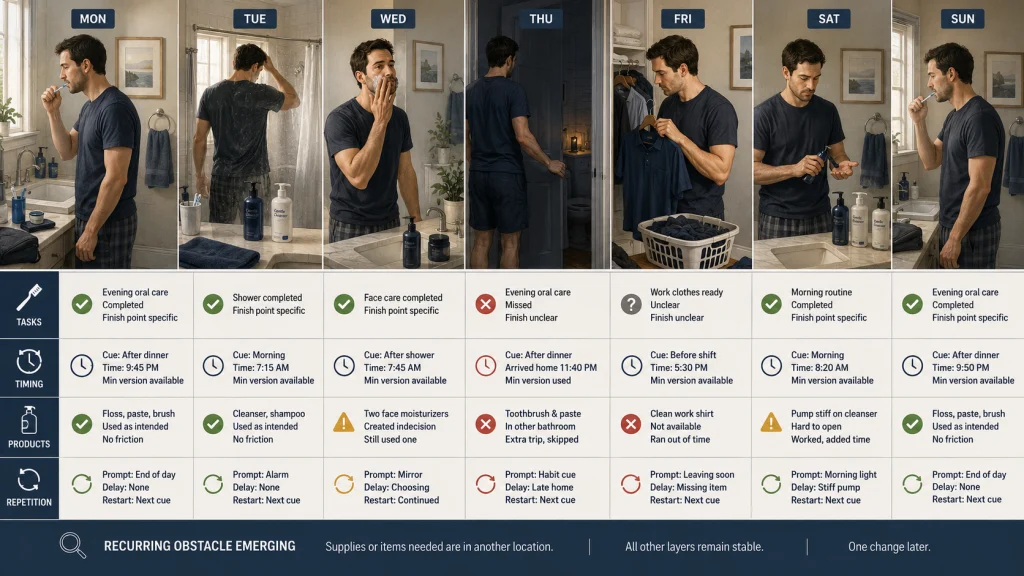
Use one ordinary week to observe the system before rebuilding it. The aim is to locate friction, not to grade personal worth or achieve flawless completion.
| Layer | What to record | Useful question |
|---|---|---|
| Tasks | Which task was completed, missed, or left unclear | Was the finish point specific? |
| Timing | The cue, time, event, and whether the minimum version was available | Did the task have a realistic place in the day? |
| Products | What was used, missing, duplicated, hard to open, empty, or stored elsewhere | Did the supply solve the intended job without adding friction? |
| Repetition | What prompted action, what delayed it, and how the routine restarted | Was the first step easy to recognize and begin? |
Keep the notes brief. “Evening oral care missed because supplies were in another bathroom” points to point-of-use friction. “Clean clothes unavailable after work” may reveal a clothing and laundry workflow issue rather than a body-care problem.
Note: A one-week audit cannot explain severe distress, symptoms, cognitive change, or a major loss of function. Those concerns require a different response.
Change One Broken Layer Instead of Rebuilding Everything
At the end of the audit, choose the layer with the clearest recurring obstacle. Keep the other parts stable long enough to see whether the change works.
For example, if a task is repeatedly forgotten because the necessary item is stored elsewhere, move the existing item to the point of use before adding a reminder. If the item is already visible but the task has no stable cue, leave storage alone and test the cue.
Review the change after several real opportunities to use it. Keep it when the routine becomes clearer or easier. Modify it when the barrier only partly improves. Change destinations when the audit reveals a body-area question, access constraint, or symptom rather than a foundational-system problem.
Know When Routine Design Is Not Enough
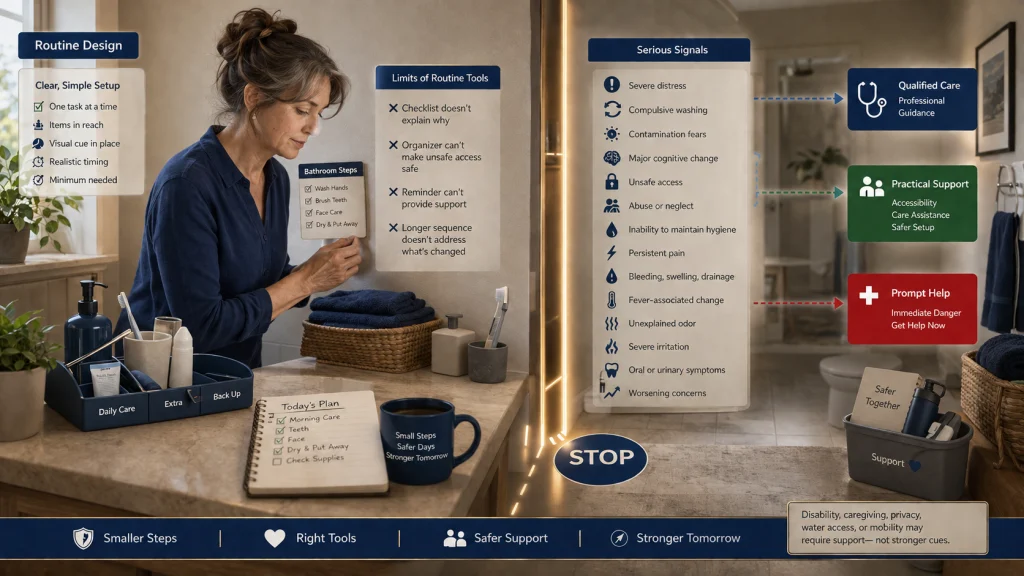
A checklist, organizer, reminder, or restart rule cannot diagnose why hygiene has become difficult. It also cannot make an unsafe bathroom accessible, provide supported care, or treat a physical or mental-health condition.
Safety warning: Severe distress, compulsive washing, contamination fears, major cognitive or functional change, unsafe access, abuse, neglect, or inability to maintain essential hygiene requires appropriate support. Immediate danger requires prompt help.
Persistent pain, bleeding, swelling, drainage, fever-associated changes, unexplained odor, severe irritation, oral symptoms, urinary symptoms, or other worsening concerns belong in the relevant qualified care. Do not respond by adding products, washing more often, or building a longer routine.
When disability, caregiving, privacy, water access, or mobility changes the task, use situation-specific guidance and involve appropriate support where needed. The person may need a safer setup or assistance rather than a stronger cue.
Name the Broken Layer and the First Action
Write down whether the current problem belongs to tasks, timing, product function, or repetition. Choose the matching guide, then make one no-purchase change that can be tested in the coming week.
Set a review point and a stop condition. Keep the change when it reduces friction without creating a new burden. Change direction when the issue belongs to a body area, access constraint, or symptom, and seek appropriate support when essential care or safety is affected.
Continue With the Layer That Still Needs Work
The four detailed guides complete different decisions. Use the task checklist when completion is unclear, the adult routine guide when timing and minimum versions are the obstacle, the product-function guide when supplies create duplication or friction, and the guide to building hygiene habits when cues and restarting are the weak point.
Choose only the layer that remains unresolved after the one-week audit. Keeping the other layers stable makes the result easier to understand.
FAQs
🧭 Where should I start if my hygiene routine feels disorganized?
Identify whether the problem is an unclear task, unrealistic timing, a product-function mismatch, or repeated misses. Change only that layer first so you can see whether the adjustment helps.
📋 Do all adults need the same personal hygiene checklist?
No. Tasks vary with body needs, activities, climate, work, access, culture, and personal circumstances. A checklist should define the jobs in your system without turning optional grooming into a universal requirement.
⏰ Should every hygiene task happen every day?
No. Some tasks are daily, some follow an event, and others are periodic. Assign each task according to its actual job rather than forcing everything into a morning or evening list.
🧴 How do I know whether I need another hygiene product?
Name the function the new item would perform and check whether an existing supply already does that job. Also consider storage, usability, refills, portability, recurring cost, and whether a no-purchase change would solve the barrier.
🔁 What is a good restart rule after missing my routine?
Complete the next available minimum version, reset the necessary supplies, and return to the normal cue. Avoid compensating with an oversized routine that makes the next restart harder.
✂️ Is grooming part of basic personal hygiene?
Some grooming tasks overlap with ordinary care, while many styling and appearance steps are optional. Include them according to preference, comfort, culture, work needs, time, and budget rather than treating them as universal requirements.
🧠 What if severe distress or contamination fears affect hygiene?
Severe distress, compulsive washing, contamination fears, or major changes in daily function require appropriate professional support. A longer checklist, stronger reminder, or additional product is not an adequate response.
♿ What if disability or unsafe access blocks essential care?
The task may need a safer setup, accessibility adaptation, supported care, or qualified practical guidance. Immediate danger, abuse, neglect, or inability to meet essential needs requires prompt and appropriate help.