Oral hygiene is easier to manage when each task has a clear role. Brushing cleans exposed tooth surfaces, interdental cleaning reaches between teeth, optional adjuncts add a specific function, and dental appliances need their own routine. Start with the surface, tool, symptom, or appliance creating the uncertainty, then follow the matching workflow instead of adding products at random. Pain, swelling, uncontrolled bleeding, persistent sores, loose adult teeth, breathing or swallowing difficulty, or an appliance causing injury require professional care rather than another home-care step.
Start With the Card That Matches the Actual Question
Picture one bathroom sink surrounded by eleven labeled cards: daily routine, brushing, between-teeth cleaning, water flosser, rinse, toothbrush type, tongue, breath, dry mouth, dentures, and braces. Beside them sits a separate stop card for pain, swelling, bleeding, sores, trauma, and a broken appliance.
These cards do not ask the same question. A mouthwash decision is not a brushing-technique problem. A loose denture is not solved by buying another toothbrush. Breath odor that persists despite ordinary care is not automatically proof of poor hygiene.
Start here: Name the surface, tool, symptom, or appliance that is creating the uncertainty. Then choose the matching route instead of building a longer product checklist.
| Route | Primary question |
|---|---|
| Daily routine | What belongs in the smallest workable sequence? |
| Brushing | How should exposed tooth surfaces be cleaned? |
| Between-teeth cleaning | How should contact areas be cleaned? |
| Water flosser | Which tool fits the surface, appliance, and dexterity need? |
| Rinse | Is mouthwash optional, therapeutic, cosmetic, or unnecessary? |
| Toothbrush type | Which handle and feature set fit the user? |
| Tongue | Would optional tongue cleaning add value without overdoing it? |
| Breath | Where and when does recurring odor begin? |
| Dry mouth | How should ordinary care adapt when the mouth feels persistently dry? |
| Dentures | How should a removable appliance be brushed, soaked, stored, and checked? |
| Braces | How should cleaning change around brackets, wires, and travel needs? |
Define the Main Oral-Care Terms
Oral hygiene is the home-care system used to clean teeth, gums, tongue, and dental appliances while supporting regular professional care. Plaque is a film that forms on oral surfaces and must be managed through appropriate cleaning rather than a promise to remove every microorganism.
Fluoride toothpaste is toothpaste formulated with fluoride for cavity-prevention use according to current guidance and the product label. Interdental cleaning means cleaning between teeth and around contact areas that a toothbrush may not reach well.
An adjunct is an optional step added for a specific reason, such as a rinse or tongue-cleaning tool. It does not replace foundational cleaning. A dental appliance may be fixed, such as braces, or removable, such as dentures.
A symptom is a change such as pain, bleeding, swelling, dryness, odor, a sore, or difficulty using an appliance. Professional instruction means directions from a dentist, hygienist, orthodontist, physician, or prosthodontist that apply to the individual’s condition or appliance.
Confirm That This Oral-Care Guide Fits the Decision
This guide fits ordinary home oral-care questions for generally healthy adults. It helps separate routine order, cleaning technique, tool selection, adjuncts, breath troubleshooting, dry-mouth adaptations, dentures, and braces.
Use the broader personal hygiene guide when the uncertainty concerns another hygiene area. Questions about grip limits, caregiver support, access barriers, or supported-care adaptations may need a separate ability and access pathway.
Stop using a home-hygiene route when the main issue is severe pain, facial swelling, trauma, uncontrolled bleeding, a persistent sore or lump, loose adult teeth, swallowing or breathing difficulty, or an appliance causing injury. Those are professional-care decisions.
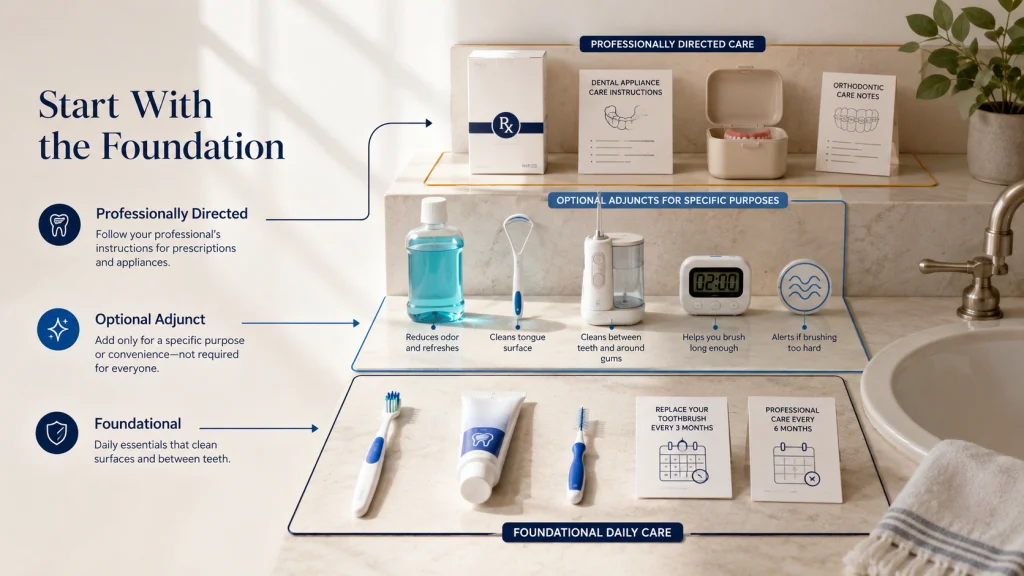
Separate Foundational, Optional, and Prescribed Steps
| Layer | Typical role | Examples | Boundary |
|---|---|---|---|
| Foundational | Daily surface cleaning and regular professional care | Brushing with fluoride toothpaste, cleaning between teeth, replacing worn tools | Technique and consistency matter more than adding products. |
| Optional adjunct | Adds a specific convenience or function | Mouthwash, tongue cleaning, water flosser, timer, pressure alert | Should solve a named problem and follow the label. |
| Professionally directed | Addresses an individual condition, risk, or appliance | Prescription products, condition-specific instructions, appliance-specific care | Do not substitute general advice for individual instructions. |
A workable system begins with the foundational layer. Optional steps come later, after the missing surface or routine problem is clear.
Build the Daily Sequence Before Adding Extras
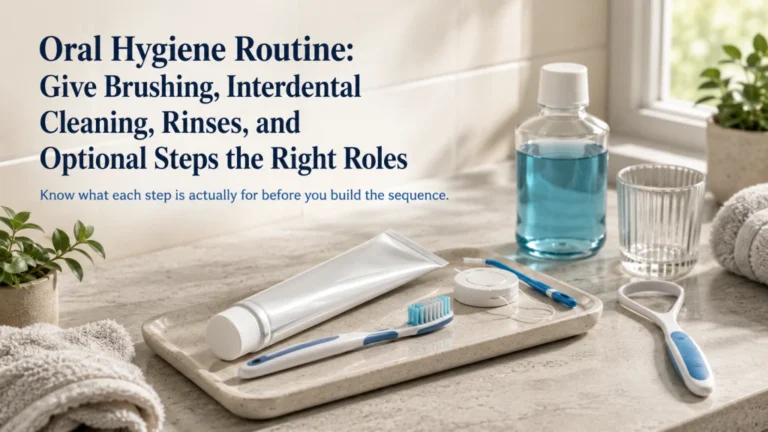
When order, frequency, or product roles are the main source of confusion, begin with the oral hygiene routine. That workflow organizes brushing, between-teeth cleaning, toothpaste, rinse timing, and replacement tasks into one repeatable sequence.
The aim is not to build the longest routine at the sink. It is to cover the needed surfaces with steps that still fit the user’s morning, evening, bathroom space, and travel pattern.
Route Surface Coverage and Pressure to Brushing Technique
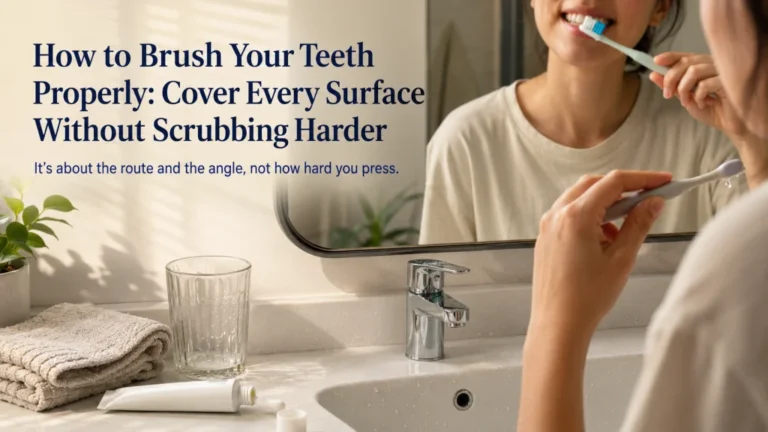
If the problem is missed surfaces, excess pressure, timing, toothpaste amount, brush angle, gumline access, or brush care, move to how to brush your teeth properly.
A different handle or powered feature cannot fix a routine that repeatedly skips the same tooth surfaces. Technique needs to be clear before feature comparison becomes useful.
Route Contact Cleaning to Floss Technique
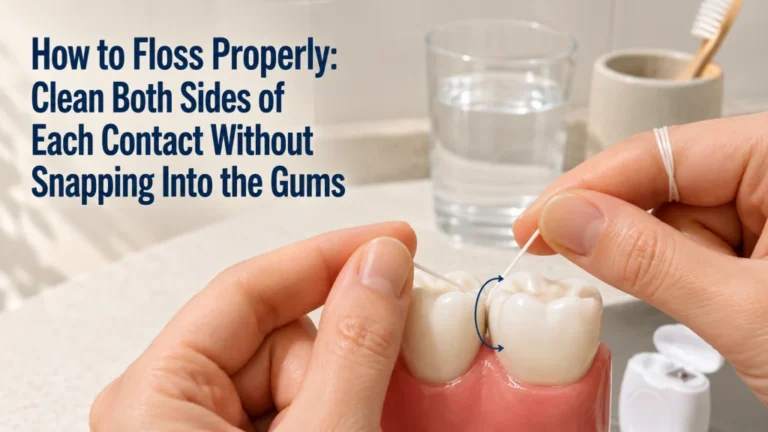
Questions about string-floss handling, wrapping the tooth surface, passing the contact point, or avoiding forceful snapping belong in how to floss properly.
This is a surface-coverage problem rather than a product-count problem. The right tool is the one that reaches the intended area safely and can be used with enough consistency to matter.
Choose Between a Water Flosser and String Floss by Fit
When braces, hand dexterity, reservoir upkeep, recurring replacement cost, storage, or travel drive the decision, compare water flosser versus floss by fit rather than by treating either tool as the automatic winner.
Editorial observation: A tool can be easy to use in the mouth but difficult to keep in the bathroom. Reservoir drying, counter space, charging, replacement tips, noise, and travel storage can determine whether a device remains part of the routine.
Decide Whether Mouthwash Has a Defined Role
A rinse deserves its own decision only when the role is clear. The guide do you need mouthwash separates cosmetic and therapeutic claims, label timing, active ingredients, age limits, and whether the rinse adds anything to the foundational routine.
Mouthwash remains an adjunct. It does not replace brushing or cleaning between teeth, and the exact label and individual dental instructions control how it should be used.
Editorial observation: Rinse packaging can create more routine friction than the front label suggests. Large bottles occupy storage, measuring caps need regular cleaning, travel sizes may be wasteful, and repeated refills can cost more than expected. Those details matter only after the rinse has a defined job.
Choose Manual or Powered Toothbrush Features by Routine Fit
Handle grip, brush-head size, timers, pressure alerts, charging, travel storage, replacement heads, and dexterity all belong in the electric versus manual toothbrush comparison.
Powered features may support timing or pressure awareness, but they cannot substitute for reaching the intended surfaces or cleaning and storing the brush correctly.
Editorial observation: A compact brush head may fit the mouth well but still pair with a bulky charger, awkward travel case, or expensive replacement cycle. The easiest brush to maintain is often the one whose handle, head supply, charging pattern, and storage all fit the same bathroom.
Treat Tongue Cleaning as an Optional Adjunct
Optional tongue care belongs in how to clean your tongue when the question is scraper versus brush technique, light pressure, or claims that extend beyond ordinary cleaning.
It should not become forceful scraping or a promise to solve every breath problem. Pain, bleeding, or repeated irritation is a reason to stop.
Troubleshoot Recurring Breath Odor by Timing and Source
When breath odor persists, returns quickly, or seems linked to dryness, food, the tongue, or an appliance, the next route is how to get rid of bad breath.
Recurring odor is not proof of laziness or poor character. A useful first step is to locate the timing and likely source without diagnosing the cause or covering the issue with repeated fragrance.
Adapt the Routine When Dryness Persists
A mouth that repeatedly feels dry may make brushing, rinsing, speaking, eating, or wearing an appliance harder. The guide to oral care for dry mouth organizes gentle routine adaptations, over-the-counter label checks, and evaluation triggers.
That route does not diagnose the cause of dryness or recommend changing medication. It helps reduce routine friction while keeping persistent or worsening symptoms within the professional-care boundary.
Give Removable Dentures Their Own Cleaning System
Removable dentures need a separate system for brushing, soaking, storage, adhesive removal, handling, and fit checks. That workflow is covered in how to clean dentures.
The appliance, mouth tissues, storage container, and cleanser directions all need attention. Treating dentures like another natural-tooth surface can create a poor fit between product, material, and routine.
Editorial observation: Denture care becomes harder when the storage container has no dedicated place, the lid stays damp, the brush is mixed with household brushes, or several soaking products compete for space. A simple, assigned storage system can reduce contamination and missed steps without adding another product.
Route Brackets, Wires, and Travel Kits to Braces Care
Brackets and wires create new edges, contact points, and travel needs. The route for brush access, interdental tools, and compact kits is oral hygiene with braces.
A broken wire, loose bracket, or appliance causing injury belongs to the orthodontic instructions and professional-care route. Improvised repair can worsen the problem.
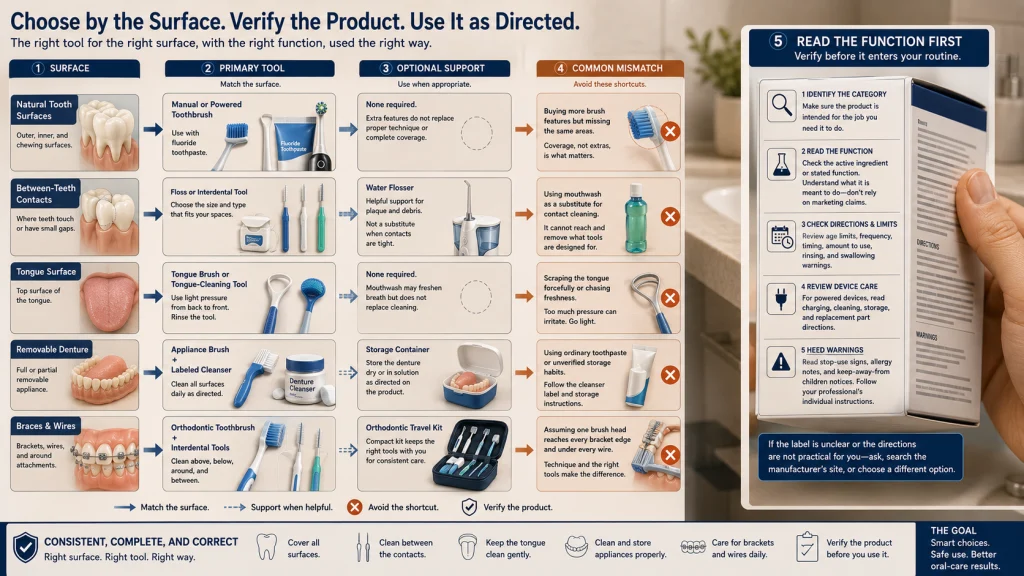
Match the Surface to the Tool Before Buying More Products
Once the correct route is clear, the next question is whether the chosen tool actually reaches the intended surface. This matrix turns the route into a practical match.
| Surface or task | Primary tool category | Optional support | Common mismatch |
|---|---|---|---|
| Outer, inner, and chewing tooth surfaces | Manual or powered toothbrush with fluoride toothpaste | Timer or pressure alert | Buying more features while missing the same surface |
| Between teeth | Floss or an appropriate interdental tool | Water flosser when it fits the need | Using mouthwash as a substitute for contact cleaning |
| Tongue surface | Brush or tongue-cleaning tool | None required | Scraping forcefully to chase freshness |
| Removable denture | Appliance-specific brush and labeled cleanser | Storage container | Using ordinary toothpaste or storage habits without checking instructions |
| Brackets and wires | Toothbrush plus suitable interdental tools | Travel kit or water flosser | Assuming one brush head reaches every bracket edge |
Read Product Labels by Function, Direction, and Warning
- Identify whether the product is toothpaste, rinse, appliance cleanser, adhesive remover, dry-mouth product, or another category.
- Read the active ingredient or stated function without treating marketing language as proof.
- Check age limits, frequency, timing, amount, rinsing instructions, and whether swallowing must be avoided.
- Read storage, charging, cleaning, and replacement directions for devices.
- Follow stop-use warnings and individual professional instructions.
A familiar package shape does not prove that two products have the same role. Read the function before adding the item to the routine.
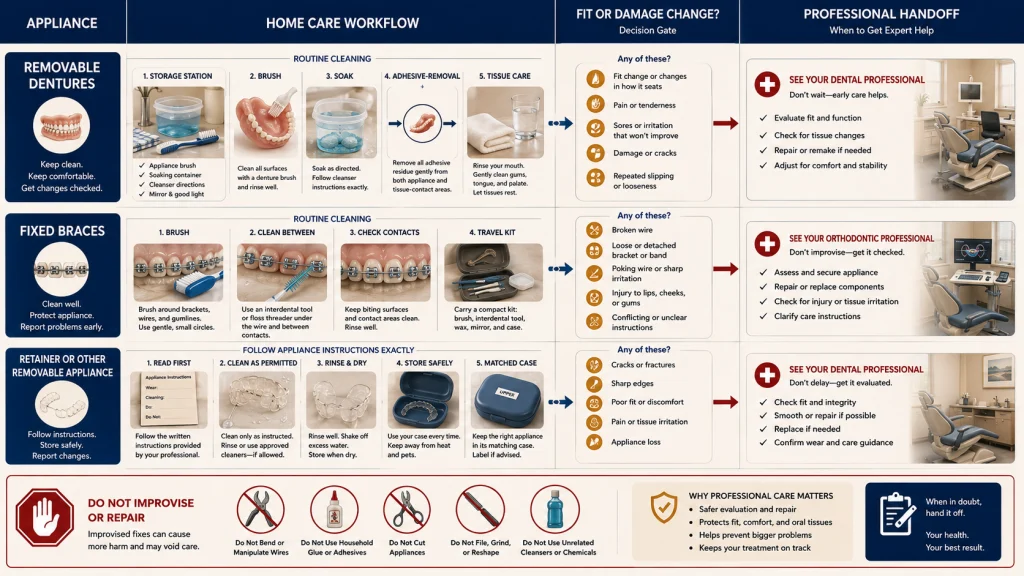
Use an Appliance Handoff Map
| Appliance situation | Home-care route | Professional handoff |
|---|---|---|
| Removable denture needs routine cleaning | Denture brushing, soaking, storage, and container care | Fit change, pain, sores, damage, or repeated slipping |
| Fixed braces need daily cleaning | Bracket, wire, gumline, and interdental workflow | Broken wire, loose bracket, injury, or instructions that conflict |
| Retainer or other removable appliance | Follow the exact appliance instructions | Cracks, sharp edges, poor fit, pain, or loss |
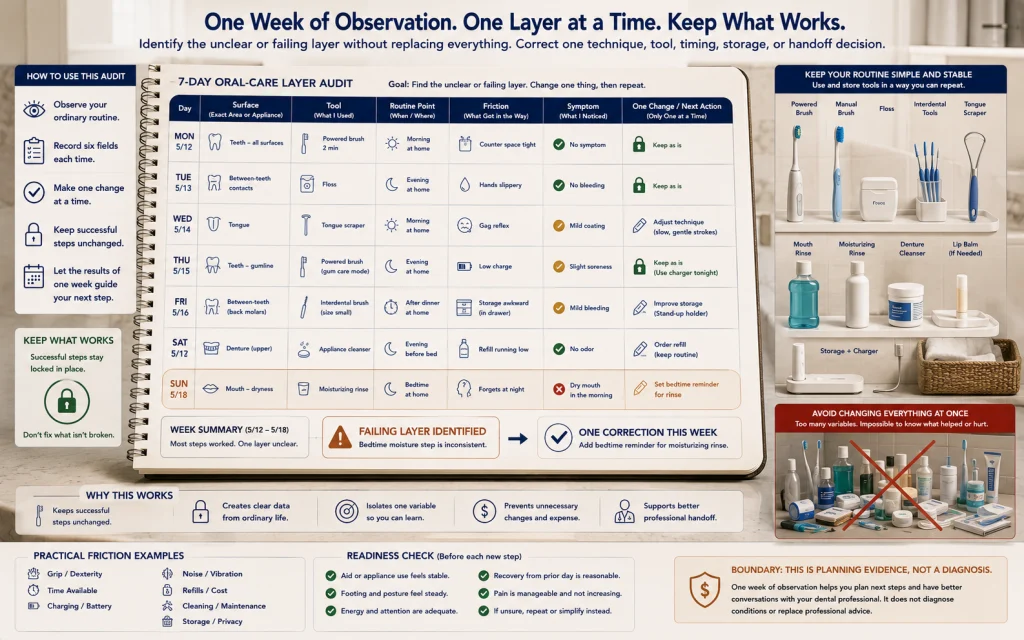
Run a One-Week Surface, Tool, and Symptom Audit
Use one week to identify the missing layer without changing every product at once.
| Audit field | What to record |
|---|---|
| Surface | Teeth, between teeth, tongue, denture, brackets, or another exact area |
| Tool | Brush type, floss, interdental tool, water flosser, rinse, or appliance product |
| Routine point | Morning, evening, after meals, travel, or appliance removal |
| Friction | Grip, time, charging, counter space, noise, refills, cleaning, or privacy |
| Symptom | Pain, bleeding, dryness, odor, sore, swelling, or no symptom |
| One change | Technique correction, tool fit, timing, storage, or professional handoff |
At the end of the week, name one failing layer. Keep successful steps unchanged while correcting only that layer.
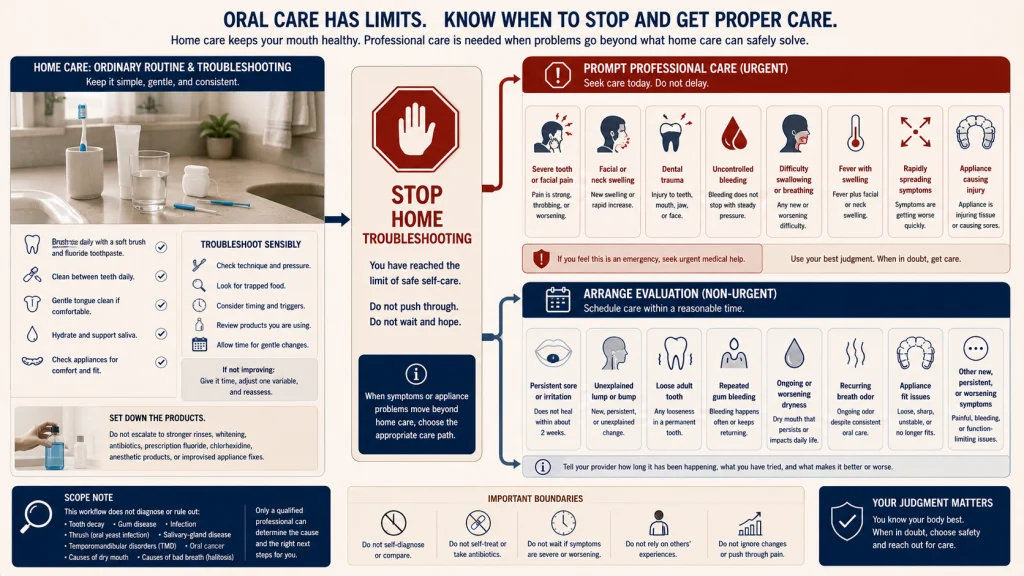
Separate Urgent and Non-Urgent Professional Boundaries
Severe tooth or facial pain, facial or neck swelling, trauma, uncontrolled bleeding, difficulty swallowing or breathing, fever with swelling, rapidly spreading symptoms, or an appliance causing injury requires prompt professional care.
Arrange dental or medical evaluation for new, persistent, worsening, unexplained, painful, bleeding, or function-limiting oral symptoms, including persistent sores or lumps, loose adult teeth, repeated gum bleeding, ongoing dryness, recurring breath odor, or appliance fit problems.
This article does not diagnose or treat tooth decay, gum disease, oral infection, thrush, salivary-gland disease, temporomandibular disorders, oral cancer, dry-mouth causes, or halitosis causes. It does not prescribe medication, antibiotics, prescription fluoride, chlorhexidine, anesthetic products, whitening treatment, or dental procedures.
Name the Surface, Choose the Route, and Set the Stop Condition
Begin with the exact surface, tool, symptom, or appliance creating uncertainty. Follow the direct workflow, take the first low-risk action, and leave optional products out until the foundational routine is clear.
A useful oral-care system is not the longest one on the counter. It is the one that reaches the needed surfaces, fits the person and bathroom, follows product and professional instructions, and stops when symptoms move beyond home care.
FAQs
🪥 What are the foundational steps in oral hygiene?
The foundation includes brushing with fluoride toothpaste, cleaning between teeth, caring for tools and appliances, and receiving regular professional care based on individual needs.
🧵 Is flossing the only way to clean between teeth?
No. String floss is one option. Interdental brushes, water flossers, or another appropriate tool may fit different surfaces, braces, and dexterity needs.
💧 Do I need mouthwash every day?
Not automatically. Mouthwash is an adjunct with cosmetic or therapeutic roles. Use it only when the function, label, and individual instructions fit the routine.
⚡ Is an electric toothbrush always better?
No. Choose by grip, head size, pressure control, charging, cost, maintenance, and the ability to reach all intended surfaces consistently.
👅 Should everyone clean the tongue?
Tongue cleaning is optional. A light brush or scraper technique may fit some routines, but forceful scraping and broad health promises are not appropriate.
😮 Does bad breath always mean poor hygiene?
No. Recurring odor may involve dryness, food, the tongue, an appliance, another oral source, or a condition requiring evaluation. It should not be framed as a character flaw.
🦷 Do dentures use the same routine as natural teeth?
No. Removable dentures need appliance-specific brushing, soaking, storage, handling, and fit checks in addition to care for the mouth tissues.
🧷 What changes with braces?
Cleaning must reach around brackets, wires, gumlines, and contact areas. Tool choice, travel setup, and broken-appliance instructions become more important.
🚩 When should oral symptoms be evaluated?
Seek professional care for severe pain, swelling, trauma, uncontrolled bleeding, swallowing or breathing difficulty, persistent sores or lumps, loose adult teeth, unexplained bleeding, worsening dryness, or an appliance causing injury.