There is no single desk-sitting limit that is safe or medically optimal for every adult. The more useful starting point is to separate total sitting from the longest uninterrupted bouts and identify where the workday repeatedly removes opportunities to change position. Track meetings, focused work, meals, commuting, and leisure sitting as separate contexts, then shorten one repeatable block at a natural task boundary. Keep workstation fit, structured exercise, symptoms, disability, pregnancy-related concerns, and medical restrictions in their proper roles rather than forcing them into one timer rule.
The Same Eight Hours Can Hide Two Very Different Sitting Patterns
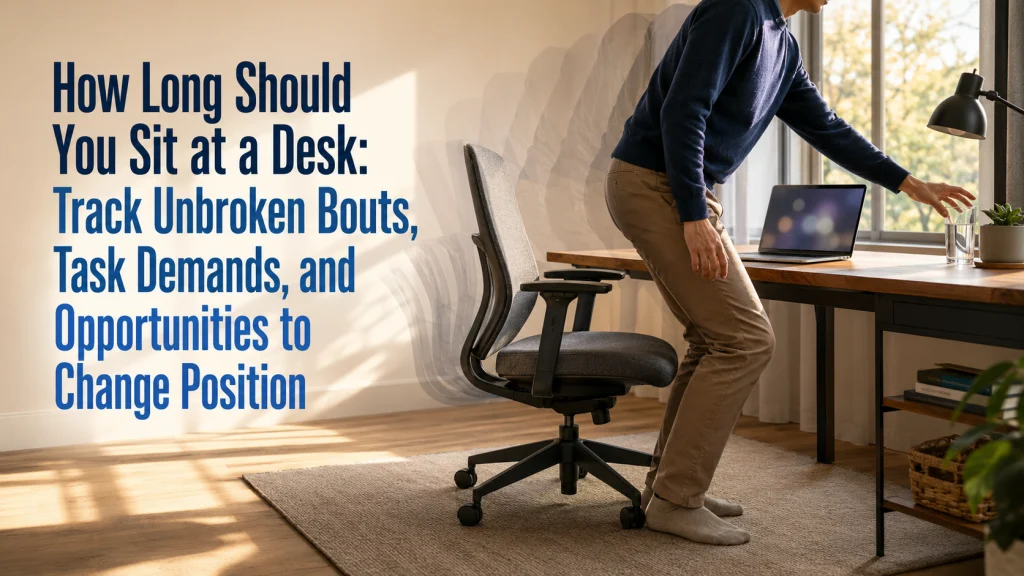
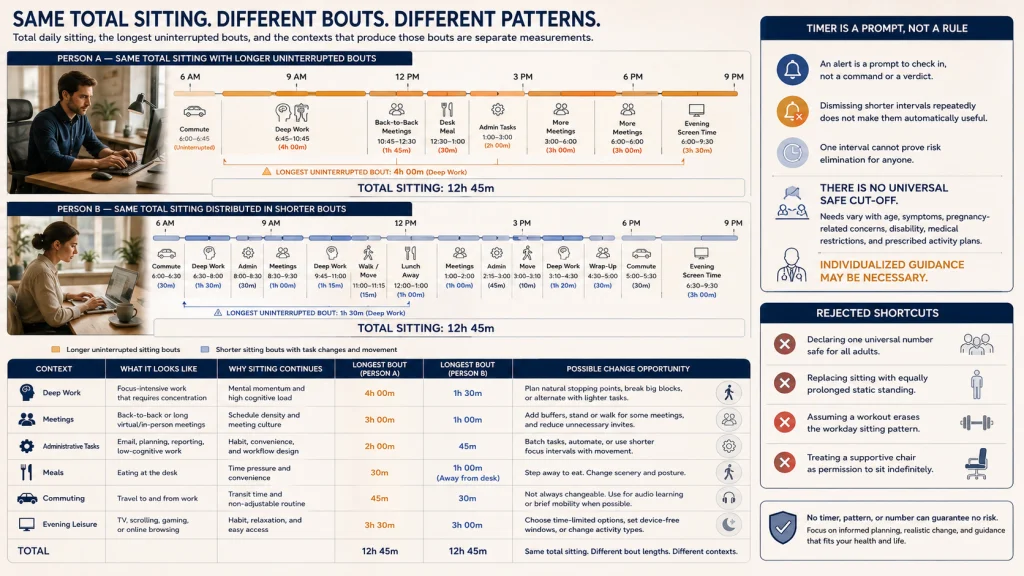
Two people both describe the day as “eight hours at a desk.” The first sits through four uninterrupted two-hour blocks, with lunch eaten at the screen and calls handled without leaving the chair. The second also accumulates eight seated hours, but those hours are broken up by standing for short calls, walking between rooms, changing tasks, and leaving the desk for lunch.
The total is the same. The pattern is not.
Equal-total, different-pattern opening:
Pattern A
Two hours seated → brief screen pause → two hours seated → desk lunch → two hours seated → two hours seated
Pattern B
Seated focus → task change → short walk → seated meeting → lunch away from desk → standing call → seated detail work → ordinary movement between tasks
What the comparison shows
Equal daily sitting can contain different bout lengths, task demands, and opportunities to move.
What it does not prove
A more varied pattern should not be presented as eliminating health risk or creating a guaranteed safe day.
The practical question is not only how many hours were seated. It is where sitting became continuous, why the block continued, and what realistic event could interrupt it next time.
Define Total Sitting, Desk Sitting, Uninterrupted Bouts, Position Changes, and Physical Activity
Total sitting is the accumulated seated time across the day. It can include desk work, meals, commuting, television, gaming, reading, and other seated activities.
Desk sitting is the part tied to computer work, paperwork, study, meetings, or other tasks performed at a workstation. It may represent only part of the day’s sedentary time.
An uninterrupted sitting bout is a continuous seated period with no meaningful change in position or activity. Briefly shifting in the chair does not necessarily change the overall exposure pattern.
Sedentary behavior refers to waking time spent sitting, reclining, or lying with very low energy use. A position change means moving from one working posture to another, such as sitting to standing. A position change may be useful, but it is not automatically the same as walking or a movement break.
Physical activity includes bodily movement that raises energy use above rest. Structured exercise is one form of physical activity, while ordinary walking, household movement, and task-related movement are other forms.
Sitting, standing, and movement across the workday places duration questions beside standing-desk use, break content, fatigue, and exercise without treating the categories as interchangeable. Posture and ergonomics connects those choices with task demands, support, recovery, and everyday movement.
Population-Level Associations Do Not Create One Personal Safe Cutoff
Research and public-health guidance can support the general principle of moving more, sitting less, and reducing prolonged sedentary time. That does not produce one medically safe maximum for every desk worker.
Population studies describe patterns across groups. An individual workday also includes age, health status, disability, pregnancy-related concerns, medication effects, sleep, commuting, exercise, job control, task demands, and the ability to move safely. A number taken from a headline cannot account for all of those conditions.
This is why several common questions cannot be answered with one guaranteed threshold:
- How many total hours are safe?
- Is one uninterrupted hour always dangerous?
- Does standing for the same length remove the concern?
- Does a workout make the rest of the day irrelevant?
- Does a comfortable chair make long sitting medically harmless?
Timer-limit box:
- A timer is a prompt, not proof of a medical outcome.
- No single interval proves that a person has eliminated medical risk.
- A shorter interval that is ignored is less useful than a practical cue that leads to a real change.
- Symptoms, medical restrictions, disability, and pregnancy-related concerns may require individualized guidance rather than self-selected timing.
The useful translation is modest: identify the longest repeatable bouts, create more opportunities to change position or task, and review whether the new pattern is sustainable.
Audit One Ordinary Workday and Mark the Longest Uninterrupted Bouts
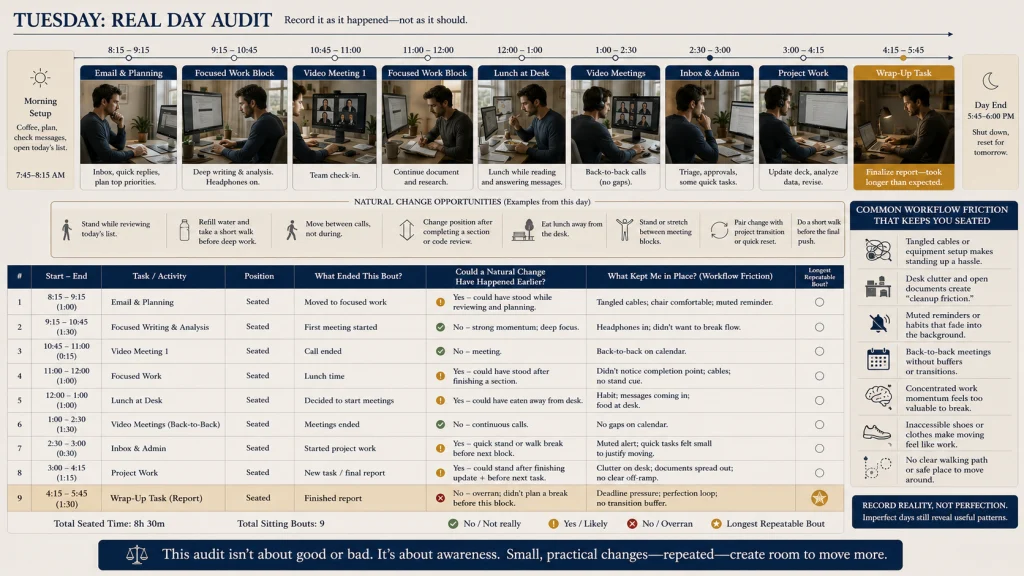
Do not begin with an ideal schedule. Begin with one representative day. A normal Tuesday often reveals more than a perfectly planned day created for tracking.
| Workday sitting audit | Start and end | Task | Position | What ended the bout? | Could a natural change happen earlier? |
|---|---|---|---|---|---|
| Morning setup | [record] | Email and planning | Seated | First meeting | Stand while reviewing the day’s list or walk to refill water |
| Focused block | [record] | Writing, analysis, design, or coding | Seated | Task completion or interruption | Use the end of a section, file, or review cycle |
| Meeting block | [record] | Video calls | Seated | Calendar gap | Change position between calls instead of during the discussion |
| Lunch | [record] | Meal and screen use | Seated | Return to work | Move the meal away from the desk when practical |
| Afternoon work | [record] | Mixed tasks | Seated or standing | End of work | Pair a change with project transitions or a routine household task |
Record the bout as it happened, not as it should have happened. Include calls that ran long, the lunch eaten at the desk, and the final hour that disappeared into one last task.
Nora’s observation: Chairs, converters, reminder apps, and wearable alerts can all add options, but meetings, cables, concentrated work, and desk clutter still decide whether a person changes position. I look for the point where movement becomes inconvenient. That friction often explains the longest bout better than the absence of another feature.
Track Meetings, Deep Work, Calls, Meals, Commuting, and Leisure Separately
One daily total can hide several different problems. A long meeting block is controlled by the calendar. Deep work may continue because the person does not want to break concentration. A commute offers fewer choices. Leisure sitting may begin immediately after a seated workday.
| Total-versus-bout table | Context | Why the sitting continues | Possible planning response |
|---|---|---|---|
| Work total | Deep work | Concentration and task momentum | Use project milestones rather than random mid-thought interruptions |
| Work total | Meetings | Camera, notes, screen sharing, and social expectations | Change position between meetings or during suitable audio-only portions |
| Work total | Administrative tasks | Short tasks blend into one long seated chain | Group one task away from the desk or stand for a brief review |
| Non-work total | Meals | Convenience and continued screen use | Separate the meal from the workstation when practical |
| Non-work total | Commuting | Limited choice during travel | Create movement before departure or after arrival when appropriate |
| Non-work total | Evening leisure | Fatigue and recovery after work | Notice whether the workday flows directly into another long seated block |
The purpose is not to judge every seated activity equally. It is to find the part of the day where a small change is possible and likely to repeat.
Add Position Changes at Natural Task Boundaries Before Relying on Constant Alarms
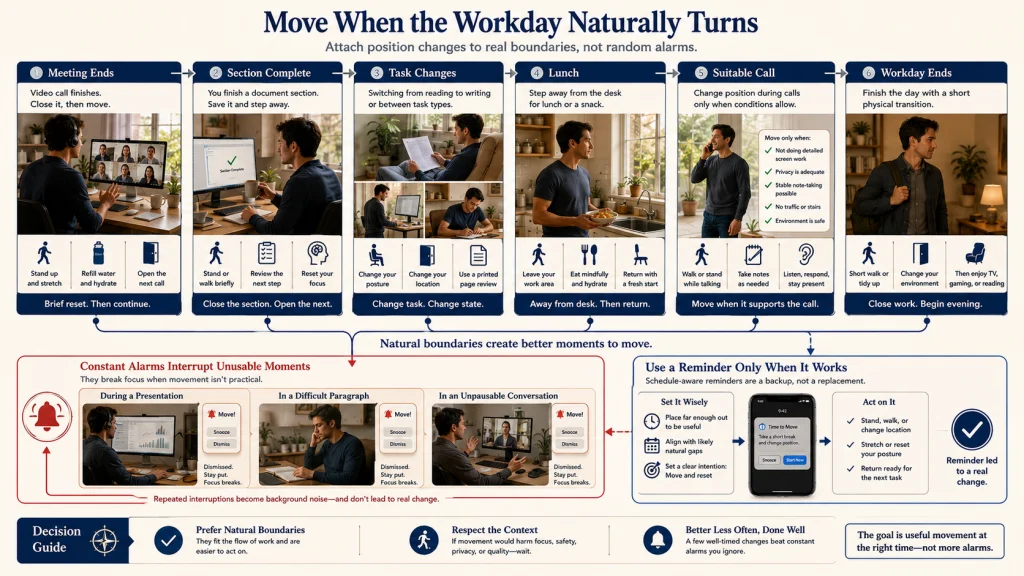
A timer can interrupt the wrong moment. It may appear during a presentation, a difficult paragraph, or a conversation that cannot be paused. After several dismissals, the alert becomes another notification rather than a useful cue.
Natural task boundaries already exist in most workdays. They can be used without pretending that every hour follows the same pattern.
Natural-task-boundary map:
End of a meeting
Stand, walk briefly, refill water, or reset the workstation before opening the next call.
Completion of a document section
Save the file, change position, and review the next step away from the exact working posture.
Switch from reading to writing
Use the task change as a cue to sit, stand, or relocate a printed page.
Lunch or snack transition
Leave the desk when practical rather than attaching the meal to the same seated block.
Phone call
Change position when the call does not require detailed screen work, privacy restrictions, or stable note-taking.
End of the workday
Create a brief physical transition before beginning another seated activity.
When natural boundaries are too far apart, a reminder may still help. Set it around the actual schedule, then observe whether it produces a change rather than simply measuring time.
Break-frequency planning addresses reminder timing, meeting blocks, flexible prompts, and what to do when alerts are repeatedly ignored.
Compare Standing, Walking, and Non-Screen Tasks Without Treating Them as Identical
Standing changes position but can remain static. Walking adds movement. A non-screen task may change visual and hand demands while still being seated. Each option can interrupt one part of the pattern, but they do not produce the same exposure.
| Change option | What changes | What may stay the same | Useful example |
|---|---|---|---|
| Stand at the same desk | Lower-body position and load distribution | Screen demand, hand task, and low movement | A short call or reading task |
| Walk briefly | Position, movement, and often visual distance | The work problem may still be waiting on return | Refill water, retrieve a document, or move between rooms |
| Complete a non-screen task | Visual demand and possibly hand position | The person may remain seated | Review a printed page or organize physical notes |
| Change seated support | Pressure distribution and working posture | Total sitting and low movement | Move from focused input to supported reading |
| Structured exercise | Planned physical activity outside the immediate desk task | The earlier sitting pattern has still occurred | A separate workout or training session |
The goal is not to rank every change. It is to choose the one that is appropriate, available, and safe at that moment.
Practical movement during work covers quiet options, short walks, task integration, and ways to interrupt desk time without turning each pause into a workout.
Keep Workstation Fit Separate From Exposure Duration
A supportive chair, readable monitor, and accessible keyboard can improve how a seated task is performed. They do not create a universal license to remain seated indefinitely.
The reverse is also true. Frequent breaks cannot compensate for a workstation that forces reaching, twisting, unsupported input, or an unreadable screen. Fit and duration are separate controls that should support each other.
Ask two different questions:
- Fit question: Can the person perform the task with appropriate support, access, visibility, and room to move?
- Duration question: How long does the same exposure continue before another position, task, or movement opportunity occurs?
Home office ergonomics covers the chair, desk, monitor, keyboard, mouse, and room relationship. This page remains focused on how sitting accumulates over time.
Exercise and Long Sitting Can Coexist in the Same Day
A person can complete a morning run, strength session, class, or walk and still spend the workday in long seated bouts. That does not make the exercise pointless. It means the workout and the workday pattern answer different questions.
Structured exercise may support fitness, strength, skill, endurance, or other goals. Interrupting long desk bouts changes how sedentary exposure is distributed during the day. Neither should be described as completely erasing or replacing the other.
Nora’s observation: A wearable may celebrate a completed workout and still show long inactive periods later. That can feel contradictory until the two measures are separated. One describes a planned activity; the other reveals what happened between activities. The useful response is not guilt, but a clearer map of the day.
Exercise and prolonged sitting addresses the relationship between fitness activity, sedentary time, public-health guidance, and the limits of all-or-nothing claims.
Create a Realistic Reduction Target Without Prescribing a Universal Number
Use the audit to choose one block that is both long and changeable. Do not rebuild the entire day at once.
Reduction target worksheet:
- Longest repeatable bout: [meeting block, deep work, lunch at desk, commute, evening screen time]
- Why it continues: [concentration, calendar, habit, equipment, social expectation, fatigue]
- Natural boundary: [end of meeting, completed section, phone call, meal, arrival home]
- Change to test: [stand, walk, move rooms, complete a non-screen task, reset support]
- Friction to remove: [cables, clutter, muted reminders, inaccessible footwear, no clear path]
- Review question: Did the change occur often enough to shorten the bout without disrupting essential work?
A useful target might be “leave the chair between the final two morning meetings” or “eat lunch away from the workstation on three ordinary workdays.” These are examples of behavior tests, not medical prescriptions.
Keep the change small enough to survive a busy day. Once it becomes ordinary, review the next longest bout rather than chasing a perfect schedule.
Seek Individual Guidance When Symptoms or Activity Restrictions Affect the Plan
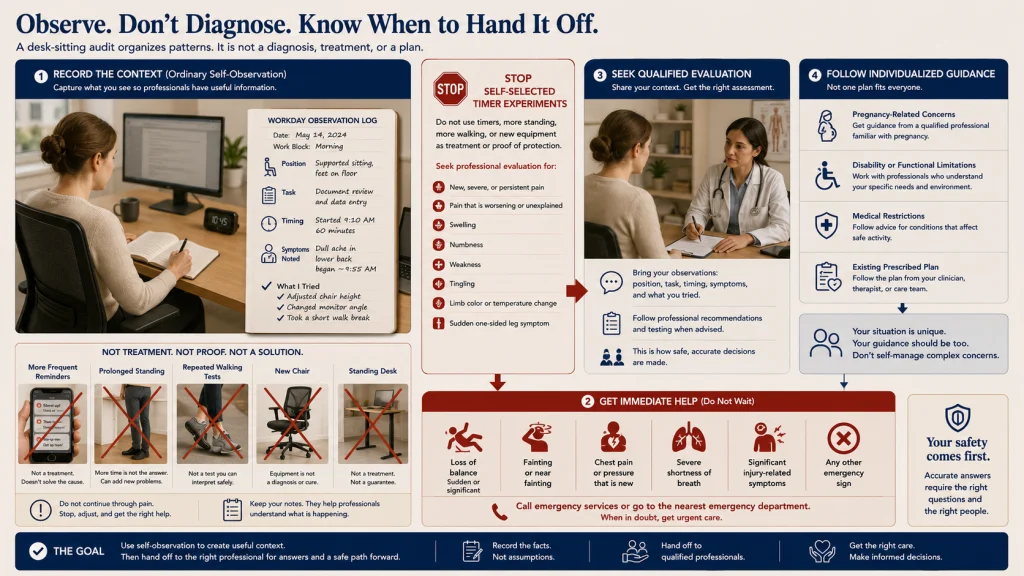
Self-observation can help organize ordinary desk exposure, but it cannot diagnose cardiovascular disease, diabetes, blood clots, venous disease, joint disorders, nerve conditions, spinal conditions, balance disorders, or a work-related musculoskeletal condition.
Escalation card:
- New, severe, persistent, worsening, or unexplained pain requires appropriate professional evaluation.
- Swelling, numbness, weakness, tingling, color or temperature change in a limb, or a sudden one-sided leg symptom should not be managed with a self-selected sitting timer.
- Loss of balance, fainting, chest pain, severe shortness of breath, symptoms after injury, or other emergency signs require immediate appropriate help.
- People with medical restrictions, disability, pregnancy-related concerns, or a prescribed activity plan should follow qualified individualized guidance.
Do not continue through pain, use standing as treatment, or treat a break schedule as proof of protection. Record the position, task, timing, and symptoms, then seek suitable evaluation.
Reduce the Longest Repeatable Bout and Review the Pattern
Start by separating total sitting from uninterrupted desk bouts. Audit one ordinary day, mark the longest recurring blocks, and identify whether meetings, deep work, meals, commuting, or leisure sitting are driving them.
Use natural task boundaries before depending on constant alarms. Choose among standing, walking, non-screen work, and other position changes according to the task rather than treating them as identical. Keep workstation fit and structured exercise in their own roles.
Then test one realistic reduction target. Remove the friction that prevents the change, observe whether it happens during a normal week, and review the next longest bout only after the first adjustment becomes workable. The goal is not to discover one safe number. It is to create more choice inside the sitting pattern that actually repeats.
FAQs
🕒 How many hours should you sit at a desk?
There is no universal number that is safe or medically optimal for every adult. Track total sitting and the longest uninterrupted desk bouts, then reduce a repeatable block at a realistic task boundary.
⏳ How long is too long to sit without moving?
No single bout length can be declared dangerous for every person. Use the longest recurring period as the first target for change, especially when the workday offers no position or task variation.
🔔 Should I use a timer to stop sitting?
A timer can help when it leads to a real change. It is not a medical guarantee. Match prompts to meetings and focused work, and use natural boundaries when constant alerts are repeatedly dismissed.
🧍 Does standing reset a long sitting bout?
Standing changes position, but static standing is not the same as walking or broader movement. Choose the change that fits the task and avoid replacing one long static position with another.
🚶 What can I do between desk-sitting blocks?
Walk to another room, refill water, stand for a suitable call, review a printed page, reset supplies, or change support. The option should be practical, safe, and compatible with the work.
🪑 Does a better chair make long sitting safe?
A suitable chair can improve support for seated work, but it does not establish a universal safe duration. Workstation fit and exposure length are separate decisions.
🏋️ Does exercise cancel out sitting at a desk all day?
Exercise and desk-sitting patterns have different roles. A workout remains valuable, while the workday may still contain long uninterrupted sedentary bouts that can be addressed separately.
⚠️ When should I stop changing sitting time on my own?
Seek appropriate guidance for severe, persistent, worsening, or unexplained pain; swelling; numbness; weakness; tingling; limb color or temperature change; balance loss; fainting; chest pain; severe shortness of breath; symptoms after injury; or a sudden one-sided leg symptom.