Fear of falling in older adults can be protective when it points to a real hazard, uncertain capacity, or a recent change that needs attention. It becomes costly when avoiding every risky-feeling activity also removes walking, bathing, stairs, errands, and social participation. A cautious plan separates the hazard from the remembered threat, removes what can be fixed, and uses the smallest supported step back into the activity. Falls, head injury, new dizziness, fainting, sudden weakness, chest pain, severe shortness of breath, or major functional decline require qualified evaluation and immediate help when symptoms are urgent.
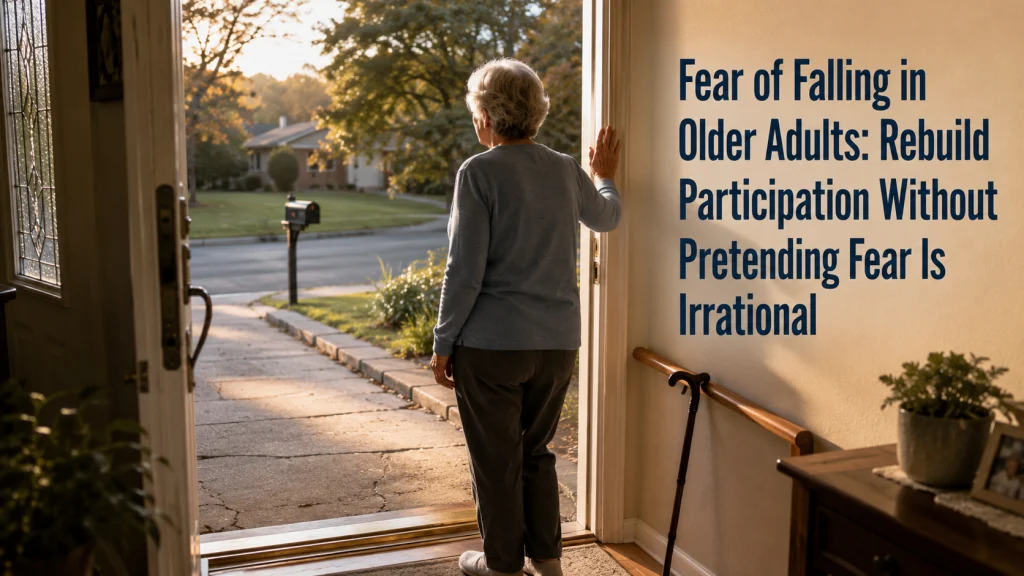
Start with the mailbox that suddenly feels too far away
The person can still walk from the front door to the mailbox. The distance has not changed, and the route is familiar. But the last near-fall happened where the driveway meets the curb, so the mailbox has quietly disappeared from the daily routine.
At first, avoiding that curb feels sensible. The person stops checking the mail alone, then stops walking outside without company, then begins declining short neighborhood visits because the route includes the same uneven edge. The decision that began as protection starts removing movement, errands, and confidence from the week.
Fear can be protective and still become too expensive when it removes every opportunity to move.
Define fear of falling without dismissing it
Fear of falling is concern about losing balance, being injured, becoming stranded, or needing help during an activity. It may follow a fall, a near-fall, a period of illness, a mobility change, or witnessing someone else fall.
The fear is not automatically irrational. A loose rug, dim stairwell, unstable shoe, medication change, unfamiliar mobility aid, or recent dizziness can make caution appropriate. The useful question is whether the current response matches the current risk.
When fear leads to avoiding nearly all movement, the person loses opportunities to practice familiar tasks and participate in daily life. That does not mean confidence should be forced. It means fear, hazards, and current capacity need to be examined separately.
This article covers non-clinical planning, environmental risk reduction, cautious participation, and support. It does not diagnose an anxiety disorder, balance disorder, frailty, cognitive impairment, or another medical condition, and it does not provide psychotherapy or post-fall rehabilitation.
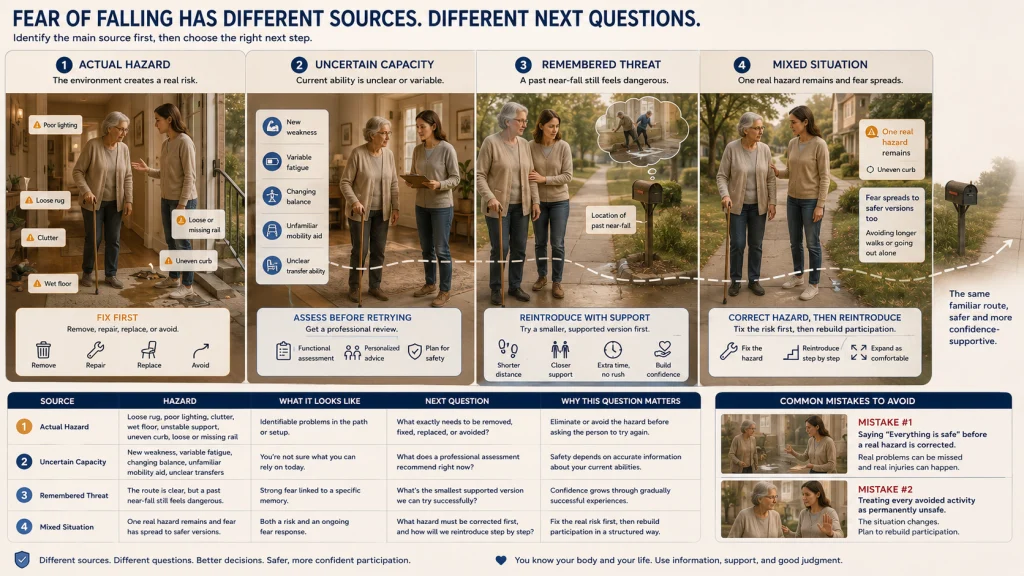
Separate actual hazards, uncertain capacity, and remembered threat
Fear can come from more than one source at the same time. A useful plan names each source instead of treating the whole activity as either safe or unsafe.
| Hazard-versus-confidence check | What it may look like | Next question |
|---|---|---|
| Actual hazard | Loose mat, poor lighting, cluttered path, wet surface, missing rail, unstable chair | Can the hazard be removed, repaired, replaced, or avoided? |
| Uncertain capacity | New weakness, unfamiliar aid, changing balance, unclear transfer ability, fatigue that varies | Does this need professional assessment before another attempt? |
| Remembered threat | The location or movement feels dangerous because of a previous fall or near-fall | Can a smaller supported version provide new information? |
| Mixed situation | A real hazard remains while fear has spread to safer versions of the task | What must be fixed first, and what can be reintroduced afterward? |
This distinction prevents two common mistakes. One is reassuring someone before addressing a real hazard. The other is treating every avoided activity as permanently unsafe when the original problem may be fixable.
Map the activities being avoided and what each avoidance costs
Write down the activities that have changed since the fall, near-fall, or increase in fear. Include small changes that may not look important on their own.
Participation map:
- ☐ Walking to the mailbox, garden, or building entrance
- ☐ Using stairs inside or outside the home
- ☐ Bathing, showering, or stepping into a tub
- ☐ Carrying food, laundry, or household items
- ☐ Shopping, appointments, worship, hobbies, or social visits
- ☐ Getting up at night to use the bathroom
- ☐ Walking on uneven ground, curbs, ramps, or parking lots
- ☐ Using public transportation or entering a vehicle
For each item, record what the avoidance is protecting against and what it is taking away. Avoiding a wet shower floor may prevent an immediate hazard, while avoiding bathing entirely creates a different problem. Skipping one curb may be reasonable, while abandoning every outdoor walk removes movement and contact with the neighborhood.
When avoidance begins affecting several daily functions at once, the mobility planning guide can help organize the wider pattern.
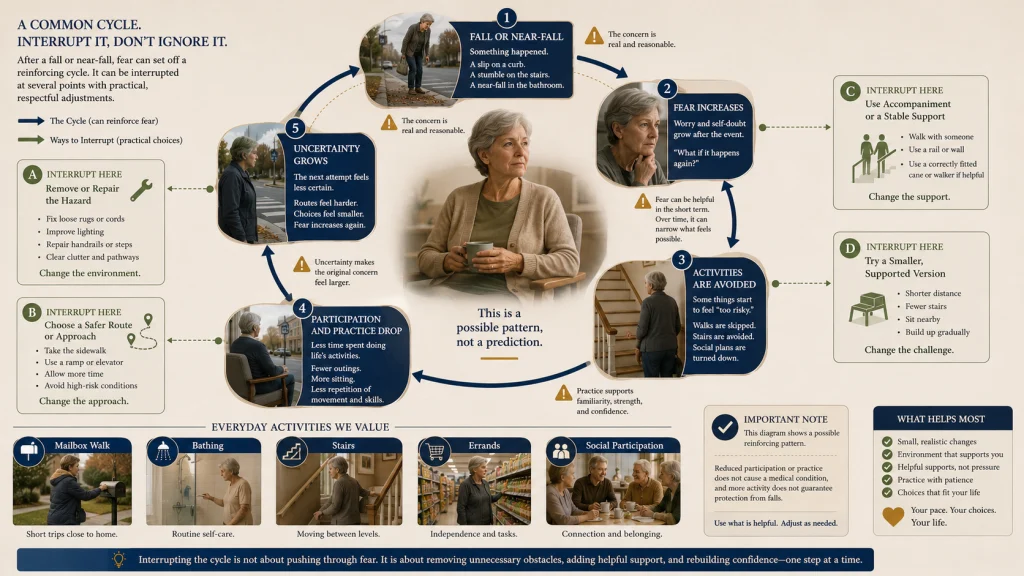
See how fear and avoidance can reinforce each other
Fear-avoidance cycle:
The cycle does not prove that reduced practice caused a specific decline. It shows why avoiding every activity can make the next attempt feel less familiar and more uncertain.
The cycle can be interrupted at more than one point. Removing a hazard, using accompaniment, changing the route, adding a rail, or choosing a smaller task can make participation possible without pretending the fear has vanished.
Correct immediate environmental hazards
Deal with fixable hazards before asking the person to try the activity again. Confidence should not be used to compensate for a dark hallway, unstable step, loose rug, or wet floor.
- Improve lighting along the entire route, including switches and nighttime access.
- Remove loose mats, cords, clutter, and unstable furniture.
- Repair uneven thresholds, broken steps, and loose rails.
- Keep frequently used items within a practical reach.
- Use stable seating where rest or shoe changes are needed.
- Dry wet surfaces and address recurring leaks or spills.
- Check footwear and mobility aids for condition, fit, and appropriate use.
It can be frustrating when a small obstacle keeps controlling a large part of the day. Correcting one hazard will not erase fear immediately, but it gives the next attempt a fairer starting point.
Editorial observation: Household friction can keep a hazard in place after everyone agrees it should be fixed. A box waits beside the stairs for several days, the night-light remains in its package, or a chair blocks the stronger rail. Assigning the change to a person and a time is often what turns concern into a safer route.
A broader review of home routines, independence, and participation belongs in the healthy aging guide.
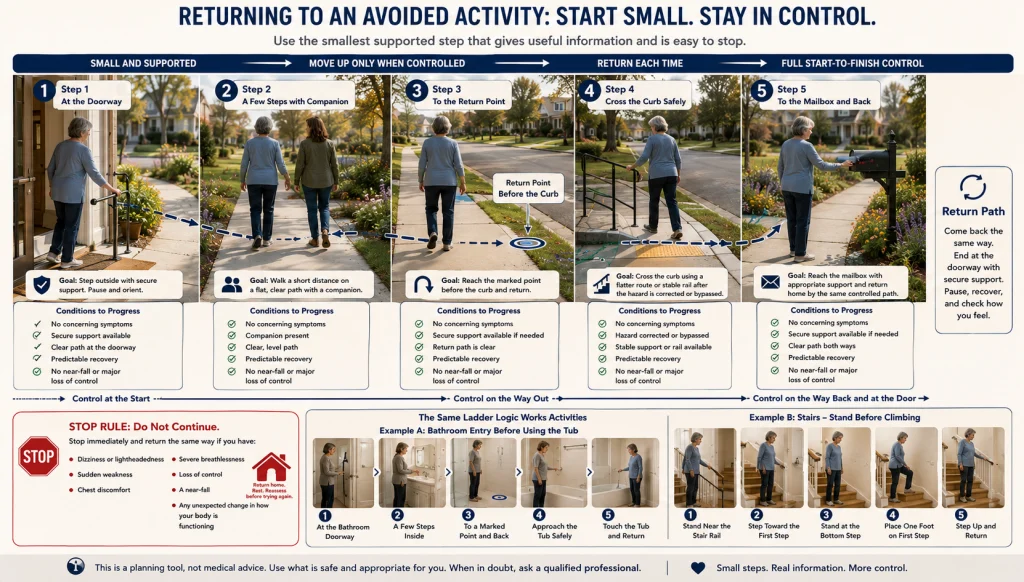
Choose the smallest supported re-entry task
Re-entry should be small enough to provide information without recreating the full feared situation. The first step is not a test of bravery. It is a controlled way to learn whether the corrected environment, support, and current capacity make part of the activity manageable.
| Activity re-entry ladder | Mailbox example | What must be true before moving up |
|---|---|---|
| Step 1 | Stand at the open doorway with a stable support | No concerning symptoms and the support is secure |
| Step 2 | Walk a few steps on the flat part of the path with accompaniment | The route is clear and recovery is predictable |
| Step 3 | Walk to a point before the curb and return | No near-fall, major loss of control, or worsening response |
| Step 4 | Approach the curb using the safer route or rail | The specific hazard has been corrected or bypassed |
| Step 5 | Reach the mailbox with support and return | The task remains controlled from start through recovery |
The ladder should be adapted to the actual activity. For bathing, the first step may be entering a dry bathroom with support rather than stepping into the tub. For stairs, it may be standing near the rail rather than climbing a flight.
Repeated success at a smaller level matters more than one forced attempt at the final step.
Use accompaniment, route changes, rails, or mobility aids appropriately
Support should solve a defined problem. Accompaniment can provide observation and practical help. A route change can remove a curb or uneven surface. A rail can improve contact during a transition. A mobility aid may support walking when it is appropriate, fitted, and used as intended.
Clarify the support before starting:
- Who is accompanying the person, and what help can they safely provide?
- Which route avoids the known hazard?
- Where are the stable rails, seats, and rest points?
- Is the mobility aid the correct type, height, and condition for the user?
- What happens if fatigue or fear increases halfway through?
A family member should not improvise lifting, catching, or transfer techniques beyond their ability. Complex aid selection, repeated instability, or uncertainty about assistance belongs with a qualified professional.
Seated movement may preserve activity while standing or walking questions are being reviewed; the chair exercise guide develops that option in more detail.
Avoid reassurance that ignores the reason for fear
Statements that promise everything will be fine or reduce the problem to confidence can make the person feel unheard when the curb is still broken, dizziness remains unexplained, or the last fall caused a real injury.
Use questions that respect both safety and participation:
- What exactly feels dangerous about this activity?
- Did something change in the route, body, aid, or timing?
- Which part could be made smaller or more supported?
- What would make stopping easy if the attempt does not feel controlled?
- Does this need professional review before another attempt?
Respecting fear does not require accepting permanent avoidance. It means responding to the reason for fear before asking for another step.
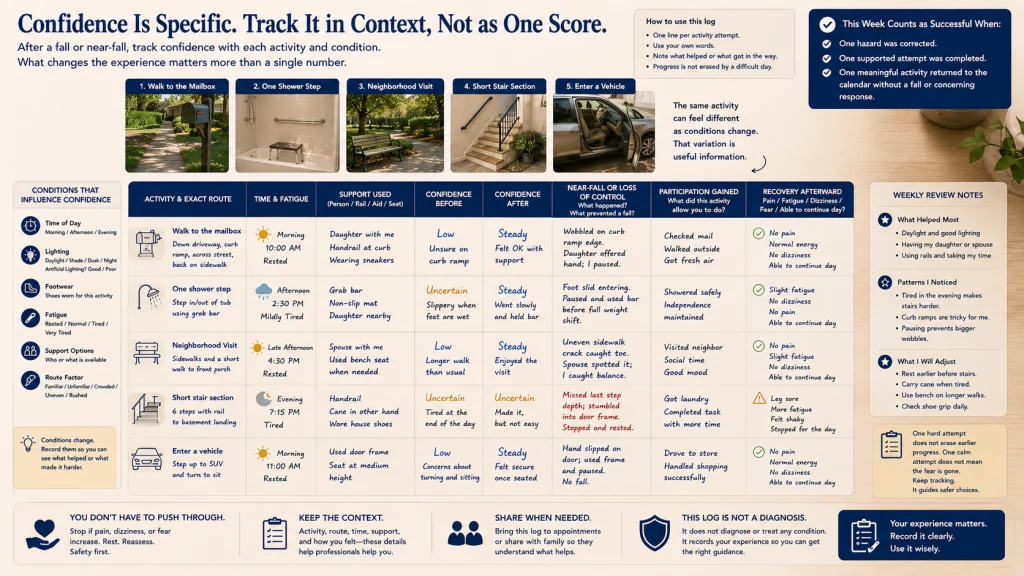
Track confidence, near-falls, and participation
Track what happened rather than recording confidence as a single personality trait. Confidence may differ by route, lighting, footwear, fatigue, time of day, and whether support is present.
A difficult attempt does not erase earlier progress, and a calmer attempt does not mean the fear has disappeared. The record is useful because it shows which conditions make participation feel more possible.
| What to record | Useful detail |
|---|---|
| Activity attempted | Exact route, transfer, stair, bathing step, or community task |
| Support used | Person, rail, aid, seat, route change, or lighting change |
| Confidence before and after | Use a simple personal description such as low, uncertain, or steady |
| Near-fall or loss of control | What happened, where, and what support prevented a fall |
| Participation gained | Mail collected, shower completed, visit attended, or route extended |
| Recovery | Pain, fatigue, dizziness, fear afterward, and ability to continue the day |
A successful week is not defined by eliminating fear. It may be one corrected hazard, one supported attempt, and one activity returned to the calendar without a fall or concerning response.
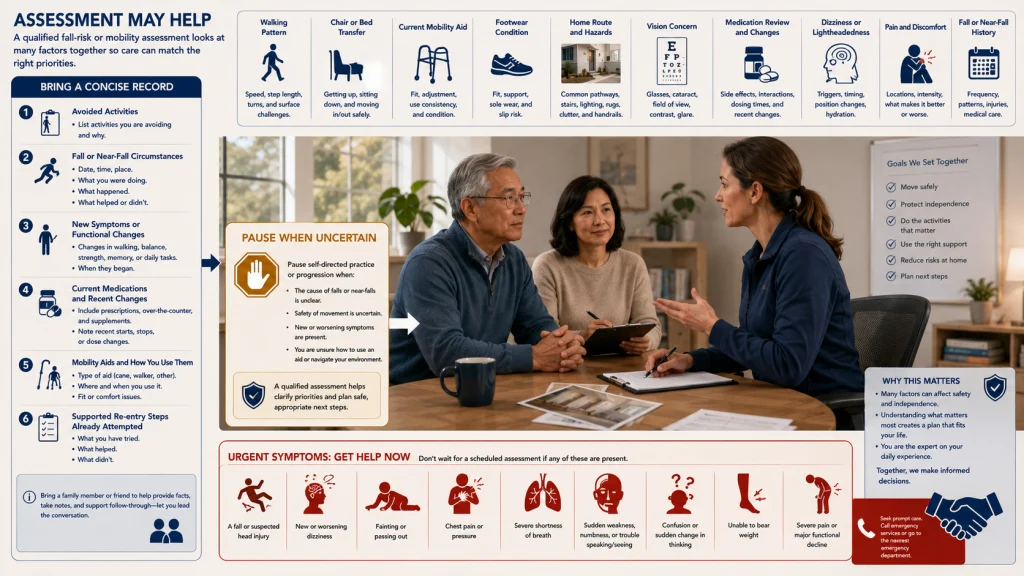
Discuss professional fall-risk and mobility assessment
Professional-support callout: Qualified assessment is appropriate when the person has fallen, has repeated near-falls, is unsure how to use a mobility aid, has new difficulty with walking or transfers, or cannot identify whether the main problem is balance, strength, vision, medication effects, dizziness, pain, footwear, or the environment.
A professional assessment may review movement, transfers, walking, aids, footwear, vision concerns, medications, home hazards, and the circumstances surrounding a fall. The exact process depends on the person’s situation and the professional’s role.
Bring a concise record:
- The activities that are now avoided
- The fall or near-fall circumstances
- New symptoms or functional changes
- Current medications and recent changes
- Mobility aids and how they are being used
- The re-entry steps already attempted
Self-directed practice should wait when the cause or safety of movement is uncertain. Where it remains appropriate, the balance exercise guide offers a focused next step.
Escalate after falls, head injury, new dizziness, or sudden weakness
Stop self-directed re-entry: A fall, suspected head injury, new dizziness, fainting, chest pain, severe shortness of breath, sudden weakness, confusion, inability to bear weight, severe pain, or major functional decline requires qualified evaluation. Emergency symptoms require immediate help.
Do not repeat the activity simply to see whether the same event happens again. A sudden change in walking, balance, transfers, or alertness may require assessment beyond environmental correction and confidence planning.
This article does not provide diagnosis, rehabilitation, medication changes, or individualized exercise clearance.
Name one avoided activity, remove one hazard, choose one supported step, and state the stop rule
Finish the plan in four lines:
- Avoided activity: Name the specific route, transfer, stair, bathing task, or community activity.
- Hazard correction: Remove or bypass one concrete environmental risk.
- Supported re-entry: Choose the smallest step that can be attempted with the right person, rail, aid, route, or rest point.
- Stop rule: State the symptom, near-fall, loss of control, or functional change that ends the attempt and triggers review.
A complete example might read: “I have stopped walking to the mailbox because of the curb where I nearly fell. The loose gravel will be cleared, and I will use the flatter side of the driveway. My first step is walking to the point before the curb with another person beside me. I will stop for dizziness, sudden weakness, loss of control, a near-fall, chest discomfort, or severe breathlessness.”
If the next goal is practicing movements connected to reaching, carrying, transfers, and other daily tasks, continue with the functional exercise guide.
The goal is not to prove that fear was wrong. It is to make the next decision safer, smaller, and more connected to the activity the person wants back.
FAQs
🧠 Is fear of falling irrational?
Not necessarily. Fear may point to a real hazard, uncertain capacity, or a remembered threat after a fall or near-fall. The task is to identify which part is active now.
🚶 Should someone keep walking even when afraid?
Not without reviewing hazards, support, current symptoms, and the specific route. A smaller supported task may be appropriate, while new or complex limitations may need professional assessment first.
🏠 What home hazards should be corrected first?
Prioritize hazards directly connected to the avoided activity, such as loose rugs, dim lighting, clutter, wet surfaces, unstable furniture, broken steps, or missing rails.
🪜 How small should the first re-entry step be?
It should be small enough to stay controlled and easy to stop. The first step may only approach the feared location rather than complete the full activity.
🤝 Is accompaniment always enough?
No. Another person cannot correct an unstable route, unexplained dizziness, or an inappropriate mobility aid. Support should be matched to the actual problem.
📈 How should confidence be tracked?
Record confidence in relation to a specific activity, route, support, and time of day. Also track near-falls, participation, and recovery rather than confidence alone.
🦯 When is a mobility-aid review useful?
Review is useful when the aid is new, damaged, poorly fitted, difficult to use, or no longer matches the person’s movement. A qualified professional can assess selection and use.
🚩 When should a fall or symptom be evaluated?
Seek qualified evaluation after a fall, suspected head injury, new dizziness, fainting, sudden weakness, severe breathlessness, chest pain, confusion, or major functional decline. Emergency symptoms require immediate help.