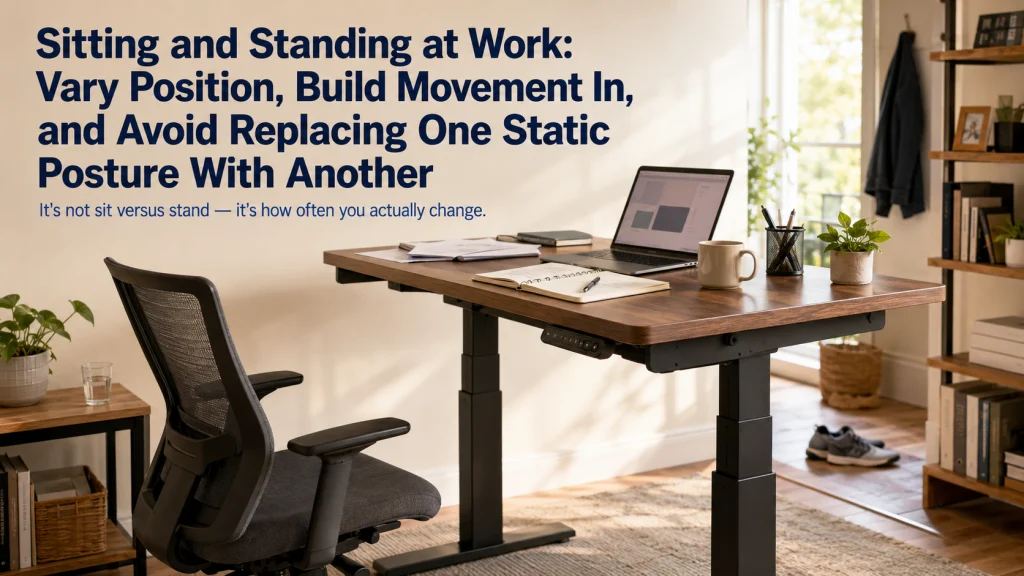
Sitting and standing at work should be treated as positions to vary, not teams to choose between. A standing desk can change posture, but it does not automatically add walking, task variety, or structured exercise. Build the day around shorter unbroken exposures, practical position changes, and movement that fits the work being done. The next step depends on whether the real question is duration, reminder timing, break content, standing-desk use, fatigue, or the relationship between exercise and sedentary time.
Three Eight-Hour Timelines Have No Automatic Winner
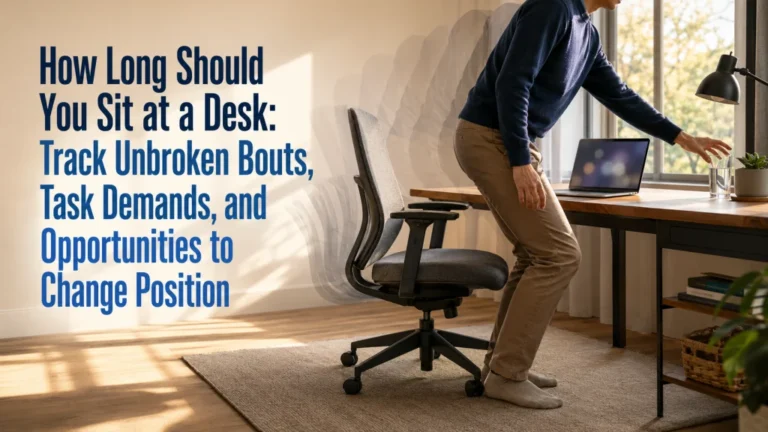
The same workday can look very different on a timeline. In the first version, a person sits through email, focused work, lunch at the desk, calls, and the final hour without a meaningful position change. In the second, the chair is pushed away in the morning and the person stands until the feet and legs feel tired. In the third, sitting and standing alternate around ordinary tasks, with a few short walks, a change of room for one call, and a seated period when precise work needs more support.
Three-timeline opening:
Timeline A: uninterrupted sitting
Sit → sit → sit through calls → sit through lunch → sit through late work
Timeline B: uninterrupted standing
Stand → stand through focused work → stand through calls → shift weight repeatedly → remain standing despite fatigue
Timeline C: varied exposure
Sit for supported focus → stand for a short suitable task → walk to refill water → sit for detailed input → change position during a call → take a brief movement break
The third timeline is not better because it contains a particular ratio. It is more adaptable because the person has choices, movement opportunities, and tasks matched to the position that supports them best.
The goal is not to maximize standing or eliminate sitting. It is to avoid letting one static position quietly consume the whole workday.
Define Sedentary Behavior, Static Standing, Position Change, Movement Break, Microbreak, and Exercise
Sedentary behavior is waking time spent sitting, reclining, or lying with very low energy use. Sitting exposure describes how much desk time is spent seated and how long the seated periods remain unbroken.
Static standing means remaining upright with little movement. It changes joint angles and load distribution, but it is still a low-movement position when the feet stay planted.
A position change may be as small as moving from sitting to standing or changing support. A movement break includes more active motion, such as walking to another room, climbing a flight of stairs when appropriate, or completing a short mobility sequence. A microbreak is a brief pause from the current work demand. It may include movement, visual recovery, hand relaxation, or simply releasing a fixed posture.
Structured exercise is planned physical activity performed as a workout or training session. It is valuable for reasons beyond the workday, but it answers a different question from whether long desk periods are being interrupted.
Posture and ergonomics connects these time-based choices with work demands, setup, recovery, and everyday movement.
Do Not Turn Sitting or Standing Into the All-Day Default
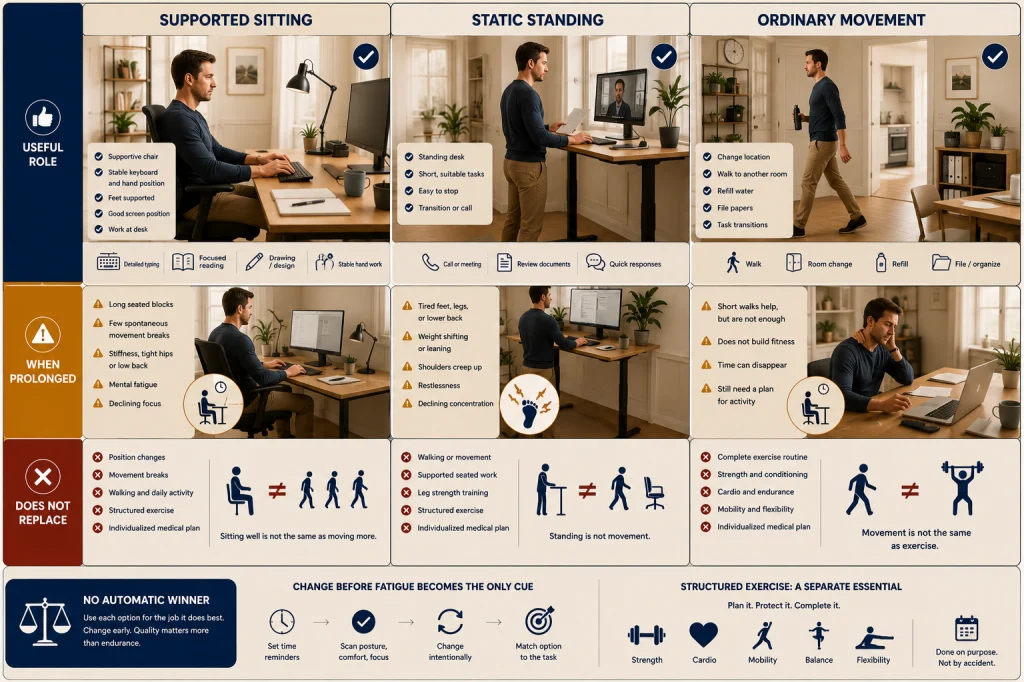
Sitting can provide useful support for detailed keyboard work, reading, drawing, and tasks that require steady hands. Standing can create a change in load, make short conversations feel more active, and help some people transition between tasks. Problems begin when either position becomes a test of endurance.
| Sitting-standing-movement comparison | Useful role | Limitation when prolonged | What it does not replace |
|---|---|---|---|
| Supported sitting | Detailed input, focused reading, stable hand work, recovery from standing | Long unbroken exposure, reduced task variety, fewer spontaneous movement opportunities | Position changes, movement during the day, or structured exercise |
| Static standing | Short suitable tasks, calls, transitions, a change from sitting | Foot and leg fatigue, leaning, shifting weight, loss of concentration on demanding work | Walking, meaningful movement, or a well-fitted seated position |
| Ordinary movement | Changes the exposure, uses more joints, breaks the fixed work pattern | May be skipped when the workflow gives no natural reason to leave the desk | A complete physical-activity routine or individualized medical plan |
A position can feel comfortable at first and become less useful as the uninterrupted period grows. The practical signal is not whether sitting or standing is morally better. It is whether the current position still fits the task and whether another option is available before fatigue drives the change.
Posture fundamentals help separate ordinary variation from the idea that the body must be held in one ideal pose.
When the Question Is Sitting Duration, Start With the Longest Unbroken Block
The hardest seated block is often the one that disappears into the day. A morning begins with email, continues into focused work, and reaches lunch before the chair has moved. Asking only for a daily hour total misses the way one uninterrupted stretch can take over.
Look first for the block that repeatedly stretches because of meetings, focused work, commuting, gaming after work, or lunch eaten at the desk. Then ask what naturally marks its beginning and end. A calendar transition, completed document, phone call, refill, or room change may provide a more usable interruption than a universal ratio.
Questions about how long a seated period continues, how to recognize an overly long block, and how to reduce exposure without abandoning supported sitting belong with desk-sitting duration.
When the Question Is Timer Frequency, Match the Prompt to the Work Pattern
A reminder can be technically perfect and still fail in real life. It appears during a call, gets dismissed during a deadline, or becomes background noise after a few days. The useful interval depends on the task, meeting structure, ability to pause, and whether the prompt leads to an actual change.
Notice what happens after the alert. Does the person stand for a few seconds and immediately sit again? Dismiss it during every call? Walk away but return to the same tense position? Reminder adherence matters more than the elegance of the timer setting.
For prompts, missed reminders, meeting blocks, and flexible intervals, move to break frequency from sitting rather than forcing one schedule onto every workday.
When the Question Is What to Do, Build Movement Into Ordinary Work
A break does not need to become a miniature workout or another task to perform correctly. It can be a short walk to refill water, standing while reviewing a printed page, taking a call away from the desk, putting away supplies, or completing a few comfortable movements before the next task begins.
The best option is often the one that already has a reason to happen. A printer in another room creates a walk. A phone call creates a chance to change position. A transition between projects creates a pause for the hands and eyes. These moments are easier to repeat than a complicated routine that requires equipment and privacy.
Practical break ideas, quiet-space options, and ways to fit motion into ordinary work are covered through movement breaks at work.
When the Question Is First Use, Set Up the Standing Position Before Extending It
The first standing session often reveals how much the desk alone cannot solve. The screen may rise too high, the mouse may feel farther away, cables may pull tight, or papers may need to be moved before the surface can change height. The keyboard, floor, footwear, and task all become part of the setup.
Start with a short, low-pressure task while checking whether the desk reaches a usable height, the monitor remains readable, the pointer stays close, and the floor area allows a stable stance. Make sure the transition does not require moving stacks of paper, reconnecting cables, or clearing objects every time.
Height, screen position, footwear, floor conditions, transition friction, and suitable first tasks are addressed through standing-desk setup and first use.
Home office ergonomics remains the place for coordinating the desk, chair, monitor, keyboard, mouse, and room arrangement.
When the Question Is Standing Duration, Change Before Fatigue Becomes the Timer
New standing-desk owners often stay upright because sitting down feels like giving up on the purchase. By the time the chair returns, the feet are tired and the next task already feels harder. That makes fatigue the only transition cue and turns standing into another long static exposure.
Duration should be built gradually around task fit, comfort, footwear, floor, prior tolerance, and the ability to sit again easily. A short standing period that ends while the position still feels manageable is more repeatable than a long period that makes the next hour unpleasant.
Progression, stopping cues, alternating patterns, and the limits of fixed ratios belong with standing duration at a desk.
When Standing Creates Foot, Leg, Back, or Task Problems, Troubleshoot the Cause
Standing discomfort is not always a simple sign to buy another accessory. It can come from duration, hard flooring, footwear, desk height, reaching, locked knees, leaning, an unsuitable task, or a transition pattern that leaves no seated recovery. Adding more standing time does not identify which condition is responsible.
Notice when the problem begins and what changes it. Does discomfort appear only during detailed mouse work? Does the person lean on the desk after a call? Does one foot search for a raised surface? Does the position become harder late in the day even though the desk height has not changed?
Ordinary setup, duration, footwear, floor, support, and task-fit problems can be worked through with standing-desk pain and fatigue troubleshooting. Do not continue through pain to satisfy a target.
When the Question Is After-Work Exercise, Separate Fitness From Breaking Up Desk Time
It is easy to finish a workout and feel that the desk day has been accounted for. The workout may build fitness, strength, skill, or endurance, while position changes and movement breaks answer a different question: how the workday itself was organized.
This distinction prevents two opposite mistakes. One is assuming that an evening workout makes eight uninterrupted seated hours irrelevant. The other is treating brief work breaks as a complete replacement for planned physical activity.
The relationship between structured exercise and sedentary time, including what each can and cannot accomplish, is explored through exercise and all-day sitting.
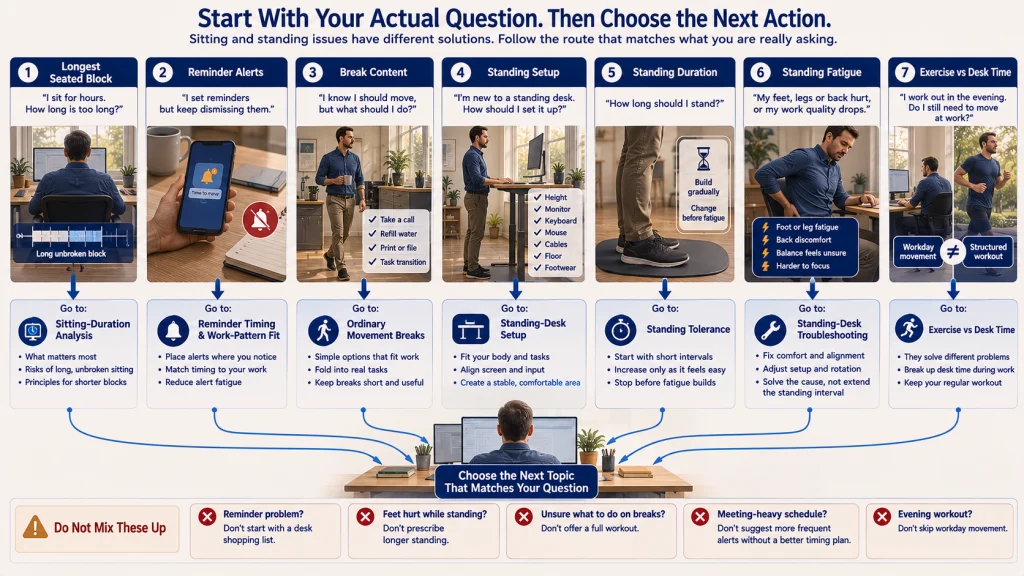
Choose the Next Step From the Question You Actually Have
| Seven-question routing table | Primary question | Best next topic |
|---|---|---|
| 1 | How long is my longest seated block, and what should shorten it? | How long to sit at a desk |
| 2 | How often should a reminder appear, and why do I keep dismissing it? | How often to take a break |
| 3 | What can I do during a short break without disrupting work? | Movement breaks during work |
| 4 | How should I set up and begin using a standing desk? | How to use a standing desk |
| 5 | How long should I stand before changing position? | How long to stand at a desk |
| 6 | Why do my feet, legs, back, or work quality worsen while standing? | Standing discomfort and fatigue |
| 7 | Does regular exercise make movement during the workday unnecessary? | Exercise and prolonged sitting |
The routing question should come before the solution. A person asking about reminder timing does not need a desk-shopping list. Someone whose feet become uncomfortable while standing needs troubleshooting, not encouragement to extend the interval. Choosing the right question first can make the next step feel smaller and more manageable.
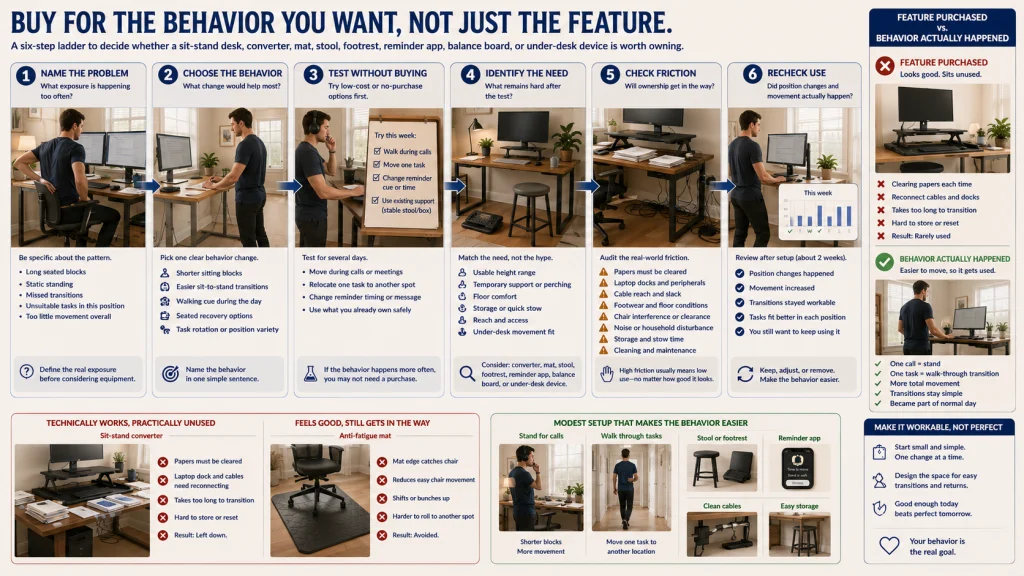
Keep Furniture and Accessories Separate From the Behavior They Are Meant to Support
Sit-stand desks, converters, mats, stools, footrests, reminder apps, balance boards, and under-desk devices are often presented as complete solutions. Each one can support a specific change, but ownership does not prove that the workday has become more varied.
Product-versus-behavior ladder:
- Name the exposure problem. Long seated blocks, static standing, missed transitions, unsuitable tasks, or lack of movement.
- Choose the behavior change. Shorter blocks, easier transitions, a walking cue, seated recovery, or task rotation.
- Test a no-purchase version. Move during calls, relocate one task, use an existing stable support, or change the reminder cue.
- Identify the remaining equipment need. Height range, floor comfort, temporary support, storage, or access.
- Check ownership friction. Transition effort, footwear, floor, cables, noise, storage, cleaning, and whether the item will actually be used.
- Recheck behavior after setup. Confirm that position changes and movement occur rather than assuming the purchase created them.
Nora’s observation: A converter can raise the screen and keyboard yet remain unused because changing positions means moving a laptop dock, clearing papers, and managing cables each time. A mat can feel helpful while also becoming something the chair catches on. I look at the transition itself, not only the feature list, because the product must make the intended behavior easier on an ordinary workday.
Nora’s observation: The most sustainable variation often looks unremarkable. Someone sits for careful work, stands for one call, walks to another room between tasks, then sits again without treating any change as a performance goal. That ordinary rhythm is easier to keep than a plan that makes every hour feel like a test.
Use ergonomic equipment choices only after the required behavior, fit, compatibility, storage, and maintenance needs are clear. Treadmill desks, balance boards, and similar product comparisons remain outside this decision.
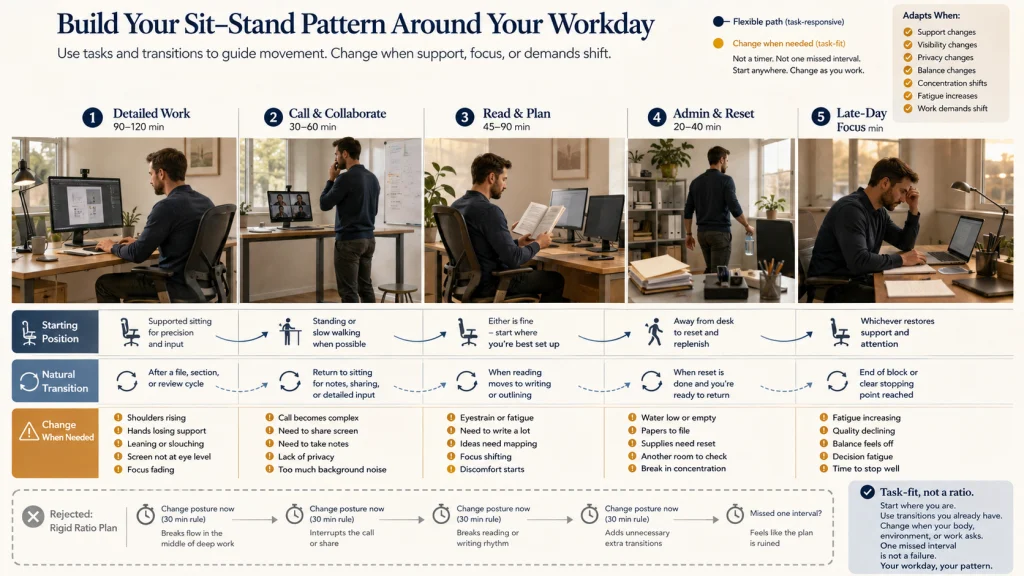
Build a Task-Based Variation Map Instead of a Perfect Ratio
A flexible day can be built from work transitions rather than a rigid countdown. Assign positions and movement opportunities to tasks that already occur, then leave room to change the plan when the body, workload, or environment differs.
| Task-based variation map | Likely starting position | Natural change opportunity | Reason to change the plan |
|---|---|---|---|
| Detailed typing or design work | Supported sitting | Stand or walk after completing a section, file, or review cycle | Shoulders rise, hands lose support, concentration fades, or the block becomes long |
| Short internal call | Standing or slow walking when the environment allows | Sit for notes or screen sharing | The call requires precise input, privacy, or stable visual attention |
| Reading and planning | Either supported sitting or standing | Change position when moving from reading to writing | Leaning begins, the screen becomes difficult to read, or the task lasts longer than expected |
| Administrative transition | Leave the desk briefly | Refill water, file papers, check another room, or reset supplies | Walking is not safe, practical, private, or allowed in that moment |
| Late-day work | Choose the position that restores support and attention | Use a shorter block and a clear stopping point | Fatigue, discomfort, reduced balance, or declining work quality appears |
The map is a starting pattern, not a prescription. A meeting-heavy day, a deadline, pregnancy-related concern, disability, temporary injury, medication effect, or medical restriction can change what is appropriate. A useful plan should bend with the day instead of making the person feel that one missed interval has ruined it.
Everyday ergonomics extends task-based choices beyond the desk into household activities, commuting, hobbies, and shared spaces.
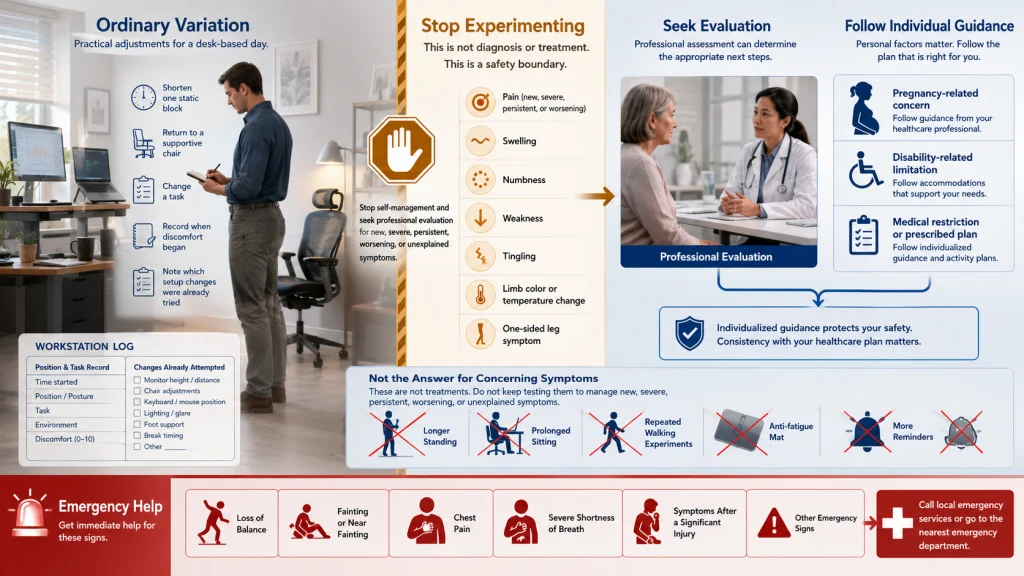
Stop Self-Management for Red Flags or Activity Restrictions
Ordinary variation can help organize a desk-based day, but it cannot diagnose cardiovascular disease, diabetes, blood clots, venous disease, joint disorders, nerve conditions, spinal conditions, balance disorders, or a work-related musculoskeletal condition.
Medical stop box:
- New, severe, persistent, worsening, or unexplained pain requires appropriate professional evaluation.
- Swelling, numbness, weakness, tingling, color or temperature change in a limb, or a sudden one-sided leg symptom should not be managed by extending sitting, standing, or walking experiments.
- Loss of balance, fainting, chest pain, severe shortness of breath, symptoms after an injury, or other emergency signs require immediate appropriate help.
- People with medical restrictions, pregnancy-related concerns, disability, or a prescribed activity plan should follow qualified individualized guidance.
Do not continue through pain, use standing as treatment, or prescribe movement breaks as a medical intervention. Record when the problem occurs, what position and task were involved, and which ordinary changes have already been tried, then seek suitable guidance.
Identify the Exposure, Position, Task, Movement Opportunity, and Next Decision
Start with the longest unbroken exposure rather than searching for a universal sitting-to-standing ratio. Notice which task keeps the person seated, which standing period becomes tiring, and where the day already contains a practical chance to move.
Use sitting for tasks that benefit from support, standing for suitable shorter tasks, and ordinary movement to break the fixed pattern. Keep structured exercise in its own role rather than asking it to erase the workday or asking microbreaks to replace it.
Then choose the next question: sitting duration, reminder frequency, break content, standing setup, standing duration, standing discomfort, or exercise and sedentary time. The useful pattern is the one that can change with the task and remains workable after the novelty of a new desk, timer, or accessory has faded.
FAQs
🪑 Is sitting or standing better for desk work?
Neither should become the automatic all-day position. Sitting can support detailed work, standing can provide a useful change, and movement breaks the static pattern. Match the position to the task and change before fatigue becomes the only cue.
⏰ Is there one ideal sit-stand ratio?
No universal ratio accounts for task demands, body differences, footwear, floor, desk range, prior tolerance, disability, medical restrictions, and the ability to move. Build a flexible pattern and adjust it from actual response.
🚶 Does standing count as a movement break?
Standing changes position, but static standing includes little movement. A movement break adds walking or another comfortable activity that changes more of the work pattern.
💻 Does buying a standing desk solve prolonged sitting?
Not by itself. The desk must fit, the transition must be easy, suitable tasks must be chosen, and the person must actually change position. It also does not replace walking or structured exercise.
🔔 What should I do when I ignore every break reminder?
Change the cue or attach the break to a real task transition. A prompt after a meeting, completed document, refill, or phone call may be easier to follow than an alert that repeatedly interrupts focused work.
👟 Why do my feet get tired at a standing desk?
Possible practical factors include duration, floor, footwear, desk height, leaning, task choice, and lack of seated recovery. Shorten the standing period and troubleshoot the setup rather than pushing through discomfort.
🏋️ Does an evening workout make workday breaks unnecessary?
No. Structured exercise and breaking up long desk periods have different roles. Keep both questions separate rather than treating either one as a complete replacement for the other.
⚠️ When should I stop adjusting sitting and standing on my own?
Seek appropriate evaluation for severe, persistent, worsening, or unexplained pain; swelling; numbness; weakness; tingling; limb color or temperature change; balance loss; fainting; chest pain; severe shortness of breath; symptoms after injury; or a sudden one-sided leg symptom.