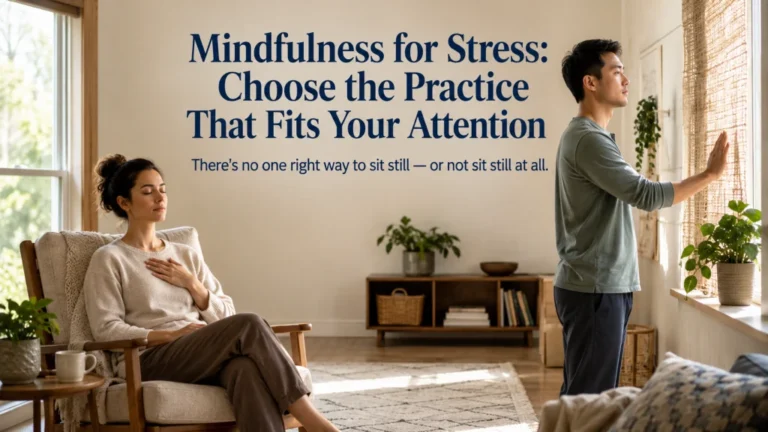
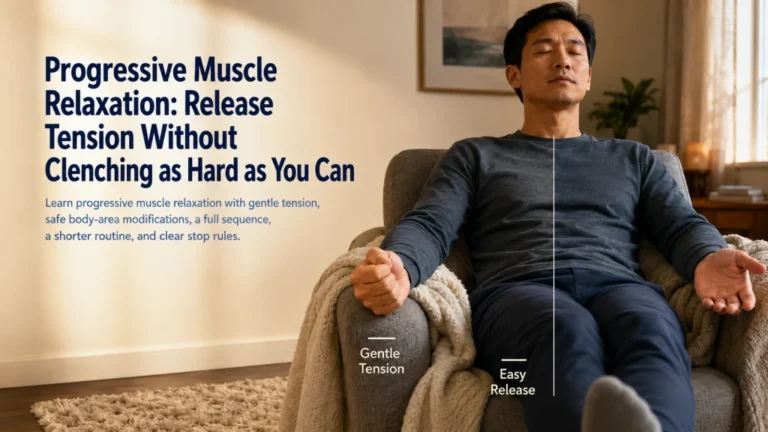
Mindfulness and meditation overlap, but they are not identical. Mindfulness is a quality of attention that can be used during ordinary activity, while meditation is a family of structured practices that may or may not use mindfulness as the main method. Choose a formal session when you want dedicated practice time, and choose an informal mindfulness exercise when you want to bring attention into an activity already happening. An app, course, or audio track is optional, and inward practice should be changed or stopped when it increases fear, disconnection, intrusive material, or persistent distress.
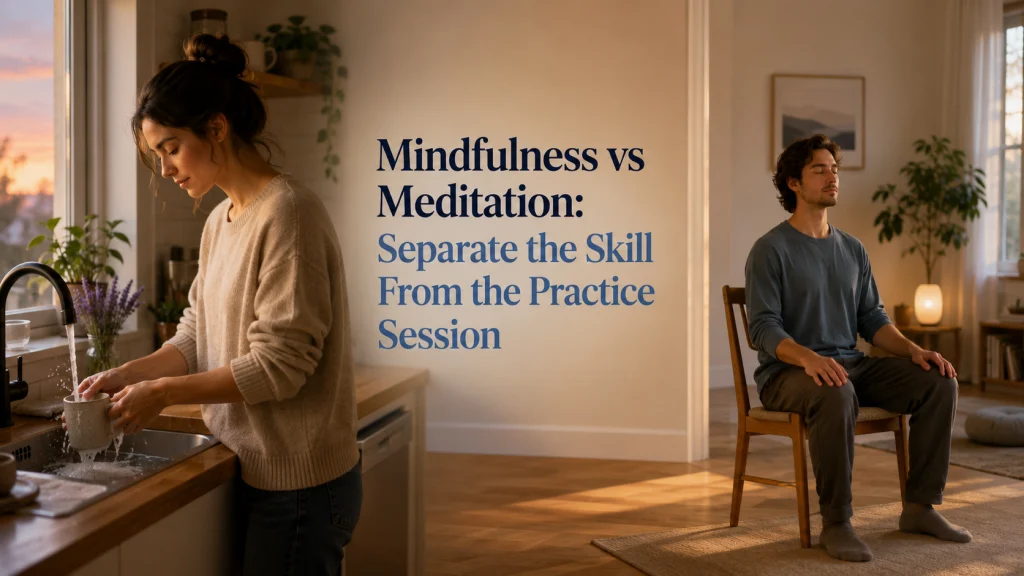
One Person Washes a Mug While Another Sits for Ten Minutes
At one kitchen counter, a person washes a mug while noticing the warmth of the water, the pressure of the handle, and the sound of the cup touching the sink. Nearby, another person sits in a chair for ten minutes and repeatedly returns attention to the breath.
The first activity can be mindfulness without a formal meditation session. The second can be meditation that uses mindfulness. Both involve deliberate attention, but the structure and setting are different.
Practical distinction: Mindfulness describes how attention is being used. Meditation describes a practice format. They overlap when a meditation session trains mindful attention.
Define Mindfulness as a Quality of Attention
Mindfulness means paying attention to present experience with awareness of what is happening now. The attention target may be a sound, physical sensation, movement, thought, emotion, object, or ordinary task.
The mind does not need to become empty. Thoughts may continue, attention may wander, and discomfort may still be present. The mindful part is noticing what is happening and choosing where attention goes next.
Mindfulness can be brief and informal. A person may use it while drinking water, walking down a hallway, preparing food, listening during a conversation, or pausing before replying to a message.
Define Meditation as a Family of Practices
Meditation is a broad category of practices that deliberately organize attention for a period of time. A session may be seated, lying down, standing, or moving. It may use silence, spoken guidance, sound, imagery, repeated words, breath awareness, body awareness, or another focus.
Because the category is broad, the word meditation does not identify one universal posture, tradition, goal, or mental state. Two practices can both be called meditation while asking the participant to do very different things.
Formal meditation usually creates a distinct practice period with a beginning and an end. That session format can help someone repeat the same attention skill under predictable conditions.
See Where Mindfulness Meditation Overlaps
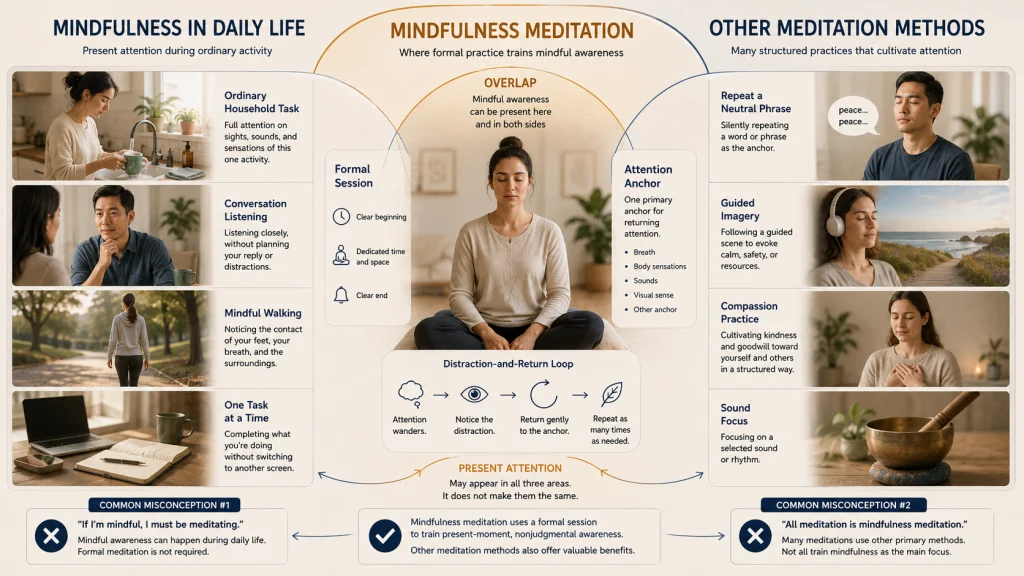
Mindfulness meditation is the overlapping area. It uses a formal practice session to train present-moment awareness, often by noticing an anchor and returning when attention wanders.
- Noticing water temperature while washing a mug
- Listening closely during a conversation
- Feeling foot contact during an ordinary walk
- Observing one task without opening another screen
- A dedicated session
- Present-moment attention
- Noticing distraction
- Returning to an anchor
- Repeating a word or phrase
- Following a guided scene
- Using a structured compassion practice
- Focusing on a selected sound
This Venn-style relationship map prevents two common mistakes. Mindfulness is not limited to meditation, and meditation is not always centered on mindfulness.
Recognize Meditation That Is Not Primarily Mindfulness
Some meditation practices organize attention around repetition, imagery, compassion, sound, or another structured focus. Present-moment awareness may still be involved, but it is not always the main instruction.
- A repeated word or phrase can provide a stable focus.
- Guided imagery can organize attention around an imagined place or sequence.
- A compassion-focused session can use repeated intentions toward oneself or others.
- A sound-focused session can ask the participant to stay with a tone or rhythm.
These examples belong to the broader meditation family without proving that all meditation methods work the same way or pursue the same goal.
Use Mindfulness Outside a Formal Session
Informal mindfulness attaches present-moment attention to an activity that is already part of the day. It does not require a cushion, timer, recording, closed eyes, or separate room.
A person might notice the first three bites of lunch, feel the hands during dishwashing, listen to the sound of a fan during a work break, or observe the body settling into a chair before beginning a task.
Use mindfulness exercises for adults when the goal is to practice attention during everyday routines rather than build a formal meditation session.
Choose by Goal: Train Attention, Pause During Activity, or Build a Routine
The correct starting point depends on what the person wants the practice to do.
| Goal | Better starting format | Why it may fit | Next step |
|---|---|---|---|
| Practice returning attention repeatedly | Formal meditation session | A defined period makes repetition easier to notice | Choose one anchor and a brief session |
| Interrupt automatic behavior during the day | Informal mindfulness | The skill is placed inside the moment where it is needed | Attach attention to one ordinary activity |
| Create a repeatable daily ritual | Formal meditation or a fixed mindful pause | A stable cue can support consistency | Choose the same time, place, or activity cue |
| Explore several attention methods | Short guided sessions or simple exercises | Different formats can be compared without a long commitment | Review which target and setting felt workable |
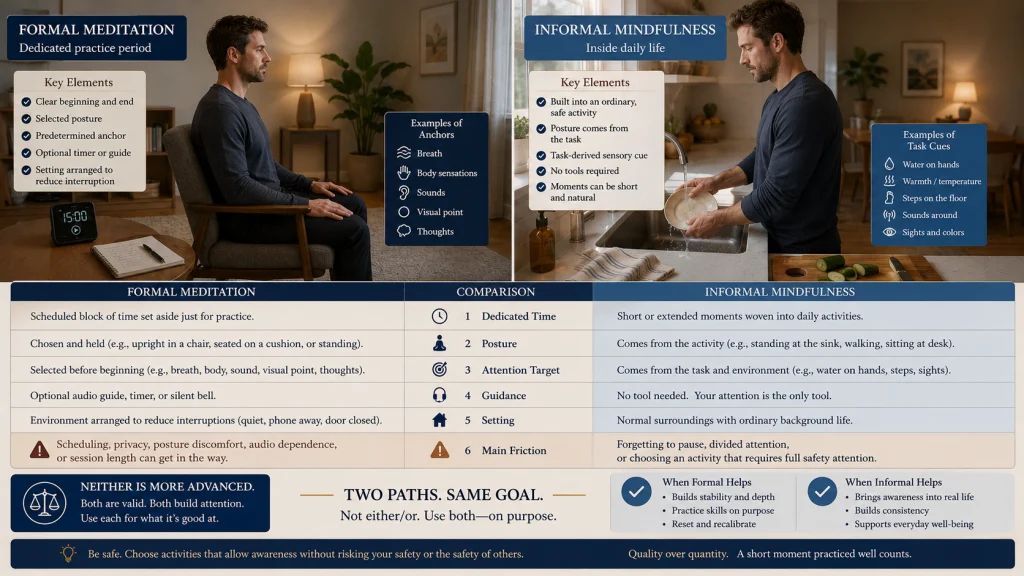
Compare Formal and Informal Practice
| Feature | Formal meditation | Informal mindfulness |
|---|---|---|
| Time | A dedicated session with a beginning and end | Built into an activity already happening |
| Posture | Often selected before the session | Determined by the ordinary activity |
| Attention target | Usually chosen in advance | Drawn from the task or environment |
| Guidance | May use an instructor, audio, app, or written steps | Often needs no tool after the cue is learned |
| Setting | Usually selected to reduce interruption | Can happen in daily life when the activity is safe |
| Main friction | Scheduling, posture, privacy, session length | Remembering to pause and avoiding divided attention |
Formal does not mean more advanced, and informal does not mean less serious. They are different ways to practice attention.
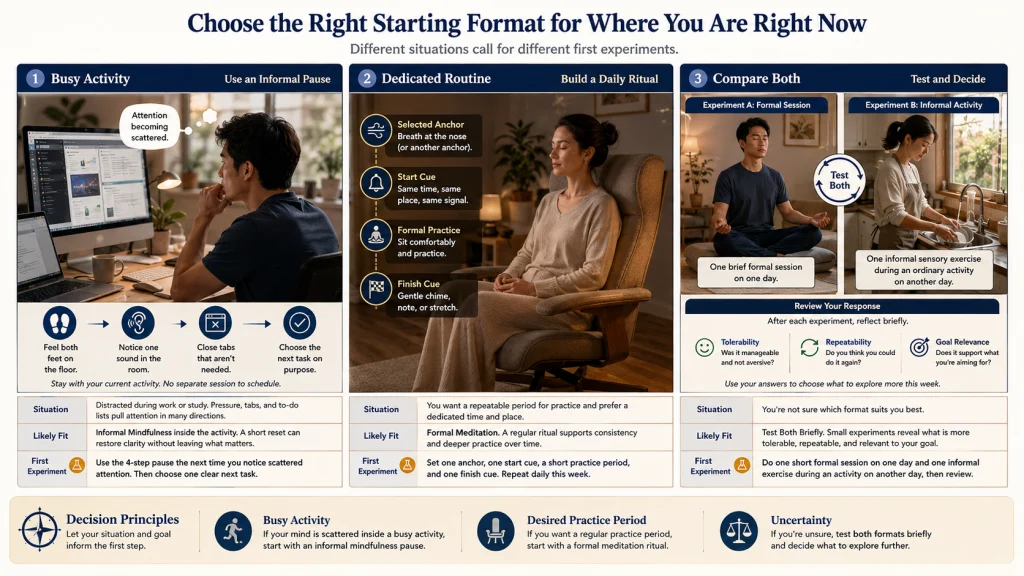
Use Three Scenarios to Choose a Starting Point
Scenario 1: Attention Feels Scattered During Work
The person does not want another scheduled session. A brief informal practice may fit better: feel both feet, notice one sound, and choose the next task before opening another tab.
Scenario 2: A Dedicated Evening Routine Is the Goal
The person wants a clear beginning and end. A short seated meditation may fit because the practice can use the same chair, attention anchor, and finish cue each evening.
Scenario 3: The Terms Are Clear but the Method Is Not
The person can test one brief formal session and one informal exercise on different days. The useful comparison is which format was tolerable, repeatable, and relevant to the intended goal.
| Situation | Likely fit | First experiment |
|---|---|---|
| Needs a pause inside a busy activity | Informal mindfulness | Use one sensory cue before the next action |
| Wants a repeatable practice period | Formal meditation | Use one brief session with a clear stopping point |
| Unsure which format feels workable | Compare both | Test one short example of each and review the response |
Avoid the Clear-Mind Myth
Neither mindfulness nor meditation requires the mind to stop producing thoughts. Trying to force silence can turn the practice into a performance test.
During mindfulness, the person notices what is present and redirects attention when needed. During meditation, the same return may happen many times within one session. Repeated wandering does not automatically mean the session failed.
When the idea of mental silence is creating frustration, use the guide on how to clear your mind to replace an impossible standard with a practical attention task.
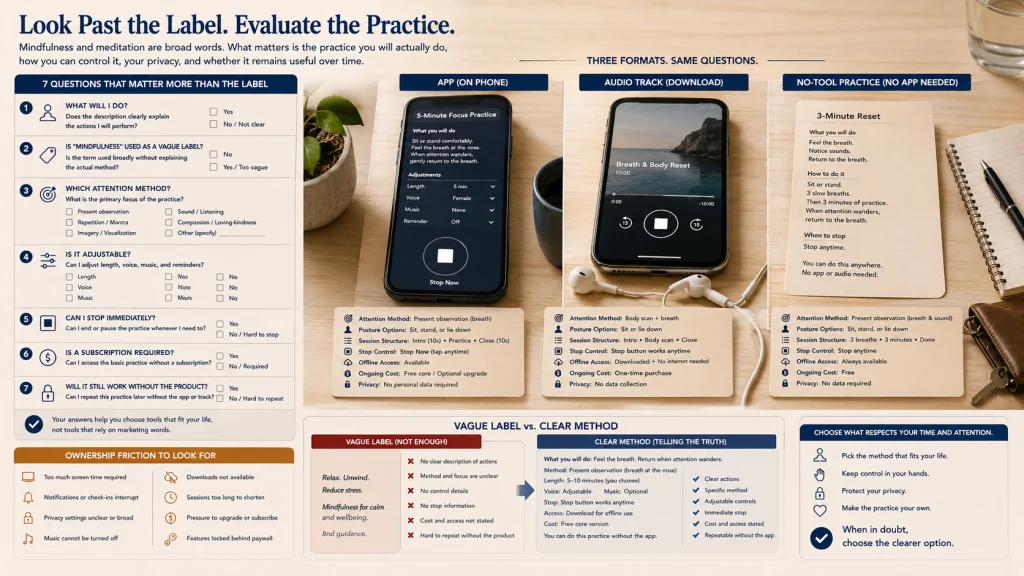
Decide Whether an App, Audio Track, or No Tool Is Needed
A tool can provide timing, spoken instructions, reminders, or a consistent voice. It can also add subscription pressure, screen time, privacy concerns, unwanted music, or sessions that are difficult to shorten.
- Does the description define what the participant will actually do?
- Is mindfulness being used as a broad marketing label for every calming activity?
- Does the session use present-moment observation, repetition, imagery, sound, or another method?
- Can the session length, voice, music, and reminders be adjusted?
- Can the exercise be stopped immediately without losing access or progress?
- Is a subscription required for the basic practice?
- Can the method be repeated without the app after the instructions are learned?
Editorial observation: App labels and course descriptions often use mindfulness and meditation loosely. The useful question is not which word appears on the home screen. It is whether the session format, attention target, privacy level, voice style, download access, and stopping controls fit the person using it.
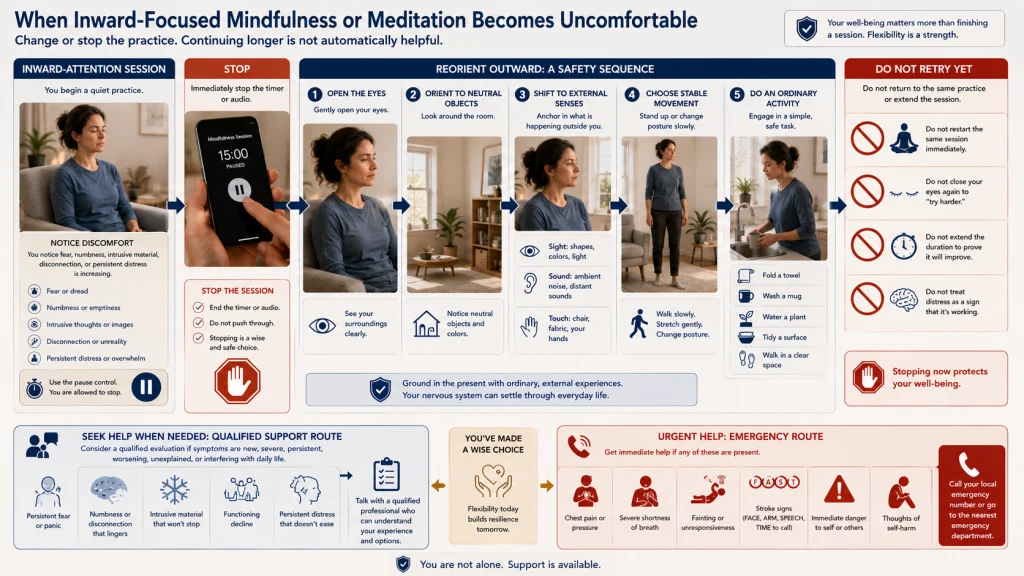
Change the Practice When Inward Attention Is Uncomfortable
Quiet inward attention can make sensations, thoughts, or memories more noticeable. That experience is not automatically helpful, and continuing longer is not always the right response.
- Open the eyes and orient to the room.
- Stop the timer, audio, or formal session.
- Move attention toward external sights, sounds, or textures.
- Choose a movement-based or ordinary activity instead.
- Do not immediately repeat a practice that increased fear, numbness, intrusive material, or disconnection.
New, severe, persistent, worsening, unexplained, or function-limiting symptoms require qualified evaluation. Chest pain, severe shortness of breath, fainting, stroke signs, immediate danger, or self-harm thoughts require urgent help. This article does not diagnose anxiety disorders, depression, trauma-related conditions, panic disorder, burnout, dissociation, or a medical cause of symptoms.
Choose the Skill, the Session, or Both
Choose mindfulness when the main goal is to bring deliberate attention into present experience. Choose meditation when a structured practice period, selected method, and clear beginning and end are useful.
Use both when a formal session helps train a skill that can later be carried into ordinary activity. Neither option requires a blank mind, special posture, subscription, or long session.
For a formal starting routine, use how to meditate for beginners. For the broader practice-selection framework, return to mindfulness for stress or how to manage stress.
FAQs
🧠 Are mindfulness and meditation the same thing?
No. Mindfulness is a quality of present-moment attention, while meditation is a family of structured practices. They overlap in mindfulness meditation.
☕ Can an ordinary activity count as mindfulness?
Yes. Washing a mug, walking, eating, listening, or beginning a task can become an informal mindfulness practice when attention is directed deliberately to present experience.
🪑 Does meditation require sitting with closed eyes?
No. Meditation may be seated, lying down, standing, or moving, with eyes open or closed depending on the method and safety of the setting.
🔄 Is every meditation a mindfulness meditation?
No. Some practices focus mainly on repeated words, imagery, sound, compassion, or another structured method.
⏱️ Which option is better when I have little time?
Informal mindfulness may fit easily inside an existing activity. A brief formal meditation can also work when a separate practice period is preferred.
📱 Do I need an app to practice either one?
No. An app can provide timing or guidance, but both formal meditation and informal mindfulness can be practiced without a subscription or device.
💭 What if thoughts keep appearing?
Thoughts do not need to disappear. Notice that attention wandered and return to the selected sound, sensation, phrase, movement, or task.
🚩 When should I stop an inward practice?
Stop or switch methods when the practice clearly increases fear, disconnection, intrusive material, numbness, or persistent distress. Seek qualified guidance when the reaction is severe, recurring, worsening, or function-limiting.