HEPA and activated carbon solve different air-cleaning problems. HEPA media captures airborne particles such as pollen, dust, smoke particles, and mold spores, while activated carbon adsorbs certain gases and odor molecules onto its surface. Neither mechanism should be judged from a filter percentage alone because whole-device airflow, seals, media quantity, target pollutant, and replacement condition all matter. Classify the concern as particles, gases, or a mixture before comparing filter construction, clean-air delivery, and ownership cost.
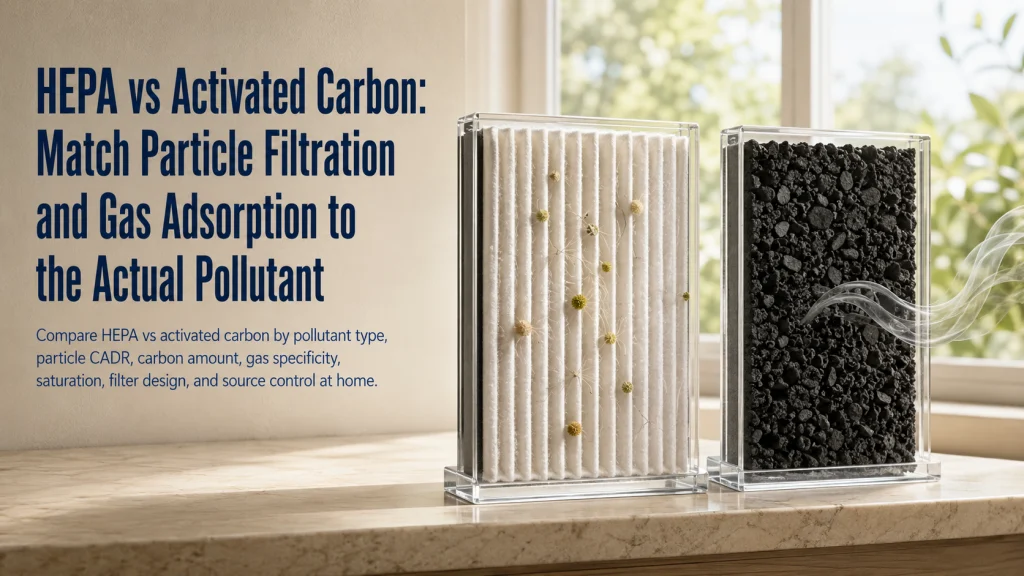
Pollen and Cooking Odor Follow Different Filter Pathways
Imagine two transparent filter boxes sitting side by side. A stream carrying pollen enters the first box, where a pleated particle filter captures the visible grains and smaller airborne particles. A cooking odor enters the same box, but the odor molecules do not become particles simply because the filter is labeled HEPA.
In the second box, air passes through activated carbon. Some odor molecules attach to the carbon surface, but pollen still needs effective particle media and enough airflow through the complete device. The carbon does not become a substitute for the particle filter.
| Air concern | Main physical form | Relevant mechanism | Common buying mistake |
|---|---|---|---|
| Pollen, dust, smoke particles, and mold spores | Airborne particles | Mechanical particle filtration with adequate clean-air delivery | Choosing carbon-heavy media while ignoring particle airflow |
| Some odors and gases | Gas or vapor molecules | Adsorption using suitable gas media | Assuming a HEPA percentage proves odor or VOC removal |
| Mixed smoke or a mixed indoor source | Particles plus gases | Particle filtration and gas adsorption evaluated separately | Treating the source as one pollutant with one rating |
Both filters can be useful without being interchangeable. The first decision is not which label sounds stronger. It is whether the air concern is made of particles, gases, or both.
Define Filtration, HEPA, Particles, Gases, Adsorption, Saturation, and CADR
Mechanical filtration moves air through fiber media that captures particles. HEPA describes particle-filter media that meets a defined efficiency test, commonly stated as at least 99.97 percent at 0.3 microns under the applicable test conditions.
A particle is a small piece of solid or liquid material suspended in air. Examples include PM2.5, pollen, household dust, smoke particles, and mold spores. A gas or vapor consists of molecules dispersed in air rather than solid particles that can be trapped in the same way.
Adsorption occurs when gas molecules attach to the surface of a material. Activated carbon is a porous adsorbent with a large internal surface area. A sorbent is a broader category of material used to capture gases, sometimes with chemical treatment designed for particular targets.
Saturation describes the loss of available adsorption capacity as sites become occupied. Breakthrough occurs when the media no longer controls the target gas effectively and molecules pass through or are no longer retained as expected.
CADR is a clean-air delivery rate for stated particle categories. It combines particle removal with airflow through the complete device. It is not a universal gas-removal rating.
The broader guide to air cleaners and air filters places these mechanisms alongside source control, ventilation, central filtration, maintenance, and other indoor-air decisions.
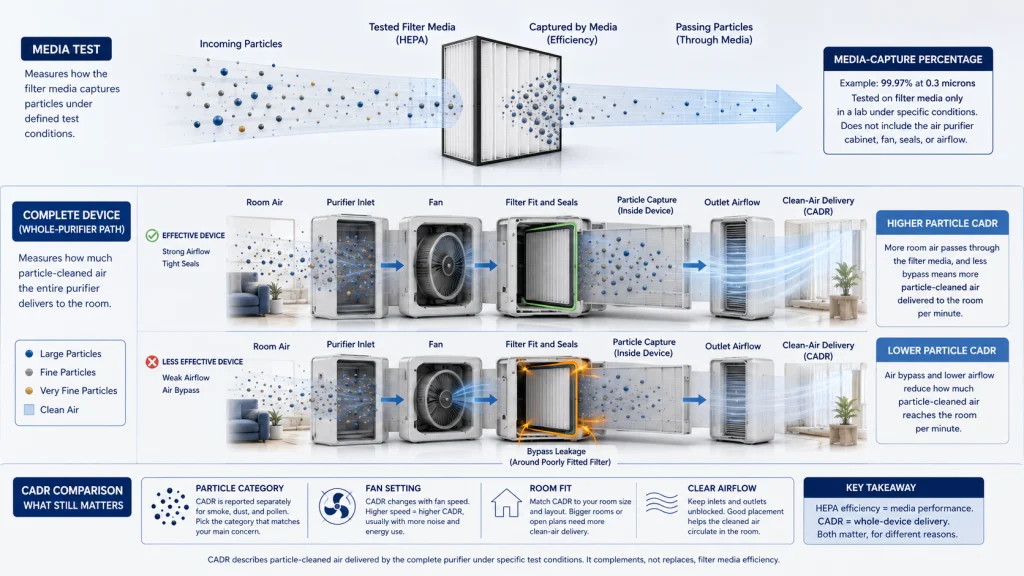
Read HEPA Efficiency as a Media Claim, Not a Whole-Device Promise
A HEPA percentage describes the tested particle efficiency of the filter media under defined conditions. It does not automatically tell the shopper how much room air the complete purifier can process, whether air leaks around the filter, or how the fan behaves at different speeds. This is why a reassuring number on the box can still leave a household wondering why the room feels unchanged after the purifier has been running.
A high-efficiency filter inside a low-airflow or poorly sealed device may deliver less cleaned air than the percentage suggests. More airflow is not enough either when particles pass through the media or escape around it. The filter and the device have to work as one path rather than as two separate marketing claims.
Filter-media efficiency versus CADR diagram:
Filter-media path
Incoming particle → contact with tested media → capture efficiency under the test condition
Whole-device path
Room air → inlet and fan → filter fit and seals → particle capture → outlet airflow → clean-air delivery to the room
Buying implication
Media efficiency answers “How well does this material capture the tested particles?” CADR answers “How much particle-cleaned air does the complete device deliver under the stated test?”
The distinction becomes important when two products advertise similar filter percentages but disclose very different clean-air rates. The percentage can be accurate while still leaving the main room-performance question unanswered.
Use CADR to Compare Particle Delivery, Especially for Fine Particles
For particle concerns, clean-air delivery is more informative than filter efficiency alone because it includes the amount of air moving through the complete unit. Smoke CADR is commonly used as the comparison for fine particles, while dust and pollen CADR represent different particle categories. That distinction matters when a shopper sees several impressive numbers and assumes they all describe the same kind of work.
CADR does not make every room claim equal. The number still needs to be matched to room volume, the air-change assumption, the fan setting behind the rating, and a placement that leaves the inlet and outlet clear.
A device can carry HEPA media and still be a poor capacity match for a large open room. A correctly sized unit can also underperform in practice when the household runs it only on a low setting that has no documented delivery rate.
Use the guide on choosing an air purifier for the wider buying sequence involving room fit, noise, controls, filters, certification roles, and annual cost. The article on what air purifiers can and cannot do covers the broader evidence and system limits.
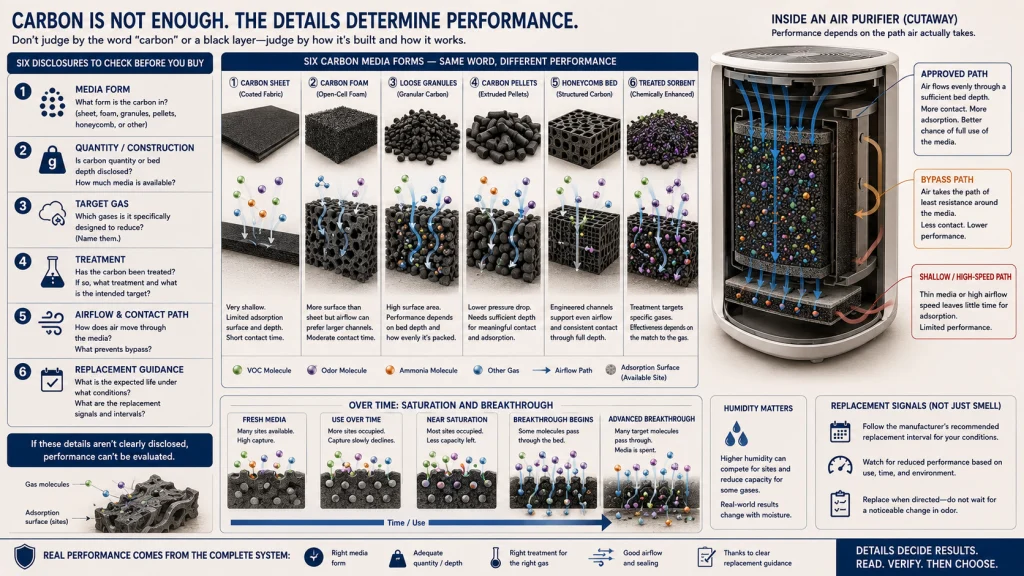
Evaluate Carbon Amount, Contact Time, Treatment, and the Target Gas
Activated carbon does not treat gases through the same capture process used for particles. Gas molecules must reach available adsorption sites and remain in contact with suitable media. That makes media quantity, airflow, contact time, construction, and the identity of the target gas important.
More carbon can provide more potential adsorption surface, but weight alone does not prove performance for every gas. Pellet shape, bed depth, humidity, airflow, chemical treatment, and the target compound can all change how the media behaves. Even a substantial-looking filter can perform unevenly when air finds an easier route around part of the bed.
Treated sorbents may be designed for particular gases that untreated carbon handles poorly. That added specificity should be supported by exact documentation rather than inferred from words such as advanced, enhanced, or multi-stage.
| Carbon-disclosure checklist | Useful information | What remains uncertain when absent |
|---|---|---|
| Media form | Sheet, foam, granules, pellets, honeycomb, or another construction | How much gas media is actually present and how air contacts it |
| Carbon quantity | Disclosed media weight or another precise construction detail | Whether the layer is substantial or mainly a light odor-control feature |
| Target gases | Named compounds or gas categories supported by exact evidence | Whether broad VOC language applies to the household concern |
| Treatment | Impregnated or chemically treated sorbent and its intended target | Whether the treatment is relevant to the gas in question |
| Airflow and contact path | How room air passes through the carbon section | Whether air can bypass or move through too quickly for the intended role |
| Replacement signal | Supported service guidance tied to use and conditions | When saturation or breakthrough may occur |
Nora’s observation: When I compare consumer filters, the particle side is often described with a prominent HEPA percentage and a CADR table, while the carbon side may be summarized as one dark sheet and the word odor. That disclosure imbalance is useful information. It means the gas-performance claim deserves more questions, not an estimated carbon weight invented from a photograph.
Treat a Thin Carbon Sheet as a Limited Feature Unless Evidence Shows More
A thin carbon-coated sheet or foam layer may help with some light odors under certain conditions. That can be useful in an ordinary room, especially when a household simply wants a mild cooking or pet odor to fade sooner. It should not be interpreted automatically as substantial gas control, broad VOC removal, or protection from an unknown chemical source.
The problem is not that the layer is useless. The problem is that its capacity, target gases, contact time, and breakthrough behavior are often undisclosed. A household may notice an odor change during the first few days, feel relieved that the purchase is working, and then assume the same media has broad or lasting performance that the available information does not establish.
Odor is also an incomplete signal. Some hazardous gases have little or no warning odor, while some strong smells can be unpleasant without identifying the exact compound or concentration. A fading smell does not prove that the source has been controlled or that the air is safe.
When gas removal is a major purchase reason, look for more than the presence of carbon somewhere in the filter stack. The useful questions concern how much media is present, what it targets, how air passes through it, and how replacement is determined.
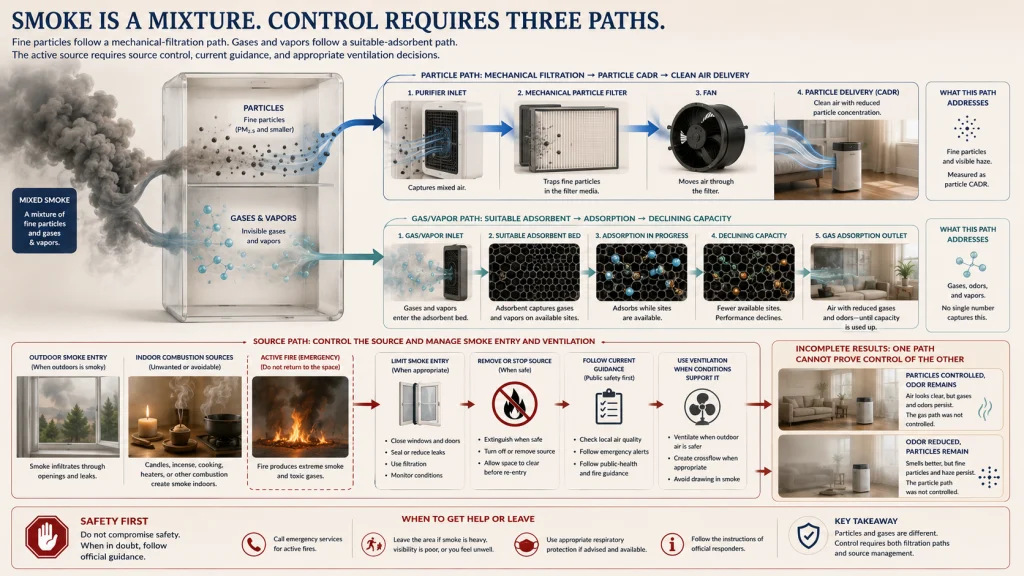
Treat Smoke as a Mixture of Particles and Gases
Smoke is not one pollutant. It can contain fine particles along with gases and vapors. This is why a room can look clearer while still carrying an odor, or smell better while fine particles remain a concern. A particle filter and a gas adsorbent may both have roles, but each is working on a different part of the mixture.
Mixed-smoke example:
Particle pathway
Fine smoke particles → purifier inlet → mechanical filter → particle clean-air delivery
Gas pathway
Smoke gases and vapors → suitable adsorbent → gas-specific adsorption until capacity declines
Source pathway
Active fire, outdoor smoke entry, or indoor combustion → source control, current safety guidance, and suitable ventilation decisions
A high smoke CADR describes particle delivery, not removal of every gas in smoke. A carbon layer does not make it safe to remain near visible fire, heavy smoke, combustion, or an unknown release.
During a wildfire smoke episode, follow current emergency and local public-health guidance, limit smoke entry when appropriate, use source control and filtration within their supported roles, and prioritize people at greater risk. Severe or worsening symptoms require qualified medical guidance.
Separate Airborne Mold-Spore Capture From Moisture and Mold Control
Mold spores are particles, so effective particle filtration can capture spores that reach the purifier. That can make the filter look busy and useful while the real source remains unchanged behind a cabinet, beneath flooring, or around a damp window. Capturing airborne spores does not remove mold growing on a wet surface, repair a leak, dry materials, or determine whether the building problem has been resolved.
A purifier can become a distraction when the visible source remains active behind furniture, inside a wall, around a window, or beneath flooring. Moisture control, source identification, cleanup, and appropriate professional assessment remain separate tasks.
Do not use a lower airborne particle level, reduced odor, or cleaner-looking filter as proof that a mold-related problem is safe or complete. The device only acts on air passing through it and cannot diagnose a health condition or inspect hidden building materials.
For ordinary dust, pollen, pet particles, and other household particle concerns, route the source and cleaning questions to the relevant household dust and allergen guidance rather than assigning every visible particle to the purifier.
Compare Separate and Combined Filters by Airflow, Replacement, Disclosure, and Cost
Some purifiers use separate particle and carbon filters. Others combine both into one cassette. Either design can be practical, but the ownership experience is different. One household may appreciate replacing each medium separately, while another may prefer one simple cassette even if both sections must be replaced together.
| Design factor | Separate media | Combined filter |
|---|---|---|
| Replacement timing | Particle and gas sections may be replaced on different schedules when supported | The entire cassette is replaced when one section reaches its service point |
| Media disclosure | Construction and quantity may be easier to describe separately | A single product name can hide how much space each medium receives |
| Airflow resistance | Each layer adds resistance according to its construction | The complete stack must balance particle media, carbon, seals, and fan performance |
| Inspection | Owners may see each section and its condition more clearly | Internal layers may be difficult to inspect independently |
| Ownership cost | Replacement purchases may be staggered | One purchase replaces both sections, whether both are exhausted or not |
| Fit and sealing | Multiple pieces create more installation steps | One cassette may simplify fit but still needs correct sealing and orientation |
A combined HEPA and carbon filter does not prove that both mechanisms are equally substantial. Review the particle delivery and gas-media disclosure separately, then include replacement availability and annual cost.
Nora’s observation: Combined filters often feel easier at the shelf because one part number seems simpler than two. I still check whether the replacement forces the household to discard a lightly used section because the other medium has reached its limit. Convenience at purchase can become unnecessary cost later if the service paths are mismatched.
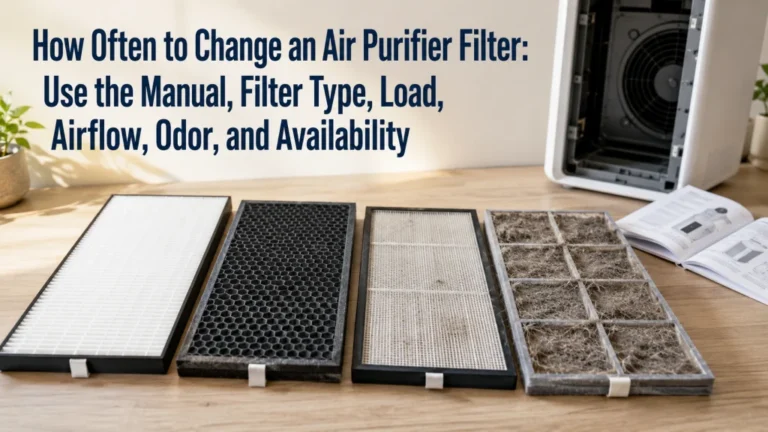
The maintenance guide on when to change an air purifier filter covers inspection, indicators, fit, environmental load, and replacement records without inventing one universal service life.
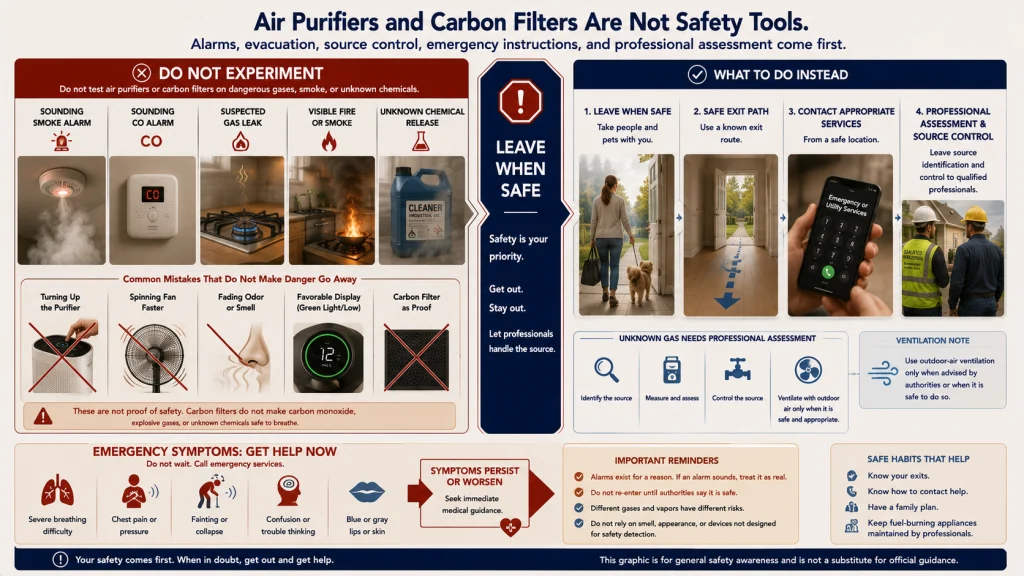
Keep Hazardous and Unknown Gases Outside Consumer Filter Guesswork
Hazardous-gas boundary:
- A sounding smoke or carbon monoxide alarm requires leaving the area when safe and contacting emergency services as appropriate.
- A suspected gas leak, visible fire, active smoke, strong unknown chemical release, or rapidly worsening condition requires evacuation or professional guidance, not purifier experimentation.
- Activated carbon must not be described as removing all VOCs, carbon monoxide, or hazardous gases.
- A fading odor, favorable display color, or running fan does not confirm that a dangerous gas is absent.
- Source control and suitable clean outdoor-air ventilation remain primary when applicable and safe.
Consumer filter language is not a substitute for identifying an unknown source. Chemical spills, combustion gases, fuel odors, solvent releases, and building incidents can require utility, emergency, environmental, industrial-hygiene, or other professional assessment.
Severe breathing difficulty, chest pain, fainting, confusion, blue or gray lips, or other emergency signs require immediate appropriate help. Persistent or worsening symptoms require qualified medical guidance.
Reject Percentages Without Pollutant, Method, Airflow, and Time Context
A percentage can look decisive because it turns a complicated mechanism into one clean number. That simplicity is comforting when the household is trying to solve dust, smoke, odor, or an unfamiliar smell quickly. “Removes 99 percent” still means little unless the claim identifies what was removed, how the test was run, how much air moved through the device, how long the test lasted, and whether the result applies to new or aged media.
Ask four questions:
- Which pollutant? A particle result does not become a gas result, and one gas does not represent every VOC.
- Which test method? Media-only testing and complete-device testing answer different questions.
- Which airflow and fan speed? A result at maximum speed does not prove equal performance in sleep mode.
- Which time and loading condition? Initial capture does not explain long-term saturation, breakthrough, or replacement.
The same discipline applies to product labels, comparison charts, and odor demonstrations. A dramatic before-and-after result can be real within its test while remaining too narrow to support a broad household claim.
Classify the Pollutant Before Comparing the Filter
Begin by deciding whether the concern is an airborne particle, a gas or vapor, or a mixture. That first classification prevents a household from buying an impressive filter that is designed for the wrong problem. For particles, evaluate the media together with complete-device clean-air delivery, seals, room fit, fan speed, and placement. For gases, identify the target compound and look for meaningful disclosure of adsorbent quantity, construction, treatment, contact path, and replacement limits.
HEPA and activated carbon can complement each other, but neither label makes the other mechanism unnecessary. A HEPA percentage does not prove odor or VOC control. A carbon sheet does not replace particle filtration or support broad claims about unknown gases.
The final decision should name the pollutant, mechanism, delivery metric, media disclosure, and source-control plan. Once those pieces are clear, the choice becomes less about trusting a dramatic label and more about matching a real household concern to the filter that can actually address it. For the wider relationship among ventilation, moisture, source removal, filtration, and household conditions, return to the healthy home environment guide.
FAQs
🌾 Is HEPA or activated carbon better for pollen?
Pollen is a particle, so particle filtration and adequate clean-air delivery are the relevant mechanisms. Activated carbon is not a substitute for effective particle media.
🍳 Does a HEPA filter remove cooking odors?
HEPA media is designed for particles, not odor molecules. Suitable activated carbon or another gas adsorbent may help with some odors, while source control and kitchen exhaust remain important.
🖤 Is a thin black carbon sheet enough for VOCs?
Its presence alone does not establish broad VOC performance. Look for disclosed media construction, quantity, target gases, airflow path, treatment, and replacement guidance.
🌫️ Does smoke CADR include gases from smoke?
No. Smoke CADR is a particle clean-air delivery metric. Smoke can also contain gases and vapors that require separate evaluation and source-control decisions.
🦠 Can HEPA remove mold from a home?
HEPA media can capture airborne mold spores that reach the filter. It does not repair moisture problems, remove mold growing on materials, inspect hidden areas, or prove that cleanup is complete.
⏳ How do I know when activated carbon is saturated?
There is no universal visual test or service period. Follow the exact product guidance, consider the gas load and use conditions, and do not rely only on odor as a safety measure.
🧩 Is a combined HEPA and carbon filter always better?
No. Compare particle delivery, carbon disclosure, airflow, replacement design, filter availability, and cost. A combined label does not reveal how substantial each medium is.
⚠️ Can activated carbon remove carbon monoxide or unknown hazardous gases?
Do not rely on a consumer carbon filter for carbon monoxide or an unknown hazardous gas. Leave the area when safe, follow alarm or emergency instructions, and contact the appropriate services.