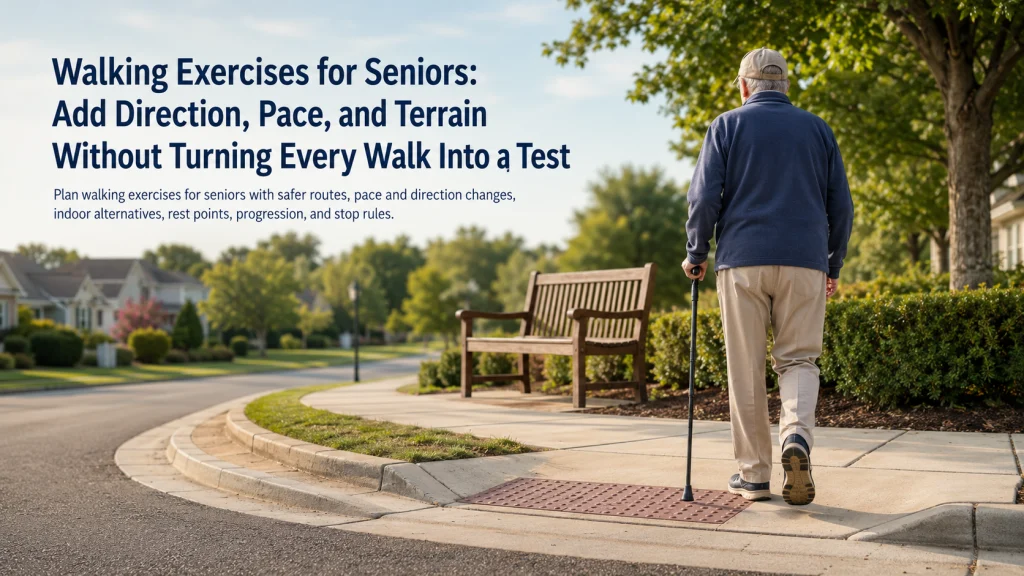
Walking practice becomes more demanding when the route adds turns, crowds, uneven surfaces, poor lighting, or limited places to rest, even when the total time stays the same. Separate walking skill from endurance, choose a route that fits the current day, and add only one challenge at a time. Keep footwear, mobility aids, weather, energy, and rest access inside the plan rather than treating them as side issues. Sudden gait change, repeated tripping, falls, pain, dizziness, fainting, chest pain, severe shortness of breath, sudden weakness, or major functional decline requires qualified evaluation.
Compare one ten-minute walk in three different places
Picture the same ten-minute walk in a straight hallway, a crowded store, and an uneven outdoor path. The clock stays the same, but the body must solve three different tasks.
| Route | Main demands | What can make it harder | Useful starting version |
|---|---|---|---|
| Straight indoor hallway | Steady forward walking and predictable turns | Polished floors, narrow space, doors, or poor lighting | Clear route with a chair or railing nearby |
| Crowded store | Stopping, starting, turning, scanning, and avoiding people or carts | Noise, visual distraction, slippery entrances, and limited rest access | Quiet shopping hour with a short list and known seating |
| Uneven outdoor path | Surface changes, slopes, curbs, weather, and longer visual planning | Cracks, gravel, wet leaves, heat, wind, and distance from help | Short familiar loop in good conditions with an easy exit |
A person may feel relaxed in the hallway and cautious in the store without losing fitness between the two. The environment has changed the number of decisions required with every step.
Equal minutes do not create equal walking demands.
Separate walking skill from walking endurance
Walking endurance describes how long or how far a person can continue before needing to slow down or rest. Walking skill describes how the person manages turns, changes in pace, obstacles, surface transitions, narrow spaces, and attention demands.
These qualities interact, but they should not be progressed together automatically. A longer flat walk increases duration. A shorter route with several turns, doorways, and surface changes increases complexity.
Choose the primary goal for each practice session. If the goal is endurance, keep the route familiar. If the goal is route skill, keep the duration modest enough that fatigue does not hide what the environment is asking.
Use the mobility planning guide when walking is only one of several daily movement patterns that need attention.
Choose an indoor, track, neighborhood, or store route
The best route is not the most impressive one. It is the route that matches the practice goal, current energy, mobility aid, weather, and access to rest.
| Route format | Useful advantage | Main limitation | Choose it when |
|---|---|---|---|
| Indoor hallway or room loop | Predictable surface, easy stopping, and close rest access | Limited space can create frequent turns | Weather, low energy, or unfamiliar outdoor conditions make outside practice impractical |
| Track or marked loop | Known distance and fewer navigation decisions | Repetitive turns, exposure, and limited shade may still matter | The goal is steady walking with a repeatable route |
| Neighborhood route | Real curbs, driveways, slopes, and community navigation | Traffic, dogs, weather, and uneven pavement add complexity | The person knows the route and has planned rest and exit points |
| Store or indoor public space | Weather protection, lighting, and possible seating | Crowds, carts, noise, and visual distraction | The location is familiar and a quieter time is available |
Route choice should feel practical rather than heroic. A shorter indoor loop completed with confidence may be more useful than an outdoor route that creates anxiety before the first turn.
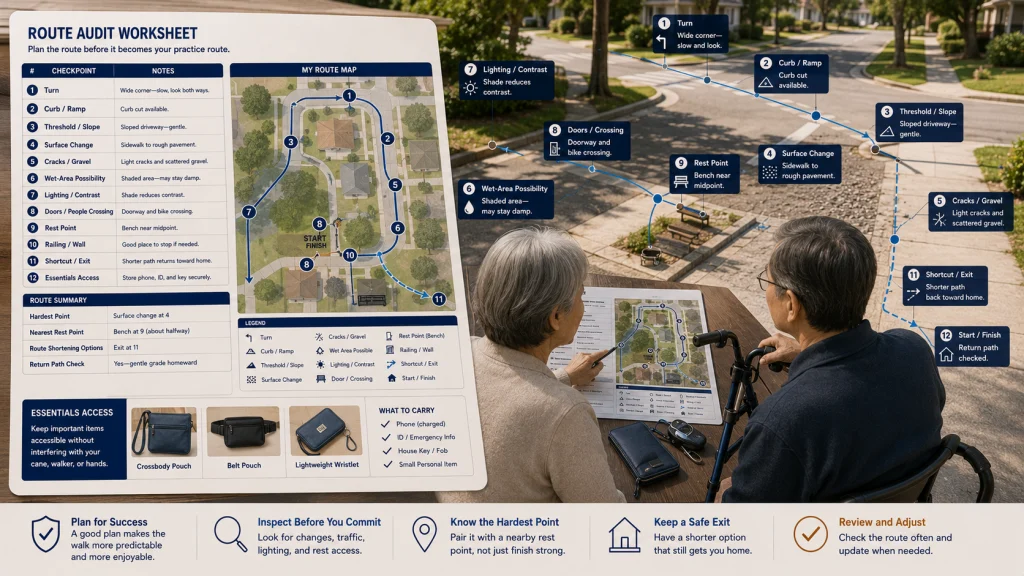
Audit turns, curbs, surfaces, lighting, and rest points
Walk through the route mentally or inspect it before using it for practice. The audit should identify where attention must increase and where the person can pause without blocking others or feeling rushed.
Route-audit worksheet:
- ☐ How many turns require slowing, looking, or changing direction?
- ☐ Are there curbs, steps, ramps, thresholds, or sloped driveways?
- ☐ Does the surface include cracks, gravel, wet areas, rugs, glare, or loose objects?
- ☐ Is the lighting even enough to see changes in surface height?
- ☐ Are there doors, carts, pets, bicycles, or people likely to cross the path?
- ☐ Where are the nearest chairs, benches, railings, walls, or safe stopping areas?
- ☐ Can the route be shortened without creating a difficult return?
- ☐ Is a phone, identification, key, or other necessary item accessible without affecting aid use?
An ordinary route can become demanding when the only bench is at the far end or the return path includes an uphill section. Rest access belongs in the route design, not only in the emergency plan.
Use pace changes and direction changes conservatively
Pace practice can include a comfortable start, a brief slightly quicker section, and a return to the usual rhythm. Direction practice can include planned turns at known landmarks rather than sudden pivots on command.
Change one variable at a time. Do not add faster walking, sharper turns, a longer route, and an unfamiliar surface in the same session.
Use wide, deliberate turns when needed. Slow before changing direction, look toward the new path, and avoid rushing to keep pace with another person. A practice partner should match the walker rather than pulling the pace forward.
Confidence can disappear quickly when every walk becomes a performance test. The purpose is to make real routes more manageable, not to create pressure to move faster than the environment allows.
Add obstacle awareness without creating improvised hazards
Obstacle awareness means learning to notice and plan around ordinary route features. It does not mean scattering household objects on the floor or building a homemade course that increases fall risk.
Use real, visible features that already belong in the environment, such as a doorway, a change from carpet to hard flooring, a wide corner, or a clearly marked stopping point. Keep the route uncluttered and remove loose objects before practice.
Avoid stepping over cords, boxes, stools, pets, or unstable objects for exercise. Do not use narrow furniture gaps, moving obstacles, or low items that are difficult to see.
Obstacle boundary: If a route requires stepping over hazards, sudden sidestepping, or repeated recovery from loss of balance, it is no longer a simple self-directed walking practice.
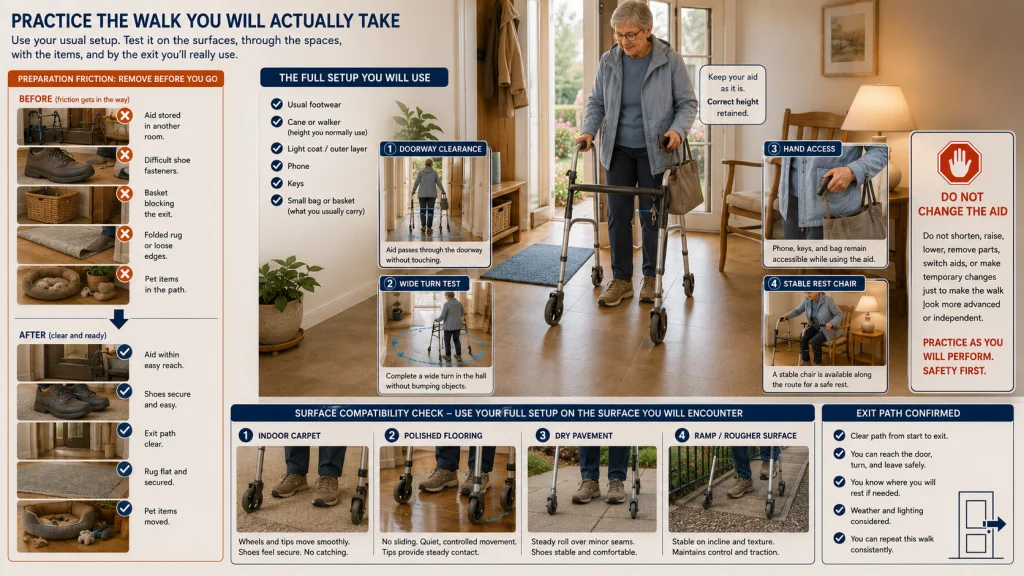
Coordinate footwear and mobility aid use
Practice in the footwear normally used for the route. A shoe that feels acceptable on carpet may behave differently on polished flooring, wet pavement, gravel, or a ramp.
Use a mobility aid in the way it has been fitted or instructed. Do not shorten, raise, lower, remove, or switch the aid solely to make the walk look more advanced.
Check that the aid fits through doorways, turns within the planned space, and remains usable when carrying personal items. Bags, baskets, coats, and shopping carts can change hand access and route width.
Editorial observation: Household friction often appears before the walk begins. The aid may be in another room, shoes may be difficult to fasten, or the exit path may be blocked by a basket, pet item, or folded rug. Fixing those repeat obstacles can make practice more consistent without making the route harder.
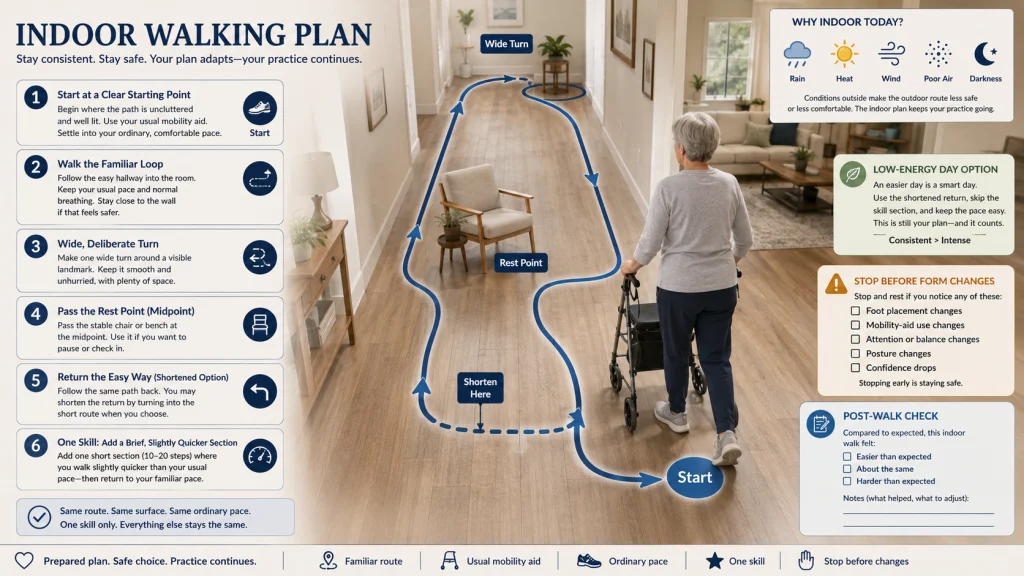
Create weather and low-energy alternatives
A walking plan should include a version for heat, rain, wind, poor air conditions, darkness, and low-energy days. The alternative should be chosen before the original route becomes unsuitable.
Indoor walking plan:
- Choose a clear hallway, room loop, or familiar indoor public space.
- Mark one starting point, one wide turning point, and one rest point.
- Begin at the usual comfortable pace.
- Add only one planned skill, such as one pace change or one extra turn.
- Stop before fatigue changes foot placement, aid use, attention, or confidence.
- Record whether the indoor version felt easier, similar, or harder than expected.
A low-energy alternative is not a failed version of the outdoor plan. It protects continuity while respecting a day when sleep, illness recovery, heat, stress, or other demands have reduced available energy.
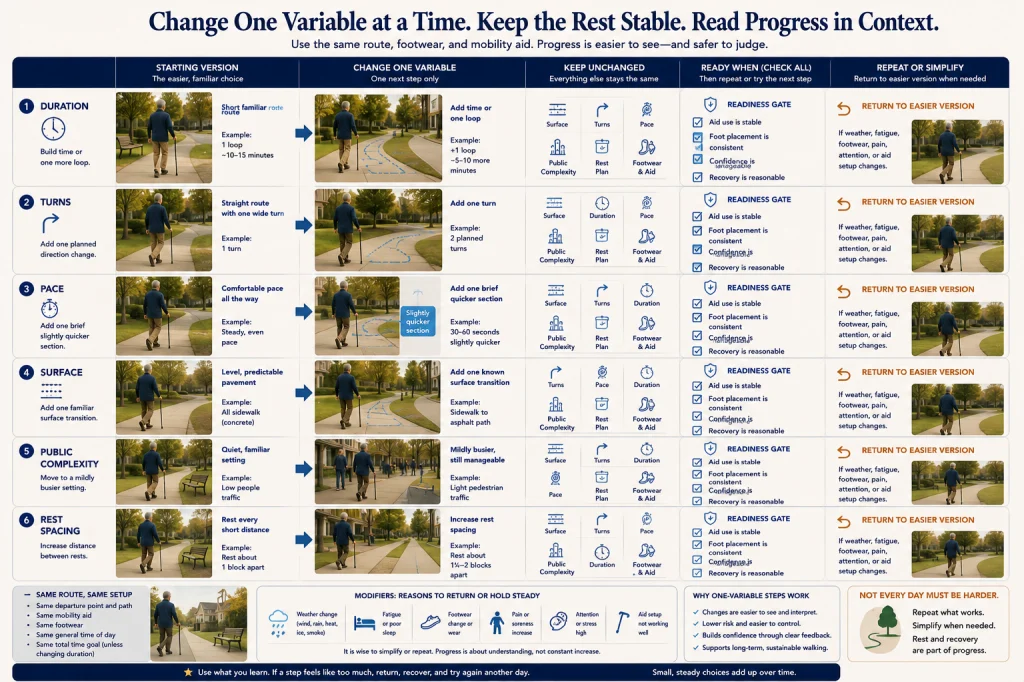
Progress route complexity separately from duration
Progress becomes easier to interpret when only one part of the route changes. Keep duration steady while adding a turn, or keep the route simple while adding a small amount of walking time.
| Progression variable | Starting version | Next step | Keep unchanged |
|---|---|---|---|
| Duration | Short familiar route | Slightly longer time or one additional loop | Surface, pace, turns, and rest access |
| Turns | Straight route with one wide turn | Add one planned direction change | Duration, pace, and surface |
| Pace | Usual comfortable rhythm | Add one brief slightly quicker section | Route, turns, and total time |
| Surface | Level predictable flooring | Add one familiar surface transition | Duration, pace, and direction changes |
| Public complexity | Quiet familiar space | Choose a mildly busier but still manageable time | Route length and rest plan |
| Rest spacing | Frequent known rest access | Slightly increase the distance between planned rests | Terrain and pace |
Return to the easier version when weather, fatigue, footwear, pain, aid setup, or attention has changed. Progression is a route decision, not a promise that every day must be harder than the last.
Log confidence, recovery, and near-misses
A useful log records more than minutes or steps. It should show whether the route felt understandable, whether recovery was reasonable, and whether anything nearly caused a loss of balance.
| Log item | What to record |
|---|---|
| Route | Location, surface, turns, weather, and rest access |
| Skill variable | Pace change, direction change, surface transition, or public complexity |
| Confidence | Whether the route felt calm, uncertain, rushed, or overly demanding |
| Recovery | How long it took to feel ready for ordinary activity afterward |
| Near-miss | Trip, slip, unexpected stop, aid catch, missed curb, or need for sudden support |
| Next decision | Repeat, simplify, change one variable, or seek assessment |
A near-miss should not be hidden because no fall occurred. It is useful information about the route, timing, footwear, aid, or current capacity.
Use the functional exercise guide when the log needs to include chair rise, carrying, reaching, and other daily tasks. Use the balance exercise guide when steadiness rather than route design is the main concern.
Escalate after sudden gait change, repeated tripping, pain, or dizziness
Safety boundary: Stop self-directed troubleshooting and seek qualified evaluation after a fall, sudden change in walking, repeated tripping, new or worsening pain, dizziness, fainting, chest pain, severe shortness of breath, sudden weakness, new neurological symptoms, or major functional decline. Emergency symptoms require immediate help.
Do not keep increasing route complexity to test whether a sudden problem resolves. Difficulty that appears abruptly, worsens, or affects essential walking may not be a simple exercise issue.
Assessment is also appropriate when the person repeatedly catches a foot, needs unexpected support, cannot use the mobility aid as intended, or begins avoiding necessary community routes because walking no longer feels manageable.
Use the chair exercise guide when a seated routine is needed while walking difficulty is being evaluated or the route cannot be used safely.
Choose the route, one skill variable, a rest plan, and a stopping condition
Finish the plan in four lines:
- Route: Name the surface, turns, lighting, weather, and available rest points.
- Skill variable: Choose one change, such as pace, direction, surface, or public complexity.
- Rest plan: Identify where to stop, how to shorten the route, and how to return safely.
- Stopping condition: Write the symptom, near-miss, fall, or loss of confidence that ends practice or triggers assessment.
A complete example might read: “I will use the quiet indoor loop with one wide turn and a chair near the midpoint. I will practice one brief pace change while keeping the route length the same. I will stop if foot placement becomes inconsistent, the mobility aid catches, I feel dizzy, or the route no longer feels manageable.”
Use the broader healthy aging guide when route planning is part of a larger plan for movement, independence, and daily routines.
Purposeful walking does not require turning every outing into a test. Choose one demand, keep the route understandable, and preserve enough confidence to walk again another day.
FAQs
🚶 What makes a walk an exercise rather than ordinary walking?
A practice walk has a clear route, one selected variable, a rest plan, and a stopping condition. It does not need to be faster, longer, or more difficult every time.
🧭 Should walking skill and endurance be trained together?
They can interact, but changing both at once makes the result harder to interpret. Keep the route simple when increasing duration, and keep duration modest when adding route complexity.
🏠 Is indoor walking useful?
Yes. A clear indoor route can support consistent practice during poor weather or low-energy days. It should still include safe turns, rest access, and an uncluttered path.
↩️ How should direction changes be practiced?
Use wide, planned turns at known landmarks and slow before changing direction. Avoid sudden pivots or commands that create rushing.
🚧 Should I build an obstacle course at home?
Do not create improvised hazards with cords, stools, boxes, or loose objects. Practice awareness around real, visible route features while keeping the path clear.
👟 Should I practice in my usual shoes?
Use footwear that matches the planned route and ordinary use. Surface, weather, fit, and how the shoe works with a mobility aid can affect the experience.
📋 What should I record after a walk?
Record the route, selected skill, confidence, recovery, weather, aid use, and any trip, slip, sudden stop, or near-miss. Those details are more useful than step count alone.
🚩 When should walking changes be assessed?
Seek qualified evaluation after a fall, sudden gait change, repeated tripping, new or worsening pain, dizziness, fainting, chest pain, severe shortness of breath, sudden weakness, neurological symptoms, or major decline. Emergency symptoms require immediate help.