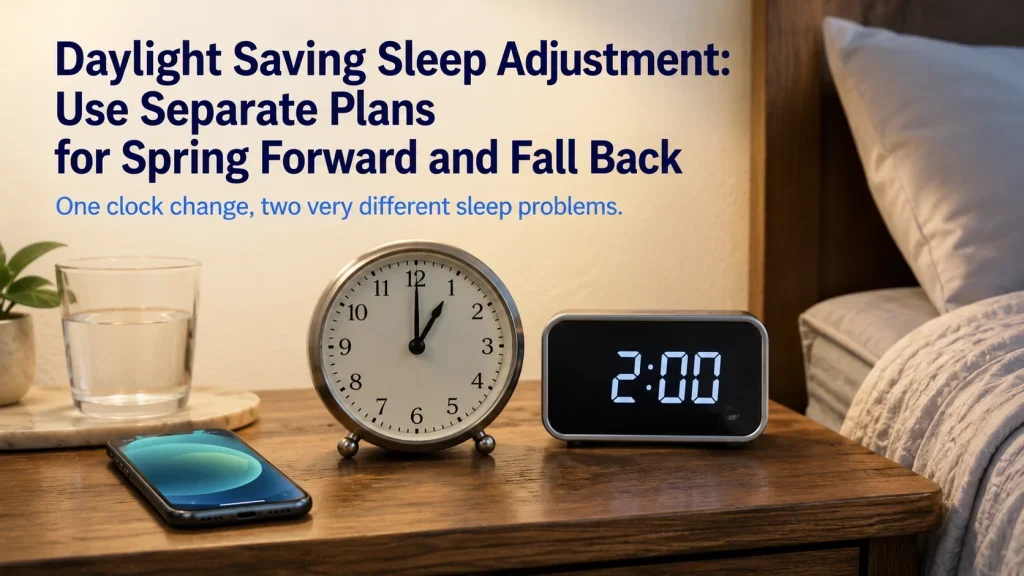
A daylight saving sleep adjustment needs separate spring and autumn plans because losing an hour and repeating an hour create different practical problems. Verify whether the reader’s location changes clocks, protect sleep opportunity before the transition, and move routines in the same direction as the upcoming clock change. Audit automatic and manual devices so alarms, lights, reminders, vehicles, calendars, and household routines do not give conflicting cues. Dangerous sleepiness, drowsy driving, unintended sleep episodes, or persistent impairment requires immediate safety action and qualified evaluation where appropriate.
See two kitchen clocks creating two different problems
One kitchen clock moves forward beside a calendar marked with an early Monday commute. The other moves back beside an evening routine that suddenly feels too early by the new clock. In both homes, the person may know exactly what the clock is supposed to do and still feel unsettled when breakfast, bedtime, and the first alarm no longer line up the way they did the day before.
Spring forward
- The clock skips ahead by one hour
- The night offers less clock time for sleep
- The next morning arrives earlier by the body’s recent pattern
- Commutes and alertness-sensitive work may feel harder
Fall back
- The clock repeats one hour
- Evening sleepiness may arrive early by the new clock
- Morning waking may also occur earlier
- A long weekend sleep-in can create additional drift
A phone may update automatically while an oven, bedside clock, car clock, and scheduled lamp remain on the old time. The household can begin Sunday with several clocks pointing in different directions even when everyone remembers that a change occurred.
A one-hour change needs two plans, not one recycled checklist.
Verify whether the location changes clocks and confirm the transition date
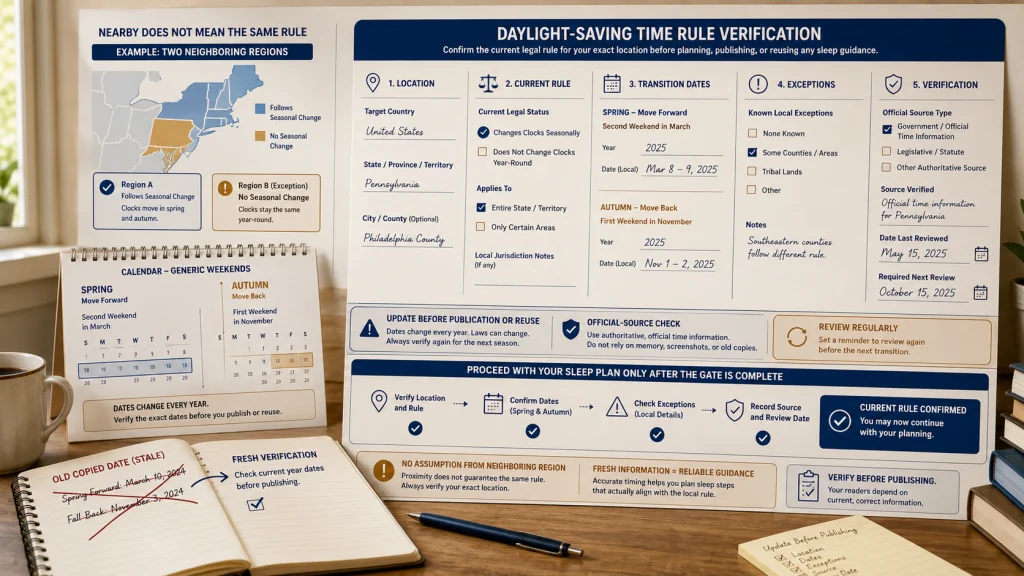
Seasonal clock rules vary by country, region, and local exception. Confirm the rule for the reader’s actual location before using either timeline. A nearby state, territory, province, or neighboring country may follow a different schedule.
Location and date verification for publication:
- Target edition: United States
- Status reviewed: July 31, 2026
- Current federal pattern: Participating locations begin daylight saving time on the second Sunday in March and return to standard time on the first Sunday in November.
- 2026 review dates: The spring transition occurred on March 8, 2026. The autumn transition is scheduled for November 1, 2026.
- Exceptions: Hawaii, most of Arizona, and several U.S. territories do not observe the seasonal change.
- Required update: Recheck the target location, legal status, and exact date immediately before publication or seasonal republication.
The timelines below are evergreen planning frameworks. Replace the date check when the article is updated rather than copying an old transition date into a new season.
Understand why spring forward and fall back are not mirror images
Spring compresses the clock night. If bedtime remains unchanged by the clock and the alarm also remains unchanged, the sleep opportunity becomes shorter. The next workday can begin before the body has fully adjusted to the earlier clock. For many adults, this makes spring forward more disruptive than fall back, even though either change can create practical problems.
Autumn repeats an hour, but the practical challenge is not simply “extra sleep.” Evening sleepiness may appear early, morning waking may occur before the intended time, and social plans can use the repeated hour to move the entire weekend later.
The plans therefore move in different directions:
- Spring: Protect sleep and begin shifting key routines earlier.
- Autumn: Keep the new wake schedule from drifting late while managing earlier evening sleepiness.
This local clock transition is different from rapid travel across time zones. Use the itinerary-based jet lag guide when the disruption comes from travel rather than a seasonal local change.
Protect adequate sleep in the week before either change
The clock change is harder to interpret when it lands on top of several short nights. Begin by protecting the ordinary sleep opportunity rather than using the transition as a reason for a major schedule overhaul.
In the days before the change:
- Keep bedtime and wake time within a workable range.
- Finish late household tasks earlier where realistic.
- Reduce optional late-night screen use or social delay.
- Prepare clothes, bags, meals, and transportation for the first workday.
- Keep naps from replacing the intended nighttime sleep period.
The objective is not perfect sleep every night. It is to avoid entering the clock change already carrying a preventable sleep shortage.
Use the consistent sleep schedule guide when ordinary weekly timing is the main problem rather than the seasonal transition.
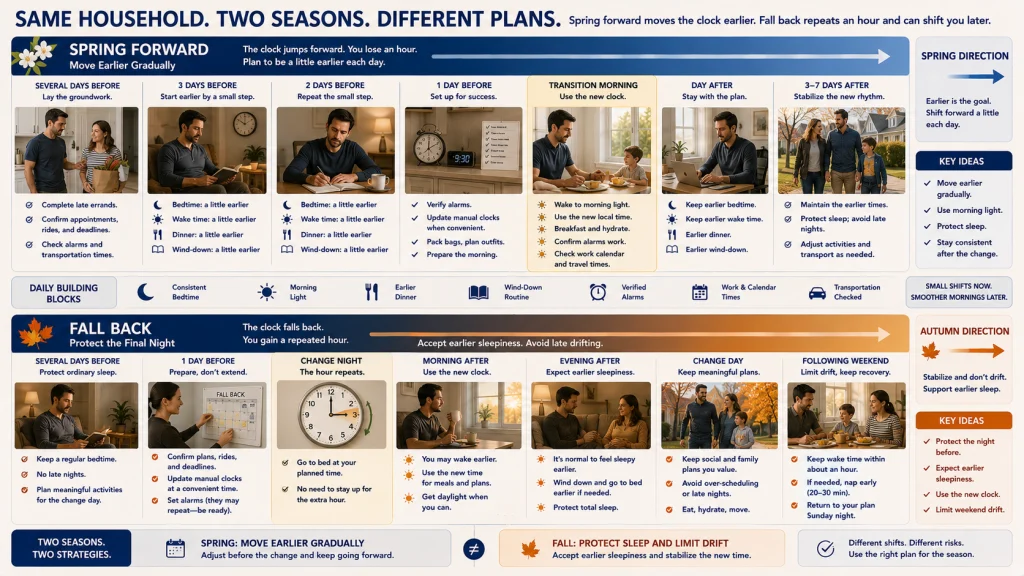
Begin the spring-forward plan several days before the change
Spring preparation moves sleep and routine cues modestly earlier. Small changes are easier to repeat than one dramatic early bedtime on the final night.
| Spring timeline | Sleep timing | Routine cues | Household task |
|---|---|---|---|
| Several days before | Move bedtime and wake time slightly earlier if practical | Bring dinner, evening activity, and wind-down forward | Identify every clock, alarm, reminder, and scheduled device |
| Two days before | Protect the earlier sleep opportunity | Use ordinary morning light after waking | Finish late errands and work that could crowd bedtime |
| Day before | Avoid trading the final night for a late event | Keep meals and activity aligned with the earlier plan | Update manual clocks at a convenient evening time |
| Transition morning | Wake by the new local clock | Use morning light, breakfast, and ordinary activity as new-time cues | Confirm alarms, work calendars, lights, and transportation times |
Morning light is a supporting cue, not an individualized clinical treatment. Use the morning light guide for a broader explanation of how light fits a daily schedule.
The purpose of the timeline is not to make every day look perfect. It is to keep the final night from carrying the entire adjustment by itself.
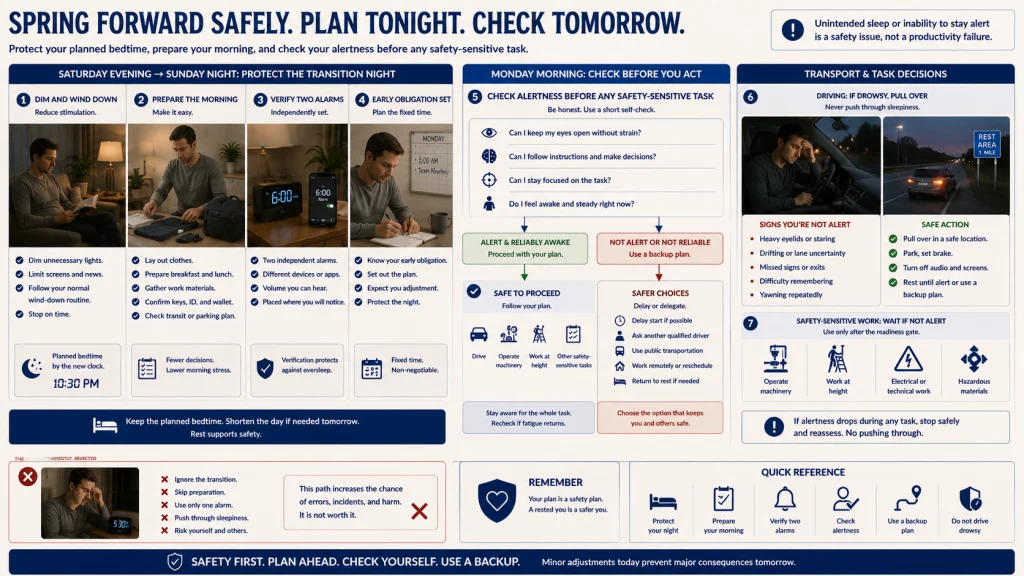
Protect spring transition night and the first workday
Spring transition weekend can create a false sense that Sunday is available for recovery without consequences. A long late nap, an extended social evening, or unfinished Monday preparation can push the first workday further from the new clock.
On transition night:
- Keep the planned bedtime by the new clock.
- Dim unnecessary evening light and begin the normal wind-down sequence.
- Prepare the morning before getting into bed.
- Use more than one verified alarm when an early obligation cannot move.
First-workday safety check:
- Confirm alertness before driving, operating machinery, working at height, or performing another safety-sensitive task.
- Arrange alternate transportation or a delayed start when sleepiness makes attention unreliable.
- Pull over safely rather than trying to finish a drive while drowsy.
- Treat unintended sleep or inability to stay alert as a safety problem, not a productivity problem.
A busy first morning is easier when the device audit, commute plan, clothes, food, and required materials were handled before the final sleep period. Those small preparations matter most when the alarm rings and the body still feels as though it belongs to yesterday’s clock.
Use a fall-back plan for earlier sleepiness and weekend drift
Autumn does not require the same earlier-shift strategy as spring. The main task is to settle into the new clock without using the repeated hour to move bedtime and waking much later.
| Autumn timeline | Likely experience | Practical response |
|---|---|---|
| Several days before | Little change may be needed | Protect ordinary sleep and identify the first fixed obligation after the transition |
| Day before | The repeated hour may invite a later event | Keep meaningful plans while avoiding an unnecessary late-night extension |
| Transition evening | Sleepiness may arrive early by the new clock | Use a calm routine and choose a reasonable bedtime rather than fighting sleep for several hours |
| First mornings | Waking may occur earlier than desired | Use the new clock for meals and activity, then allow gradual settling |
| Following weekend | Sleeping very late can extend the shift | Keep wake time reasonably close to the new schedule while protecting adequate sleep |
The autumn plan should not turn the repeated hour into a rigid demand to stay awake. It should also avoid converting one clock change into a full weekend schedule drift.
With the sleep plan chosen, the next practical problem is making sure the household follows the same clock.
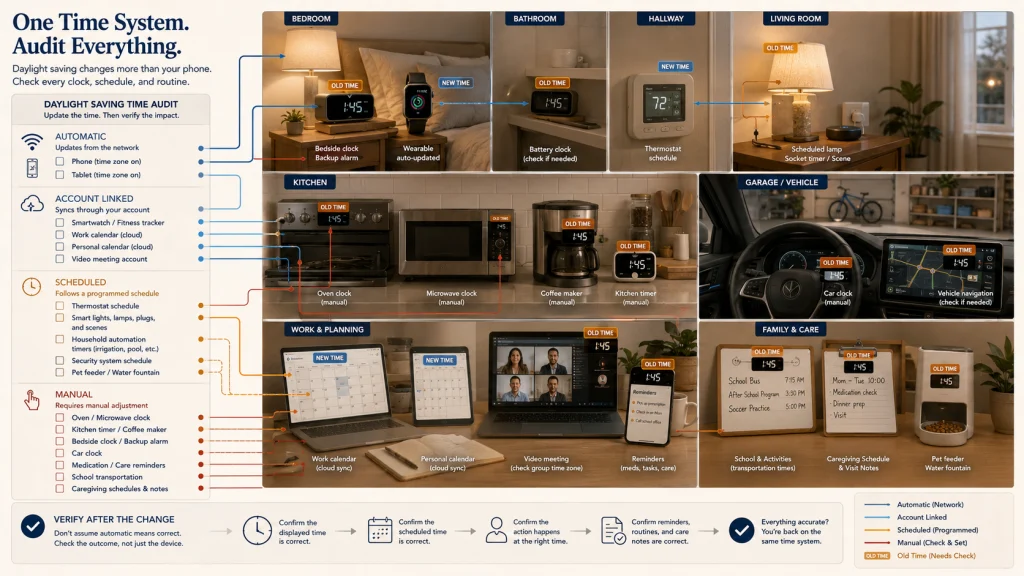
Audit automatic and manual clocks as one household system
Clock changes now happen across a mixture of devices. Some update from a network, some follow a linked account, some use a programmed schedule, and others remain manual. The mismatch often shows up in ordinary moments: the phone alarm is correct, the oven is an hour behind, the car appears to disagree with both, and a scheduled lamp turns on before anyone expects it. One incorrect device can still move a meal, reminder, commute, or bedtime cue.
Household time-change audit:
- ☐ Phone and tablet time zone settings
- ☐ Bedside clock and backup alarm
- ☐ Smartwatch, fitness tracker, or other wearable
- ☐ Oven, microwave, coffee maker, and kitchen timer
- ☐ Car clock and vehicle navigation
- ☐ Work and personal calendars
- ☐ Video meetings and appointments created across time zones
- ☐ Scheduled lamps, shades, plugs, and smart-home scenes
- ☐ Thermostat schedules
- ☐ Medication and care reminders
- ☐ School, transportation, and caregiving schedules
- ☐ Security, feeding, or household automation timers
Check the result after the transition instead of assuming automatic means correct. A phone can show the new time while an oven, car, scheduled lamp, or imported calendar event still follows the old cue. That small disagreement can make a household feel strangely out of rhythm, even when no single clock error seems important on its own.
Move meals, exercise, commuting, and caregiving cues with the clock
Sleep timing sits inside a larger household schedule. Meals, movement, travel, care routines, and evening preparation all tell the day when to begin and end.
Choose the cues that most strongly shape the reader’s week:
- Meals: Move breakfast and dinner toward the new local time rather than leaving the kitchen on the old schedule.
- Exercise: Keep activity in a familiar part of the day and avoid using a late intense session to force alertness.
- Commute: Recheck traffic, transit, pickup, and departure times for the first workday.
- Caregiving: Update shared alarms, meal cues, appointments, and handoff times together.
- Pets and household routines: Expect feeding or activity cues to follow the old rhythm briefly and adjust consistently.
These cues should support the chosen sleep plan, not crowd it. When the household changes dinner but leaves work, lighting, and alarms untouched, the day can still feel split between two clocks.
If preparation never happened, the answer is not to rebuild the whole week overnight. A short recovery plan is enough to restore the main cues first.
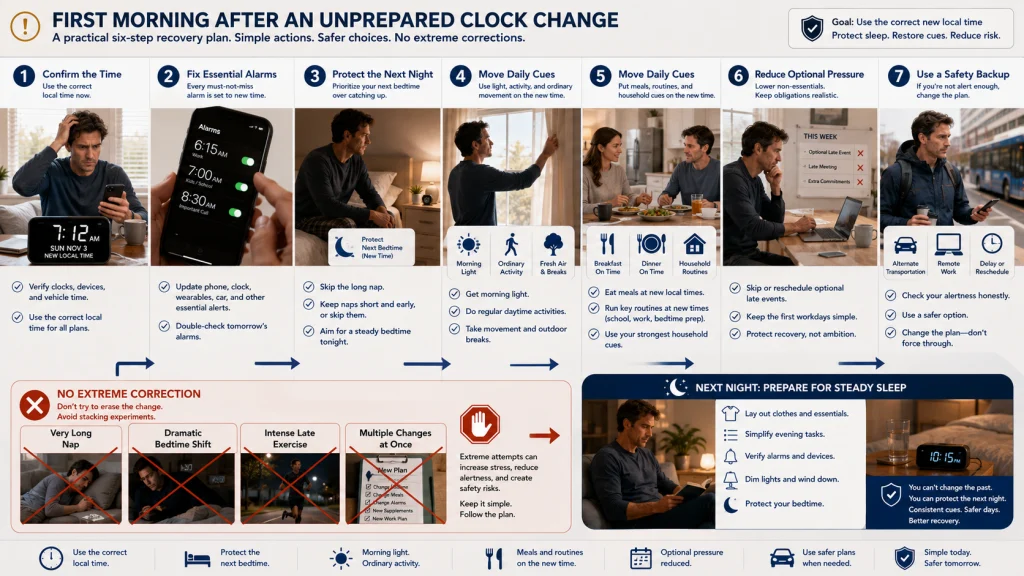
Recover when no preparation was possible
Missing the pre-change window does not require an extreme correction. Use the new local clock immediately for essential commitments, then protect the next few sleep opportunities.
No-preparation recovery plan:
- Confirm the correct local time and fix every essential alarm.
- Protect the next bedtime instead of trying to erase the change with a very long nap.
- Use morning light and ordinary daytime activity when safe and practical.
- Move meals and household cues to the new clock.
- Reduce optional late events during the first workdays.
- Use alternate transportation or schedule changes when alertness is inadequate.
The recovery plan is deliberately simple. A person who already feels behind does not need a second schedule experiment layered on top of the missed preparation. The useful goal is to make the next night and first workday calmer, not to prove that the change had no effect.
Avoid stacking the transition with another major disruption
The clock change becomes harder to interpret when the same weekend includes a late event, long drive, overnight travel, major workout change, or attempt to repair a completely different sleep schedule.
Where possible, avoid combining the transition with:
- A very late celebration before an early obligation
- Long-distance driving at a time when the person usually sleeps
- A new early-morning training plan
- A major caffeine or nap experiment
- An abrupt bedtime shift larger than the clock change itself
Keep essential events and remove optional complexity. Use the sleep schedule repair guide later if broader drift remains after the seasonal transition has settled.
Use extra caution with driving and alertness-sensitive tasks
Sleepiness can reduce attention, reaction, and judgment. The safest response is to change the task, transportation, or timing rather than trying to push through.
Stop driving or another alertness-sensitive activity when the person is struggling to keep the eyes open, missing exits or instructions, drifting in attention, or experiencing unintended sleep. Move to a safe location and arrange another plan.
This article does not prescribe stimulants, medication timing, sedatives, melatonin, or clinical light therapy. A product or drink cannot be used as proof that a sleepy person is safe to drive.
Use a three-day recovery plan
The first three days should reinforce the new local time without demanding perfection. Keep the plan recognizable and reduce optional pressure.
| Recovery day | Morning | Daytime | Evening |
|---|---|---|---|
| Day one | Confirm alarms, use local morning cues, assess driving alertness | Keep meals and activity on the new clock | Protect the normal wind-down and avoid a late recovery project |
| Day two | Repeat a steady wake pattern without forcing an abrupt correction | Note whether concentration and energy are improving | Keep the routine steady rather than moving bedtime dramatically |
| Day three | Check whether the morning is becoming easier | Resume ordinary commitments only as alertness allows | Continue the regular schedule if recovery is moving in the right direction |
Use the sleep schedule guide if the problem continues beyond the transition and begins affecting the wider week.
Seek help for persistent or severe difficulty
Qualified evaluation is appropriate when sleep disruption or daytime impairment is severe, persistent, worsening, or difficult to explain. Dangerous sleepiness, unintended sleep episodes, or inability to stay alert during essential tasks requires prompt safety action.
This article does not diagnose or treat insomnia, a circadian-rhythm disorder, another sleep disorder, or a medical cause of fatigue. It also does not provide individualized plans for children, shift workers, medication changes, or clinical light treatment.
Choose the spring or autumn checklist, update every device, and protect the first workday
Finish the plan in four lines:
- Location and date: Confirm whether the clock changes and verify the exact local transition.
- Direction: Use the spring timeline for an earlier clock or the autumn timeline for a repeated hour.
- Household system: Update phones, alarms, appliances, vehicles, lights, calendars, thermostats, and reminders.
- First workday: Protect sleep opportunity and create a transportation or task backup when alertness is inadequate.
A complete decision might read: “My location changes clocks this season, and I have verified the date. I am using the spring plan because the next morning starts earlier by the new clock. I will move bedtime, dinner, and morning cues slightly earlier, update every manual device on Saturday evening, and arrange another commute option if I am too sleepy to drive safely.”
Use the broader sleep improvement guide when the transition exposes a wider sleep problem rather than a short seasonal adjustment.
The clock changes once, but the household changes through alarms, lights, meals, vehicles, calendars, and obligations. A useful plan brings those cues onto the same time before the first workday asks them to cooperate.
FAQs
🕰️ Does every location observe daylight saving time?
No. Rules vary by country, state, territory, and local exception. Verify the reader’s exact location and current transition date before using a seasonal plan.
🌱 When should I begin preparing for spring forward?
Begin several days before when practical. Move sleep and daily cues modestly earlier while protecting adequate sleep opportunity.
🍂 Should I stay awake later during fall back?
Not simply because the hour repeats. Keep meaningful plans, but avoid turning the repeated hour into a much later bedtime and wake time.
📱 Will my phone update automatically?
It may update when its automatic time settings and network information are correct. Verify the result and check manual appliances, clocks, cars, lamps, calendars, and reminders separately.
☀️ Can morning light help after the change?
Ordinary morning light can support the new wake schedule when used safely and practically. This article does not provide individualized clinical light-treatment timing.
😴 Should I take a long nap after spring forward?
A long or late nap can make the next bedtime harder. Protect nighttime sleep and keep any nap from replacing the intended local sleep period.
🚗 What should I do if I feel drowsy while driving?
Stop driving and move to a safe location. Arrange another driver, transportation option, or schedule rather than trying to push through sleepiness.
🚩 When should persistent difficulty be evaluated?
Seek qualified evaluation when sleep disruption or daytime impairment is severe, persistent, worsening, or unexplained. Unintended sleep or dangerous sleepiness requires prompt safety action.