Social jet lag describes a difference between sleep timing on constrained days and free days, not a diagnosis and not proof that sleeping later on weekends is automatically harmful. Measure bedtime, estimated sleep onset, wake time, and sleep midpoint before deciding what needs to change. Check whether weekday sleep is being compressed by an early alarm, because reducing weekend recovery without improving weekday sleep can make the real problem worse. The useful plan identifies the measured gap, the main driver, the sleep-duration problem, and one realistic change that preserves social life and needed recovery.
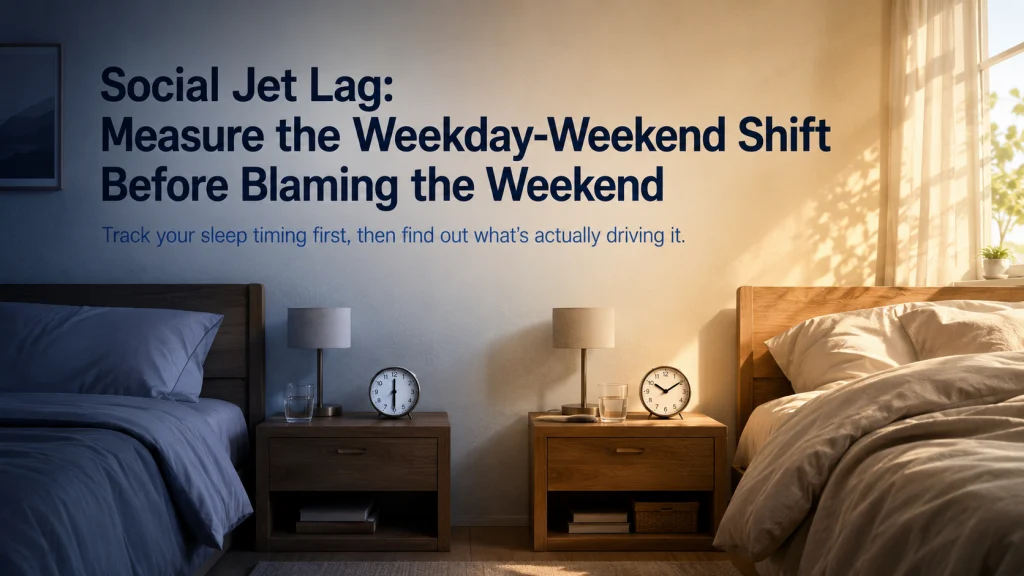
See two sleep midpoints on the same weekly calendar
A weekly planner shows workdays with sleep from late evening to an early alarm. Free days show a later bedtime and a later wake time. The total sleep can become longer on free days even while the midpoint shifts several hours later.
Workday pattern
- Bedtime: 11:00 p.m.
- Estimated sleep onset: 11:30 p.m.
- Wake time: 6:30 a.m.
- Sleep duration: about 7 hours
- Sleep midpoint: 3:00 a.m.
Free-day pattern
- Bedtime: 12:30 a.m.
- Estimated sleep onset: 1:00 a.m.
- Wake time: 9:00 a.m.
- Sleep duration: about 8 hours
- Sleep midpoint: 5:00 a.m.
The calendar looks inconsistent, but the cause is still unknown. The early work alarm may be compressing weekday sleep, free-day social plans may be delaying bedtime, or both may be happening at once.
The weekend is not the diagnosis; the mismatch needs a cause.
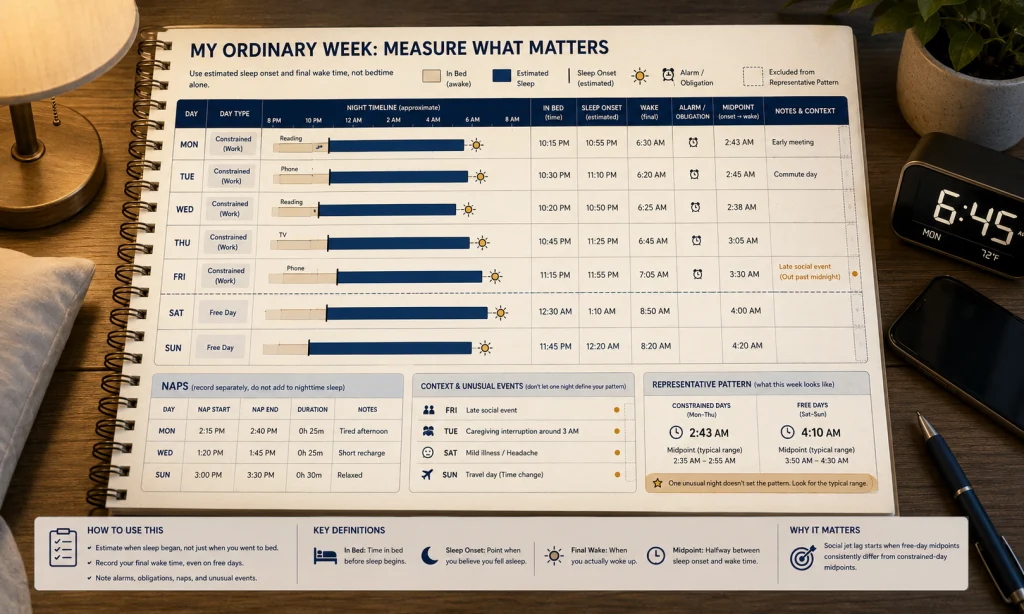
Record bedtime, estimated sleep onset, wake time, and sleep midpoint
Bedtime alone is not enough to measure the pattern. Time in bed and estimated sleep onset can differ, especially when the evening includes reading, phone use, conversation, or difficulty settling.
Measure one ordinary week:
- ☐ Record the time you got into bed.
- ☐ Estimate when sleep began.
- ☐ Record the final wake time.
- ☐ Note whether an alarm or obligation caused waking.
- ☐ Mark the day as constrained or free.
- ☐ Record naps separately rather than adding them to nighttime sleep.
- ☐ Note unusual late events, caregiving, illness, travel, or poor sleep.
- ☐ Calculate the midpoint between estimated sleep onset and final wake time.
Use several ordinary days rather than one unusually late event. A single celebration or early flight can distort the pattern without representing the schedule the person normally lives.
Use the broader sleep schedule guide when work, naps, meals, and household obligations need to be mapped across the full week.
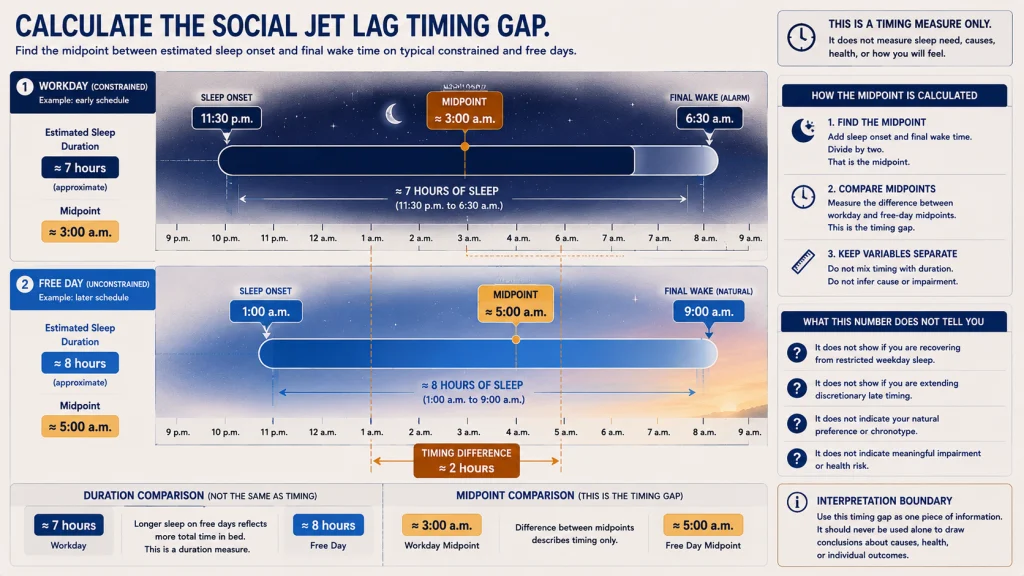
Calculate the timing difference with a worked example
Start with estimated sleep onset and final wake time. Find the halfway point of each sleep period, then compare the workday midpoint with the free-day midpoint.
| Sleep-timing calculation | Workday | Free day |
|---|---|---|
| Estimated sleep onset | 11:30 p.m. | 1:00 a.m. |
| Final wake time | 6:30 a.m. | 9:00 a.m. |
| Sleep duration | 7 hours | 8 hours |
| Sleep midpoint | 3:00 a.m. | 5:00 a.m. |
| Timing difference | Free-day midpoint is 2 hours later | |
The two-hour result describes timing only. It does not explain why the difference exists, whether the person is getting enough sleep, or whether the schedule is causing meaningful impairment.
Repeat the calculation with typical workdays and typical free days. When schedules vary widely, use an average or a representative pattern rather than selecting the most dramatic night.
The number now shows how far the clocks differ. It still cannot tell whether the weekend is repairing lost sleep or extending a schedule that was already adequate.
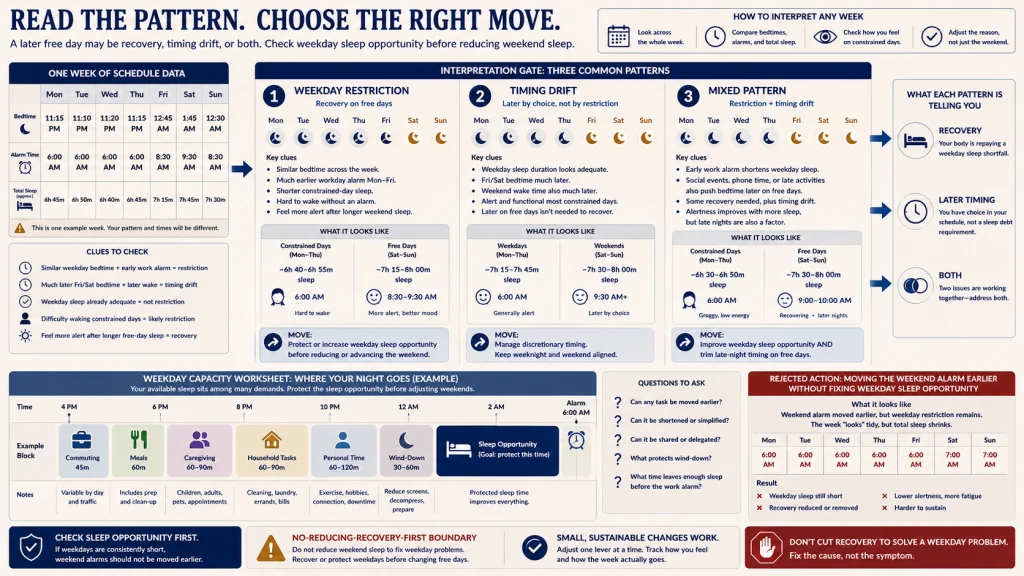
Check weekday sleep opportunity before reducing weekend sleep
A later free-day wake time can be partly driven by insufficient sleep during the week. Before changing the weekend alarm, calculate whether the workday actually contains enough room for sleep after commuting, meals, caregiving, household tasks, and wind-down time.
This section is about capacity. If the weekday schedule leaves too little room for sleep, the main task is to recover time from the evening or morning rather than trimming the free-day recovery that follows.
Is the weekend later because of recovery, timing drift, or both?
- More consistent with weekday sleep restriction: Free-day sleep is longer, waking without an alarm feels difficult on workdays, and daytime sleepiness improves after recovery sleep.
- More consistent with timing drift: Free-day bedtime moves much later for discretionary reasons even when sleep duration is already adequate.
- Often mixed: An early alarm shortens weekday sleep while social plans or bedtime delay push free-day sleep later.
A neat-looking calendar is not useful when it is built on chronically short weekday nights. Regularity and adequate sleep opportunity belong in the same decision.
Once weekday capacity is clear, the next step is to ask what is actually moving the clock later.
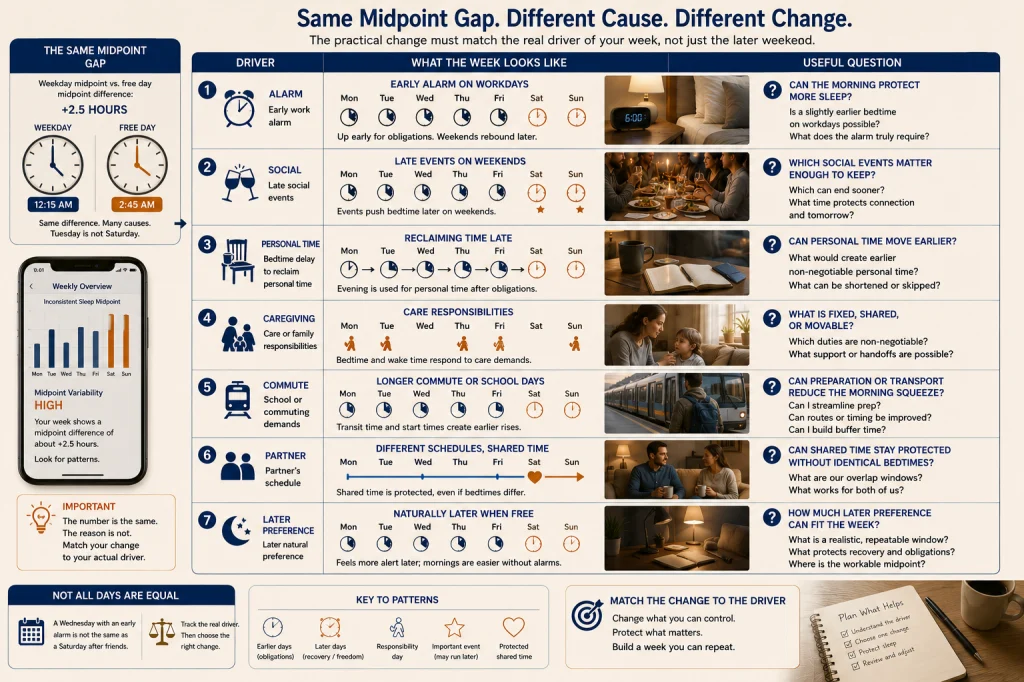
Identify the driver behind the weekday-free-day shift
The same measured gap can come from very different constraints. Once weekday sleep capacity has been checked, the next task is to identify which pressure is moving the schedule. Match the change to the driver rather than treating every later weekend as the same problem.
| Likely schedule driver | What the week may look like | Useful question |
|---|---|---|
| Early work alarm | Bedtime stays similar, but weekday wake time is much earlier | Can the evening routine or morning obligation move enough to protect more sleep? |
| Late social events | Free-day bedtime and wake time both move later | Which events matter enough to keep, and which can start or end earlier? |
| Bedtime procrastination | Personal time begins late after work and sleep is delayed to reclaim it | Can protected personal time move earlier instead of being taken from sleep? |
| Caregiving or family schedule | Bedtime, wake time, or both depend on another person’s needs | Which responsibilities are fixed, shared, or movable? |
| School or commuting | Morning constraints force an early alarm despite a later evening schedule | Can preparation, transport, or evening timing reduce the squeeze? |
| Partner schedule | Sleep timing follows shared time even when obligations differ | Can shared time be protected without requiring identical bedtimes? |
| Later natural preference | Free-day sleep shifts later when alarms disappear | How much of that preference can fit the week without diagnosing a chronotype? |
A planner or sleep app can make the week look disorganized because it treats Tuesday and Saturday as if they carry the same demands. In real life, an early meeting, a partner’s schedule, school pickup, or the first quiet evening of the week can pull sleep in different directions. The useful interpretation starts with what each day is asking from the person, not with how tidy the graph looks.
Use the bedtime procrastination guide when late sleep is being used to reclaim personal time after a demanding day.
Separate recovery sleep from timing drift
Sleeping longer and sleeping later are related but not identical. This section is about interpretation: what does the free day reveal after the weekday schedule has been measured?
Compare three questions:
- Did bedtime move later, or did waking simply occur later because the alarm disappeared?
- Did total sleep duration increase enough to suggest the person was catching up?
- Did the longer sleep improve daytime function, or did the later timing mainly make Sunday night harder?
A similar bedtime followed by later natural waking points toward restricted weekday sleep. A much later bedtime with little change in total duration points more strongly toward discretionary timing. When both occur, the plan needs two separate actions: protect more weekday sleep and reduce the repeated late-night tail.
Recovery sleep is information, not a character flaw. The useful response depends on what it reveals about the week.
Choose a smaller weekend shift or improve weekday sleep opportunity
Pick the change that addresses the measured cause. A person with short weekday sleep may need an earlier weekday wind-down or a less compressed morning before limiting free-day sleep. A person with adequate duration and very late free-day timing may choose to reduce the shift gradually.
Possible changes include:
- Move weekday bedtime earlier by a manageable amount.
- Reduce nonessential morning tasks before the alarm.
- Keep free-day wake time somewhat closer to the workday pattern without forcing an extreme early alarm.
- End selected late events earlier rather than eliminating all social plans.
- Use a short nap strategically when needed instead of moving the entire sleep period later.
Change one part of the schedule and watch what happens to sleep duration, daytime function, Sunday evening, and Monday morning. A smaller measured gap is not useful if it is achieved by making the person more sleep deprived.
This is where the plan shifts from measurement to negotiation. The best change is often the one that protects sleep while asking the least from work, family, and social life.
Use the consistent sleep schedule guide when the main problem has shifted from measurement to long-term maintenance.
Use morning light, meals, activity, and bedtime routine as supporting cues
Timing cues can support a chosen schedule, but they do not replace adequate sleep opportunity. Use them to reinforce the plan rather than force an abrupt change.
- Morning light: Use ordinary morning light when it supports the intended wake period and can be done safely.
- Meals: Keep the first meal and evening meal reasonably aligned with the chosen day rather than letting the whole weekend drift later.
- Activity: Place ordinary movement earlier in the day when possible instead of using late-night activity to extend wakefulness.
- Bedtime routine: Start the same basic sequence even when the exact bedtime differs slightly.
This article does not prescribe clinical light therapy or individualized circadian treatment. Use the morning light guide for a broader explanation of light as a schedule cue.
Build a Sunday transition without forcing an extreme early bedtime
An extreme early bedtime can fail when the person is not sleepy yet. It may create a long period awake in bed, frustration, and another late night.
Build Sunday from the morning forward:
- Wake closer to the intended Monday pattern without using a severe cut in total sleep.
- Use morning light and ordinary daytime activity.
- Avoid a long late-afternoon nap that removes evening sleepiness.
- Finish meals, preparation, and personal time early enough that bedtime is not crowded out.
- Begin the routine at a familiar time and allow sleep to arrive rather than trying to force it.
Monday preparation belongs in the schedule. Clothes, bags, breakfast, charging, and transport plans can be handled earlier so the final evening does not become another workday compressed into bedtime.
Use the sleep schedule repair guide when the pattern has drifted beyond a weekday-free-day mismatch and now affects most days.
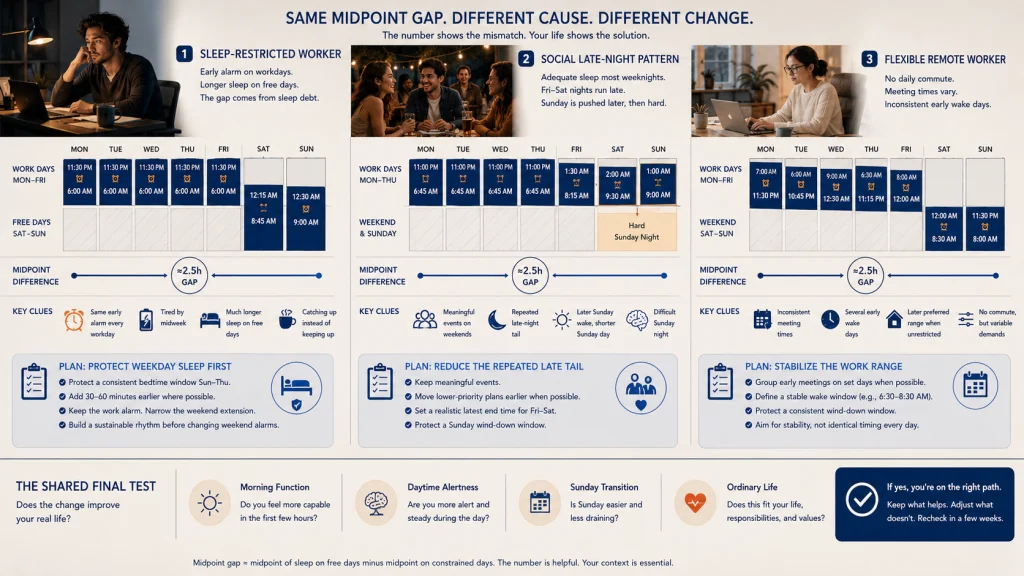
Compare three different causes behind a similar timing gap
Sleep-deprived worker
The worker sleeps from about 11:30 p.m. to 6:00 a.m. on constrained days and from 12:30 a.m. to 9:00 a.m. on free days. The free-day midpoint is later, but the larger change is the additional sleep duration. The first plan is to protect more weekday sleep opportunity and then reassess how much weekend timing remains different.
Social late-night schedule
The person gets adequate sleep on most weekdays but regularly moves bedtime several hours later for Friday and Saturday events. Sunday wake time also moves later, and Sunday night becomes difficult. The plan keeps selected social events while moving lower-priority activity earlier and reducing the repeated late-night tail.
Flexible remote worker
The worker has no commute and can start later on some days, but meetings create inconsistent wake times across the week. Free days reveal a later preferred schedule, while selected workdays still require early waking. The plan groups early obligations where possible and creates a more stable range rather than forcing every day to match the earliest meeting.
The three people can show a similar midpoint difference while needing different changes. The number measures the mismatch; it does not choose the solution.
The final test is whether the chosen change improves the day, not whether the calendar becomes visually perfect.
Track daytime function rather than schedule neatness alone
A weekly calendar can look tidy while the person remains tired, irritable, unfocused, or unsafe. Track whether the change improves the life the schedule is meant to support.
| What to track | Useful question |
|---|---|
| Morning function | Is waking easier, or is the person simply sleeping less? |
| Daytime alertness | Is attention steadier during work, driving, or caregiving? |
| Evening sleepiness | Does sleepiness arrive near the intended bedtime? |
| Sunday night | Is the transition becoming less difficult without an extreme bedtime? |
| Monday morning | Is function improving after a realistic amount of sleep? |
| Social life | Has the plan removed unnecessary delay without eliminating meaningful activities? |
App regularity scores can help organize observations, but they are not a diagnosis or proof of individual health damage. Sleep opportunity, daytime function, and real constraints still need interpretation.
Seek support for persistent delayed timing, severe impairment, or mood symptoms
Self-directed schedule changes are not the right tool for every pattern. Qualified evaluation is appropriate when delayed timing remains persistent despite a realistic schedule, when impairment is severe, or when mood symptoms, unintended sleep episodes, or dangerous sleepiness are present.
Safety boundary: Driving and safety-critical tasks should stop when alertness cannot be maintained. Drowsy driving, unintended sleep, severe or persistent impairment, or a sudden worsening of function requires prompt safety action and qualified evaluation.
This article does not diagnose or treat a sleep disorder, circadian-rhythm disorder, mood condition, or another medical cause. It also does not prescribe melatonin, sedatives, stimulants, medication timing, or clinical light therapy.
Write the measured gap, driver, duration problem, and one change
Finish the plan in four lines:
- Measured gap: Record the difference between typical workday and free-day sleep midpoints.
- Driver: Name the early alarm, social event, bedtime delay, caregiving duty, partner schedule, or later preference shaping the week.
- Duration problem: State whether weekday sleep opportunity is adequate before reducing free-day sleep.
- One change: Choose one realistic adjustment and track daytime function for a week.
A complete decision might read: “My free-day midpoint is about two hours later. The main driver is a weekday alarm that compresses sleep, plus a later Friday bedtime. I will protect an earlier weekday wind-down before moving the weekend alarm. I will keep one meaningful social event and shorten the repeated late-night phone time.”
Use the broader sleep improvement guide when the weekly timing difference is one part of a larger sleep problem.
The goal is not a perfectly symmetrical calendar. It is a week that provides enough sleep, reduces unnecessary swing, and still leaves room for work, relationships, and recovery.
FAQs
📅 What is social jet lag?
It is a difference between sleep timing on constrained days and free days. It describes a schedule mismatch, not a diagnosis or proof of individual health damage.
🕒 How do I calculate my sleep midpoint?
Find the halfway point between estimated sleep onset and final wake time. Calculate it separately for typical workdays and free days, then compare the two midpoints.
😴 Is sleeping in on weekends always harmful?
No. Later waking may reflect needed recovery from short weekday sleep. Measure sleep duration and identify the cause before reducing it.
⏰ Should I use the same alarm every day?
Not necessarily. A somewhat steadier wake range can help some schedules, but it should not be used to preserve chronic sleep restriction. Adequate sleep opportunity remains part of the decision.
🎉 Do I need to stop late social events?
No. Keep meaningful activities and look for repeated low-value delay that can move earlier or end sooner. The plan should reduce unnecessary swing without eliminating social life.
📱 Can a sleep app diagnose social jet lag?
An app can help record timing, but it cannot determine the cause or diagnose a disorder. Review sleep opportunity, alarms, obligations, and daytime function alongside the data.
🌤️ Can morning light reduce the schedule difference?
Morning light can support a chosen wake schedule, but timing and individual response matter. This article does not provide clinical light-treatment instructions.
🚩 When should I seek professional help?
Seek qualified evaluation when delayed timing or impairment persists, mood symptoms are significant, or unintended sleep and dangerous sleepiness occur. Do not drive when you cannot remain alert.