A useful jet lag plan begins with the actual itinerary, not a universal list of airport tips. Direction, time-zone difference, trip length, arrival time, first fixed obligation, local daylight, and realistic sleep opportunity all change the plan. Translate the journey into destination local time, decide which flight segments support sleep, and protect the first local-time anchors after arrival. Medication, sedatives, stimulants, individualized bright-light treatment, severe symptoms, and safety-critical duties require qualified guidance rather than a generic travel schedule.

Compare an eastbound overnight itinerary with a westbound daytime itinerary
Place two boarding passes on the table. The first leaves North America in the evening and arrives in Europe the next morning. The second leaves Europe around midday and arrives in North America during the afternoon.
Eastbound overnight itinerary
- Departure: evening at home
- Arrival: morning at destination
- Flight overlaps destination night
- Arrival day begins while the traveler may still feel ready for sleep
- First obligation may arrive before a full local night has occurred
Westbound daytime itinerary
- Departure: midday at origin
- Arrival: afternoon at destination
- Flight overlaps a long destination day
- The traveler may need to remain awake until local evening
- The first night can begin later than the body expects
The two boarding passes create opposite questions about sleeping on the aircraft, seeking daylight after arrival, using a nap, and protecting the first night.
Jet-lag advice begins with the itinerary, not with a universal travel checklist.
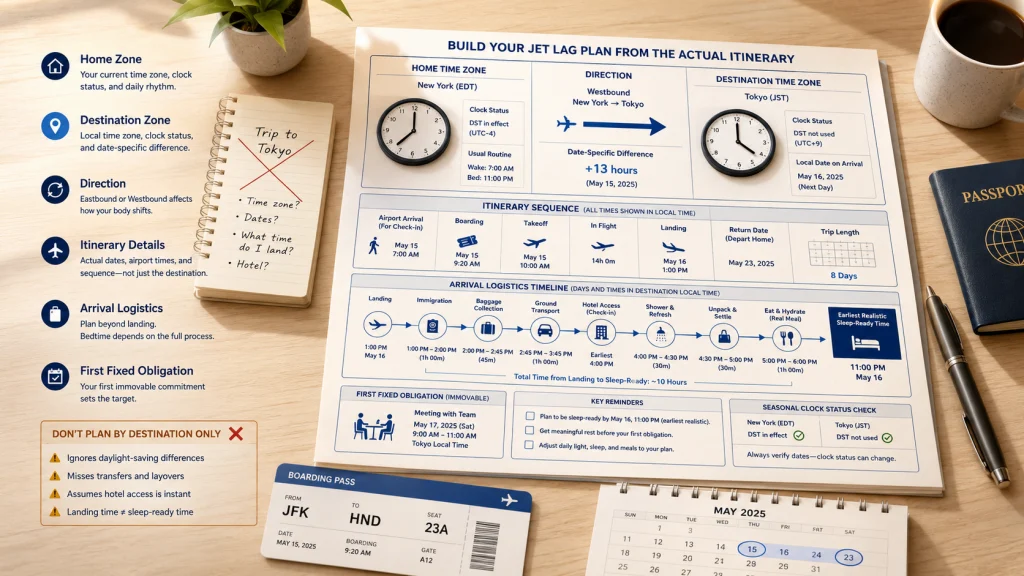
Collect the home zone, destination zone, direction, departure, arrival, trip length, and first obligation
Build the plan from information that appears on the itinerary and calendar. A destination name alone is not enough because the same route can create different decisions when the flight or first meeting changes.
| Itinerary input worksheet | What to record | Why it matters |
|---|---|---|
| Home time zone | Usual wake time, bedtime, and local zone | Shows the schedule the body is leaving |
| Destination time zone | Local zone and seasonal clock status | Defines the clock used after arrival |
| Direction | Eastbound or westbound | Changes whether the plan is generally moving sleep earlier or later |
| Time-zone difference | Difference on the actual travel dates | Prevents errors caused by daylight-saving differences between locations |
| Departure | Airport arrival, boarding, takeoff, and home-zone time | Shows whether the traveler begins tired or rushed |
| Arrival | Landing, immigration, baggage, transport, and hotel access | Landing time is not the same as sleep-ready time |
| Trip length | Nights at destination and return date | Helps decide whether full adaptation is useful |
| First fixed obligation | Meeting, event, drive, tour, performance, or family duty | Defines the first local-time anchor that cannot move |
Add hotel check-in, airport transfers, meals, and the time needed to shower, unpack, and prepare for bed. An arrival listed at 7:00 a.m. may not create a quiet room until late morning.
Use the broader sleep schedule guide when the trip plan needs to fit an already irregular routine.
Decide whether full adaptation is useful for the trip length
A short business stop, a weeklong vacation, and a multiweek stay do not need the same goal. Full adjustment may consume much of a very short trip and then create another difficult transition on the return.
| Trip type | Possible planning goal | Main tradeoff |
|---|---|---|
| Very short stay | Protect the first obligation and retain part of the home schedule when practical | Local meals, events, and daylight may conflict with the retained schedule |
| Several days | Move toward destination time while protecting sleep and daytime function | The traveler may still be adjusting near the return date |
| Longer stay | Build a stable destination schedule around local wake time, meals, light, and bedtime | The return-home transition requires its own plan |
Do not treat full adaptation as a moral achievement. The useful target is the schedule that supports the trip’s purpose without creating avoidable sleep loss or unsafe obligations.
Use the final days before departure without promising complete adjustment
When the calendar allows, move sleep and wake times gradually toward the destination rather than attempting one extreme change the night before departure. Eastbound travel may call for an earlier pattern, while westbound travel may call for a later one.
Keep the change modest enough that work, driving, caregiving, and ordinary function remain safe. A rushed pre-travel shift that creates severe sleep loss can make the flight and arrival harder rather than easier.
Protect the final full sleep opportunity before travel. Finish packing, charging, cleaning reusable items, arranging transport, and confirming documents early enough that bedtime does not become the first casualty of the trip.
Use the sleep schedule repair guide when the starting routine is already drifting before travel.
Translate the itinerary into destination local time
Once travel begins, label each major flight segment in destination time. This makes it easier to decide whether that segment belongs to the destination’s day, evening, or sleep period.
- Write the destination clock beside departure, meal service, connection, intended sleep window, landing, and hotel arrival.
- Set one phone or travel clock to destination time after boarding when practical.
- Use destination time for planned sleep, meals, and light rather than switching back and forth mentally.
- Keep the first fixed obligation visible beside the schedule.
A meal served because the aircraft has reached a particular segment is not automatically aligned with the destination plan. The same is true of cabin lighting and entertainment schedules.
Decide when sleep on the flight supports the destination schedule
Sleep on the plane is useful when the chosen segment overlaps the destination sleep period and when the traveler has enough time to settle without missing a connection or required arrival task.
A sleep mask is useful only during the part of the itinerary when sleep aligns with the destination plan. Wearing it through a segment that should support destination daytime can make the first local evening harder.
Divide the flight into purposeful segments:
- Sleep-supporting segment: Reduce light and noise, use the planned neck support, and avoid unnecessary screen activity.
- Destination-day segment: Remain awake when practical, use ordinary cabin light, move as permitted, and begin orienting to local time.
- Connection segment: Protect enough alertness to navigate gates, documents, baggage, and transport.
Aircraft sleep is often interrupted. Treat it as part of the total sleep opportunity, not proof that the traveler will arrive fully rested.
Use light exposure and avoidance carefully because timing changes the effect
Light is an important time cue, but the useful timing depends on direction, the number of zones crossed, the travel date, the person’s current schedule, and the desired local sleep period.
Do not improvise a clinical bright-light schedule from a simple rule such as “morning light is always good.” Use a current authoritative jet-lag calculator or qualified travel-health guidance when precise timing matters, especially across many zones or before a safety-critical obligation.
At a general planning level, seek ordinary local daylight when it supports staying awake during the destination day. Reduce unnecessary bright light when preparing for the planned local sleep period, but never in a way that makes walking, driving, navigation, or personal safety worse.
Use the light timing guide for a broader explanation of how light fits a sleep schedule without turning it into individualized treatment.
Use meals, hydration, caffeine, alcohol, and movement as supporting factors
These choices support the schedule but do not replace sleep. Plan them around destination time and the first local obligation.
- Meals: Use manageable portions during travel and begin placing meals near destination daytime when practical.
- Hydration: Keep water accessible and drink regularly enough to avoid arriving depleted.
- Caffeine: Use cautiously for planned alertness and keep it away from the intended sleep period.
- Alcohol: Avoid excess because it can disrupt sleep and complicate hydration, judgment, and arrival function.
- Movement: Move during permitted travel periods and after arrival when appropriate, without treating exercise as a substitute for sleep.
Use the caffeine timing guide when the cutoff is the main unresolved decision. Use the alcohol and sleep guide when drinking is likely to affect the first travel night.
Build the arrival day by local time
The arrival day should begin with the actual clock at the destination. List transport, hotel access, meals, daylight, a possible short nap, the first obligation, and the intended bedtime.
Arrival-day sequence:
- Confirm whether the traveler is alert enough to drive or navigate independently.
- Move luggage and check in without adding nonessential errands.
- Use local daylight when it supports the destination-day plan.
- Eat and hydrate without turning the arrival meal into a heavy celebration before sleep.
- Use a short nap only when needed and when it will not consume the local day.
- Protect a realistic local bedtime rather than forcing an extreme early or late target.
The first obligation should shape the day. A traveler arriving for an evening family event needs a different plan from someone with an early meeting the next morning.
Keep naps after arrival strategic
A short nap can support alertness when the traveler must remain awake through the local day. A long or poorly timed nap can consume the sleepiness needed for the first local night.
Include settling time and a wake-up buffer, especially before driving, meetings, performances, childcare, or unfamiliar navigation. An alarm can end time in bed but cannot guarantee immediate alertness.
Use the nap timing guide to decide where the nap fits in the local day. Keep the nap subordinate to the destination bedtime and first fixed obligation.
Protect the first two nights and early obligations
The first night may begin with exhaustion but still contain early waking or fragmented sleep. Prepare the room and morning before lying down rather than relying on willpower after waking.
Set out clothing, documents, water, chargers, and the next day’s route. Confirm alarms and transport. Reduce avoidable noise and light while keeping essential communication available.
Do not schedule optional late-night activities simply because the traveler feels briefly alert. A temporary evening lift does not guarantee that the first local morning will be easy.
When possible, leave recovery room before the first high-stakes meeting, long drive, performance, or safety-critical duty. The itinerary should acknowledge that arrival and readiness are different events.
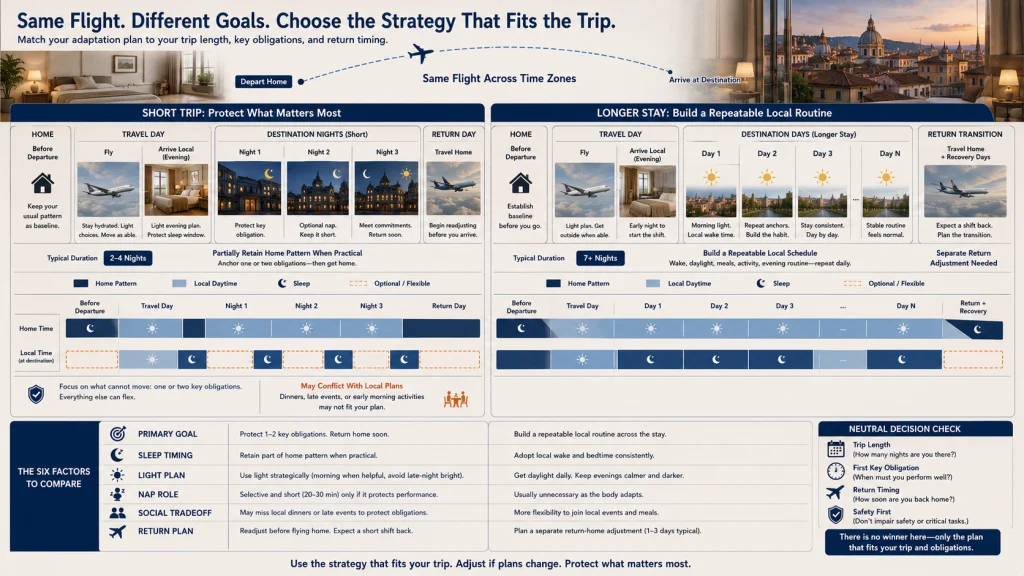
Choose a short-trip strategy or a long-stay strategy
| Planning question | Short trip | Longer stay |
|---|---|---|
| Primary goal | Function during key obligations without forcing complete adaptation | Build a repeatable destination schedule |
| Sleep timing | May retain part of the home pattern when practical | Moves toward local bedtime and wake time |
| Light plan | Supports the limited itinerary and first obligation | Supports repeated local daytime and nighttime anchors |
| Naps | Used selectively to protect function | Reduced as the destination schedule becomes more stable |
| Social tradeoff | Some local events may conflict with retained home timing | More local participation, followed by a larger return-home shift |
| Return preparation | Home schedule may be partly preserved | Requires a separate transition plan |
Do not present the two strategies as better and worse. They solve different itinerary problems.
Build a return-home plan before the trip ends
The return journey is another time-zone transition, not the point where planning stops. Record the home arrival time, transport, work or family obligations, and the first realistic home bedtime.
Protect the final destination sleep period and avoid using the last night for unfinished packing. Translate the return flight into home local time so sleep on board supports the schedule being resumed.
Leave room after arrival for food, unpacking, laundry, and ordinary household demands. A return flight that lands on Sunday evening may not support an early Monday obligation without a clear backup or reduced load.
Use the clock-change sleep guide only when the remaining problem is a local clock shift rather than rapid travel across several zones.
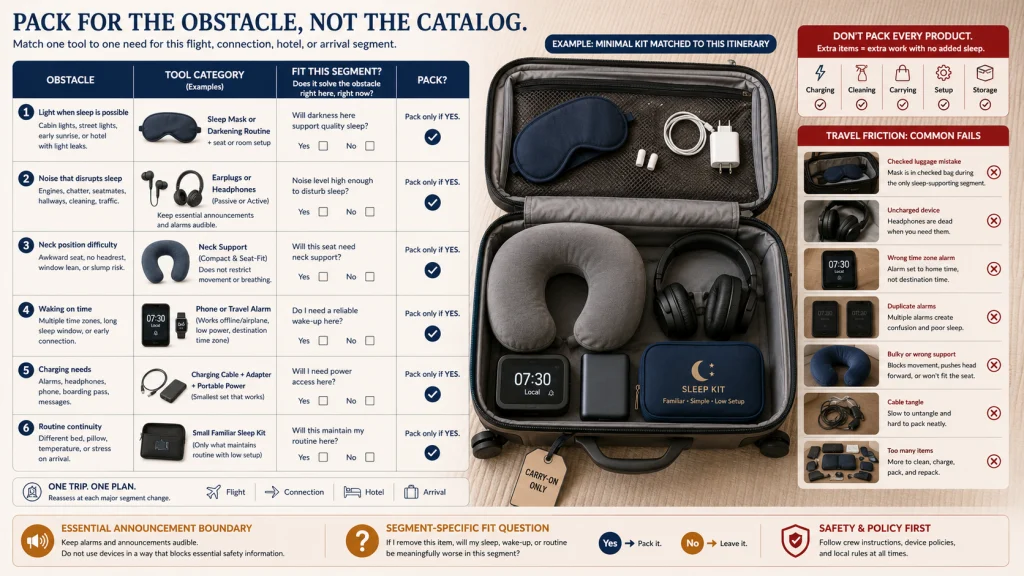
Pack products by the actual obstacle
Travel accessories should solve a specific segment problem. Packing every sleep product can create more cleaning, charging, carrying, and setup work without improving the itinerary.
| Obstacle | Generic tool category | Fit question | Travel friction to check |
|---|---|---|---|
| Cabin or hotel light | Sleep mask or room-darkening routine | Will darkness support sleep during this exact segment? | Heat, pressure, cleaning, and access during connections |
| Noise | Earplugs or headphones | Can essential announcements or alarms still be heard? | Charging, comfort, cleaning, and battery status |
| Neck position | Portable neck support | Does it support the chosen seat and sleep position? | Bulk, packing, heat, and whether it interferes with movement |
| Waking on time | Phone, watch, or travel alarm | Will it work in airplane mode, low power, or an unfamiliar room? | Time-zone settings, volume, charging, and duplicate alarms |
| Charging | Cable, adapter, and portable power routine | Which devices must work for transport, alarms, and communication? | Outlet access, cable confusion, battery rules, and hotel placement |
| Routine continuity | Small familiar sleep kit | Which few items reduce setup rather than add it? | Cleaning, repacking, loss, and storage during the trip |
Editorial observation: A product can work at home and fail during travel because it appears at the wrong point in the itinerary. The mask is packed in checked luggage, the headphones are uncharged, the alarm keeps home time, or the neck support is too bulky to use during the only sleep-supporting segment.
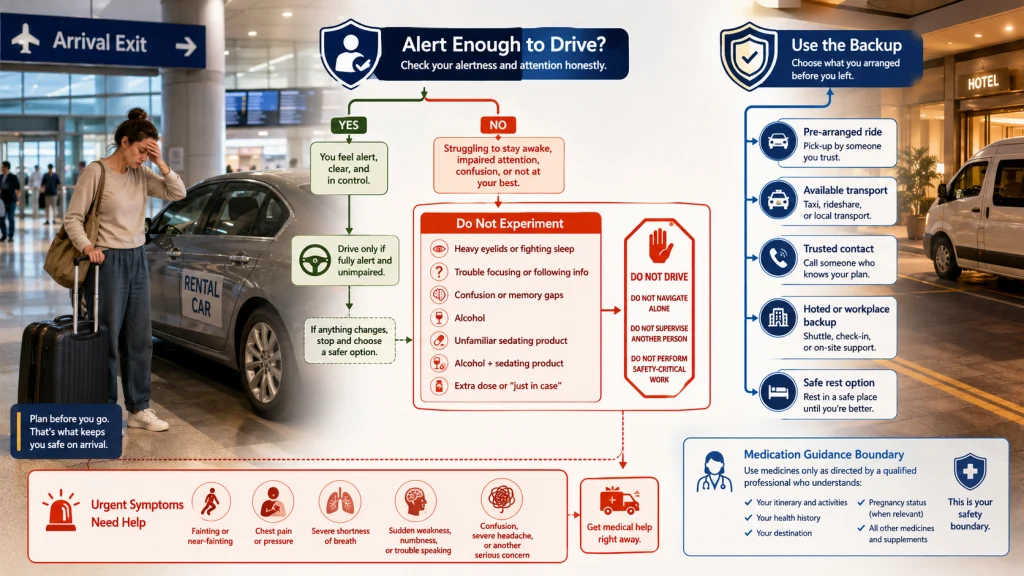
Keep medication, sedatives, severe symptoms, and driving outside self-directed experimentation
Driving and sedating-product boundary:
- Do not drive when struggling to stay awake, unable to maintain attention, confused, or impaired after travel.
- Do not try an unfamiliar sedating product for the first time on a flight or before driving, navigating alone, supervising another person, or performing safety-critical work.
- Do not combine alcohol with sedating products or use extra doses to force sleep.
- Use medication only as directed by a qualified professional who understands the itinerary, health history, destination, and other medicines.
- Arrange transport and a backup before departure when arrival sleepiness is likely.
This article does not prescribe melatonin, sedatives, stimulants, medication timing, or clinical bright-light treatment. Travelers with medical conditions, pregnancy, medication questions, severe or persistent symptoms, or safety-critical duties should seek qualified travel-health or medical guidance.
Seek urgent help for severe symptoms, fainting, chest pain, severe shortness of breath, sudden weakness, confusion, or another emergency concern rather than assuming the problem is ordinary jet lag.
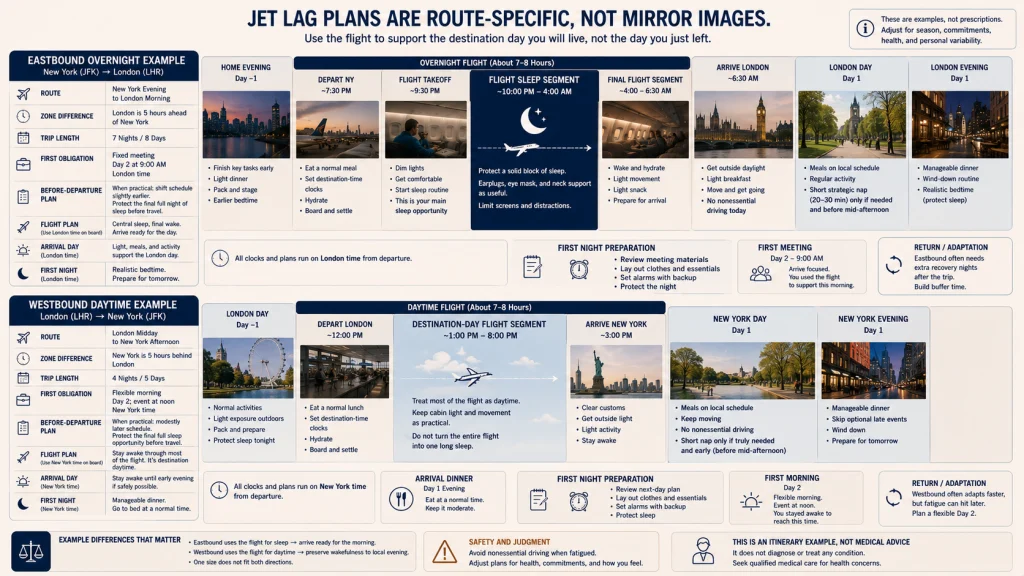
Compare one completed eastbound plan with one completed westbound plan
These schedules are examples of itinerary logic, not personal medical or light-treatment instructions.
Eastbound overnight example
| Input | Example plan |
|---|---|
| Route | New York to London, five-hour time difference |
| Departure and arrival | Depart 7:00 p.m. New York time, arrive 7:00 a.m. London time |
| Trip length | Seven nights |
| First fixed obligation | Meeting at 10:00 a.m. the day after arrival |
| Before departure | Move bedtime and wake time slightly earlier when practical, finish packing before the final night, and protect the last full sleep opportunity |
| Flight plan | Set the working clock to London time, treat the middle of the flight as a sleep-supporting segment, and use the final portion for waking, movement, and arrival preparation |
| Arrival day | Use daylight and local meals to support the London day, avoid nonessential driving, allow a short strategic nap only if needed, and protect a realistic local bedtime |
| First night | Prepare meeting materials and alarms before bed so early waking does not become a scramble |
Westbound daytime example
| Input | Example plan |
|---|---|
| Route | London to New York, five-hour time difference |
| Departure and arrival | Depart 1:00 p.m. London time, arrive 4:00 p.m. New York time |
| Trip length | Four nights |
| First fixed obligation | Dinner at 7:30 p.m. on arrival day and an event at noon the next day |
| Before departure | Move bedtime slightly later when practical without sacrificing the final full night of sleep |
| Flight plan | Treat most of the journey as destination daytime, use movement and ordinary cabin light as practical, and avoid turning the entire flight into a long sleep period |
| Arrival day | Stay awake through the early local evening if safely able, use a manageable meal, and avoid adding optional late activities after dinner |
| First night | Use a realistic New York bedtime, prepare for possible early waking, and keep the next morning flexible before the noon event |
The two plans are not mirror images. The eastbound flight uses an onboard sleep segment to support a morning arrival, while the westbound flight protects enough wakefulness to reach local evening.
Fill the itinerary table and identify the first local-time anchor
Finish the plan in six lines:
- Direction and difference: Record eastbound or westbound travel and the time-zone difference on the actual dates.
- Trip goal: Decide whether the trip needs limited adjustment or a stable destination schedule.
- Flight sleep: Mark which segment supports destination sleep and which segment supports destination daytime.
- Local light and nap: Use general local-time anchors, with qualified guidance for precise light timing.
- First obligation: Protect enough arrival and sleep time before the first meeting, event, drive, or duty.
- Safety backup: Write the transport, medical, or schedule alternative used when alertness is inadequate.
A complete decision might read: “This is a seven-night eastbound trip with a morning arrival. I will use destination time on the flight, reserve the central segment for sleep, and treat the arrival as a local day. My first fixed meeting is the following morning, so the arrival evening stays quiet. I will not drive if I am too sleepy to maintain attention.”
Use the broader sleep improvement guide when travel is exposing a larger sleep problem rather than creating a temporary schedule conflict.
A strong jet lag plan does not promise to erase the time-zone change. It makes the itinerary visible, protects the first local anchors, and keeps safety ahead of squeezing one more activity into the trip.
FAQs
✈️ Should I sleep on an eastbound overnight flight?
Sleep may support the plan when the chosen flight segment overlaps the destination sleep period. Include the connection, landing, and first obligation rather than treating the entire flight as one sleep window.
🌇 Should I stay awake on a westbound flight?
Many westbound daytime itineraries benefit from preserving enough wakefulness to reach local evening, but the exact plan depends on departure, arrival, prior sleep, and safety. A brief rest is different from sleeping through most of the destination day.
🕰️ When should I switch my phone to destination time?
Switching after boarding can make meals, sleep, and arrival preparation easier to organize. Keep connection and boarding information clear so the change does not create a travel error.
☀️ Is morning light always best for jet lag?
No. The effect of light depends on timing, direction, time-zone difference, and the person’s schedule. Use an authoritative calculator or qualified guidance when precise timing matters.
😴 Should I nap immediately after arrival?
A short strategic nap may help when the traveler must remain awake through the local day. A long nap can make the first local night harder, so protect the intended bedtime and allow a wake-up buffer.
☕ Can caffeine fix jet lag?
Caffeine can support planned alertness but does not replace sleep or reset the schedule by itself. Keep it away from the intended sleep period and seek qualified advice for health or medication concerns.
🧳 Is full adaptation useful on a short trip?
Not always. A short trip may benefit from protecting key obligations while retaining part of the home schedule, especially when a return transition follows quickly.
🚗 When should I avoid driving after a flight?
Do not drive when struggling to stay awake, unable to maintain attention, confused, or impaired by travel, alcohol, medication, or a sedating product. Arrange a safer alternative before departure when arrival sleepiness is likely.