A night shift sleep plan works best when sleep is protected as a scheduled block rather than squeezed into whatever time remains. Build the day around one anchor sleep period, then decide whether a pre-shift nap, light boundary, caffeine cutoff, meal plan, and household agreement are needed. Give the commute home the same attention as the shift because dangerous sleepiness can turn the final trip into the highest-risk part of the schedule. Permanent, rotating, and occasional night work require different tradeoffs, so the plan should be tested against real obligations instead of copied from one universal template.
See how sleep gets squeezed out of a 24-hour day
Place one full day on a strip. Add the shift, the commute in both directions, family time, caregiving, meals, errands, showering, and the time needed to settle after work. The remaining block is often labeled “sleep,” even when it is too fragmented or too exposed to daytime noise to function as real recovery time.
| Time block | Planned demand | What can squeeze sleep |
|---|---|---|
| Before shift | Family, meals, preparation, optional nap, commute | Late errands, delayed nap, social obligations |
| During shift | Work, breaks, light exposure, caffeine, meals | Unplanned overtime, weak alertness, irregular breaks |
| After shift | Commute, food, winding down, household transition | Dangerous sleepiness, bright light, errands, phone use |
| Daytime sleep period | Protected anchor sleep | Deliveries, family noise, heat, light, appointments |
A blackout curtain can improve darkness and still fail as a sleep solution when deliveries, family noise, heat, or an unprotected commute keep the sleep period fragmented.
Night-shift sleep fails when it is treated as leftover time.
Separate permanent nights, rotating nights, and occasional overnight duty
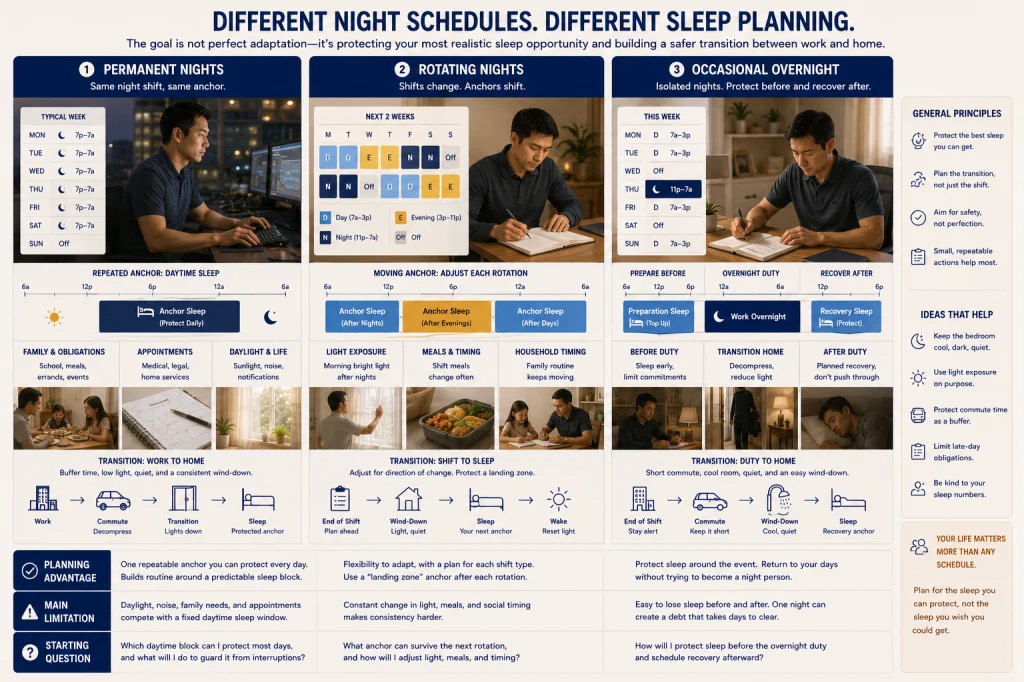
The first planning decision is the type of night work. A stable overnight schedule offers different possibilities from a rota that moves between days and nights or an occasional overnight assignment.
| Shift pattern | Main planning advantage | Main limitation | Useful starting question |
|---|---|---|---|
| Permanent nights | Work timing is predictable enough to protect a repeated sleep block. | Family, appointments, daylight, and days off may pull the schedule earlier. | Which daytime hours can remain protected every workday? |
| Rotating nights | The schedule may include recovery days between blocks. | The body and household keep changing direction, making one stable routine difficult. | Which anchor period can survive the next schedule change? |
| Occasional overnight duty | The person may not need to maintain a night-oriented schedule long term. | The shift can arrive without enough preparation or recovery time. | How will sleep be protected before and after the overnight duty? |
The useful goal is not perfect adaptation. It is to protect sleep opportunity, reduce avoidable disruption, and create a safer transition between work and home.
Identify fixed shift, commute, family, caregiving, meal, and recovery obligations
Write down obligations that cannot move. Include the true shift start and end, handoff time, parking, commute, school pickup, caregiving, shared meals, appointments, and the minimum time needed to wind down.
Then mark obligations that look fixed but may be negotiable. Deliveries can be rescheduled. Phone alerts can be silenced. Household chores can move to another person or another day. Some meals can be prepared before the work block instead of after it. This is where the plan begins to feel less like a timetable and more like protection for a tired person who still has a household to return to.
The schedule becomes more realistic when the invisible transitions are visible. A shift that ends at 7 a.m. may not create a sleep opportunity at 7 a.m. if the commute, shower, food, and household activity continue for another hour or more.
Use the broader sleep schedule planning guide when workdays, days off, naps, and social timing are interacting across the entire week.
Protect one anchor sleep period instead of relying only on fragments
An anchor sleep period is the block treated as the main sleep opportunity. It should be protected from routine errands, nonessential appointments, deliveries, and household interruptions as consistently as the schedule allows.
Some workers also use a second sleep period or nap, but scattered fragments should not become the only plan by default. Several short opportunities can disappear one by one when the day becomes busy.
Choose the anchor by working backward from the next fixed obligation. Include the commute home, a short transition, realistic settling time, and the time needed to wake before family or work responsibilities begin.
Anchor-period test: Can this block stay protected on most workdays, and can the household recognize it as unavailable time rather than flexible daytime?
Decide whether a pre-shift nap fits
A pre-shift nap can add sleep opportunity before an overnight work period, but it must fit around the anchor sleep, commute, meal, and time needed to wake fully before work.
Do not add a nap simply because the schedule contains an empty hour. Decide what the nap is meant to do, how much time is available in bed, and what alertness is required afterward.
Use the nap timing guide to place the nap relative to waking and the shift. Use the nap duration guide to include settling time, alarm time, grogginess risk, and the wake-up buffer.
A nap that ends just before driving to work may create a poor transition even when the duration looks reasonable on paper.
Plan light during the first and second parts of the shift
Light can support alertness during the work period, but the plan should reflect the full sequence of work, commute, and sleep. Brighter surroundings may be useful during the early part of the shift when alertness needs to be supported.
Near the end of the shift, avoid creating a rigid light-reduction routine that makes the commute less safe. Do not wear dark glasses or reduce alerting light in a way that worsens sleepiness before driving.
After arriving home safely, reduce unnecessary light in the sleep environment as part of the wind-down routine. Light timing here is a scheduling tool, not individualized treatment, and it should never be used in a way that makes the drive home less safe.
Use the light timing guide when daytime light exposure needs to be considered within the broader sleep schedule.
Place caffeine inside the shift and set a cutoff
Caffeine should be planned around the intended sleep period rather than used whenever alertness drops. A dose late in the shift may still be active when the worker reaches bed, even if it was helpful several hours earlier.
Mark the likely caffeine window near the beginning or middle of the shift, then set a personal cutoff early enough to protect the anchor sleep opportunity. Keep total use, timing, food, and hydration reasonably consistent while testing the plan.
No universal cutoff hour fits every worker. Questions involving stimulants, medication, health conditions, or pregnancy belong with qualified guidance rather than a generic shift template.
Use the caffeine cutoff guide when the main decision is how caffeine timing relates to the intended sleep period.
Plan meal and hydration logistics without prescribing a diet
Night work can create long gaps between meals, rushed vending-machine choices, or a heavy meal immediately before daytime sleep. The practical goal is to reduce last-minute decisions.
Pack food and drinks before the shift when possible. Decide which meal will happen before work, which food is available during the shift, and whether a small post-shift option is needed before bed.
Use containers, utensils, refrigeration, and charging routines that fit the actual transition times. A meal plan that requires preparation after an exhausting commute may fail even when the food choices are reasonable.
The purpose is logistical, not nutritional prescription. Diet, calorie, meal-frequency, and condition-specific questions require a different level of guidance.
Build a bedroom setup that protects daytime sleep
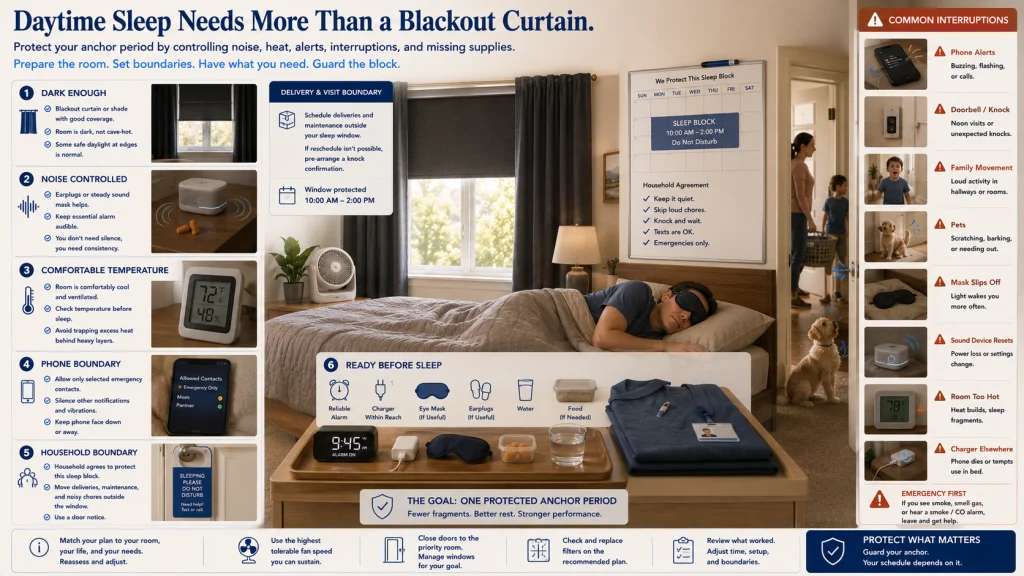
Darkness is only one part of the room. Noise, temperature, phone settings, deliveries, family movement, pets, and maintenance visits can fragment the anchor period. A worker can hang a blackout curtain perfectly and still lose sleep to a warm room, a buzzing phone, or the doorbell at noon.
Room-setup checklist:
- ☐ Curtains, shades, or a mask reduce unwanted light without making the room uncomfortably hot.
- ☐ Earplugs or steady sound reduce predictable noise without blocking an essential alarm.
- ☐ The room temperature remains comfortable through the full anchor period.
- ☐ Phone settings allow only genuine emergencies or selected contacts.
- ☐ Deliveries, doorbells, and scheduled visits are moved away from sleep hours.
- ☐ Family members know the exact time the worker is unavailable.
- ☐ The alarm can wake the person without creating a chain of repeated snoozes.
- ☐ Chargers, mask, earplugs, water, food container, and work items are ready before sleep begins.
The room does not need to become silent or perfect. It needs to remove the predictable friction that keeps appearing at the same transition points. A mask that slips, earplugs that make the alarm hard to hear, a sound machine that must be reset after a power interruption, or a charger left in another room can each break a routine that looked complete on paper.
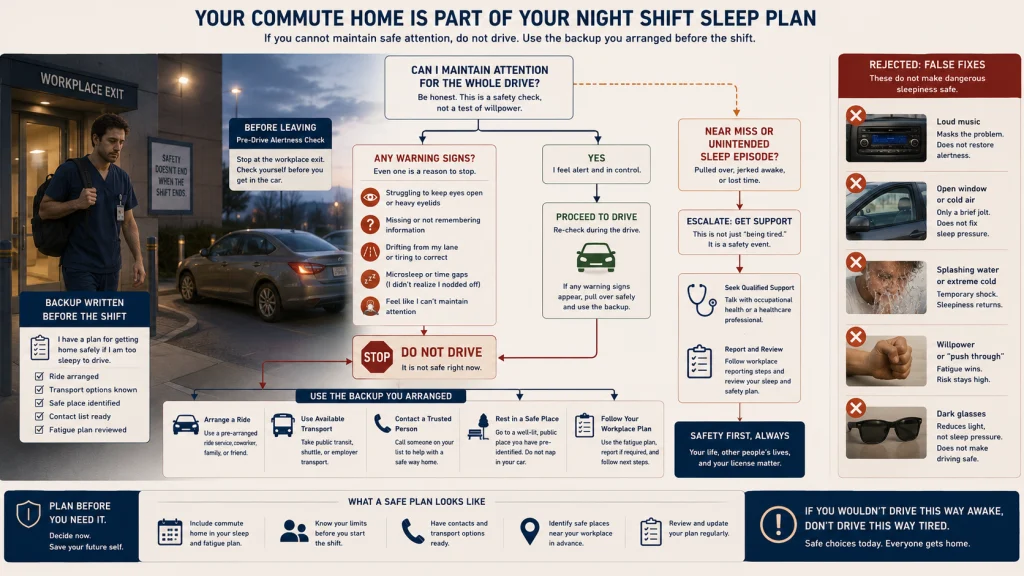
Use a commute-home decision tree for dangerous sleepiness
Commute-safety decision:
- Before leaving: Am I struggling to keep my eyes open, missing information, drifting, or feeling unable to maintain attention?
- If yes: Do not begin or continue driving. Stop in a safe place and use a safer alternative.
- Choose a backup: Arrange a ride, use available transport, rest in an appropriate safe place, contact someone, or follow the workplace fatigue plan.
- After a near miss or unintended sleep: Seek qualified occupational or medical support rather than treating the event as a normal part of night work.
Music, open windows, cold air, willpower, or darker glasses do not make dangerous sleepiness safe. The backup must be written before the shift, while judgment and planning are easier.
Give the commute home equal status with the work period. A plan that protects performance during the shift but leaves no safe route home is incomplete.
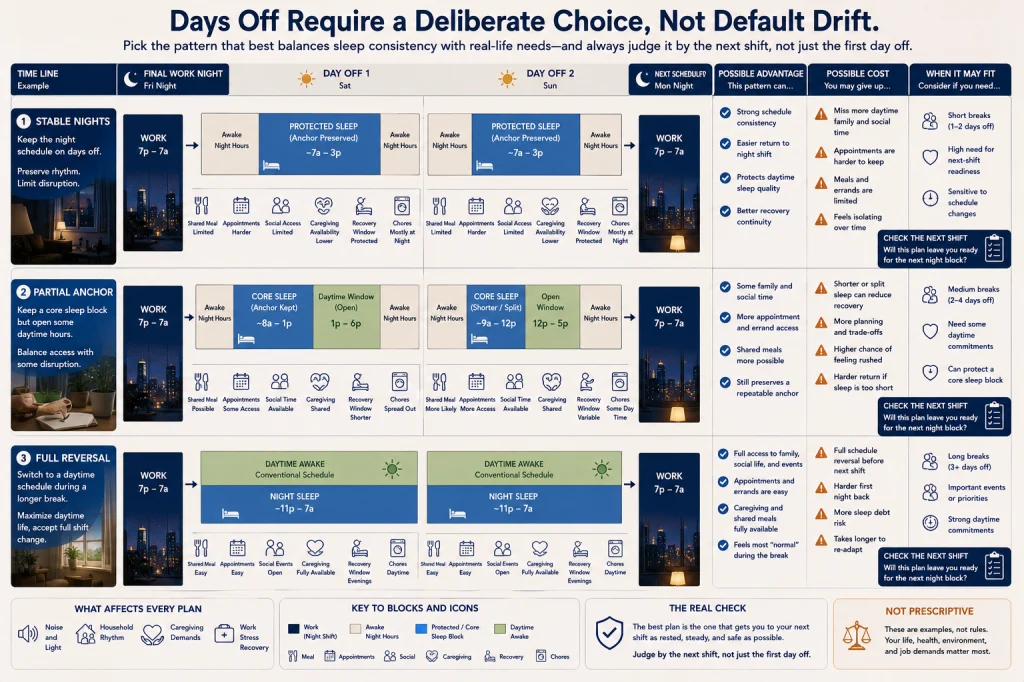
Choose a days-off strategy with social and family tradeoffs
Days off create a difficult choice: keep the night-oriented schedule, move partly toward daytime, or reverse fully. No option removes every tradeoff.
| Days-off option | Possible advantage | Possible cost | When it may be considered |
|---|---|---|---|
| Stable night schedule | Preserves the workday sleep pattern. | Limits daytime family, social, and appointment access. | Permanent night work with predictable obligations. |
| Partial anchor | Keeps part of the sleep period consistent while opening some daytime hours. | Creates shorter or split sleep opportunities and requires careful planning. | Workers balancing repeated nights with family or social needs. |
| Full reversal | Creates more conventional daytime availability. | Requires repeated schedule changes and may make the next night block harder. | Longer breaks between night blocks, when recovery time is available. |
Choose the option by looking at the next shift, not only the first day off. A social plan that feels successful on Saturday may leave too little recovery before Sunday night work.
Household coordination matters here. The days-off decision affects shared meals, caregiving, noise, errands, and the expectations of people who may view daytime as automatically available.
Recognize why rotating shifts resist one universal plan
A rotating schedule may move from days to evenings to nights before one pattern becomes predictable. The anchor period, light exposure, caffeine window, meal timing, and family availability can all change together.
Build the plan for the current block and the transition that follows it. Protect the most repeatable sleep opportunity, avoid changing every variable at once, and leave recovery room before another major schedule change.
Rotating work may never feel fully settled because the direction keeps changing. Persistent inability to sleep, severe impairment, or dangerous sleepiness requires qualified occupational or medical support.
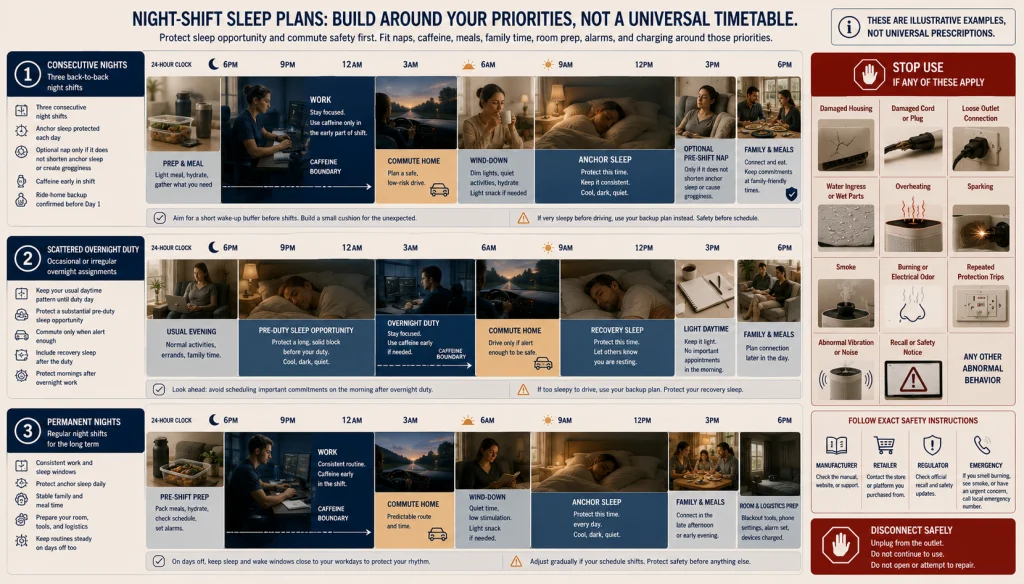
Compare three schedule examples
These examples show planning logic, not universal prescriptions. Exact times must be adjusted to the real shift, commute, household, sleep opportunity, and individual response.
Three consecutive night shifts
Illustrative schedule: Work from 11:00 p.m. to 7:00 a.m., commute home from 7:00 to 7:40 a.m., wind down and eat lightly, then protect an anchor sleep period from about 8:30 a.m. to 3:30 p.m. A pre-shift nap from roughly 8:30 to 9:15 p.m. is optional only when it does not shorten the anchor period or leave the worker groggy before the commute. Caffeine stays in the earlier part of the shift, and the ride-home backup is confirmed before the first night.
Scattered overnight duties
Illustrative schedule: Keep the usual daytime pattern until the duty day, then protect a sleep opportunity from about 2:00 to 6:00 p.m. before a 10:00 p.m. to 6:00 a.m. overnight assignment. After the shift, commute only if alert enough to do so safely, then use a recovery sleep block from around 7:30 a.m. to early afternoon. Family plans and appointments stay out of that morning rather than assuming one pre-shift nap can replace recovery afterward.
Permanent night schedule
Illustrative schedule: Work from 9:00 p.m. to 5:00 a.m., arrive home near 5:45 a.m., and protect a repeated anchor period from about 7:00 a.m. to 2:30 p.m. Use the late afternoon for family, meals, and errands, then prepare for work without compressing the final hour before the shift. Room protection, food containers, phone settings, alarms, and charging routines become part of the repeated transition instead of emergency fixes.
Each example begins with sleep opportunity and commute safety. Products, alarms, and blackout tools are fitted around those priorities, not used to compensate for a schedule with no protected recovery block.
Log sleep opportunity, actual sleep, naps, alertness, and commute risk
A short log can reveal whether the plan fails because the sleep window is too small, the room is repeatedly disrupted, the nap is poorly placed, or alertness falls at a predictable point in the shift.
| Log item | What to record |
|---|---|
| Sleep opportunity | Time set aside in bed with interruptions blocked. |
| Estimated actual sleep | Approximate sleep obtained without treating a wearable estimate as a diagnosis. |
| Nap | Timing, time in bed, wake-up buffer, and purpose. |
| Alertness | When attention became difficult during work or the commute. |
| Room disruption | Light, noise, heat, deliveries, calls, pets, or family interruption. |
| Commute risk | Sleepiness, near misses, unintended lane drift, or the need to use a backup. |
Change one part of the plan at a time when possible. Moving the anchor, nap, caffeine, room setup, and days-off schedule together makes the result difficult to interpret.
Know when occupational or medical support is needed
Escalation boundary: Drowsy driving, unintended sleep episodes, near misses, severe daytime sleepiness, persistent inability to function, pregnancy-related concerns, or repeated failure to obtain adequate sleep opportunity requires qualified occupational or medical support and immediate safety action where appropriate.
The scope remains schedule planning. Diagnosis, medication, supplements, individualized light treatment, and employer compliance require qualified support.
Support is also appropriate when the schedule repeatedly requires safety-sensitive work without adequate recovery, when the worker cannot protect a realistic sleep period, or when symptoms persist despite a practical plan.
Protect the anchor period, choose the nap rule, set the caffeine boundary, and write the commute backup
Finish the plan in four lines:
- Anchor period: Write the protected sleep block and the household boundaries around it.
- Nap rule: State when a pre-shift nap is used, how it fits the window, and how much wake-up time is required.
- Caffeine boundary: Mark the part of the shift when caffeine may be used and the cutoff that protects the sleep period.
- Commute backup: Write the action taken when the worker is too sleepy to drive safely.
A complete plan might read: “My daytime anchor is protected after each shift. I will use a pre-shift nap only when it does not shorten that block. Caffeine stays in the earlier part of the shift. If I am struggling to stay awake after work, I will not drive and will use the backup arranged before the shift.”
Use the broader sleep improvement guide when the night-work schedule is one part of a larger sleep problem.
The strongest plan does not ask the worker to power through. It protects sleep as real time, keeps the commute inside the safety plan, and makes household cooperation part of the schedule rather than an afterthought.
FAQs
🌙 What is the most important part of a night shift sleep plan?
Protect one anchor sleep period instead of treating daytime sleep as flexible leftover time. The room, household, commute, meals, nap, and caffeine plan should support that block.
😴 Should I nap before a night shift?
A pre-shift nap can fit when it adds sleep opportunity without shortening the main sleep period. Include settling time and a wake-up buffer before driving or work.
☕ When should caffeine stop during a night shift?
Set the cutoff relative to the intended daytime sleep period rather than using one universal clock time. Keep health, pregnancy, medication, and stimulant questions within qualified guidance.
🕶️ Should I wear dark glasses before driving home?
Do not reduce alerting light in a way that worsens sleepiness before driving. Commute safety comes before a light-reduction routine.
🏠 How can family help protect daytime sleep?
Treat the anchor period as unavailable time, move deliveries and chores, reduce predictable noise, and reserve phone interruptions for genuine needs. Clear household boundaries are part of the plan.
📆 Should I switch back to days on days off?
Stable nights, a partial anchor, and full reversal each involve social and sleep tradeoffs. Choose by the length of the break, next shift, family needs, and ability to recover.
🔄 Can rotating shifts be handled with one schedule?
Usually not. Build the plan for the current block and the transition that follows it, while protecting the most repeatable sleep opportunity available.
🚗 What should I do if I am too sleepy to drive home?
Do not begin or continue driving. Stop in a safe place and use the backup arranged before the shift, such as a ride, available transport, an appropriate rest option, or the workplace fatigue plan.