Air purifier and HVAC filters should not be cleaned or replaced on one universal calendar. Begin by identifying every filter stage and its part number, then use the manual to learn whether each part may be vacuumed, washed, dried, reset, or replaced. Track how the machine is used, what the filter encounters, how airflow and odor performance change, and whether a properly fitting replacement remains available. Stop using the affected equipment when the required media is unsafe, damaged, recalled, or impossible to replace through a supported path.
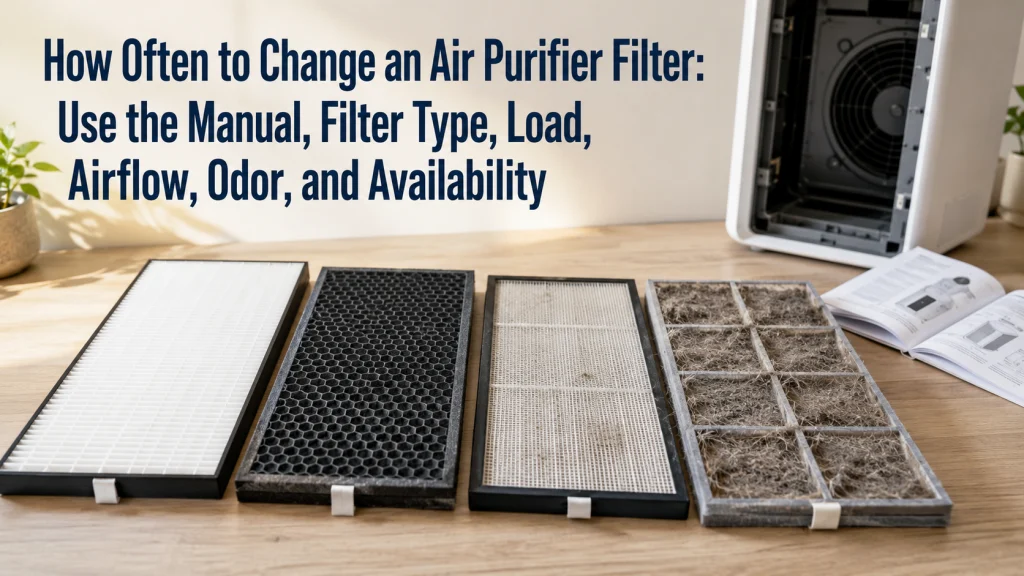
Four Six-Month-Old Filters Can Need Four Different Actions
Four filters have all been in service for six months. A bedroom particle filter ran quietly at low speed in a low-dust room. Another filter handled a period of heavy smoke. A washable prefilter is covered in hair and lint. A thin carbon sheet still looks intact but no longer reduces the odor that originally prompted its use.
The calendar age matches. The media, load, condition, and next action do not.
Four-filter opening:
Filter A: lightly used bedroom particle filter
Manual allows replacement only → inspect condition, airflow, fit, indicator history, and documented interval
Filter B: smoke-loaded particle filter
High source load → inspect sooner and replace when the manual or condition calls for it
Filter C: washable prefilter covered in hair
Manual permits washing → clean through the approved method and dry completely before reinstalling
Filter D: thin carbon sheet with odor breakthrough
Odor-control function has declined → check the replacement instruction for that stage rather than copying the particle-filter schedule
The useful question is not simply how old the filter is. It is what the media is designed to do, what it has encountered, how the equipment is behaving, and what the model manual permits. That distinction matters when an owner is staring at a clean-looking filter and wondering whether replacing it now wastes money or postponing it risks using the machine incorrectly.
Define Prefilters, Particle Media, Carbon, Combination Filters, Loading, Bypass, and Indicators
Prefilters sit upstream and catch larger debris such as hair, lint, and coarse dust before it reaches later stages. Some can be washed, some may only be vacuumed, and others must be replaced. The model manual determines which instruction applies.
Particle filters capture airborne particles through fibrous or other physical media. HEPA media appears in many portable air cleaners, but the label alone does not reveal whether that particular part is washable, vacuumable, reusable, or compatible with another model.
Activated carbon supports control of certain gases and odors, and its condition cannot be judged the same way as visible particle loading. Combination filters place particle and carbon functions in one assembly, which means one stage cannot always be serviced independently.
Loading is the buildup of captured material in or on the media. Saturation describes a stage that can no longer provide its intended adsorption function effectively under the current use. Bypass occurs when air travels around a poorly fitting filter rather than through it.
Filter indicators may estimate elapsed time, operating hours, pressure behavior, or another model-specific condition. Their value depends on understanding what is measured and how the reset works. One light should not be treated as proof that every filter stage has the same remaining service condition.
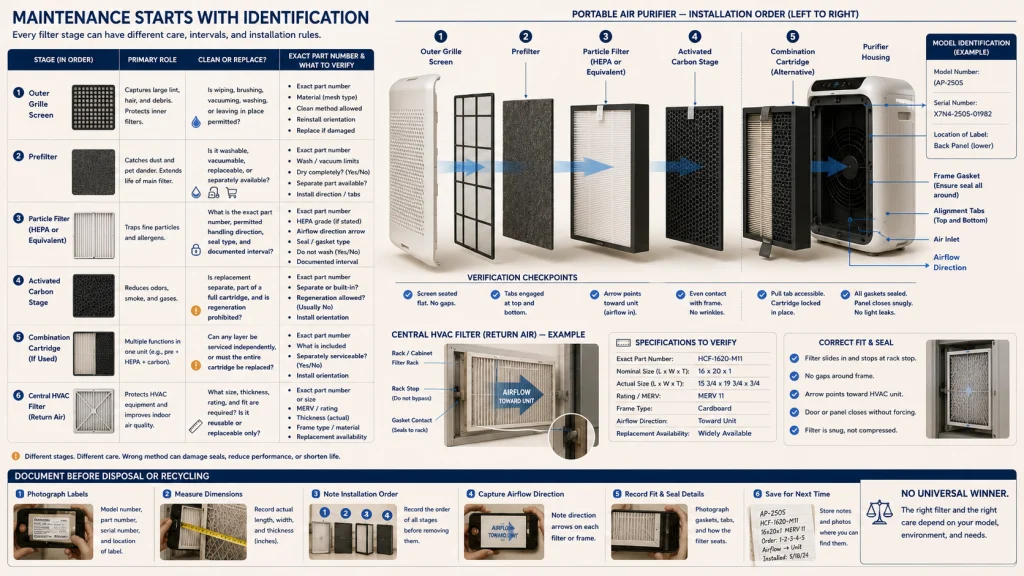
Inventory Every Filter Stage and Part Number
Open the maintenance section of the manual before removing anything. A purifier may have a grille screen, removable prefilter, particle filter, carbon sheet, combination cartridge, sensor cover, or another serviceable part. An HVAC system may use a return-grille filter, an equipment-side filter, or an approved media cabinet.
| Filter-stage maintenance table | Primary role | Typical maintenance question | What must be verified |
|---|---|---|---|
| Outer screen or grille | Keeps large debris away from internal parts | Wipe, brush, vacuum, wash, or leave in place? | Removal method, electrical boundary, cleaning method, and drying requirement |
| Prefilter | Captures hair, lint, and coarse dust | Clean or replace? | Whether it is washable, vacuumable, replaceable, and sold separately |
| Particle or HEPA stage | Captures airborne particles | Inspect or replace? | Part number, permitted handling, installation direction, seal, and interval guidance |
| Carbon stage | Supports control of certain gases or odors | Replace separately or with the main cartridge? | Media form, part number, odor-use limits, and whether regeneration is prohibited |
| Combination filter | Combines two or more functions | Can any layer be serviced alone? | Assembly instructions, gasket condition, frame fit, and replacement availability |
| Residential HVAC filter | Filters recirculated air within the approved central system | Replace by condition and current instructions? | Actual dimensions, thickness, airflow arrow, approved rating, rack fit, and system behavior |
Record the model, filter name, part number, actual dimensions, number of stages, installation order, and airflow direction. Photograph the labels before disposal so the replacement search does not depend on memory, a rounded size, or a similar product image.
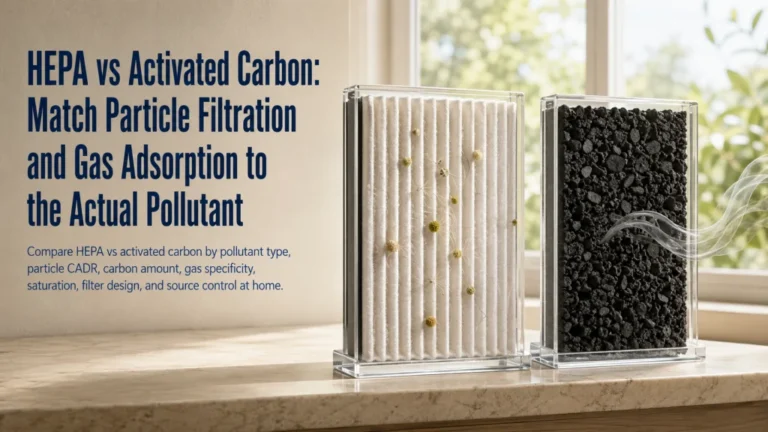
Particle and activated-carbon filter roles explains why these media solve different problems and should not be placed on one shared maintenance schedule.
Follow the Manual for Cleaning, Vacuuming, Washing, Drying, Resetting, and Replacement
The model manual controls what can be done to each stage. One removable black screen may be washable, while a similar-looking part in another machine must be replaced. Particle media can differ just as sharply, so appearance is a poor substitute for the written instruction.
For every stage, confirm:
- Whether the equipment must be unplugged or otherwise made safe before access.
- Which parts may be removed by the owner.
- Whether brushing, wiping, vacuuming, rinsing, washing, or no cleaning is allowed.
- Which cleaning agents, temperatures, tools, and water exposure are prohibited.
- How long the part must dry and whether complete dryness is required before reinstallation.
- Whether the stage is reusable or must be replaced.
- How the filter indicator is reset after the correct maintenance is completed.
- How damaged, damp, or heavily soiled media should be handled and discarded.
Do not reset the light merely to silence it. The reset should record that the correct cleaning or replacement action has actually occurred.
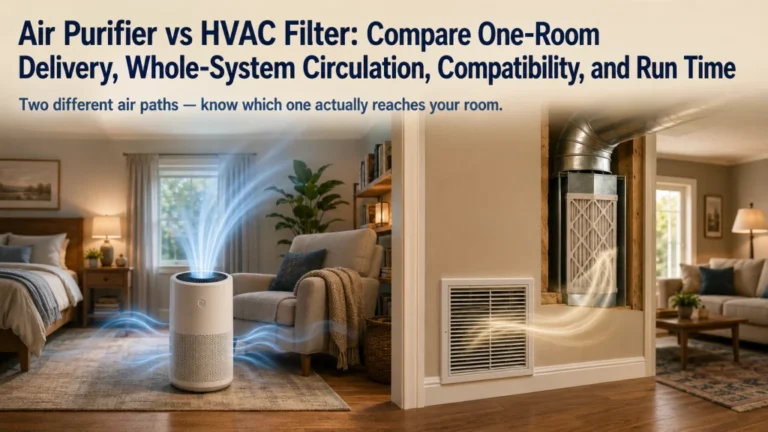
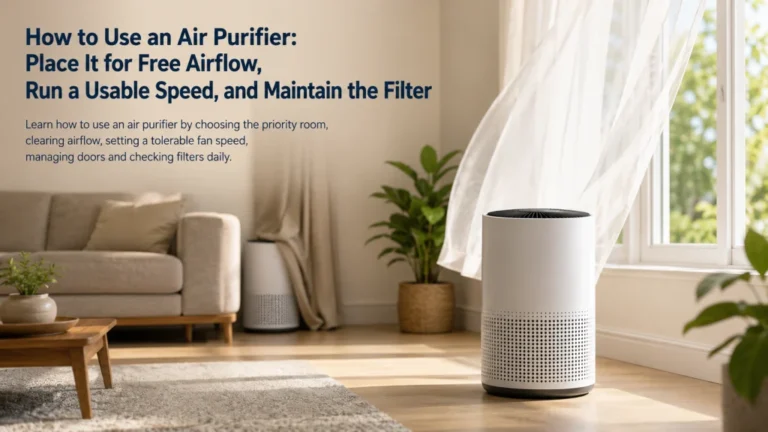
Routine air-purifier operation covers placement, airflow clearance, fan use, room boundaries, and ordinary checks around the maintenance cycle.
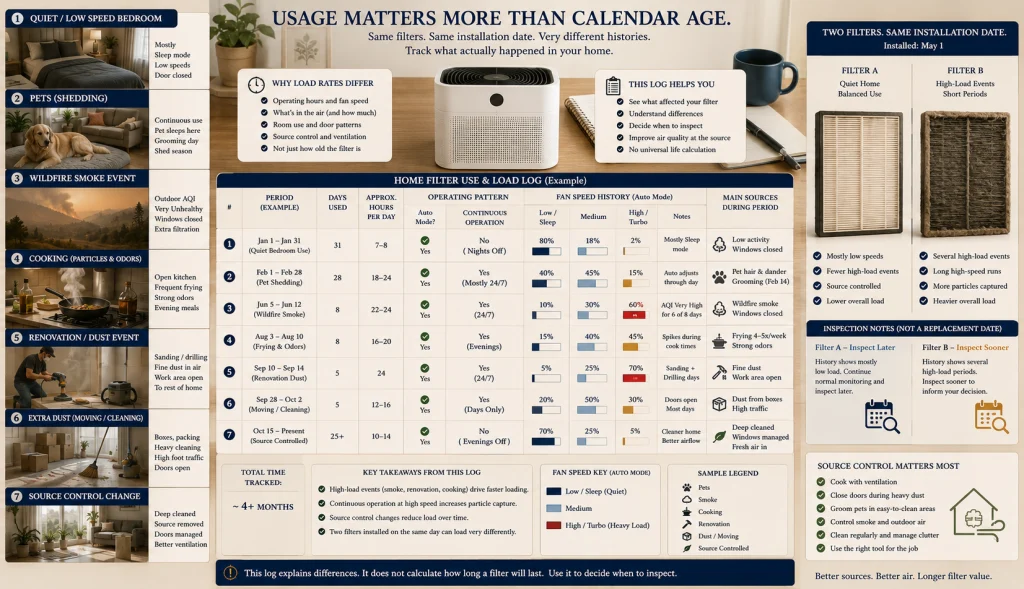
Track Operating Hours, Fan Speed, Pets, Smoke, Cooking, Renovation, Dust, and Source Events
Identical filters can age differently because they live in different rooms and encounter different sources. Continuous operation near a shedding pet, open kitchen, or renovation zone creates a different maintenance history from occasional use in a closed bedroom.
| Use-and-load log | What to record | Why it matters |
|---|---|---|
| Operating pattern | Days used, approximate hours, automatic mode, and periods of continuous operation | Separates calendar age from actual use |
| Fan speed | Low, medium, high, sleep, or changing automatic speeds | Shows how aggressively air has been drawn through the media |
| Pets | Hair, dander sources, sleeping area, and grooming events | Helps explain rapid prefilter blockage or surface loading |
| Smoke events | Wildfire smoke, indoor smoke, or another verified source event | Identifies periods that may accelerate loading or odor breakthrough |
| Cooking | Frequent frying, strong odors, or open-kitchen use | Helps separate particle and carbon-stage demands |
| Renovation and dust | Sanding, drilling, moving, construction, or unusually dusty cleaning | Signals a need for earlier inspection without inventing a universal interval |
| Source-control change | Source removed, room cleaned, ventilation changed, or door pattern changed | Explains why the next filter may load differently from the previous one |
Use the log to explain differences, not to calculate an unsupported life expectancy. A short period of severe loading may matter more than several quiet months.
Source control and clean outdoor-air ventilation remain primary when applicable and safe. Filtration maintenance should support those actions rather than become a reason to leave an avoidable source in place.
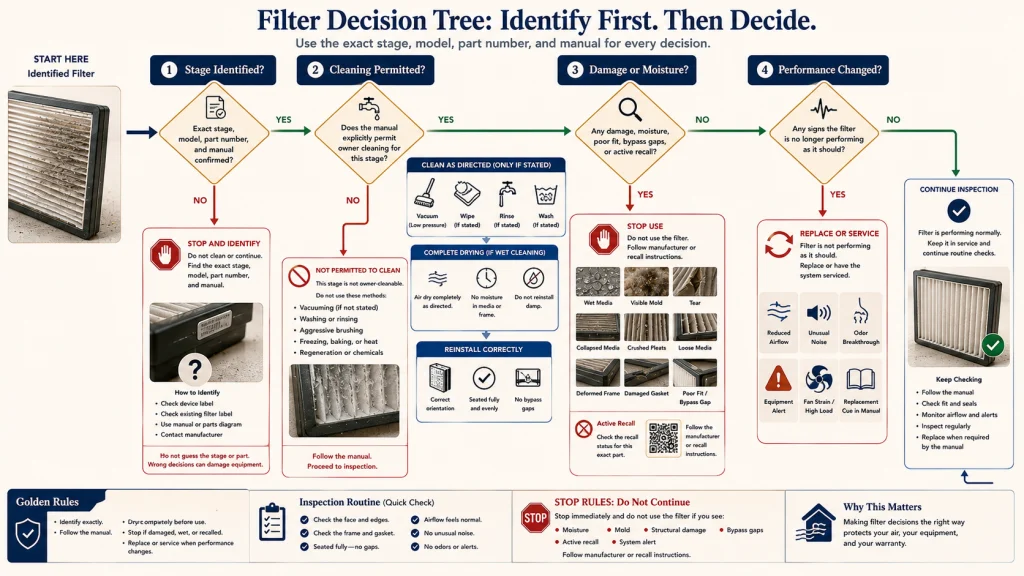
Inspect Blockage, Airflow, Noise, Odor, Damage, Moisture, and Fit
Inspect the filter and the equipment as one system. A clean-looking surface does not rule out internal loading, carbon decline, a damaged gasket, or an airflow problem elsewhere in the pathway.
Clean-versus-replace decision tree:
Is the filter stage identified?
No → Stop and confirm the model, part number, and manual.
Yes → Continue.
Does the manual permit owner cleaning?
Yes → Use only the stated method, then dry and reinstall as directed.
No → Do not vacuum, wash, brush aggressively, freeze, bake, or attempt regeneration.
Is the stage damaged, wet, moldy, deformed, poorly fitting, or recalled?
Yes → Stop using the affected equipment and follow the manufacturer or recall instructions.
No → Continue.
Is there reduced airflow, unusual noise, odor breakthrough, a system alert, or another documented replacement cue?
Yes → Follow the manual’s replacement or service route.
No → Continue the approved inspection routine.
Inspect prefilter blockage, frame stiffness, gasket contact, tears, bowed edges, crushed pleats, loose media, moisture, staining from a known event, and any gap that allows air to pass around the filter. Listen for a new whistle, rattle, fan strain, or change in normal operating sound.
For carbon stages, odor breakthrough may be a useful functional clue when the source and original odor-control purpose are known. It should not be used to diagnose a hazardous exposure or to prove that the surrounding air is safe.
Treat Filter Color and Timer Lights as Incomplete Clues
Dust type, lighting, media color, room source, and collection pattern can all change how a filter looks. Darkening may reflect visible loading, while a pale surface says little about deeper media, the carbon stage, or the airflow condition.
Indicator lights also differ. One may count elapsed days, another may estimate operating hours, and another may respond to a model-specific sensor or pressure condition. Its meaning comes from the equipment documentation, not from the color of the light alone.
Nora’s observation: A filter light can create false precision because it looks like a direct measurement of the media. I check what the indicator actually counts before treating it as a maintenance decision. I also record the installation date and source events, since a light cannot remember that the room was renovated or exposed to smoke.
Use color, indicator status, observed condition, airflow, odor performance, and the recorded use history together. None of these should override a manual instruction, recall, or clear physical damage.
Never Wash, Vacuum, or Reuse Media Unless the Manual Permits It
Cleaning can damage media, disturb captured material, weaken a seal, deform a frame, or leave moisture inside the filter. Even a method that feels careful may alter the part in a way the owner cannot see. This is where the understandable wish to save a replacement cost can create a larger problem.
Do not:
- Wash a particle or HEPA stage unless the manual identifies that part as washable.
- Vacuum the media unless the manual allows that method and explains how to do it.
- Use compressed air to blow captured material back into the room.
- Freeze, bake, microwave, sun-treat, spray, perfume, or chemically regenerate a filter.
- Reinstall a washable part before it is completely dry when dryness is required.
- Reuse a torn, moldy, wet, deformed, or contaminated filter because a replacement is inconvenient.
When the filter encountered a hazardous or unknown substance, do not improvise cleaning or disposal. Follow the relevant product, local safety, and qualified professional instructions for the situation.
Do-it-yourself air cleaners also depend on filter condition and fit. Dirty, damaged, or poorly secured media should not be treated as a permanent reusable component.
Replace Residential HVAC Filters by Current Instructions, Condition, and Snug Fit
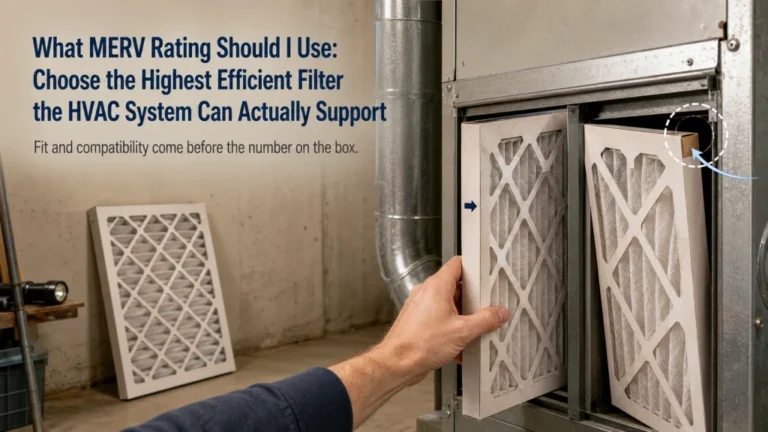
Residential HVAC filters belong to the approved central system. Their maintenance depends on the equipment, rack, actual size, thickness, airflow direction, and permitted efficiency.
Before replacement:
- Confirm the equipment and filter location.
- Record nominal size and measured length, width, and thickness.
- Check the approved filter type and rating.
- Inspect the rack, access door, clips, stops, gasket, and airflow arrow.
- Remove the old filter without dropping accumulated debris into the equipment.
- Install the replacement squarely without crushing, trimming, stacking, or improvising a spacer.
- Confirm that the door closes normally and no obvious bypass gap remains.
Replacement timing should follow current equipment and filter instructions together with observed loading and system behavior. Unusual noise, reduced airflow, repeated alerts, icing, overheating, collapsing media, or comfort changes require qualified HVAC assessment rather than a shorter calendar guess.
MERV selection and HVAC-filter fit covers efficiency categories, nominal versus actual size, airflow compatibility, bypass, and when a technician should review the system.
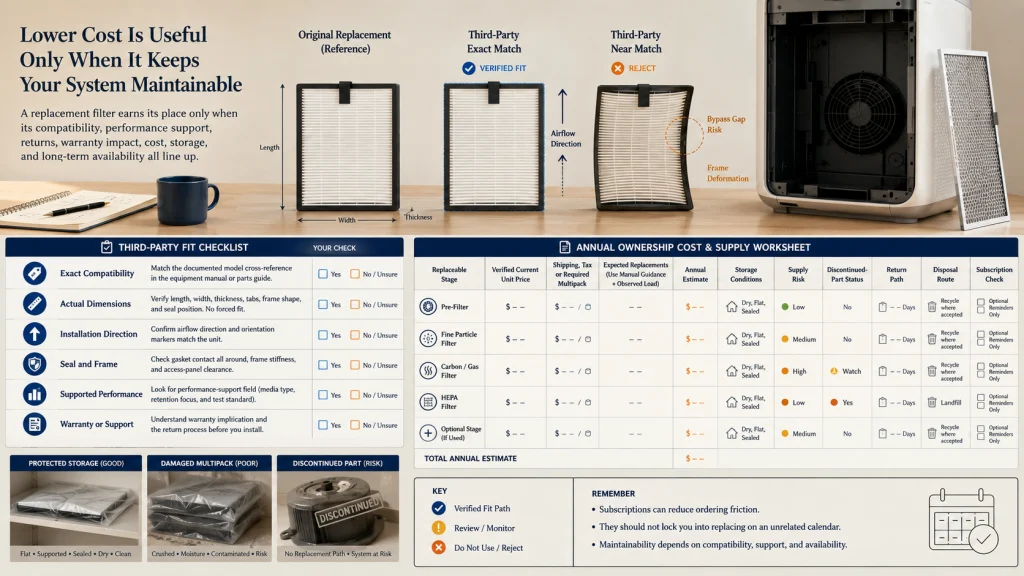
Verify Third-Party Filters by Dimensions, Seal, Supported Performance, and Warranty Implications
Lower-cost replacements may look identical in a listing while differing in dimensions, frame stiffness, gasket placement, media area, airflow resistance, or performance documentation. A nearly correct fit can still create rattling, bypass, a difficult access panel, or a filter that shifts during use. That near-match is frustrating because the problem may not appear until the package is open and the old filter has already been discarded.
| Third-party-fit checklist | What to verify | Reject when |
|---|---|---|
| Part compatibility | The replacement identifies the equipment model or a documented cross-reference | The listing relies only on a similar shape or broad model family |
| Actual dimensions | Length, width, thickness, tabs, frame shape, and seal location | The frame must be forced, bowed, taped, or left loose |
| Installation direction | Airflow arrow, front and back, tabs, handles, and stage order | The orientation cannot be matched to the equipment |
| Seal and frame | Gasket contact, stiffness, edge integrity, and access-panel clearance | Visible bypass gaps, rattling, deformation, or poor retention appear |
| Performance support | Clear documentation for the claimed media and intended use | The claims rely only on vague marketing language |
| Warranty and support | Current equipment terms, seller return process, and replacement responsibility | Compatibility risk is shifted entirely to the owner without usable documentation |
Do not assume that a third-party part is unsafe merely because it is not original, or that it is equivalent merely because it fits the opening. Verify the replacement from its own documentation and understand any warranty implications before installation.
Plan Annual Cost, Storage, Supply Risk, Discontinued Parts, and Disposal
The purchase price of the machine is only the first ownership cost. Separate prefilters, particle filters, carbon sheets, combination cartridges, shipping, subscriptions, and disposal can change the long-term burden.
| Annual filter-cost worksheet | Entry | Planning question |
|---|---|---|
| Filter stages | [list every replaceable stage] | Are stages replaced separately or as one cartridge? |
| Current unit price | [record verified current price] | Does the price include shipping, tax, or a required multipack? |
| Expected replacements | [use the manual and observed load, not a universal interval] | Which source events could increase inspections or replacement needs? |
| Annual estimate | Unit cost × expected replacement count | Is the estimate based on actual household use rather than package marketing? |
| Storage | [space, humidity, temperature, frame protection] | Can multipacks be stored without crushing, moisture, or contamination? |
| Supply risk | [direct availability, retailer options, part status] | Is the required part consistently available, delayed, or discontinued? |
| Disposal route | [manufacturer and applicable local instructions] | Does the filter require special handling because of what it captured? |
Nora’s observation: A low purchase price can become expensive when the filter is proprietary, sold only in combination packs, frequently backordered, or discontinued before the machine wears out. I check replacement availability and the total filter system before treating the appliance price as the real cost.
Subscriptions may reduce ordering friction, but they should not force replacement on a schedule that ignores condition and use. Confirm cancellation terms, shipment timing, storage needs, and whether the supplied part still matches the equipment.
Air-purifier ownership planning includes replacement availability, filter access, noise, room fit, controls, and recurring cost before purchase.
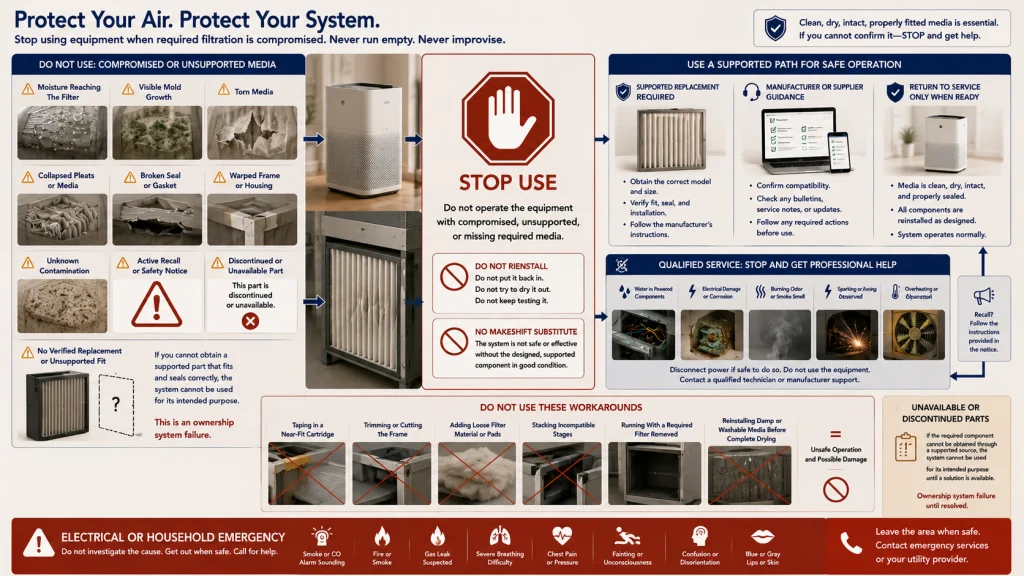
Stop When the Required Filter Is Unsafe, Damaged, Recalled, or Unavailable
Wet-and-damaged filter warning:
- Stop using the affected equipment when moisture reaches a filter and the manual provides no approved recovery step.
- Do not clean and reinstall media with visible mold growth, tears, collapsed structure, broken seals, warped frames, or unknown contamination.
- Follow current recall instructions immediately when the equipment or filter is recalled.
- Do not operate the machine without required filter stages or with a makeshift substitute.
- When the required replacement is unavailable, discontinued, or cannot be verified, treat the ownership system as failed until a supported part or manufacturer-approved path is found.
- Stop and seek qualified help for electrical damage, water entering powered components, burning odors, sparking, overheating, or abnormal equipment behavior.
Missing replacement parts create more than a shopping inconvenience. Without the required stage, the machine no longer has the filtration path it was designed to use. Avoid taping in a near-fit cartridge, trimming a frame, layering loose media, or running the unit empty.
If a smoke or carbon monoxide alarm sounds, fire or smoke is visible, a gas leak is suspected, or severe breathing difficulty, chest pain, fainting, confusion, blue or gray lips, or other emergency signs occur, leave the area when safe and contact emergency or utility services as appropriate. Persistent or worsening symptoms require qualified medical guidance.
Use Media Type, Manual, Load, Condition, Fit, Supply, and Cost
Begin by identifying every filter stage, part number, measured dimensions, installation order, and maintenance instruction. Keep prefilter cleaning, particle-media replacement, carbon performance, combination cartridges, and HVAC filters on their own decision paths rather than giving them one calendar age.
Keep a short record of use and unusual source events, then inspect how the machine sounds, moves air, controls odor, and holds the filter in place. Color and indicator lights can support the decision, but neither one can carry it alone.
Never wash, vacuum, freeze, bake, regenerate, or reuse media unless the manual permits the method. Verify third-party replacements, plan recurring cost and supply risk, and pause operation when the filter system can no longer be maintained safely or as designed.
For the broader relationship among filter types, placement, runtime, source control, ventilation, and maintenance, continue through air cleaners and air filters. The wider home context belongs within a healthy home environment.
FAQs
📅 How often should I change an air purifier filter?
Start with the model manual and the filter stage, then consider use history, source load, airflow, odor performance, condition, fit, and what the indicator actually measures. No single interval fits every purifier or household.
🧹 Can I vacuum an air purifier filter?
Only when the model manual permits vacuuming for that stage and explains the method. A visible fabric surface or reusable frame does not make the media vacuum-safe.
💧 Can I wash a HEPA filter?
Only when the product manual identifies that filter as washable. Do not rinse ordinary replaceable particle media or reinstall an approved washable part before it is fully dry as directed.
💡 Does the filter light mean the filter is dirty?
Not necessarily. The indicator may count time, operating hours, or another model-specific condition. Check what it measures and reset it only after completing the correct maintenance.
🎨 Can filter color show when replacement is needed?
Color is only one clue. Dust type, lighting, media color, and loading pattern can change appearance. Use the manual, condition, airflow, odor performance, use history, and damage checks together.
🧩 Are third-party replacement filters acceptable?
They may be, but verify dimensions, seal, frame, installation direction, performance documentation, equipment compatibility, return options, and warranty implications. A similar shape or broad model claim is not enough.
🌬️ When should I replace a residential HVAC filter?
Follow current equipment and filter instructions together with loading and system behavior. Preserve the approved size, thickness, rating, airflow direction, and snug fit. Seek HVAC assessment for abnormal noise, reduced airflow, alerts, icing, or overheating.
⚠️ When should I stop using the air cleaner?
Stop when the filter system is no longer safe or serviceable, including moisture exposure, visible mold, tears, deformation, recall status, poor fit, or unavailable required parts. Electrical damage, burning odor, sparking, overheating, or abnormal operation also require the manufacturer or a qualified service path.