Doubling a recipe is not just ingredient arithmetic. A larger yield changes pan crowding, headspace, stirring room, appliance airflow, cooking time, browning, seasoning, temperature verification, and the amount of hot food that must be cooled afterward. Confirm that the recipe is appropriate to scale, decide where the extra food will go, and compare one larger batch with two standard batches before committing. The safest plan preserves the original method as much as possible while giving the finished food a clear cooling and storage route.
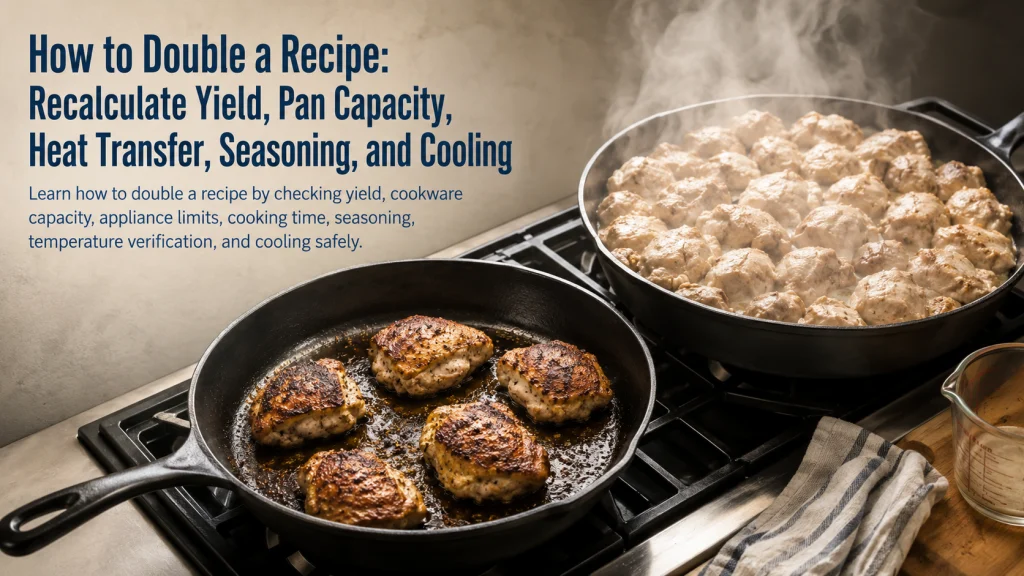
Doubled Ingredients Can Create Four Problems That Math Does Not Show
A familiar skillet dinner is doubled on paper. Every ingredient fits neatly into a new column, so the cook reaches for the same pan and begins. The meat crowds instead of browning, vegetables release moisture into a deeper layer, the center takes longer to cook, and the finished food ends up in one deep storage container because the shallow ones were never prepared.
The multiplication was correct. The process was not ready for the larger batch.
Ingredient math versus process graphic:
Arithmetic layer
Original yield → desired yield → multiplication factor → recalculated ingredients
Process layer
Pan surface → headspace → stirring access → appliance airflow → cooking verification → cooling allocation
Planning rule
Ingredient math starts the scaling decision. Geometry, heat transfer, and post-cook handling determine whether the larger batch behaves like the original.
A recipe can be mathematically doubled and still be a poor candidate for one oversized cook. Sometimes the better decision is to repeat the standard batch, preserve the known method, and combine the finished portions only after both are safely cooked.
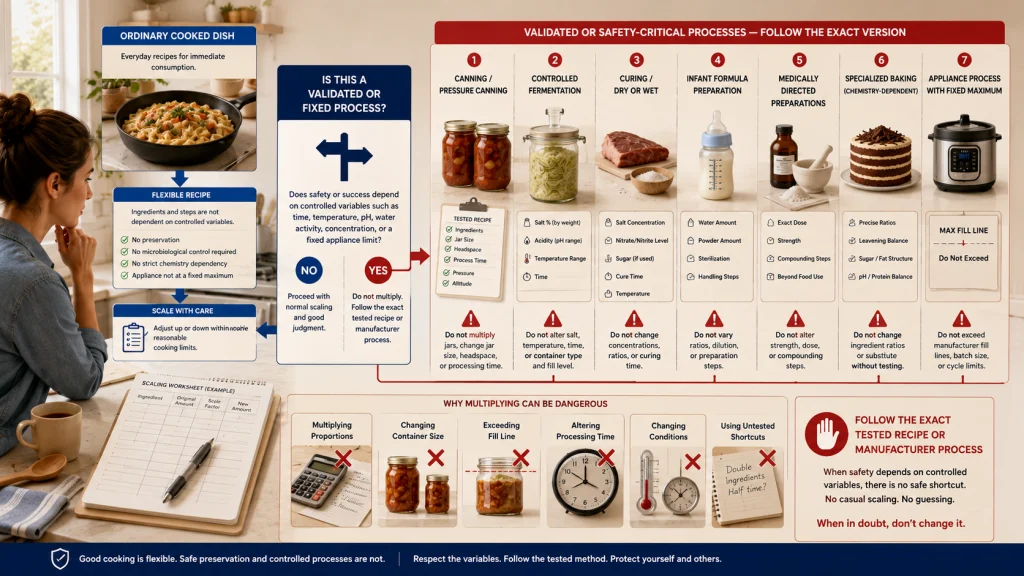
Exclude Validated and Safety-Critical Recipes From Casual Scaling
Ordinary dinner recipes often allow some flexibility. Validated preservation processes do not belong in the same category. Changing proportions, container sizes, processing conditions, acidity, concentration, or other controlled variables can alter the safety of the final product.
Do-not-scale list:
- Canning and shelf-stable preservation formulas.
- Fermentation processes with controlled salt, acidity, temperature, or time.
- Curing recipes and other preservation methods that depend on exact concentrations.
- Infant formula or medically directed preparations.
- Specialized baking formulas where structure depends on validated ratios or tightly controlled chemistry.
- Any recipe or appliance process that explicitly says not to exceed, alter, or multiply the stated batch.
When a recipe is validated for safety or designed around a precise process, follow the exact tested version rather than applying ordinary batch-cooking logic. This article covers everyday cooked dishes whose yield can be adjusted without changing a controlled preservation system.
Confirm the Intended Yield and Name the Extra Uses
Before multiplying anything, decide how much finished food is actually needed. “Double it” is vague when the original recipe already feeds more people than the household will serve that night.
Write down:
- The original stated yield.
- The number of servings or containers needed now.
- The planned second use, freezer portion, or household assignment.
- The container sizes available after cooking.
- The amount the refrigerator or freezer can realistically hold.
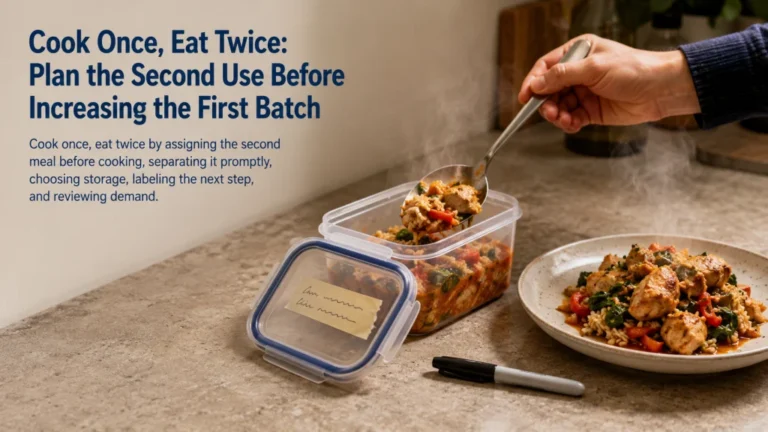
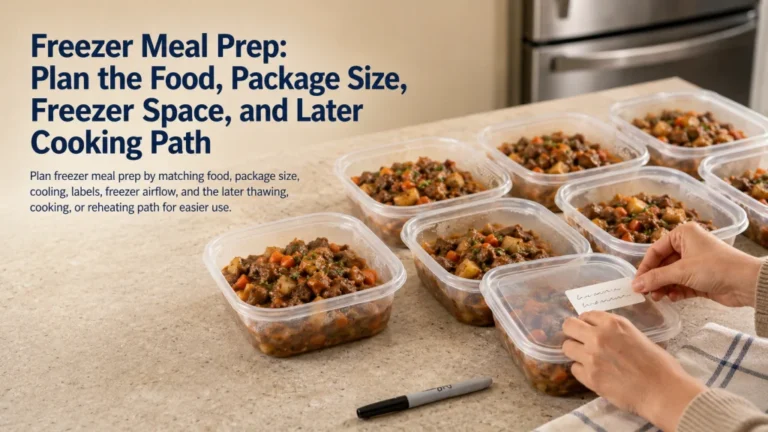
A larger batch should have a destination before the ingredients enter the pot. The cook once, eat twice method helps define one deliberate second use. When the goal is frozen storage, the freezer meal prep process adds package shape, one-layer freezing, labels, and later-use instructions.
If the household needs only one additional meal, the correct factor may be smaller than two. Scaling to actual demand protects the cooking method and reduces the amount of hot food that must be cooled at once.
Recalculate Ingredients and Convert Awkward Measures Carefully
Calculate the scaling factor by comparing the desired yield with the original yield. Then apply that factor to each ingredient that can be scaled directly. Keep the original recipe visible so the new values can be checked against it.
Awkward measures deserve a second pass. A multiplied fraction may be easier to weigh, convert to a larger unit, or divide across repeated batches than to measure with several partial spoonfuls. Record the converted amount rather than doing mental arithmetic while the stove is already on.
| Ingredient calculation check | Question to answer | Practical response |
|---|---|---|
| Yield factor | What is the desired yield divided by the original yield? | Use that factor as the starting point rather than assuming every plan needs exactly twice as much |
| Fraction conversion | Does the new amount become difficult to measure accurately? | Convert to a larger unit or use weight when the recipe and ingredient allow it |
| Package quantity | Does the calculated amount match real package sizes? | Decide whether to measure the needed amount, choose a different factor, or plan another use for the remainder |
| Divided addition | Is the ingredient added in stages? | Preserve the original sequence instead of pouring the full multiplied amount in at once |
| Recordkeeping | Will this version be repeated? | Write down the exact adjusted amounts and any process changes |
Arithmetic should be completed before cooking begins. Once timing, heat, and several pans demand attention, a small conversion error becomes harder to notice and correct.
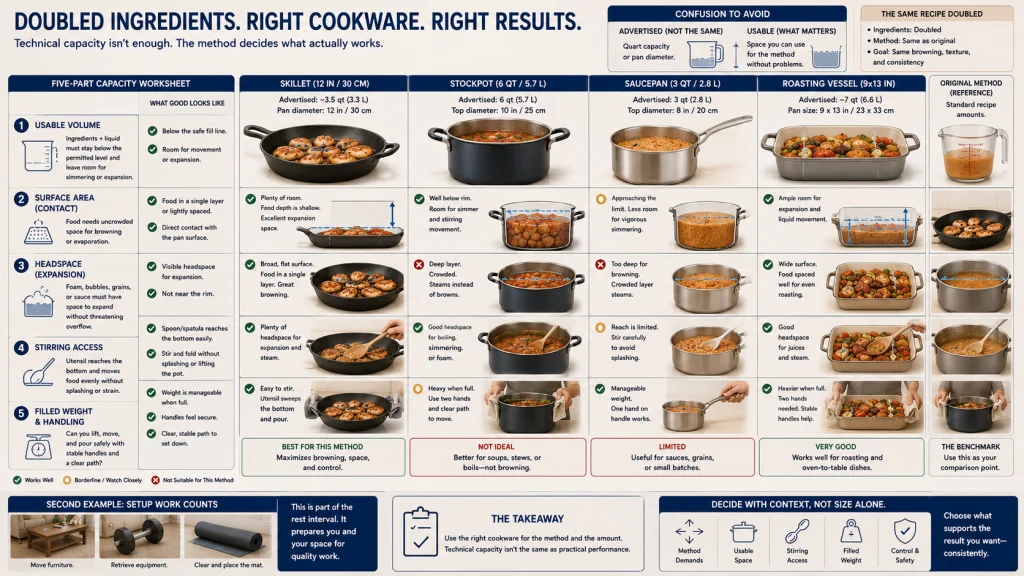
Check Cookware Volume, Surface Area, Headspace, and Stirring Access
Cookware capacity is often marketed by diameter or total volume. Those measurements do not reveal how much flat cooking surface is available for browning, how much headspace remains for boiling or stirring, or whether a spoon can move through the food without spilling it.
| Cookware-capacity worksheet | Original method needs | Larger-batch check |
|---|---|---|
| Usable volume | Enough room for ingredients and ordinary movement | Will the food stay below the permitted fill level with space for expansion, simmering, and stirring? |
| Cooking surface | Direct contact for browning, evaporation, or searing | Will ingredients form a deeper crowded layer that steams instead? |
| Headspace | Room above liquids, grains, sauces, or foaming foods | Is there enough space to prevent overflow and support the original method? |
| Stirring access | Ability to reach the bottom and move food evenly | Can the cook stir safely without lifting an overloaded vessel or spilling hot food? |
| Weight and handling | Safe movement from stove or oven to the work surface | Will the filled cookware be too heavy or awkward to lift and pour safely? |
Nora’s observation: A pot can meet the advertised volume and still be wrong for the method. I look for usable surface, room above the food, access for stirring, handle stability, and the weight of the vessel when full. A technically larger pot may hold the ingredients while making browning, mixing, or safe transfer much harder.
The larger cookware question belongs to the broader guide on meal prep tools and appliances only after the method and capacity gap are clearly defined.
Check Oven Space, Burners, Baskets, Cookers, and Manufacturer Maximums
An appliance has a process limit, not just an interior volume. Oven racks need airflow. Air fryer baskets depend on exposed surfaces and moving air. Slow cookers and pressure cookers have fill limits and operating requirements. Burners must match the cookware and support it steadily.
Before increasing the batch, check the exact instructions for:
- Maximum and minimum fill levels.
- Required headspace and liquid amount.
- Basket depth, tray spacing, and permitted layering.
- Rack position and airflow around multiple pans.
- Cookware size, weight, and burner compatibility.
- Whether the appliance allows the recipe quantity or category to be increased.
Do not override a fill line, crowd a basket that depends on circulation, or load an oven so tightly that the original baking environment disappears. When the larger quantity exceeds the permitted capacity or changes the required airflow, that appliance cannot support the scaled method as planned.
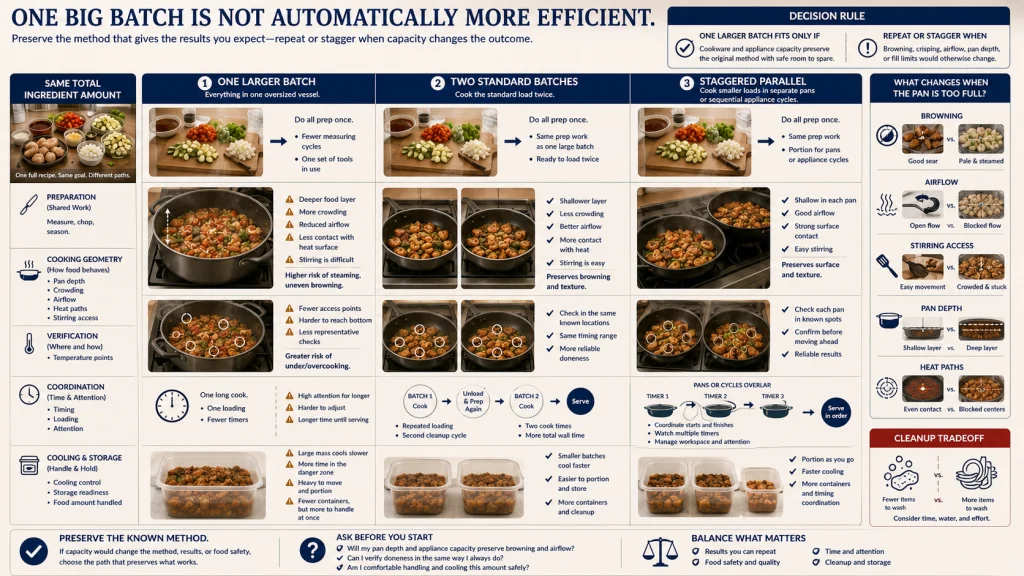
Choose One Larger Batch or Repeat the Standard Batch
One oversized cook can reduce repeated measuring and cleanup, but it can also change the way heat reaches the food. Repeating the known batch preserves the original pan depth, surface contact, stirring pattern, and cooking verification.
| Method | Potential advantage | Main limitation | Better fit when |
|---|---|---|---|
| One larger batch | One preparation sequence and one main cooking session | Geometry, heat transfer, stirring, and cooling may change | The cookware and appliance preserve the original method with safe capacity to spare |
| Two standard batches | Known pan depth, browning, timing range, and verification process | More repeated loading, active attention, and cleanup | The original method depends on uncrowded surface, precise airflow, or limited vessel capacity |
| Staggered parallel batches | Some shared prep while preserving smaller cooking loads | More coordination among pans, timers, and cooling containers | The kitchen can support separate vessels without overloading one appliance or work area |
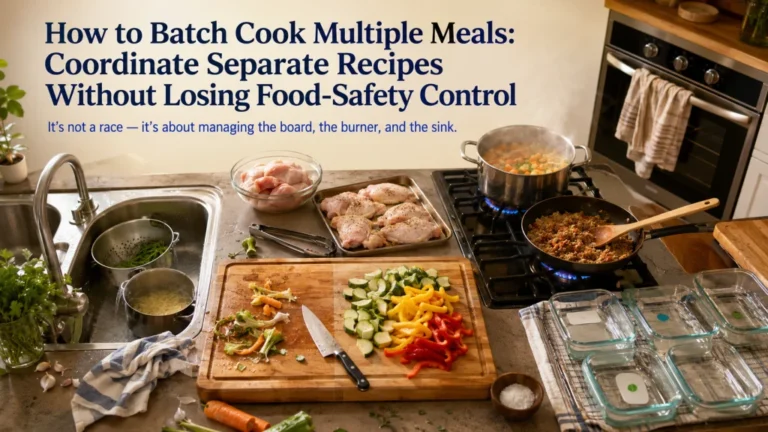
A repeated standard batch is not a failed scaling attempt. It is often the method that protects the result when one large vessel would create crowding or uneven cooking. The guide to batch cooking multiple meals covers coordination when several separate dishes or cooking cycles share the same session.
Expect Cooking Time and Browning to Change
Cooking time does not scale in a straight line with ingredient quantity. A deeper pot of food, a crowded skillet, or several pans in one oven can heat differently from the original batch. The outside may appear ready while the center still needs more time, or extra moisture may delay browning.
Preserve the original visual and process cues where they remain meaningful, but do not use appearance, smell, or taste as the only safety test. Stir when the method calls for it, rotate pans only when appropriate, and verify doneness at the relevant locations rather than relying on the original timer alone.
For foods that depend on surface evaporation, searing, or crisping, dividing the cook may produce a closer match to the original recipe. Adding more time to a crowded pan may eventually cook the food through while still producing a softer, wetter result.
Write down the actual time and pan arrangement after the first successful scaled batch. That record is more useful than repeatedly rediscovering the same delay.
Adjust Seasoning and Thickening Cautiously
Some ingredients scale cleanly by the same factor. Seasonings, concentrated flavors, leavening, thickeners, and ingredients added to correct texture may respond differently when the batch geometry and evaporation change.
Start from the recalculated amount only when the recipe and ingredient support direct scaling. For adjustable seasoning, consider adding part of the new amount, cooking to the appropriate stage, then reassessing before the final addition. This is a flavor adjustment, not permission to judge food safety by taste.
Thickening deserves patience because a larger volume can take longer to heat, reduce, or fully activate the thickener. Adding more too early can produce an overly dense result once the entire batch reaches the intended temperature.
Record what happened. Note the ingredient amount, pan, batch depth, cooking time, and final texture. A scaled recipe becomes repeatable only when the process changes are documented along with the ingredient list.
Verify Safe Internal Temperature Where Applicable
A larger batch can create cold spots, deeper centers, and uneven heating. When a food requires internal-temperature verification, use a suitable food thermometer and follow current food-specific guidance rather than assuming the original cooking time remains sufficient.
Cooking-verification checkpoint:
- Identify whether the recipe contains food that requires a safe internal-temperature check.
- Measure in the thickest or slowest-heating portions as appropriate for the food and method.
- Check more than one location when the batch is large, layered, or divided among pans.
- Do not let surface browning or bubbling substitute for temperature verification.
- Continue cooking or follow current guidance when the required endpoint has not been reached.
Do not publish one temperature for every food category or use a single reading from an easy-to-reach edge as proof that the entire larger batch is ready. The verification method must match the food, vessel, and cooking arrangement.

TempPro TP19H is a fast digital food thermometer designed for checking internal temperatures during everyday cooking and meal prep. Its folding probe, rotating display, temperature-lock function, and calibration feature make temperature checks quick and easy to read around pots, pans, and larger dishes. The waterproof body and straightforward controls also make it practical for frequent use in a busy kitchen.
Check On AmazonIf you click this link and buy, we earn a commission at no additional cost to you.
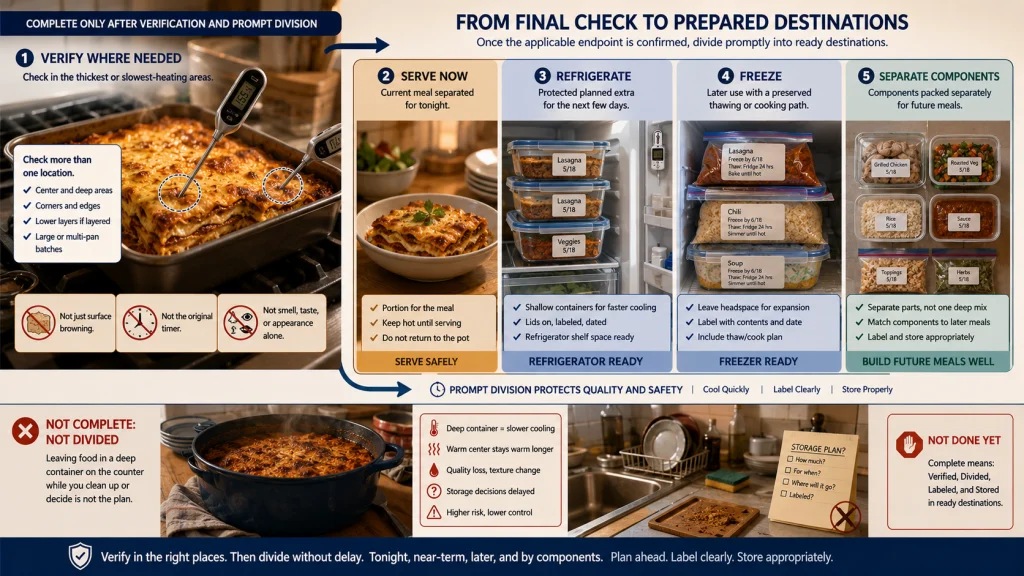
Divide the Finished Food for Prompt Cooling and Planned Storage
The batch is not complete when the cooking ends. A larger pot leaves more hot food to portion, label, cool, refrigerate, or freeze. Waiting until cleanup to find containers can turn a successful cook into one deep, slow-cooling storage problem.
| Cooling allocation table | Destination | Preparation before cooking ends | Immediate checkpoint |
|---|---|---|---|
| Current meal | Serve now | Identify the amount intended for the table | Keep the planned extra separate rather than serving the entire batch |
| Near-term meal | Refrigerator | Prepare suitable shallow containers, lids, label, and shelf space | Divide and cool promptly according to current guidance |
| Later frozen use | Freezer | Choose package size, expansion allowance, label, and later cooking path | Complete the required cooling route before freezing as appropriate |
| Multiple components | Separate refrigerator or freezer packages | Match each component to its later meal and container | Prevent one large mixed package from recreating weekday work |
Large cooked amounts should not be left in one deep vessel at room temperature while the kitchen is cleaned. Divide them into suitable shallow containers or smaller portions and follow current cooling and storage guidance.
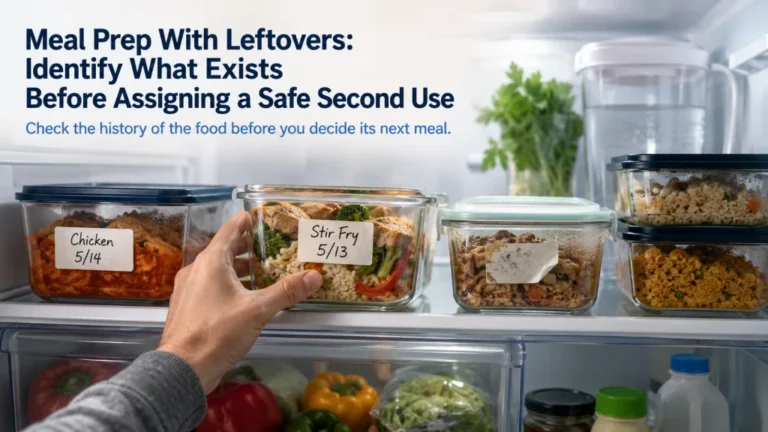
Use the meal prep storage guide for the wider handoff involving containers, labels, refrigeration, freezing, thawing, reheating, and storage-history decisions. The main meal prep process connects recipe scaling to the rest of the weekly system.
Confirm the Recipe, Yield, Geometry, Method, Temperature, and Cooling Route
Start by excluding recipes that should not be casually scaled. Then define the intended yield and name where every extra portion will go. Recalculate the ingredients carefully, but treat that arithmetic as only the first layer of the decision.
Check usable cookware volume, cooking surface, headspace, stirring room, appliance limits, and the weight of the filled vessel. Compare one larger batch with repeated standard batches instead of assuming the oversized cook is automatically more efficient.
Expect cooking time, browning, seasoning, and thickening to change. Verify a safe internal temperature where applicable, then divide the finished food for prompt cooling and planned storage. The best scaled recipe is not the one with the cleanest multiplication. It is the one whose method, capacity, doneness, and cooling path still work from beginning to end.
For the wider rhythm of preparing larger quantities without losing control of the kitchen, return to the batch cooking guide.
FAQs
➗ Do I double every ingredient in a recipe?
Use the yield factor as the starting point, but review seasonings, thickeners, leavening, staged additions, and any ingredient whose behavior depends on concentration or evaporation. Do not alter validated preservation recipes.
⏲️ Should I double the cooking time?
No. Cooking time depends on batch depth, surface area, pan material, appliance airflow, temperature, and the food itself. Monitor the process and verify doneness rather than multiplying the timer mechanically.
🍳 Can I use the same pan for a doubled recipe?
Only when the pan preserves enough surface area, headspace, stirring room, stability, and safe capacity for the method. A pan may hold the ingredients while still being too crowded for browning or even cooking.
🔁 Is it better to cook two separate batches?
Often, yes, when the recipe depends on uncrowded surface, known pan depth, or strong appliance airflow. Repeated standard batches can preserve the original method more reliably than one oversized cook.
🧂 Should seasoning be doubled exactly?
Some seasonings scale directly, while concentrated flavors may need a cautious final adjustment. Record the result so the scaled version can be repeated without guesswork.
🌡️ How do I know a larger batch is safely cooked?
For foods that require internal-temperature verification, use a suitable thermometer and current food-specific guidance. Check the thickest or slowest-heating areas and more than one location when appropriate.
🥣 How should I cool a doubled recipe?
Prepare shallow containers and storage space before cooking ends. Divide large cooked amounts promptly and follow current cooling, refrigeration, and freezing guidance rather than leaving food in one deep pot.
⚠️ Which recipes should not be casually doubled?
Do not casually alter canning, fermentation, curing, infant formula, validated preservation processes, or any recipe and appliance method that depends on fixed safety-critical ratios or fill limits.