Cooking several meals in one session becomes difficult when simple recipes compete for the same board, burner, oven space, sink, counter, and cooling shelf. The solution is not a minute-by-minute race. Choose compatible recipes, map shared resources, separate raw animal-food work from produce and ready-to-eat tasks, preserve each recipe’s own cooking instructions, and stop before cooling capacity is exceeded. A workable session keeps cleaning, separation, temperature verification, and prompt storage intact from the first cut to the last labeled container.
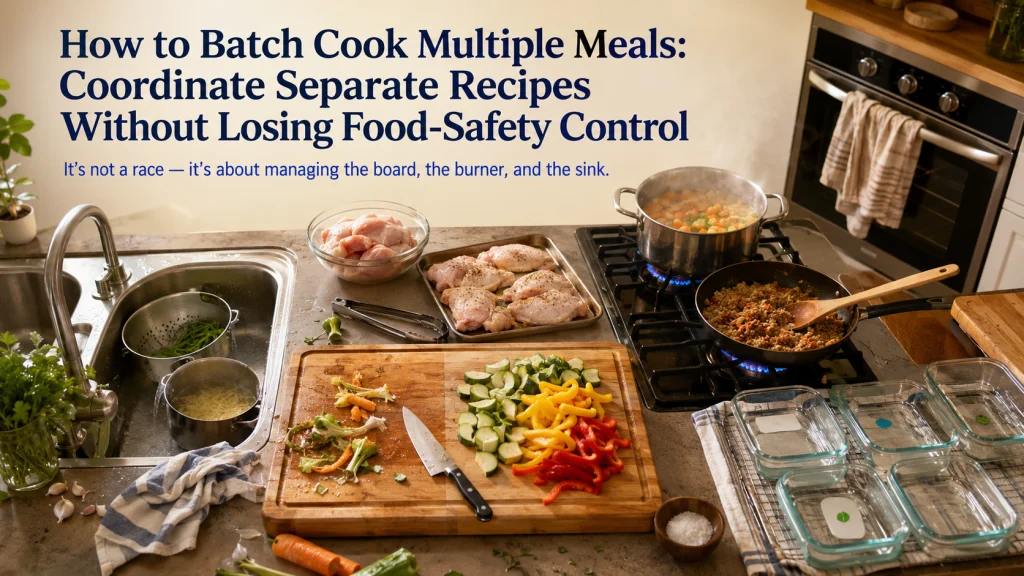
Three Simple Recipes Can Create One Complex Production Problem
Three recipes are laid out for Sunday afternoon. One needs the largest cutting board for raw poultry, another needs the same board for vegetables, and the third needs chopped herbs that will not be cooked again. Two recipes want the strongest burner. All three need the oven within the same temperature range, and every finished dish is supposed to cool on the one clear refrigerator shelf.
Nothing about the individual recipes looks difficult. The conflict appears only when they are placed in the same kitchen at the same time.
Four-resource conflict opening:
Preparation conflict
One clean board and knife are requested by raw food, produce, and ready-to-eat ingredients.
Cooking conflict
Two pans need the largest burner while multiple dishes compete for oven position and airflow.
Cleaning conflict
The sink is needed for handwashing, tool cleaning, produce preparation, and hot cookware.
Cooling conflict
More cooked food finishes than the shallow containers and cold storage can handle promptly.
Several recipes do not become one safe workflow simply because they fit inside the same afternoon. The session succeeds only when each dish keeps its own handling and cooking controls while sharing limited kitchen resources.
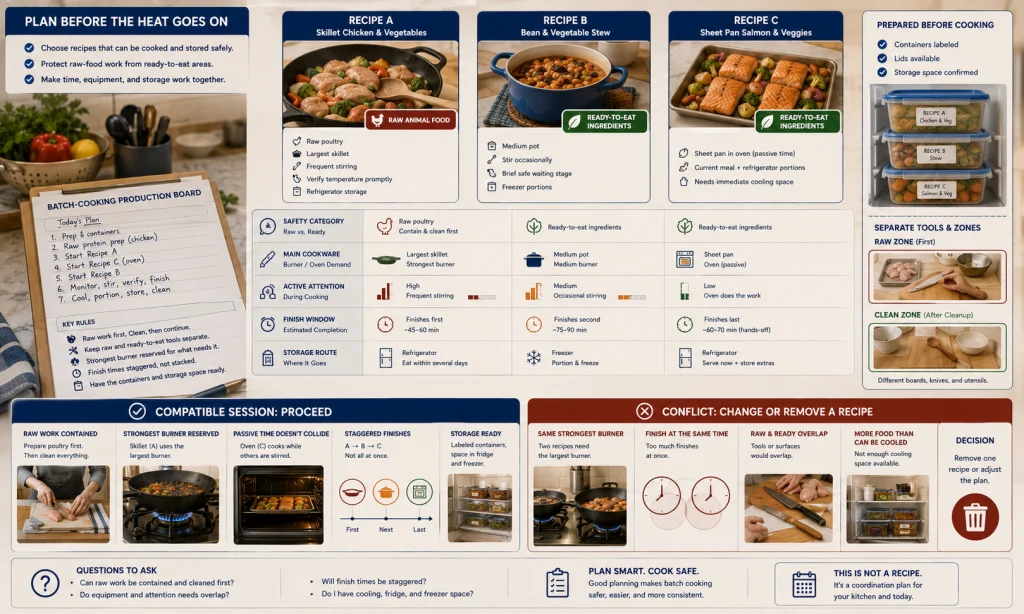
Choose Recipes With Compatible Equipment and Manageable Safety Categories
Begin with compatibility, not variety. A menu can look balanced on paper and still create too many simultaneous demands for the kitchen. Look for recipes that share preparation without forcing unsafe tool reuse, that use different pieces of equipment at different stages, or that can wait without losing an important safety or quality cue.
| Recipe-compatibility matrix | Recipe A | Recipe B | Recipe C | Conflict decision |
|---|---|---|---|---|
| Raw animal food involved | Yes | No | No | Place raw-food work in a contained stage with its own tools and cleanup |
| Main cookware | Largest skillet | Medium pot | Sheet pan | Compatible if the skillet and pot do not compete for the same burner power |
| Active attention | Frequent stirring | Occasional stirring | Passive oven time | Possible only if the oven dish does not need constant turning or close timing |
| Finish window | Needs prompt verification and portioning | Can rest briefly in its vessel | Needs cooling space when removed | Stagger completion so two hot dishes do not arrive at an empty counter at once |
| Storage route | Refrigerator | Freezer | Current meal plus refrigerator | Prepare distinct containers, labels, and shelf locations before cooking |
Recipe compatibility is not limited to oven temperature. It includes raw-versus-ready handling, burner strength, stirring frequency, tool use, finish timing, and storage destination. Remove a recipe when its demands cannot be separated cleanly from the others.
The broader batch cooking process helps decide which foods belong in the same session and which are better prepared on another day.
Preserve Each Recipe’s Cooking and Handling Instructions
Coordination should not flatten several recipes into one generic set of steps. Each dish keeps its own ingredient order, separation instructions, cooking method, doneness checks, and storage route.
Create a short control card for each recipe:
- The raw ingredients that require separation.
- The tools and surfaces needed before cooking begins.
- The appliance, vessel, and permitted capacity.
- The cooking cues and any required internal-temperature verification.
- The stage when the food can safely wait and the stage when it cannot.
- The containers and destination needed after cooking.
Do not shorten a cooking step because another pan is waiting for the burner. Do not skip a cleaning stage because the next ingredients are already on the counter. The shared session must adapt around each recipe’s safety instructions, not override them.
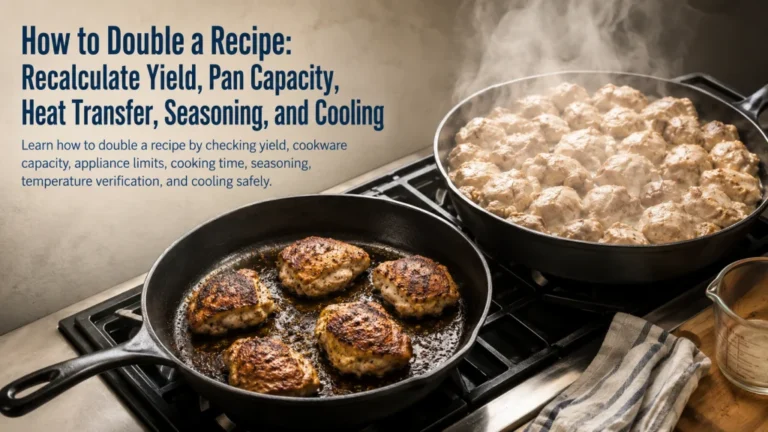
When one dish is being increased rather than merely coordinated, use recipe scaling checks for yield, cookware geometry, heat transfer, seasoning, verification, and cooling.
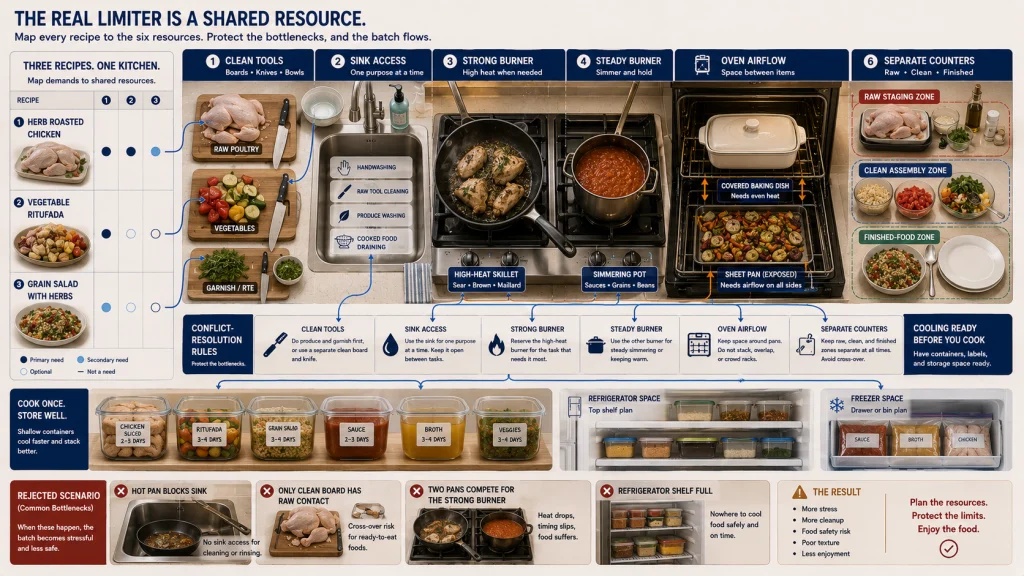
Map Boards, Knives, Bowls, Sink Access, Burners, Oven Zones, Counters, and Cooling Containers
The kitchen’s limiting resource is often smaller and less impressive than the appliance. A multi-function cooker may support several modes, yet the session can still stop because the only clean board is contaminated, the sink is blocked by a hot pan, or the cooling shelf is full.
| Equipment conflict grid | Recipe A demand | Recipe B demand | Recipe C demand | Resolution |
|---|---|---|---|---|
| Cutting boards and knives | Raw poultry preparation | Vegetable chopping | Ready-to-eat garnish | Complete produce and garnish first, or reserve separate clean tools and space |
| Sink | Handwashing and raw-tool cleaning | Produce washing | Draining cooked food | Keep the sink clear and schedule one purpose at a time |
| Burners | High-heat skillet | Steady simmer | None | Assign the strongest burner to the method that depends on it |
| Oven zones | None | Covered baking dish | Sheet pan requiring airflow | Verify rack space and avoid crowding that changes the cooking environment |
| Counter space | Raw staging area | Ingredient assembly | Finished-food portioning | Do not overlap raw staging with finished-food handling |
| Cooling containers | Two shallow containers | Three freezer portions | One current meal and two refrigerated portions | Prepare all containers, lids, labels, and shelf space before heat begins |
Nora’s observation: Large prep sets and multi-function appliances suggest that more dishes can run in parallel, but the real bottleneck is often the clean board, open sink, strong burner, or empty cooling shelf. I count those ordinary resources before I count appliance modes.
Physical station design and long-term storage belong to kitchen organization for meal prep. Equipment purchases belong later, after the repeated conflict is clear, within meal prep tools and appliances.
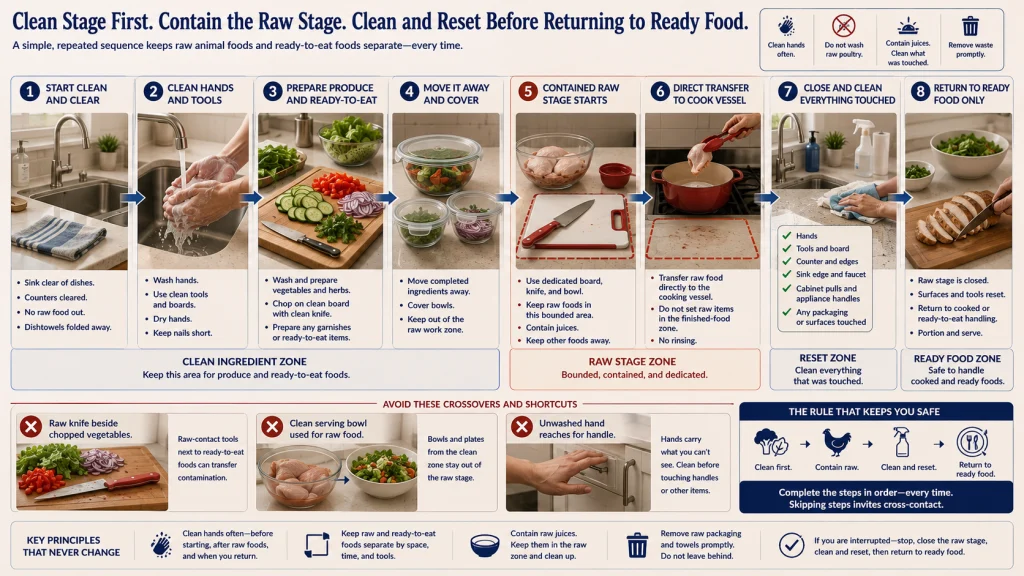
Separate Raw Animal-Food Work From Produce and Ready-to-Eat Work
A crowded session makes it easy for tools to drift from one recipe to another. A knife used for raw poultry is set beside chopped vegetables. A bowl intended for cooked food is borrowed for raw ingredients. A hand reaches for a cabinet handle before washing.
Raw-to-ready-to-eat sequence:
- Clear the sink and work surface.
- Wash hands and prepare clean tools.
- Handle produce and ready-to-eat ingredients in a clean zone.
- Move completed clean ingredients into covered bowls or containers away from raw work.
- Set up the raw animal-food stage with dedicated tools and controlled counter space.
- Transfer raw food directly to its cooking vessel without crossing finished-food areas.
- Clean and sanitize hands, tools, boards, sink areas, handles, and affected surfaces as appropriate.
- Return to cooked or ready-to-eat handling only after the raw stage is fully closed.
Separate boards can help, but color alone does not make a board clean. Each tool still needs correct use, cleaning, condition, and storage. A cracked surface, overloaded sink, or hurried handoff can undermine a carefully labeled system.
Do not wash raw poultry or splash raw-food liquids through the sink area. Keep raw juices contained and follow current food-safety guidance for the exact ingredient and preparation.
Complete and Clean One Contamination-Risk Stage Before Switching
Parallel cooking does not require every task to happen at once. Some stages should remain deliberately sequential. Raw-food preparation is one of them.
Finish the stage completely:
- Move the raw food into the correct cooking vessel.
- Remove packaging and raw-contact waste.
- Wash hands before touching controls, handles, towels, phones, or clean containers.
- Clean and sanitize affected tools and surfaces as appropriate.
- Replace towels or cloths that received raw-food contact.
- Confirm that the next work area is ready before bringing out cooked or ready-to-eat food.
The moment after raw food enters the pan often feels like a natural place to rush forward. The burner is active, another recipe is waiting, and the counter looks almost clear. Taking a short reset here prevents the rest of the session from carrying raw-food contact into every handle and utensil.
Schedule Passive Cooking Only When Active Monitoring Remains Possible
An oven dish or steady simmer can create useful working time, but passive does not mean unattended. The session should leave enough attention for stirring, turning, temperature checks, alarms, boil-over risk, and safe movement around hot cookware.
Before starting a passive stage, ask:
- What must be checked while this dish cooks?
- Can the check be missed while raw-food cleanup or another active recipe is underway?
- Will two dishes require immediate attention at the same moment?
- Is there a clear heat-safe surface for the vessel when it finishes?
- Are the cooling containers already open, labeled, and ready?
A timer is a reminder, not permission to overload attention. If one recipe requires frequent stirring while another is approaching a critical finish point, pause the third recipe rather than relying on faster movement.
The weekly placement of the cooking block belongs to meal prep scheduling. Inside the session, safety cues and recipe stages take priority over the clock.
Verify Every Dish Independently
Several recipes sharing one oven or stovetop do not share one doneness result. A finished casserole does not prove that the poultry pan on another rack is ready. A bubbling sauce does not verify the center of a second dish.
For each recipe:
- Identify whether an internal-temperature check is required.
- Use a suitable thermometer and the appropriate food-specific method.
- Measure in the relevant thickest or slowest-heating locations.
- Check more than one place when the dish is large, layered, divided, or unevenly heated.
- Keep raw-contact thermometer surfaces and hands from contaminating cooked food or clean areas.
- Continue cooking when the required endpoint has not been reached.
Do not rely on one oven timer, one visual cue, or one temperature reading to clear several dishes at once. Smell, appearance, and taste are not sufficient as the sole safety test.

TempPro TP19H is a fast digital food thermometer designed for checking internal temperatures during everyday cooking and meal prep. Its folding probe, rotating display, temperature-lock function, and calibration feature make temperature checks quick and easy to read around pots, pans, and larger dishes. The waterproof body and straightforward controls also make it practical for frequent use in a busy kitchen.
Check On AmazonIf you click this link and buy, we earn a commission at no additional cost to you.
Stop Cooking Before Cooling or Cold-Storage Capacity Is Exceeded
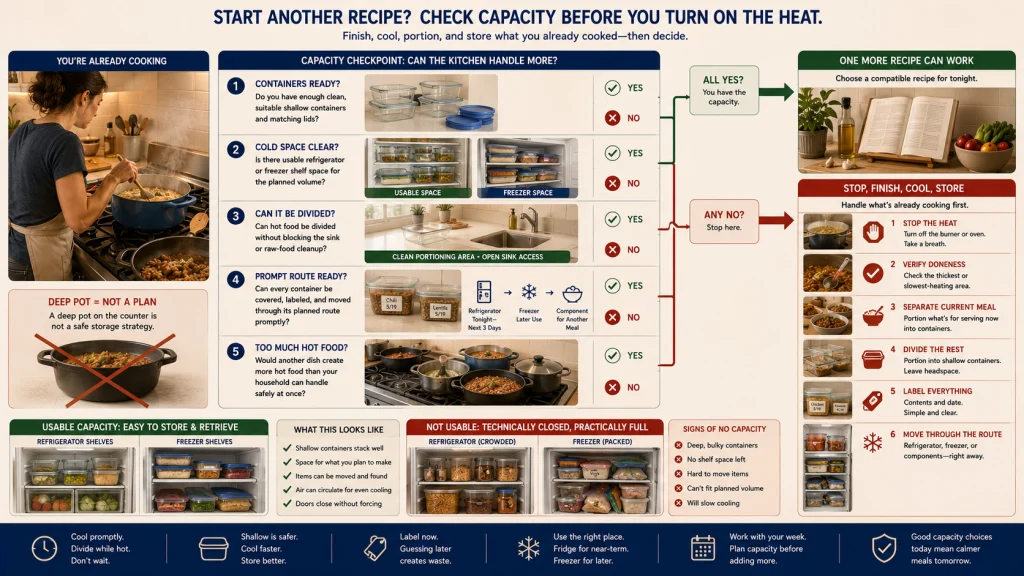
The session should stop before the refrigerator, freezer, containers, or clear counter can no longer receive the next finished dish safely. Cooking one more recipe is not productive when the existing food is waiting in deep pots for space to appear.
Cooling-capacity checkpoint:
- Are enough suitable shallow containers clean and ready?
- Is there clear refrigerator or freezer space for the planned volume?
- Can hot food be divided without blocking the sink or raw-food cleanup?
- Can each container be covered, labeled, and moved through the correct cooling route promptly?
- Will adding another recipe create more hot food than the household can handle safely at once?
Stop rule: When any answer is no, finish, divide, cool, and store the food already cooked before starting another recipe.
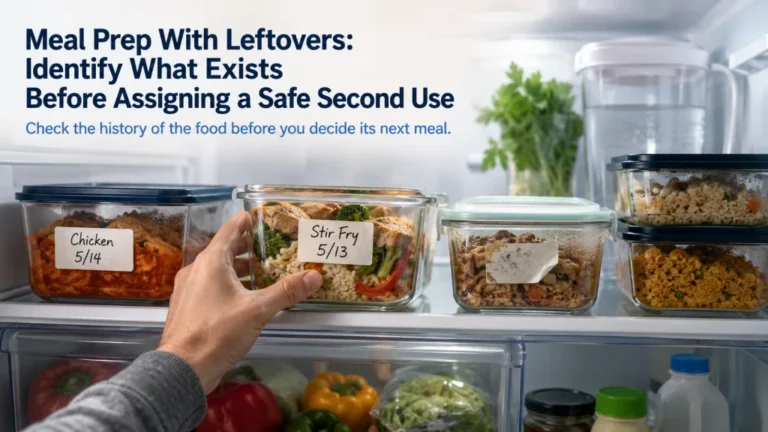
A crowded refrigerator can also reduce practical storage access and make labels disappear behind deeper containers. Capacity means more than whether the door can close. It includes enough usable space to place and retrieve the finished food as planned.
Divide, Label, and Place Finished Food Promptly
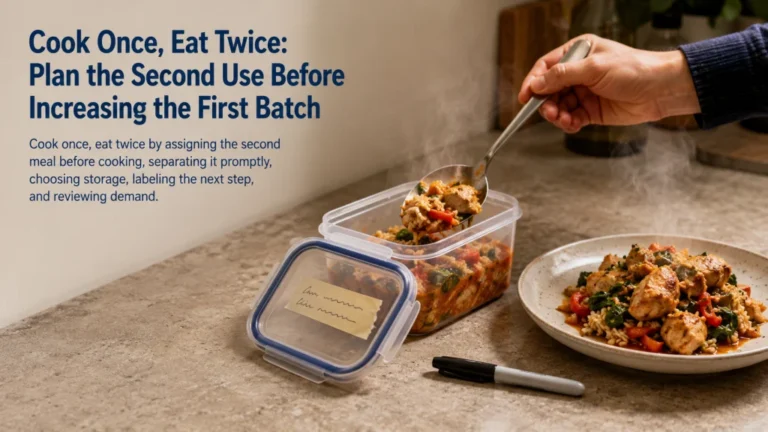
Prepare the storage handoff before cooking begins. Match each recipe to its containers, destination, date or use, and any later thawing or reheating step. That prevents three finished dishes from becoming one unlabeled row of warm containers.
As each dish finishes:
- Verify the cooking endpoint independently.
- Separate the amount intended for the current meal.
- Divide the remaining food into suitable portions and shallow containers.
- Label the contents, intended use, and next action clearly.
- Follow current guidance for prompt cooling, refrigeration, or freezing.
- Record anything that changed from the plan.
Do not let cooked food sit beside raw ingredients while the next recipe is assembled. Create a clean finished-food zone and keep its tools, lids, and labels separate from the remaining raw work.
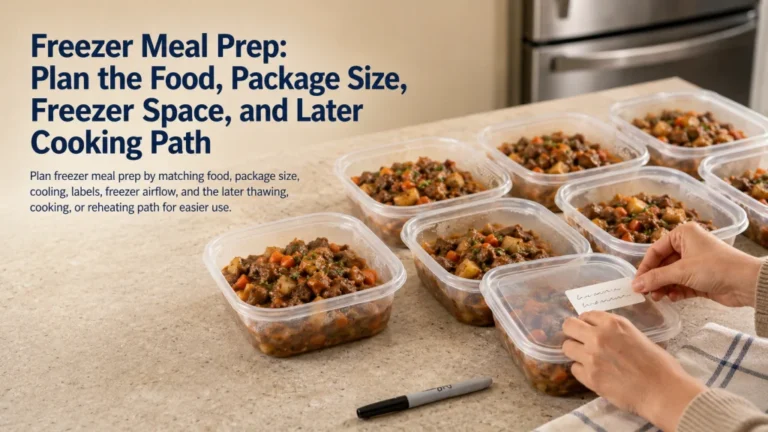
Meal prep storage decisions cover containers, cooling, refrigeration, freezing, thawing, reheating, and storage history. Make-ahead meal planning helps match the finished dish to the later day and final cooking step.
Compare Sequential, Partially Parallel, and Separate-Day Production
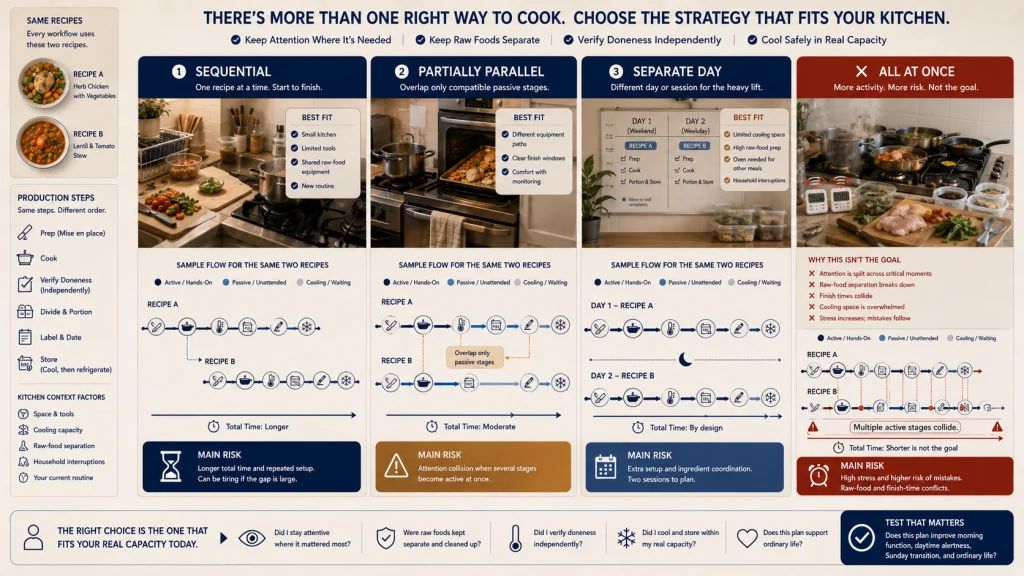
Parallel work is not automatically more efficient. The best workflow is the one that keeps attention, separation, cooking verification, and cooling within the kitchen’s capacity.
| Three-workflow comparison | How it works | Best fit | Main risk |
|---|---|---|---|
| Sequential production | One recipe moves through preparation, cooking, verification, and storage before the next begins | Small kitchens, limited tools, shared raw-food equipment, or new routines | Longer total session and repeated setup |
| Partially parallel production | Compatible passive stages overlap while active and high-risk stages remain separate | Recipes with different equipment needs and clear finish windows | Attention conflicts when several stages become active at once |
| Separate-day production | Recipe groups are split across different days or shorter sessions | Limited cooling space, incompatible oven needs, heavy raw-food prep, or household interruptions | More setup periods and a need to coordinate ingredients across days |
A shorter, calmer session can produce more usable food than an ambitious session that ends with crowded counters and delayed cooling. Separating one recipe to another day is a capacity decision, not a failure of planning.
Review the Bottleneck and Remove One Recipe Next Time If Needed
After the session, identify the moment when the workflow stopped feeling controlled. It may have been the raw-food cleanup, the strongest burner, the oven rack, the only clean knife, the crowded sink, or the lack of shallow containers.
| Bottleneck review | What happened | Next-session correction |
|---|---|---|
| Clean tools ran out | Raw-food work delayed ready-to-eat preparation | Change the sequence, reserve dedicated tools, or remove one recipe |
| Cooking attention collided | Two dishes needed stirring or verification at once | Stagger start times or move one dish to another day |
| Oven or burner conflict | The method changed because the preferred zone was unavailable | Choose recipes with different equipment paths |
| Cooling space filled | Finished food waited for containers or shelf room | Reduce total yield or total recipe count before buying more equipment |
| Session became exhausting | Labels, cleanup, or verification were rushed near the end | Move one recipe to a shorter separate session |
Use the review to make one concrete change rather than rebuilding the whole session. Shorten the menu, stagger one finish time, prepare containers earlier, or move the most demanding dish to another day. A smaller correction is easier to repeat and gives the next session a clear test.
Select Compatible Recipes, Map Resources, Sequence Risk, Verify, and Cool
Start with recipes that can share a session without competing for the same safety-critical tools, cooking zones, and finish windows. Preserve each recipe’s instructions, then map boards, knives, bowls, sink access, burners, oven zones, counters, appliances, containers, and cold-storage space.
Keep produce and ready-to-eat preparation separate from raw animal-food work. Close and clean the raw stage before returning to finished food. Overlap passive cooking only when active monitoring remains possible, and verify every dish independently.
Stop before the next recipe creates more hot food than the kitchen can divide and cool promptly. Label and place each completed dish through its planned storage route, then review the session’s real bottleneck. The best multi-meal workflow is not the one with the most pans active. It is the one that remains controlled when the sink is busy, the oven timer sounds, and the first hot dish needs a safe place to go.
For the complete planning sequence from weekly choice through cooking and storage, return to how to meal prep.
FAQs
🍲 How many recipes should I batch cook at once?
Use the number your boards, sink, burners, oven, attention, containers, and cold storage can support without weakening cleaning, separation, cooking verification, or prompt cooling. Fewer compatible recipes can be more productive than a crowded session.
🔪 Can I use the same cutting board for several recipes?
Only after correct cleaning and sanitizing as appropriate, and only when the sequence prevents raw-food contact from reaching produce, cooked food, or ready-to-eat ingredients. Separate clean tools can make the workflow easier, but labels or colors do not replace cleaning.
🥬 Should I prepare vegetables before raw meat?
Preparing produce and ready-to-eat ingredients in a clean stage before raw animal-food work can simplify separation. Move the clean ingredients away, complete the raw stage, then clean hands, tools, and surfaces before returning to cooked food.
⏱️ Is it safe to cook several dishes at the same time?
It can be when the kitchen has enough equipment, space, attention, and cooling capacity, and when each recipe keeps its own handling and cooking instructions. Do not create a minute-by-minute schedule that overrides safety or doneness cues.
🌡️ Can one temperature check cover the whole session?
No. Verify each dish independently using the appropriate food-specific method and locations. One reading from one pan does not prove that another dish or a different part of the oven is ready.
🧊 What should I do when the refrigerator is already full?
Do not start another recipe. Finish, divide, cool, and store the food already cooked through an appropriate route. Reduce the total batch or move a recipe to another day when cold-storage capacity is limited.
🔥 Should I use every burner and appliance at once?
No. Use only the equipment that can be monitored safely and that preserves the required heat, airflow, and capacity for each method. More active appliances can create attention and cooling conflicts.
📝 How do I improve the next batch-cooking session?
Record the real bottleneck: tools, sink, burner, oven space, attention, containers, or cooling shelf. Change the sequence or remove one recipe before purchasing more equipment.