Freezer meal prep should make a future meal easier, not leave behind a hard, anonymous package that nobody wants to open. Plan the food, package shape, amount, cooling route, freezer space, and later cooking step as one workflow. A freezer-safe container does not prove that the meal itself will freeze, thaw, or reheat well. Decide how the food will be used before filling the package so the next cook can understand it and finish it without rebuilding the plan.
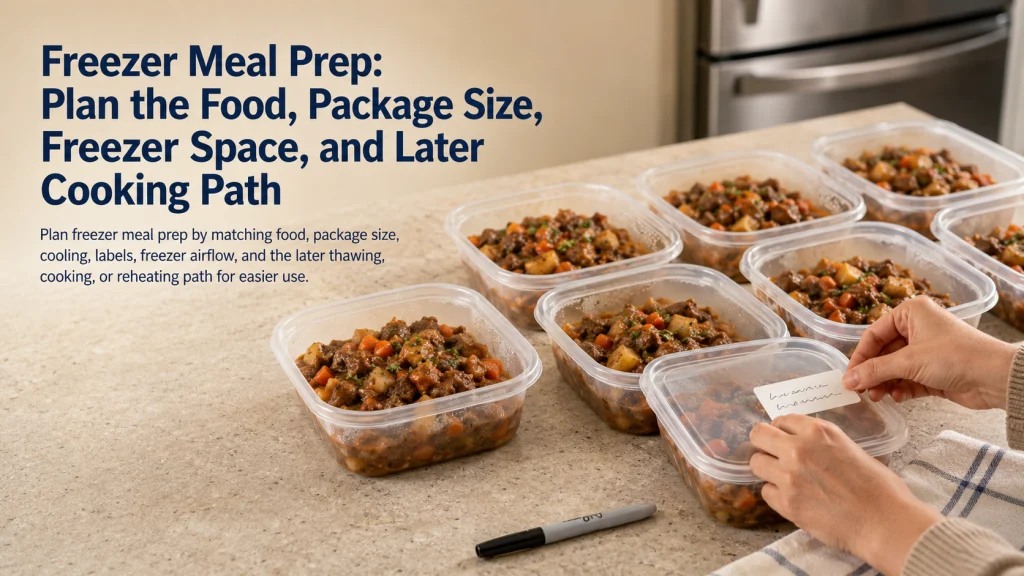
The Same Meal Behaves Differently in Three Freezer Packages
The same cooked meal can enter the freezer in one deep container, four shallow portions, or one unlabeled bag. A week later, those packages can create three very different evenings: one oversized block that must be used at once, four manageable portions, or a mystery bag that nobody remembers preparing. The food began the same, but the package changed the cooling, storage, and later-use experience.
| Package | What happens during freezing | What happens later |
|---|---|---|
| One deep household container | The center may cool and freeze more slowly, and the container occupies one large block of space | The whole amount may need to be thawed or reheated even when only part is needed |
| Four shallow planned portions | The packages can cool and freeze more efficiently when arranged with space around them | Only the amount assigned to one meal needs to be removed |
| One unlabeled bag | The package may freeze flat, folded, lumpy, or stuck to nearby items depending on how it is placed | The household must guess the contents, cooking status, and next step |
Freezer prep begins with the shape of the package and the next cooking step, not with the words freezer-safe on a box. A good package fits the food, the available shelf space, and the moment when someone will pull it out and ask, “What do I do with this now?”
Separate Freezer Meals, Frozen Leftovers, Uncooked Assemblies, and Components
A freezer meal is planned for frozen storage before or during preparation and has a defined later path. It may be fully cooked, assembled but uncooked when the recipe supports that stage, or divided into components that will be finished later.
A frozen leftover begins as food cooked for another meal and is redirected to frozen storage. An assembled uncooked meal has been placed together but still requires its main cooking step. A frozen component is one prepared part, such as a sauce, cooked grain, or other building block, stored for a named later use.
The distinction matters because identical-looking frozen containers can be at completely different stages. “Dinner” is not enough when one package is ready to reheat, another contains raw ingredients, and a third is only a sauce or base. The label has to preserve the difference after the preparation day has faded from memory.
Use the guide to choosing a make-ahead stopping point when the main question is whether the meal should be fully cooked, assembled, or left at an earlier stage. Use the batch-cooking method guide when deciding whether freezing is the right destination at all.
Confirm That the Recipe or Food Is Suitable for Freezing and Later Use
Not every successful dinner needs a second life in the freezer. Some foods separate, soften, dry out, break, or lose the texture that made the meal satisfying in the first place. That change may be harmless yet still disappointing. Safety and best quality are separate questions, and a technically freezable meal may not be one the household looks forward to eating.
Freezer-suitability checklist:
- Does the recipe clearly support freezing at the chosen stage?
- Is the meal fully cooked, assembled uncooked, or stored as components?
- Will the package protect the food and allow it to be removed without damage?
- Will the later meal need thawing, direct cooking, reheating, or final assembly?
- Are delicate toppings, crisp finishes, or fresh additions better stored or added separately?
- Can the household identify a food-specific storage and later-use path?
- Is there enough freezer space to place the package correctly until solid?
When the recipe does not explain freezing, do not assume that the container label fills the gap. A storage dish can tolerate freezer conditions while the food inside still freezes poorly or requires instructions that have not been preserved.
Editorial observation: Flat packages make a freezer look beautifully ordered, but neatness can become its own trap. A dense or fragile dish may be difficult to remove, protect, or finish from that shape. Organization helps only when the frozen food still comes out of the package in a form the household can use.
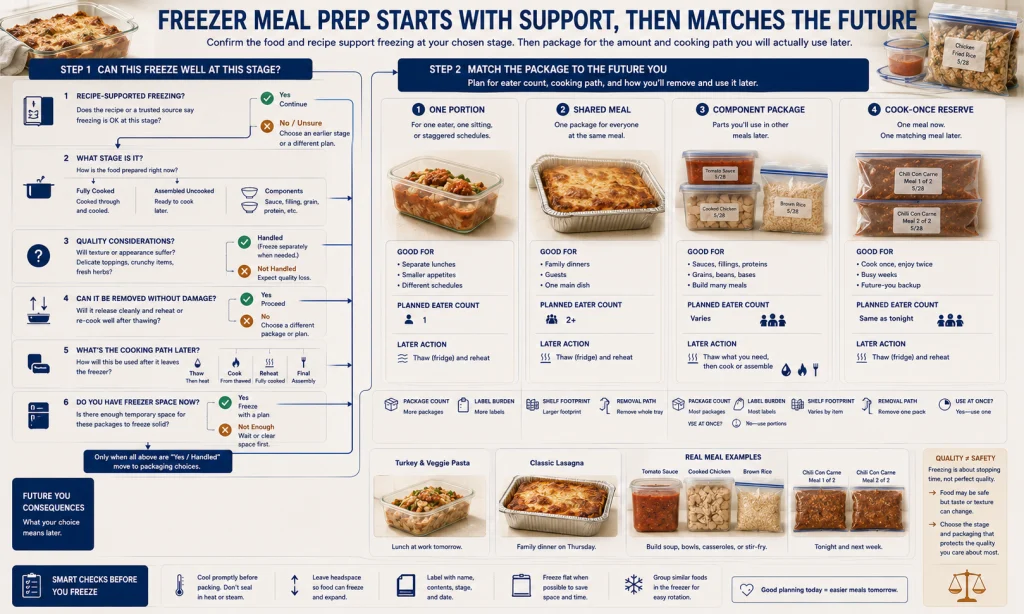
Choose Package Size From the Planned Later Use
The package should answer a future question before it enters the freezer: how much food will be needed on the day it is used? A family-size block is frustrating when only one person needs lunch, while several tiny packages can feel wasteful when the whole household eats together. Dividing a batch without a use plan can create the same burden as freezing it in one oversized container.
| Package plan | Best fit | Later-use advantage | Main tradeoff |
|---|---|---|---|
| Individual portion | Separate lunches, staggered schedules, or one-person meals | Only one portion needs to leave the freezer | More packages, labels, seals, and freezer slots |
| Household meal | One shared dinner with a predictable number of eaters | The meal stays together and needs fewer containers | The entire package may need to be used at once |
| Component package | A sauce, filling, cooked base, or other part with several named uses | The component can support more than one later meal | Final assembly and other ingredients are still required |
| Cook-once reserve | One meal now and one matching meal later | The frozen package has a clear destination from the start | The recipe must scale, cool, package, and reheat appropriately |
Package volume tells only part of the story. A container can hold the right amount and still waste shelf space, hide its label, or make the frozen food difficult to remove. Picture the later moment: will the contents slide out, be scooped while frozen, thaw in the package, or remain there during cooking? That answer matters more than the number printed on the container.
Before increasing a batch, use the recipe-scaling process rather than assuming every cooking time, vessel, and cooling step simply doubles.
Cook Safely and Give Large Cooked Amounts a Rapid Cooling Path
Freezing does not correct an uncertain cooking process. Cook each food using the safe method that applies to it, keep raw animal foods separate from ready-to-eat ingredients, and clean hands, tools, surfaces, and containers when contamination could transfer.
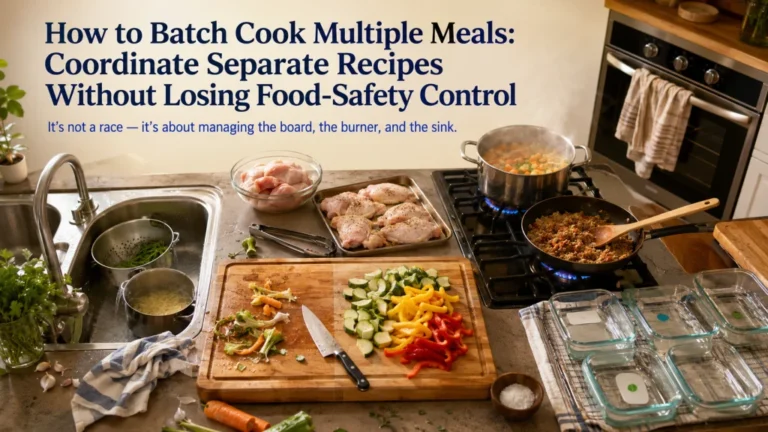
The most rushed part of a batch session often arrives after the cooking is finished, when the counter is crowded and attention has moved to cleanup. Plan the cooling route before the pot leaves the stove. Divide large amounts into shallow containers or smaller portions when needed, then refrigerate or freeze promptly according to the appropriate guidance. Do not leave a large deep pot at room temperature while waiting for every other task to end.
Safety warning: Do not use freezing as a way to rescue food that was handled, cooked, or cooled unsafely. Freezing does not kill all bacteria, and smell, appearance, or taste cannot serve as the sole safety test.
A fully cooked meal and an assembled uncooked meal require different handling. Keep the status visible throughout preparation so raw contents are not mistaken for ready-to-eat food.
Use Freezer Packaging That Fits the Food and Leaves Expansion Space
Use packaging intended for freezer storage and follow its instructions for filling, sealing, temperature range, and care. The package has to do more than close on preparation day. It should still protect the food, open reliably, and remain practical when the contents are hard, cold, and possibly covered with condensation.
Liquids and foods with substantial moisture may expand as they freeze, so leave the appropriate space when required by the package and recipe. Remove excess air from flexible packaging when the food and sealing method allow it, but do not crush delicate food or create a seal that is likely to fail.
Match the package to the later action. A rigid container may protect a fragile layered dish, while a flexible bag may suit a sauce that freezes flat and pours after thawing. A meal intended for a particular cooking vessel may need an easy transfer path rather than a package that promises direct cooking.
Container size, lid fit, materials, care, and appliance compatibility belong in meal-prep tools and appliances. A package feature should be checked against the exact food and later method rather than treated as a general quality guarantee.
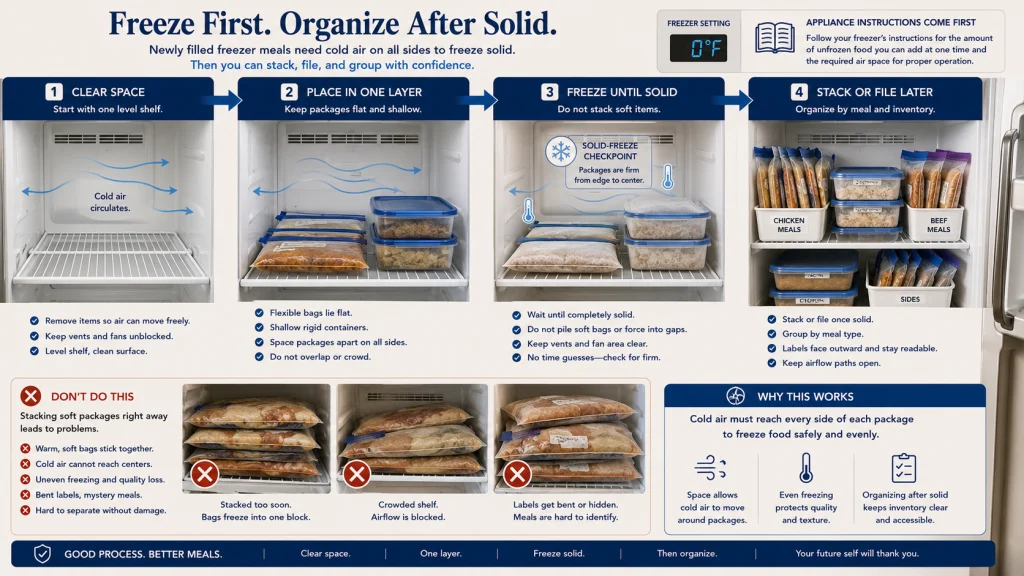
Freeze Packages Rapidly in One Layer Before Stacking
Freshly filled packages are tempting to stack because the freezer already feels crowded. That shortcut can press soft bags into one uneven block and reduce airflow around the food. Give new packages a temporary one-layer area, then stack or file them after they are solid.
One-layer freezing diagram:
Stage 1: Prepare the space
Clear a level area before the packages arrive.
Stage 2: Place packages separately
Lay flat bags flat and keep rigid containers in one layer with airflow around them.
Stage 3: Freeze until solid
Do not pile soft packages or force them into a tight stack.
Stage 4: Reorganize
Once solid, stack, file, or group the packages according to the freezer inventory.
Keep the freezer at 0°F and avoid loading so much unfrozen food at once that rapid freezing and airflow become difficult. The practical limit depends on the appliance and current load, so follow its instructions rather than guessing from empty shelf space.
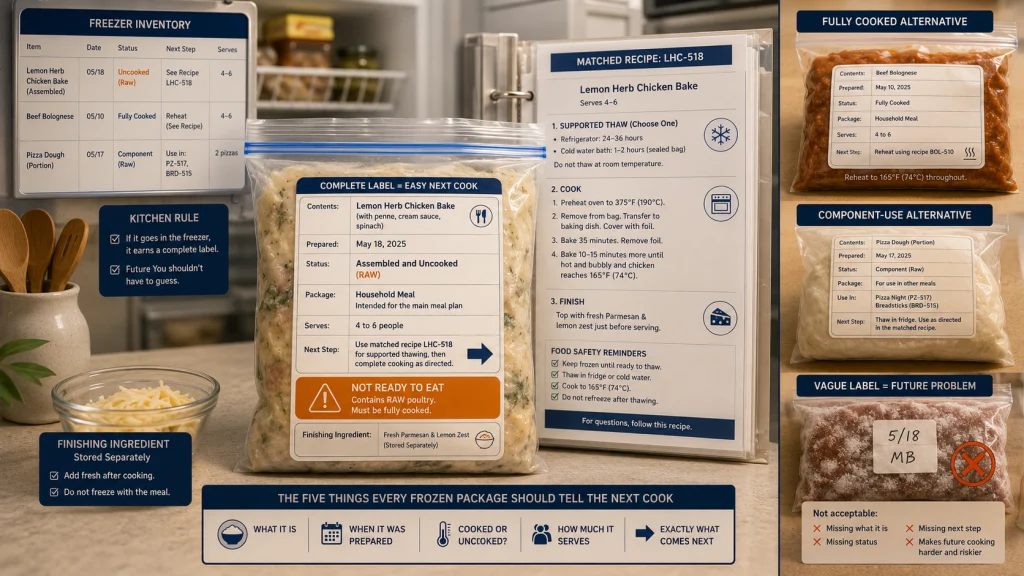
Label the Contents, Date, Cooking Status, and Next Required Step
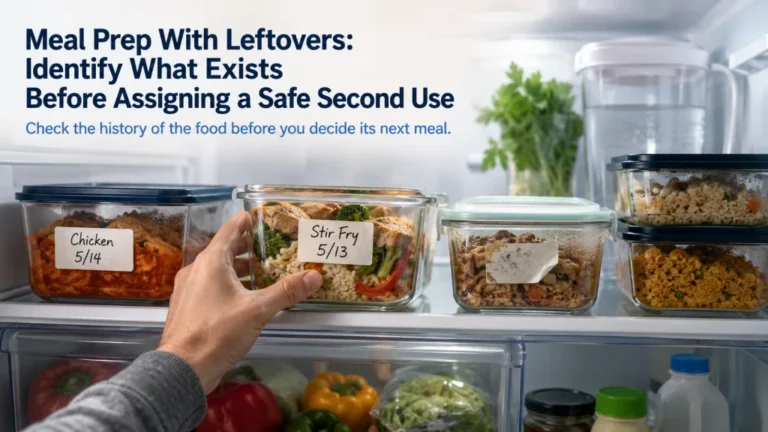
Once food is frozen, color and shape stop being reliable memory cues. A package can look ready to serve while holding raw ingredients, or look like a full meal while containing only one component. The label should tell the next cook what it is, what has already happened, and what still needs to happen.
Complete label example:
Meal: vegetable and chicken bake
Prepared: July 31
Status: assembled and uncooked
Package: household meal
Next step: follow the attached recipe’s supported thawing and full cooking directions
Important: contains raw poultry and is not ready to eat
Finish with: fresh topping stored separately
For a cooked package, state that it is cooked and preserve the supported thawing or reheating path. For a component, name the meals it belongs to. The date identifies the batch, but it does not create a universal freezer duration or prove that quality will remain unchanged.
When the final directions are too long for the package, attach them or store them in a clearly matched inventory. A private shorthand that only the original cook understands turns the freezer back into a memory test. Anyone expected to use the meal should be able to find the full path.
Keep an Inventory Without Blocking Freezer Airflow
A full freezer can feel reassuring until the meal planned for tonight disappears behind unlabeled packages and frosted containers. An inventory reduces the cold, frustrating search at the open door and helps the household use what is already prepared before adding another batch.
Record the meal or component name, date, package count, cooking status, and intended use. Group similar packages only after they are frozen solid, and leave the vents and required airflow paths clear according to the appliance instructions.
A package that technically fits can still make the freezer harder to use when it traps three meals behind it. Leave enough working space to see labels, rotate food, and remove one package without unloading an entire shelf onto the counter.
The broader meal-prep systems guide can help connect the inventory with shopping, cooking days, planned meals, and household responsibilities.
Compare Complete Meals, Components, and Cook-Once-Freeze-One Systems
Freezer meal prep can remove different kinds of later work. Some evenings need one complete meal with no decisions left. Others benefit from a sauce or filling that turns fresh ingredients into dinner. The best method depends on what the household will need when time and energy are limited.
| Method | What enters the freezer | What remains later | Main planning risk |
|---|---|---|---|
| Complete freezer meal | A fully cooked or recipe-supported uncooked meal in its planned package | The preserved thawing, cooking, reheating, or serving path | The package is too large or the recipe does not handle frozen storage well |
| Frozen components | Separate sauces, bases, fillings, or other building blocks | Meal selection, additional ingredients, and final assembly | Flexible parts accumulate without named later uses |
| Cook once, freeze one | A planned second package made during the current meal | Use of the duplicate meal at a later date | The larger batch exceeds the cooking, cooling, or packaging capacity |
A complete meal removes decisions but needs a reliable freezing path. Components preserve flexibility, though they can leave the weekday cook assembling dinner from several separate parts. Cook once, freeze one begins with a clear destination and often feels simple, but the larger batch still has to fit the recipe, cookware, cooling space, and freezer.
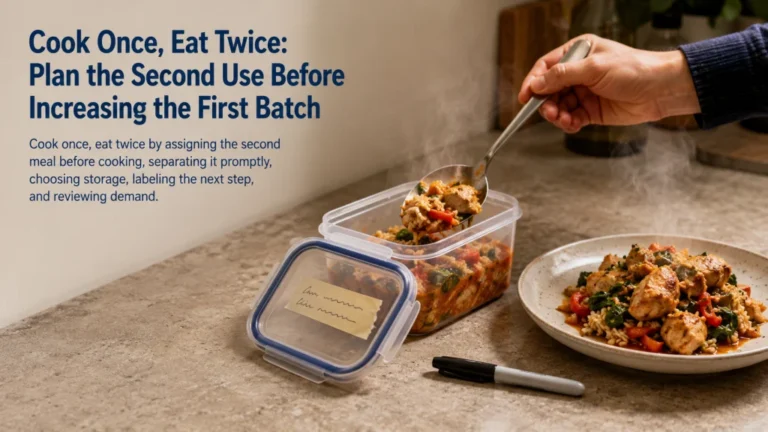
Use the cook-once-eat-twice method when the main goal is dividing one cooking session between an immediate meal and a planned second use.
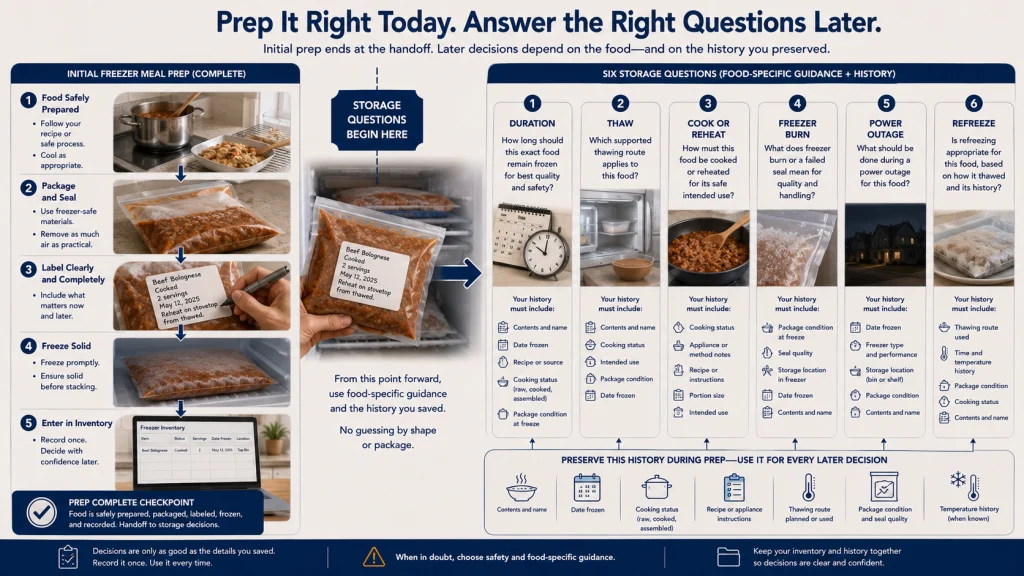
Route Duration, Thawing, Reheating, Freezer Burn, and Outages to Storage Guidance
Initial freezer prep ends once the food is safely prepared, packaged, labeled, frozen, and entered in the inventory. From that point forward, the answer depends on the exact food, whether it is cooked or raw, how it was packaged, and what happened during storage.
| Later question | Why it needs food-specific guidance | What to preserve now |
|---|---|---|
| How long should this food stay frozen? | Best-quality periods vary by food, preparation, package, and storage conditions | Contents, date, cooking status, and package condition |
| How should it be thawed? | The safe route depends on the food and what happens immediately afterward | The recipe or food-specific thawing instruction |
| How should it be cooked or reheated? | Raw, fully cooked, and partly assembled packages require different final steps | Appliance, cooking status, and complete next-step directions |
| What if freezer burn appears? | Quality changes and safe handling are separate questions | Package history and whether the seal failed |
| What if the power goes out? | Safety depends on time, temperature, appliance condition, and whether the food still contains ice crystals or remained sufficiently cold | Keep the freezer closed and follow current outage guidance |
| Can the food be refrozen? | The answer depends on how it was thawed, held, and handled | The thawing route and temperature history |
Use the meal-prep storage guide for food-specific duration, thawing, reheating, freezer burn, refreezing, and power-outage decisions. Do not improvise those steps from the package shape or assume frozen food keeps its best quality forever.
Plan the Package and the Later Meal at the Same Time
Start with food or a recipe that supports freezing, then picture the later meal before choosing the package. A useful portion, a clear cooling route, suitable freezer packaging, and temporary one-layer space should already have a place in the plan before the kitchen fills with finished food.
Every package should answer the questions a tired person will have later: What is this? Is it cooked? What happens next? The date and inventory preserve the rest of the history, while food-specific duration, thawing, reheating, refreezing, freezer-burn, and outage decisions belong to the correct storage process.
A useful freezer meal is not simply food that fits behind the freezer door. It is a small favor prepared for a future day: stored clearly, packaged for the amount needed, and ready to guide the next cook without guesswork. Connect that method to the complete meal-prep process when planning the wider week.
FAQs
❄️ Does freezing make food safe indefinitely?
Food kept continuously frozen at 0°F can remain safe from continued microbial growth, but freezing does not make previously unsafe food safe and does not kill all bacteria. Quality can change over time, so use food-specific guidance rather than a universal duration.
🥘 Should I freeze one large meal or smaller portions?
Choose the size from the later use. Smaller packages can cool, freeze, and thaw more efficiently and let the household remove only what it needs, while one household package reduces containers and labels.
🧊 Can I put a large hot pot directly in the freezer?
Do not cool a large deep pot at room temperature or place it into storage without a supported cooling plan. Divide cooked food into suitable shallow containers or smaller portions and refrigerate or freeze promptly according to the applicable guidance.
🛍️ Is a freezer-safe bag suitable for every meal?
No. The bag may tolerate freezer storage while the food remains too fragile, dense, liquid, or awkward to remove and use. Match the package to the food, sealing method, expansion needs, and later cooking path.
🏷️ What must go on a freezer-meal label?
Write the contents, preparation date, cooked or uncooked status, package purpose, and next required step. Add a clear raw-food warning when the meal is not ready to eat.
📚 Why should new packages freeze in one layer?
One-layer placement allows cold air to circulate around the packages and helps them freeze more rapidly and evenly. Stack or file them only after they are solid.
🌬️ Can I fill every gap in the freezer?
A well-used freezer still needs the airflow required by the appliance and enough working space to retrieve and rotate food. Do not block vents or pack new unfrozen food so tightly that rapid freezing becomes difficult.
⏳ How long can a freezer meal stay frozen?
There is no single best-quality period for every meal. The answer depends on the food, package, preparation, storage conditions, and later use, so consult food-specific storage guidance and use the date as part of that decision.