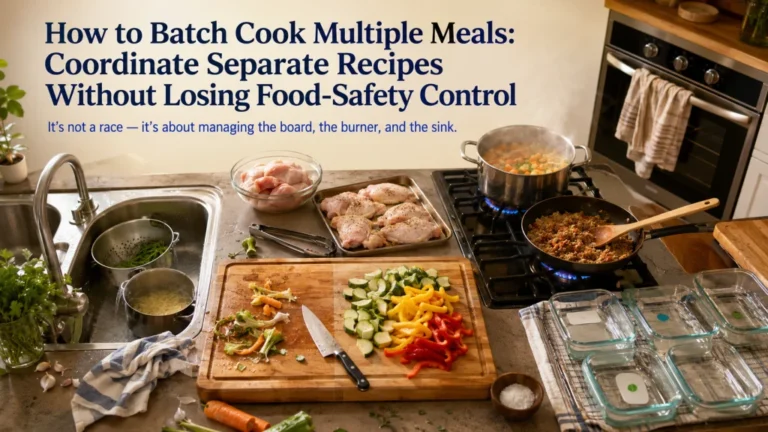
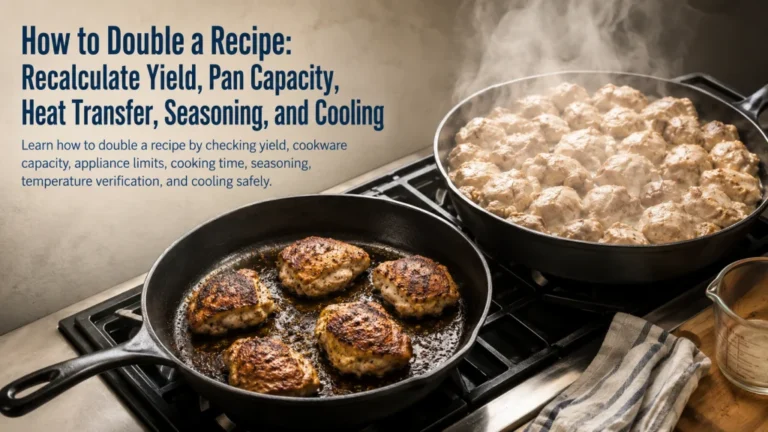
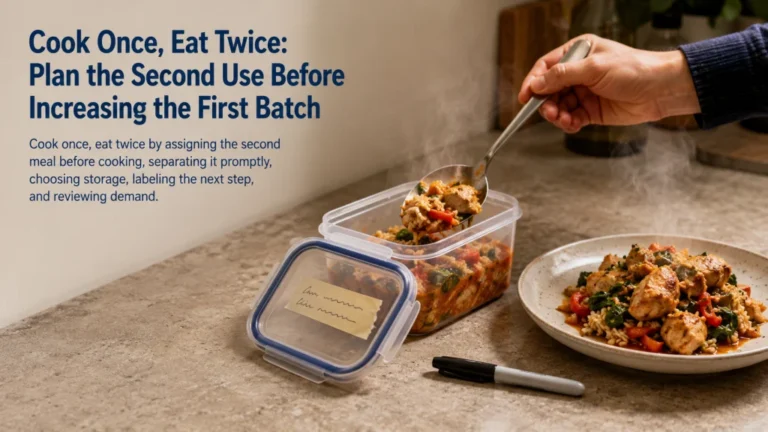
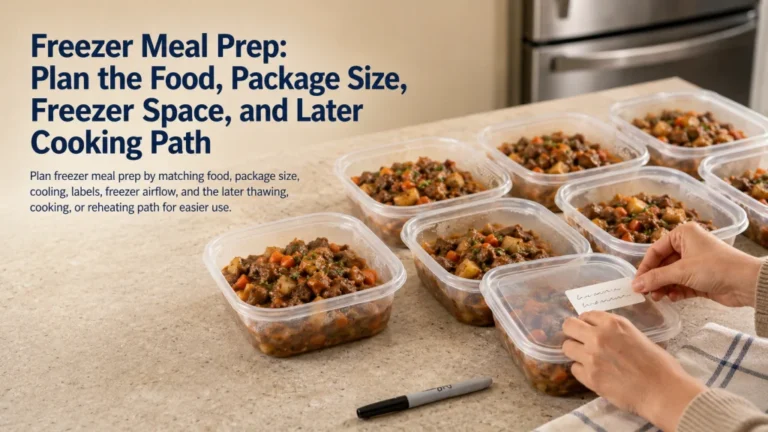
Meal prep with leftovers begins by identifying what the food is and how it has been handled, not by searching for a creative recipe. Verify the original cooking date, room-temperature exposure, cooling route, refrigerator or freezer history, and whether the food was already reheated. When that history is uncertain or an official limit has been exceeded, safe disposal takes priority over avoiding waste. Once the food passes the history check, measure the usable amount, assign a repeat, component, freezer, or no-use route, and label the exact next step.
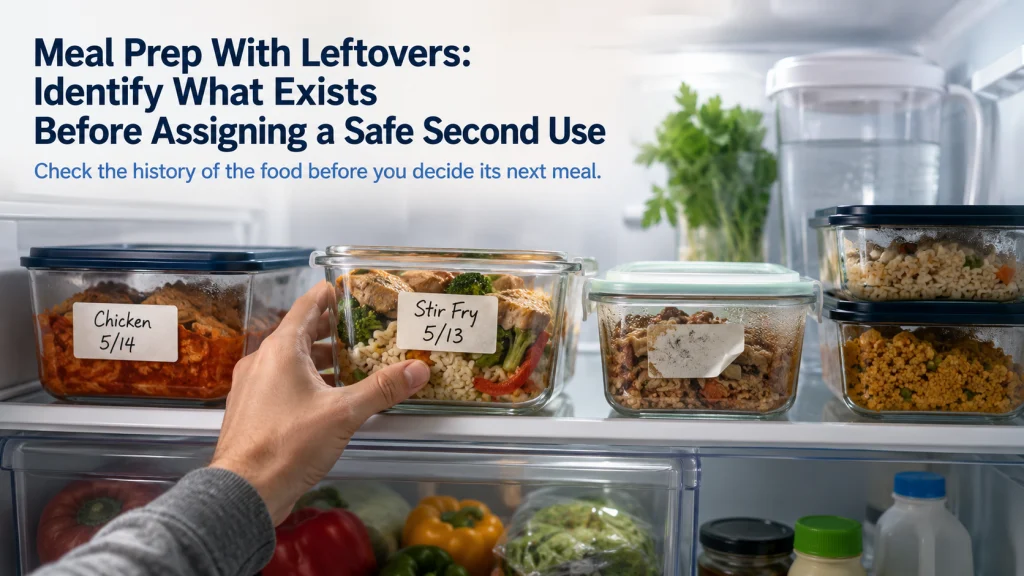
Four Similar Containers Can Have Four Different Decisions
Four containers sit on the same refrigerator shelf. The first holds rice labeled with a known cooking date and a clear cooling history. The second contains a familiar stew with a date, but nobody remembers how long it remained on the counter after dinner. The third has no label and no reliable identity. The fourth was divided, labeled, and frozen soon after cooking.
They may look equally ordinary through clear lids. They are not equivalent.
Four-container history graphic:
Container A: known identity, date, and handling
History is verifiable → continue to quantity and next-use planning
Container B: known date, uncertain room-temperature exposure
One critical part of the history is missing → do not invent a safe story
Container C: no label and uncertain identity
History cannot be reconstructed reliably → use the no-use route
Container D: labeled and frozen through a known route
Verify the label and planned thawing or reheating step → assign a future use
The first leftover question is not “What can I turn this into?” It is “What do I know about this food from cooking through storage?” Appearance alone cannot answer that question.
A history-first approach removes some of the emotional pressure from the decision. The food does not need to earn a new recipe. It needs a reliable identity, a safe handling record, and a realistic next use.
Define Leftovers, Planned Extras, Prepared Components, and Unidentified Food
A leftover is cooked food that remains after its original meal or service. It may have been intentionally saved or simply not eaten.
A planned extra is food cooked in an additional amount for a known later use. Its second meal was decided before or during the original cook, so the container, quantity, cooling route, and label can be prepared in advance.
A prepared component is a cooked or ready-to-use element intended to support several meals, such as a grain, sauce, roasted vegetable, or cooked protein. It may not represent a complete meal on its own.
Unidentified food is a container whose identity, date, cooking status, or handling history cannot be verified well enough to make the next decision. Clear plastic does not turn an unknown container into a known one.
These categories matter because they begin from different levels of control. Cook once, eat twice planning creates the second use before cooking. Component meal preparation creates flexible building blocks, while batch cooking organizes larger planned quantities. This process begins later, with food that already exists and may not have been planned.
Verify Identity, Date, Cooking Status, and Handling History
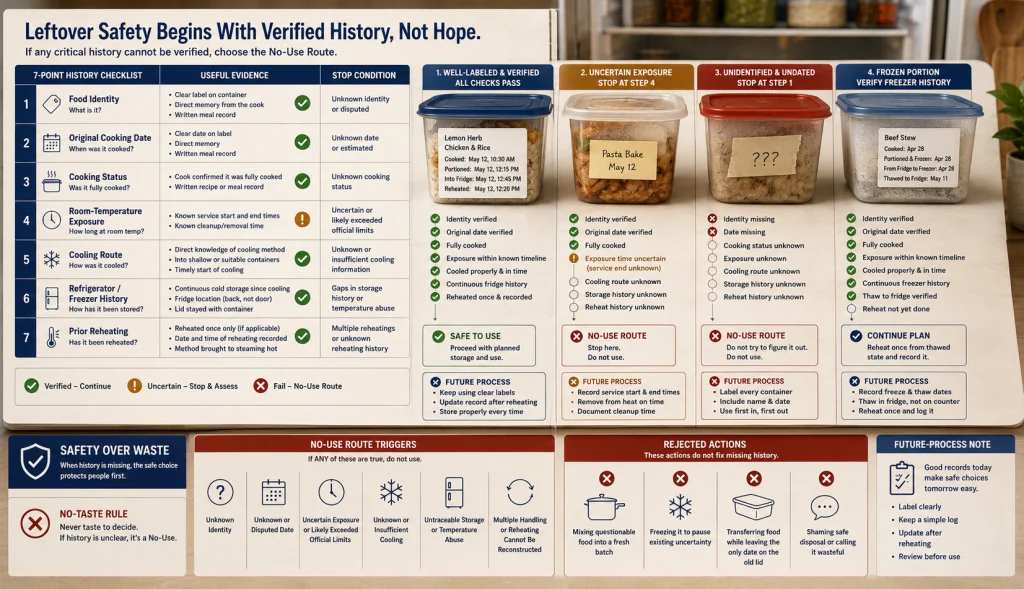
Move through the history in order. Guessing one missing detail can make the rest of the plan look more certain than it is.
| Leftover-history checklist | Question | What counts as useful evidence | Stop condition |
|---|---|---|---|
| Identity | What exactly is in the container? | A clear label, direct memory from the cook, or an unambiguous original package | The food cannot be identified reliably |
| Original cooking date | When was it prepared? | A dated label, written meal record, or confirmed household timeline | The date is unknown or disputed |
| Cooking status | Was every component fully cooked, partly cooked, or intended for a final cook later? | The original preparation plan or a specific label | The required cooking step cannot be established |
| Room-temperature exposure | How long was it outside safe temperature control? | A known service and cleanup timeline | Exposure is unknown or an official limit was exceeded |
| Cooling route | Was it divided and cooled promptly in suitable containers? | Direct knowledge of the cooling process | The food remained in a large hot vessel for an unknown period |
| Storage history | Was it refrigerated continuously, frozen, thawed, or moved repeatedly? | A label and known refrigerator or freezer history | The cold-storage history cannot be reconstructed |
| Prior reheating | Has the food already been reheated or served again? | A known meal history and updated label | Repeated handling cannot be traced |
Nora’s observation: Clear containers and inventory apps improve visibility, but they cannot reconstruct a missing date, counter interval, or cooling method. I also watch for a quieter failure: food is moved into a better container, but the original label stays on the old lid. The transfer improves storage and erases the history at the same time.
Ask the person who cooked or stored the food before relying on assumptions. If nobody can verify the key details, the uncertainty is part of the decision, not a blank space to fill with optimism.
Use the No-Use Route When History Is Unknown or Limits Were Exceeded
Discarding food can feel wasteful, especially when the ingredients were expensive or the household is trying to reduce waste. The hesitation is understandable. It still cannot restore a missing date, cooling route, or counter timeline.
Safety-over-waste box:
- Do not assign a new meal when the identity or original cooking date is unknown.
- Do not keep food when room-temperature exposure cannot be verified or exceeded current official limits.
- Do not combine questionable food with a fresh batch to avoid discarding it.
- Do not freeze food to pause an uncertainty that already exists.
- Do not shame the person who chooses safe disposal.
Decision principle: Waste prevention shapes future shopping, cooking, labeling, and portion choices. It does not override a present safety boundary.
Handle the moment in two steps. Dispose of the uncertain food without tasting it. Then note what information disappeared, such as the date, cooling route, or assigned meal, so the next batch can be easier to trust.
Meal planning to reduce food waste addresses purchasing, quantities, ingredient overlap, and household habits before uncertainty appears.
Do Not Use Smell, Appearance, or Taste as the Sole Safety Test
A container can smell familiar and still have an unsafe handling history. Another can look dry, separated, or unappealing while its history remains known. Sensory clues may reveal an obvious quality problem, but they cannot prove that questionable food is safe.
Do not take a small taste to decide whether an unknown container can be saved. Do not heat it first and then taste it. Do not ask a person with a “strong stomach” to make the test for the household.
Use the verified timeline and current food-safety guidance. When the history fails, stop there. When the history passes, sensory quality can help decide whether the food is appealing enough for a repeat or transformed use, but safety and preference remain separate questions.
This distinction can make the refrigerator cleanout feel less personal. The decision is not a judgment about the cook or the food. It is a response to whether the necessary facts survived.
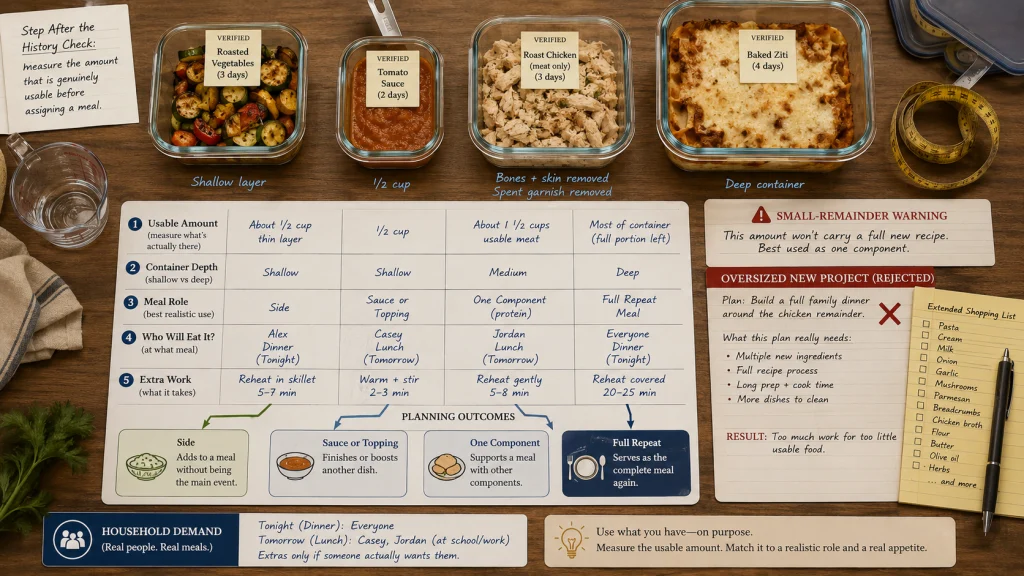
Measure the Usable Quantity Before Choosing a New Meal
Once the history is verified, measure what is actually available. A thin layer of roasted vegetables may support one lunch component, not a family dinner. Half a container of sauce may be enough to finish another dish but not enough to justify building the entire meal around it.
| Quantity check | Question | Planning effect |
|---|---|---|
| Usable amount | How much remains after removing bones, spent garnish, or portions already assigned? | Prevents a large new plan from being built around a small remainder |
| Container depth | Is the food spread in a shallow layer or packed into a deep mass? | Shapes the later reheating or thawing plan without changing safety history |
| Meal role | Is it enough for a full repeat, one component, a sauce, topping, or side? | Matches the quantity to a realistic use |
| Household demand | Who is likely to eat it, and during which meal? | Prevents assigning food to an imaginary future appetite |
| Additional work | How many new ingredients and steps would be required? | Reveals when “using leftovers” would create a second oversized cooking project |
Quantity is a design constraint, not an invitation to stretch the food beyond recognition. Sometimes the most useful answer is to keep the leftover as one side or topping and let the rest of the meal come from planned components.
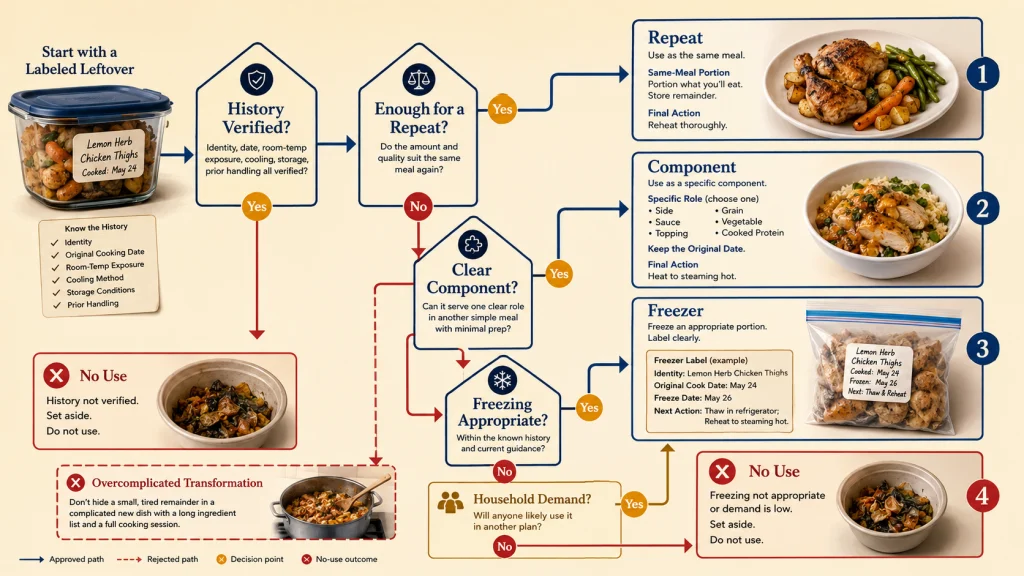
Choose a Repeat, Component, Freezer, or No-Use Route
Once the history and quantity are clear, choose the least complicated route that still preserves the required next step. The goal is not to prove that every container can be rescued.
Repeat-transform-freeze-discard decision tree:
Can identity, date, exposure, cooling, and storage history be verified?
No → No-use route.
Yes → Continue.
Is the amount enough and the quality suitable for the same meal again?
Yes → Repeat route: portion it for the same meal with the correct final reheating step.
No → Continue.
Can it serve as one clear component without obscuring its date or required final step?
Yes → Component route: assign it to a specific meal role.
No → Continue.
Is freezing still appropriate within the known history and current guidance?
Yes → Freezer route: label identity, original date, freeze date, and next action.
No → No-use route.
Transformation should not become pressure to hide a small or tired remainder inside a complicated new dish. If using half a cup of food requires a long shopping list and another full cooking session, the plan may be serving the leftover rather than the household. A transformed use is worthwhile only when the history is verified, the amount makes sense, and the required final step remains clear.
A simple repeat often uses less attention and fewer new ingredients. A component can fill one clear role. Freezing can move a verified portion to a better week. The no-use route remains valid when uncertainty or lack of demand makes the other choices a burden rather than a solution.
Keep Foods From Different Dates and Histories Clearly Separated
Combining two containers can erase the history of both. A fresh batch added to an older batch does not reset the older food’s date. A container from one meal should not inherit the label of another merely because they look similar.
Keep separate:
- Foods cooked on different dates.
- Foods with different cooling or room-temperature histories.
- Previously reheated portions and food that has not yet been reheated.
- Refrigerated and previously frozen portions.
- Fully cooked components and items still requiring a final cook.
If two verified components are combined for one meal, preserve both histories in the planning note and use the more restrictive applicable route. Do not pour an older container into a newer one and label the mixture with only the newer date.
The same principle applies during refrigerator cleanup. Consolidating containers may save space, but it should never cost the household the information needed for the next decision.
Preserve the Required Final Reheating or Cooking Step
A leftover plan is incomplete when it says only “use Tuesday.” The label or meal note should also say what must happen before the food is served.
Possible final steps include:
- Reheat the complete cooked dish according to current guidance.
- Thaw through an appropriate route before reheating.
- Add the verified cooked component during a later cooking stage.
- Complete the original cooking process when the food was intentionally prepared only partway.
- Keep ready-to-eat food separate from raw ingredients and raw-contact tools.
Do not assume that adding leftovers to a hot pan guarantees every portion reaches the necessary endpoint. Stir, distribute, and verify according to the food and method. Do not use smell, steam, bubbling, or surface heat as the sole test.
Exact cooling, refrigeration, freezing, thawing, and reheating decisions belong with meal prep storage, where the food’s specific history can be carried through the final step.
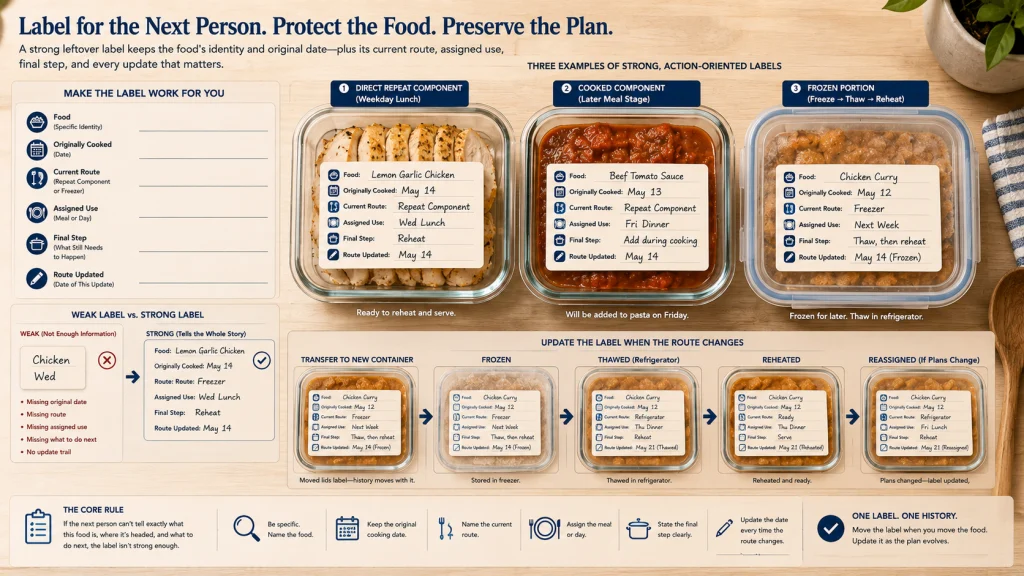
Label the Next Use, Original Date, and Final Step
A strong label protects more than the food name. It carries the history forward so the next person does not need to reconstruct the decision from memory.
Next-use label:
Food: [specific identity]
Originally cooked: [date]
Current route: repeat / component / freezer
Assigned use: [specific meal or day]
Final step: [reheat, thaw then reheat, add during cooking, or complete cooking]
Route updated: [date moved, frozen, thawed, or reheated]
Move the label when food moves into another container. Update it when the food is frozen, thawed, reheated, or assigned to a different meal. A lid without its original container should not carry the only copy of the history.
Nora’s observation: I prefer labels that name the next action, not only the contents. “Chicken, Monday” still leaves a question. “Chicken, cooked Monday, reheat for Wednesday lunch” gives the household a decision that can be completed without another round of guessing.
Review Why the Leftover Was Created and Adjust the Next Batch
Once the immediate food is assigned or discarded, look back at how it was created. The goal is not to eliminate every leftover. It is to distinguish useful planned extras from repeated food that has no owner or next step.
| Leftover pattern | Likely cause | Next-batch adjustment |
|---|---|---|
| Same side dish remains every week | The original quantity exceeds actual demand | Reduce that component while keeping the main recipe unchanged |
| Containers lose their dates | Labels are added late or left on mismatched lids | Label the destination container before food enters it |
| Food is saved without a next meal | The household treats refrigeration as the decision | Assign the repeat, component, or freezer route during cleanup |
| Several partial containers accumulate | Components were prepared without checking existing inventory | Review verified leftovers before the next cooking session |
| Safe food remains unwanted | The second meal repeats too soon or requires too much work | Change flavor direction, freeze earlier when appropriate, or cook less |
Meal prep systems can connect the refrigerator check, shopping list, cooking quantity, labels, and weekly review so leftovers are visible before another batch begins.
The adjustment should be small enough to test. Reduce one quantity, label at one earlier step, or reserve one refrigerator zone for verified leftovers. A small change that survives a busy week is more useful than an elaborate inventory system that works only when everyone remembers it.
Verify the History, Choose the Route, Label the Next Step, or Discard
Begin with identity, original cooking date, cooking status, room-temperature exposure, cooling route, cold-storage history, and prior reheating. When the required facts are missing or current limits were exceeded, choose safe disposal without tasting and without moral pressure.
When the history is verified, measure the usable amount before building a meal around it. Choose a repeat, component, freezer, or no-use route, keep different dates and histories separate, and preserve the exact final cooking or reheating step.
Then carry the decision forward with a label that names the food, original date, assigned use, and next action. The most useful leftover is not the one transformed into the cleverest recipe. It is the one whose history remains clear enough for the household to make the next decision confidently.
For the full weekly sequence from planning through cooking and storage, return to how to meal prep.
FAQs
🏷️ What information should a leftover label include?
Include the specific food identity, original cooking date, current route, assigned meal, and required final step. Update the label when the food is moved, frozen, thawed, or reheated.
👃 Can I smell leftovers to decide whether they are safe?
Do not use smell as the sole safety test. Verify the cooking date, room-temperature exposure, cooling, storage, and reheating history. Discard food when the necessary history is unknown.
🥄 Is tasting a small amount a safe test?
No. Do not taste questionable food to determine safety. A small sample cannot repair an unknown or unacceptable handling history.
🧊 Can I freeze leftovers when I am unsure how old they are?
No. Freezing does not restore a missing date or erase earlier handling uncertainty. Freeze only when the identity, date, exposure, cooling, and storage history remain acceptable.
🥘 Can I mix an older leftover with a fresh batch?
Do not mix unknown or questionable food with a fresh batch. When two verified foods from different dates are combined, preserve both histories and follow the more restrictive applicable route.
📦 Should every leftover become a new recipe?
No. A simple repeat, one component, freezing when appropriate, or safe disposal may be the better route. Transformation should not require a larger new cooking project than the quantity justifies.
♨️ How should I plan the final reheating step?
Label whether the food must be reheated, thawed and reheated, added during cooking, or fully cooked from a planned partial stage. Follow current food-specific guidance and do not rely on surface heat or bubbling alone.
🗑️ Is discarding uncertain food a failure to reduce waste?
No. Safety overrides waste prevention when the history is unknown or limits were exceeded. Use the discarded food as information for future quantity, cooling, labeling, and meal-assignment changes without shaming the decision.