Rest between sets should be long enough for the next set to meet its planned standard, not merely long enough for a timer to reach zero. Start with a practical range based on exercise demand, load, effort, training experience, and the goal of the session. Then check breathing, technique, repetitions, and equipment readiness before beginning again. Longer pauses often fit demanding strength work, while lighter or beginner work may need less time, but no single interval suits every exercise.
Let the Second Set Reveal Whether the Break Was Long Enough
Imagine two people using the same load for the same target of ten controlled repetitions. Both complete the first set as planned. One begins again after a short countdown and reaches only six repetitions before the range shortens and the torso starts to shift. The other waits longer, resets the equipment, and completes nine controlled repetitions with the original technique standard.
| Second-set result | Shorter break | Longer break |
|---|---|---|
| Repetitions completed | Six of ten | Nine of ten |
| Technique | Range shortens and body position changes | Movement remains close to the first set |
| Breathing | Still rushed at the start | Settled enough to begin with control |
| Interpretation | The interval was too short for the planned work | The interval better supported the next-set standard |
The longer pause is not automatically better in every situation. It is better here because it preserved the intended work. The useful rest interval is judged by the next set, not by the timer alone.
Define Inter-Set Rest and Keep It Separate From Rest Days
Inter-set rest is the pause between work sets during one resistance-training session. It allows breathing, local muscle fatigue, grip, coordination, and attention to recover enough for the next planned effort.
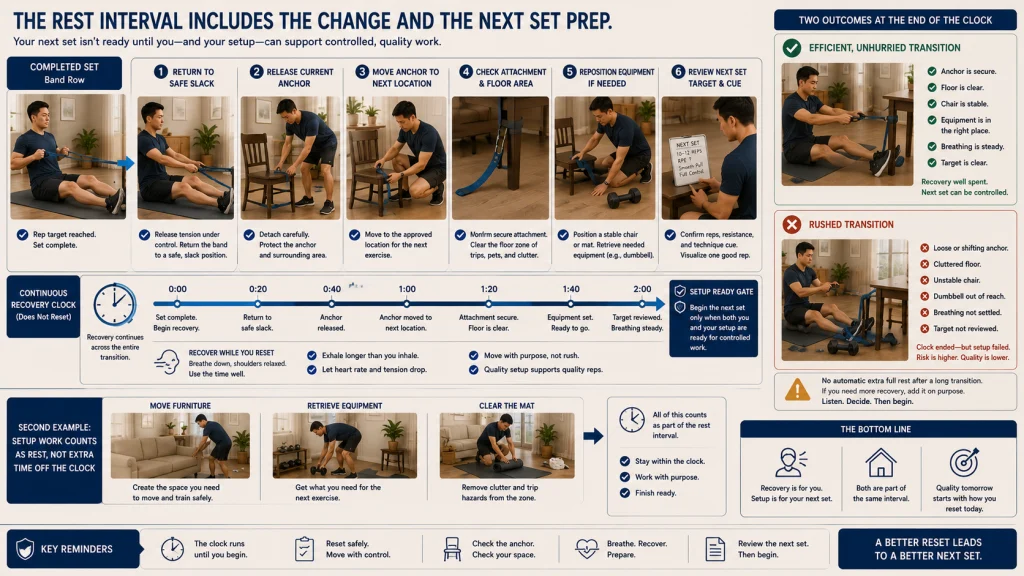
Rest between exercises may include the same recovery process plus practical transitions such as changing a band anchor, moving a chair, loading a dumbbell, or adjusting floor space. A rest day is different. It is a day or longer period between training sessions rather than a pause inside one workout.
The article on workout recovery covers between-session recovery. This guide stays inside the workout and focuses on the break before the next set or exercise.
Use the Next Set as the Practical Feedback Signal
A timer provides consistency, but it cannot see whether the next set matches the plan. The better feedback comes from what happens after the pause.
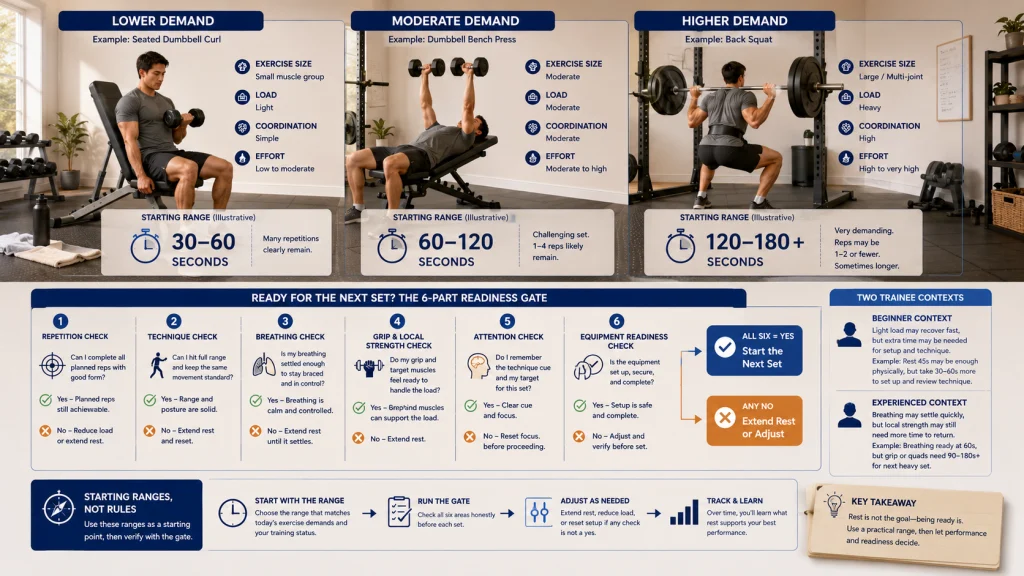
- Repetition performance: Can you complete the planned range without an unexpected drop?
- Technique: Can you keep the same range, posture, and movement path?
- Breathing: Can you begin without gasping or bracing?
- Grip and local fatigue: Can the working muscles and hands support the intended load?
- Attention: Can you remember the technique cue and set target?
- Equipment readiness: Is the setup secure and complete?
Next-set standard: The break was probably adequate when the next set stays close to the planned repetitions, technique, range, and effort. When performance collapses for reasons other than the planned difficulty, extend the next interval.
This framework works only when the set target is clear. Use sets and repetitions for beginners when the present dose has not yet been defined.
Account for Exercise Size, Load, Effort, and Training Status
Rest need rises when an exercise uses more muscle mass, a heavier load, greater coordination, or a set performed close to the person’s current limit. It may be lower when the movement is light, familiar, technically simple, and stopped with clear capacity remaining.
Training status also matters. A beginner may use lighter resistance and stop farther from failure, which can make a shorter break sufficient. The same beginner may also need extra time to remember setup and technique. An experienced trainee may recover breathing quickly while still needing more time for local strength to return.
| Demand level | Typical features | Practical starting range | Adjustment signal |
|---|---|---|---|
| Lower demand | Light resistance, simple movement, several repetitions left | About 30 to 60 seconds | Extend it if technique, breathing, or repetitions drop unexpectedly |
| Moderate demand | Moderate load, larger movement, noticeable fatigue | About 60 to 120 seconds | Add time when breathing or local fatigue still limits the next set |
| Higher demand | Heavy load, multi-joint work, high effort, complex setup | About 2 to 3 minutes, sometimes longer | Begin only when the next-set standard is likely to hold |
These ranges are starting points, not fixed prescriptions. Exercise demand, equipment setup, and next-set quality decide whether the interval should be shorter or longer.
Allow More Recovery for Strength-Oriented and Higher-Demand Work
Strength-oriented sets often need roughly two to three minutes of recovery, and sometimes more when the load, exercise size, or effort is high. Beginning too soon may reduce repetitions, change the movement path, or force a lower load than the session intended.
Multi-joint exercises can also require more time because the legs, trunk, grip, breathing, and concentration must all be ready at once. A demanding row, squat variation, press, or hinge may need a different interval from a light isolation movement even when both appear in the same workout.
Use the guide to exercise intensity for beginners when it is unclear whether the set itself is light, moderate, or highly demanding. Rest cannot be chosen well without understanding the effort that came before it.
Interpret Hypertrophy and General-Strength Guidance With Limits
In many general-strength or muscle-building sessions, roughly 60 to 120 seconds can serve as a practical starting range. Longer rest may help preserve repetitions and total work in demanding sets, while shorter intervals can still fit lighter exercises when the next set remains close to plan.
The evidence does not create one universal number for muscle growth or general strength. A supervised gym study may not reflect home transitions, limited dumbbell increments, band setup, or a video that forces the same countdown for every movement.
- Study participants may have different training experience from the reader.
- Equal planned sets do not guarantee equal completed work.
- Exercise selection changes how fatigue accumulates.
- Short studies may not capture long-term adherence.
- Home setup time is rarely the main variable being studied.
Use evidence to choose a sensible starting range, then verify it with the next set.
Use Shorter Breaks When Beginner or Lighter Work Supports Them
About 30 to 60 seconds may be enough when the exercise is light, the set stops well before failure, breathing settles quickly, and the next set remains technically similar. This can help a beginner keep the workout moving without waiting longer than necessary.
Shorter does not mean rushed. A new trainee may need time to recall foot position, adjust a chair, check the band anchor, or confirm the next target. That setup time is part of the rest period because it supports safe and repeatable work.
If the second set loses several repetitions, the range shortens, or technique becomes unstable, increase the next break. Do not blame the reader’s fitness automatically when the countdown itself was too short.
Include Equipment Changes in Rest Between Exercises
Moving between exercises often requires more than physiological recovery. A home session may need furniture moved, a band re-anchored, a dumbbell carried, a mat cleared, or a chair checked for stability.
- Finish a demanding band row.
- Return the band to a safe slack position.
- Move the anchor for the next exercise.
- Check the attachment and floor area.
- Review the next set target.
- Begin only after breathing and setup are ready.
The transition may take longer than the programmed break, or the setup itself may provide enough recovery. Avoid adding an extra full rest interval automatically after a long equipment change. Judge the next set by readiness and quality.
Know How Videos, Supersets, and Circuits Change the Goal
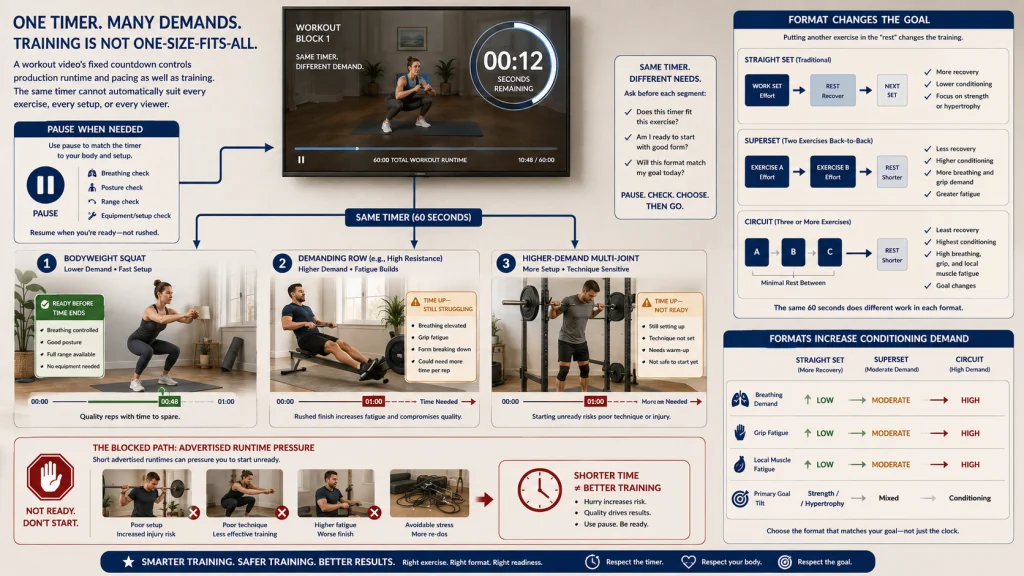
Workout videos often use fixed countdowns to control runtime, music, camera pacing, and audience engagement. That does not mean the same interval suits every exercise or every viewer.
Editorial observation: The same sixty-second timer cannot serve a bodyweight squat, a demanding row, and a heavy multi-joint movement equally. A video countdown is part of the production format as well as the training design.
Supersets and circuits place another exercise inside what would otherwise be rest. This can save time and increase conditioning demand, but it also changes the session. The next set may begin with more breathing fatigue, grip fatigue, or local muscle fatigue than a straight-set format.
Fixed-timer callout: Pause the video when the next set would require rushed setup or poor technique. A short advertised runtime does not justify starting before the movement is ready.
Start With a Range, Observe the Next Set, and Adjust
Use a simple three-step process rather than searching for one perfect number.
- Choose a starting range: Try about 30 to 60 seconds for lighter work, 60 to 120 seconds for moderate work, and about 2 to 3 minutes or more for demanding strength sets.
- Set a next-set standard: Define the planned repetitions, technique, range, and acceptable effort.
- Adjust the following break: Add time when performance drops unexpectedly, or remove unnecessary waiting when the next set is consistently ready sooner.
| What happens next | Likely interpretation | Adjustment |
|---|---|---|
| Planned repetitions and technique are repeated | The interval supported the intended work | Keep the range similar |
| Repetitions drop sharply and breathing is still rushed | Recovery was probably incomplete | Extend the next interval |
| Technique fails despite normal breathing | Local fatigue, load, or exercise difficulty may be the limit | Add rest, reduce demand, or review the set target |
| The next set is ready well before the timer ends | The programmed pause may be longer than needed | Shorten cautiously while preserving quality |
| Setup remains incomplete | The exercise is not ready regardless of elapsed time | Finish the setup before starting |
Record the interval and result for a few comparable sessions. A useful adjustment rule comes from repeated patterns rather than one unusually strong or weak day.
Separate Normal Recovery From Concerning Symptoms
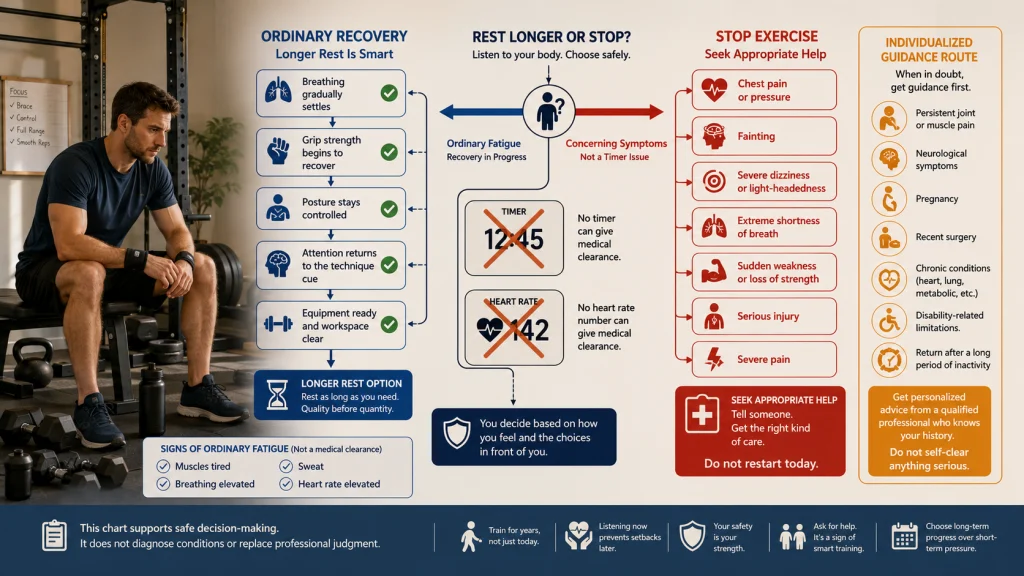
Breathing should settle enough to begin the next set with control. Technique should be deliberate, and ordinary fatigue should not become severe dizziness, faintness, chest pressure, or extreme shortness of breath.
Stop exercise and seek appropriate help for chest pain or pressure, fainting, severe dizziness, extreme shortness of breath, sudden weakness, serious injury, or severe pain. Do not use a timer or heart-rate recovery number as medical clearance to continue.
Persistent joint or muscle pain, neurological symptoms, pregnancy, recent surgery, chronic conditions, disability-related limitations, or a long period of inactivity may require individualized guidance.
Training close to failure can increase fatigue and rest need. The guide to training to failure explains effort decisions without treating every set as a maximal test.
Choose a Starting Break and an Adjustment Rule
Start with a practical range based on exercise demand, load, effort, training experience, and the goal of the set. Define what the next set should look like, including repetitions, range, technique, and breathing.
Keep the interval when it supports the planned work. Add time when recovery or setup is incomplete, and shorten it only when the next set remains ready and technically sound. The timer starts the decision, but the next set finishes it.
For the broader training system, return to how to exercise at home, strength training at home, or compare full-body and split workouts when rest periods are affecting session length.
FAQs
⏱️ How long should I rest between sets?
As a starting point, try about 30 to 60 seconds for lighter work, 60 to 120 seconds for moderate work, and about 2 to 3 minutes or more for demanding strength sets. Then adjust according to repetitions, technique, breathing, and readiness in the next set.
🏋️ Do heavy exercises need longer rest?
Often, yes. Higher loads, multi-joint movements, complex technique, and sets performed near the person’s current limit commonly need more recovery to preserve the planned work.
🌱 Can beginners use shorter rest periods?
Sometimes. Lighter sets stopped with capacity remaining may need less recovery, but beginners may also need time to reset equipment and remember technique.
📉 What if my repetitions drop in the next set?
A small planned change may be acceptable, but a sharp unexpected drop can signal incomplete recovery, excessive load, or a set performed too close to failure. Extend the next break and review the set target.
🎥 Should I follow the timer in a workout video?
Treat it as a starting cue. Pause the video when breathing, technique, or equipment setup is not ready. Production pacing does not make one countdown appropriate for every exercise.
🔄 Does changing equipment count as rest?
Yes. Equipment changes occur inside the recovery period. A long transition may provide enough rest, while a rushed or insecure setup means the next exercise is not ready.
🫁 Should I wait until my breathing is completely normal?
Not necessarily. Breathing should be settled enough to begin with control, but the next-set standard also includes technique, repetitions, grip, attention, and equipment readiness.
🚩 When should I stop instead of resting longer?
Stop and seek appropriate help for chest pain or pressure, fainting, severe dizziness, extreme shortness of breath, sudden weakness, serious injury, or severe pain. Do not use a longer rest period as a substitute for evaluation.