A fitness tracker band should be chosen by attachment, adjustment, daily environment, care, and inspection before color or material name. Pin buckle, pin-and-tuck, stretch, woven hook-and-loop, metal, and leather-style bands solve different problems around exercise, water, work, sleep, drying, and replacement. Exact compatibility, size range, water exposure, and care must be verified for the specific case and band. One band is enough when one setup handles the routine well, while two purpose-specific bands make sense only when they remove a recurring conflict.
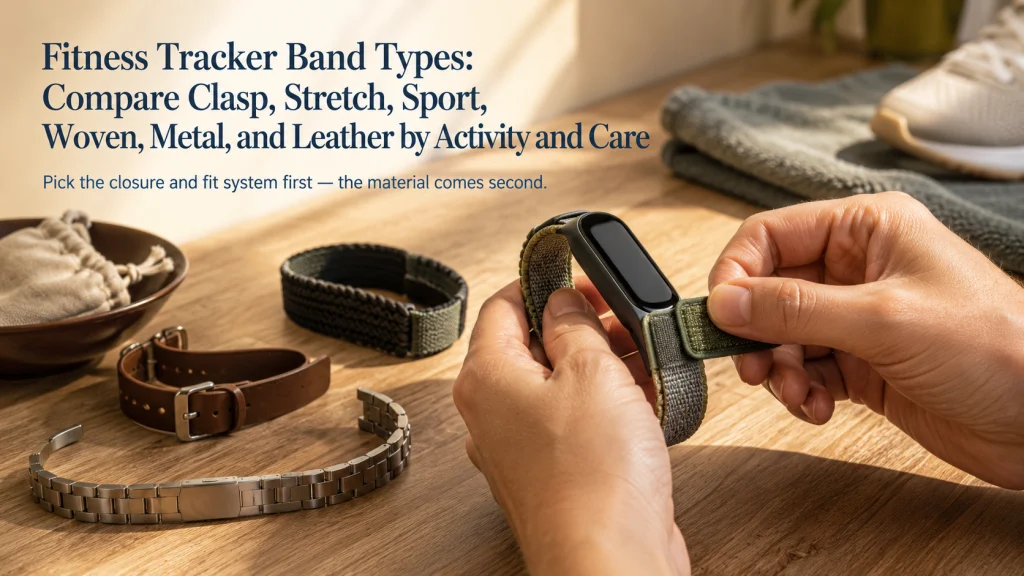
See how six band systems change the same wearable case
Attach the same tracker case to six different bands: a pin buckle, a sport pin-and-tuck closure, a stretch loop, a woven hook-and-loop strap, a metal link band, and a leather-style strap. The screen and sensors stay the same, but adjustment, security, drying, desk contact, sleep comfort, and care all change.
Fixed-position systems
- Pin buckle
- Pin-and-tuck
- Metal link
Continuous or flexible systems
- Stretch loop
- Woven hook-and-loop
- Mesh or other sliding closure
Viewed in a product photo, all six can appear to be simple style choices. On the wrist, they change how often the band needs adjustment, where the closure touches a desk, how long moisture remains after exercise, and whether the setup still feels practical at bedtime.
A softer band can improve overnight comfort while taking longer to dry after exercise. Another band may dry quickly yet feel more noticeable against a desk or under a sleeve.
The attachment and adjustment system should be chosen before the material name.
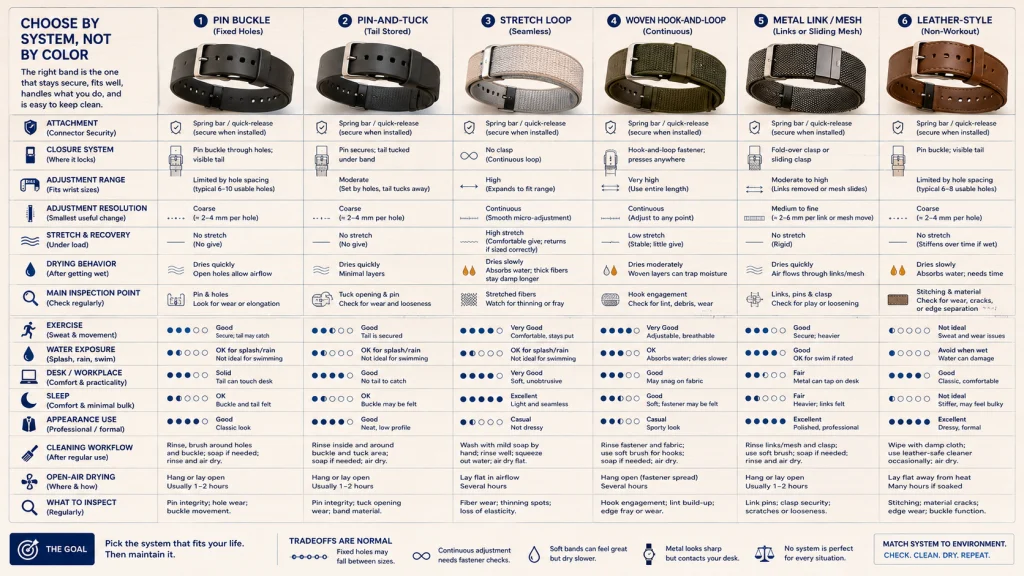
Define connector, clasp, adjustment range, adjustment resolution, stretch, and drying
Band descriptions become clearer when each part of the system has a separate job.
- Connector: The part that attaches the band to the tracker or watch case.
- Clasp: The mechanism that closes the band around the wrist.
- Adjustment range: The smallest and largest wearable settings supported by the exact band.
- Adjustment resolution: How finely the fit can be changed between available settings.
- Stretch: How much the band expands during dressing, movement, heat, or daily wear.
- Stretch recovery: Whether the band returns toward its original size after being expanded.
- Drying behavior: How much water or sweat remains in the band and how long it takes to become ready for comfortable wear again.
Connector security and fit adjustment usually matter before the material category. A visually attractive strap is not useful when it does not lock into the case correctly or when every available setting is either loose or overly tight.
| Attachment-system table | Adjustment resolution | Desk and sleep contact | Drying and care pattern | Main inspection point |
|---|---|---|---|---|
| Pin buckle | Limited by hole spacing | Buckle and tail may remain noticeable | Varies by exact band and exposure | Pin, holes, buckle, and keeper |
| Pin-and-tuck | Limited by hole spacing | Cleaner outer profile, extra underside layer | Moisture can remain beneath the tucked section | Pin, hole area, tuck opening, and hidden tail |
| Stretch loop | Determined by loop size and elasticity | No separate clasp, but pressure depends on recovery | May hold moisture depending on construction | Permanent lengthening, twisting, and thinning |
| Woven hook-and-loop | Broad continuous adjustment | Soft profile, closure edge may catch or lift | Can require open-air drying after sweat or washing | Hook engagement, edge wear, lint, and lifting |
| Metal link or mesh | Links may be coarse; sliding systems may be finer | Clasp, links, or mesh can meet a desk repeatedly | Requires exact cleaning and corrosion guidance | Links, pins, magnets, clasp, and surface damage |
| Leather-style or non-workout | Often fixed by holes or a dress clasp | Can feel familiar for work or events | Exposure limits vary and must be verified | Stitching, holes, lining, cracking, and clasp wear |
This comparison makes the real tradeoff visible: the band that feels easiest to adjust may ask for more drying time, while the band that looks most polished may demand more careful exposure and inspection.
Use the smartwatch size guide when case geometry and band range must be selected together before purchase.
Start with exercise, water, work, sleep, and appearance requirements
Write down the environments the band must handle during an ordinary week. The right system for a dry office routine may be inconvenient for daily exercise, overnight wear, frequent hand washing, or work that requires gloves and repeated wrist movement.
| Activity-care matrix | Adjustment need | Exposure question | Care question |
|---|---|---|---|
| Exercise | Secure fit with enough flexibility for movement | Will sweat, friction, or equipment contact affect the exact band? | Can it be cleaned and dried before the next wear period? |
| Water exposure | Closure must remain secure when wet if exposure is permitted | Does the exact manufacturer guidance allow this type of water use? | How should the connector, clasp, and band be dried? |
| Desk or workplace | Enough stability to avoid repeated rotation | Will the clasp strike a desk, glove, sleeve, or tool? | Does the environment add dust, oils, or repeated cleaning needs? |
| Sleep | Secure without creating pressure from the closure or tail | Will the band trap moisture after evening exercise or washing? | Is the band dry and clean before overnight wear? |
| Formal or appearance-focused use | Fit should remain usable for the full event | Will the environment include water, sweat, or heavy activity? | Do the exact care instructions match the planned use? |
Mark each environment as daily, weekly, occasional, or irrelevant. A band should not be selected around an imagined event while creating friction during the routine that happens every day.
Compare pin buckle and pin-and-tuck systems
A pin buckle uses fixed holes and a separate buckle. It is familiar, easy to inspect, and straightforward to reopen, but the hole spacing may place the preferred fit between two settings.
A pin-and-tuck system also uses fixed adjustment points, then places the remaining tail beneath the band. This can reduce a loose tail catching on clothing, but the tucked section adds another layer against the wrist.
| Decision point | Pin buckle | Pin-and-tuck |
|---|---|---|
| Adjustment | Fixed holes with visible tail management | Fixed holes with the tail stored beneath the band |
| Inspection | Pin, holes, buckle, and keeper are visible | Pin, hole area, tuck opening, and hidden tail require inspection |
| Desk contact | Buckle position may touch the work surface | Outer profile may be smoother, but the tucked tail adds underside bulk |
| Sleep | Buckle and tail position may be noticeable | Hidden tail may reduce snagging but can create a layered pressure area |
| Best reason to choose | The preferred hole gives a repeatable fit and the buckle works in the daily environment | The tucked tail solves a recurring snag without creating another comfort problem |
Neither system is universally more secure or comfortable. Test the exact closure, hole spacing, tail length, and case position during exercise, sleep, and desk work.
Compare stretch and elastic loops
A stretch loop removes the clasp and fixed holes, so the entire experience depends on one choice: whether the loop size can pass over the hand and still hold the case where it belongs.
That tradeoff often appears at different times of day. A loop may feel easy to put on in the morning, then rotate during exercise, or feel comfortable while moving and become too noticeable when the wrist warms under bedding.
Rather than waiting for a break, compare the fit over time. Permanent lengthening, thinning, twisting, uneven recovery, loose stitching, or a case that begins sitting farther from its original position all suggest the loop is changing.
Moisture creates another kind of friction. A soft loop can feel pleasant overnight yet remain damp longer after exercise, leaving the wearer to choose between changing bands, delaying sleep wear, or improving the cleaning and drying routine.
Compare woven hook-and-loop systems
Hook-and-loop systems replace fixed holes with a broad adjustment zone. That fine control can be useful when one buckle hole feels loose and the next feels too tight.
The strength of the system is also its maintenance point. Lint, fibers, repeated washing, and worn edges can change how fully the two surfaces engage, so the closure should be checked across its whole width rather than at one visible corner.
During desk work, a woven strap may fade into the background because there is less rigid hardware under the wrist. After exercise, the same soft construction may hold moisture or odor longer than expected unless the layers are opened and dried according to the exact instructions.
Those tradeoffs are why “woven” should not be treated as a universal sleep or workout answer. The useful question is whether its adjustment and care pattern fit the actual transitions in the day.
Compare metal link and mesh systems
Metal systems divide into two different adjustment stories. Link bands may need links added or removed, while mesh or sliding closures can allow smaller changes without rebuilding the band.
The practical difference becomes clear when the preferred fit sits between settings. Removing one link can make the case feel secure but leave the band too firm later in the day, while keeping the link may allow rotation. A sliding system can offer more freedom, but that advantage matters only if the closure stays where it was set.
Desk contact deserves its own test. A clasp or link edge that seems harmless in a fitting room can tap a laptop rest or counter hundreds of times during a workday.
Material category alone does not settle safety, durability, skin response, or corrosion. The exact construction, coating, care, and compatibility still need verification.
Compare leather and other non-workout bands only by exact instructions
Leather-style and other appearance-focused bands usually enter the decision for a different reason: they need to work with clothing, meetings, or social settings rather than absorb a week of exercise and washing.
That makes the transition between environments important. A band worn comfortably through a dry workday may become inconvenient when the same evening includes a workout, shower, or overnight wear.
The category name does not prove breathability, comfort, water tolerance, or cleaning method. Exact construction, lining, coating, stitching, and care instructions determine whether the band belongs in the planned routine.
Use the wearable shower guide when the unresolved question is water exposure rather than closure type.
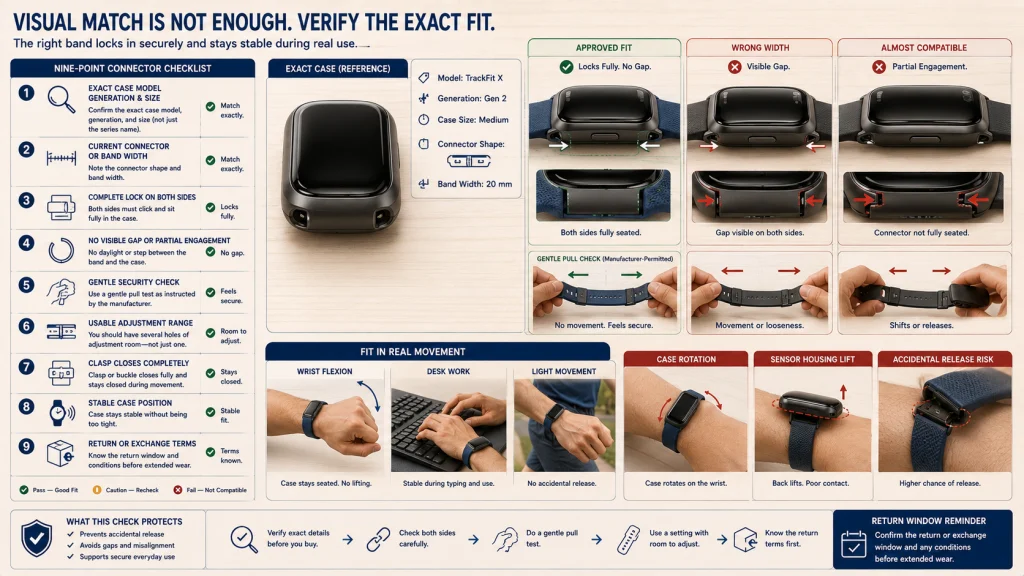
Verify case connector, band width, size range, and sensor stability
Compatibility problems often appear only after the band arrives: one side clicks in while the other remains loose, the connector leaves a visible gap, or the case shifts because the locking shape is only slightly different. A band that looks compatible can still use the wrong width, pin length, case generation, or attachment method.
Connector checklist:
- ☐ The exact case model, generation, and case size are identified.
- ☐ The band connector or width matches current compatibility information.
- ☐ Both sides lock fully without a visible gap or partial engagement.
- ☐ The band cannot slide out during a gentle pull test performed as instructed.
- ☐ The included size range contains a usable setting with adjustment room.
- ☐ The clasp closes completely and does not release during ordinary wrist movement.
- ☐ The case stays positioned without requiring excessive tightness.
- ☐ The band does not lift the sensor housing or cause repeated rotation.
- ☐ The return and exchange terms are known before extended wear.
Sensor stability here means the case remains in the intended wearing position. It does not mean that one band guarantees better accuracy, medical validity, or suitability for a health condition.
Use the wearable adjustment guide when the band is compatible but the owned device still needs positioning and tension changes.
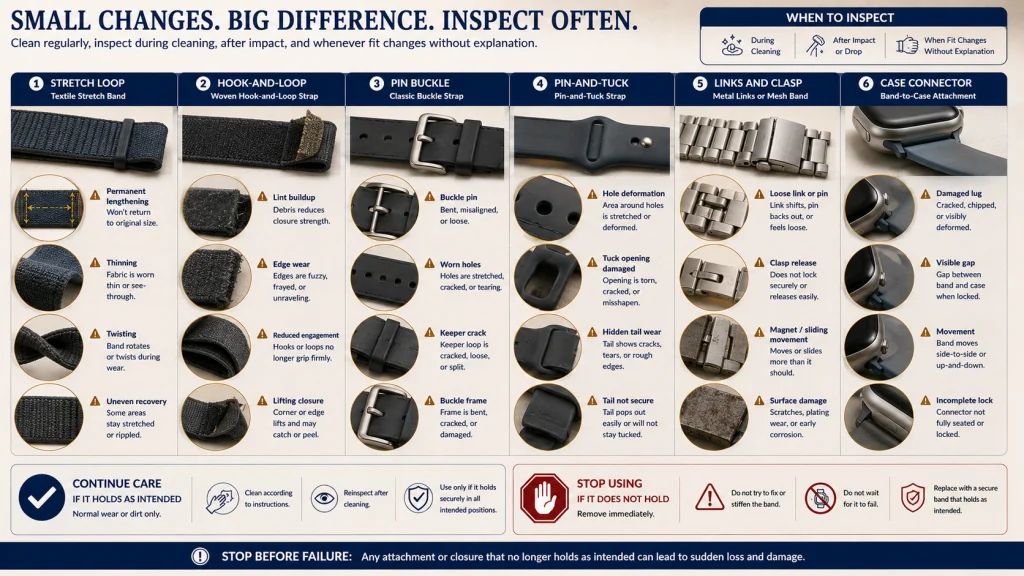
Inspect stretched loops, worn hook-and-loop, loose pins, damaged lugs, corrosion, and clasp release
Band failure often develops through small changes rather than one dramatic break. Inspect the attachment whenever the device is cleaned, after unusual impact, and whenever the fit begins changing without explanation.
Wear inspection card:
- Stretch loop: Check permanent lengthening, thinning, twisting, and uneven recovery.
- Hook-and-loop: Check edge wear, lint buildup, reduced engagement, and lifting during movement.
- Pin buckle: Check the pin, buckle frame, holes, keepers, and cracks around repeated settings.
- Pin-and-tuck: Check the pin, hole area, tuck opening, and hidden tail for damage or deformation.
- Metal system: Check loose links, pins, magnets, sliding closures, clasp release, and corrosion.
- Case connector: Check damaged lugs, incomplete locking, movement at the attachment, and visible gaps.
Stop using a band when the connector, clasp, pin, link, lug, or closure no longer holds as intended. Do not keep wearing it until complete failure simply because the case has not fallen yet.
Use the fitness tracker cleaning guide for a broader routine that follows exact device and band instructions.
Decide whether one band or two purpose-specific bands are justified
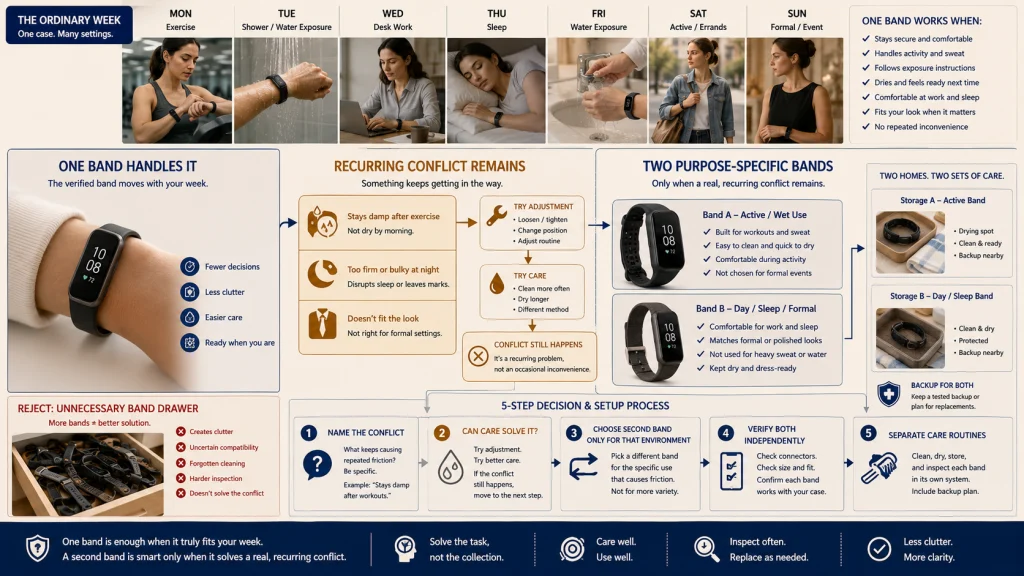
Owning more bands is not automatically better. A second band is useful only when it solves a recurring conflict that one setup cannot handle well.
| Decision | One band is enough when | Two bands may be justified when |
|---|---|---|
| Exercise and daily wear | The band handles activity, cleaning, drying, and work without repeated inconvenience | The exercise band stays damp or needs cleaning when the daily band must be worn |
| Sleep and daytime use | The same closure remains comfortable and dry through both periods | A softer overnight setup solves a repeated pressure or drying conflict |
| Water and dry settings | The exact band instructions support all planned exposure | The appearance-focused band is not intended for the regular wet environment |
| Work and formal events | The ordinary band fits appearance, safety, and care needs | A second attachment solves a repeated dress or workplace issue |
| Replacement backup | The band is easy to inspect and replace before failure | The wearable is used continuously and downtime creates a real recurring problem |
One-band-versus-two-band decision:
- Name the recurring conflict.
- Confirm that adjustment or care cannot solve it.
- Choose a second band only for that specific environment.
- Verify compatibility and size independently for both bands.
- Create a cleaning, drying, storage, and inspection routine for each.
A second band should reduce friction, not create a drawer of nearly identical options that are difficult to clean, store, and inspect.
Choose attachment, adjustment, environment, care, and an inspection rule
Complete the decision in five lines:
- Attachment: Record the connector and clasp system that fits the exact case.
- Adjustment: Confirm the usable range and whether the spacing allows a practical setting.
- Environment: Name the exercise, water, work, sleep, and appearance situations the band must handle.
- Care: Write how the exact band will be cleaned, dried, and stored.
- Inspection: Identify the wear, release, stretching, or connector change that ends use.
A complete decision might read: “The woven hook-and-loop system solves the small fit changes that bothered me during desk work and sleep, but it stays damp too long after frequent exercise. A second workout band is justified because it removes that repeated conflict, not because I need more styles. Both bands have verified connectors, separate care routines, and clear replacement signs.”
Use the broader wearable technology guide when band selection is only one part of the purchase. Use the wearable device comparison when the attachment decision is part of choosing the device category. Use the smart ring sizing guide when the alternative is a finger-worn device rather than another wrist band.
The best band is not the one with the most appealing material label. It is the attachment system that fits the case, adjusts to the wrist, survives the real routine, and can be inspected before a small failure becomes a lost device.
FAQs
🔗 What should I check before buying a replacement band?
Verify the exact case model, case size, connector, band width, size range, and return terms. Confirm the connector from current specifications rather than relying on visual similarity.
📏 Which band offers the finest adjustment?
Broad hook-and-loop or sliding systems may offer finer changes than fixed holes, but exact adjustment varies by product. Test the actual closure rather than ranking the category alone.
🏃 Which band type is best for exercise?
No category is universally best. Check security, allowed exposure, cleaning, drying, odor, movement, and how the exact clasp behaves during the activity.
💧 Can every sport band handle showers or swimming?
No. “Sport” is not a universal water rating. Verify the current exposure and care instructions for both the device and exact band.
🌙 Is a woven or stretch band always better for sleep?
No. A softer surface may feel less noticeable, but closure position, moisture, stretch, case movement, and individual response still matter.
🧲 Are magnetic or metal bands always secure?
No closure should be assumed secure by category. Inspect the exact clasp or magnetic system for movement, release, sizing, and compatibility with the intended environment.
🧼 How often should a fitness tracker band be cleaned?
Follow the exact care instructions and clean after exposures that leave sweat, dirt, oils, or residue. Let the band dry as directed before prolonged wear.
⚠️ When should a band be replaced?
Replace or stop using it when the connector, clasp, pin, link, lug, stretch, or closure no longer performs as intended. Do not wait for the case to detach completely.