Smart ring sizing starts with the exact brand and generation’s sizing process, not a familiar jewelry size or another company’s sample. Test more than one permitted finger, wear the sample across ordinary tasks and sleep as instructed, and check knuckle passage, base fit, rotation, and sensor orientation at different times of day. Confirm whether the final ring, charger, and accessories are size-specific before the exchange or return deadline. Remove the sample or ring promptly if it causes pain, numbness, swelling, color change, or difficulty with removal.
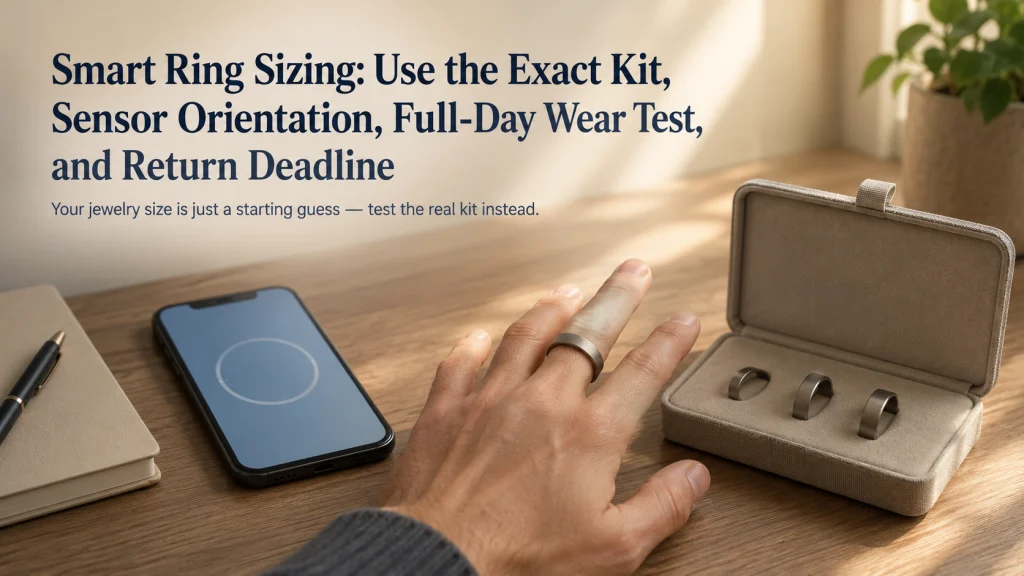
See why four rings with the same nominal size may not fit the same way
Place four rings side by side: a familiar jewelry ring, a sizing sample from one smart-ring system, a sample from another generation or brand, and the final sensor ring. The number printed on each may look comparable, yet the inner shape, wall thickness, sensor bumps, orientation marks, and manufacturing tolerances can change how each one passes the knuckle and settles at the base of the finger.
Familiar references
- Jewelry ring size
- Older smart-ring sample
- Another brand’s sample
Actual purchase decision
- Exact brand
- Exact generation
- Current official sizing kit
- Final sensor-ring geometry
A familiar jewelry size is a starting clue, not the order decision. The sample that matters is the one assigned to the exact ring generation being purchased.
A size that passes the knuckle easily can still rotate too much at the base of the finger. The opposite problem can also occur: a stable base fit may become difficult to remove when the finger is warmer or more swollen.
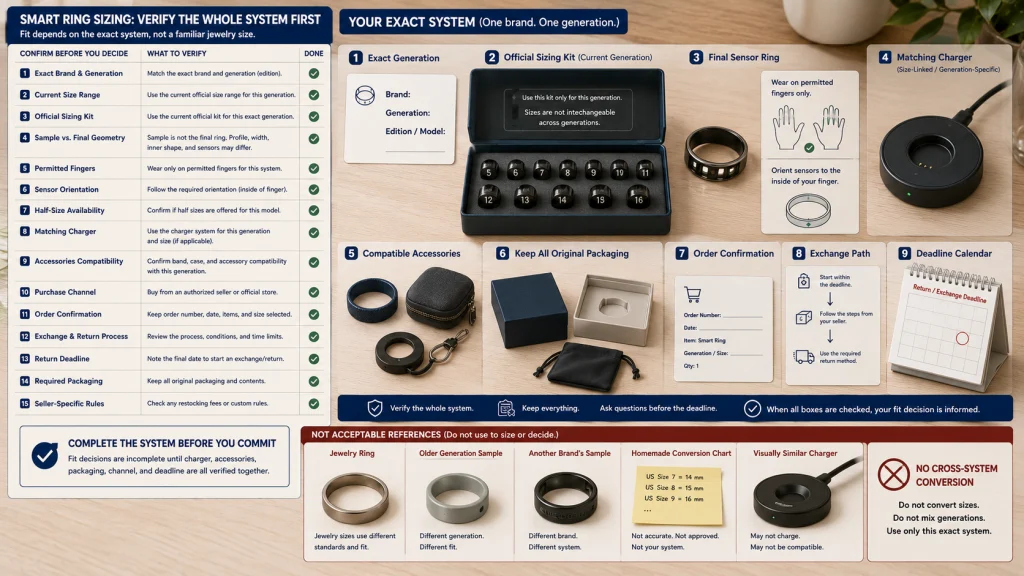
Identify the exact brand, generation, size range, kit, charger, and return process
Write down the complete purchase configuration before trying a sample. A product family name is not enough when multiple generations, case designs, kits, or chargers exist.
Confirm the exact sizing system:
- ☐ Record the full brand and generation name.
- ☐ Confirm the current official size range for that generation.
- ☐ Verify which sizing kit belongs to the final ring.
- ☐ Check whether the sample geometry differs from the finished sensor ring.
- ☐ Confirm the required sensor orientation and permitted fingers.
- ☐ Check whether half sizes are available or unavailable.
- ☐ Verify whether the charger or charging holder is tied to the selected size.
- ☐ Record the current order, confirmation, exchange, and return steps.
- ☐ Save the deadline and required packaging before testing begins.
Use only current official instructions for mutable details such as size availability, kit compatibility, charger sizing, exchange rules, and return deadlines. These details can change between generations and purchase channels.
Once the exact system is identified, the familiar ring in the jewelry box becomes useful only as a rough starting point.
Use the broader wearable form comparison when the decision still includes a watch or fitness tracker rather than a fixed-size ring.
Treat jewelry size and another brand’s ring as references, not conversions
A standard jewelry size may help identify where to begin in the kit, but it should not be copied directly into an order. Smart rings can differ in inner shape, width, thickness, sensor placement, and available sizes.
The same caution applies across smart-ring brands and generations. A sample from one system cannot prove the correct size in another, even when the printed number matches.
Conversion rule: Select the final size only from the sizing process assigned to the exact ring being purchased. Avoid homemade conversion charts, visual matching, and assumptions that one company’s size equals another company’s size.
This system-first approach may feel slower than ordering from a remembered jewelry size. It is still less disruptive than discovering after delivery that the ring rotates, catches during grip, cannot be charged with the expected holder, or must be exchanged under a closing deadline.
With conversion ruled out, the useful comparison moves from printed numbers to actual fingers and actual tasks.
Test the index, middle, and other permitted fingers according to official guidance
Begin with the fingers allowed by the current instructions, then compare more than one option. Finger shape, knuckle size, dominant-hand use, grip tasks, and daily swelling can make one finger more workable than another.
Test the same sample on the permitted fingers rather than assuming the index finger is automatically correct. A finger with an easy knuckle passage may have a narrower base that allows rotation. Another finger may hold the ring steadily but press against a neighboring finger while carrying a grocery bag, gripping a steering wheel, opening a jar, or typing for a long stretch.
| Finger test | What to check | What may change the decision |
|---|---|---|
| Index finger | Knuckle passage, grip contact, side-to-side pressure, orientation | Dominant-hand tasks, phone grip, tools, exercise equipment |
| Middle finger | Neighboring-finger contact, rotation, typing, sleep position | Other rings, wider knuckle, hand position during work |
| Another permitted finger | Base stability, task interference, removal, sensor position | Official restrictions, finger shape, daily use |
| Dominant versus non-dominant hand | Grip, impact exposure, washing, writing, carrying | How often the hand performs forceful or repetitive tasks |
The goal is not to find the finger where the sample feels least noticeable for five minutes. It is to find a permitted finger where the fit remains stable through the routine the ring will actually share.
That stability has to survive two separate tests: passing the knuckle and holding the sensors in the required position at the finger base.
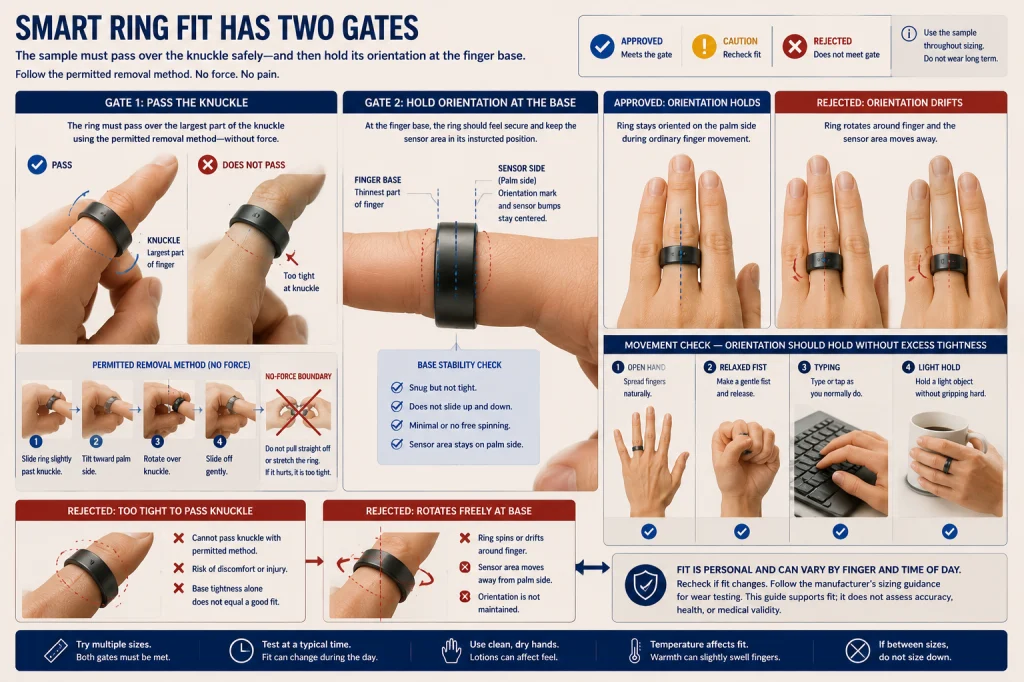
Check knuckle passage, base fit, rotation, and sensor orientation
A smart-ring fit has two separate gates. The ring must pass the knuckle for safe removal, then remain stable enough at the finger base to hold the intended orientation.
- Knuckle passage: The sample should pass over the knuckle using the method described by the manufacturer without forceful pulling.
- Base fit: The ring should settle without freely spinning or sliding around the finger.
- Rotation: Ordinary hand movement should not repeatedly move the sensors away from the required position.
- Orientation: Marks, sensor bumps, or another designated feature should face the direction specified for that exact ring.
Top-view orientation check:
The left view shows the designated sensor area staying on the palm side. The right view shows the ring rotating around the finger, which can move that area away from the required position.
Fit alone does not guarantee sensor accuracy or medical validity. This check only confirms whether the physical ring can remain in the wearing position required by the product instructions.
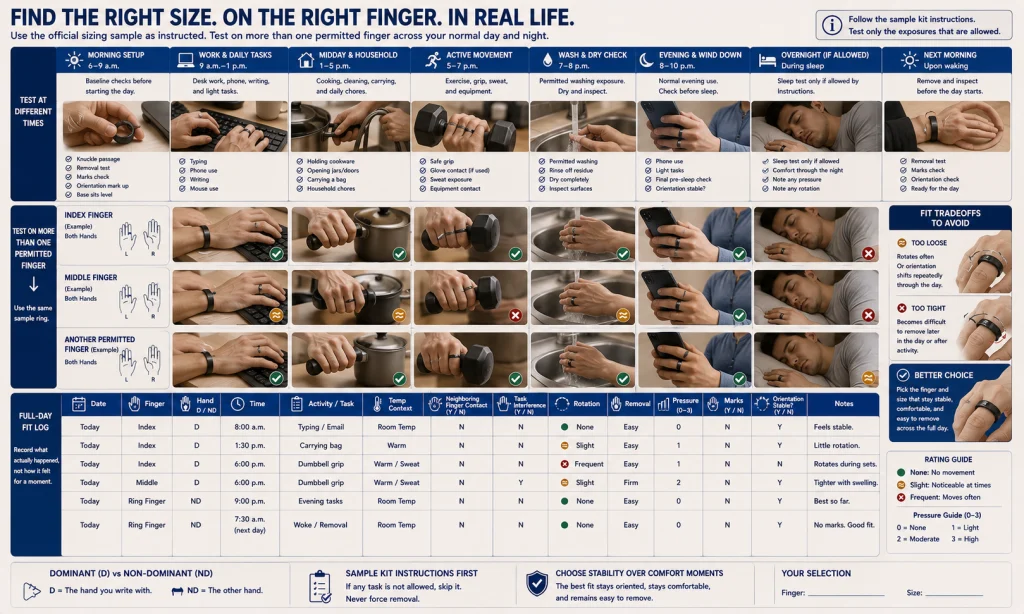
Wear the sizing sample through ordinary work, exercise, washing, temperature changes, and sleep as allowed
A quick fitting cannot show how the sample behaves when the hand warms, grips an object, rests beneath a pillow, enters a glove, or becomes wet. A sample that feels almost invisible while sitting can become distracting when a mug handle presses it sideways or when the hand curls under a pillow. Follow the official sample-wear instructions and include the ordinary situations that matter for the planned use.
| Finger-and-time test log | Task or condition | What to record |
|---|---|---|
| Morning | Waking, washing, dressing, breakfast | Removal, orientation, marks, and base stability |
| Desk or household work | Typing, writing, phone use, cookware, bags | Rotation, neighboring-finger contact, task interference |
| Exercise or active movement | Grip, sweat, gloves, equipment, arm movement | Pressure, shifting, impact exposure, and whether removal is needed |
| Water-related routine | Hand washing or another allowed exposure | Movement when wet, drying, residue, and removal |
| Temperature change | Warm room, cooler environment, travel, outdoor transition | Changes in tightness, knuckle passage, and comfort |
| Sleep | Usual sleeping position and overnight hand posture | Pressure, rotation, waking marks, and morning removal |
Include only activities permitted for the sizing sample. A sample is not automatically designed for every exposure allowed for the finished ring.
Use the all-day wearable guide when the unresolved issue is ongoing wear and removal after ownership rather than pre-purchase sizing.
Test at different times of day
Finger size can change through an ordinary day. Temperature, activity, hand position, meals, travel, and other factors may change how easily the ring rotates or passes the knuckle.
Check the same sample after waking, during the middle of the day, after ordinary activity, and before bed. The aim is not to diagnose swelling. It is to avoid selecting a size from the single moment when the finger happens to be smallest or largest.
A workable size should remain removable and should not spin freely across the tested conditions. The tradeoff often becomes clearest late in the day: the looser sample may need repeated repositioning, while the smaller one may leave the wearer thinking about removal before the test is even over. When that happens, test another permitted finger and review the official sizing guidance rather than forcing a compromise.
Record time, temperature context, activity, rotation, removal, and marks in the same log. This makes the decision easier to compare before the deadline.
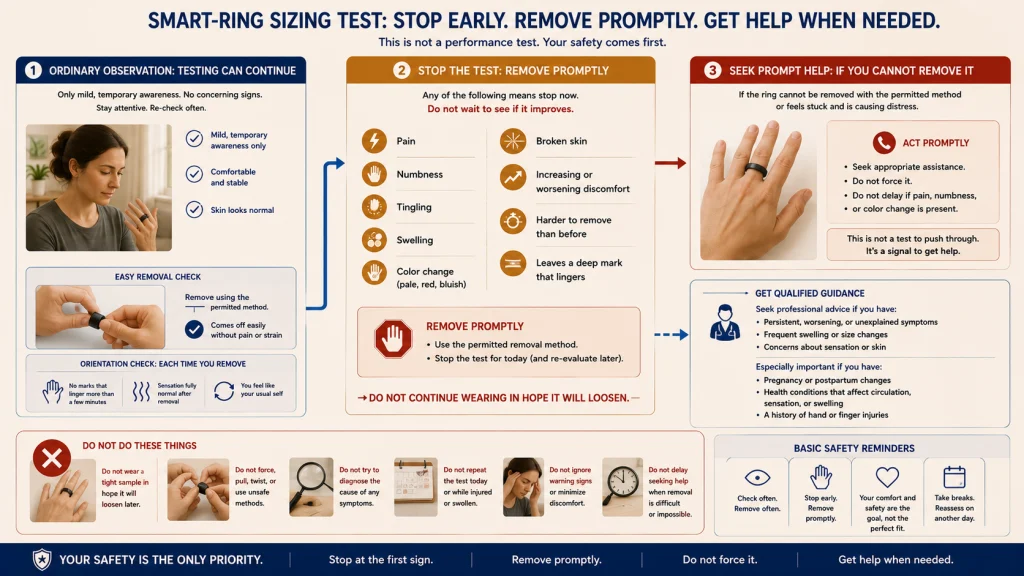
Remove the sample for pain, numbness, swelling, color change, or inability to remove it
Removal warning:
- Remove the sample or ring promptly if it causes pain, numbness, tingling, swelling, color change, broken skin, or worsening discomfort.
- Stop the test if the ring becomes difficult or impossible to remove using the permitted method.
- Do not continue wearing a tight sample to prove that it may loosen later.
- Do not use fit testing to diagnose the cause of swelling or circulation-related symptoms.
- Seek appropriate medical attention for concerning, persistent, worsening, or unexplained symptoms.
- Urgent inability to remove a constricting ring requires prompt help.
This article does not recommend ring wear during injury, acute swelling, pregnancy-related changes, or another medical situation. Qualified guidance is appropriate when health circumstances make finger size or safe removal uncertain.
Verify charger and accessory sizing
The selected ring size can affect more than the ring itself. Some charging holders, docks, or related accessories may be tied to a size, model, or generation.
Check the ring, charger, and deadline together:
- Ring: Confirm the exact final size and generation.
- Charger: Verify whether the charger is universal, grouped, or size-specific for that exact product.
- Accessories: Confirm current compatibility for covers, storage items, or other size-dependent parts.
- Package: Keep required packaging, kit pieces, labels, and included items.
- Deadline: Record the final date for size confirmation, exchange, or return.
- Channel: Check whether the rules differ between the manufacturer, retailer, carrier, or another seller.
A ring that fits can still create an expensive correction if the wrong charger size or accessory was ordered with it. Treat the final configuration as one system rather than a ring selected in isolation.
Confirm the final size before the deadline and preserve exchange options
Put the size-confirmation, exchange, and return deadlines on the calendar before the full-day test begins. A decision that feels calm on the first day can become rushed when the final email reminder arrives and the sample has only been worn at a desk. Leaving margin protects the option to compare another finger, repeat a warm-time check, or correct a charger mismatch.
Keep the kit organized and preserve the packaging required by the seller. Photograph or record the selected finger, sample size, orientation, and test notes so the final order is not based on memory.
Before confirming, answer five questions:
- Does this sample belong to the exact brand and generation?
- Can it pass the knuckle and remain stable at the base?
- Does orientation hold through work, grip, washing, and sleep as allowed?
- Does the fit remain workable at different times of day?
- Are the charger, accessories, exchange path, and deadline confirmed?
If any answer remains unclear, use the official support process before finalizing. A rushed confirmation can turn a sizing uncertainty into a fixed ring, mismatched charger, or missed exchange window.
Use the exact kit, test the finger and time, then verify orientation, charger, and return
Complete the decision in five lines:
- Exact system: Record the brand, generation, official kit, and current size options.
- Finger: Compare the permitted fingers through real tasks.
- Fit and orientation: Check knuckle passage, base stability, rotation, and required sensor position.
- Full-day test: Include different times, temperature changes, ordinary work, allowed activity, and sleep.
- Purchase system: Confirm the charger, accessories, exchange steps, and return deadline before ordering.
A complete decision might read: “My jewelry size only identified the first samples to try. The current kit shows that one size passes the knuckle easily but rotates during typing and sleep. The next size remains stable on another permitted finger and can still be removed at warmer times of day. I have confirmed the required orientation, matching charger, and exchange deadline before submitting the size.”
Use the smart ring and smartwatch comparison when fixed finger sizing is changing the device choice. Use the smart ring and fitness tracker comparison when band adjustment may suit the routine better.
Use the broader wearable technology guide when sizing is only one part of the purchase. Use the sleep and recovery tracking guide when the planned reason for overnight ring wear needs separate evaluation.
A few quiet minutes can identify an obvious mismatch, but they cannot finish the decision. Finalize only when the exact-system sample remains removable, holds orientation, works through the day, matches the charger, and still leaves time for correction before the deadline.
FAQs
💍 Can I order a smart ring using my jewelry size?
Use jewelry size only as a starting clue. Select the final size with the current official kit assigned to the exact brand and generation.
🔄 Can I convert one smart-ring brand’s size to another?
No automatic conversion should be assumed. Inner geometry, sensors, available sizes, and sizing samples can differ across brands and generations.
☝️ Which finger should I use for a smart ring?
Test the fingers permitted by the current official guidance. Compare stability, knuckle passage, task interference, orientation, and removal rather than choosing from habit alone.
🧭 How should the sensors be oriented?
Follow the orientation marks and instructions for the exact ring generation. The ring should not rotate freely or require constant repositioning.
🌡️ Why should I test at different times?
Finger fit can change during the day with temperature, activity, and ordinary variation. A size selected from one brief fitting may behave differently later.
🌙 Should I sleep in the sizing sample?
Include sleep only when the official sample instructions allow it. Check overnight rotation, pressure, marks, and morning removal.
🔌 Does ring size affect the charger?
It may, depending on the exact brand and generation. Verify current charger sizing and compatibility before confirming the ring size.
⚠️ When should I remove the ring immediately?
Remove it for pain, numbness, tingling, swelling, color change, broken skin, worsening discomfort, or difficulty with removal. Seek appropriate help when symptoms or removal problems are concerning.