Coherent breathing is a steady, no-hold breathing pattern built around a smooth inhale and exhale. The useful part is the repeatable pacing, not a promise that one exact breaths-per-minute target creates a special state. Start with a rhythm that feels easy enough to continue without air hunger, dizziness, or pressure to match a device. Keep the practice only if the pace remains comfortable and the tool supports the routine without turning a score or branded claim into medical proof.
Two Identical Pacers Can Carry Very Different Claims
Picture two breathing pacers moving at the same slow rhythm. One is labeled “calm practice.” The other is labeled “guaranteed coherence.” The movement on the screen is identical, but the second label adds a promise that the pacing alone cannot prove.
Remove the guarantee, and the practical task becomes clearer. Follow a steady inhale and exhale without a breath hold, notice whether the pace feels manageable, and stop treating one number or app score as the goal.
The behavior is simple. The claims around it need more care.
Define Coherent and Resonance Breathing Carefully
Coherent breathing generally refers to slow, regular breathing with an inhale and exhale of similar length and no intentional hold. Resonance breathing or resonant breathing may be used for a similar paced approach, sometimes with additional claims about finding an individual rate.
Those terms are not always used consistently. A generic slow-breathing exercise, a named protocol, a branded app, and a biofeedback session can look similar on the surface while differing in instructions, measurement, and claims.
Key decision: Treat the method as a pacing structure first. Do not assume that a familiar name, trademark, or device score proves a specific physiological or mental-health result.
For the broader choice among body-first methods, review breathing exercises for stress.
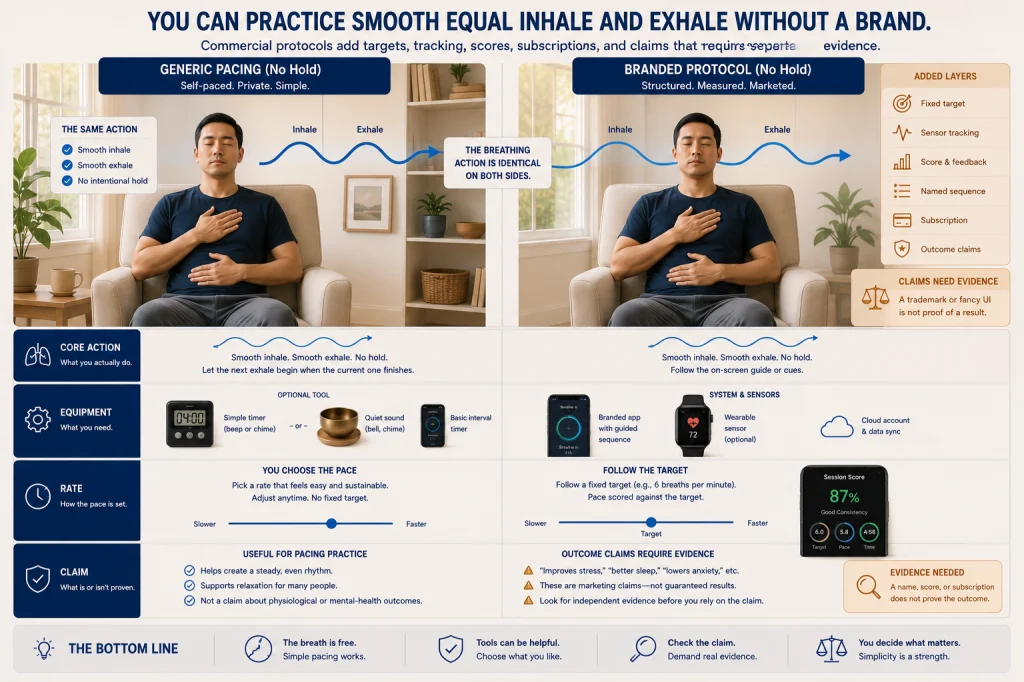
Separate a Pacing Method From a Branded Protocol
A steady inhale and exhale can be practiced with no special product. A branded program may add a particular timer, training sequence, score, subscription, sensor, or explanation of what the rhythm is supposed to produce.
| Element | Generic pacing method | Branded protocol or product |
|---|---|---|
| Core action | Follow a smooth inhale and exhale | Follow the provider’s named sequence |
| Equipment | Optional timer, sound, or self-count | May depend on an app, wearable, sensor, or subscription |
| Rate | Adjusted for comfort | May promote a fixed target or score |
| Outcome claim | No outcome implied by the pacing alone | May include claims that require separate evidence |
This distinction protects the reader from confusing a usable breathing cue with proof that a commercial system has measured a clinical change.
Choose a Comfortable Equal Inhale and Exhale
Sit in a supported position with enough room for the ribs and abdomen to move. Let the jaw and shoulders soften. Begin with an ordinary breath rather than a large preparation inhale.
Inhale gently while following the first half of the pacing cue. Exhale during the second half without squeezing the lungs empty. Keep the two phases similar in length, but allow small natural differences when forcing symmetry would create strain.
The breath should remain normal-sized. A slower rhythm does not require a deeper breath. Enlarging every inhale can make a mild pacing exercise feel demanding and may contribute to light-headedness or air hunger.
Readers who need help finding a lower-effort breathing pattern can begin with diaphragmatic breathing before adding a steady timer.
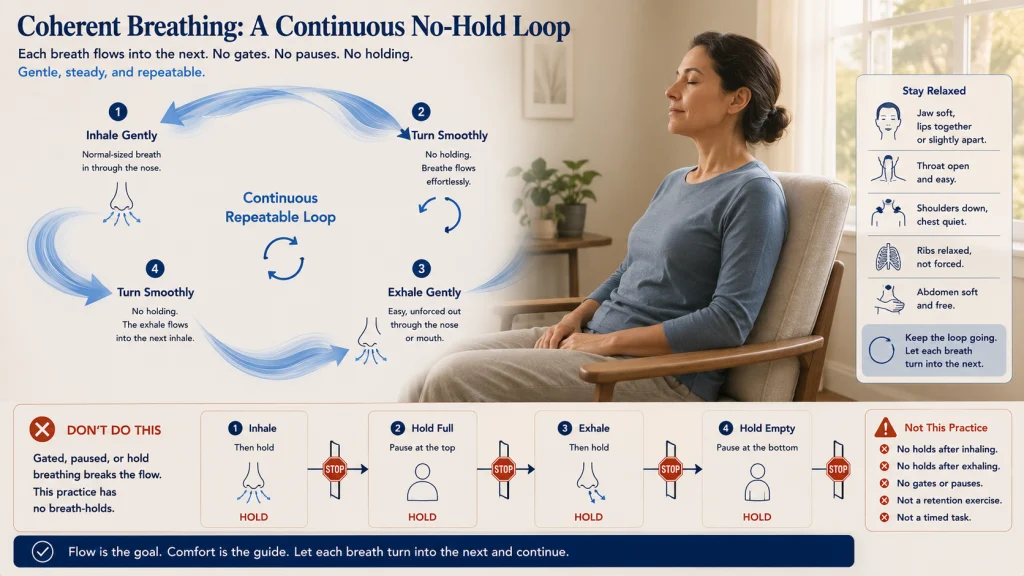
Follow a No-Hold Pacing Loop
The structure is continuous. There is no required pause after the inhale or exhale.
| Phase 1 | Transition | Phase 2 | Transition |
|---|---|---|---|
| Inhale gently | Turn smoothly without holding | Exhale gently | Begin the next inhale without holding |
Think of the rhythm as a quiet loop rather than four separate tasks. The transitions should feel like changes in direction, not gates that must be held shut.
Start Without Chasing a Precise Breaths-Per-Minute Number
Many descriptions promote a fixed rate, often around five or six breaths per minute. That number can be a pacing example, but it is not a universal prescription and should not become a test of whether the practice is being done correctly.
Begin at a rate that allows quiet breathing and a smooth transition between phases. When the cue feels too slow, shorten both phases together. When it feels rushed, lengthen them slightly without turning the inhale into a large breath.
A rate that works while lying down may feel different at a desk, after climbing stairs, or during a tense conversation. Comfort and repeatability matter more than matching an exact display.
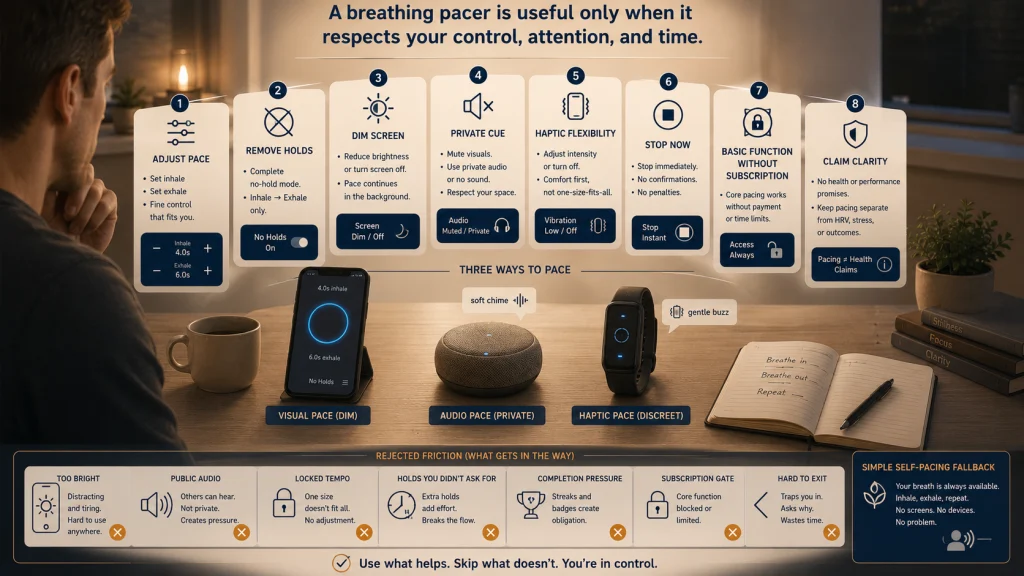
Use Audio, Visual, or Haptic Pacing With Minimal Friction
A pacing tool should make the rhythm easier to follow, not harder to leave. Compare features by how well they support adjustment and ordinary use.
- Tempo control: Can the inhale and exhale length be changed without rebuilding the session?
- No-hold option: Can pauses be removed completely?
- Screen control: Can brightness be reduced or the display turned off?
- Audio privacy: Can sound be muted or replaced with a discreet cue?
- Haptic flexibility: Can vibration cues be slowed, shortened, or disabled?
- Immediate exit: Can the session stop without a confirmation screen or penalty?
- Subscription dependence: Does the basic pacing function remain usable without ongoing payment?
- Claim clarity: Does the tool separate a pacing feature from promises about HRV, stress, or health outcomes?
Editorial observation: A simple pacer can become surprisingly demanding when the screen is bright, the audio is public, the tempo is locked, or the app rewards completion. A useful tool lets the reader change pace or stop immediately without making an unfinished session feel like failure.
Understand What the Randomized Trial Found
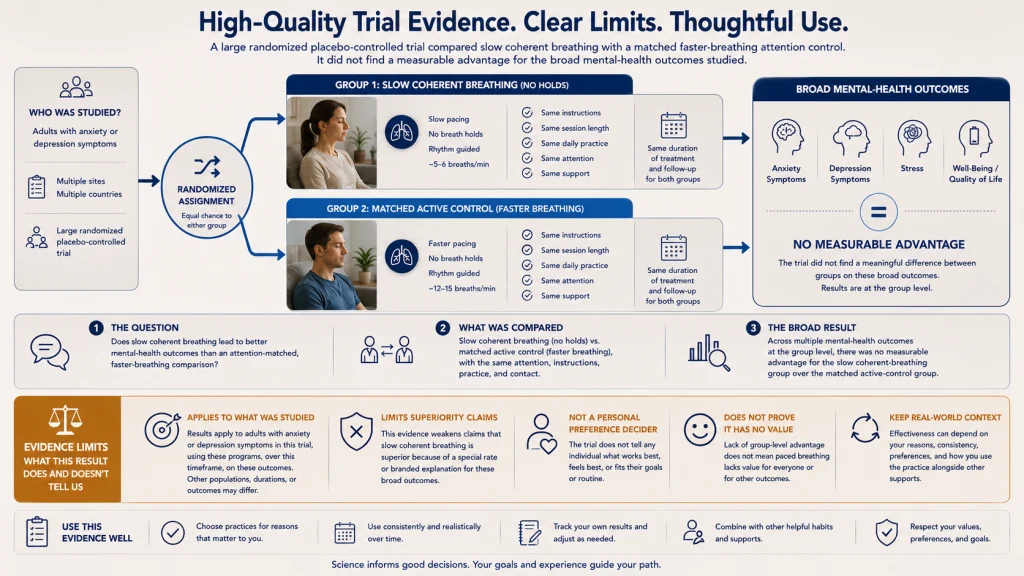
A large randomized placebo-controlled trial compared coherent breathing with a matched faster-breathing attention control. Both groups used structured breathing practice, which helped separate the special claim of the slower method from the general effects of paying attention, following instructions, and practicing regularly.
| Trial question | What was compared | Broad result |
|---|---|---|
| Did coherent breathing produce a measurable advantage? | Slow coherent breathing versus a matched faster-breathing attention control | No measurable advantage was found for the broad mental-health outcomes examined. |
| Did participants still complete a structured breathing task? | Both groups received a paced practice | Yes, which makes the comparison more informative than comparing practice with no attention-matched activity. |
| Does the result prove the method never feels useful? | Personal experience versus group-level trial outcome | No. It limits broad superiority claims rather than deciding every individual’s preference. |
The study does not require readers to abandon a rhythm they find easy and settling. It does require care with claims that the method is uniquely effective for broad mental-health outcomes.
Why an Active Comparison Matters
Breathing studies can be influenced by expectation, attention, routine, instructor contact, and the simple act of pausing. A comparison with no activity cannot separate those effects from the specific timing pattern.
An active control gives the comparison group a structured task with similar attention and effort. When the slower method does not outperform that matched activity, the result weakens claims that the special rate or branded explanation is the decisive ingredient.
Evidence limit: A neutral result does not prove that paced breathing has no value. It means the trial did not show the claimed advantage over the active comparison for the outcomes and population studied.
Know What HRV Can and Cannot Tell a Consumer
Heart-rate variability, often shortened to HRV, describes variation in timing between heartbeats. Consumer devices may estimate it during rest or breathing practice, but the number can change with measurement method, posture, time of day, breathing pattern, recent activity, device fit, and signal quality.
A higher or lower reading during one session does not diagnose stress, nervous-system health, cardiovascular disease, or treatment response. It also does not prove that a branded coherence score represents a medically validated state.
Use consumer HRV as informational data only. This article does not interpret personal readings, calculate an individual resonance frequency, or replace professional biofeedback or cardiovascular evaluation.
Compare Coherent Breathing With Box and Diaphragmatic Breathing
| Method | Structure | Main fit question |
|---|---|---|
| Coherent breathing | Steady inhale and exhale with no intentional holds | Does a smooth paced loop feel easier than counted retention? |
| Box breathing | Equal phases that usually include two holds | Are brief holds comfortable and easy to track? |
| Diaphragmatic breathing | Mechanics-first practice without a required fixed rate | Do you need to reduce upper-body effort before adding a timer? |
Choose box breathing when equal counts and brief holds feel manageable. Use diaphragmatic breathing when pacing itself is creating too much effort. The named 4-7-8 method adds an unequal hold and exhale, so compare it separately through the guide to 4-7-8 breathing.
Troubleshoot Dizziness, Frustration, and Device Dependence
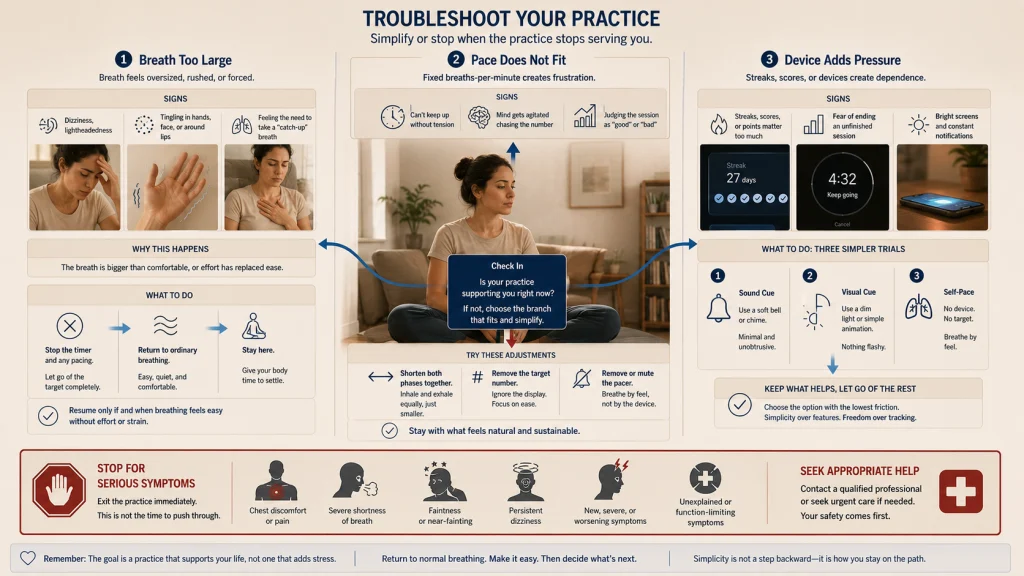
Dizziness or tingling can appear when the breath becomes too large, too fast, or otherwise forced. Return to ordinary breathing, stop the timer, and do not restart while symptoms remain.
Frustration often comes from trying to match a fixed pace that does not fit. Shorten the phases, ignore the target number, or remove the device. A self-guided rhythm should not depend on maintaining a streak or reaching a score.
Device dependence can also narrow the practice. Try one session with a simple sound, one with a visual cue, and one with quiet self-pacing. Keep the lowest-friction option that still supports a steady rhythm.
Safety warning: Stop for chest discomfort, severe shortness of breath, faintness, or persistent dizziness. New, severe, worsening, unexplained, or function-limiting symptoms require qualified evaluation.
Know When to Stop Self-Guided Practice
End the session when the pace creates air hunger, dizziness, chest discomfort, panic, or pressure to take oversized breaths. A calming label does not make an uncomfortable pattern appropriate.
Chest pain, severe shortness of breath, fainting, stroke signs, immediate danger, or self-harm thoughts require urgent help. Breathing symptoms or cardiovascular concerns should be evaluated rather than managed through a consumer pacer.
This practice should not replace medication, clinical care, respiratory treatment, mental-health treatment, or emergency action.
Keep the Rhythm for Comfort, Not for a Promise
Use a supported posture, a normal-sized inhale, a gentle exhale, and smooth transitions without holds. Adjust the tempo until the rhythm is easy to repeat, and choose a pacer that can be changed or stopped without friction.
Keep the method when the practice itself fits. Let go of the precise target, branded score, or guaranteed outcome when the evidence does not support it.
For the broader stress-management path, return to how to manage stress.
FAQs
🌬️ What is coherent breathing?
It is a paced breathing method that usually uses a steady inhale and exhale without intentional breath holds. The pace should remain easy enough to follow without oversized breaths or strain.
⏱️ Do I need exactly five breaths per minute?
No. Fixed rates are examples, not universal prescriptions. Adjust both phases together until the rhythm feels smooth and repeatable.
🔄 Is resonance breathing the same thing?
The terms often overlap, but they are not used consistently across research, clinical biofeedback, apps, and branded programs. Read the exact instructions and claims instead of assuming the names are interchangeable.
📱 Do I need an app or wearable?
No. A simple timer, sound, visual cue, or self-count can support the rhythm. A device is useful only when it allows pace changes, minimal distraction, and an immediate exit.
❤️ Does a higher HRV score prove the practice worked?
No. Consumer HRV readings are informational and can vary with measurement conditions, breathing, posture, activity, and device quality. One score does not diagnose health or validate a branded state.
🟦 How is it different from box breathing?
Coherent breathing uses a continuous inhale-exhale loop with no required hold. Box breathing usually divides the cycle into equal phases that include two holds.
🧪 Did research prove coherent breathing is better?
A large randomized placebo-controlled trial did not find a measurable advantage over a matched faster-breathing attention control for the broad mental-health outcomes studied. That result limits superiority claims without deciding every reader’s preference.
🚩 When should I stop?
Stop for dizziness, faintness, chest discomfort, air hunger, or severe shortness of breath. Persistent, worsening, unexplained, or function-limiting symptoms require qualified evaluation, while urgent signs require immediate appropriate help.