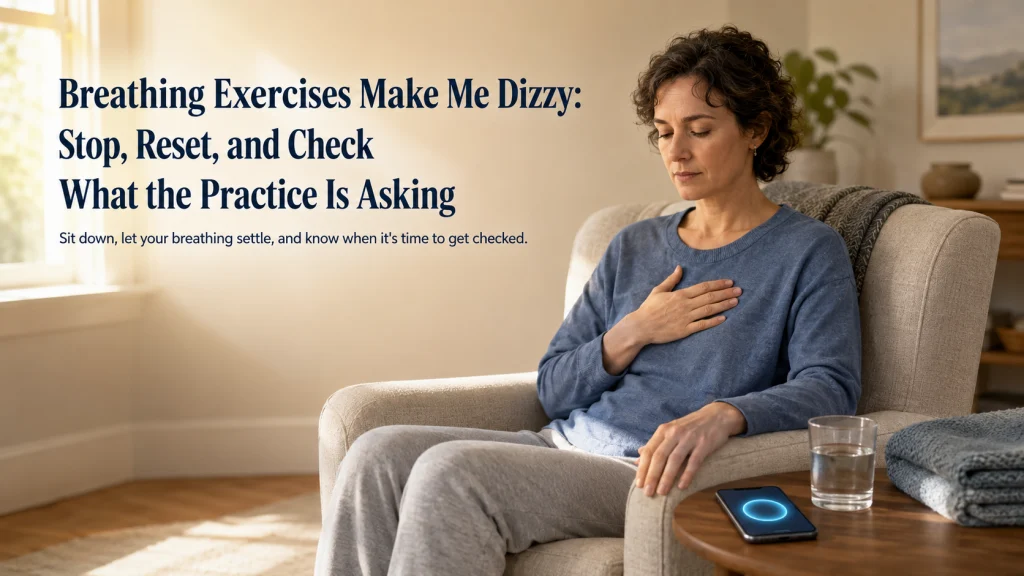
If a breathing exercise makes you dizzy, light-headed, tingly, or air-hungry, stop the exercise instead of trying to finish the count. Sit or lie down safely, return to ordinary uncounted breathing, and check whether urgent symptoms are present. The episode may reflect an overly deep, fast, held, or forced breathing pattern, but the pattern alone cannot prove the cause. Retry only later, while feeling well, with a smaller no-hold method if appropriate, or seek medical evaluation when symptoms are new, severe, persistent, worsening, unexplained, or limiting normal activity.
The App Can Keep Counting After You Stop
A breathing animation is still expanding and contracting on the screen, but the person following it has already become light-headed and sat down. The app continues because software follows a timer. The body does not have to finish the animation.
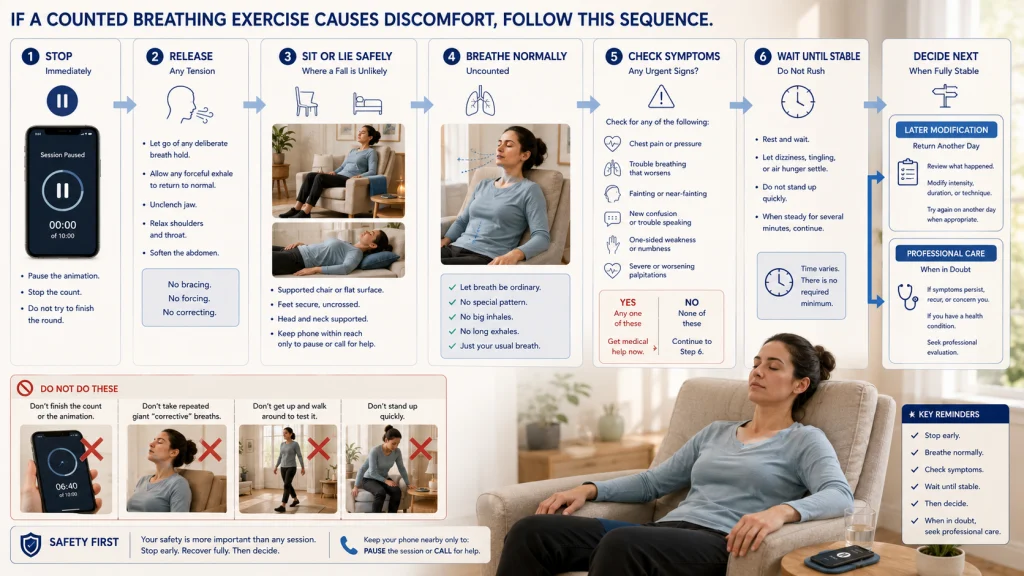
The correct response to dizziness is to stop the exercise, become physically safe, and return to ordinary breathing. A streak, vibration cue, spoken count, or unfinished session is not more important than the symptom.
Immediate rule: Do not push through dizziness to complete a breathing count. Stop, sit or lie safely, breathe normally, and assess what is happening.
Stop the Exercise and Sit or Lie Down Safely
End the counted pattern immediately. Release any deliberate breath hold, forced exhale, abdominal bracing, or posture that makes the symptom harder to manage.
- Stop walking, exercising, driving, bathing, climbing stairs, or standing near an edge.
- Sit in a stable chair or lie down where a fall is unlikely.
- Loosen an unnecessarily rigid posture without making sudden movements.
- Keep the phone or audio within reach only if it helps you pause the session or call for help.
- Do not stand up quickly to test whether the dizziness has passed.
If another person is present, tell them what you are feeling. A breathing exercise is not a reason to remain silent about severe or worsening symptoms.
Return to Ordinary, Uncounted Breathing
Let the breath settle into its usual size and pace. Do not chase a perfect inhale, a long exhale, or a particular number. Keep the jaw, throat, shoulders, and abdomen as unforced as possible.
The immediate goal is not to perform another technique correctly. It is to stop deliberately changing the breath while the symptom is active.
Stop the counted exercise → Sit or lie safely → Return to ordinary breathing → Check urgent symptoms → Wait until stable → Decide whether to seek care or modify the practice later
Do Not Take Repeated Giant Corrective Breaths
Feeling air-hungry can create an urge to inhale as deeply as possible several times in a row. That response may continue the same breathing pattern that was present when the dizziness began.
Instead, allow smaller ordinary breaths. Avoid repeated gulping inhalations, forceful sighs, long breath holds, or aggressive exhalations. If normal breathing feels impossible, symptoms are severe, or breathing difficulty is worsening, seek urgent help.
Check Immediate Red Flags and Context
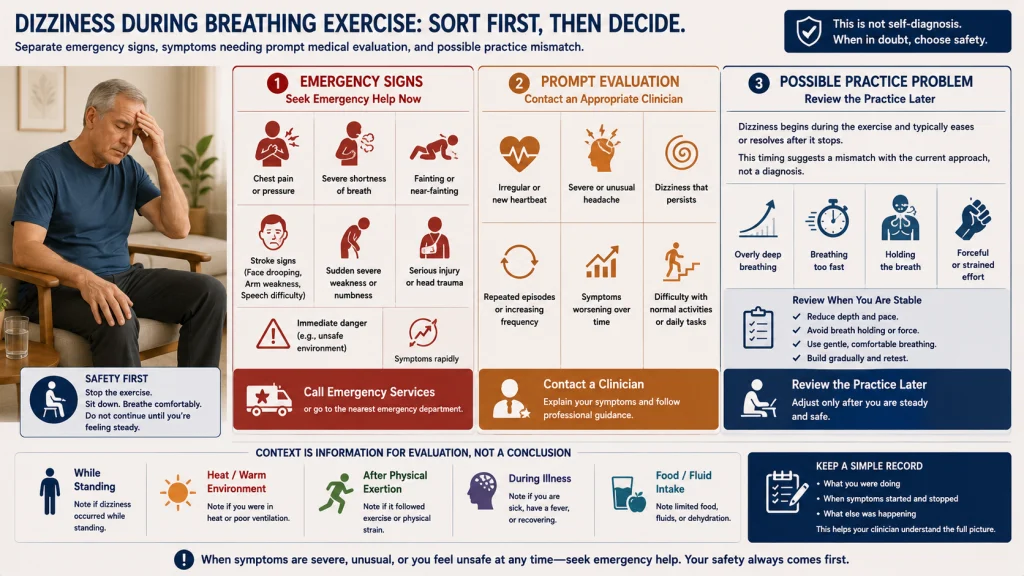
Do not assume every episode is a harmless technique error. First check whether the dizziness is accompanied by symptoms that need urgent or prompt evaluation.
| Situation | Examples | Response |
|---|---|---|
| Emergency signs | Chest pain, severe shortness of breath, fainting, stroke signs, immediate danger, severe weakness, or a serious injury | Seek emergency help |
| Prompt medical evaluation | Irregular heartbeat, severe headache, persistent dizziness, worsening symptoms, repeated episodes, or function-limiting symptoms | Contact an appropriate clinician promptly |
| Possible practice problem without red flags | Symptoms begin during an overly deep, fast, held, or forced pattern and settle after stopping | Do not diagnose the cause; recover fully and review the practice before any later retry |
Also note whether the episode occurred while standing, in heat, after exertion, after a long period without food or fluids, or during an illness. These details can matter during medical evaluation, but they do not establish the cause on their own.
Review Common Practice Factors Without Diagnosing the Cause
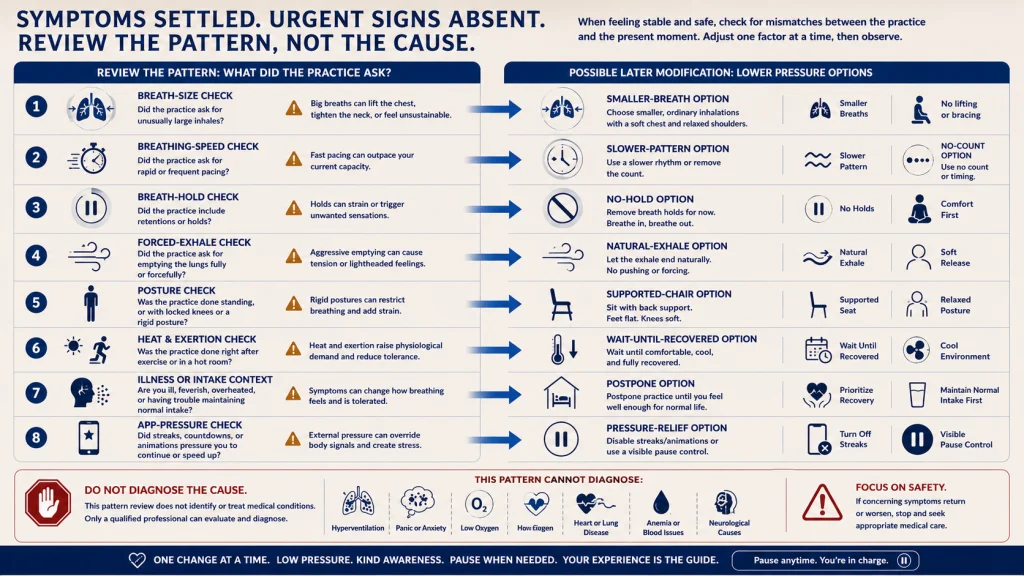
Once the symptom has settled and no urgent signs are present, review what the exercise asked you to do. The goal is to identify a possible practice mismatch, not to prove a medical explanation.
| Practice factor | Question to ask | Later modification |
|---|---|---|
| Breath size | Were the inhalations much larger than normal? | Use a smaller breath that does not lift or brace the whole upper body |
| Breathing speed | Did the pacing require rapid repeated breaths? | Choose a slower pattern or stop using a count |
| Breath holds | Did the exercise include retention that felt strained? | Use a no-hold method |
| Forced exhale | Were you emptying the lungs aggressively to match the cue? | Let the exhale end naturally |
| Posture | Were you standing, locking the knees, or holding the body rigid? | Practice seated with back and feet supported |
| Heat or exertion | Did the session follow exercise or occur in a hot room? | Wait until comfortable and fully recovered before any later practice |
| Hydration or illness context | Were you unwell, overheated, or unable to maintain normal intake? | Do not use breathing practice to override physical symptoms |
| App pressure | Did a streak, countdown, or animation make stopping feel like failure? | Disable the pressure cue or use a tool with an obvious pause control |
A pattern that appears during deep or rapid breathing may be related to the way the exercise was performed, but it cannot diagnose hyperventilation, panic, low oxygen, blood pressure changes, heart disease, lung disease, anemia, or neurological causes.
Do Not Assume the Exercise Caused Every Episode
The timing can be useful without being conclusive. Dizziness that begins during a breathing exercise may involve the breathing pattern, the posture, the environment, or a separate health issue that happened at the same time.
Avoid self-diagnosing anxiety, panic, oxygen problems, heart rhythm changes, blood pressure changes, or a vagus-nerve problem based on one episode. The same symptom can have many possible explanations that require proper history and evaluation.
New, unexplained, recurrent, worsening, or activity-limiting dizziness deserves medical attention even when it seems linked to a relaxation exercise.
Retry Only Later, While Well, With a Smaller No-Hold Pattern
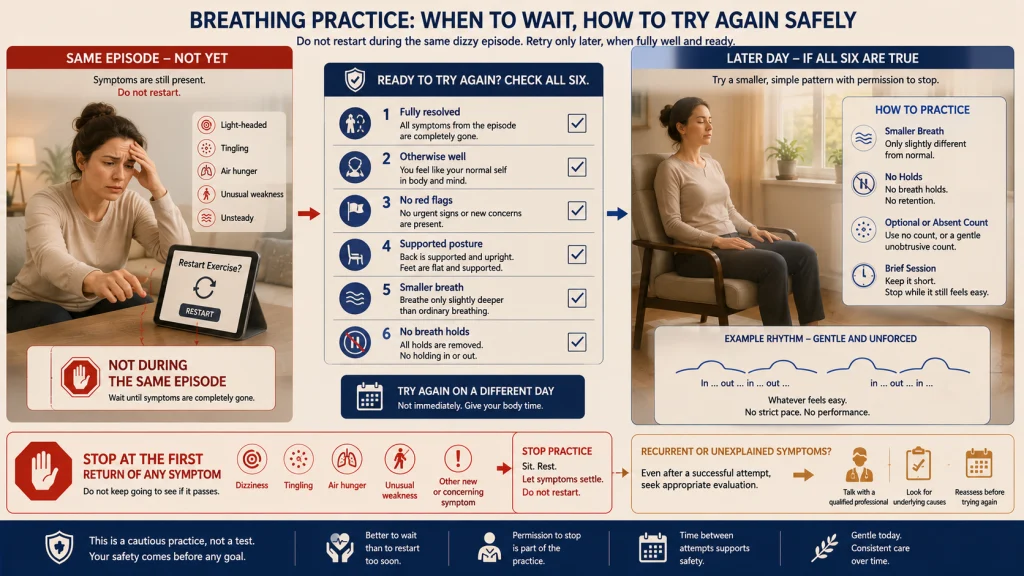
Do not restart the exercise during the same dizzy episode. A later retry may be reasonable only after symptoms have fully resolved, no red flags are present, and the person otherwise feels well.
- Sit with the back and feet supported.
- Use a smaller breath than before.
- Remove all breath holds.
- Stop using a rigid count if the count drives the breath.
- Keep the session brief.
- Stop at the first return of dizziness, tingling, air hunger, or unusual weakness.
Do not treat a successful retry as proof that the earlier episode was harmless. Seek evaluation when the pattern repeats or remains unexplained.
Choose a No-Hold Method Instead of Breath Retention
If a retention-based pattern repeatedly creates strain, switch to a method that does not require holding the breath. The goal is to reduce unnecessary effort rather than to complete a more difficult count.
Diaphragmatic breathing focuses on reducing unnecessary upper-body effort without requiring a long retention phase. Coherent breathing uses a steady rhythm without treating a breath hold as proof of success.
Counted methods such as box breathing and 4-7-8 breathing should be modified or avoided when the holds, depth, or pace provoke dizziness. A specific count is optional. Safety is not.
Remove App Pressure and Shorten the Session
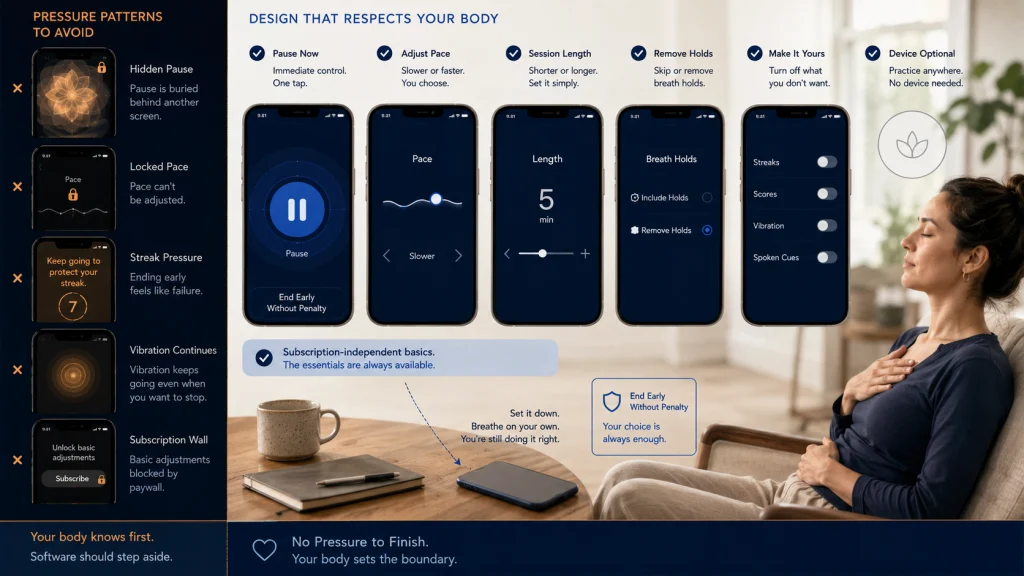
An app may reward streaks, lock pacing behind a preset, continue vibrating after the user needs to stop, or hide the pause control behind another screen. Those design choices can turn a simple exercise into a compliance task.
- The pause or stop control is visible immediately.
- The pace and session length can be adjusted.
- Breath holds can be removed.
- Streaks and performance scores can be disabled or ignored.
- Vibration and audio cues can be stopped instantly.
- The method can be practiced without a subscription or device.
- The screen does not pressure the user to finish after symptoms begin.
Editorial observation: A breathing tool is easier to use safely when stopping is simpler than continuing. A visible pause button, adjustable pace, and no penalty for ending early matter more than decorative animations or a perfect streak.
A shorter session with ordinary breathing is preferable to a longer session that repeatedly creates symptoms or makes the user feel trapped by the interface.
Know When to Contact a Clinician
Arrange medical evaluation when dizziness is new, persistent, recurring, worsening, unexplained, or limiting normal activity. Contact a clinician when episodes occur outside breathing practice, continue after the exercise stops, or appear with irregular heartbeat, severe headache, new weakness, numbness, or another concerning symptom.
Also seek individualized guidance when pregnancy, recent surgery, chronic illness, a neurological condition, a heart or lung condition, disability-related limitations, or medication concerns may affect safe practice. Do not change medication or treatment because of a breathing-exercise episode without qualified guidance.
Know When Emergency Care Is Needed
Seek urgent help for dizziness with chest pain, severe shortness of breath, fainting, stroke signs, sudden weakness, a severe headache, immediate danger, a serious injury, or rapidly worsening symptoms. Self-harm thoughts also require urgent support.
Do not continue a breathing exercise, drive yourself, or wait for an app session to end when emergency signs are present. A relaxation technique is not an emergency assessment tool.
Stop, Recover, and Decide Whether to Modify or Seek Evaluation
When a breathing exercise causes dizziness, stop the pattern, sit or lie safely, and return to ordinary uncounted breathing. Check for urgent symptoms before reviewing breath size, speed, holds, posture, heat, hydration context, or app pressure.
Retry only later, while well, with a smaller no-hold method if appropriate. Seek evaluation when symptoms are new, severe, persistent, worsening, unexplained, recurrent, or function-limiting.
For the wider decision map, return to breathing exercises for stress or how to manage stress.
FAQs
🪑 What should I do first if a breathing exercise makes me dizzy?
Stop the exercise, sit or lie down safely, and return to ordinary uncounted breathing. Check for chest pain, severe shortness of breath, fainting, weakness, or other urgent symptoms.
🌬️ Should I take several deep breaths to fix it?
No. Repeated giant breaths may continue an overly deep or rapid pattern. Allow smaller ordinary breaths and seek urgent help if breathing difficulty is severe or worsening.
⏸️ Should I finish the count before stopping?
No. Stop as soon as dizziness, light-headedness, tingling, air hunger, or unusual weakness appears. The count and app animation are optional.
🫁 Does dizziness prove I was hyperventilating?
No. Over-breathing is one possible practice factor, but the symptom pattern alone cannot diagnose hyperventilation or exclude another medical cause.
🧍 Is standing practice more likely to be unsafe?
Standing increases fall risk if dizziness begins. A supported seated position is safer for a later retry, but recurrent symptoms still require evaluation.
🔁 Can I try the exercise again immediately?
No. Wait until the episode has fully resolved and you otherwise feel well. A later retry should use a smaller no-hold pattern and stop at the first returning symptom.
📱 What should a breathing app allow me to change?
It should provide an immediate pause control, adjustable pace and session length, removable holds, and no pressure to preserve a streak after symptoms appear.
☎️ When should I contact a clinician?
Seek evaluation for new, persistent, recurrent, worsening, unexplained, or activity-limiting dizziness, especially when it occurs outside breathing practice or with other symptoms.
🚑 When is emergency help needed?
Seek urgent help for chest pain, severe shortness of breath, fainting, stroke signs, sudden weakness, severe headache, serious injury, immediate danger, or rapidly worsening symptoms.