Staying active with limited mobility begins by identifying what movement is available today rather than forcing one standing workout to become the standard. Small windows of movement can be distributed across seated, supported, lying, aquatic, or assisted formats depending on the person’s current capacity and environment. Consistency, recovery, and participation matter more than calorie estimates or matching someone else’s routine. New, severe, persistent, worsening, or unexplained symptoms, falls, fainting, chest pain, severe shortness of breath, sudden weakness, or major functional decline require qualified evaluation.

Find activity inside a week with no open thirty-minute block
The weekly calendar has no clean thirty-minute opening. Work, care, appointments, meals, rest, and household tasks fill the day. Yet several five-minute windows remain, and three body positions are usable: seated at a table, supported at a counter, and lying comfortably on a bed.
Available time
- Five minutes after breakfast
- Five minutes before lunch
- Five minutes during an afternoon television break
- A short evening window before the bedtime routine
Available positions
- Seated with back support
- Standing with stable support
- Lying on a bed or firm surface
The schedule does not contain one conventional workout, but it contains enough information to build an activity system. The decision starts with usable time, usable positions, available support, and the person’s response afterward.
Limited mobility changes the menu, not the need to choose deliberately.
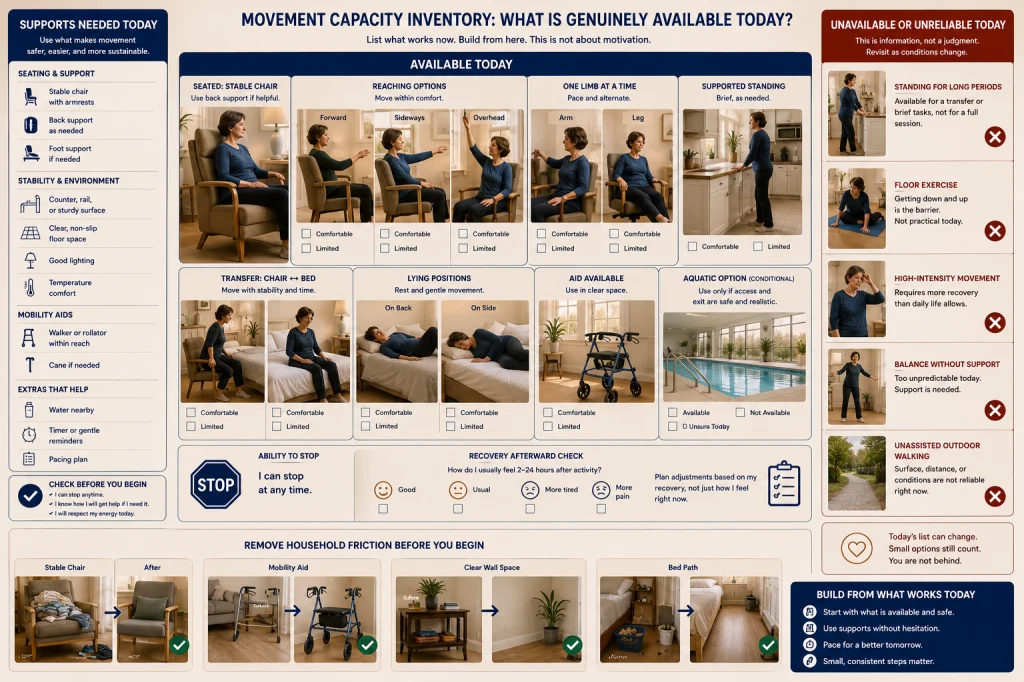
List current capacities, supports, and unavailable positions without judgment
Begin with a practical inventory of what is available now. This is not a test of motivation or worth. It is a way to avoid building a routine around positions, transitions, or tasks that are currently unrealistic.
What is available today?
- ☐ Sitting with or without back support
- ☐ Reaching forward, sideways, or overhead within a comfortable range
- ☐ Moving one arm or one leg at a time
- ☐ Standing briefly with a stable support
- ☐ Transferring between bed, chair, and standing
- ☐ Lying on the back or side comfortably
- ☐ Using a mobility aid safely in the chosen space
- ☐ Accessing water-based activity with qualified support where needed
- ☐ Following simple movement instructions and stopping when needed
- ☐ Recovering well enough to continue ordinary activity afterward
List unavailable or unreliable positions separately. A person may be able to stand for a transfer but not for a full exercise session. Another person may move well while seated but find floor access impractical because getting down and back up is the real barrier.
Editorial observation: Household friction can make an available movement look unavailable. A stable chair may be buried under laundry, the mobility aid may be stored across the room, or the clear wall space may be blocked by a small table. Removing those obstacles can create a usable option without changing the person’s body.
Use the broader mobility planning guide when the inventory needs to include walking, balance, transfers, and daily routes together.
Separate movement snacks, structured sessions, and daily activity
Not every useful movement period needs to look like a workout. Three formats can coexist in the same week.
- Movement snacks: Short, planned periods placed between ordinary tasks.
- Structured sessions: A longer block with a clear beginning, sequence, and ending.
- Daily activity: Purposeful movement already connected to dressing, cooking, tidying, transfers, hobbies, or household routines.
A person may complete two short seated movement periods, one supported standing practice, and several ordinary household tasks in a day. The value comes from the total pattern, not from whether every period is labeled exercise.
Movement snacks are especially useful when fatigue or standing tolerance makes a single long session unrealistic. Structured sessions can still have a place on better days, while daily activity helps keep the system connected to real life.
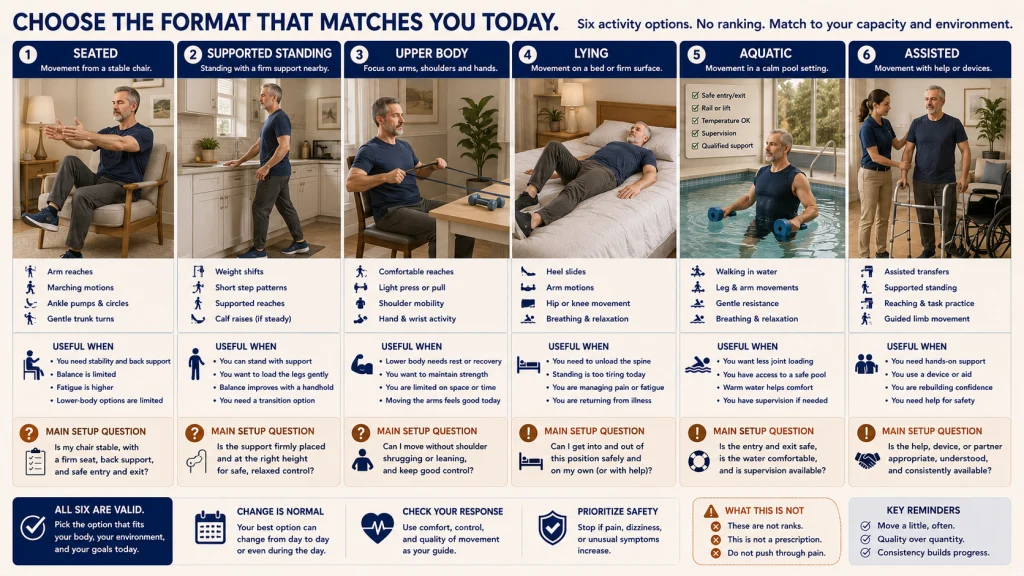
Choose seated, supported, upper-body, aquatic, or assisted options
The activity menu should reflect current positions and supports rather than ranking one format above another.
| Movement option | Useful when | Examples of general activity | Main setup question |
|---|---|---|---|
| Seated | Standing tolerance is limited or a stable chair is the safest position | Arm reaches, marching motions, ankle movement, gentle trunk turns | Is the chair stable, supportive, and easy to enter and leave? |
| Supported standing | Brief standing is available with a counter, rail, or stable aid | Weight shifts, short stepping patterns, supported reaching | Is the support stable and positioned before movement begins? |
| Upper-body focused | Lower-body movement is restricted or energy is limited | Reaching, pressing, pulling motions, hand and wrist activity | Can the shoulders, elbows, hands, and trunk move without compensation? |
| Lying | Bed or floor access is practical and the position reduces standing demand | Heel slides, arm movement, gentle hip or knee motion | Can the person enter and leave the position safely? |
| Aquatic | Water access and qualified support make movement more feasible | Walking, supported range-of-motion activity, gentle group movement | Are entry, exit, supervision, temperature, and medical considerations addressed? |
| Assisted | A partner, professional, device, or stable support helps make movement possible | Guided transfers, supported reaching, assisted limb movement | Is the assistance appropriate, understood, and available consistently? |
Use the chair exercise guide when a complete chair-based session is the next practical step. This article stays focused on selecting and combining formats across the week.
Use frequency and consistency before intensity
When activity has been inconsistent, the first useful progression is often showing up more reliably rather than making each session harder. A short pattern repeated across the week creates more information about recovery, barriers, and tolerable positions.
Choose an amount that leaves enough capacity for meals, hygiene, transfers, work, caregiving, and other essential activity. A session that consumes the rest of the day may be too demanding even when it looked brief on paper.
Progress one element at a time:
- Add another short activity window.
- Repeat the same movement for slightly longer.
- Add one additional movement to the sequence.
- Use a little less support only when that change is appropriate and controlled.
Intensity should not be increased by pushing through pain, severe fatigue, unsafe compensation, or symptoms that need evaluation.
Adapt the environment and equipment
The room can either make activity easier or turn every session into a setup project. Build around stability, access, and low-friction transitions.
- Use a stable chair that does not slide or tip.
- Clear enough space for the planned arm, leg, or mobility-aid movement.
- Place frequently used supports within reach before starting.
- Keep water, phone, and emergency access available when appropriate.
- Use footwear that fits the movement and surface.
- Choose simple equipment that can be lifted, stored, and cleaned without creating another barrier.
- Raise or lower the work surface when the current height forces awkward reaching or leaning.
Equipment is optional unless it solves a recurring task. A towel, light household object, wall, chair, bed, or counter may be enough for the chosen movement. The best setup is the one that can be prepared consistently without help that is rarely available.
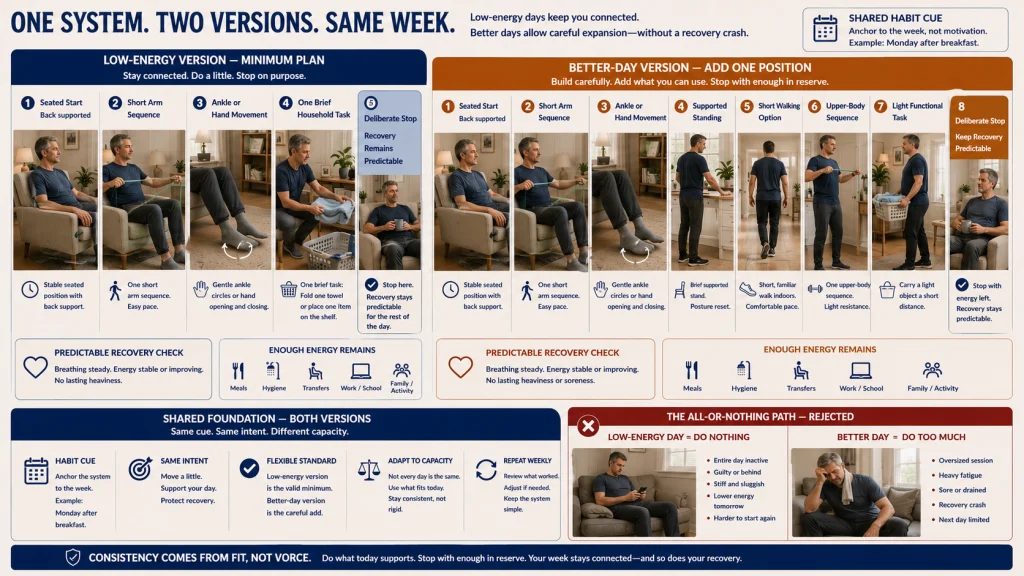
Build a low-energy version and a better-day version
A flexible system should survive an ordinary low-energy day without collapsing into all-or-nothing thinking. The movements, positions, and duration can change while the habit remains recognizable.
Low-energy day
- Seated position with back support
- One short arm sequence
- Gentle ankle or hand movement
- One brief household task
- Stop while recovery remains predictable
Better day
- Seated warm-up
- Supported standing or short walking period
- Upper-body sequence
- One functional task such as carrying a light item
- Finish with enough energy for the rest of the day
The low-energy version is not a failed workout. It is the minimum plan that keeps movement connected to the week. The better-day version adds volume or another position without turning the good day into a recovery problem.
Avoid compensating movements that create pain
When one area has limited movement, another area may begin doing extra work. A person may lean heavily to complete an arm reach, hold the breath during a transfer, grip a chair too hard, or twist through the trunk to move a leg.
Watch for:
- Shoulders rising toward the ears during arm movement
- Repeated breath-holding or straining
- Leaning so far that the chair or support becomes unstable
- Using momentum to force a range that is not available
- New pain appearing in the back, neck, shoulder, wrist, hip, or knee
- A mobility aid being pulled or pushed outside its intended use
Reduce the range, change the position, simplify the task, or stop when the movement creates pain or unsafe compensation. This article does not diagnose the cause or prescribe corrective rehabilitation.
Use the functional exercise guide when the main goal is improving movement connected to transfers, carrying, reaching, and other daily tasks.
Coordinate with a qualified professional for complex limitations
Self-directed activity planning is not enough when the limitation is new, rapidly changing, medically complex, or difficult to interpret. Individualized help may be useful when movement is affected by pain, fatigue, falls, neurological symptoms, recent surgery, injury, significant weakness, or multiple health conditions.
A qualified professional can help clarify which positions, supports, transfers, and movement ranges fit the person’s situation. That role is different from a general lifestyle article, which cannot examine the person or test movement safely.
Bring practical information to the appointment:
- Which positions are currently usable
- Which activities trigger symptoms or excessive recovery
- Whether the limitation is stable, improving, or worsening
- Recent falls, near-falls, or changes in aid use
- The low-energy and better-day versions already attempted
- The daily tasks the person most wants to preserve
Use the balance exercise guide only when steadiness is the main concern and self-directed movement remains appropriate.
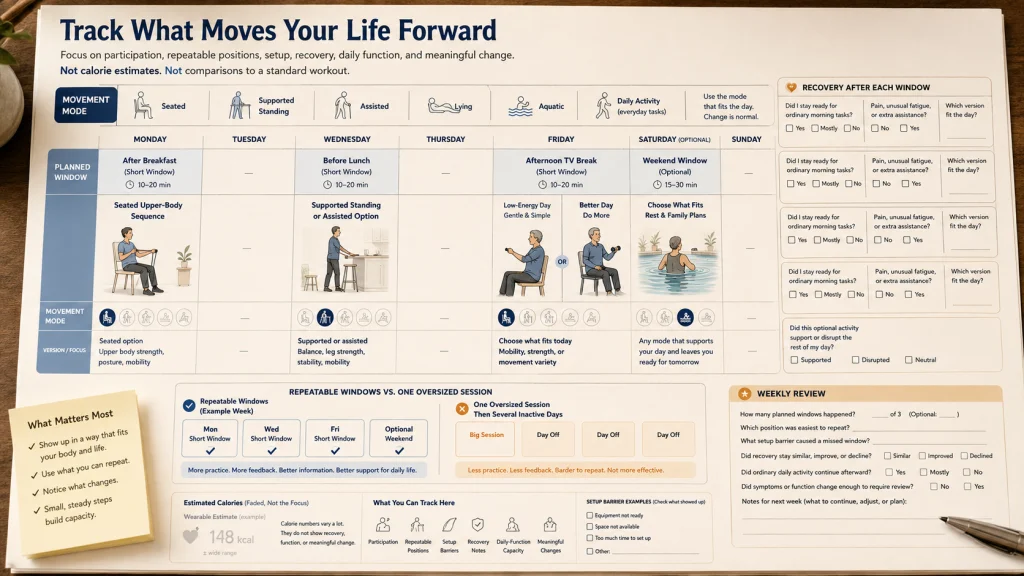
Track participation and recovery rather than calorie estimates
Calorie estimates from a wearable or app may be imprecise and can distract from the questions that actually shape the plan. Track whether movement happened, which position was used, and how the person recovered.
| Flexible weekly template | Planned window | Movement mode | Recovery note |
|---|---|---|---|
| Monday | After breakfast | Seated upper-body sequence | Ready for normal morning tasks afterward? |
| Wednesday | Before lunch | Supported standing or assisted option | Any pain, unusual fatigue, or extra help needed? |
| Friday | Afternoon television break | Low-energy or better-day version | Which version fit the day? |
| Optional weekend window | Chosen around rest and family plans | Daily activity, aquatic, lying, or seated option | Did it support or disrupt the rest of the day? |
Useful tracking questions include:
- How many planned windows were completed?
- Which position was easiest to repeat?
- Which setup barrier caused a missed session?
- Did recovery remain similar across the week?
- Could ordinary daily activity continue afterward?
- Did symptoms or function change enough to require review?
A week with three brief, repeatable windows may be more useful than one large session followed by several inactive days.
Escalate when mobility changes suddenly or daily function declines
Professional-review boundary: New, severe, persistent, worsening, or unexplained symptoms, falls, fainting, chest pain, severe shortness of breath, sudden weakness, confusion, or major functional decline require qualified evaluation. Emergency symptoms require immediate help.
Stop self-directed troubleshooting when a previously available position becomes suddenly unavailable, transfers become markedly harder, walking or standing capacity drops abruptly, or ordinary tasks begin requiring much more help.
A change in mobility should not be dismissed as lack of effort. Pain, fatigue, medication effects, illness, injury, neurological changes, and other causes may need assessment beyond a general activity plan.
Choose two movement modes, three weekly windows, and one review condition
Finish the plan in three lines:
- Two available movement modes: Choose from seated, supported, lying, upper-body, aquatic, assisted, or daily activity.
- Three weekly windows: Place short sessions where the calendar and energy pattern make them most realistic.
- Professional-review condition: Name the symptom, sudden change, or functional decline that ends self-directed planning.
A complete example might read: “My two available modes are seated upper-body movement and brief supported standing. I will use five-minute windows after breakfast on Monday, before lunch on Wednesday, and during an afternoon break on Friday. On low-energy days I will remain seated. A sudden loss of transfer ability, a fall, severe breathlessness, chest discomfort, or another major change will trigger professional review.”
Use the broader healthy aging guide when the activity system is part of a larger plan for daily function, home routines, and independence.
Meaningful activity does not need to imitate a standard standing workout. It needs to fit the body positions, time windows, supports, and recovery that are genuinely available today.
FAQs
🪑 Can seated movement count as meaningful activity?
Yes. Seated movement can be a practical activity mode when standing tolerance is limited. The useful question is whether it can be repeated and recovered from without creating new problems.
⏱️ Are five-minute activity windows worthwhile?
Short windows can help build consistency when a longer session is unrealistic. Several manageable periods may fit the week better than one demanding block.
🌧️ What should I do on a low-energy day?
Use the minimum version of the plan, such as a short seated sequence or gentle upper-body movement. Stop if symptoms or recovery are outside the person’s usual range.
🦯 Can I use a mobility aid during activity?
A mobility aid may be part of the setup when it is used as intended and the environment is stable. Complex questions about support, fit, or changing aid needs should be reviewed by a qualified professional.
🏊 Is water activity a good option?
It can be an option when entry, exit, supervision, temperature, and individual health considerations are addressed. This article does not provide individualized aquatic programming.
📊 Should I track calories burned?
Participation, recovery, and daily function are often more useful for this decision. Consumer estimates should not be treated as a diagnosis or proof of progress.
🛑 When should I stop a movement?
Stop when it creates pain, unsafe compensation, severe fatigue, loss of control, or a concerning symptom. Simplify the position or seek qualified help when the response is new or difficult to interpret.
🚩 When should mobility changes be evaluated?
Seek qualified evaluation for a sudden decline, falls, fainting, chest pain, severe shortness of breath, sudden weakness, confusion, or new, persistent, worsening, or unexplained symptoms. Emergency symptoms require immediate help.