A portable air purifier and a central HVAC filter solve different parts of the same household problem. One can stay close to the room being used, while the other depends on the home’s installed equipment and operating schedule. The better choice comes from mapping the system, naming the priority room, confirming compatibility, and deciding what the household can realistically run and maintain. Some homes need one pathway, some benefit from both, and some should pause for professional assessment before changing controls or filter hardware.
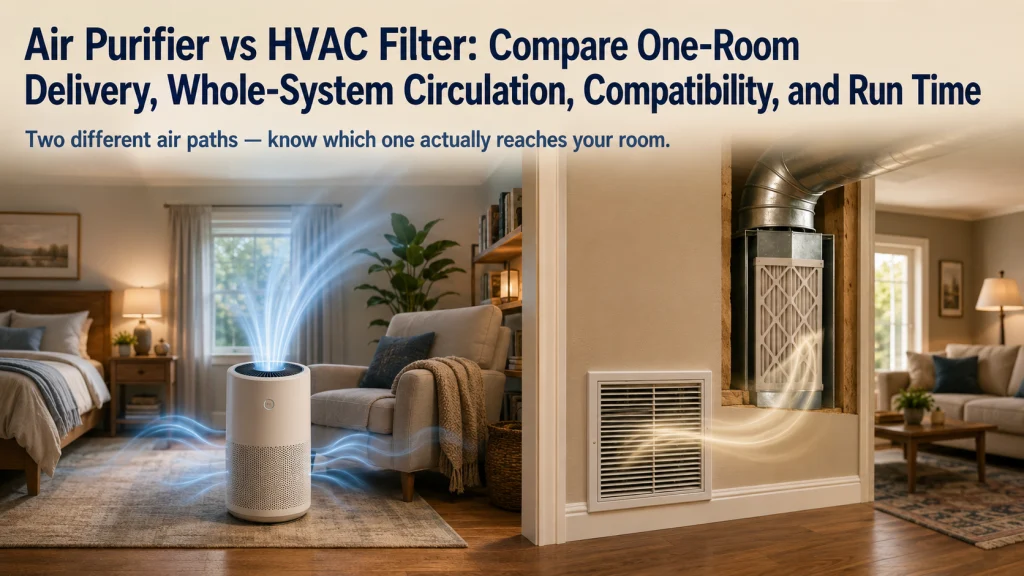
One Bedroom, One Open Living Area, and One Central Return Create Different Air Paths
A portable purifier runs beside the bed in a closed bedroom. Down the hall, the living area opens into the kitchen and contains a central return grille. The HVAC system is currently idle. Even though both filtration options are inside the same home, they are not serving the same air at the same moment.
The bedroom unit keeps working beside the sleeper even after the thermostat becomes quiet. In the living area, the installed filter waits for the next heating, cooling, or fan cycle. The contrast is easy to miss because one system is visible in the room while the other is hidden behind grilles and equipment panels.
| Zone | Filtration path | What determines delivery | Common mistaken assumption |
|---|---|---|---|
| Closed occupied bedroom | Portable unit recirculates room air locally | Room size, placement, fan speed, run time, and clear airflow | One purifier in another room will clean the closed bedroom equally |
| Open living area | Portable unit serves a connected local volume, or central air reaches the return and supplies | Open layout, equipment capacity, doors, airflow path, and system operation | Open space guarantees even cleaning everywhere |
| Central return and ducts | Air returns through the operating HVAC system and crosses the installed filter | Fan operation, return locations, filter fit, blower compatibility, and duct distribution | A high-efficiency filter cleans continuously even while the system is off |
The useful question is not which option sounds larger. It is which air each option can reach during the hours that matter.
Define Portable Air Cleaning, Central Filtration, Returns, Supplies, Runtime, MERV, CADR, and Served Zone
A portable air cleaner is a movable device that draws room air through one or more filters and returns treated air to the same local space. Its performance for particles depends partly on clean-air delivery, placement, speed, and the volume it is expected to serve.
A central filter sits within a ducted heating and cooling system. A return draws room air back toward the equipment. A supply sends conditioned air from the system into rooms. Recirculation occurs when indoor air moves through that loop without being fully replaced by outdoor air.
System runtime is the time the central fan is actually moving air. MERV is a particle-filter classification used for central filtration. A higher classification does not prove compatibility with every system. CADR describes particle clean-air delivery from a complete portable unit under stated conditions.
A served zone is the room or connected air volume that a filtration pathway can realistically influence. It should be defined from the home’s layout and equipment rather than inferred from a broad coverage phrase.
Air cleaners and air filters places these options beside source control, ventilation, maintenance, and pollutant-specific decisions.
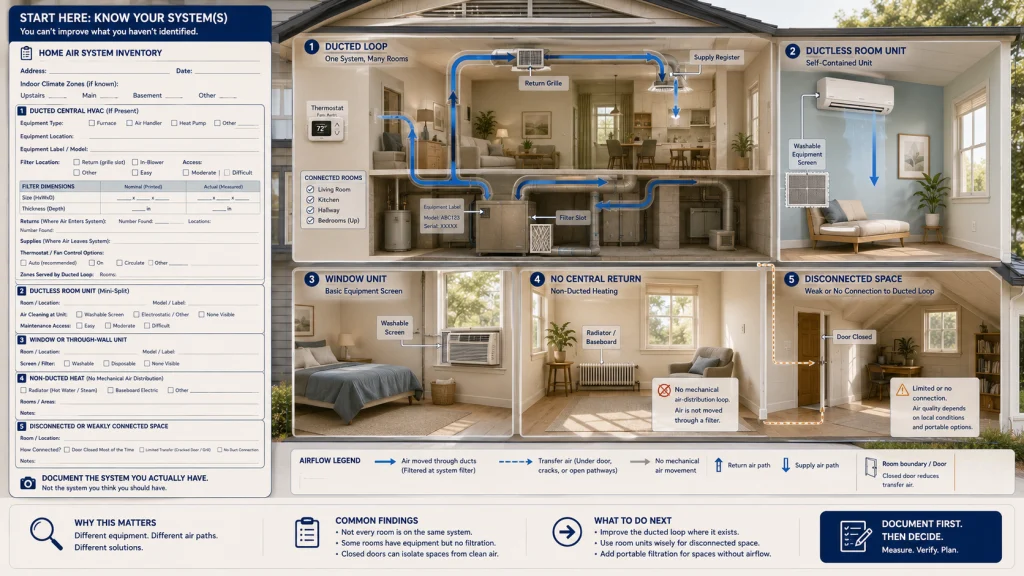
Inventory the Home’s Actual Heating, Cooling, and Air-Distribution System
Before comparing filters, identify what the home actually has. A thermostat on the wall can make the system feel unified even when an addition, upstairs bedroom, or converted room follows a different path. A mini-split, window unit, radiator, baseboard heater, or room air conditioner may heat or cool without participating in central filtration.
| Home-system inventory | What to locate | Filtration question |
|---|---|---|
| Ducted central HVAC | Return grilles, supply registers, equipment label, filter slot, thermostat fan controls | Which rooms return air, when the fan moves air, and which filters are approved? |
| Ductless mini-splits | Indoor wall units, washable screens, model documentation, room coverage | Are the screens mainly protecting equipment, and is separate particle cleaning needed? |
| Window or through-wall units | Room units, intake screens, operating modes, room boundaries | Does the unit provide meaningful fine-particle filtration beyond basic equipment protection? |
| No mechanical air distribution | Radiators, baseboards, fans, natural ventilation paths | Would a room purifier provide the only active particle-filtration path? |
| Mixed system | Ducted zones, additions, mini-splits, closed rooms, disconnected spaces | Which areas are actually connected, and where is local filtration still needed? |
Write down the equipment model, filter location, current filter dimensions, number of returns, fan-control options, and rooms that remain closed for long periods. A few minutes spent tracing grilles and doors can prevent an expensive change based on a system the house does not actually have.
Use Portable Filtration for a Defined Priority Room
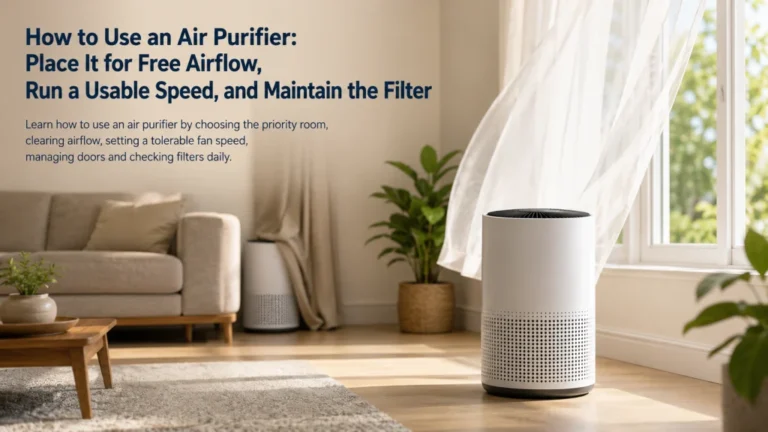
A portable unit can stay with the room that matters most at a particular time. It may run beside the bed overnight, move to a home office before work begins, or remain in the living area while the household gathers there. That directness is often easier to understand than a hidden system whose schedule changes with the weather.
The tradeoff is that the benefit follows the unit. Carrying it upstairs may help the bedroom and leave the downstairs room without local filtration. Leaving several doors open may connect spaces somewhat, but it does not turn one portable device into an equal whole-home system.
The portable path depends on:
- A capacity match for the room or connected volume.
- Clear inlets and outlets.
- A fan setting people will keep using.
- Doors positioned to match the intended served zone.
- Noise, drafts, controls, and safe floor space.
- Filter availability and a realistic maintenance routine.
Nora’s observation: I pay attention to where the household will actually tolerate the machine. A unit that looks manageable in a showroom may feel intrusive beside a bed, awkward near a desk chair, or too heavy to move between floors. Targeted filtration works best when the chosen room, noise level, controls, and daily routine fit together.
Use room-volume and clean-air delivery checks before expecting one portable unit to cover a larger connected area.
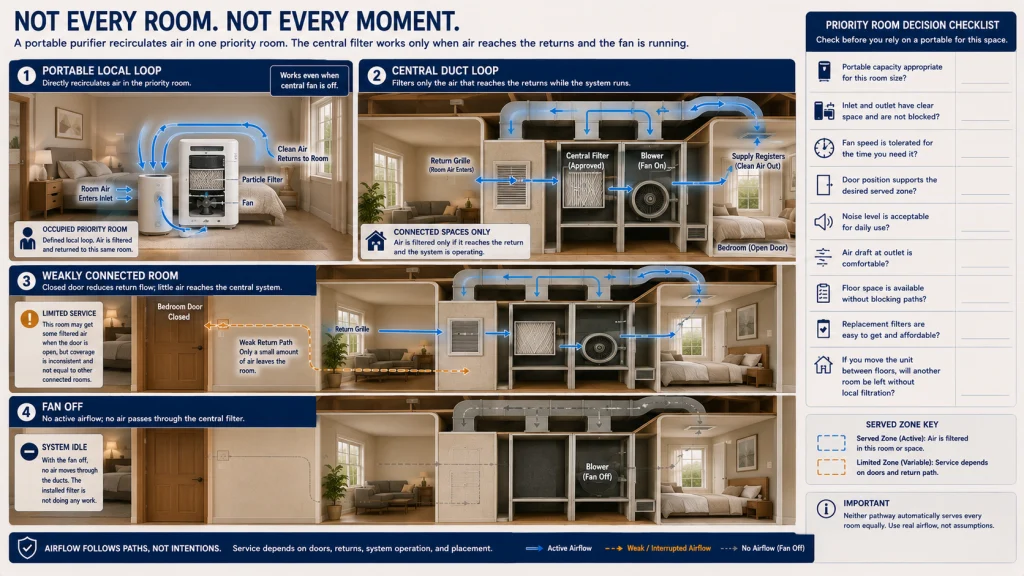
Use Central Filtration Only Within the Operating Duct Path
A central filter belongs to a circulation loop. Supply registers deliver conditioned air, but the return side brings room air back toward the equipment and filter. Rooms that connect poorly to that loop may not receive the same filtration benefit as rooms near an effective return path.
Airflow-path diagram:
Portable route
Priority-room air → portable inlet → particle filter and fan → clean-air outlet → same room
Central route
Connected-room air → return grille → duct → approved central filter → blower → supply duct → connected rooms
Interrupted route
Closed or weakly connected room → limited return path → less room air reaches the central filter
Idle route
System fan off → no active airflow through the central filter
Return placement matters. In one home, a hallway return may serve several open rooms reasonably well. In another, a closed bedroom may feel isolated from the rest of the circulation pattern. Undercut gaps, transfer paths, duct balance, and equipment design all shape that difference.
Do not seal, add, enlarge, or reroute returns as a do-it-yourself filtration fix. Distribution and pressure changes belong to qualified HVAC assessment.
Remember That an HVAC Filter Works Only While the Fan Moves Air
A mild spring day can expose the runtime problem clearly. The house feels comfortable, so heating and cooling barely operate, yet indoor activity continues. The filter remains in place, but little air crosses it unless the system has another approved fan schedule.
Continuous or extended fan operation can increase filtration time, but it may also affect energy use, equipment behavior, humidity control, comfort, noise, and maintenance. This is not a universal setting recommendation.
Before changing fan controls, check the exact equipment and thermostat documentation. Consider:
- Whether the system supports the intended fan mode.
- How the setting affects heating, cooling, and humidity management.
- Whether ducts or equipment are located in hot, cold, damp, dusty, or unconditioned areas.
- Whether increased runtime changes noise, drafts, energy use, or filter loading.
- Whether combustion equipment or other safety constraints require professional review.
This is why runtime deserves its own decision. It affects energy, comfort, humidity, equipment behavior, and how much filtration the installed pathway can provide, not merely whether the filter is present.
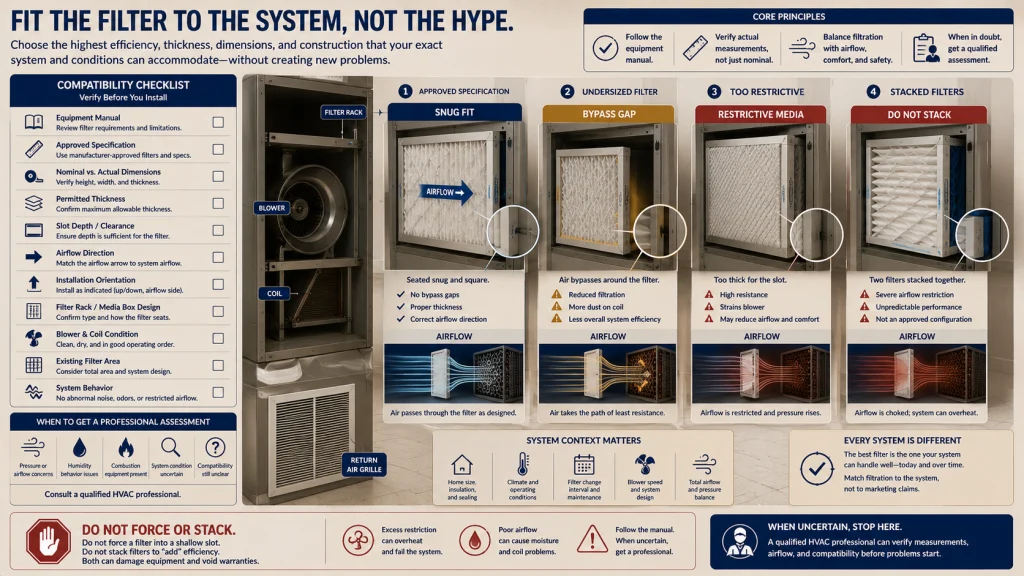
Choose the Highest Compatible Central-Filter Efficiency, Thickness, and Fit
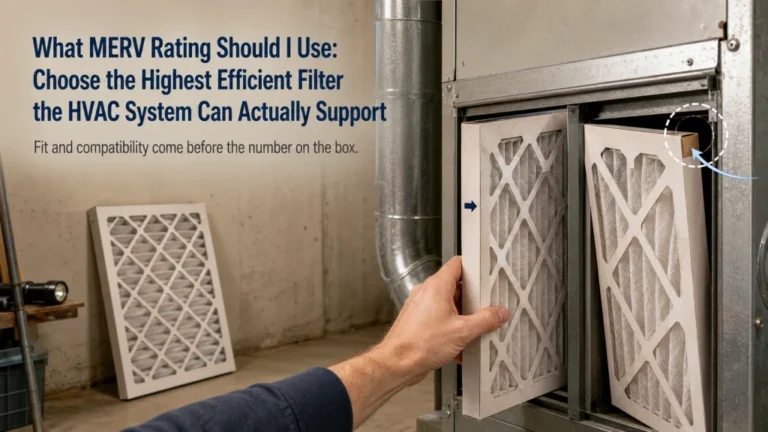
A higher-efficiency central filter can improve particle capture, but it can also increase resistance to airflow. The correct choice is the highest efficiency that the exact system, blower, filter rack, and operating condition can accommodate, not the largest number that fits on a shopping page.
Check:
- The equipment manual and approved filter specifications.
- Nominal and actual filter dimensions.
- Permitted thickness and slot depth.
- Airflow direction and installation orientation.
- Whether the filter sits snugly without large bypass gaps.
- Whether the rack, grille, cabinet, or media box is designed for the chosen filter.
- Current condition of the blower, coil, ducts, and existing filter area.
A loose filter can let air slip around the media. A restrictive one can change how the system behaves. Both failures may be invisible from the front of the return grille, which is why dimensions, thickness, condition, and equipment instructions matter more than an isolated rating.
HVAC compatibility warning: Do not assume that a higher MERV value is safe for every system. Do not force a thick filter into a shallow slot, stack filters, tape over access problems, or operate the equipment with a filter configuration outside its instructions. When compatibility, pressure, airflow, humidity, fan settings, or equipment condition is uncertain, use the manual and qualified HVAC assessment.
Central-filter efficiency and compatibility require a separate decision based on the exact system rather than a universal rating.
Do Not Treat Mini-Split and Window-Unit Screens as Central Fine-Particle Filters
Many ductless mini-splits and window units contain washable screens or basic filters intended mainly to protect internal equipment from larger dust and debris. Their presence does not prove that the unit provides substantial fine-particle clean-air delivery for the room.
Check the exact documentation for the filter’s purpose, material, cleaning method, replacement options, and any supported particle-performance claim. Do not assume that cooling or heating airflow equals effective particle filtration.
In a ductless home, room-focused filtration may be the more direct particle-control option because no single return ties the spaces together. The air-cleaning decision should still be based on the room and the purifier’s documented delivery, not on the heating or cooling capacity printed on the wall unit.
Do not add improvised dense media to a mini-split or window unit. Blocking airflow, changing pressure, trapping moisture, or placing material near moving or electrical parts can damage equipment or create a hazard.
Compare Noise, Drafts, Energy, Humidity, Filter Cost, Access, and Maintenance
The easiest option to buy is not always the easiest one to live with. A portable unit may hum beside the bed, blow across a desk, or occupy the only clear corner. A central filter may disappear from view but require a ladder, an awkward utility closet, or a service visit before the household can inspect the problem.
| Ownership factor | Portable room unit | Central HVAC filter |
|---|---|---|
| Targeting | Directly serves one priority room or connected local area | Serves connected ducted spaces whose air reaches the returns |
| Runtime | Independent controls and schedule | Depends on HVAC fan operation and control settings |
| Noise and drafts | Fan sound and local outlet draft occur in the occupied room | Equipment and duct noise may be distributed or located elsewhere |
| Energy | Uses its own fan at the selected speed and duration | Additional fan operation may change whole-system energy use |
| Humidity and comfort | Does not control whole-home temperature or humidity | Fan operation may interact with cooling, heating, and humidity behavior |
| Filter access | Usually accessible in the room, but placement must allow maintenance | May be in a return grille, closet, attic, basement, crawlspace, or equipment cabinet |
| Recurring cost | Replacement filters, energy, cleaning, and possible multiple units | Compatible filters, service needs, energy, and access difficulty |
| Storage and movement | Needs floor or tabletop space and may be moved between rooms | No room appliance to store, but the installed system is not portable |
Maintenance should fit the person doing it. A heavy purifier that must be carried upstairs every evening may soon stay downstairs. A filter hidden behind a difficult access panel may remain unchanged because checking it becomes a postponed weekend job. Those ordinary frictions often decide whether the planned strategy lasts.
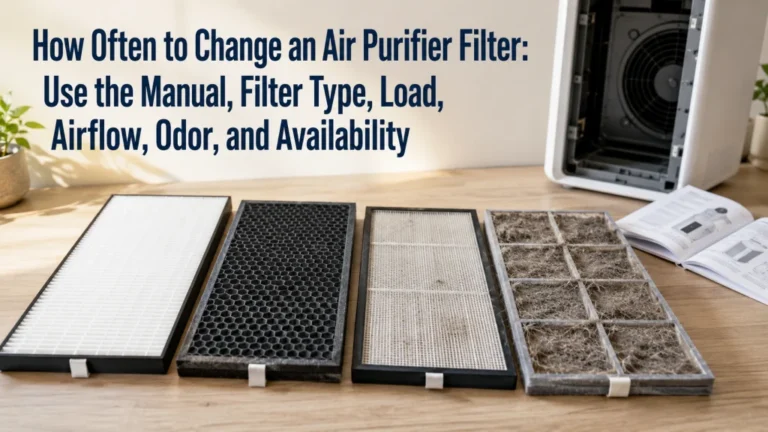
Filter inspection and replacement timing should follow the exact equipment, environment, use, and manufacturer instructions rather than one universal calendar.
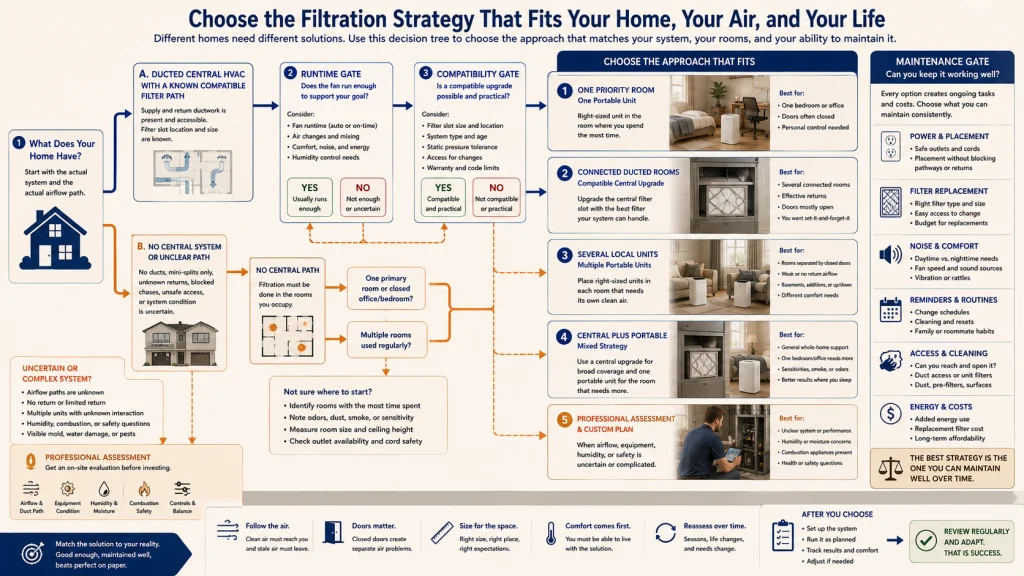
Choose One Portable Unit, Several Units, a Central Upgrade, Both, or Professional Assessment
The best answer may be a sequence rather than one winner. Start with the room where the household spends time, then ask whether the installed system can support the broader part of the plan safely.
Combined-strategy decision tree:
Does the home have ducted central HVAC with a known compatible filter path?
No → Use room-focused filtration where needed, or seek assessment if the system is unclear.
Yes → Continue.
Does the central system run enough to support the filtration goal without creating unresolved comfort, humidity, energy, or equipment concerns?
No or uncertain → Keep the current safe configuration and seek qualified assessment before changing controls.
Yes → Continue.
Is the main concern concentrated in one occupied room or behind a frequently closed door?
Yes → A correctly sized portable unit may provide the most direct local delivery.
No → Continue.
Are several ducted rooms occupied and connected to effective returns?
Yes → A compatible central-filter upgrade may support broader particle filtration.
No → Multiple local units or a mixed approach may fit better.
Do both central distribution and a priority room matter?
Yes → Combine compatible central filtration with a portable unit in the priority room.
Several portable units can support separate rooms, but they also create several cords, several filters, several noise sources, and several reminders. A compatible central upgrade can reduce room clutter, while a local unit can remain in the one space that needs more direct attention. The mixed approach is useful only when the household can maintain both sides.
Use portable purifier placement and operating routines after choosing a room-focused pathway.
Stop Before Modifying Filter Slots, Ducts, Blowers, or Fan Controls
Filtration troubleshooting should not become unapproved HVAC modification. A tight filter slot, weak airflow, noisy return, humidity change, repeated equipment shutdown, or unusual odor can signal a system issue that cannot be solved safely by forcing in different media.
Stop condition:
- Do not cut, enlarge, seal, or rebuild filter slots without approved instructions and qualified assessment.
- Do not modify ducts, returns, supply registers, blower settings, wiring, controls, or combustion equipment as a filtration experiment.
- Stop using a damaged, wet, overheating, sparking, smoking, or recalled portable unit.
- Stop when a filter is collapsing, being pulled into the equipment, bypassing visibly, or causing abnormal system behavior.
- Use professional assessment when filter resistance, airflow, humidity, combustion safety, equipment condition, or compatibility is uncertain.
A sounding smoke or carbon monoxide alarm, visible fire or smoke, suspected gas leak, severe breathing difficulty, chest pain, fainting, confusion, blue or gray lips, or other emergency signs require leaving the area when safe and contacting emergency or utility services as appropriate.
Persistent or worsening symptoms require qualified medical guidance. Filtration does not diagnose or treat a respiratory, cardiovascular, neurological, infectious, mold-related, or chemical-exposure condition.
Match the System Path, Priority Room, Compatible Filter, and Runtime
Start with the home’s actual equipment and the room that matters most. Identify returns, supplies, ducts, mini-splits, window units, and spaces that remain closed. That map turns a broad product comparison into a specific household decision.
For central filtration, verify the highest compatible efficiency, thickness, dimensions, fit, and system condition. For portable filtration, match the unit to the room and choose a placement and speed the household can use consistently. Include noise, drafts, energy, humidity behavior, filter access, and recurring cost.
The final answer may be one portable unit, several local units, a compatible central upgrade, a mixed strategy, or professional assessment. What matters is that the chosen pathway reaches the intended space, works within the equipment limits, and can be maintained after the first week of attention has passed.
For the wider relationship among source control, ventilation, moisture, filtration, and household conditions, revisit the healthy home environment.
FAQs
🏠 Is an HVAC filter better than a portable air purifier?
Neither is universally better. A central filter can serve connected ducted spaces while the fan runs. A portable purifier can provide more direct clean-air delivery in one occupied room.
🚪 Can one portable purifier clean several closed bedrooms?
Do not assume equal coverage. Closed doors and weak air exchange limit how much room air reaches a purifier located elsewhere. Separate local units or a different strategy may be needed.
🌬️ Does a furnace filter work when the system is off?
No active filtration occurs through the central filter when the system fan is not moving air. The installed filter acts only during airflow through the equipment.
📈 Should I install the highest MERV filter available?
Use only the highest efficiency, dimensions, and thickness compatible with the exact system and filter slot. A higher rating is not automatically safe for every blower or duct system.
🧱 Do closed doors reduce central filtration?
They can affect whether room air reaches the returns and completes the central airflow loop. The effect depends on return placement, transfer paths, duct design, and system balance.
❄️ Does a mini-split filter fine particles?
Many mini-split screens mainly protect equipment from larger dust. Check the exact documentation before treating the unit as meaningful fine-particle filtration.
🔄 Can I use central and portable filtration together?
Yes. A compatible central filter can support connected ducted rooms while a correctly sized portable unit targets a priority room, especially one that is occupied or often closed.
⚠️ When should an HVAC professional assess the setup?
Seek qualified assessment when filter compatibility, airflow, pressure, fan settings, humidity, combustion safety, duct condition, slot fit, or abnormal equipment behavior is uncertain.