Size a portable particle air cleaner from the room volume, a verified smoke CADR, the comparison assumption, the likely fan speed, and the way air actually moves through the space. Square-foot coverage alone can hide different air-change assumptions, ceiling heights, and operating speeds. A high ceiling or open doorway increases the air volume the unit must serve, while closed rooms may need separate cleaning locations. Use every calculation as an estimate, then verify the exact product metric and whether the household can run the unit at the setting behind that metric.
Three Identical Coverage Claims Can Describe Different Air Delivery
Three boxes each say the purifier covers 1,000 square feet. To a shopper standing in an aisle or comparing tabs late at night, the numbers appear to settle the decision. Yet the first reaches that figure by assuming one air change per hour, the second pairs it with a much smaller suggested room for stronger circulation, and the third offers no independent clean-air metric or clear explanation of speed, ceiling height, and test method.
The labels look equal because they use the same area. The room experience behind them may be very different.
| Coverage label | Assumption behind the number | What the shopper still needs |
|---|---|---|
| 1,000 square feet at one air change per hour | A large area is served slowly under a stated ceiling assumption | Verified smoke CADR and a decision about whether that turnover fits the particle goal |
| 1,000 square feet maximum coverage, smaller suggested room | The same unit is described under more than one turnover assumption | The room-size basis that matches the desired performance comparison |
| 1,000 square feet with no verified CADR | The method, speed, and clean-air delivery are unclear | An independently verified metric or enough exact documentation to make a transparent comparison |
The same square-foot number can describe very different performance. The useful sizing question is not “Which box lists the largest room?” It is “How much cleaned air can this unit deliver to this volume at a speed we will actually live with?”
Define Area, Volume, CADR, ACH, Suggested Room Size, and Open Plans
Room area is the floor space, usually found by multiplying length by width. Room volume adds ceiling height, producing the amount of air inside the room. Two rooms with the same floor area can have very different volumes when one has a taller ceiling.
CADR is the clean-air delivery rate of the complete device for a stated particle category. Smoke CADR is commonly used when comparing fine-particle performance. It combines airflow and particle removal into one figure, but it does not describe gas adsorption or what happens at every fan speed.
ACH, or air changes per hour, describes how many room-volume equivalents of cleaned air are delivered in an hour under the chosen assumptions. It helps put products on a common basis, but it does not promise that every corner receives equal treatment and it is not a universal medical target.
Suggested room size is a room estimate tied to a program or manufacturer’s stated assumptions. Open plan describes connected areas without reliable doors or boundaries, such as a living room that opens into a kitchen, dining area, hallway, or stairwell.
The broader guide to air cleaners and air filters separates portable particle cleaning from gas media, central filtration, maintenance, source control, and other indoor-air decisions.
Measure the Room, Ceiling, Doors, Openings, and Connected Space
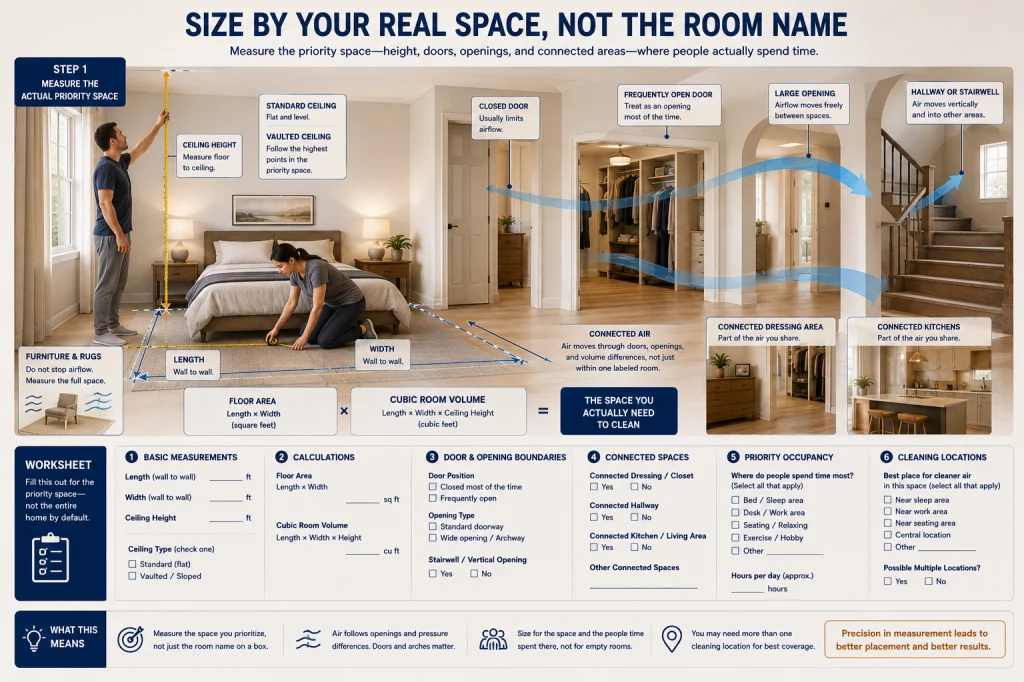
A room name rarely tells the full story. One bedroom may be compact, closed, and easy to define. Another may open into a dressing area, bathroom entrance, and hallway beneath a vaulted ceiling. Two people can both say “bedroom” while asking a purifier to handle very different amounts of air.
| Measurement worksheet | What to record | Why it changes sizing |
|---|---|---|
| Length | Wall-to-wall distance of the priority space | Combines with width to establish floor area |
| Width | Second wall-to-wall dimension | Prevents choosing from a room-name guess |
| Ceiling height | Standard, tall, vaulted, or changing height | Converts floor area into the volume the unit must serve |
| Doors | Which doors stay closed, open, or move throughout the day | Determines whether the room behaves as a boundary |
| Openings | Arches, pass-throughs, large doorways, and stairwells | Adds connected air and weakens a simple closed-room estimate |
| Connected spaces | Kitchen, dining area, hallway, landing, or adjacent room sharing air | May require a larger calculation or multiple cleaning locations |
| Priority occupancy | Where people spend time and when the pollutant matters most | Helps decide whether one zone should be treated before the entire open area |
Measure the space the purifier is expected to serve, not every room visible from where it sits. A normally closed doorway can create a meaningful boundary. A wide opening that never closes usually means the adjoining air belongs in the calculation, even when the furniture makes the rooms feel separate.
Name the Fine-Particle Goal and Compare Verified Smoke CADR
This sizing method is for portable particle air cleaners. It can support decisions involving airborne smoke particles, fine household particles, pollen, pet dander, and other particle concerns when the appropriate device and filter are used. It does not size gas adsorption, moisture control, carbon dioxide reduction, commercial systems, or infection-control systems.
For fine particles, smoke CADR gives the cleanest common basis for comparing complete devices. A filter-efficiency label alone does not show how much treated air returns to the room, while a large airflow claim says little about how well particles are removed.
Before comparing numbers, name the particle and ask whether the source is occasional or still active. Wildfire smoke slipping through leaks, repeated cooking emissions, an open window, or dusty indoor work can keep adding material while the purifier is trying to remove it. A larger unit cannot substitute for source control or suitable clean-air ventilation when those actions are available and safe.
A sounding smoke or carbon monoxide alarm, visible fire or smoke, or a suspected gas leak is not a sizing problem. Leave the area when safe and contact emergency or utility services as appropriate. Severe breathing difficulty, chest pain, fainting, confusion, blue or gray lips, or other emergency signs require immediate appropriate help.
When the broader question is which filter, control, noise level, and ownership cost fit the household, use the guide on how to choose an air purifier.
Put EPA Estimates and AHAM Suggested Room Size on a Common Basis
EPA sizing guidance connects room area with clean-air delivery, while AHAM suggested room size ties a listed model to a stated air-change assumption. Both are more useful than a free-floating maximum-coverage badge because the shopper can see what the number is built on.
A familiar AHAM shorthand is to look for a smoke CADR that is roughly two-thirds of the room’s square footage when the standard ceiling and program assumptions apply. That shortcut is not a universal rule for high ceilings, open plans, lower fan settings, every pollutant, or medical use.
The goal is not to crown one label as flawless. It is to stop placing unlike numbers side by side and treating them as equal simply because they share the same unit.
Show the Relationship Among Room Volume, CADR, and ACH
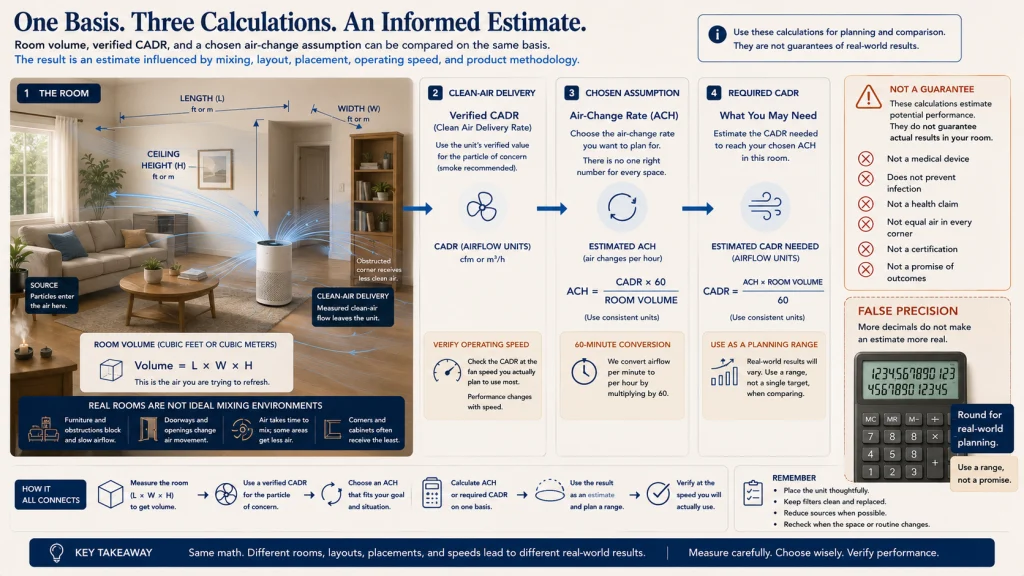
The formula feels less intimidating once every part is visible. For a CADR stated in cubic feet per minute and a room volume stated in cubic feet, the relationship is:
CADR-ACH relationship graphic:
Room volume = room length × room width × ceiling height
Estimated ACH = CADR × 60 ÷ room volume
Estimated CADR needed = chosen ACH assumption × room volume ÷ 60
The number 60 converts cleaned air delivered per minute into an hourly estimate. The result assumes enough mixing for the delivered air to influence the room. Furniture, walls, doorways, source location, and purifier placement can make the real distribution less even.
False-precision warning: A calculator result is an estimate built from chosen assumptions. Do not round it into a medical guarantee, an infection-prevention target, or proof that every corner receives equal cleaned air. Exact product performance must be verified for the stated fan speed and methodology.
Use the formula to compare options on the same basis. It should clarify the decision, not produce a falsely precise answer that hides uncertain room mixing, operating speed, or product data.
Increase the Estimate When the Ceiling Is Higher Than Eight Feet
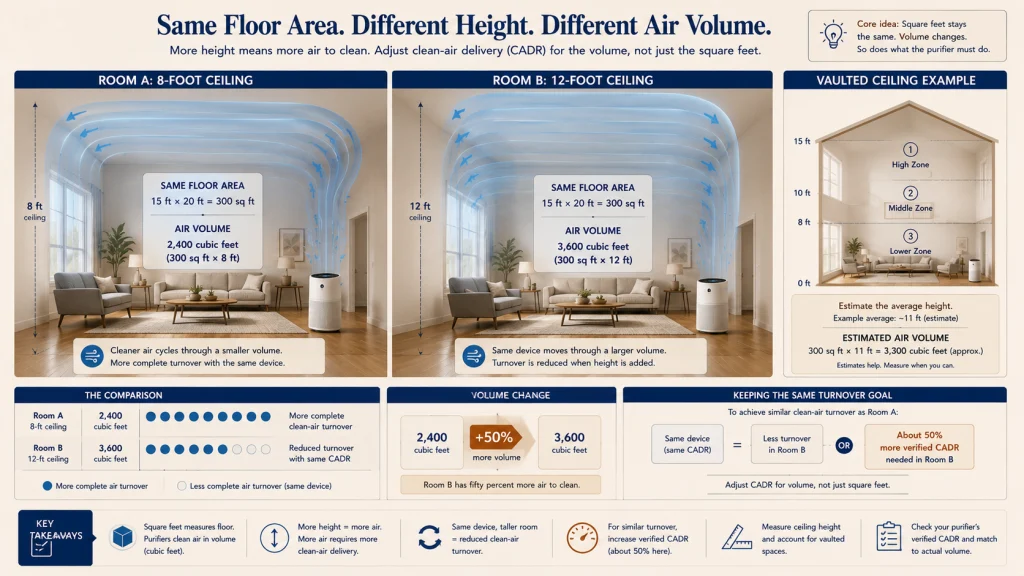
Square-foot shortcuts often picture an eight-foot ceiling, even when the actual room rises much higher. The floor may look ordinary, but the purifier is still serving all the air above it. With more volume and the same clean-air rate, turnover falls.
High-ceiling example:
A room measuring 15 feet by 20 feet has 300 square feet of floor area.
At an 8-foot ceiling, the estimated volume is 2,400 cubic feet.
At a 12-foot ceiling, the estimated volume is 3,600 cubic feet.
The taller room contains 50 percent more air. Holding the same ACH assumption would therefore require about 50 percent more CADR than the eight-foot version of the room.
A vaulted ceiling may not have one uniform height. A reasonable average or a few simple sections can produce a useful planning figure. The point is to acknowledge the extra air rather than pretending an irregular room can be captured perfectly by one square-foot label.
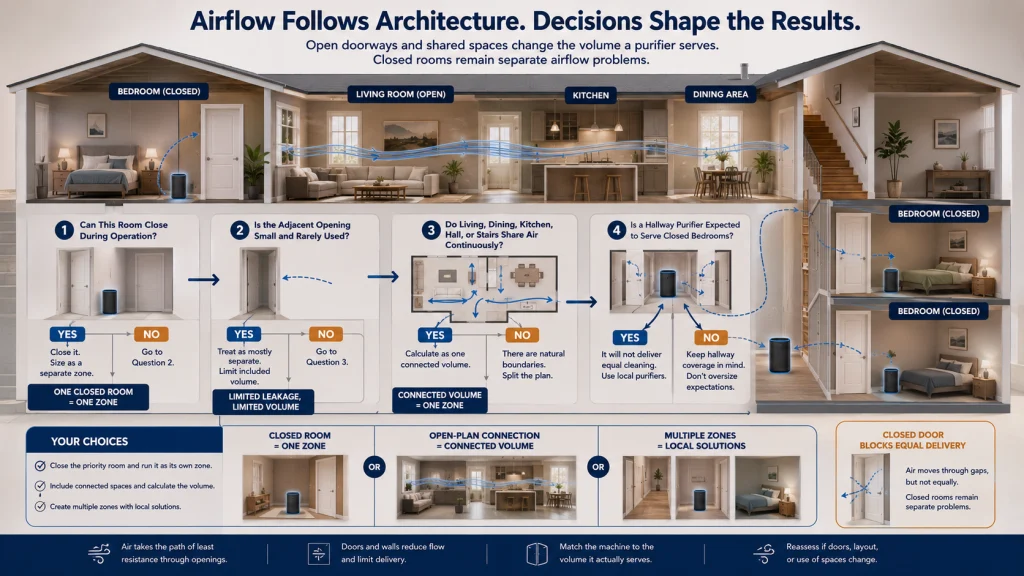
Treat Open Plans and Frequently Open Doors as Connected Volume
A purifier in an open living room does not stop serving air at the edge of the rug. Cleaned air drifts toward the kitchen, hallway, stairs, and nearby rooms, while pollution from those spaces moves back toward the unit. The furniture may define a living area visually, but airflow does not respect that boundary.
Open-plan decision tree:
Can the priority room close with a door during operation?
Yes → Size the closed room and use the door as part of the operating plan.
No → Continue.
Is the adjacent opening small and rarely used?
Yes → Record the opening and test whether the room behaves as a practical zone.
No → Continue.
Do the living, dining, kitchen, hall, or stairs share air continuously?
Yes → Include the connected volume or divide the problem into multiple cleaning zones.
Are closed bedrooms expected to benefit from a hallway unit?
Yes → Treat each closed room as a separate airflow problem rather than assuming equal delivery through the doors.
Sometimes the practical answer is not one enormous calculation for everything visible from the living room. A household may care most about the bedroom overnight and the main living area during the day. Treating those as separate priorities can be clearer than pretending one central machine serves every door and corner equally.
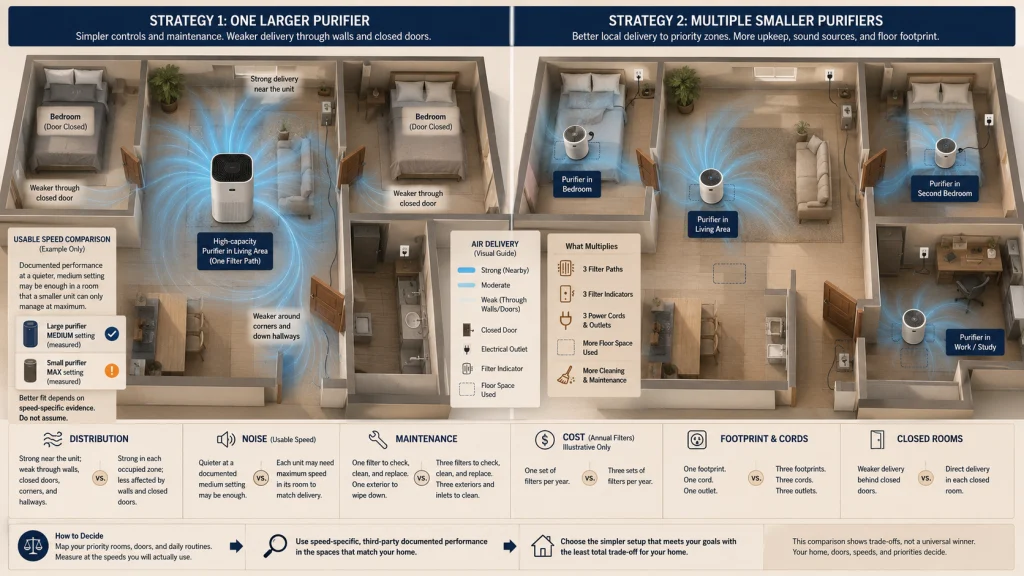
Compare One Larger Unit With Multiple Smaller Units
One larger purifier can simplify filter ordering and controls, which is appealing when maintenance already feels like one more household chore. The tradeoff is distribution: walls, corners, and closed doors may keep that capacity far from the rooms that matter. Multiple units bring treatment closer to occupied zones, but they also multiply outlets, filters, floor space, sound, and upkeep.
| Decision factor | One larger unit | Multiple smaller units |
|---|---|---|
| Distribution | Strong delivery near one location but limited reach through barriers | Delivery can be placed in separate rooms or opposite parts of an open area |
| Noise | One sound source that may need a higher setting | Several sound sources that may operate at lower settings if verified |
| Maintenance | One prefilter and replacement path | More filters, indicators, cleaning, and replacement schedules |
| Cost | Higher single-unit purchase may reduce duplicate accessories | Several purchases, filters, and electrical loads |
| Footprint | One larger placement area with adequate clearance | Several smaller placement areas and available outlets |
| Closed rooms | Cannot provide equal delivery through closed doors | Allows a unit to serve each priority room directly |
Editorial observation: A quieter oversized unit running at a verified medium setting may be more usable than a smaller unit that must remain at maximum speed. The advantage cannot be assumed from size alone because speed-specific performance must be documented.
Count the annual filter cost, cleaning time, electrical access, sound, and storage around each option. Several small units can look ideal on a floor plan and still become frustrating when three indicators light up, three filters need ordering, and three cords compete for outlets.
Size for a Fan Setting the Household Can Actually Use
Many headline performance claims reflect the highest fan setting. That sound may be tolerable during a short smoke event and impossible beside a bed, desk, television, or conversation area. Once the unit is turned down for ordinary life, the amount of cleaned air changes too.
Do not invent a medium-speed or quiet-speed CADR by dividing the maximum number. Fan speed, airflow, filter resistance, and control design do not guarantee a simple proportional relationship. Use an exact speed-specific metric only when it is documented for the product and method being compared.
The sizing process therefore has two parts: what capacity the room requires under the chosen assumption, and what documented delivery remains at a sound level the household can sustain. A machine that reaches the target only on a setting everyone avoids is a poor practical match, even when the box looks impressive.
Placement, run time, door position, fan routine, and filter care belong in the guide on using an air purifier effectively.
Reject Portable Whole-Home Claims That Ignore Airflow Paths
A portable unit can only treat air that reaches its intake and return cleaned air from its outlet. Walls, closed doors, long hallways, separate floors, and weak circulation interrupt that path. A machine humming in the hallway may feel central without delivering equal results to the rooms around it.
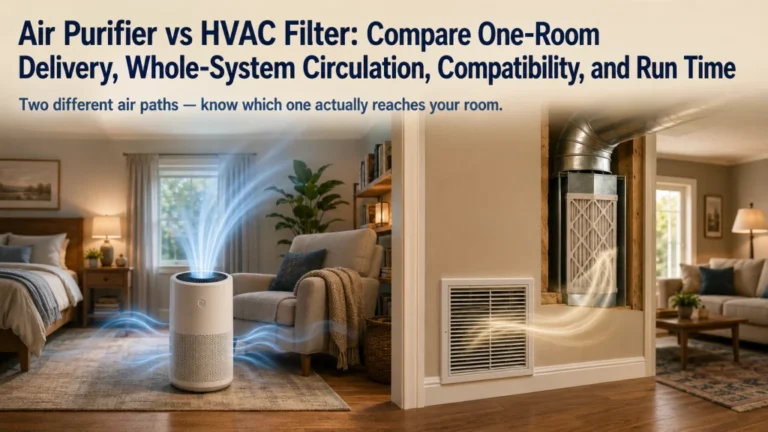
When the goal includes several closed rooms, map each room as its own zone. A central HVAC filter may affect recirculated air through the duct system, while portable units act locally. The guide to portable air purifiers versus HVAC filters explains that system distinction.
A temporary do-it-yourself device also needs its own construction, electrical, filter-fit, and operating guidance. Use the DIY air purifier guide rather than applying a portable retail label as construction instructions.
A whole-house goal may require source control, ventilation decisions, central filtration, and several room-based cleaners. One large coverage number cannot replace an airflow plan.
Route Gas and Odor Needs Away From Particle CADR
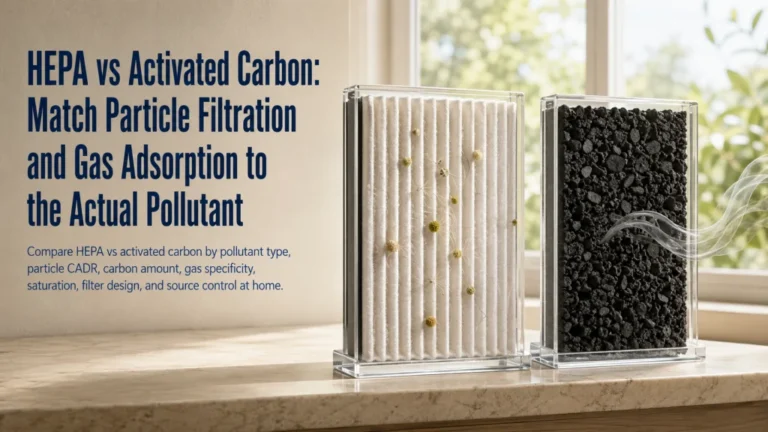
Particle CADR does not size activated carbon or another gas adsorbent. A purifier can move and filter fine particles effectively while doing little for a particular odor or vapor. Gas performance depends on the target compound, media type, media amount, airflow, contact time, source strength, and remaining capacity.
If the concern is paint odor, cleaning-product vapor, combustion gases, or another chemical source, begin with source control and appropriate ventilation when it is safe to do so. Do not use a particle-size calculation to remain near a suspected hazardous release or to declare the air safe.
Return to the air-purifier buying workflow for separate particle and gas-media decisions. This article’s formulas apply only to portable particle-air-cleaner delivery.
Persistent or worsening symptoms require qualified medical guidance. A purifier cannot diagnose asthma, allergies, smoke injury, mold-related illness, chemical exposure, infection, or another medical condition.
Size the Real Volume Under a Stated Assumption
Measure the priority room, include the ceiling height, and decide whether doors and openings make adjoining spaces part of the volume. For a fine-particle goal, compare complete-device smoke CADR and translate each coverage claim back to the same air-change assumption.
Adjust for tall ceilings, open plans, closed rooms, and the fan speed the household can tolerate. When one location cannot distribute cleaned air effectively, compare multiple zones instead of stretching one portable unit across the house.
The final answer should name five things: room volume, the clean-air metric used, the assumption behind the calculation, the operating speed people can tolerate, and the layout being served. That may not feel as satisfyingly simple as one number on a box, but it produces a decision tied to the room people actually live in. For the larger sequence involving source control, ventilation, moisture, filtration, and home comfort, use the healthy home environment guide.
FAQs
📏 Should I size an air purifier by square feet or cubic feet?
Use floor area to begin, then include ceiling height so the estimate reflects room volume. Square-foot shortcuts work only when their ceiling and air-change assumptions match the actual room.
🌫️ Why is smoke CADR useful for sizing?
Smoke CADR provides a common complete-device comparison for fine-particle delivery. It does not describe gas removal, every fan speed, open-plan distribution, or medical effectiveness.
🧮 Can an air purifier CADR calculator give an exact answer?
No. The result depends on room dimensions, the chosen ACH assumption, airflow mixing, layout, fan speed, and the accuracy of the product metric. Treat it as a transparent estimate rather than a guarantee.
🏛️ How do I size for a vaulted or high ceiling?
Calculate or estimate the full cubic volume rather than using floor area alone. If the ceiling changes height, divide the room into simpler sections or use a reasonable average, then label the result as an estimate.
🚪 Does an open bedroom door change the required size?
Yes, when the open door allows the room to exchange air continuously with a hallway or adjoining space. Include the connected volume or close the door as part of the operating plan.
🔊 Should I buy extra capacity for quieter operation?
Extra verified capacity may allow a lower usable setting, but do not assume medium-speed performance from the maximum CADR. Compare documented delivery and sound at the setting the household will use.
🏠 Can one portable purifier clean several closed rooms?
Not evenly through closed doors and separate airflow paths. Treat each closed priority room as its own zone or compare portable and central filtration roles.
🧪 Can particle CADR size a purifier for odors or gases?
No. Particle CADR does not measure adsorbent capacity for gases or odors. Define the target gas and evaluate the media, source control, ventilation, and exact product evidence separately.