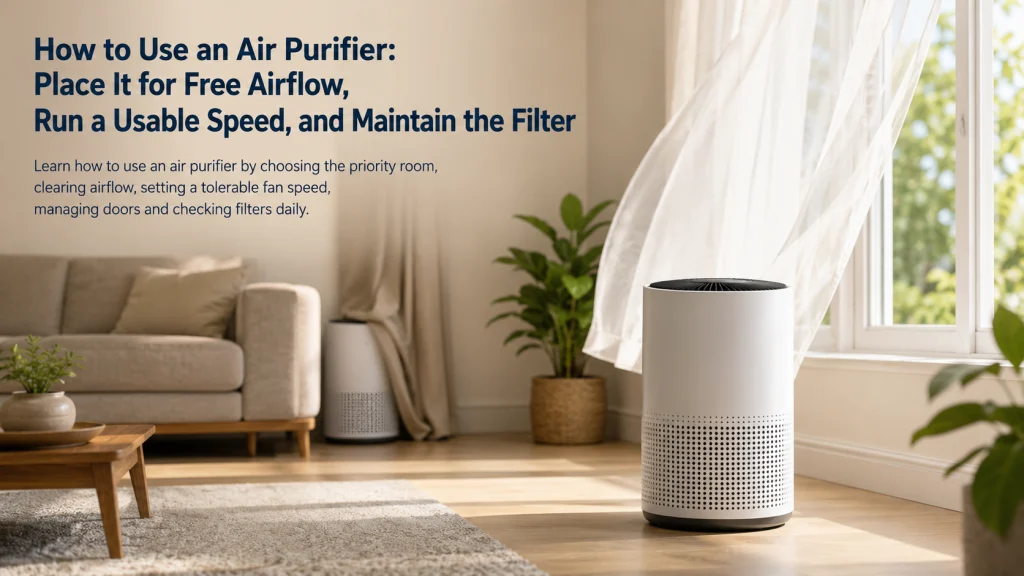
Using an air purifier well is mostly a matter of putting it in the right room, keeping its air path open, and choosing a fan setting the household can tolerate consistently. The same unit can perform very differently when it is hidden behind furniture, placed inside a closet, left beside an open doorway, or positioned where its inlet and outlet can move air freely. Run it during occupancy and relevant particle events, coordinate doors and windows with the actual goal, and treat auto mode as a limited model-specific control rather than a complete picture of indoor air. Regular filter checks and a clear stop rule for damaged or overheating equipment complete the routine.
The Same Purifier Can Behave Like Four Different Machines
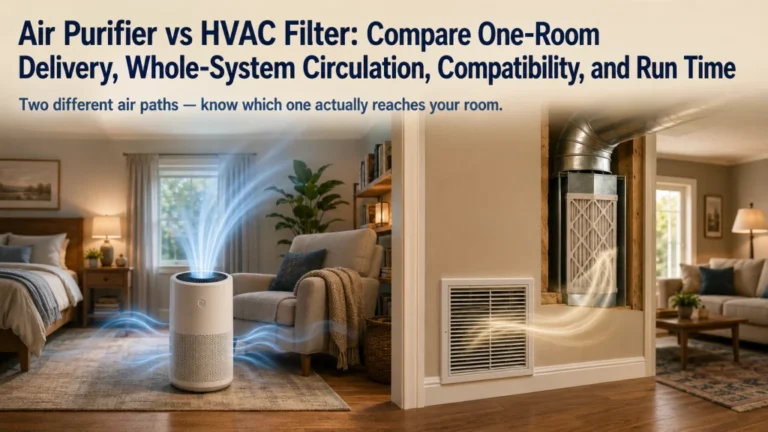
Picture one portable air purifier moved through four positions in the same home. Behind a sofa, it is quiet and out of sight, but the inlet is crowded and the outlet sends cleaned air into upholstery. Inside a closet, it mostly recirculates the small pocket of air around itself. Beside an open doorway, it is expected to serve two rooms at once. In the priority room with open space around the intake and outlet, the same filter and fan finally have a path that matches the job.
| Placement | What happens to airflow | Likely ownership problem |
|---|---|---|
| Behind a sofa | Furniture crowds the intake or redirects the outlet | The unit runs, but less room air reaches it freely |
| Inside a closet | The purifier recirculates a small enclosed pocket of air | The room receives little useful circulation |
| Beside an open doorway | Air moves between spaces without a clear room boundary | One unit is expected to clean two rooms equally |
| In the priority room with clear airflow | Room air can reach the inlet and leave the outlet without immediate obstruction | The routine is easier to understand and repeat |
The filter has not changed. The daily habit has. A purifier can be technically running while furniture, a closed door, a low fan setting, or a forgotten filter keeps much of its available capacity from reaching the room that matters.
Define the Room, Air Path, Source Event, Speed, and Control Mode
A priority room is the room the purifier is expected to serve first, usually where people spend the most time or where the target particle source is occurring. An inlet is where room air enters the unit. An outlet is where filtered air returns to the room.
An obstruction is anything that blocks, crowds, or immediately redirects that path, including furniture, curtains, walls, bedding, boxes, or a shelf positioned too close to the wrong side of the unit. A draft is airflow that feels uncomfortable or pushes papers, curtains, or lightweight objects in a way that makes the chosen setting difficult to tolerate.
A source event is a period when particles are being added, such as cooking, cleaning, smoke entering from outdoors, dusty work, or another temporary activity. Fan speed controls airflow and sound. Run time is how long the unit operates under the chosen conditions.
Auto mode changes fan behavior using the purifier’s onboard sensor and programming. A room boundary is a door, wall, or other physical separation that affects which volume the unit is realistically serving.
The broader guide to air cleaners and air filters explains how portable units fit alongside source control, ventilation, and central filtration.
Confirm the Unit Is Correctly Sized and Intact Before Optimizing Placement
It is easy to keep moving a purifier around when the room still feels unchanged. Placement cannot make an undersized unit behave like a larger one, and a longer run time cannot repair a damaged fan, cracked housing, blocked filter, or incorrect replacement part. Before rearranging the furniture again, confirm that the unit fits the actual space and is operating as intended.
Check the exact manual for:
- Approved orientation and whether the unit is intended for floor, tabletop, or another stable surface.
- The location of every inlet and outlet.
- Required clearances and ambient limits.
- Approved filter type, fit, and installation direction.
- Electrical, cleaning, child, pet, and ventilation warnings.
- Whether any transport locks, packaging, protective films, or internal bags must be removed before use.
If the room-size question is still unresolved, use the guide on matching purifier capacity to room volume before trying to compensate with placement tricks.
A unit that sounds unusual, vibrates abnormally, shows damage, or cannot hold its filter securely should not be treated as a routine placement problem.
Place the Purifier Where People Spend Time or Where the Particle Source Is Active
A purifier works on the air that reaches it. That makes the priority room more important than a visually central spot in the home. A hallway may look like the fairest place for everyone, yet the person sleeping behind a closed bedroom door may receive little benefit from a machine humming several rooms away.
For ordinary use, start with the room where people spend the longest uninterrupted period. That may be a bedroom overnight, a home office through the afternoon, or a living area where the household gathers after dinner. During a temporary particle event, the priority may shift, provided the new position remains stable, dry, and consistent with the manual.
Do not place the unit so close to an active source that grease, moisture, heat, debris, or another contaminant enters the purifier in a way the instructions do not permit. The goal is to serve the room, not to use the purifier as a substitute for a range hood, local exhaust, cleanup, or source removal.
When one unit must move between rooms, give the routine clear times and destinations. Carrying it only after the air already feels unpleasant can turn every move into a late reaction rather than a usable household system.
Keep the Inlet and Outlet Clear According to the Exact Manual
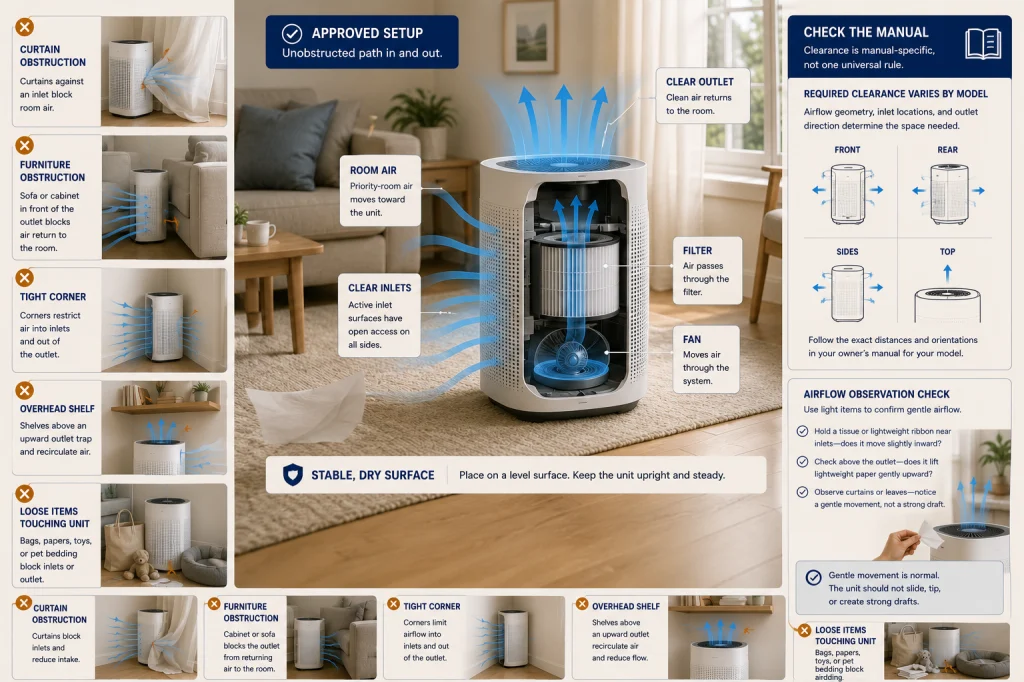
Portable purifiers use different airflow paths. Some pull from several sides and release air upward. Others draw from the back or front and send air forward. A universal wall distance would ignore these differences, so the manual should control the exact clearance.
Inlet-outlet clearance diagram:
Room air → clear approach to every active inlet → filter and fan → clear outlet path → room circulation
Avoid: curtain against inlet → furniture over outlet → unit pressed into a corner → shelf immediately above an upward outlet → bags, papers, or pet bedding touching the housing.
Look at the purifier from the direction air enters and leaves, not only from the front. A unit can appear neatly placed while its rear intake is pressed against a wall or its top outlet sends air directly into a shelf. The room may look organized even though the airflow path is not.
After positioning it, run the fan and observe lightweight curtains, papers, and nearby objects. The aim is not to chase a dramatic breeze across the room. It is to confirm that the purifier can draw and release air without immediate blockage, vibration, or unstable movement.
Use the Highest Fan Speed the Household Can Tolerate Consistently
Higher fan settings generally move more air through the filter, but they also create more sound and a stronger local draft. A setting that seems ideal in a specification table may be the one everyone lowers during a movie, switches off during a call, or abandons after trying to sleep beside it.
Editorial observation: The best routine is often quieter than the one imagined at purchase. People lower the speed during work, sleep, conversation, and television, then forget to raise it again. It is more useful to plan around the highest setting the household will keep using than around a louder setting that exists only on paper.
In a bedroom, the usable setting may change between evening activity and sleep. In a living area, it may change during calls, meals, or quiet conversation. A schedule can reflect those moments without pretending that the quietest mode provides the same airflow as the highest setting.
Do not infer speed-specific performance by dividing a maximum rating. Use a lower-speed clean-air metric only when the exact documentation provides it. Otherwise, treat the quieter setting as a practical compromise whose precise delivery is unknown.
Run It During Occupancy and Relevant Particle Events
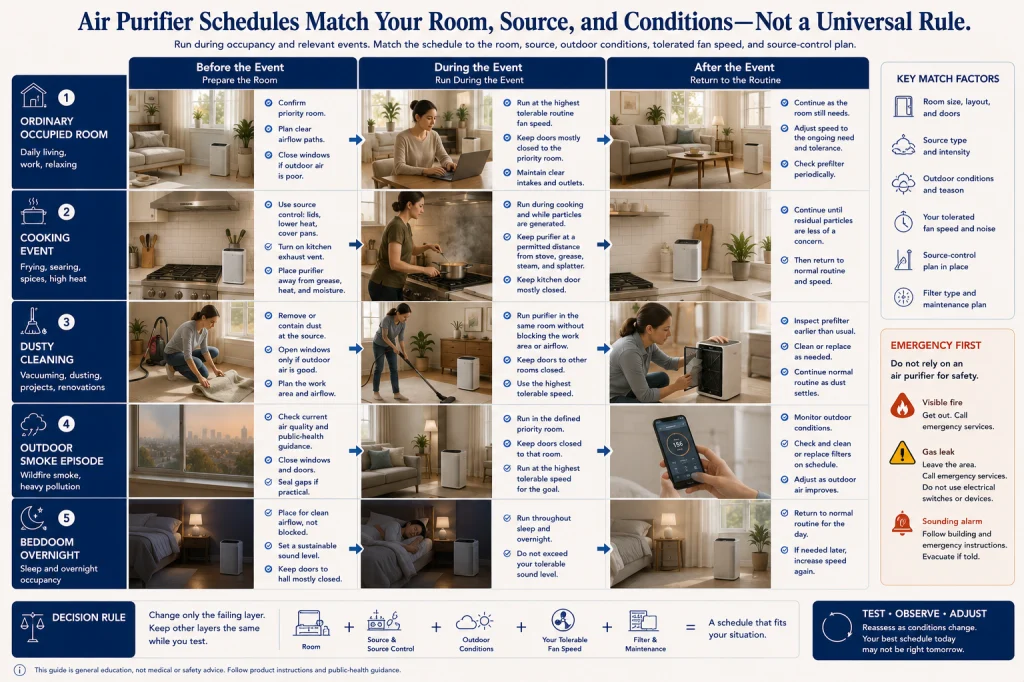
A purifier removes particles while it operates, so longer operation gives it more opportunities to process room air. The practical mistake is waiting until the air already seems unpleasant, switching the unit on briefly, and expecting an immediate reset. There is no universal daily-hour prescription because the useful schedule depends on occupancy, the source, outdoor conditions, room boundaries, tolerated speed, and capacity.
| Source-event operating schedule | Before or at the start | During the event | After the event |
|---|---|---|---|
| Ordinary occupied room | Place the unit in the priority room and confirm clear airflow | Run at the highest tolerable routine setting | Continue according to the room’s ongoing need and household routine |
| Cooking particles | Use source control and suitable kitchen exhaust when available | Operate the purifier where the manual permits without exposing it to grease, heat, or moisture | Continue while residual particles remain a concern, then return to the normal schedule |
| Dusty cleaning or household work | Remove or contain the source where practical | Run the unit in the affected priority space without obstructing the work area | Inspect the prefilter or filter sooner if the event added substantial dust |
| Outdoor smoke episode | Follow current emergency and public-health instructions and limit smoke entry when appropriate | Operate in the priority room with doors and windows managed for the smoke goal | Keep checking outdoor conditions, indoor source control, filter condition, and the household’s safety needs |
| Bedroom overnight | Choose a stable position and a setting that will not be abandoned after lights out | Run during occupancy at the tolerated setting | Return to a higher setting later if the routine and room conditions support it |
A purifier should not be used to remain near a visible fire, active smoke emergency, suspected gas leak, or sounding smoke or carbon monoxide alarm. Leave the area when safe and contact emergency or utility services as appropriate.
Choose Open or Closed Doors From the Volume Being Served
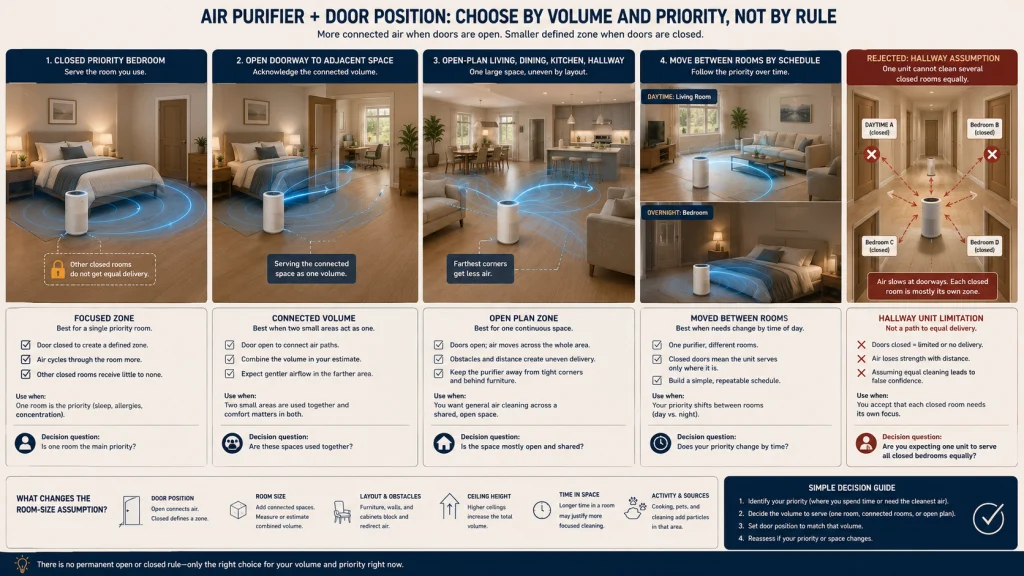
Opening a door connects more air to the purifier. Closing it creates a smaller, more defined room. Neither choice is always correct. The right position depends on whether the household wants focused cleaning in one occupied room or is asking one machine to take responsibility for several connected spaces.
| Room-and-door decision | Door position may fit when | Main caution |
|---|---|---|
| Closed priority room | The unit is sized for that room and the goal is focused cleaning during occupancy | Other closed rooms will not receive equal delivery |
| Open doorway to a small connected area | The combined volume is understood and the purifier can serve it at a usable speed | The original room-size assumption may no longer apply |
| Open plan | The connected volume and airflow path are part of the operating plan | Furniture and distance can create uneven distribution |
| One purifier moved between rooms | The household has a repeatable schedule and safe placement in each room | Closed rooms receive no direct cleaning when the unit is elsewhere |
Do not expect a hallway unit to provide equal results inside several closed bedrooms. When rooms have different occupancy periods, a practical routine may prioritize one room at a time or use separate capacity where the need justifies it.
Coordinate Windows With Outdoor Air and the Ventilation Goal
Window decisions often become household rules because rules are easier to remember than changing conditions. “Always open the windows” and “never open the windows” are both too broad. Clean outdoor air can support ventilation and source removal, while smoke, pollution, pollen, extreme heat, or moisture can make the same open window work against the immediate goal.
Before changing the windows, ask:
- Is the outdoor air currently suitable for ventilation?
- Is the goal to dilute an indoor source or prevent outdoor particles from entering?
- Is mechanical exhaust available near the source?
- Will the open window increase the volume beyond what the purifier can serve?
- Are heat, humidity, security, noise, or household safety part of the decision?
During an outdoor smoke episode, follow current local guidance rather than a permanent household rule. During an ordinary indoor source event, suitable ventilation and source control may do work that filtration alone cannot.
The wider healthy home environment guide places filtration beside ventilation, moisture, temperature, source control, and household routines.
Avoid Closets, Furniture Gaps, Unstable Surfaces, Water, and Heat
A purifier is often pushed out of sight because nobody wants another appliance dominating the room. It should not disappear so completely that its airflow, controls, cord, and condition become difficult to inspect. Closets, tight furniture gaps, soft bedding, unstable stools, and crowded shelves can interfere with circulation or create a tipping hazard.
Keep the unit away from water, wet cleaning areas, sinks, tubs, leaking windows, and locations where liquid can reach the housing, cord, plug, or outlet. Do not place it against heaters, cooking appliances, open flames, hot surfaces, or other heat sources unless the exact instructions permit the location.
Children and pets can pull cords, block inlets with toys or bedding, press controls, tip lightweight units, or place objects into openings. Use the provided lock or control features when appropriate, route cords safely, and follow the manual’s household warnings.
Never use furniture, stacked books, loose boxes, or an improvised shelf to create a tabletop position. The support must remain stable during operation, cleaning, filter access, and ordinary contact.
Treat Auto Mode and Color Displays as Limited Model-Specific Controls
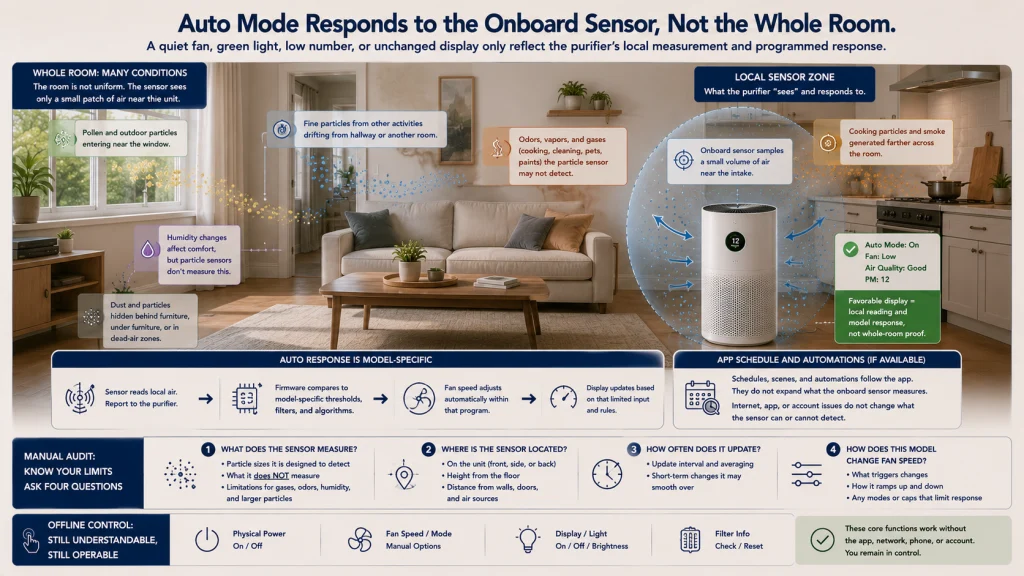
Auto mode is convenient because it makes the purifier feel attentive and self-managing. The limit is that the onboard sensor may measure only certain particles or conditions, and the small patch of air around the sensor may not represent the whole room.
Auto-mode limitation: A quiet fan, green light, low number, or unchanged display does not prove that every pollutant is absent. The sensor may not measure the target concern, may react differently to particle size or location, or may use thresholds and programming specific to that model.
Review the exact manual to learn what the sensor measures, where it is located, how often it updates, and how auto mode changes the fan. Do not assume that an odor, gas, smoke particle, pollen grain, humidity change, or cleaning vapor will produce the same response.
Schedules and apps can make the routine easier, but offline controls should still be understandable. A purifier that becomes difficult to operate when the network, phone, or account is unavailable creates unnecessary ownership friction.
Inspect Prefilters and Filters Without Guessing From the Indicator Alone
A filter light can feel reassuringly precise, yet it may count time, estimate use, respond to pressure, or follow another model-specific method. Treat it as a reminder to inspect the system, not as a universal measurement of how much capacity remains.
Inspect the unit according to the manual. Look for visible loading on cleanable prefilters, correct filter seating, damaged seals, unusual vibration, reduced airflow, and contamination that the instructions say requires service or replacement. Do not wash, vacuum, brush, or reuse a filter unless the exact directions allow it.
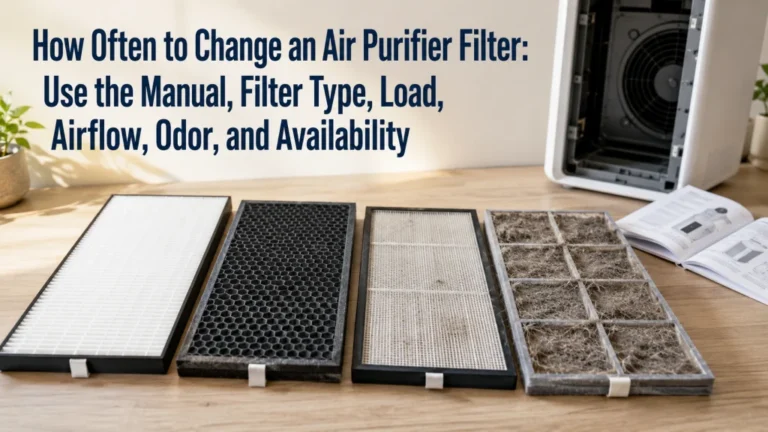
Source events, pets, dust, renovation, smoke, and heavy routine use can change how quickly a prefilter or filter needs attention. The deeper guide on when to change an air purifier filter covers indicators, inspection, environment, replacement fit, and ownership records.
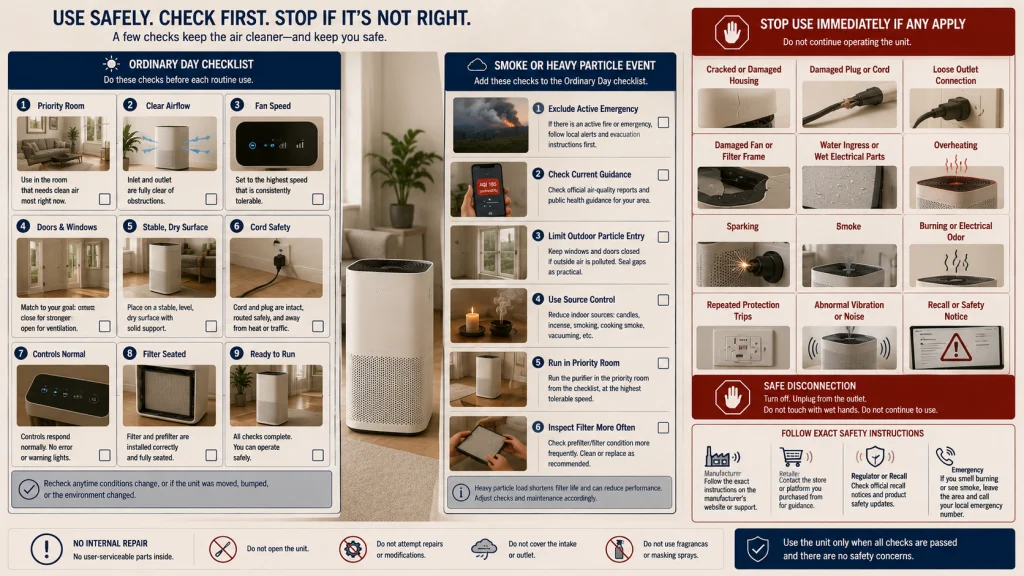
Daily and smoke-event checklist:
Ordinary day
Priority room confirmed → inlet and outlet clear → tolerated fan speed selected → doors and windows match the goal → cord and surface stable → display and controls normal.
Smoke or heavy-particle event
Emergency conditions ruled out → current guidance checked → outdoor entry limited when appropriate → source control used where possible → purifier run in the priority room → filter condition checked more often → household symptoms and safety needs monitored.
Stop Using Damaged, Wet, Overheating, Sparking, Recalled, or Unusually Odorous Equipment
Damaged-product stop box:
- Stop using the unit if the housing, plug, cord, outlet connection, controls, filter frame, or fan is visibly damaged.
- Stop if water enters the purifier or electrical parts become wet.
- Stop if the unit overheats, sparks, smokes, produces a burning or electrical odor, repeatedly trips protection, or behaves abnormally.
- Stop if the purifier or a critical component is subject to an applicable recall or safety notice.
- Disconnect power safely when appropriate and follow the exact manufacturer, retailer, regulator, or emergency instructions.
Do not cover an unusual smell with fragrance, continue running the unit to see whether the problem disappears, or attempt an internal repair outside the permitted maintenance instructions.
Ozone-producing devices and ozone-related claims require a separate safety decision. Use the guide on ozone air purifier safety rather than treating ozone generation as an ordinary operating mode.
Severe breathing difficulty, chest pain, fainting, confusion, blue or gray lips, or other emergency signs require immediate appropriate help. Persistent or worsening symptoms require qualified medical guidance.
Build the Routine Around the Priority Room and Usable Airflow
Start with an intact, correctly sized purifier and place it in the room that matters most. Give the inlet and outlet the clearance required by the exact manual, then choose a fan setting the household can live with. A sensible routine used every day is more valuable than an aggressive setting that is repeatedly switched off.
Run the unit during occupancy and relevant particle events. Let the served volume decide whether doors stay open or closed, and coordinate windows with actual outdoor conditions and the ventilation goal. Treat auto mode as a convenience with limits, not as proof that every pollutant has been measured.
The routine comes down to five checks: priority room, clear airflow, tolerable speed, appropriate run time, and filter condition. When those choices fit the household, the purifier becomes a quiet part of the room rather than an appliance that is constantly moved, muted, forgotten, or expected to solve more than it can.
FAQs
📍 Where should I place an air purifier?
Place it in the priority room where people spend time or where the particle source is occurring. Keep every active inlet and outlet clear according to the exact manual, and use a stable, dry surface.
🛋️ Can an air purifier go behind a sofa?
Only when the manual’s required clearances remain available and the furniture does not block or immediately redirect the inlet or outlet. In many rooms, a sofa creates too much obstruction.
🔊 Which fan speed should I use?
Use the highest setting the household can tolerate consistently, then reserve louder settings for times when more airflow is acceptable. Do not assume the quietest mode provides the maximum rated performance.
⏱️ How long should an air purifier run?
There is no universal number of hours. Run it during occupancy and relevant particle events, considering room size, source activity, outdoor conditions, fan speed, and the household routine.
🚪 Should bedroom doors stay open or closed?
Close the door when the purifier is sized for that room and focused cleaning is the goal. Open it only when the connected volume and airflow path are part of the plan.
🪟 Should windows be open while the purifier runs?
It depends on outdoor air and the goal. Clean outdoor air may support ventilation, while smoke or pollution can work against particle cleaning. Use current conditions rather than one permanent rule.
🎛️ Can I rely on auto mode all day?
Auto mode can help, but it responds only to the sensors and programming built into that model. A quiet fan or favorable color display does not prove that every pollutant is absent.
⚠️ When should I stop using the purifier?
Stop if it is damaged, wet, overheating, sparking, smoking, producing a burning or electrical odor, behaving abnormally, or affected by a safety recall. Follow the exact safety instructions and seek emergency help when conditions require it.