Alcohol can make some people feel drowsy before bed while the rest of the night becomes more fragmented or less restorative. Judge the full pattern by separating sleep onset, awakenings, breathing observations, heat, thirst, bathroom trips, and next-day function. Compare naturally occurring evenings without increasing alcohol or changing several other sleep variables at once. Seek qualified support when drinking feels difficult to control, stopping may cause withdrawal, breathing pauses or gasping occur, or sleepiness creates danger.
Two Logs Can Share a Bedtime and Describe Different Sleep
Two sleep logs both show lights-out at 10:45 p.m. In the first, sleep seemed to begin quickly after an evening drink. The same log also records three awakenings, feeling hot, getting water, using the bathroom, and waking with heavy grogginess.
In the second log, settling took longer. Once sleep began, the night was more continuous, and morning function felt steadier. Looking only at the first few minutes would favor the first night. Looking across the entire night changes the comparison.
That difference can be frustrating because the early effect is the part you can feel immediately. The later cost, if it appears, may not become clear until 2 a.m., 4 a.m., or the moment the alarm rings and the day already feels harder than expected.
| Observation | Log A | Log B |
|---|---|---|
| Intended bedtime | 10:45 p.m. | 10:45 p.m. |
| Estimated sleep onset | Quicker than usual | Somewhat slower |
| Overnight continuity | Several remembered awakenings | One brief remembered awakening |
| Other observations | Heat, thirst, bathroom trip, partner noticed louder snoring | No unusual heat or thirst noted |
| Morning function | Groggy and slow to start | More restored and easier to begin the day |
Core distinction: Feeling sleepy is one event; sleeping well is an overnight pattern.
This is why alcohol and sleep quality cannot be judged only by how relaxed or heavy-eyed someone feels before bed. The complete sleep improvement guide covers the wider system, while the healthy sleep habits framework helps place alcohol observations beside schedule, light, caffeine, food timing, activity, and the sleep environment.
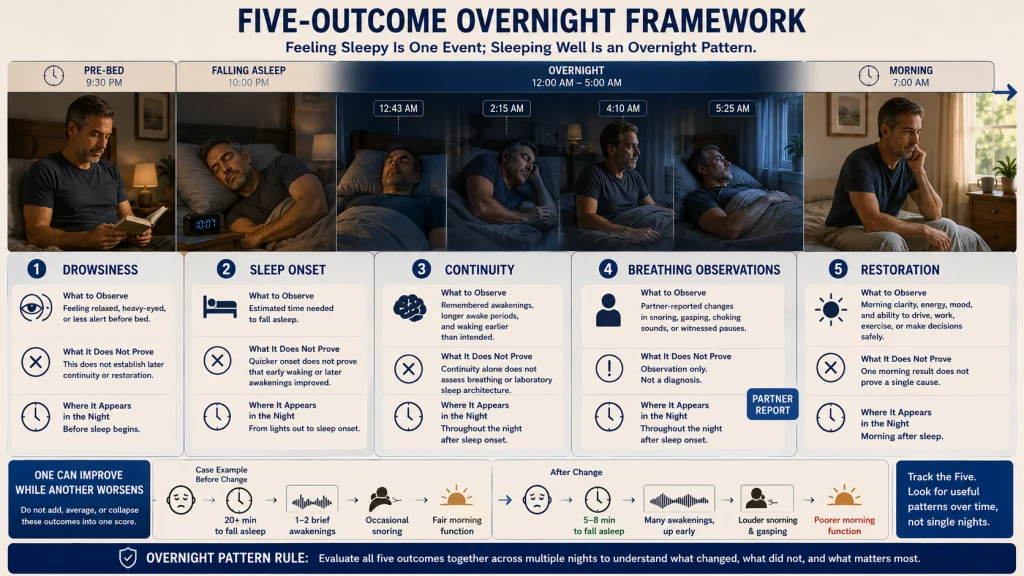
Separate Drowsiness, Sleep Onset, Continuity, Breathing, and Restoration
It is easy to use one word, sleep, for several different outcomes. That makes a quick sedating sensation look like proof that the night improved.
| Outcome | What to observe | What it does not prove |
|---|---|---|
| Drowsiness | Feeling relaxed, heavy-eyed, or less alert before bed | That sleep will remain continuous or restorative |
| Sleep onset | How long it seems to take to fall asleep | That later awakenings or early waking improved |
| Continuity | Remembered awakenings, long awake periods, and waking earlier than intended | That breathing or sleep architecture was normal |
| Breathing observations | Snoring changes, gasping, choking sounds, or witnessed pauses | A diagnosis or severity estimate |
| Restoration | Morning clarity, energy, mood, and ability to function safely | That one factor caused the result |
A night can improve in one column and worsen in another. Quicker sleep onset may occur alongside more awakenings or poorer morning function. A useful comparison keeps those outcomes separate instead of awarding the entire night one score.
Editorial observation: The relaxing sensation is immediate and easy to demonstrate. The harder question arrives hours later: did sleep stay continuous, and did the morning feel restored? Those outcomes are invisible at the moment the ritual feels comforting, so they require a log rather than a first impression.
Use the Evidence Without Turning Group Findings Into a Personal Verdict
Research generally supports separating early drowsiness from later sleep quality. A systematic review of healthy adults found changes in sleep architecture after alcohol, including delayed rapid eye movement sleep and less rapid eye movement sleep, with greater disruption as the tested dose increased.
Another systematic review of snoring and sleep apnea pooled laboratory sleep studies and found worse breathing-related measures after alcohol among people susceptible to snoring or obstructive sleep apnea.
Those findings do not predict exactly what will happen to one person on one evening. Studies differ in dose, timing, participant health, habitual use, sex, age, laboratory conditions, sleep measures, and whether the research concerns occasional use or alcohol use disorder.
| Evidence question | Reasonable conclusion | Limit |
|---|---|---|
| Can alcohol change sleep architecture? | Controlled studies and pooled research indicate that it can. | A wearable cannot confirm sleep stages with the same method as a laboratory study. |
| Can amount and timing matter? | Research suggests that both can affect the pattern. | No universal amount or cutoff can predict an individual’s response. |
| Can breathing-related sleep measures worsen? | Pooled studies report worsening among susceptible groups. | Partner observations cannot diagnose sleep apnea. |
| Does one poor night prove alcohol caused it? | No. It identifies a possible pattern worth comparing. | Stress, illness, food timing, caffeine, room conditions, and schedule can also change sleep. |
Evidence limit: Use research to choose what to observe. Use repeated personal observations to decide whether the exposure belongs in your own sleep plan. Do not claim causation from one night or a consumer sleep score.
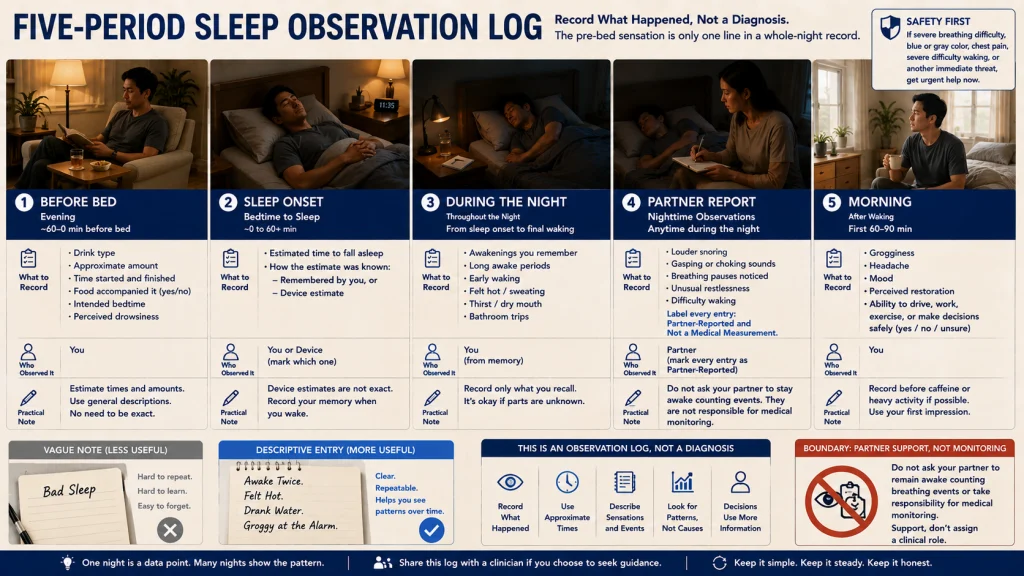
Build an Observation List for the Whole Night
Start with details that can be noticed without trying to diagnose the cause. The aim is not to create a perfect sleep diary. It is to prevent the pre-bed feeling from becoming the only outcome remembered.
| Time period | Observation checklist |
|---|---|
| Before bed | Alcohol type, approximate amount, time started and finished, food with it, intended bedtime, and level of drowsiness |
| Sleep onset | Estimated time to fall asleep and whether the estimate is remembered or device-derived |
| During the night | Remembered awakenings, long awake periods, early waking, heat, sweating, thirst, dry mouth, and bathroom trips |
| Partner observations | Change in snoring, gasping, choking sounds, breathing pauses, restlessness, or unusual difficulty waking |
| Morning | Grogginess, headache, mood, perceived restoration, and ability to drive, work, exercise, or make decisions safely |
Record what happened, not what you think should have happened. “Awake twice and thirsty” is more useful than “bad sleep.” If an observation comes from a partner, label it as partner-reported rather than treating it as a measured medical result.
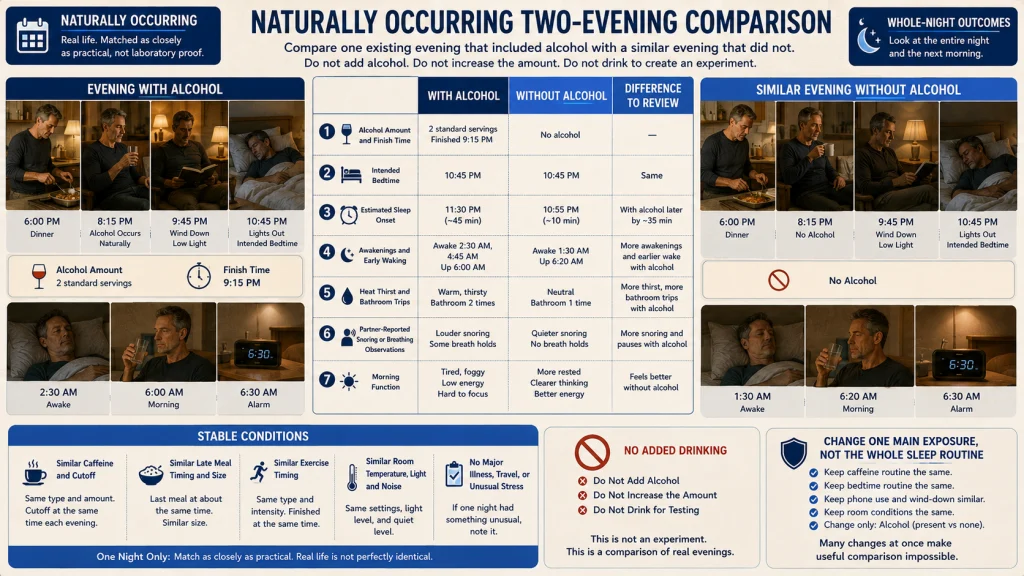
Compare Similar Evenings Without Creating a Drinking Experiment
Use evenings that occur naturally. Do not add alcohol, increase the amount, or drink solely to create a comparison. Instead, compare an evening when alcohol was already part of the routine with a similar evening when it was not.
Match the conditions as closely as practical:
- Similar intended bedtime and wake time.
- Similar caffeine amount and cutoff.
- Similar late meal timing and size.
- Similar exercise timing.
- Similar room temperature, light, and noise.
- No major illness, travel, or unusually stressful event on one night only.
| Comparison field | Evening with alcohol | Similar evening without alcohol |
|---|---|---|
| Alcohol amount and finish time | Record the actual serving and time | None |
| Intended bedtime | Record time | Keep similar |
| Estimated sleep onset | Record estimate | Record estimate |
| Awakenings and early waking | Record brief notes | Record brief notes |
| Heat, thirst, and bathroom trips | Record occurrence | Record occurrence |
| Snoring or breathing observations | Partner note when available | Partner note when available |
| Morning function | Clear, groggy, impaired, or unusually sleepy | Clear, groggy, impaired, or unusually sleepy |
Do not change caffeine, bedtime, room temperature, phone use, and alcohol at the same time. A cleaner comparison changes one main exposure while acknowledging that real evenings will never be identical.
Do Not Use a Single Good Night as Proof
One night can feel convincing, especially when falling asleep was difficult for several evenings beforehand. It may still be an unusual night shaped by accumulated sleep loss, stress ending, a quieter room, different food timing, or chance. If waking up at night after alcohol becomes a repeated pattern, that repeated pattern matters more than one unusually smooth bedtime.
Look for a repeated pattern across several naturally occurring comparisons. Ask whether quicker sleep onset is consistently followed by better continuity and better morning function, or whether the early benefit is followed by later costs.
A consumer device can add context, but do not use one sleep score or estimated stage chart as the deciding evidence. Wearables differ in algorithms and cannot determine why an awakening or breathing change occurred.
Interpretation rule: A single night can generate a question. Repeated observations under reasonably similar conditions are needed before changing the routine based on that question.
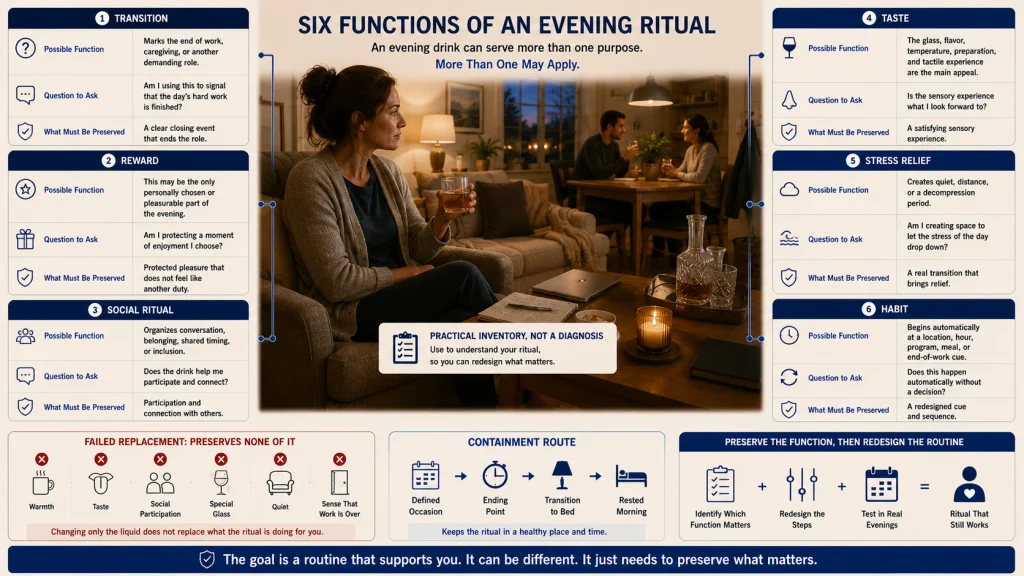
Identify the Job the Drink Is Performing
A nightcap can feel less like a drink and more like the moment the day finally releases its grip. Removing it without understanding that function can leave the same need waiting at the end of the evening. The function may be transition, reward, social connection, taste, stress relief, or habit.
| Possible function | Question to ask | What must be preserved |
|---|---|---|
| Transition | Does this mark the end of work or caregiving? | A clear event that closes the demanding part of the day |
| Reward | Is this the only part of the evening that feels chosen? | A protected pleasure that does not feel like another duty |
| Social ritual | Does the drink organize conversation or belonging? | Participation, shared timing, and an easy way to remain included |
| Taste and sensory ritual | Are the glass, flavor, temperature, and preparation the main appeal? | A satisfying sensory experience |
| Stress relief | Is the drink being used to quiet thoughts or physical tension? | A real decompression period rather than immediate substitution |
| Habit | Does it happen automatically at a location or time? | A replacement cue or a redesigned sequence |
This is not a diagnosis of why someone drinks. It is a practical inventory of what the evening routine would lose if the drink changed. More than one function may be present.
Replace or Contain the Function, Not Just the Liquid
Once the function is visible, the next step becomes less about removing a habit and more about protecting what the habit was doing for you. This does not require prescribing a special beverage, supplement, or branded ritual.
If the function is transition, choose a closing event such as changing clothes, leaving the work area, dimming a room, or writing tomorrow’s first task. If the function is social, keep the shared time and make the drink itself optional. If the function is reward, protect a defined part of the evening that still feels personally chosen.
Containment may be more realistic than pretending the function does not matter. Decide in advance which occasions belong in the observation period, when the evening ritual ends, and what marks the transition to bed. The goal is to make the pattern visible, not to create a moral test.
Practical observation: A replacement fails when it preserves none of the original experience. Warmth, taste, social participation, a special glass, quiet, or the sense that work is over may be the part that needs redesign.
Avoid Compensation With Extra Caffeine or Extreme Schedule Changes
A groggy morning can trigger extra coffee, an energy product, a long nap, or an unusually early bedtime. Those changes may carry the effect into the next night and make the original comparison harder to read.
During the observation period, keep the usual morning caffeine pattern reasonably stable. Record any extra serving rather than hiding it. Avoid forcing an extreme bedtime solely to correct one poor night, and do not drive or perform hazardous work when sleepiness makes the activity unsafe.
If the evening also included a late heavy meal, use the guide to late-night eating and sleep to separate food-related observations from the alcohol comparison.
Use Partner Observations Carefully and Act on Breathing Red Flags
A partner may notice louder snoring, repeated gasping, choking sounds, breathing pauses, unusual restlessness, or greater difficulty waking. These observations matter, but they do not establish a diagnosis.
Record the exact observation and whether it occurs only on some evenings. Do not ask a partner to count breathing events throughout the night or take responsibility for medical monitoring.
Breathing red flags: Repeated witnessed breathing pauses, gasping or choking during sleep, severe difficulty waking, blue or gray color, chest pain, severe breathing difficulty, or another immediate threat requires prompt medical or emergency help. Dangerous daytime sleepiness also requires evaluation, regardless of what a wearable reports.
Do not assume that reducing snoring volume resolves a breathing problem. Snoring and sleep apnea require appropriate assessment when concerning signs persist.
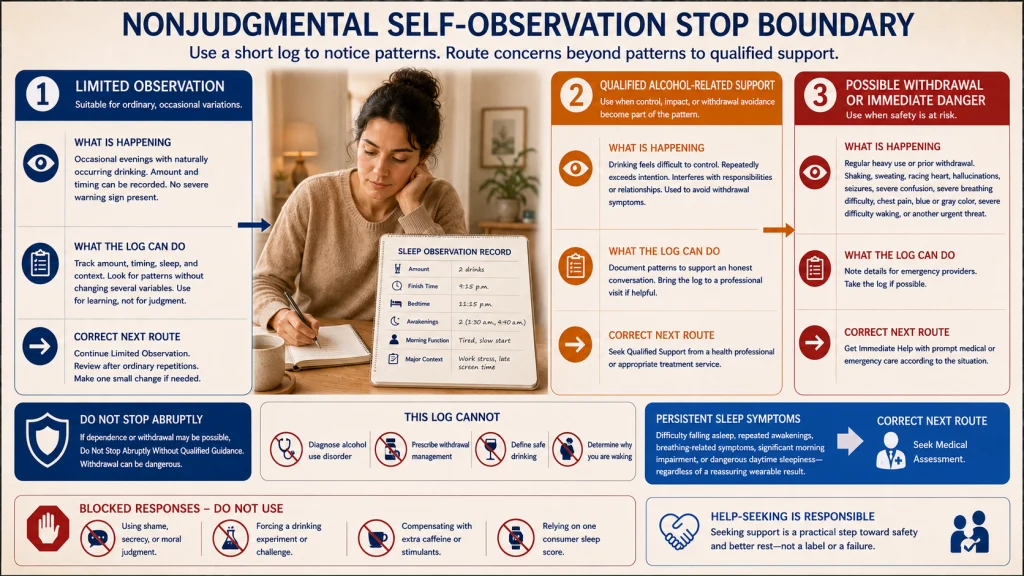
Seek Professional Support When Alcohol Use Itself Is the Concern
The sleep comparison is no longer the main task when alcohol feels difficult to control, repeatedly exceeds the person’s intention, interferes with responsibilities or relationships, or is used to avoid withdrawal symptoms.
Withdrawal can be medically serious for someone who has developed dependence. Do not advise or attempt abrupt cessation without qualified guidance when regular heavy use, prior withdrawal, shaking, sweating, racing heart, hallucinations, seizures, or other concerning symptoms may be present.
Nonjudgmental support boundary: A sleep log cannot diagnose alcohol use disorder or plan withdrawal. The NIAAA overview of possible alcohol-related warning signs can help identify reasons to speak with a qualified health professional or treatment service. Immediate severe symptoms require emergency care.
Asking for support does not require waiting for a crisis or proving that the problem is severe enough. It can begin with one honest description: what is being consumed, how often control is lost, what happens when use is reduced, and how sleep or daytime life is being affected.
Seek Medical Assessment When Sleep Symptoms Persist
Alcohol may be one exposure in a wider sleep problem. Persistent difficulty falling asleep, repeated awakenings, early waking, breathing-related symptoms, significant morning impairment, or severe daytime sleepiness deserves appropriate assessment even when the alcohol comparison is unclear.
Bring the observation log rather than presenting one conclusion. Note the timing and amount of alcohol, bedtime, awakenings, breathing observations, morning function, medicines, caffeine, and major schedule changes. A clinician can decide which details matter for further evaluation.
Medical boundary: This article does not diagnose insomnia, sleep apnea, alcohol use disorder, medication interactions, or another condition. Do not ignore severe symptoms because one alcohol-free night was better or because a consumer wearable showed a reassuring score.
Compare the Full Night, Not Only How Quickly Sleep Began
Compare the early effect with the overnight result: sleep onset, awakenings, heat, thirst, bathroom trips, partner-reported breathing, and morning function. Then identify what the drink contributes to the evening so that any change preserves the transition, reward, taste, social connection, or decompression that still matters.
If the full-night pattern repeatedly looks worse, use that information to redesign the routine. When alcohol use or sleep symptoms move beyond ordinary observation, bring the pattern to qualified support rather than trying to solve it with a stricter self-test.
FAQs
🍷 Why can alcohol make me sleepy but leave me tired?
Drowsiness before bed and restoration across the night are different outcomes. Alcohol may shorten perceived sleep onset while later continuity, breathing, temperature, thirst, or morning function changes.
🌙 Can one drink prove that my sleep is worse?
No. One evening can raise a question but cannot prove individual causation. Compare repeated, naturally occurring evenings with similar bedtime, caffeine, meal timing, and room conditions.
📝 What should I record in an alcohol and sleep log?
Record approximate amount and finish time, bedtime, estimated sleep onset, awakenings, early waking, heat, sweating, thirst, bathroom trips, partner observations, and morning function.
🧪 Should I drink on purpose to test the effect?
No. Use evenings that occur naturally. Do not add alcohol or increase the amount for an experiment. Compare an existing drinking evening with a similar evening when alcohol was not used.
😴 Can a wearable tell whether alcohol disrupted my sleep?
A wearable can add context, but it cannot determine the cause of an awakening, confirm sleep stages like a laboratory study, or rule out a breathing disorder. Use it as one observation source.
🫁 When is snoring after drinking concerning?
Seek assessment when snoring is accompanied by witnessed pauses, gasping, choking, severe difficulty waking, or dangerous daytime sleepiness. Immediate severe breathing difficulty requires emergency help.
🔄 Should I stop drinking abruptly if sleep is worse?
Do not make an abrupt unsupported change when dependence or withdrawal may be possible. Regular heavy use, prior withdrawal, shaking, sweating, racing heart, hallucinations, or seizures require qualified medical guidance.
🚩 When should I seek professional help?
Seek help when alcohol feels difficult to control, withdrawal may occur, drinking repeatedly causes harm, sleep symptoms persist, breathing pauses or gasping occur, or daytime sleepiness makes driving or work unsafe.